‘Encouraging news’ in fight against invasive plant in Sokokis Lake
Brittle naiad has tufts of spiny, stiff leaves on stems that can grow 2.5 meters long. People can distinguish the invasive plant from native naiads by the serrations on its leaves, which are visible without magnification, according to the Maine Department of Environmental Protection. Photos courtesy Debbie Broderick.
Over the summer, the state of Maine applied herbicide to part of Sokokis Lake in Limerick in the hopes of snuffing out a pesky invasive plant. Early signs show it might be working.
If the efforts prove successful long-term, it would mark a significant win against what the Lakes Environmental Association describes as “arguably the most difficult invasive plant to control in Maine.”
Brittle naiad, an aquatic plant native to Europe and originally introduced in the United States as a food source for waterfowl, can spread quickly and choke out native plant species.
The invasive plant was first found in Sokokis, also known as Holland Pond, in 2022 in the lake’s southern basin. Attempts to control it manually with trained volunteers pulling the plants by hand proved to be an uphill battle.
Eradicating invasive aquatic plants is no easy task. What makes brittle naiad particularly problematic is that it is small and resembles a native species of naiad, making it difficult to identify. The invasive species reproduces by fragmentation and the dispersal of tiny seeds, which can hitchhike on boats and be consumed and transported by waterfowl. If even a tiny piece of a plant makes its way to a different location, it can start a new population.
John McPhedran, an invasive aquatic species biologist at the Maine Department of Environmental Protection, said several factors led to the decision to use herbicide: the infestation was still relatively isolated; the plant continued to bounce back after attempts to manually remove it; and there was a risk that it would spread throughout the lake or to nearby water bodies.
“You think, well, maybe we should try and nip this in the bud and use herbicide now,” McPhedran told The Maine Monitor.
The DEP held a public information meeting in June and later got approval under its general herbicide application permit to apply the herbicide AquaStrike. On July 31, a state contractor submerged a perforated hose to spray the herbicide on the plant in three locations on the south end of Sokokis, treating about four acres of the 192-acre lake.
There are early signs that the treatment worked. Last month, staff from Lake Stewards of Maine, the DEP, and the York County Soil and Water Conservation District, along with volunteers from Sokokis Lake Association and Patrollers of Arrowhead’s Littoral Zone, conducted a post-treatment survey and did not find any living brittle naiad.
“That’s encouraging news,” McPhedran said. “But the visibility can be difficult in Sokokis — kind of murky and cloudy — so just because we didn’t find any in the fall doesn’t mean that we are out of the woods.”
As part of the ongoing response, the DEP and its partners will continue monitoring Sokokis and will return in late spring or early summer to see how much, if any, of the plant escaped the herbicide. If the invasive plant can’t be eliminated altogether, it will likely have to be managed long into the future, McPhedran said.
Brett Willard, the aquatic invasive species program director at Lake Stewards of Maine, which led the recent post-treatment survey, said the Sokokis infestation highlights the importance of early detection and rapid response. The plant was first found by a trained volunteer who was paddling the lake and actively looking for invasive species.
“There’s a really great group of volunteers that we have statewide, but particularly in York County, which is a high population center, but also there’s a number of infestations,” Willard said.
A survey crew examines Sokokis Lake in Limerick on September 23 for any live remnants of the invasive plant brittle naiad. It did not find any but will return to check next year. Photo courtesy Jim Kelley, York County Soil and Water Conservation District.
The DEP fielded a number of concerns ahead of applying the herbicide in July, including from a local beekeeper and dog owners worried about their pets drinking from the lake, McPhedran said. A notice that went out to lakefront property owners told them not to drink, swim in or use lake water for irrigation in the days after the treatment.
The DEP collected and analyzed water samples to monitor the levels of endothall and Diquat dibromide, the active ingredients in AquaStrike, following treatment. The water samples it tested two weeks after applying the herbicide showed no detectable levels of the chemicals, according to the DEP. It said it found “limited to no” harm to native vegetation.
McPhedran said the state would prefer not to use herbicides when managing aquatic invasives. But in doing so at Sokokis, the DEP is hoping to avoid a similar situation at Milton and Northwest ponds on the Maine-New Hampshire border, where the state and several partners have been fighting a brittle naiad infestation since 2015.
“Obviously, if it’s a new plant and we have a chance at eradication, we need to move quickly,” he said.
New map brings Maine’s seaweed forests to the surface
A new, interactive map shows seaweed density along Maine’s coast. Red marks the areas with the highest seaweed density; green shows medium density; and blue shows areas with the least. (Screenshot)
Amid the Trump administration’s cuts to federal climate change research, a New England remote sensing company released a new high-definition map of Maine’s coastline that its founder hopes will help local officials plan for climate resilience.
The online platform, from New Hampshire-based company Nearview, plots the best opportunities to fortify dunes and beaches along Maine’s 3,500-mile coastline to protect against sea-level rise. The map also marks where wild underwater forests lurk off the coast, which could inform seaweed harvesters and regulators.
The Coastal Ecosystem Map Application Platform, or CEMAP, was in the works for years before Nearview released it this August, said Stefan Claesson, Nearview’s founder and a specialist in geographic information systems.
Claesson hopes CEMAP will provide data that municipal officials, regulators, researchers and seaweed harvesters can use to manage Maine’s coastline and plan for climate change.
The first phases of CEMAP were funded by a grant from the National Oceanic and Atmospheric Administration. Many of Claesson’s remote sensing projects are supported by federal grants, and, while this project didn’t lose any funding, Claesson said his other projects have experienced sudden funding cuts.
“We’ve had a number of grant projects that we were part of that have been completely closed down,” Claesson said. “The funding level certainly isn’t where it used to be, but we’re happy to provide this data now. Maybe it’s timely.”
The platform has five different maps, and each plot a unique mosaic of data lines and points. One shows which stretches of Maine coast are best suited for dune stabilization or other climate resilience projects. Others detail the location and density of aquatic vegetation such as wild seaweed.
Each data point is the result of meticulous fieldwork and analysis. Claesson flew drones up and down the Maine coast, using multispectral cameras to peer beneath the water’s surface and capture images of aquatic vegetation.
Collaborators at the Maine Maritime Academy, Schoodic Institute, Bigelow Laboratory for Ocean Sciences, and the University of Vermont then helped estimate the mass of seaweed by taking field samples and analyzing satellite imagery, which Nearview plugged into a complex algorithm that plotted the size of the seaweed forests.
The platform can be used in two ways, Claesson said, by creating a “treasure map” of concentrated seaweed for the harvesting industry and estimating total vegetation biomass, which regulators could use to establish limits for a sustainable harvest.
Seaweed farmers also see potential applications of Nearview’s map, said Timothy Ehle, who runs an organic winged kelp farm with his cousin Isaac Lash in Friendship.
Establishing a productive farm depends on intricate environmental factors such as tidal flows and wind exposure. It also helps to have more general indicators such as whether wild seaweed is flourishing nearby, Ehle said.
“If it’s going to grow there wild, it’s definitely going to grow there cultured,” Ehle said.
Dune restoration project near the Wells Reserve. Photo by Emmett Gartner.
For help with the coastal resilience map, Nearview turned to Jacob Aman, stewardship director at the Wells National Estuarine Research Reserve and a resilience planning expert.
Aman and the Wells Reserve were developing their own climate resilience map at the time and partnered with Nearview, combining Aman’s knowledge of sea-level-rise and coastal habitat with Claesson’s detailed imagery.
The collaboration resulted in a map from each contributor identifying segments of Maine shoreline that could provide communities the most protection from storms fueled by climate change and sea-level rise.
The map from Wells Reserve, however, goes a step further to suit its intended audience of York and Cumberland counties. It maps the shoreline from South Berwick to Cape Elizabeth with variables that measure both how suitable a site along the coast is for restoration and how difficult it would be for a local government to execute such a project.
Projects could include nourishing a beach with more sand or stabilizing dunes with native plants, Aman said. His main objective for the map is to empower local leaders to decide for themselves.
For both Aman and Claesson, the next steps of their mapping projects involve getting them into the hands of potential users, whether local officials or seaweed businesses.
“Maps are powerful that way. They change people’s perspective,” Claesson said. “You get to see the coastal environment in a way that you haven’t seen before.”
Maine’s food pantries stare down volunteer shortage while anticipating cuts
Phylis Allen organizes supplies at Neighbor’s Cupboard, a food pantry in Winterport, Maine, that she has helped run for the past 17 years. Photo by Katherine Emery.
Sowing Resilience: Rural communities across the country are grappling with food insecurity. Schoolchildren, seniors, grocers and even farmers face a food crisis compounded by government cuts and soaring costs. The nine stories in this project reveal how communities are navigating — and reimagining — the systems that have left them hungry.
Phylis Allen spends her days looking for things. She searches for potatoes at Sam’s Club, cheap beets and ginger at Walmart and a local grocery store. She studies the weekly inventory from Good Shepherd, Maine’s only food bank, for good deals on butter and cheese.
Every Monday morning, she shops at three different stores, keeping lists of prices in her head and remembering what particular clients want. On a recent trip to Sam’s Club, she was searching for affordable eggs.
The diminutive 78-year-old food pantry director found them in a huge cooler. Stretching, she pulled two huge boxes off the top shelf — seven dozen eggs each, $21 a box. “$2.82 a dozen,” she said. “That’s a good price for eggs.”
The eggs were destined for Neighbor’s Cupboard, the food pantry in Winterport, Maine, that Allen has helped run for the last 17 years. Every Wednesday, she and a tight-knit group of volunteers provide 25 to 30 families with heaping bags of food.
Downtown Winterport in August. Photo by Katherine Emery.
Maine has long been one of the most food insecure states in New England. Directors of food pantries say the task of making sure people are fed is getting harder because of diminishing food supplies, increasing demand and an overwhelming reliance on volunteers, many of whom are retirees with ages up into their 80s.
About 1 in 7 people in rural Waldo County, where Neighbor’s Cupboard is, were food insecure in 2023, a rate that was similar to the state and national average, according to an Associated Press analysis of U.S. Census Bureau and Feeding America data.
The U.S. Department of Agriculture will stop collecting and releasing statistics on food insecurity after October, saying on Sept. 20 that the numbers had become “overly politicized.”
Federal cuts are hurting food banks
In March, the Trump administration cut more than $1 billion from two U.S. Department of Agriculture programs — the Emergency Food Assistance Program, which provides free food to food banks nationwide, and the Local Food Purchase Assistance Cooperative Agreement Program, which provides funds to state, territorial and tribal governments to purchase food from local farmers for distribution to hunger relief organizations.
“I can watch the availability of federal food going down every month,” Allen said.
Charitable food networks are also bracing for $186 billion in cuts to the Supplemental Nutrition Assistance Program (SNAP), the federal low-income nutrition program better known as food stamps. In turn, Feeding America predicts that food pantries will see more demand.
Complicating matters is the infrastructure through which the United States distributes most food to those who need help. In Maine, the nearly 600 hunger relief agencies that get free and low-cost food from Good Shepherd Food Bank rely on volunteers. This includes 250 food pantries as well as soup kitchens, senior centers, shelters, schools and youth programs.
More than 75% of these organizations rely completely on volunteers, with no paid staff, according to Good Shepherd.
Left: Neighbor’s Cupboard volunteers haul and unpack the canned goods that arrived on the morning delivery truck. Right: Bags of food are prepared for home deliveries. Photos by Katherine Emery.
Anna Korsen, who co-chairs the Ending Hunger in Maine advisory committee, said food pantries alone aren’t the answer to food insecurity.
“If our goal is to end hunger in Maine, which is a lofty goal, then we’re not going to do that through a charitable food network that’s run by volunteers, right?” she said. “That’s supposed to be for crisis situations … but what has happened is that it is just a part of the food system now. It shouldn’t be.”
Neighbor’s Cupboard hummed with activity on a recent Wednesday morning, cans stacked in piles six feet high and children’s collages taped to a cooler.
Keith Ritchie was greeting clients — and keeping a gentle eye out to make sure no one took more than their fair share of limited foods. At 89, he is the pantry’s oldest worker, although Betty Williams, 88, teases him about who’s older.
Keith Ritchie, 89, and Betty Williams, 88, are the pantry’s two eldest volunteers. Photo by Katherine Emery.
In more than 17 years of service, Ritchie said, “I’ve only missed twice.” He drives 20 miles each way to dole out groceries and fill bags with “surprises” – donated items like Girl Scout cookies.
“You see a lot of people you know,” he said. “I don’t know anybody’s name, but I don’t need a name. I just look at their faces.”
An aging volunteer workforce
Younger volunteers can be harder to come by than affordable eggs. About 35% of Mainers volunteer — the third-highest rate in the nation, according to a 2024 report on the state of Maine’s civic health. But just 20% of millennials volunteer in Maine, half the rate of Gen Xers and baby boomers, the same report said.
It’s not a lack of desire to serve, but obstacles in the way, said researcher Quixada Moore-Vissing, an author of the report.
“I would categorize it as being an overwhelmed and overworked society,” Moore-Vissing said. “The rising costs of everything, and in particular the cost of housing, means that people have to work more.”
Younger volunteers are increasingly seeking out what the Minnesota Alliance of Nonprofit Advancement calls “event-based” volunteering — one-time efforts with no commitment to future shifts. About 20% of all volunteers contribute through a mix of online and in-person work, according to a 2023 Americorps survey.
The decline in volunteer numbers and the move toward one-time engagements can cause serious problems.
On Tuesdays, volunteers at Neighbor’s Cupboard unload boxes of dry goods and sort fresh produce. Photos by Katherine Emery.
Second Harvest Heartland in Minnesota had to turn away thousands of pounds of food in early September because the country’s second-largest food bank didn’t have enough people to sort and package it, volunteer engagement director Julie Greene said. As a result, food pantries in Minnesota and western Wisconsin had less food to give out.
Greene is struggling to bridge the mismatch between a need for in-person volunteer labor, like produce packers, and the increasing desire for occasional service.
“How can we provide more of these one-and-done volunteer opportunities, so folks are engaging with us,” she said, “and continue to do what we need to do to get the work done?”
At Neighbor’s Cupboard, Allen said funding cuts aren’t the most challenging part of her work. It’s keeping volunteers, she said, especially, “as they get older and they have health concerns or their families have health concerns.”
Phylis Allen keeps lists of prices in her head and remembers what particular clients want. Photo by Katherine Emery.
Distributing food requires muscle — dependable, strong volunteers who can drive long distances in snow and ice to pick up or deliver heavy boxes of food.
A year ago, Allen told her colleagues, “Find me a hunk with a truck.” They had lost a 78-year-old volunteer when his wife got sick. Without a replacement, they would have no way to pick up hundreds of pounds of food each week.
Through word of mouth, Allen found one: 67-year-old Bryan MacLaren. But just months after he’d started, he needed knee surgery. Staff once again had to search for a replacement.
Neighbor’s Cupboard volunteers Mike Masnyk and Ellie Jordan unload the morning delivery of produce. Photo by Katherine Emery.
Since March, Maine’s pantries have seen their food from Good Shepherd cut by half or more. So far, Neighbor’s Cupboard has enough to go around, in part because local residents donated 5,000 pounds of food during a May drive. But changes are coming.
In late August, Allen received an email from Good Shepherd. Because demand is rising, the food bank said, pantries running low on supplies are now allowed to turn away visitors who don’t live nearby — a reversal of Good Shepherd’s long-standing philosophy of food for all.
Allen wasn’t having it.
“We will keep serving everyone,” she wrote in an email to The Maine Monitor.
Sowing Resilience
How Maine churches are reckoning with fear of immigration raids
Williston-Immanuel United Church in Portland. Photo by Stephanie McFeeters.
Selma, an asylum seeker from Angola, moved to Texas at the start of the pandemic and then to Maine in January 2022. She fears persecution if she returns because of a family member’s involvement in a human rights group.
“As a Christian, I was praying, and then God just gave me direction, which was Maine,” she said.
She joined a nondenominational Christian church in Portland right away, and she and her two children have been regular attendees ever since. After President Donald Trump’s inauguration in January, her 12-year-old daughter asked if it was still safe to go to school.
As immigration enforcement efforts have increased dramatically this year, many migrants have also reckoned with whether it’s safe to go to places of worship, whether they’re congregants or faith leaders like one Westbrook pastor detained by Immigration and Customs Enforcement earlier this month.
In one of his first acts in office, Trump rescinded a policy that essentially barred ICE agents from making arrests at sensitive locations like churches, hospitals and schools. A coalition sued the Department of Homeland Security over the policy in February, arguing it violated religious freedom. A judge declined to block the policy, citing a lack of evidence that churches were “singled out as special targets” for immigration enforcement.
Faith leaders are preparing for the possibility of enforcement regardless, and several other lawsuits have been filed on similar grounds, including one in late July with a New England plaintiff.
Michel Tshimankinda, a Westbrook man who founded a church in South Portland, has been in ICE detention in New Hampshire since Aug. 14, according to the Portland Press Herald. He wasn’t arrested on church property, but his detention has shaken his family and congregation.
Tshimankinda was born in the Democratic Republic of Congo and first came to the U.S. from Botswana in 2016 on a temporary visa, according to ICE. In a statement to The Monitor, an ICE official said that Tshimankinda “showed a disregard for U.S. immigration laws” after overstaying his visa by nine years, and was apprehended during “targeted enforcement operations” in Portland.
The Department of Homeland Security has said officers would need secondary supervisor approval before carrying out enforcement at sensitive locations like churches. In a statement to the Religious News Service in late July, DHS assistant secretary for public affairs Tricia McLaughlin wrote that the agency expected such enforcement to be “extremely rare.”
There have been at least 10 instances of federal agents carrying out immigration enforcement activity “on or immediately near church grounds” this year, the Religion News Service reported in early August.
Selma, whom The Monitor is identifying by her first name because of safety concerns, said the fear among Maine’s immigrant communities is widespread. But she has requested asylum and has a work permit and a Real I.D., so she has decided to keep attending church services.
“My living in fear is not going to solve nothing,” she said. “Every morning, I pray that God protect me and protect all of us, because we can do nothing about it.”
Whether there is anything to be done is a pressing question for Maine churches and other places of worship. A number of churches have reported declining attendance due to fears of ICE agents showing up, and have seen congregants turn to online services instead.
In this climate, faith leaders are working to set up protocols for interacting with federal agents and ensuring immigrants know their rights. Some are also participating in an initiative to create a hotline and document ICE activity across the state, set to launch this fall.
A climate of fear
ICE made 142 arrests in Maine through July 28 this year, an increase from 102 over the same time period last year, according to the Deportation Data Project.
Several faith leaders that cater to immigrant-heavy congregations declined to speak to The Monitorabout how they’re dealing with the threat of immigration enforcement, citing concerns for their parishioners’ safety.
The ACLU of Maine has a checklist for interacting with ICE at a place of worship that offers several recommendations, including establishing a response team and training staff to deescalate the situation and get the agents’ identifying information. They recommend requesting to see a warrant, and then verifying that it was signed by a judge and that it specifies the names of people under arrest and areas to be searched.
The group also instructs faith leaders to designate public and private areas of the building and to deny access to private areas, “politely but firmly,” unless a warrant specifically permits entry. According to Luminus, an immigrant advocacy group, sanctuaries are generally considered public spaces, while areas that require keys or a staff member to enter are considered private areas.
Bishop Nathan Pipho of the New England Synod of the Evangelical Lutheran Church in America (ELCA) said ministers from across the 160 churches in the synod, including 15 in Maine, have reported declining attendance among immigrants following Trump’s inauguration. Many of the ELCA churches have made new immigrants a focus of their ministry, and the sharp drop in immigration this year has impacted their work.
The New England Synod is one of several plaintiffs in a lawsuit against the Department of Homeland Security aimed at stopping the administration from carrying out immigration enforcement at houses of worship.
The lawsuit argues that such enforcement impedes religious freedom by creating an atmosphere of fear among worshippers. Pipho said the threat of enforcement has not only impacted religious services but also the number of immigrants seeking social services such as food pantries that operate out of churches.
“We support comprehensive immigration reform; we support thoughtful dialogue on immigration,” Pipho said. “Immigration is a complex issue which is not served by scapegoating and striking fear into immigrant communities.”
Even churches without large immigrant congregations are feeling the impacts. First Parish Congregational Church of Gorham has run a transitional housing program for asylum seekers since 2023, converting second-floor space into rooms for four families.
Lead minister Christine Dyke says the program has made immigration a more personal issue for church members. “They listen to particular things in the news. They’re listening because they’re doing the same kind of thing I am,” she said. “‘Is this gonna affect our people?’ That’s what they call them — these are our people now.”
Since November 2023, the church has hosted more than 25 families, mostly from Angola and the Democratic Republic of Congo. Initially, most people stayed for an average of three months, but as the housing market in Maine has tightened the stays have increased to six months or longer.
Dyke said she and other church leaders have created a plan in case federal immigration officers show up on church property. Congregation members know how to respond, Dyke said, and the goal is to keep residents safe while following the law.
Everyone in the transitional housing has claimed asylum and is known by ICE, but Dyke said they still fear that legal status may be ignored or revoked on short notice. The Trump administration has already stripped the legal status of more than 500,000 immigrants who were previously approved for humanitarian parole and instructed them to “self-deport,” and recently revoked more than 6,000 student visas.
ICE Watch
Jake Fahey, faith-in-action coordinator for First Parish Unitarian Universalist Church in Portland, is one of more than 40 faith leaders across the state working with the Maine Immigrants’ Rights Coalition (MIRC) on rapid response to immigrants’ needs. He estimates that roughly ten faith leaders are also helping MIRC to develop an initiative to track ICE enforcement across the state, with a particular emphasis on quelling rumors and verifying real activity.
The group plans to launch a hotline this fall, where immigrants can fact-check information and get connected with resources, said Hunter Cropsey, MIRC’s senior program and community engagement manager. The program will initially focus on southern Maine, with plans to expand later.
Several statewide denominations including the United Church of Christ, the United Methodist Church, the Unitarian Universalists, Reform Jewish congregations and the Baha’i community plan to support the ICE Watch initiative once it’s more developed, Fahey said.
One key element will be to send out “verifiers,” trained volunteers who will go to communities to document ICE agents’ actions when called. Verifiers in similar neighborhood programs nationally confirm officers’ identities during enforcement actions before sharing information with residents in the area, sometimes by going door to door.
The goal is to combat rumors and ensure people understand their rights if approached by federal agents. Verifiers will not disrupt ICE operations, Cropsey said.
“There’s a lot of really deep enthusiasm among faith-based groups and other folks from a volunteer perspective, and a deep enthusiasm for immigrant community members and leaders for this type of service,” Cropsey said. The hotline will rely on multilingual volunteers to manage the phones, and MIRC hopes to offer post-detention support for community members, as well.
Fahey is helping to build out a network of volunteers for the initiative, including through churches. Churches are uniquely positioned to mobilize around social issues, Fahey said, because people are already gathering to develop their views on morality and justice.
“The level of hate and injustice that not only this administration but the general powers-that-be have demonstrated through the tactic of deportation and fear and harassment, it just strikes deeply for many people, but particularly those of faith,” Fahey said. “They have an access to community engagement that I think is declining in this country, which is like a place to really go and wrestle with and invite action.”
Cropsey described faith-based organizations as engaged supporters of MIRC’s mission. The organization lists nine faith groups as members of the coalition, including the Maine Council of Churches, the Congregation Bet Ha’am Tikkun Olam Council and the Roman Catholic Diocese of Portland, including its Hispanic Ministry. Churches have been especially helpful in providing volunteers and monetary support for immigrants, Cropsey said.
For church leaders like Rev. Reba Delzell, pastor at Williston-Immanuel United Church in Portland, supporting immigrants is a Biblical imperative. Her church hosts two congregations of Congolese and Sudanese immigrants, and she said at least the Congolese congregation has had a drop in attendance since January.
“I read scripture, the message over and over again is you welcome the stranger,” Delzell said. “You take care of those who have needs greater than your own. You walk with people. You give what you have to help others, and for me, that’s the commandment … when we welcome the stranger who is in the form of an immigrant, we are carrying out that commandment.”
Maine town facing taxpayer revolt rejects school budget for the second time
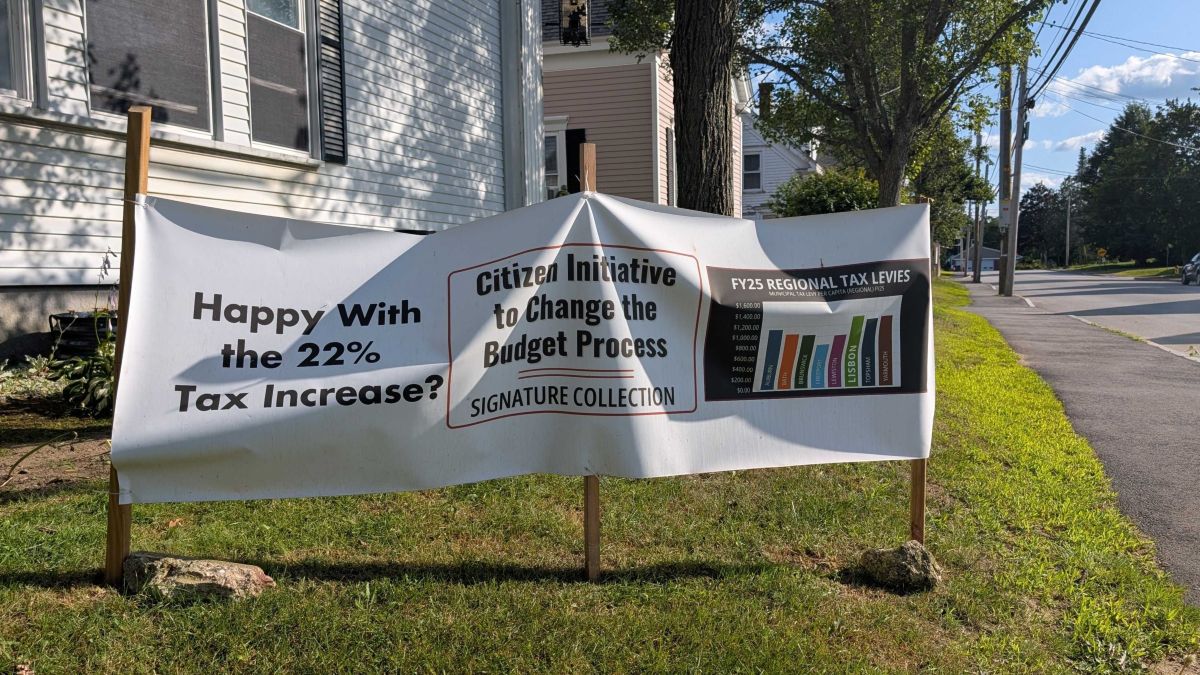
A sign protesting the town budget on Village Street in Lisbon. Photo by Daniel O’Connor.
Nearly 60 percent of Lisbon voters rejected a $21.3 million school budget in Tuesday’s election, marking the escalation of a taxpayer revolt in the Androscoggin County town.
It was the second rejection for the school budget this year. Turnout increased during the second election, with nearly 21 percent of voters coming out on Tuesday. The margin tightened relative to the 70 percent of voters who rejected the budget in June.
Nearly two-thirds of voters said Tuesday that the budget was too high. That came after the school board and town council had put forward a near-identical budget back in June.
Residents have been protesting against a roughly 20 percent increase in Lisbon’s tax levy, caused by years of heavy spending by the town council and a multimillion-dollar clerical error.
Officials considered the June vote to be a message to the town council over its budget — which residents cannot vote on — so they returned the budget to voters nearly unchanged.
The town council has since passed a municipal budget and acquiesced to petitioners demands of change in the town charter. Lisbon will vote in November on whether to create a commission tasked with handling charter revisions.
Councillors had hoped these measures would quell discontent. Those hopes were dashed Tuesday night in an outcome that will likely force the school board to reexamine the budget and make cuts.
Councilor Nicholas Craig said the outcome was what he expected, but not what he’d hoped for.
“I just hope that we can move forward in a way that we can still support the school and make sure the kids aren’t affected or suffering because of the dissatisfaction of the citizenry with the municipal budget side,” he said Tuesday night.
With the school year starting soon, the district will continue to operate under the prior year’s budget until residents vote through a new funding scheme.
Daniel O’Connor is aReport for Americacorps member who covers rural politics as part of the partnership between The Maine Monitor and the Bangor Daily News, with additional support from BDN and Monitor readers.
New state law adds ‘insult to injury’ for Maine solar, clean energy
A new law signed in late June will overhaul the payments for solar projects but will not impact smaller rooftop arrays under 1 megawatt. Photo by Murray Carpenter.
It would be hard to argue that Maine’s solar incentive program hasn’t been successful in spurring the development of small-scale solar projects. Since it was established in 2019, the program, formally called Net Energy Billing, has helped bring hundreds of arrays and more than 1 gigawatt of solar power onto the grid — far exceeding the program’s 750 megawatt goal.
Where community support for the program wanes is on the issue of costs, with critics arguing that NEB has become a raw deal for Maine ratepayers who have subsidized solar development to the tune of more than $200 million annually.
Enter L.D. 1777, a bill that the Maine Legislature passed with bipartisan support last month and that Democratic Gov. Janet Mills signed into law on June 27. The administration and other proponents of the measure, including lead sponsor Rep. Sophia Warren (D-Scarborough), say overhauling the NEB program is necessary to better protect ratepayers amid rising energy prices.
“We can’t afford to let soaring electricity bills undermine public support for renewable energy,” Maine Public Advocate Heather Sanborn said in a statement applauding Mills for signing the bill. “This new law is a responsible, forward-looking reform that ensures we can continue growing clean energy while protecting Mainers from rising electricity bills.”
But solar energy advocates and developers warn that the law, which retroactively impacts projects that have already been built or are already under construction, threatens to put Maine’s growing renewable energy sector on ice.
Eliza Donoghue, executive director of the Maine Renewable Energy Association, a local trade association, called the law “penny wise and pound foolish” and “incredibly bad news” for Maine’s solar industry.
“The cost of electricity, the numbers on folks’ utility bills, we need to take those incredibly seriously and look for the many ways that those costs can be lowered,” she told The Maine Monitor.
“But one of the primary ways that can happen is by having more renewable energy on the grid in Maine and I’m very concerned that by creating an atmosphere in Maine where the Maine legislature has conveyed that renewable energy investment is not welcome here, or can not be relied on here, we have set ourselves up to not enjoy the incredible stabilizing effect that renewable energy has on energy costs. That’s incredibly disappointing.”
Among other things, the law tasks the Public Utility Commission with establishing a new credit payment structure for non-residential customers in NEB’s tariff rate program. Instead of the current structure, where rates are tied to standard utility electricity rates, they would be capped and increase at 2.25 percent annually.
When Warren introduced her bill in May, she said having the tariff rate tied to volatile natural gas and fossil fuel markets ultimately led to “unexpectedly high returns” for renewable energy developers.
“In many cases, these rates now exceed what is required for project viability and are placing an unnecessary burden on nonparticipating ratepayers,” she wrote in written testimony to her colleagues in the House.
The law also makes changes to the NEB credit program, imposing new monthly per-kilowatt fees on community solar projects ranging in size from 1 to 5 megawatts beginning next year, with larger arrays paying more to local utilities. A 1 megawatt array would pay $2,800 per month, while a 5 megawatt project would pay $30,000. The new fees do not impact projects smaller than 1 megawatt, such as household rooftop arrays.
The changes are expected to slash overall payments to existing community solar farms by approximately 20 percent and save Maine ratepayers approximately $61 million annually over the next 16 years, according to the state’s Office of the Public Advocate.
Across the board, members of MREA in the solar development space have voiced to Donoghue that L.D. 1777 will significantly impact their current projects in Maine and their future relationship with the state.
“They are likely or have already directly communicated to me that they are no longer going to look to build projects in Maine because they perceive it as too risky from a regulatory perspective,” she said.
Nexamp, a member of MREA that has dozens of community solar projects across Maine, called the law’s retroactive policy changes “a breach of economic trust” that will “permanently damage Maine’s reputation as a climate leader.”
The adoption of L.D. 1777 came as Republicans in Congress were putting the final touches on President Donald Trump’s so-called “Big, Beautiful” budget bill, which includes numerous provisions meant to stymie the nation’s buildout of renewable energy.
The federal act, which Trump signed into law days after L.D. 1777 received Mill’s signature, rapidly phases out Biden administration-era tax credits for wind and solar projects and terminates tax credits for home energy efficiency upgrades, including rooftop solar, electric heat pumps and insulation, at the end of 2025.
Together, the federal act and the new state law leave Maine’s clean energy sector in a precarious place, according to Donoghue and Kate Daniel, Northeast regional director for the Coalition for Community Solar Access, a national trade group.
“I do find that it’s been a little frustrating to hear state policymakers in Maine criticizing these federal actions when they really don’t need the help of DC to kill solar programs in the state of Maine,” Daniel said, stressing that uncertainty in the Maine market will drive clean energy investors to do business elsewhere.
“We’re going to be exceptionally challenged to meet those goals,” she said, adding that the combination of L.D. 1777 and Trump’s “Big, Beautiful” Act adds “insult to injury.”
How will Maine’s coastal spruce forests handle climate change?
The canopy of a red spruce stand at Penny’s Preserve in Blue Hill. Photo by Emmett Gartner.
As a cadre of Maine foresters and ecologists shuffled down the sun-baked roads of Surry Forest on Wednesday they were faced with the same sweltering heat they are trying to prepare Maine’s coastal forests for in the face of climate change.
Like much of Maine’s coast, this 2,100-acre tract of land likely hosted shady, lichen-covered stands of red spruce forests before it was heavily harvested and succeeded by sun-tolerant species like oak and aspen.
But since the tract was purchased by the Blue Hill Heritage Trust in 2017, ecologists with the University of Maine have been working with the Blue Hill group, state foresters and others to try and restore red spruce to Surry Forest. The effort is part of a regional research project studying how best to manage coastal spruce forests under intensifying heat and drought.
“A lot of the places that had red spruce along the coast of Maine don’t have it anymore for a variety of land use and management reasons,” said Jay Wason, the University of Maine professor spearheading the project, during Wednesday’s workshop. “We want to better understand where red spruce is along the coast of Maine and what its current condition is.”
The breadth of challenges that climate change and land use pose to red spruce are laid bare in a forest management guide by Rose Gellman, a UMaine master of forestry student, that was published as part of the project.
The coastal spruce forests where Wabanaki people have lived for millennia shifted from seeing low-intensity fire and cultivation to heavy harvesting with the arrival of European settlers, Gellman writes. Since then, most Maine forests have been cut at least twice over.
Despite a transition to more precise harvesting techniques in recent years, coastal spruce forests have not recovered, and climate change models show their habitat range will shrink significantly by 2060.
These downward trends haven’t robbed Gellman and other spruce proponents of hope, however. The guide and accompanying research serve as resources for foresters like Jw Harriman of Blue Hill Heritage Trust to consult as they push restoration efforts forward.
In Surry Forest, Harriman has been experimenting with a management technique to open up the forest and plant sun-tolerant species of oak to leverage their broad leaves and create layered, shady habitat that spruce thrive in.
The initiative has been set back by deer and caterpillars that have nipped away the oak leaves, yet Harriman and forester Nicole Rogers with the Maine Forest Service say it has been helpful in determining what works for spruce restoration and how to strengthen Maine forests more broadly.
“I might want this to be a full blown red spruce forest, and that just may not happen in my lifetime anyway,” Rogers said. “If we as a community… can communicate with each other about what worked and what didn’t work, that would be huge.”
Rogers added that preparing Maine for climate change means looking to species beyond red spruce to build forest resilience to heat, storms and other threats.
Elsewhere in Surry Forest, Kathy Pollard is practicing that ethos by planting white oak, black walnut and other fruit-bearing trees that have historic ranges in lower Maine and further south as part of her ecology work with Know Your Land Consulting.
Pollard, who is of mixed European and Cherokee descent, leads the organization with her daughter Ann Pollard-Ranco, a Penobscot Nation citizen, to bring indigenous sustainability practices to the Blue Hill Peninsula and cultivate trees for food production.
“With climate warming, a lot of those trees are… going to be marching northward,” Pollard said, while other Maine trees like beech that feed wildlife are under threat. “So if you put out American chestnut and black walnut in some places where (beech) thrive, those will be producing food and kind of substituting… what’s being lost.”
The workshop ended a few miles away at Penny’s Preserve, under the cool canopy of a red spruce stand. A smattering of light green mosses and lichens covered the forest floor, illuminated by soft beams of sunlight filtering through dense spruce branches.
The stand is emblematic of the broader aims of the Coastal Spruce Project. It’s among several that UMaine PhD student Colby Bosley-Smith is plotting, measuring and monitoring along Maine’s coast.
She and Wason, the project coordinator, say this vibrant, century-old stand and others that Bosley-Smith has identified can inform foresters about the conditions where spruce flourish and how spruce respond to ongoing challenges posed by climate change.
“’I’m hoping that this is the start of a lot more renewed research and interest in better managing and conserving these forests,” Wason said.
Across Maine, towns continue to grapple with school district reorganization
Photo by Robert F. Bukaty of the Associated Press.
As children played at recess during one of the final weeks of the school year, MSAD 58 Superintendent Laura Columbia explained how several towns began pushing to leave the school district this spring, mainly out of concern that their communities could lose their local schools.
“I’m not coming here to try to close a school, that is nothing any superintendent wants to do,” Columbia said. “But I do want to have our resources going towards our students, and right now I feel like we have so many building needs, that the focus is on buildings, and less about students.”
This school year, MSAD 58 began weighing whether to consolidate some of its four schools to address aging infrastructure costs and preserve resources for students. This prompted a great deal of debate in the community.
“They’re talking about closing schools,” said Strong Selectman Rupert Pratt. “And they’re not talking about closing the high school, where we don’t have students. They’re talking about closing individual schools in the towns. You take a town school away, you shut the town down. People don’t move to a town where they don’t have a school.”
The district currently serves around 560 students from four towns — Strong, Phillips, Avon and Kingfield — and several unorganized territories. Strong is home to the district’s middle school, and Phillips is home to one of its elementary schools.
In May, Strong and Phillips voted to formally start the process to withdraw from MSAD 58; Kingfield and Avon are also looking to start the process. In early June, residents rejected the district’s $12.6 million budget.
If the Franklin County towns succeed in completing the lengthy withdrawal process, they will join a growing list of Maine municipalities that have left their school district in recent years. This includes the town of Eustis, which left MSAD 58 in 2013.
Nearly two decades after Maine made a controversial push to consolidate its school districts, and decades after it adopted a funding formula that aimed to increase equal access to education, towns are continuing to debate whether the cost savings and educational improvements promised by these plans have materialized.
Gov. John Baldacci’s 2007 consolidation bill aimed to condense Maine’s 290 school systems into 80 districts as a way of saving money and improving education. The initiative was met with strong pushback, with many worrying towns could lose their local schools and would have less of a say in school governance.
Since that effort, and the policies in place to enforce it lapsed, 42 towns have chosen to withdraw from their school districts, following a 22-step process set by the state.
The consolidation experiment initially saw the number of districts shrink to 215 in 2010-11 school year, but that number has now risen to 264, according to state data.
As towns explore withdrawal as a way to take back local control of schooling or address budget challenges, the number of school districts will continue to grow: each town that withdraws must form its own school administrative unit, either to run its own schools or to pay tuition to send students back to its former district.
And the cost of education continues to rise: statewide spending on public education has increased by about $1 billion since 2001, according to data from the Maine Education Policy Research Institute.
At the same time, statewide enrollment has dropped from over 200,000 to around 170,000, yet spending has more than doubled from around $7,000 to nearly $18,000 per student.
Some districts have seen the need to close schools. This year, that includes the Agnes Gray School in RSU 17, Sabattus Primary School in RSU 4 and Viola Rand Elementary School in RSU 34. Others are still seeking reorganization: Bremen, Damariscotta, Newcastle and Great Salt Bay Consolidated District are forming RSU 48 on July 1.
While many education policy experts point to consolidation as a way to save on administrative and other costs as buildings fall into disrepair and enrollment continues to drop, a number of towns across the state are pushing in the opposite direction.
The rocky history of consolidation
The effort to consolidate Maine’s school districts did not play out as planned, and while some consolidated districts have seen benefits from the change, many towns have looked for a way out.
University of Maine professor Janet Fairman has studied the issue and said the policy failed in part because there was such a short timeline to implement it, language was unclear, and penalties were delayed and then eliminated, quickly returning the state to a system of voluntary collaboration. The outcome was similar to an older push to condense schools, the 1957 Sinclair Act, which ultimately resulted in a higher number of school districts.
Reflecting on recent withdrawal efforts, Fairman pointed to a “perfect storm” of catalysts: rising costs to operate schools, lower enrollment rates and, in some districts, resources shrinking to the point where communities are weighing whether they should close schools. Small communities that had to partner with bigger communities during the consolidation push often lost voting power over school issues.
“I think that some of the opposition and withdrawals that we may be seeing now may be motivated from a desire to keep those small community schools open even longer than they are really viable, in terms of keeping them staffed and offering students a comprehensive education,” Fairman said.
The state’s school funding model — Essential Programs and Services (EPS) — has also been a flashpoint.
In Embden, a Somerset County town that recently voted against exploring the possibility of withdrawing from RSU 74, both residents for and against withdrawal pointed to a need to revamp how EPS is calculated.
The state takes town valuations, which have been on the rise for the past decade, into account when calculating cost distribution for education in districts. Towns with high valuations like Embden are considered more capable of paying for education. The formula also can lower state assistance when enrollments drop.
And many say the funding minimum set by the state is not sufficient. In recent years, towns have spent more and more above what is allocated by the state through this formula — in fiscal year 2024, school districts across the state raised an additional $604 million for their budgets.
A mix of factors can lead towns to consider withdrawal, but Fairman points to a broader takeaway.
Maine stands out for its extensive school infrastructure: the state has 593 schools and over 260 school districts for just 172,000 students — that’s significantly more schools per student than the national average, according to federal data.
Maine also operates fewer schools in each district, with an average of 2.2 schools per district, while the national average is 5.2 schools per district, MEPRI research shows.
A Brookings Institution report published as part of the 2007 consolidation push argued that it would be difficult for the state to continue supporting its high number of school administrators as enrollment declined.
“Maine is at least as much ‘Administrationland’ as ‘Vacationland’ given the large numbers of especially state and school district administrative personnel that seem to populate the state’s expensive bureaucracies,” the report read.
A rural issue
In a far northern town that shares a border with Canada, Limestone Community School students are starting their summer break, marking nearly six years as an independent school district after the town joined RSU 39 during the 2007 consolidation push. The town of Limestone withdrew from RSU 39 in 2019 out of fears the district would close their local school, which served up to grade 12.
“(Residents) were afraid that by staying in the RSU they would lose their school,” said Limestone Superintendent William Dobbins. “A community is built around a school.”
Instead of risking losing a school, Limestone opted to take on a multi-million dollar annual school budget and run a PreK-8 school, while tuitioning high school students out of the district. RSU 39 data shows that Limestone was paying around $600,000 into the school budget prior to withdrawal. Now the town raises around $1 million in local education funds, according to state data.
A Maine Monitor analysis of state data shows that a vast majority of towns that succeeded in withdrawing in the past 20 years were in rural areas, and spiked after penalties associated with the 2007 push were lifted in 2011.
Aroostook saw the most withdrawals, totaling eight. Regional School Unit 20 in Waldo County lost the most towns: between 2013 and 2015, it lost seven municipalities who joined together to form RSU 71. RSU 20 was left with just Searsport and Stockton Springs.
After towns completed the withdrawal process, some formed new regional school units or joined another regional school unit. Many formed new, independent school districts, sometimes mimicking the school units they had prior to consolidation. Some towns, such as Oxbow Plantation, de-organized as a municipality after withdrawing from their school districts.
Shifting costs
Amy Johnson, a researcher at MEPRI, said that withdrawal creates challenges for school districts by pushing costs onto other towns. In some cases, withdrawal can force school districts to weigh cuts.
An analysis of school budget data in districts that lost towns shows that many districts continue to raise similar amounts for education after withdrawals.
Towns that leave often pay tuition to send students back to their original school district, and while this can be a revenue source for school districts and a cheaper way of educating local students for towns, it normally does not cover the total cost it takes to educate a student. This is because tuition rates are capped by the state for each district every year. This year, tuition rates for K-8 education average about $12,000 a year, and secondary education averages about $14,000 a year.
Smaller school districts, such as the ones towns often form after withdrawal, cannot offer the same range of programs as larger districts, Johnson said. While small districts offer benefits like small class sizes and local control over education decisions, they also have their limitations, such as not being capable of offering as diverse a selection of classes, particularly at the secondary level, as larger schools with more resources.
“Of course, these situations are nuanced and there is always a mix of community motivations for wanting to keep their small schools open,” Johnson said. “The challenge is identifying the tipping point at which a small school no longer has enough resources to provide what students need for an adequate education.”
What the public lands fight means for Maine
A view of Acadia National Park. Photo by Stephanie McFeeters.
Maine is about as far away as you can get from the bulk of America’s federal public lands, the vast majority of which are concentrated in a dozen states west of the Mississippi River — a result of the nation’s history of westward expansion.
Whereas states like Utah, Nevada and Alaska are each between 60 and 80 percent federal land, just 1.5 percent of Maine is federally managed.
But Mainers have as much of a stake in the current political fight over the future of federal resources as anyone else. Public lands, waters and wildlife are part of our birthright as American citizens, a public domain that we all collectively own, regardless of our proximity.
Over the last five months, the Trump administration has worked to slash funding for federal land management agencies and conservation programs; open up more public lands to fossil fuel drilling, mining and other extractive development; and lay off or force out thousands of park rangers and other civil servants.
The words “protect” and “conserve” have been largely absent from the administration’s vocabulary, as it prioritizes dismantling environmental safeguards in its quest for so-called “energy dominance.” Meanwhile, Congress is considering federal land sales to help offset Trump’s tax and spending cuts — a contentious proposal that House lawmakers ultimately yanked from that chamber’s version of Trump’s so-called “big, beautiful” budget package, but that Senate Republicans resurrected this week.
During a recent congressional hearing to outline the Trump administration’s budget proposal for fiscal year 2026, Interior Secretary Doug Burgum invoked Maine and other East Coast states to argue that Western states with large amounts of federal land are at an economic disadvantage.
“We’ve got states in the East, including the 13 states that were part of the original colonies, none of them have more than 2 percent of federal land,” he said. “I don’t think any of them would stand up and say, ‘We need more federal ownership in our states.’”
Burgum’s statement is both inaccurate — nine of the original 13 states have more than 2 percent federal land, with New Hampshire on top at 14 percent — and casts aside the history of the nation’s East-to-West settlement.
David Feinman, vice president of government affairs at the Conservation Lands Foundation, said it also seemed designed to pit regions of the country against each other.
“Americans across the political spectrum in every state support public land protections, whether it’s Maine or Utah or anywhere else,” Feinman said. “Regardless of the secretary’s narratives, these lands do belong to everybody.”
Rep. Chellie Pingree (D-Maine), Feinman and others The Maine Monitor spoke to encouraged Mainers to pay close attention to the battle taking place in Washington, as it will likely impact everything from visits to national parks to our ability to stave off the worst impacts of climate change.
“It does impact all of us,” Pingree said. “If there’s one thing that the changing climate has taught us it’s that we’re all in this together, that overheating in one part of the country impacts another part of the country, that our weather is all impacted, that we need land to sequester carbon. There’s just a whole variety of reasons that we need undeveloped lands in this country wherever it may be.”
Pingree worries what the current turmoil inside the National Park Service and other federal agencies will mean not only for federally managed sites in Maine, including Acadia National Park and Katahdin Woods and Waters National Monument, but parks, monuments and wildlife refuges around the country.
Since Trump took office, NPS has lost 13 percent of its workforce, according to the National Parks Conservation Association, and the administration’s budget proposal calls for slashing more than $1 billion from NPS next year, approximately one-third of its entire operating budget. Current staffing shortages have already created numerous operational issues and public safety concerns at America’s national parks.
“It’s a real crime what they’ve done to these precious jewels,” Pingree said.
Sen. Angus King (I-Maine) echoed that sentiment during a budget hearing on Tuesday, telling Burgum “it’s hard for me to understand how gutting ‘America’s best idea’ isn’t America’s worst idea.”
Trump’s agenda also threatens to stymie future conservation, outdoor recreation and forest protection efforts here at home. Among other things, Trump’s Department of Government Efficiency, or DOGE, froze $68 million in funding for the U.S. Department of Agriculture’s Forest Legacy Program, which focuses on protecting private forest lands through conservation easements and land acquisitions. The program is one of several funded through the Land and Water Conservation Fund, or LWCF, which uses offshore oil and gas drilling royalties to buy land and establish and protect parks, trails, wildlife refuges, forests and important wildlife habitat.
As for LWCF as a whole, Trump’s 2026 budget request proposes diverting $387 million from the fund to pay for deferred maintenance at the National Park Service and other federal land management agencies — a move that Amy Lindholm, director of federal affairs at the Appalachian Mountain Club and a national coordinator at the LWCF Coalition, said would “rob Peter to pay Paul.”
Over the last five decades, Maine has received more than $220 million in LWCF funding, which has helped boost protection for places like Acadia and the Appalachian National Scenic Trail as well as supported hundreds of conservation projects via state grants.
“It’s really important that we have these tools fully funded, because there’s always going to be developers with deep pockets who want to acquire pieces of land,” Lindholm said. “We just have to balance that out a little bit with access for the local community and for growing and diversifying rural economies.”
Andy Cutko, director of the Maine Bureau of Parks and Lands, said cuts to federal conservation funding could impede progress toward Maine’s goal of conserving 30 percent of its land by 2030, part of Maine’s four-year climate plan.
“Programs like the Land and Water Conservation Fund and Forest Legacy protect forests, strengthen the forest products sector, support rural communities, and expand outdoor recreation,” Cutko said in an email. “They are vital tools for protecting the natural resources that are the essence of Maine.”
In the absence of more public land — just 7 percent of Maine is owned by federal, state and local governments — a network of land trusts has become a model for conservation and for meeting the growing demand for outdoor access in the Pine Tree State.
More than 80 land trusts have collectively safeguarded nearly three million acres, almost 15 percent of all land in the state, primarily through conservation easements on private land, according to a recent report from the Maine Land Trust Network.
“Apart from what’s happening out West, the Maine model works,” said Jeff Romano, public policy director at Maine Coast Heritage Trust, which runs the Maine Land Trust Network. “Hopefully we can push back some of these cuts to agencies and conservation programs because we do rely on that collaboration with those entities to do some good work here.”
At the end of the day, public demand for open space and protecting nature isn’t going anywhere, Lindholm said.
“Everybody loves the outdoors,” she said. “It’s the thing that brings people together across the political spectrum.”