A price hike led Palmyra to ditch its fire protection deal with Newport
An ambulance sits in a Newport Fire Department garage on Sept. 13, 2024. Photo by Linda Coan O’Kresik of the Bangor Daily News.
Daniel O’Connor is a Report for Americacorps member who covers rural government as part of the partnership between The Maine Monitor and the Bangor Daily News, with additional support from BDN and Monitor readers.
Officials in Palmyra are negotiating with Corinna over a fire and emergency services contract after ditching a decades-old deal with Newport.
Maine’s small towns commonly share fire and emergency coverage through contracts with neighboring communities. For more than 20 years, that meant Newport’s Fire Department covered calls in Palmyra. Late last year, Newport more than doubled its asking price, something Newport Fire Chief Jeff Chretien said had not ever been raised.
“The Select Board just let it go for 20 years without addressing it and it was time to readdress it,” he said.
The strife over fire protection costs in the Newport area comes as small towns across the state are reeling from years of high costs, causing discontent and difficult budget talks in both local service hubs that have been hit hardest by cost increases and the communities around them.
Newport is in the first category. Homeowners there pay more than 3% of income in taxes, double the amount of Palmyra residents, according to data provided to the Legislature. Part of this is because Newport was subsidizing the smaller town’s fire service, Chretien argued.
When the contract was initially finalized, Newport’s charge was set at 20% of the fire department’s operating costs. Last year as the town reassessed, it found that Palmyra still accounted for about 20% of the department’s calls. So they asked for 20% of the department’s operating budget.
After decades of inflation, that meant a jump from about $39,000 to $88,000 per year. Chretien said that to give Palmyra time to adjust to the increased cost, that price would increase gradually over three years. Chretien called the offer “very, very fair.”
But it didn’t land well in Palmyra, which allowed the contract to expire at the end of December. The town was not going to have any money available to absorb the increase unless voters allowed them to at the town meeting next week.
Palmyra is now negotiating with Corinna, which is covering the town while negotiations continue. Michael Cray, the Palmyra Select Board’s vice chair, has asked Corinna to accept a price of $40,000 based on the 54 calls covered by Newport last year.
Chretien said that while his department covered 54 calls classified as a fire response, they responded to 191 calls in total in 2025. He also added that Newport is continuing to cover Palmyra in emergencies and has responded to 34 calls there since the contract expired.
Cray said the deal is likely to be approved, which may make the upcoming town meeting easier.
“For the fire protection part of it, there won’t be a substantial increase in taxes,” he said.
Indigenous organization trained 30 new doulas
Wabanaki Public Health and Wellness helped train about 30 doulas to help fill gaps in services as other birthing services across the state have ceased. Photo courtesy Wabanaki Public Health and Wellness.
Wabanaki Public Health and Wellness for the first time has trained about 30 doulas to help families leading up to and during birth as other birthing services across the state have ceased.
Lisa Sockabasin, co-CEO of the health organization based in Bangor, said she heard from concerned community members about the crisis of closing birthing centers across Maine, so Wabanaki Public Health and Wellness decided to help fill in the gaps.
Most of the participants in the late-September training were Indigenous, though some were not, she said. A tribal chief participated, as well as other community members. The trainers were Indigenous doulas from Canada.
Sockabasin said it is important to have Indigenous doulas in particular because they can incorporate cultural aspects into their work.
“It’s about that time being honored, being sacred. It’s a very spiritual time,” she said. “That birth is a ceremony.”
Doulas are nonmedical care workers who provide educational, physical and emotional support to pregnant, birthing and postpartum people and their families. A 2023 survey of 45 doulas, conducted by the Maine Doula Coalition, found they were overwhelmingly female and white, and highly concentrated in southern Maine.
Sockabasin said doulas with her organization will also be able to connect families with other services for challenges related to substance use disorder, poverty and mental health.
Wabanaki Public Health and Wellness serves the Houlton Band of Maliseet Indians, the Aroostook Band of Micmacs, the Passamaquoddy Tribe at Indian Township, the Passamaquoddy Tribe at Pleasant Point and the Penobscot Nation.
“When you wrap love and support around an individual, they thrive,” Sockabasin said. “If they have a baby inside them, that baby is going to thrive, too.”
Wabanaki Public Health and Wellness had hoped to start up a doula program soon, but the current federal funding landscape has made that more difficult, Sockabasin said. It is now likely the organization will have to wait for additional funding or until doulas can be reimbursable by MaineCare, the state’s version of Medicaid.
Sockabasin said conversations with the state around reimbursement are ongoing, but any change likely wouldn’t take effect until 2027.
Sockabasin said her broader goal would be to have an Indigenous birthing center in Maine. Minnesota recently opened one, with support from the state’s Legislature. She’d like to see the same thing happen here.
Eleven birthing units in Maine have closed in the last decade, four of which closed in the last year. The closures leave 17 hospitals with delivery wards remaining across the state.
The training was funded by part of a $385,000 grant Wabanaki Public Health and Wellness received from the state, Sockabasin said.
A pastor searched for a missing congregant. He found a car with the keys on the floor
Carlos Nzolameso holds up a picture of Evaristo Kalonji, a South Portland man who was detained by federal agents on Thursday. Photo by Kristian Moravec.
Around 10 a.m. on Thursday, Jan. 22, Westbrook pastor Carlos Nzolameso received a call from a member of his congregation who was searching for a roommate. Evaristo Kalonji, who organizes and plays the music at the church, had not shown up to his job at Chipotle.
Several other congregants also reached out to Nzolameso, concerned that Kalonji, an asylum seeker from Angola, was missing. Nzolameso, who leads the predominantly Portuguese-speaking Rehoboth Christian Church, said Kalonji, who has no family in the United States, is like a son.
He set out to find him.
Nzolameso spent a couple hours searching for Kalonji in and around South Portland, where Kalonji lives. Nzolameso checked with the police department for any traffic stops or accidents. His efforts yielded no answers. He weighed checking the hospital next.
It wasn’t until the pastor made a final trip to retrace Kalonji’s commute that he spotted his car — a black Ford Fusion — two minutes away from Kalonji’s home. It was parked on Westbrook Street in South Portland. The car was unlocked, he said, and the keys were on the floor.
“I was devastated. I couldn’t even believe it,” said Noemia Nzolameso, the pastor’s daughter, when she heard the news. “I was in shock. Literally.”
Though Kalonji has no criminal record, the pastor suspected he could have been detained by federal agents as the U.S. Department of Homeland Security began a widespread immigration enforcement operation in Maine last week.
But Nzolameso had no way of confirming what had happened until later that day, when he received a brief call from Kalonji, who said he had been detained by immigration agents. He was calling from a detention center in Burlington, Massachusetts, and seemed confused as to why he was there, Nzolameso said.
Kalonji has a pending asylum case, according to the Executive Office for Immigration Review, part of the U.S. Department of Justice. Kalonji originally had a court date scheduled for this year, but it was recently postponed to May 2028, Nzolameso said.
Evaristo Kalonji is active in his church: He plays music, organizes cleaning and helps lead services. He is one of four congregants at his church in Westbrook to be detained by federal immigration agents in the past six months. Photo courtesy Carlos Nzolameso.
Nzolamesco later learned that Kalonji was then moved to a detention center in Central Falls, Rhode Island, according to an online federal database.
On Saturday, a lawyer for Kalonji filed an emergency petition in U.S. District Court in Massachusetts for a writ of habeas corpus, challenging the detention, according to online court records. The detainee locator system showed Kalonji was still in Rhode Island as of Jan. 28.
A background search in TLOxp, a database from TransUnion, returned no criminal records for Kalonji.
The Maine Monitor asked U.S. Immigration and Customs Enforcement on Monday why it had detained Kalonji. The agency had not provided an answer as of Wednesday morning.
Officials from homeland security told Fox News last week, when the operation started, that it was targeting approximately 1,400 people in Maine. So far, the agency claims to have detained more than 200 people in Maine. It has only released limited names but said in a press release that it is going after “the worst of the worst.”
The Immigrant Legal Advocacy Project, however, said that most people who have been detained and sought its help are going through lawful immigration processes and have no criminal background.
A recent report from the Cato Institute, a libertarian think tank, found that nearly three in four people detained by ICE in October and early November last year had never been convicted of a crime.
Last week, Maine Monitor reporting found that a mother of four with no criminal history was detained after dropping off a child at school, and a civil engineer with no criminal history was detained by masked agents who smashed his window and left his car running in the street.
Nzolameso, who has been leading the church for five years, has found himself navigating a challenging immigration detention system on behalf of some of his congregants. Kalonji is the fourth congregant of his church to have been detained by immigration officials in the past six months, Nzolameso said. Three other men were detained between August and December, he said, and only one has been released.
“I’m the pastor. I need to take care them,” he said. “I preach the word of God for them. But I need to care for them, too, because they have no family.”
Carlos Nzolameso, pastor of the Rehoboth Christian Church in Westbrook, searched for a congregant, Evaristo Kalonji, ultimately finding his car with the keys on the floor. Photo by Kristian Moravec.
While sitting at a desk in the basement of his Westbrook home, Nzolameso’s phone rang repeatedly as church members tried to reach him. On the night before Kalonji was detained, Nzolameso had told his congregants to reach out if they had any concerns as the immigration operation took on a new force in Maine.
Many church members have stopped showing up to services, he said, which has led him to start preaching online. Others are not going to work.
“Everybody is afraid,” Nzolameso said. “They don’t know what’s going to happen.”
Masked agents detain civil engineer in Portland, leave his car running in the street with a smashed window
Colleagues of Juan Sebastian Carvajal-Munoz, a civil engineer with a work visa detained by agents Thursday morning, discuss where to move his car. Colleagues Amanda Barnett, left, and Ali Brady, right, talk to Top of the Old Port parking lot attendant, Greg Seligman. Photo by Rose Lundy.
Masked agents in police vests detained Juan Sebastian Carvajal-Munoz, a civil engineer from Colombia employed by an engineering consulting company, in Portland on Thursday morning. Carvajal-Munoz earned a master’s degree from the University of Maine, and colleagues said he was in the country on a work visa.
An unmarked dark Subaru with tinted windows cut off Carvajal-Munoz as he was driving his grey Hyundai Tucson on Pearl Street in downtown Portland at 8:46 a.m., according to Jesse Smith, who witnessed the encounter.
Agents got out and quickly began using a crowbar to try and pry open his window, Smith said. They then smashed it to pieces. Three agents pulled Carvajal-Munoz out of his car, placed him in their Subaru and drove off, he said.
Smith couldn’t hear what, if anything, the agents said to Carvajal-Munoz but said the whole encounter was very quick.
“In less than two minutes, they smashed his window and dragged him out of the car,” Smith said. “He was compliant. He wasn’t resisting or anything.”
Agents left the car running — with its smashed window — on the street, according to interviews with Smith and a nearby parking attendant. A passerby then drove the vehicle into the parking lot, the attendant said. Smith said Carvajal-Munoz’s bag and keys were left in the passenger seat, and his phone was discarded on the road behind the car.
In a video shared by Smith, a bystander can be heard saying agents “smashed their window in, by force, after the person had their hands up.”
The detention happened as U.S. Immigration and Customs Enforcement is conducting what it is calling “Operation Catch of the Day,” an immigration enforcement effort across Maine, “targeting the worst of the worst criminal illegal aliens who have terrorized communities,” according to an ICE press release.
But Carvajal-Munoz has no criminal record, according to TLOxp, a background check system from TransUnion.
He is at least the third person detained in Maine whom news outlets have found does not have a criminal record. ICE did not immediately respond to a request for comment and has not publicized a complete list of people it has detained. The agency said on Tuesday it had arrested 50 people in Maine, but the “Worst of the Worst” list it published contained only 13 names as of 12 p.m. on Thursday.
“In America, we don’t believe in secret arrests or secret police,” said Gov. Janet Mills during a Thursday press conference on ICE enforcement in Maine.
Agents pulled Carvajal-Munoz over by the Top of the Old Port parking lot between Cumberland and Congress streets, according to Greg Seligman, the parking lot attendant working at the time. Seligman said he didn’t see the interaction but saw the aftermath: Agents had smashed a car window and left the car running, he said.
Seligman said someone who witnessed the incident asked him if they could move the car into the parking lot. The car was still there around 10 a.m., and there was still glass on the road from where Carvajal-Munoz had been pulled over.
Seligman said Portland police responded to 911 calls after the detention but told him there was nothing local police could do as it was a federal operation. The Portland Police Department confirmed it received a report of a disturbance at 8:48 a.m. and that officers responded to check out the area.
Amanda Barnett, Carvajal-Munoz’s coworker at GEI Consultants in Portland, said Carvajal-Munoz is in Maine legally on a work visa. He has worked at the company for two-and-a-half years, according to another colleague, Ali Brady, who said they started on the same day in June 2023.
“I’m really scared for him,” Barnett said.
GEI Consultants is an engineering and environmental consulting firm with 62 locations across the U.S. and Canada, according to its website. Reached by phone, a company representative confirmed Carvajal-Munoz worked there but declined to comment on the detention while the company was gathering information.
An observer posted a video online of agents in police vests leading Carvajal-Munoz with his hands behind his back to a dark-colored car with flashing lights above the windshield. A second video showed the agents’ car driving away, leaving the car Carvajal-Munoz had been driving in the street.
Juan Sebastian Carvajal-Munoz’s car was still in the Top of the Old Port parking lot in Portland on Thursday morning after agents detained him and left the car running with a smashed window. Photos by Josh Keefe.
Barnett said she heard from Carvajal-Munoz’s girlfriend that she received an emergency alert from Carvajal-Munoz’s phone. The girlfriend asked Barnett if he had made it to work. When Barnett and Brady learned he hadn’t, and saw the videos of him online, they both went to Pearl Street.
Carvajal-Munoz received a master’s degree in civil engineering from the University of Maine in Orono in May 2023, the school confirmed Thursday.
Aaron Gallant, associate professor of civil and environmental engineering at UMaine, said Carvajal-Munoz was one of the hardest-working students he has had.
“I know that the entire department and faculty look very highly on Juan Sebastian,” Gallant told The Maine Monitor. “I’m shocked to hear this. I know his employers have been extremely happy with his performance as they’ve communicated to me regularly.”
Carvajal-Munoz has three years of experience in geotechnical engineering, geotechnical instrumentation, and construction observation, according to his LinkedIn profile.
“I have overseen and conducted geotechnical investigations for communities, cities, and agencies using a wide range of drilling, sampling, and in-situ testing methods,” he wrote on the platform. “My technical expertise includes shallow and deep foundation analysis, soil and rock slope stability analysis, and instrumented pile load testing.”
Deputy Editor Erin Rhoda contributed reporting.
Update (Jan. 22, 5 p.m.): This story was updated to include information provided by Jesse Smith.
Mother of 4 detained in Portland as immigration enforcement ramps up in Maine
Micheline Ntumba’s car remained at her apartment in Portland after agents took her into custody on Wednesday, as immigration enforcement activity was increasing in Maine. Photo by Rose Lundy.
Agents wearing police tactical vests detained Micheline Ntumba, a Portland resident, before 8:30 a.m. Wednesday after Ntumba dropped off one of her four children at Portland High School, according to her 20-year-old daughter.
Plamedi Sifa, the daughter, said agents she believed to be from U.S. Immigration and Customs Enforcement followed Ntumba from the high school back to the parking lot of their apartment near Deering Oaks Park in Portland. Ntumba noticed them following her and called Sifa, the daughter said.
Sifa was on the phone with her mom and watching from their apartment above the parking lot as the officials took Ntumba’s phone and wallet, and ended the phone call with Sifa. The agents did not ask for identification or give any explanation before they got Ntumba out of her car and put her in their vehicle, Sifa said.
Two videos taken by people nearby and posted online showed agents wearing vests with the word “police” on them standing with Ntumba in the parking lot.
Ntumba is from the Democratic Republic of the Congo and has no criminal record, according to her daughter. Sifa has an older brother, younger brother and younger sister. She said her mother has been in the United States for almost 10 years and has a pending asylum application.
The Maine Monitor ran Ntumba’s name through TLOxp, a background check system from TransUnion, which found no criminal record. The Monitor could not talk with Ntumba’s lawyer, and ICE did not immediately answer questions about why it had detained Ntumba.
ICE told Fox News that it had arrested 50 people in Maine on Tuesday, out of 1,400 targets in the state. Patricia Hyde, ICE deputy assistant director, said the agency was arresting people who had committed crimes of sexual assault, drug trafficking, driving under the influence and assault, who came from Senegal, Honduras, Somalia, the Democratic Republic of the Congo and Guatemala.
“You name it; they’re on the target list,” Hyde said.
Videos and reports of ICE arrests in Portland and the surrounding area began circulating on social media on Tuesday. The Maine Immigrants’ Rights Coalition, an advocacy group that runs a hotline to track federal immigration enforcement activities in the state, received nearly 1,000 calls on Tuesday, according to a spokesperson.
A neighbor who witnessed the detention said Ntumba “was very calm. She was not screaming.” The neighbor, who asked to not be named out of fear of retaliation, said the encounter was traumatizing for others in the building.
The Monitor was unable to determine where Ntumba is being held. She was not at the Cumberland County Jail on Wednesday morning. The online detainee locator system run by the U.S. Department of Homeland Security did not return a record of her whereabouts; it can take up to 48 hours for detainees to be entered into the system.
Reporter Sean Scott contributed reporting.
Use of antipsychotic meds in nursing homes remains flat
The rate of residents receiving antipsychotic medication in Maine nursing homes has stayed the same despite efforts to reduce use of these medications, which can have negative health effects. Photo by Becky Shea.
One in five long-term nursing home residents in Maine are still receiving antipsychotic medication, despite statewide efforts to reduce reliance on these medications, which can come with health risks for older adults.
Maine made a concerted effort to reduce use of antipsychotic medication in nursing homes in the years after a national focus brought attention to the issue, ultimately reducing the rate in Maine from 27 percent of long-term stay nursing home residents in 2011 to 17 percent in 2017.
But then Maine’s rate crept back to 20 percent in 2024, higher than the national average of 14.7 percent and the sixth highest across all states, according to data from the U.S. Centers for Medicare and Medicaid Services.
Long-stay residents are in nursing homes for more than 100 days. Short-stay residents are in them for 100 days or fewer, often to recover after being discharged from a hospital, according to the Centers for Medicare and Medicaid Services.
In response to the increase, a stakeholder group including nursing facilities administrators and medical directors reconvened to address rising rates, among other quality measures, and published a report that found that lower-rated nursing homes prescribed antipsychotic medication more often than high-performing, five-star facilities. In addition, the Maine Department of Health and Human Services included rates of antipsychotic medication as one of the quality metrics to be tied to reimbursement for nursing homes.
But the rates both nationally and in Maine don’t seem to have budged as of November, the most recent month data were available. Maine’s rate is now 12th highest in the country. South Dakota is highest at 24 percent, and Wyoming is second highest at 22 percent, according to data from the Centers for Medicare and Medicaid Services.
Antipsychotics, such as Risperdal and Seroquel, are designed to manage psychosis and delusions. They can be particularly problematic for older adults by increasing their risk of drowsiness, confusion and falling. Side effects can include tremors, and heart and circulatory problems. The use of antipsychotic medications among nursing home residents is “an indicator of nursing home quality,” a Centers for Medicare and Medicaid Services spokesperson told The Maine Monitor.
There are times when antipsychotic medications are necessary to prevent a resident from harming themselves or others, but those occasions are rare, Dr. Susan Wehry, associate clinical professor at the University of New England in Biddeford and a board-certified geriatric psychiatrist, previously told The Monitor. Wehry said what may appear to be challenging behaviors from residents with dementia may actually be residents trying to communicate an unmet need or frustration.
It can be challenging for nursing homes to cut down on antipsychotic medication because residents often are referred to the facilities with existing prescriptions and rely on them. The nursing homes then must figure out whether and how best to wean residents off the medication.
“In many cases, physicians not directly affiliated with the long term care facility are diagnosing patients and prescribing these medications prior to the admittance of a resident to a facility,” said Angela Cole Westhoff, president and CEO of the Maine Health Care Association, which represents nursing homes across the state. “Even family members, with the best of intentions, can sometimes urge their use.”
Nursing homes are increasingly caring for residents with severe mental health and behavioral health issues, she said, adding that her organization continues to participate in statewide efforts to educate facilities about these medications.
Experts said it has been difficult to bring rates down due to staffing shortages in nursing homes, reliance on temporary agency staffing and MaineCare underfunding. In addition, the COVID-19 pandemic redirected attention away from the use of antipsychotic drugs and more toward infection control.
“To lower the use of these medications, we need a collaborative effort from all parties involved including physicians, family members, and nursing homes,” Cole Westhoff wrote in an email. “We also need adequate Medicaid reimbursement to support direct care givers wages, which is why MHCA continues to fight for wage reform and salary increases tied to reimbursement rate increases.”
Portland and Lewiston are bracing for ICE to come to their cities
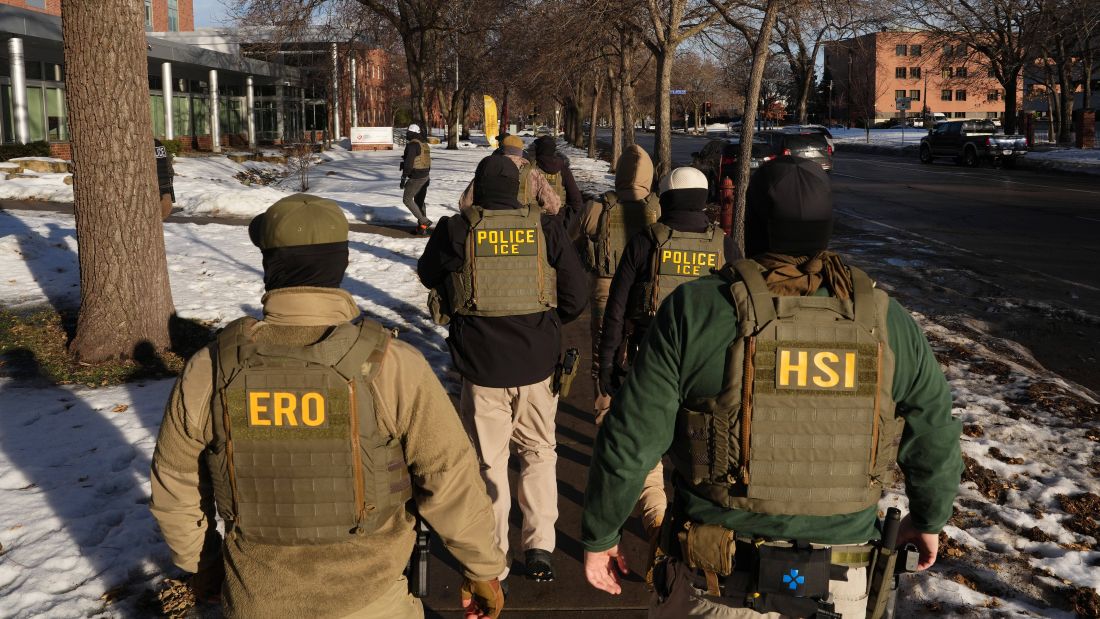
Federal law enforcement agents walk through a neighborhood in Minneapolis. Photo by Adam Gray of the Associated Press.
This story appears as part of a collaborationbetween The Maine Monitor and Maine Focus, the investigative team of the Bangor Daily News, a partnership to strengthen investigative journalism in Maine. You can show your support for this effortwith a donationto The Monitor.Read more about the partnership.
The mayors of Maine’s two largest cities say they believe federal immigration agents will soon arrive.
Lewiston Mayor Carl Sheline issued a statement to media outlets saying it is his “understanding” that there will be U.S. Immigration and Customs Enforcement agents on the ground in the city soon.
Shortly after, Portland Mayor Mark Dion issued a similar statement that said he expects ICE to be in the city next week.
“Our community is anxious and fearful regarding the understanding that ICE is planning to send agents to Portland and Lewiston next week. We are a welcoming city,” Dion, a former Cumberland County sheriff, said. “While we respect the law, we challenge the need for a paramilitary approach to the enforcement of federal statutes.”
Similarly, Sheline said he understands the news comes at a difficult time for his community.
“I understand that this is an unsettling time for many of our residents. Lewiston is a strong city and we care about our community and each other,” his statement said. “Please check on your neighbors and stay safe.”
Neither Sheline’s statement nor Dion’s offered further details as to how they got this information. There has been consistent but targeted enforcement across Maine since Trump took office, but the mayors’ extraordinary moves to raise the possibility of increased action comes at a tense time for the Somali community on the heels of intense enforcement in Minnesota.
Spokespeople for ICE and the Department of Homeland Security did not immediately respond to requests for comment.
The announcements came a day after President Donald Trump’s administration announced that it would end temporary protected status for Somali immigrants. Maine has a Somali community that has been growing in power and prominence in recent years. It is centered in Lewiston and Portland and took root in the early 2000s. Most of them were either born in the U.S. or have become citizens.
That move was the latest for the Trump administration in the wake of a federal immigration crackdown in Minneapolis, which followed nearly 100 federal prosecutions of people in welfare and Medicaid fraud schemes. Those cases largely centered on the large Somali community there. An immigration agent shot and killed a woman in her car there last week, leading to national protests against the Republican president’s policies.
Immigration authorities visited Lewiston last month, posting pictures of Homeland Security Investigations agents visiting the Lewiston office of Gateway Community Services, an immigrant health care provider that Maine suspended payments to last month while alleging more than $1 million in interpreter fraud.
MaineCare providers based in Lewiston and Portland have been at the center of widespread allegations of fraud within the state’s version of Medicaid in recent weeks and months. Reporting in May from The Maine Wire, the media arm of the conservative Maine Policy Institute, led Republican lawmakers to call for more investigations and further scrutiny of the state’s payments via MaineCare for interpreting services.
Those calls have intensified in recent weeks following the state’s pause in payments to Gateway. Last week, Republicans on the Legislature’s Government Oversight Committee filed a request to investigate alleged fraud against MaineCare vendors.
It also follows a series of Bangor Daily News articles, including one examining a 2021 report from an investigator outlining a suspicious billing pattern for interpreter services, especially among providers working with the state’s Somali community, that indicated widespread fraud within the MaineCare system.
Another, focused on the quiet federal prosecution of three people tied to the Lewiston-based Bright Future Healthier You, for allegedly trying to defraud the federal government. The mental health organization that was the largest biller of MaineCare for interpreting services in the last 10 years.
BDN writer Callie Ferguson contributed to this report.
Overlooked during the opioid crisis, more of Maine’s oldest began to struggle with drugs
A patient waits for assistance at the makeshift street medicine clinic at the Union Street Brick Church in Bangor in September. The street medicine team has seen an increase in older adults doing harder drugs in recent years. Photo by Katherine Emery.
Megan Harrigan hurried around the Union Street Brick Church in Bangor in September, gathering clients and bringing them to the back corner of the church where there was a makeshift clinic of folding tables and metal chairs. Each client was homeless, and most had an opioid addiction. Harrigan knew them all by name.
Between helping patients get referrals for opioid treatment medication, providing care for wounds that can come with opioid use, checking on clients she hadn’t seen in a while, and joking with other staff of the street medicine team, Harrigan talked with a Maine Monitor reporter about a shift she has witnessed in recent years: more older adults are doing harder drugs.
Harrigan, a mental health and rehabilitation technician, first started helping people with addiction more than 20 years ago. At that time, her older patients primarily struggled with prescription opioids. But regulatory crackdowns on overprescribing meant some of those patients turned to illicit drugs, now largely fentanyl, Harrigan said.
What’s more, she’s now working with more older people, a surprising observation as illicit drug use typically declines after young adulthood.
The opioid epidemic is still primarily a problem among younger people. But as it has worn on, a change has been happening that’s largely gone unnoticed. The Maine Monitor analyzed Medicare claims data to show for the first time that the number of Medicare patients in Maine, ages 65 and older, who received buprenorphine treatment for their addiction to opioids increased about 70 percent between 2019 and 2023.
This increase is large, but it represents a small number of all patients: about 450 more people seeking help at different health care systems and doctors across the state. It means the change might be imperceptible to individual medical practitioners. But some are starting to notice the increase in their every day, and it is worrying to them. They wonder if it is the start of a trend.
“Eventually they’re going to age, and our drugs are not stopping,” said Harrigan, a liaison with OPTIONS, a state-coordinated initiative that stands for Overdose Prevention Through Intensive Outreach Naloxone and Safety.
In Maine, some family doctors, addiction treatment providers and public health officials have seen anecdotal increases in older adults struggling with opioid use, pointing to the potential emergence of a growing problem in pockets of the state.
However, other organizations, including MaineHealth Behavioral Health based in Westbrook and the Bangor Area Recovery Network in Brewer, said they have not seen a notable increase in the older patients they serve.
Meanwhile, total overdoses in the state continue to plummet, and older adults account for a relatively small portion of those overdoses. Mainers 65 and older made up 23 percent of the state population but just 12 percent of nonfatal overdoses last year and 13 percent so far this year, according to the most recent state data.
Those between ages 35 and 44, in comparison, made up 12 percent of the population and 26 percent of nonfatal overdoses last year. It means some experts are hesitant to focus on a segment of the population with less need.
Gordon Smith, the state director of opioid response, said each age group deserves attention, but he has limited resources and a responsibility to focus on the most vulnerable groups. He added that opioid use disorder is an “adolescent onset disease,” and the vast majority of people who struggle with substance use started before they were 18, which is why prevention efforts focus on younger age groups.
“I have to be responsible for all my age cohorts, and where is the biggest struggle? Where is the biggest bang for my buck?” Smith said. “A lot of people want to — and this is not wrong — to put more into the adolescent population and deal with prevention because you have more years of life lost.”
As Maine’s population continues to age, others said the state should start planning for how to address what might become a growing problem.
Kaylie Smith, a licensed clinical professional counselor in the addiction care program at Northern Light Acadia Hospital in Bangor, works as a therapist for older adults receiving methadone or buprenorphine for an opioid addiction. While adults 65 and older make up only about 3 percent of her roughly 400 patients, she said that number has doubled during her decade working there. She thinks the trend will continue.
“It’s almost a special niche group, but I think it’s important to talk about because our population is aging,” Kaylie Smith said. “Maine is one of the oldest states in the nation, and that is impacting how patients are presenting with us.”
‘It’s all fentanyl’
Walt Bresnahan, now 68, first started taking opioids in his 30s after an old injury from playing sports started flaring up. He got a prescription for Percocet and became addicted, he said.
Bresnahan, of Old Orchard Beach, is now sober two years and seven months. He spends his time volunteering at the Portland Recovery Community Center. He hasn’t seen an increase in older adults attending the community center, but he said older people can be particularly hard to reach.
“The older generation right now is the Boomers,” he said. “What is the one thing that comes with those generations that sticks out more than anything? It’s pride.”
It can be harder for older Mainers to disclose they have a problem in part because they may feel more stigma than younger generations, according to those who help people with addiction.
Leon Licata, pastor at the Union Street Brick Church in Bangor, said he’s been stunned to see older people he serves getting involved in street drugs. People over 65 make up a small portion of those using the church’s warming and cooling center — he guessed maybe 5 percent — but anecdotally he has seen their numbers increase significantly in the last couple years.
A woman in her 70s at the shelter who spoke to a reporter insisted she had not used drugs in 30 years. Licata, who knows her, said that wasn’t true, but “they’re not going to tell you.”
Leon Licata, pastor at the Union Street Brick Church in Bangor, said older adults make up a small portion of the people they serve at the church’s warming and cooling center, but he has seen that number increase in recent years. Photo by Katherine Emery.
Older adults with opioid use disorders may not look like the stereotype, said Dr. Rachel Solotaroff, clinical advisor for substance use disorder services at Penobscot Community Health Care based in Bangor. Most of her older patients smoke, rather than inject, and it’s more often women — usually “very frail women,” she said. She added that her observations are limited to those who are seeking help.
“It’s all fentanyl,” Solotaroff said, referring to the powerful synthetic opioid. “I haven’t seen heroin in a long time, nor prescription opioids.”
Often her patients started with prescription opioids, but then their use evolved to more illicit substances, Solotaroff said. And sometimes they’ve had long periods of sobriety in between, until they face a crisis such as losing their home.
Maine has made a significant effort to improve access to life-saving medications for opioid use disorder and harm reduction services such as safe syringe exchanges, Solotaroff said. But she believes the state needs to take more of a population-health approach to helping older adults, which would entail creating interventions designed specifically for this group.
“You also need an intentional focus by policymakers, by people who design these systems, on this population as distinct from a group of folks in their 40s or a group of folks in their 20s,” Solotaroff said.
Gordon Smith said his office looks at demographic data about overdoses every week. He pointed to initiatives such as youth recovery coaches as evidence of age-targeted programs.
“We have all kinds of strategies that look at particular populations, and we’re talking every day about whether it’s middle-aged people or older people,” he said. “It doesn’t matter whether you are 13 or 83, we’re going to have as many options available to people as possible.”
‘Maine is no exception’
Multiple health officials said older Mainers are likely to feel most comfortable talking to their primary care doctors. Solotaroff and two primary care doctors told The Monitor they are seeing increases in older patients struggling with opioid use disorder, although most hadn’t tracked it with data.
The nation as a whole is seeing a marked increase of older adults with an addiction to opioids. A recent study found a 9,000 percent increase in overdose deaths of older adults from fentanyl mixed with stimulants, such as cocaine and methamphetamines, over the past eight years.
Between 2014 and 2023, the number of overdose deaths from any opioid among people 55 and older increased threefold nationally and fivefold in Maine, according to a KFF analysis. Nationally, adults 65 and up experienced the largest increase in drug overdose rates of any age group from 2022 to 2023.
“I think the trend is clearly an issue, and Maine is no exception,” said Dr. Noah Nesin, a family care doctor and medical director of research and innovation at Community Care Partnership of Maine.
Nesin estimated that “overwhelmingly” people over 65 with opioid use disorder largely still use prescription opioids, but some people on the younger end might also have started using illicit opioids.
“It used to be earlier in my career that you would never see somebody in rural Maine, which is where I practiced, who had an opioid use disorder to anything other than prescription,” Nesin said. “Now we do see in , and in others where opioid use disorders are treated, people over 65 who have used illicit drugs like heroin and fentanyl.”
Members of the street medicine team in Bangor make regular visits to Union Street Brick Church, among other locations. Photo by Katherine Emery.
While Mainers 65-plus make up a small percentage of overdoses in the state, Nesin said he’d expect most of those overdoses to be fentanyl, not prescription opioids. It should raise alarms, he said. (The state does not publicize data showing the number of overdoses by age in each county.)
“We have to be alert to the possibility that a population of people for whom we previously didn’t have to consider illicit drug use as part of their addiction, that has to be considered and explicitly evaluated,” he said.
Doctors are prescribing far fewer opioids now, while prescriptions for buprenorphine, which treats opioid use disorder, have jumped. It was the top prescribed controlled medication in Maine last year, according to the state’s Prescription Monitoring Program.
While more people are seeking help, they may not always find it valuable. Nationally, fewer than 40 percent of Medicare beneficiaries with opioid use disorder received treatment that met quality metrics, according to a recent study published in Health Affairs.
Recognizing and treating opioid use among older adults comes with a unique set of challenges, said Dr. Erik Steele, a family physician at Martin’s Point primary care in Brunswick, who has been a doctor for 30 years. Opioid use can have cognitive effects that mimic aging issues, such as memory loss, ability to function and fall risks. An older patient may have more health conditions and prescribed medications that interact with opioids in different ways, and they may have chronic pain with few non-opioid treatment alternatives, he said.
Primary care doctors sometimes struggle to start conversations with older patients about opioid use because they don’t want to offend people in their care. When he does random drug testing and pill counts on older patients who have been on opioids for more than a decade, Steele said they often are surprised and insulted. He said he suspected family physicians might be less likely to do random drug screens on a 75-year-old who has been on opioids for 10 years than a 40-year-old who has been on them for five years.
“There’s no question that asking somebody, in common parlance, ‘Are you addicted to your medication?’ is a challenging conversation and is potentially a barrier to asking it,” Steele said. “As you do more and more of this work, you do get more comfortable asking the question.”
With older patients, Steele said, it’s especially important to figure out if they are physiologically dependent on the opioids, meaning they would experience withdrawal symptoms, or if they are pathologically dependent, meaning they are using opioids to treat an underlying issue such as post-traumatic stress, anxiety or depression — in an escalating manner to the point where it becomes an illness. There isn’t good data currently about how many older patients are pathologically addicted to opioids, he said.
‘It reflects broader shifts’
A growing number of Medicare recipients in Maine are getting buprenorphine to medically treat opioid use disorder.
Between 2019 and 2023, the number of Medicare recipients in Maine receiving buprenorphine, who were 65 and older, increased from 638 to 1,087, according to a Maine Monitor analysis of Medicare claims data. That’s a 70 percent increase, while the overall population of Mainers 65 and older grew 12 percent during that time.
The numbers are likely an undercount because The Monitor did not include totals for categories of buprenorphine that were suppressed because they were too small for Medicare to publish. The numbers also do not include how many people took other drugs, such as naltrexone and methadone, to treat opioid use disorder.
Christy Daggett, CEO of Aroostook Mental Health Services, said any increase in older adults seeking treatment is a hopeful sign that they feel more comfortable reaching out for help. The facility’s total number of Aroostook County patients in treatment for opioid use decreased 12 percent between fiscal years in 2020 and 2025, but clients who were 65 and older increased slightly from 14 to 21.
Even as more older adults are seeking treatment, it can be difficult for them to continue taking opioid treatment medications when they need higher levels of care for other health problems. Multiple providers told The Monitor that nursing homes and assisted living facilities are not equipped to handle people with opioid addictions.
The warming and cooling shelter at Union Street Brick Church in Bangor regularly hosts a clinic from a street medicine team. In Maine, some family doctors, addiction treatment providers and public health officials have seen anecdotal increases in older adults struggling with opioids, including fentanyl. Photos by Katherine Emery.
Kaylie Smith, from Northern Light Acadia Hospital, said treatment should be more available in all health care settings. Sometimes her patients have a hard time going to rehabilitation facilities because they can’t get their methadone, which is often dispensed at regulated clinics.
“For them to go without their medicine, it’s just not realistic because that would totally destabilize them in different ways,” Smith said. “It’s like you’re choosing which way you want to be destabilized.”
In 2022, Amelia Hersey tried to change that. As a physician’s assistant specializing in geriatric substance use, she spent a year working with a dozen nursing homes across the state to establish and expand their policies to better serve residents with addiction.
“We made very little gains, unfortunately,” she said, and “met a lot of resistance.”
The only nursing homes that ultimately updated their practices were the two where she was already employed. There was near constant turnover in nursing homes, forcing her to retrain new people and get buy-in from new administrators, she said. In addition, staff are overworked with limited capacity for more tasks.
The Maine Health Care Association, which represents nursing homes and assisted living facilities, said these facilities are already caring for more residents with substance use disorders.
“This isn’t uncommon anymore,” said Angela Cole Westhoff, president and CEO of the industry group. “It reflects broader shifts in both the population and the challenges people are living with as they age.”
Maine Monitor reporter Taylor Nichols contributed data reporting to this story.
This story was made possible in part by a workshop on reporting on aging, convened by the Craig Newmark Graduate School of Journalism at CUNY.
Two years after Lewiston shooting, Maine voters approve red flag law
Two years after the mass shootings in Lewiston and more than a year since efforts to pass stricter gun laws failed in the state legislature, voters across Maine approved a red flag law that will give family members the ability to ask a judge to temporarily take weapons away from a person at risk of harm.
The Associated Press called the race shortly before 10 p.m. on Tuesday. As of 4:30 p.m. Wednesday, with 98 percent of ballots counted, sixty-three percent of voters had voted “yes.”
A coalition called Safe Schools, Safe Communities led the petition to put Question 2 on the ballot through a process called a citizen initiative. The law is expected to go into effect no more than 40 days after the election, unless it is determined that the money needed to implement the bill exceeds available funds.
A red flag law will allow family and household members to directly petition a judge to temporarily take weapons away from a person they believe is at risk of harm to themselves or others. Maine will join 21 other states and the District of Columbia that have enacted such laws.
There is already an “extreme risk protection order” law in effect in Maine that allows for weapons to be temporarily removed from a potentially dangerous person, and it will remain on the books alongside the new measure.
Under the current one-of-a-kind yellow flag law, only a law enforcement officer has the power to initiate a protection order. Under a red flag law, this power is extended to family and household members.
The yellow flag law also differs in that it requires law enforcement to take a person into protective custody and get that person evaluated by a mental health practitioner, who must confirm law enforcement’s belief that the person demonstrates a “likelihood of foreseeable harm,” before it can go to a judge for final endorsement. Protective custody nor a behavioral health assessment is required with a red flag law.
It remains to be seen how exactly the two laws will work together. Michael Rocque, a sociology professor at Bates College who studies gun violence, told The Maine Monitor he hopes each law will be used for different situations — yellow flag for “decompensating mental health situations,” and red flag for more immediate threat concerns.
“But I know that the implementation will depend on people’s awareness and law enforcement’s capacity across the state,” Rocque said. “If I had to predict, I’d say that the yellow flag will start to be supplanted by the red flag law.”
The bill that created the yellow flag law was drafted by a bipartisan group of lawmakers and advocates, including Democratic governor Janet Mills, the Sportsman’s Alliance of Maine and the bill’s sponsor, Republican senator Lisa Keim.
The law was seldom used prior to the October 2023 shootings in Lewiston that left 18 people dead and more than a dozen people injured. A state commission investigating the Lewiston shootings wrote in its final report last year that there were myriad opportunities to use the yellow flag law to take weapons away from the shooter. Gun safety advocates responded by pushing for the state to adopt a red flag law.
But attempts to get a red flag law passed in the legislature failed. A bill introduced by then-speaker of the house, Portland Democrat Rachel Talbot Ross, died in committee. A bill that would have banned bump stocks was vetoed by the governor. And while a 72-hour waiting period did make it into law, it is currently on hold as it passes through the court system.
Lawmakers did pass a protective custody warrant law in response to criticism that the yellow flag law depends on an individual’s willingness to enter into protective custody.
Safe Schools, Safe Communities spokesperson Jack Sorensen previously told The Monitor that the yellow flag law was an “experiment (that) failed in Lewiston, horrifically and tragically, despite the fact that the gunman’s family knew he was dangerous and repeatedly warned law enforcement.”
A red flag law “adds a tool to the toolbox” to get dangerous weapons out of potentially violent people’s hands quickly, he added.
A hearing must be held within 14 days after a petition is filed, during which a judge will determine if the petitioner has shown a preponderance of evidence that an individual “poses a significant danger of causing physical injury to the respondent or another person by purchasing, possessing or receiving a dangerous weapon or by having or attempting to have or control a dangerous weapon.”
If a judge approves the order, the respondent must relinquish their weapons to law enforcement and is prohibited from possessing or purchasing a weapon for up to one year, at which point a judge can either extend or lift the order. Once the order is issued, law enforcement can seek a search order for any weapons.
A petitioner can also seek an “emergency extreme risk protection order,” which, if approved by a judge, would immediately remove weapons from an individual for no more than 14 days. An emergency order can be issued “ex parte” — without giving the respondent prior notice.
Supporters of a red flag law, including the Maine Gun Safety Coalition, have said that it is also an important tool for suicide prevention. People close to an individual would likely be the first to notice concerning behavior and a red flag law gives them the ability to act quickly, Sorensen said.
The vast majority of firearm deaths in Maine are suicides, according to data from the Maine Center for Disease Control and Prevention. The state has one of the highest rates of gun suicides among older adults.
“Maine voters have taken the safety of our communities into our own hands by passing common-sense, responsible gun legislation that will save lives and help keep our kids and families safe, not just from the horrors of a tragedy like Lewiston, but from the devastating impacts of everyday gun violence,” Nacole Palmer, the executive director of the Maine Gun Safety Coalition, said in a statement released Tuesday night.
She added, “We reject a false choice between gun rights and responsibilities and say that in Maine, we believe in both.”
Opponents of Question 2 said that a red flag law is merely an attempt at “eliminating due process in the law.”
David Trahan, the executive director of the Sportsman’s Alliance of Maine, said passage of a red flag law would be a “slippery slope,” putting citizens’ other Constitutional rights at risk.
He questioned the need for a red flag law, pointing to the explosion in the use of the yellow flag law since the Lewiston shootings. More than 1,000 orders have been completed since Oct. 25, 2023, compared to 80 orders that were completed in the three years between the bill’s passage and the mass shootings.
Gov. Janet Mills also came out in opposition to Question 2, writing in an op-ed published in the Portland Press Herald that a red flag law would “create a new, separate and confusing process that will undermine the effectiveness of the law and endanger public safety along with it.”
In a statement released late Tuesday night, Mills said, “I sincerely hope that this measure will strengthen public safety as proponents have argued,” and promised to work with law enforcement and the public to implement it.
Shortly after the race was called, the No on 2 campaign said in a statement, “We are glad that Maine’s yellow flag law remains intact, and we look forward to continuing to work to improve our state’s safety.”
The campaign thanked “all the Mainers who helped us stand up to the out-of-state dark money.”
Safe Schools, Safe Communities raised $580,000 in contributions and loans. Just over half of donations came from in-state sources. The campaign’s largest donor was Giffords, an organization that advocates for stricter gun laws and is named after former congresswoman Gabrielle Giffords, who was shot at an event in 2011. The organization donated $100,000.
The two opposition committees, Keep Maine Safe and Protect ME – No Red Flag, raised a combined sum of $133,000 for their campaigns.
A referendum in this Maine vacation town is all about child care
Greenville residents are being asked in the November election to contribute $1 million to a community building that will include up to 40 child care slots. Photo courtesy the town of Greenville.
Daniel O’Connor is aReport for Americacorps member who covers rural government as part of the partnership between The Maine Monitor and the Bangor Daily News, with additional support from BDN and Monitor readers.
Residents of Greenville will decide whether to borrow $1 million to help build a recreational building that would support child care and preschool in a referendum this November.
The project could boost employment and growth in the four-season vacation town with just under 1,500 residents on Moosehead Lake, but some have questioned whether taxes should pay for the building slated for the site of the town’s defunct elementary school.
The question on the November ballot shows an isolated part of Maine grappling with a child care crisis that is hitting all parts of the state. There are just 16 registered providers in Piscataquis County, which is one of the most rural areas in Maine. Two are in Greenville, but none of them had open slots for kids as of May.
“People understand we need child care,” Town Manager Michael Roy said. “It’s tough for young families to come in without jobs, local jobs, and so people are having to commute in to work from other towns.”
A local nonprofit partnered with the town more than three years ago in an attempt to build a municipal building that would be partially leased to a child care provider. It was granted federal funding with support from U.S. Sens. Susan Collins and Angus King, but inflation during a slow planning process has driven up costs and pushed the town to seek more money.
The Moosehead Caring for Kids Foundation, the town, and Greenville’s school district are pushing for the building, which would include space for up to 40 children ages 0-5 while expanding the town’s preschool program and including a fitness center aimed at adults.
The lack of child care space has caused problems for Greenville before. Officials said limited child care for workers helped derail a redevelopment of a local ski area in 2022. Roy added that some in the town have expressed “heartburn” over the fact that out-of-town children will likely use the new child care facility as well.
Between the federal allocation and other grants and donations, millions are already slated for the project, which is expected to cost a total of $4.8 million. If the bond passes, taxpayers would have to cover the $1 million cost plus interest over the coming years.
If voters reject the plan to pursue a bond, it’s not clear what will happen with the money already set aside for the project. Roy said officials will have time to consider how to move forward, and officials are optimistic that voters will support the plan.
“I think the people that are in desperate need of child care may come out and vote,” said Jennifer Clark, the treasurer of The Moosehead Caring for Kids Foundation.