For Rural Students, Going to College is Not Easy

For Rural Students, Going to College is Not Easy

The first announcement arrived in the mailbox outside my faculty apartment in early May. Inside a small white envelope was a card that read Congratulations, Class of 2012! It was covered with photos of a teenager, someone I recognized. She was tall, probably taller than me. She had traded her pink T-shirt and purple plastic barrettes for a long dress and sophisticated heels—but there she was, nearly 10 years older than the last time I’d seen her, a mortar board on her head and a diploma in her hand. My third graders were graduating from high school.

I knew the envelope’s postmark, too: Vanleer, Tennessee—a place with green hills and old tobacco barns and fences that no longer mark much, a place my third graders used to struggle to find on a map, a place that felt, at once, so familiar and so far. It was there that, just out of college, I began my teaching career. I found my way to Vanleer because I wanted a rural teaching job and the school’s principal was willing to hire me; I never imagined that, 10 years later, I’d be college faculty, teaching college kids and studying rural education and, from a distance, watching my third graders graduate.

Over the next few years, every May, the mailman would drop a stack of graduation announcements in my box, and more would appear on Facebook. With the photos were notes about their future plans, comments on the lives that awaited them. They were becoming mechanics, vet techs and linemen, some enrolling at the local community college for the associate degree or trade certificate they’d need. Under their caps and gowns, I could still see my smart, curious eight-year-olds, and I could see these eight-year-olds—and often, their families—in their plans, too.

(University of Chicago Press)

I also noticed what my kids weren’t doing. Few were going to four-year colleges, and none was headed to an elite school—the kind of school where I was teaching by then.

I had just been hired at Bates College, a small, wealthy, highly selective, private liberal arts college located in the small city of Lewiston, Maine. At Bates, courses are rigorous, extracurriculars are extensive and facilities are state of the art. A career office will edit your résumé, and a tutoring center can help with your math homework. Sometimes there’s even lobster mac and cheese in the dining hall.

So, why weren’t my former third graders enrolling at four-year schools? Why weren’t they going to colleges like Bates? I didn’t question my kids’ plans; their plans were sensible, and the work they would do, valuable. But I wondered whether these plans had been a choice—if they’d had options and what those options were. The resources, the opportunities, the abundances of college were striking, and I wanted all of that—or at least, the possibility of all of that—for my third graders, too.

After a few years of teaching at Bates, though, my questions started to change. Bates seemed far from rural Tennessee—really, far from rural anywhere. Busy streets and crowded apartment buildings surround the campus. Its trees are deliberately placed. The school’s majors wouldn’t be much help in hanging a power line or vaccinating a horse. Its students don’t go four-wheeling, and they wouldn’t know what to do with a turnip green. On warm spring days, when dorm room windows are open and music spills out, it’s not country.

I still wondered why my students hadn’t gone to a four-year college, but now I also wondered, what if they had?

College opportunity and place

College means opportunity, or at least it’s supposed to. Admission is taken as evidence of hard work and talent. Graduation is, theoretically, a chance to cash in on that investment, the opportunity for steady employment and future security. It’s both high school aspiration and national narrative—the stuff of American dreams—and for decades, policymakers and researchers have preached the bene- fits and, increasingly, the necessity of a degree.

Elite colleges occupy a particular place in this narrative: They’re a special destination with the biggest rewards for the best and brightest students. And their benefits are clear. They offer small classes, intensive advising and robust academic support, and unlike many colleges and universities, they boast high retention rates. Their students develop networks, acquire cultural capital, even find spouses. Their graduates are more likely to land good jobs and enter graduate school, and they earn more—over 20% more than graduates of the least selective schools.

But I was beginning to question the “best and brightest” part of that narrative. Not because my new college students weren’t talented and smart and determined—they were. But they were also mostly white and wealthy. And despite rural America making up 20% percent of the U.S. population, they weren’t rural. “Best and brightest” seemed also to signify something about race and class and geography.

The racial and class inequities of higher education are well documented. We know that, for example, 42% of white students enroll in college after high school, but only 37% of Black students and 36% of Hispanic students do. And while enrollment for students from the wealthiest quintile of families nears 90%, it’s less than 40% for those from the poorest. Study after study makes clear why. Students of color and low-income students face barriers throughout the college pipeline: inadequate college advising, rising tuition, shrinking state aid, racially hostile campuses, mounting debt and countless other obstacles and costs. These disparities, though intractable, are widely acknowledged by advocates, political leaders and college administrators, many of whom are working for change.

But so much of this is about who students are and what they have, not where they are or how the latter might shape the former. Geography has mostly been neglected as a factor structuring college access. It shouldn’t be. Where my rural third graders and my not-so-rural college students are from—and where they are going— suggests that place may actually matter a great deal. I was also beginning to suspect that it isn’t just at admission that it matters. Geography might shape it all: who gets a degree, what that degree means, and what that degree costs.

I wanted to know how.

Spatial injustice and college access

Talent is everywhere; opportunity is not—and this may be especially true in rural places. We know that opportunity is unequally distributed across geography. Some places enjoy more resources, like houses with working plumbing or grocery stores with fresh produce, than others. This asymmetry creates what the urban geographer Edward Soja calls “spatial injustice,” a geography of opportunity that marginalizes the residents of many places, both urban and rural.

A variety of factors produce these spatial inequities, including the political and social organization of space, as with, for example, segregation; discriminatory policies and practices, such as redlining; and uneven development, which leads to disparities like health care deserts and digital divides. Spatial injustice usually reinforces racial and economic injustice, such that the opportunities are most limited in places with larger Black and Brown communities and higher poverty levels. Geography also influences residents’ understanding of opportunities. Individuals learn about resources, like jobs and training programs, and the institutions that offer them, like factories and social service agencies, from their local social networks, in everyday conversations with family and neighbors. This information is based on a community’s accumulated experiences with the opportunity structure, and it is deeply influential. It defines values and perceptions—of the “right” decision or the “worthy” goal—and shapes whether and how residents access opportunities.

Studies of spatial inequity tend to focus on urban centers, and few consider the geography of college access and attainment. Yet spatial injustice may profoundly shape college opportunity for students—and for rural students specifically. One way is through local education levels. Parental education is known to predict children’s college aspirations and enrollment, as well as the type and selectivity of the institution that children pursue. College-educated parents understand application processes, financial aid forms and academic requirements, and they’re more likely to expect that their children will attend college, to talk with their children about college and financial aid and to take their children on college visits. But, because degree attainment is unequal across geography, many rural children don’t have college-educated parents, and therefore, they can’t access those parental supports.

Spatial inequities in wealth may also limit rural college attainment. Family income is a reliable predictor of college attendance for students from all geographies. Given the limited job opportunities and reduced salaries of rural places, rural families have lower incomes than nonrural families, forcing many rural students to either forgo college or take the cheapest college path available.

The geographic unevenness of school resources can shape college opportunity, too. Public schools rely on local property taxes for much of their revenue; because many rural communities don’t have the taxable wealth of more affluent metropolitan areas, their schools are often underfunded. Low-income schools are less likely to have resources like qualified teachers, experienced staff, and high-quality facilities that support rigorous academic preparation, an important predictor of aspirations, enrollment and attainment for rural students. Rural districts also face challenges related to sparsity and distance that can compromise quality; many rural schools lack strong postsecondary counseling programs or, in some cases, any counselors at all, and they’re less likely to offer advanced classes.

These disparities extend to higher education. Most U.S. students attend schools within 50 miles of home. According to the sociologist Ruth López Turley, proximity makes attending college “logistically, financially and emotionally easier.” The chance a student will even apply to college increases with each additional school nearby; living close to a college may raise awareness of the benefits of a degree and expand understanding of application processes. Many rural students don’t enjoy this kind of proximity, though, because most colleges and universities are located in more populated, metropolitan locations, while vast swaths of rural America are education deserts. Institution type also varies geographically: rural places tend to have fewer four-year colleges and more two-year schools. And most colleges do little to mitigate the distance, failing to send admissions officials to rural high schools to recruit students.

These spatial inequities—the distance of higher education, the underfunding of rural K-12 schools, the lack of parental education and wealth—undoubtedly shaped college access for my rural third graders. But another factor might have mattered, too, one that raises complicated questions about opportunity and choice: the rural economy.

Producing the “rural disadvantage”

From cotton to coal, rural economies historically centered on the cultivation, extraction and processing of natural resources, relying on industries like agriculture and logging and mining. It was often exploitative work, dependent on the labor of enslaved and poor men and women. Typically, this work marked every aspect of daily life, including children’s expectations for their adult lives—who they would be and what they would do. And mostly, these expectations did not include college, for work was something learned in the fields or the woods or the mines.

Today’s rural economies are diverse. Some sectors are growing, like tourism, clean energy and prisons. Thanks to the pandemic, remote work from rural areas is also expanding. Traditional rural industries, though, are shrinking. Only 10% of rural workers are now employed in the industries that once defined rural economies and structured rural life. Rural work—whether in traditional industries or in newer, service-oriented sectors—is also disproportionately low-wage work, especially for Black and Brown workers, such as jobs picking strawberries or cleaning hotel rooms that don’t leave much to live on.

And fewer and fewer people are left to do this rural work. In rural places where industries are failing and jobs are disappearing, populations are also shrinking. From 2010 to 2020, rural America recorded its first-ever decade-long population decline, with two-thirds of non-metropolitan counties experiencing loss. Much of that loss is due to out-migration, with many rural residents moving to cities, where jobs are more plentiful and better paid. Some, like the sociologists Maria Kefalas and David Carr, argue that rural America is getting hollowed out.

Even with all that change, one thing remains constant: most rural jobs do not require a college degree, whether in a declining rural industry, like farming or mining, or in a growing newer sector, like tourism or prisons. When a degree is necessary, it’s often a professional certification or two-year credential—and indeed, for these degrees, there is no urban-rural attainment gap. Bachelor’s degrees simply aren’t as relevant to rural work.

College, writes the education scholar Michael Corbett, remains “ ‘invisible’ training for invisible jobs in an elsewhere economy”—and this is especially true for four-year degrees. Thus, the decision to pursue one can feel fraught, like a choice between education and home. Therefore, it might also be the spatial asymmetry of the economy—which jobs are available where—fueling the rural-urban attainment gap, with rural young people just calibrating their plans to their local context.

And perhaps this is as intended. Even as rural economies change and restructure, the country remains dependent on its rural industries to feed, fuel, entertain and imprison. These rural industries are economically and politically necessary, and so rural workers are necessary. Rural youth become rural workers; limiting their education keeps them rural and working and cheap. The rural attainment gap, then, is more than an unfortunate statistic; it’s what sustains these industries. Rural youth—my third graders—aren’t supposed to want to go to college.

Those who go

Despite all this, though, some rural students do go to college. This “invisible minority,” as researchers Sarah Schmitt-Wilson and Soo-yong Byun have called them, often pursues a degree for practical reasons—specifically, employment. Those from places marked by poverty and economic decline may be especially motivated to earn a degree, and although some hope to return home after college, most recognize the challenges of finding work there. Their parents often support college aspirations; they may not be able to help with completing applications or navigating admissions, but they can offer more general support, like high expectations and conversations about careers, that promote college-going. Communities, too, can support college-going, with dense networks that expose students to careers and keep students “on track” for college.

Less is known about these rural students’ college experiences. A couple of studies suggest that they face challenges during college, such as difficulty adjusting and shifts in their identities, and they’re disproportionately likely to take on debt. They also have resources to rely on, including families and communities that encourage them to persist. But it’s not clear how they navigate those challenges, use those resources or understand those years. We also know little about their plans after college, how those plans might change as graduation nears, and what their degree means for them and for their families and communities.

So, as much as I wanted to know why my rural third graders weren’t going to college, I also wanted to know about those who do go: What’s college like for them? What’s it like for their parents, the ones with so much at stake in sending them? Did these families make the right choice? How does geography shape college opportunity?

What happens when they get there

For these students—for the nine, rural first-generation students I followed from matriculation to graduation during the course of my research—college was never an assumption. They grew up in rural places tied to industries that didn’t require college, transitioning to economies that won’t need them either. They were surrounded by adults who hadn’t gone to college and by neighbors who questioned whether they should. The postsecondary messaging of their K-12 schools was uneven—“go to college” messages were often coupled with low expectations and little support. Popular media has made an industry out of rural ignorance: rural people are uneducated, the TV shows and movies and news anchors say, and they have little interest in getting educated. Over and over, these students heard that college—especially the elite kind—isn’t a place for rural youth: rural kids stay home, get rural jobs, do rural work.

But these students resisted. Not in the ways so often written about—that is, resisting education—but instead, resisting through education: they went to college. For this group of high-performing, academically savvy students, college was an act of resistance. They were resisting an American economy that, despite restructuring, still depends on poorly compensated rural workers to pick produce, haul freight, clean hotel rooms. They were resisting the cultural messages that support this economy—the messages that tell them that they don’t need a degree, that they shouldn’t want one, that they aren’t meant for anything but this kind of work. And they were resisting an education that is conflicted, caught between its loftier ideals of equality and mobility and its darker charge of vocational sorting.

It’s not just that rural students aren’t expected “to go on and exceed”; there’s a vast economic system dependent on them not going. But these students did. They went to college—and to the kind of college that seemed the strongest guarantee against a lifetime of low-paid, undervalued rural work. And they finished that college, learning all the strategies (hiding, passing, code switching) and using all the resources (family, home, stubborn determination) to graduate.

The costs of that resistance, though, were high. Access was only partial, belonging was often conditional and promises were sometimes empty. They paid an emotional toll, too: loneliness and disappointment but also the pressure of big expectations, the worry of losing an increasingly distant home, the conflict and doubt and questions wrapped up in their rurality. For some, there was also regret—they didn’t want an urban life, after all. And there was fear—it’s too late, and they can’t return. These weren’t just their costs. Their parents felt them, too. These college decisions weren’t uncomplicated for them. There was the anxiety: the practical concerns of loans and bills and FAFSA forms, but also the apprehension that comes with sending a child to a place you don’t know and a world you don’t understand.

And there was the prickly reality that this departure would likely be not just four years but, instead, permanent. Their rural towns would also pay this price in the form of lost human capital, lost tax dollars, lost potential. So college was costly, for these students and for those who love and depend on them.

Research suggests that, as rural youth consider their futures, they face a hard choice: between college, for the opportunities it offers, and home, for its relationships and community. These students felt that tension, too, and four years later, it sometimes seemed as though college came at the price of home. But the students, I notice, never described that decision as a binary choice, even later, as the costs became more real. College was never just about the opportunities—at least, opportunities of the individualistic sort. For them, college was about their parents and their hopes and dreams. It was about stereotypes and the chance to disprove them. And it was about resistance: refusing to participate in rural undereducation and exploitation. College, then, wasn’t only—or even mostly—about them; it was also about their families, their friends and their communities. They went to college for them, too, so that higher education and its opportunities wouldn’t seem so remote. These students weren’t choosing opportunity over home; they were choosing both.

Now, after graduation, they’re doing everything they can to hold on to each. Most of them didn’t get the opportunities they were promised: the shiny résumé, the powerful connections, the “good job” in the city. And they can’t return home: there’s little work for them, and four years away has changed things. But they’re not yet willing to let go of either, and so they’re still holding on, still resisting.

Reprinted with permission from Educated Out by Mara Casey Tieken, published by The University of Chicago Press © 2025 by The University of Chicago. All rights reserved.

The post For Rural Students, Going to College is Not Easy appeared first on Barn Raiser.

New law aims to expand rural pharmacy access

New law aims to expand rural pharmacy access
Western Maine Pharmacy, in Kingfield, opened in 2011. Owner and pharmacist, Audrey Parks, said there hadn’t been another pharmacy in the town for at least 50 years. Photo by Audrey Parks.

A bill signed into law late last month aims to increase pharmacy access in rural communities across Maine. L.D. 239 directs the Maine Board of Pharmacy to adopt rules for the licensing and regulation of retail pharmacy remote dispensing sites no later than June 2026.

The bill’s sponsor, Sen. Brad Farrin, said in testimony that allowing retail pharmacies to operate remote dispensing sites “addresses a critical need for improving access to prescription medications in rural areas while maintaining the necessary safeguards.”

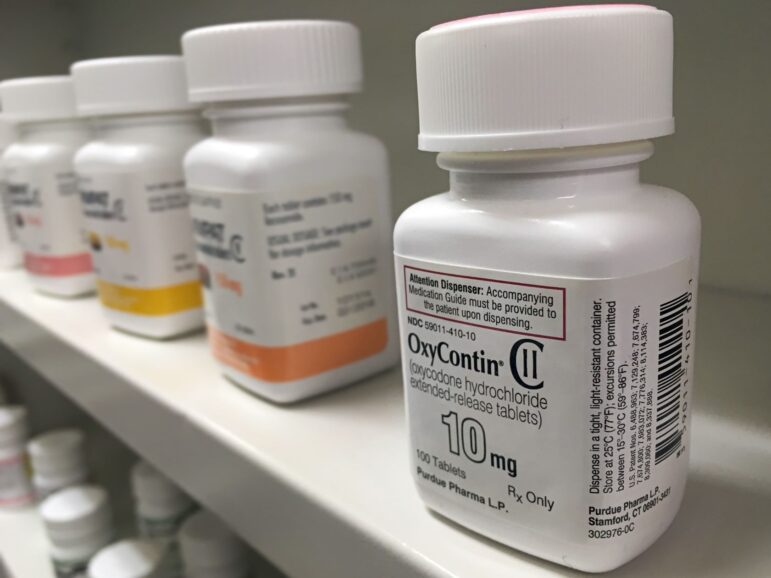
A Maine Monitor analysis of state pharmacy licensing data last year found that a tenth of Maine pharmacies closed between 2013 and 2024. These closures hit rural communities particularly hard, with some counties losing more than a fifth of their pharmacies.

Farrin, a Republican whose district covers wide swaths of rural Somerset, Kennebec and Penobscot counties, added that while mail order pharmacy services are helpful in some situations, they are not the solution in situations where “acute medications,” like antibiotics, need to be picked up quickly in order to avoid serious health issues.

“In many rural areas, it’s not financially possible for a full-service pharmacy to stay open, but a remote dispensing site that provides essential acute medications could make a huge difference,” he said. “It would save Mainers hours of travel time and help them start their medications on time.”

What exactly a “remote dispensing site” will look like or how it will operate will be determined by the Maine Board of Pharmacy, which licenses and regulates pharmacies, pharmacists and pharmacy technicians.

The bill Gov. Janet Mills signed into law on May 29 states that the pharmacy board rules “must, at a minimum, require a demonstration that the geographic area in which the remote dispensing site is to be located lacks adequate access to retail pharmacy services for the general public.”

Penny Vaillancourt, director of the Office of Professional and Occupational Regulation, said that the pharmacy board will develop a timeline to implement the legislation and propose draft rules over the coming months, but that it was too soon to comment on what those rules may look like.

Current rules require that retail pharmacies must be open a minimum of 40 hours a week and must have a pharmacist on duty at all times, unless a location receives a waiver from the board.

Model rules drafted last August by the National Association of Boards of Pharmacy, of which Maine is a member, defined a remote dispensing site as a location where “drugs are maintained and prescriptions are filled by a certified pharmacy technician,” who dispenses drugs under the remote supervision of a pharmacist.

A retail pharmacy that obtains a license to operate one of these sites would be considered the “supervising pharmacy” and must, among other requirements, maintain a common record-keeping system and have a pharmacist on duty available for patient or caregiver counseling via telehealth at all times.

Independent pharmacies, typically a lifeline in many rural communities, have shuttered at a higher rate than chain pharmacies such as CVS or Walgreens. Where just about 3 percent of chain pharmacy locations have closed in the decade leading up to 2024, nearly 31 percent of independents have shut their doors.

Washington County, which saw the steepest decline in the number of pharmacies statewide, had just nine pharmacies in operation as of February 2024, a 44 percent decline compared to 2013. All four pharmacies that closed in the preceding decade were independents.

The Monitor found that overall, 10 Maine counties had fewer pharmacies in 2024 than they did in 2013. Just three counties –– Lincoln, Piscataquis and Waldo –– saw new pharmacies open during that time period.

In distracting times, rumble strips are saving lives — and money — on rural Maine roads

In distracting times, rumble strips are saving lives — and money — on rural Maine roads
Photo by Justine Cotton Photography/iStock.

The honeymoon was almost over for Steven Lavrenz and Sandhya Madan. After sightseeing in Acadia National Park, the newlyweds from Michigan woke early and started a long drive back to Boston Logan International Airport on the gray morning of June 3, 2019.

But they wouldn’t get very far before their trip — and their lives — were nearly upended.

Heading north on Route 102, Lavrenz noticed a red pickup truck on the other side of the thoroughfare veering toward his Subaru rental car. Growing up in Iowa, Lavrenz had always held his breath on these kinds of two-lane rural roads, keeping one eye on oncoming traffic to ensure passing cars stayed in their lane.

So when the Nissan crossed the centerline, Lavrenz was quick to react, swerving away from the approaching vehicle. The maneuver may have saved his life: The truck crashed into the door just behind Lavrenz, totaling the car but leaving him physically unscathed.

Madan and the truck’s driver also escaped the incident without injury, which is fortunate after what transit experts call a “lane-departure crash.” While representing just 30 percent of Maine’s traffic collisions between 2010 and 2022, lane-departure crashes accounted for 73 percent of fatalities.

These head-on and sideswipe collisions are especially deadly in Maine, where researchers say that extreme weather, an aging population and infrastructure and a preponderance of winding, two-lane rural roads contribute to the highest crash fatality rate of any state in New England.

Though Lavrenz was physically unharmed, the crash rattled him for a different reason than most. As a transportation safety researcher, he’d spent years thinking about lane-departure crashes and trying to prevent them from happening. But it was the first time the Wayne State University professor had ever personally faced the life-or-death consequences of his profession.

Lavrenz had once worked with the Federal Highway Administration to add rumble strips to rural roads. Transportation departments around the country have gradually installed these grooved lines to jolt drivers who are asleep or distracted, the most common causes of lane-departure crashes. The strips vibrate the vehicle when it passes over the centerline or into the shoulder. 

Yet there were no rumble strips on this stretch of Route 102 that could have stirred the distracted truck driver, Lavrenz observed after their destroyed Subaru sputtered to a stop next to a Maine Department of Transportation facility. The next morning, after they secured another rental car and caught their flight, he decided to tweet at the agency.

“Centerline rumble strips could’ve prevented this,” he wrote, linking to a dashcam video of his crash.

Research from a bevy of states backed his assertion at the time. But a new study led by civil engineers at the University of Maine provides the most relevant data yet for the effectiveness — and cost-effectiveness — of centerline rumble strips on Maine’s sprawling network of rural roads, many of which remain without these life-saving grooves.

In a before-and-after analysis, the researchers found that installing centerline rumble strips on rural two-lane roads reduced head-on and opposite sideswipe collisions by anywhere from 28 to 48 percent. By limiting these dangerous crashes, the state saves not only lives but money, according to the authors, who estimated that “the benefits of the rumble strip installations are at least 14 times the cost.”

“They’re one of our most cost-effective safety countermeasures that we can deploy out there — and also one of the most effective,” said Bob Skehan, the director of MaineDOT’s Office of Safety and Mobility.

Jhan Kevin Gil-Marin, one of the study’s co-authors, started working on the paper as a master’s student in civil engineering at the University of Maine. With guidance from Ali Shirazi, who was then the principal investigator of the Maine Transport Lab based at the school, Gil-Marin used data from MaineDOT to compare crashes on similar roads with and without rumble strips.

Unlike some past analyses in Maine and elsewhere, however, the study examined before-and-after crash data on roads specifically with centerline rumble strips. And it used these figures to model how many crashes would ensue if the grooves had never been installed on them, allowing the researchers to better determine the safety measure’s true effectiveness.

It also enabled them to perform a cost-benefit analysis, calculating this number based on MaineDOT’s reported installation cost ($3,500 per mile, according to the study, though Skehan said it can now be higher) and the Federal Highway Administration’s assigned costs for different types of crashes. Even using a very conservative service life for rumble strips of seven years, the study showed the strips pay for themselves and then some.

“I think rumble strips are a very good idea,” said Gil-Marin, who’s now pursuing his PhD at Rensselaer Polytechnic Institute.

Before uprooting to Maine from Colombia to work with Shirazi, Gil-Marin had never seen rumble strips. On a quiet road, he guided his car over the grooves and felt the vibration for the first time.

It wasn’t long ago that many Mainers may have had the same experience.

Getting ready to rumble

When Per Gårder arrived in Maine in 1992, there were no rumble strips in the state. During the Swedish engineer’s interview for a position at the University of Maine, however, he met John Alexander, a fellow engineer who’d taken a personal interest in the safety measure. A neighbor of Alexander’s had died after driving off the interstate and hitting a tree. 

“He started talking to me about installing rumble strips by driving a bulldozer down the highway and roughing up the shoulder so that people would wake up before they go off the road,” recalled Gårder, a professor emeritus of civil and environmental engineering and co-author of the new study.

Road safety was personal for Gårder, too. As a kid, he recalls one trip when his sleepy father ceded the wheel to his mother late at night. When Gårder woke up, they were in a ditch — his mother had dozed off. “We didn’t hurt ourselves, but that was probably the first time I started thinking there should be waking you up when you are drifting to sleep, and that it actually could happen to everybody,” Gårder said.

After Gårder joined the faculty, he made shoulder rumble strips a focus of his research. There were few studying it at the time. In the U.S., “singing shoulders” debuted on the Garden State Parkway in New Jersey during the 1950s, but they were rarely seen elsewhere for decades. MaineDOT and the Maine Turnpike Association didn’t start installing rumble strips along the edges of Interstate 95 in Maine until 1994.

In his early years at the school, Gårder photocopied and analyzed police reports of fatal crashes on Maine’s interstates between 1989 and 1993, which revealed that nearly half of them involved drivers falling asleep. Yet, after the installation of hundreds of miles of continuous shoulder rumble strips along Maine’s interstates, driver drowsiness was no longer as deadly; an analysis co-authored by Gårder in 2006 showed that the safety measure had reduced sleep-induced “run-off-road” crashes by 58 percent.

That same year, MaineDOT began installing rumble strips on the centerline of state roads. While the addition of the safety measure to the shoulders of interstates had helped prevent drivers from veering off the interstate, implementing rumble strips in the middle of rural thoroughfares could reduce the often lethal head-on collisions between cars in opposite lanes.

“When you have two vehicles traveling at 50 miles an hour that hit head on, essentially, it’s the same as being in a 100 mile an hour crash and hitting a fixed object, like a tree, if you went off the side of the road,” Skehan said. “So they’re definitely our biggest risk from a safety perspective.”

Initially, the agency targeted corridors with a speed limit of at least 45 miles per hour and a traffic volume of more than 8,000 vehicles per day to add rumble strips. The pilot produced excellent results: the new rumble strips on these roads cut head-on crashes in half and eliminated fatal collisions entirely during an initial period, Skehan recalled.

That level of effectiveness wouldn’t quite hold up over the long term. And as MaineDOT installed more rumble strips in areas where head-on crashes were common, there were still some deadly collisions even after the safety measure was implemented.

But time after time, the little grooves significantly reduced crashes and fatalities.

“It’s still, by far, our biggest lifesaver with regards to two-lane, rural, head-on collisions,” Skehan said.

He pointed to a 20-mile stretch of Route 202 between Lewiston and Manchester where head-on and sideswipe collisions dropped precipitously in the three years after the installation of centerline rumble strips about a decade ago.

“It was pretty remarkable,” he said.

Still, part of what made rumble strips so effective also disturbed more than a few neighbors when they were first installed on rural roads. 

“There were some noise concerns,” Skehan said.

After MaineDOT added rumble strips to Route 302 in Bridgton, neighbor Bill Muir compared their clamor to a tractor trailer “going down a steep grade and shifting into low gear.” 

“I know from personal experience that it could be heard inside our home quite clearly even with all windows closed,” Muir wrote to The Bridgton News in February of 2017.

The next year, MaineDOT began exclusively using sinusoidal rumble strips, colloquially known as “mumble strips.” When they’re driven over, the quieter, shallower alternatives to rectangular rumble strips create slightly less sound inside the car but drastically decrease the noise outside of the vehicle, according to Skehan.

“That has pretty much eliminated all noise calls that I’ve received.”

Looking down the road

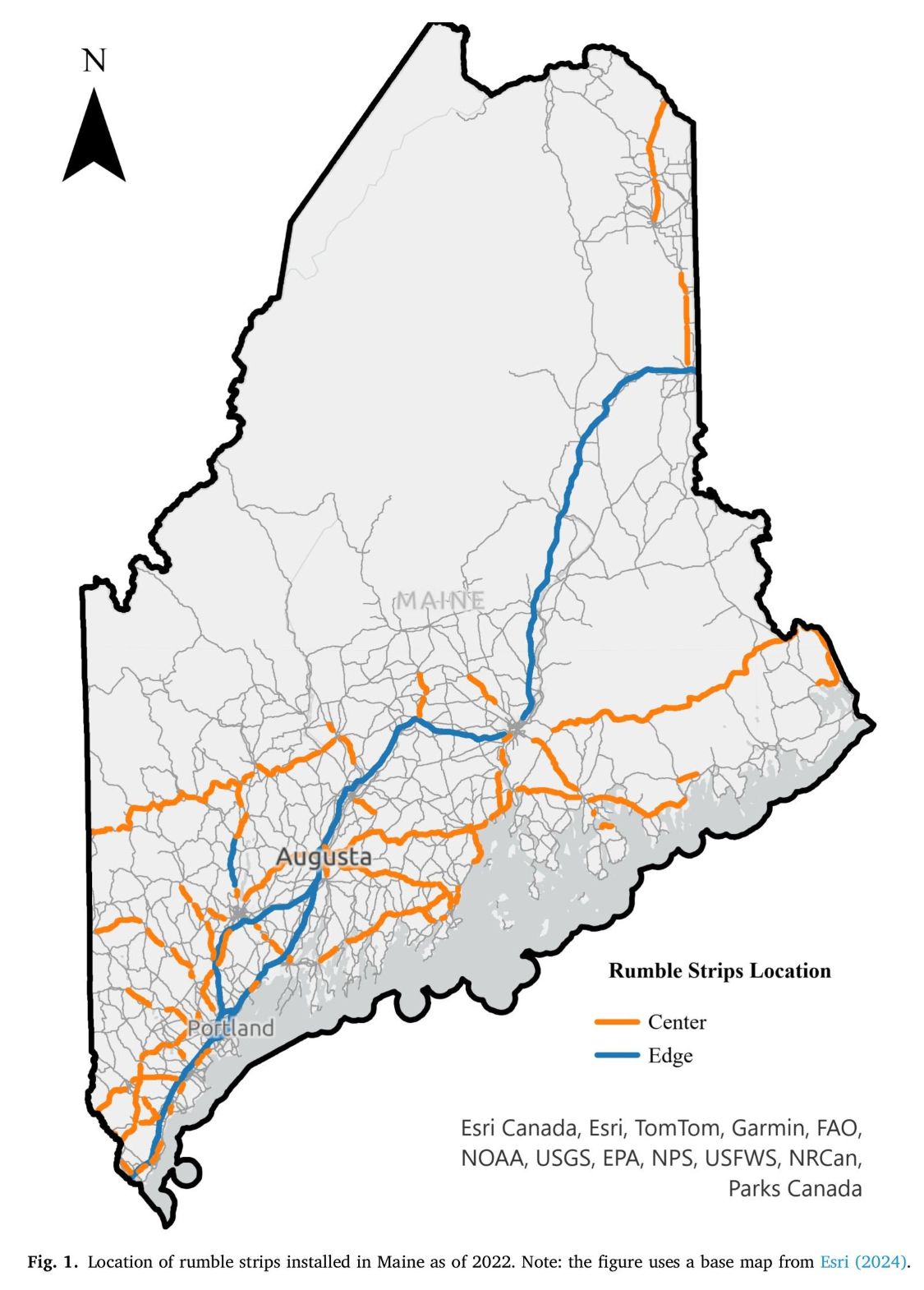
Rumble strips now line the edges of all interstate highways in Maine. But centerline grooves remain absent from most roads in rural areas, particularly in the northern part of the state.

MaineDOT aims to add about 100 miles of rumble strips to state roads every year, according to Skehan. The agency prioritizes areas with high traffic and fresh pavement to maximize the service life of the grooves. MaineDOT allocated about $750,000 for these projects annually, per Skehan, with about 90 percent of this funding coming from the federal Highway Safety Improvement Program funding, and the remainder from the state.

map showing locations of rumble strips in maine.
Location of rumble strips installed in Maine as of 2022. Source: University of Maine study

Route 102 doesn’t have rumble strips yet. It’s a candidate to receive them, according to Skehan, but the area where a truck crashed into Lavrenz and Madan’s rental car is less of a priority than other corridors.

The state also doesn’t manage town and city roads that thread through communities. Bar Harbor police chief David Kerns doesn’t see much of a need for rumble strips on these generally lower-speed roads.

“Really, those in-town streets are so narrow anyway, people tend to go center of the road more to get away from parked cars and open doors,” Kerns said.

Still, he’s noticed a rise in collisions he attributes to the distraction of cell phones and displays in cars.

The town of Bar Harbor received a federal grant to make its streets safer after five fatal and 17 incapacitating crashes between 2019 and 2023. Additional signage and collapsible line delineators are among the interventions under consideration.

At the same time, Kerns recognizes that technology can also be part of the solution. Some cars are now built with sensors to detect when the vehicle has left its lane. And though Gårder doesn’t advocate checking your phone while driving, he stresses glancing at displays every once in a while to stave off sleep, which is still a common cause of crashes.

“Like in an airplane, pilots are supposed to have certain tasks every now and then,” he said. “They are not supposed to be completely inactive.”

For Lavrenz, it’s simple: “Human drivers are always going to make a mistake.” And instead of waiting for crashes like his to happen, transportation departments can address the problem proactively by deploying low-cost safety measures like rumble strips across many miles.

“Let’s go out and try to treat a broad swath of these two-lane rural roads because we know that they’re a major risk factor,” he said, “and hopefully prevent a lot of these crashes from happening in the first place.”

Amid rising education costs, a rural Maine town weighs leaving its school district

Amid rising education costs, a rural Maine town weighs leaving its school district
Regional School Unit 74 is home to four schools that serve Anson, Embden, New Portland and Solon. Embden, a significant contributor to the district’s budget, is weighing whether to initiate a process to leave the district. Photo by Kristian Moravec.

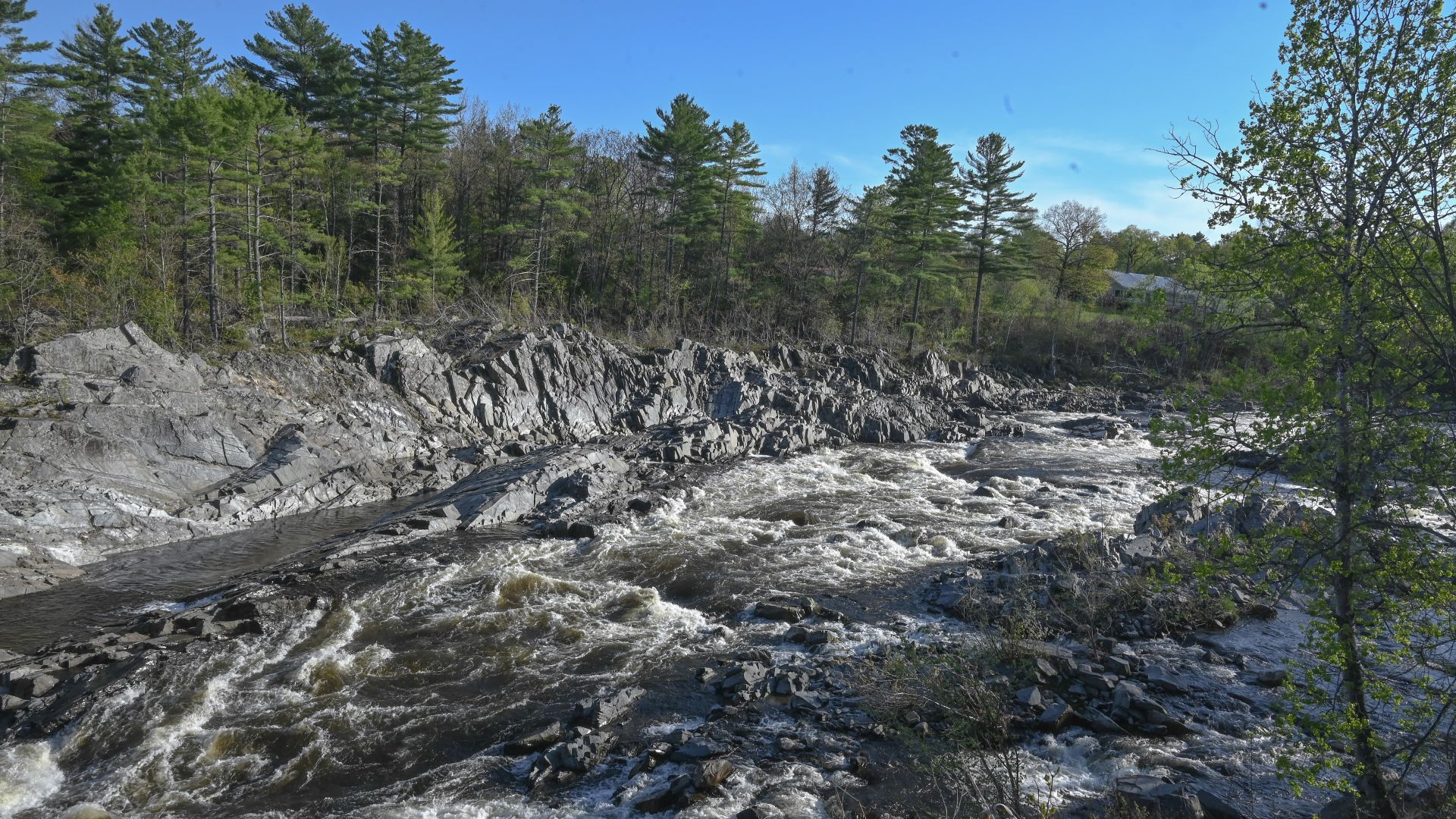
The Carrabassett River, a tributary of the Kennebec, rushes over the North Anson Gorge Falls.

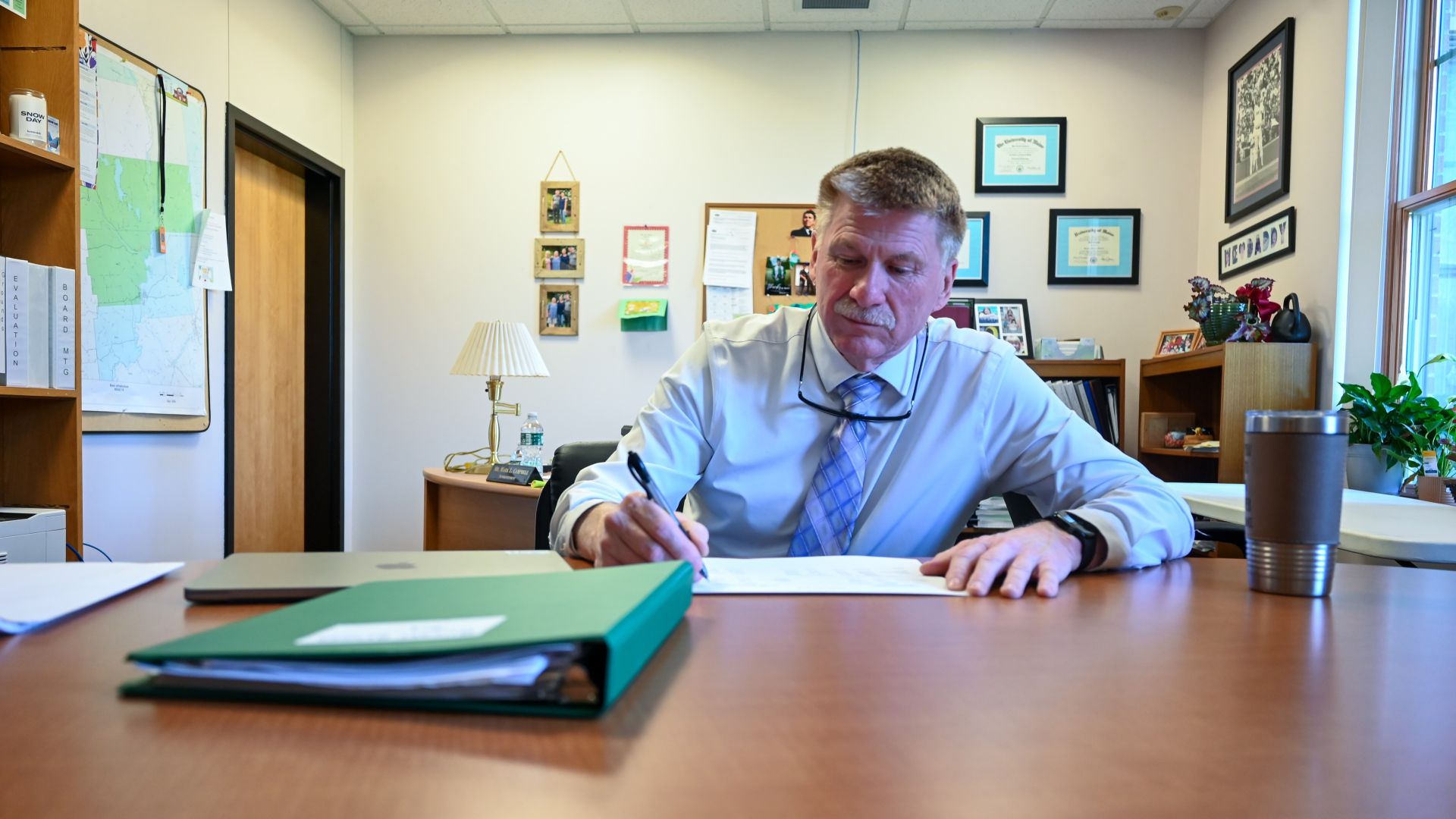
Just up the road, Regional School Unit 74 Superintendent Mark Campbell shuffled papers on his desk, pointing out colorful bass fishing lures that students had made for him. He described the school district, which serves the Somerset County towns of Anson, Embden, New Portland, and Solon, as a “close-knit family.”

fishing lure held in hands.
Superintendent Mark Campbell holds a fishing lure made for him by RSU 74 students. Photo by Kristian Moravec.

“We look out for each other,” Campbell said. “And as a result of that, the communities have always stood behind their schools.”

But that could change. 

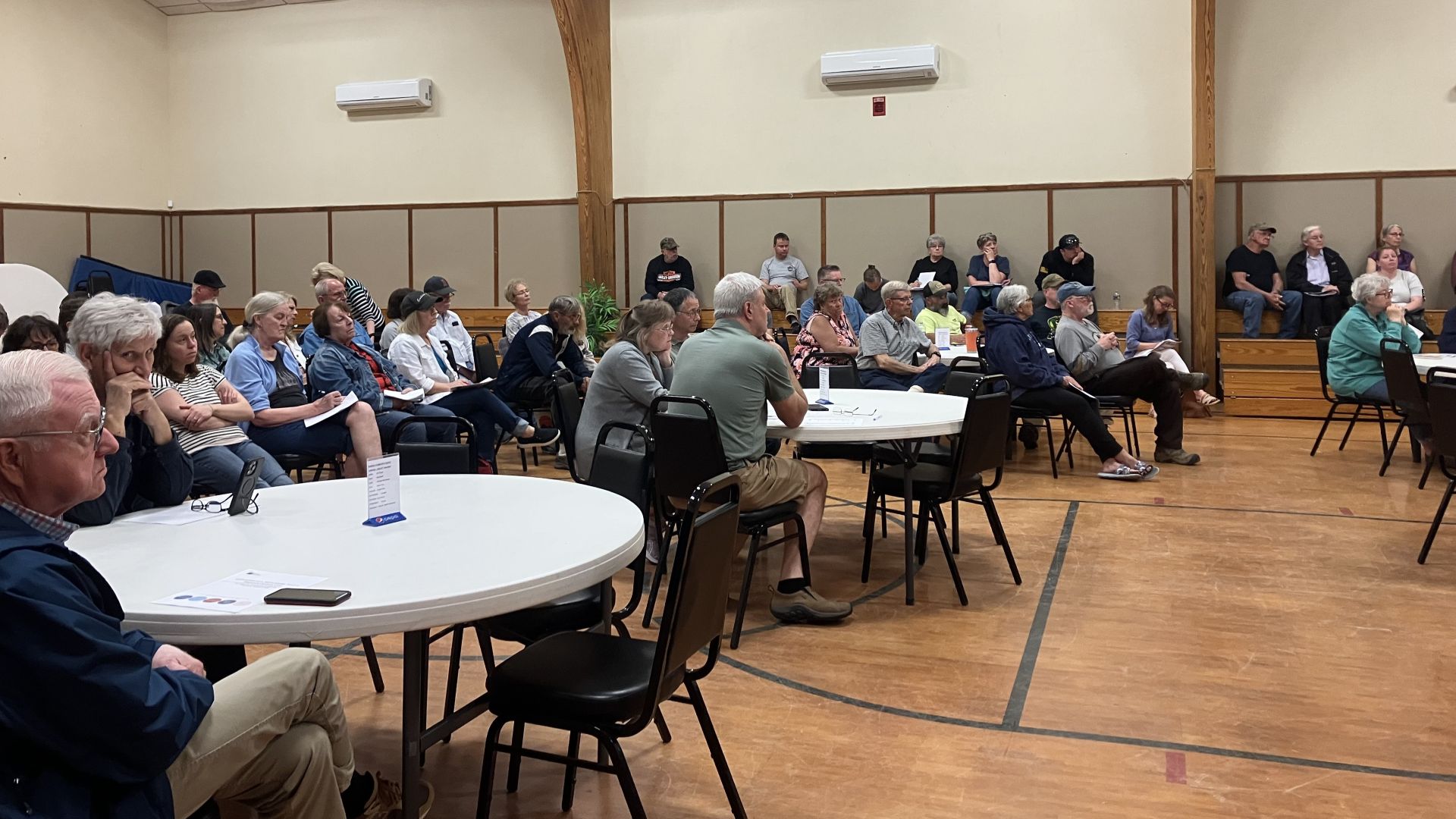
On Thursday, around 50 residents gathered at Embden’s community center to discuss a proposal to leave the school district.  

“We’re sitting in a gymnasium that used to be part of an elementary school that unfortunately closed, in part because we don’t have a student population here anymore,” said Patricia Cobb, a member of the withdrawal exploratory committee that Embden formed earlier this year. 

Embden, which contributes nearly a third of the local share of the school district’s budget, is home to less than a fifth of the district’s students. This spring, residents started circulating a petition to explore what it would look like to leave the district, citing concerns about rising costs and arguing that declining enrollment is at odds with school budget increases. 

RSU 74 has a $12.9 million budget on the table — about a $350,000 increase from last year. If Embden were to undertake the complex, 22-step process to withdraw and decide to go through with it, Campbell said, the district’s four schools would take a big hit.

Gorge Falls.
Down the road from the RSU 74 administrative offices, the Carrabassett River, a tributary of the Kennebec, rushes over the North Anson Gorge Falls. Photo by Kristian Moravec.

The proposal has sparked controversy and tension among neighbors.

Those in favor of withdrawing say that rising costs make continuing to fund a significant portion of the district’s budget unsustainable, and they see a need to relieve the town’s tax burden. Those against the proposal worry about the impact withdrawal would have on the schools and their students, and are wary of spending thousands on legal fees and other costs associated with the process — particularly since the town pursued withdrawal a decade ago and was unsuccessful. 

On Thursday, most residents at the public hearing appeared to be against the idea. 

Embden is not the only town considering withdrawal in the region: nearby Strong and Phillips recently voted to establish formal committees and begin exploring an exit from their district, MSAD 58, which lost the town of Eustis in 2013. Another district in the area, MSAD 59, or Madison Public Schools, lost three towns — Starks, Athens and Brighton Plantation — between 2012 and 2013. 

These withdrawals fit into a longstanding debate over the size and nature of Maine’s school districts, and follow a statewide consolidation push in 2007 that generated significant controversy.

They also come at a time when property values, and thus taxes, are spiking in towns across Maine, and when growing education costs are prompting cries to reassess how the state and local towns should divide responsibility for funding public schools.

A changing landscape

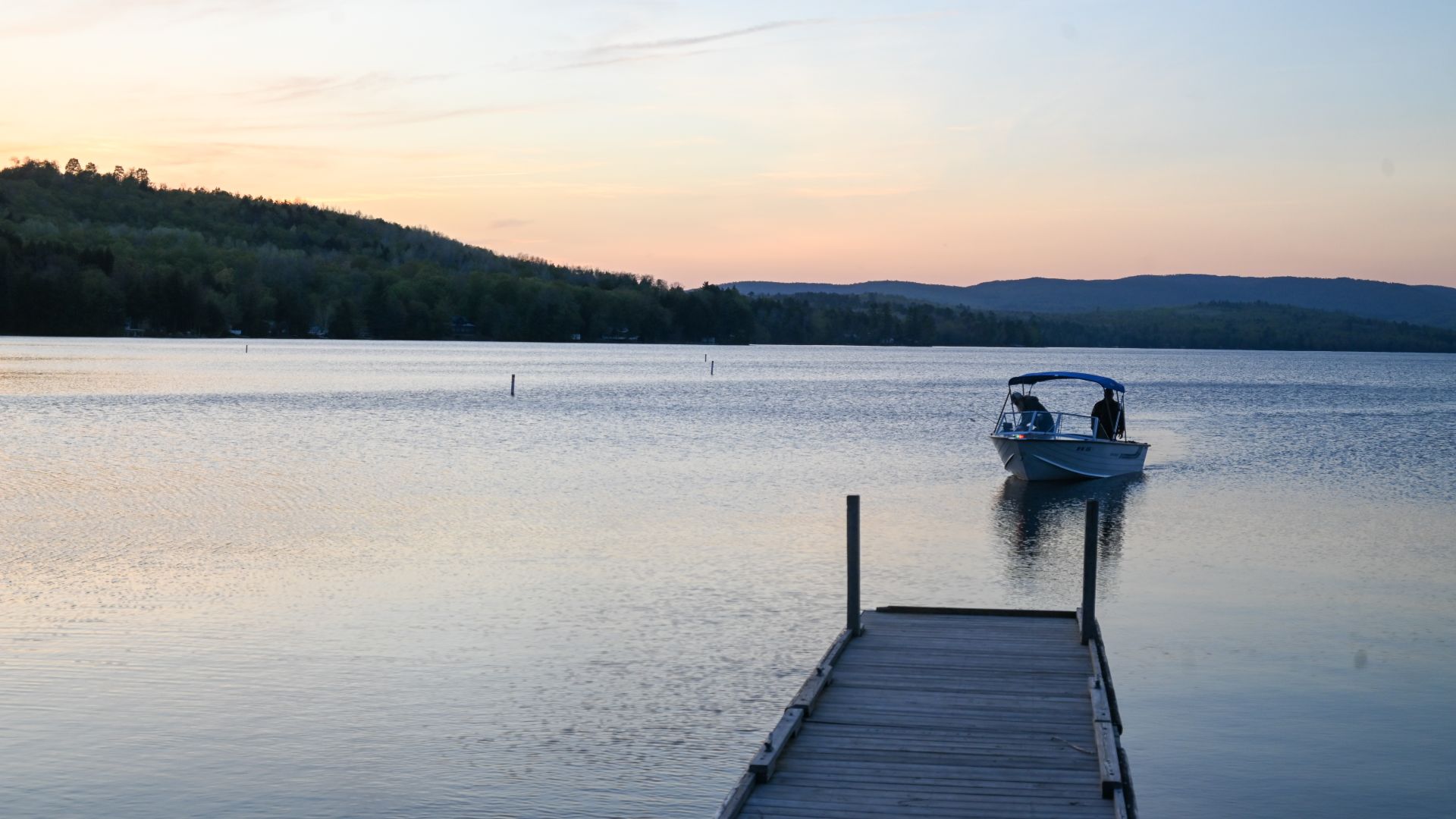
Embden, which has around 940 year-round residents and around 90 students in RSU 74, is situated around a series of ponds — the largest of which is the town’s namesake. 

The town is neither the wealthiest nor the largest in the district, per census data, but its waterfront property means it has the highest property valuation, which has more than doubled since 2015.

The state’s Essential Program and Services formula, which sets the minimum cost for education in each school district, uses property values to determine a town’s share of the costs. In RSU 74, the state requires Embden to contribute the most out of the minimum school budget — 34 percent.

However, towns often feel the need to raise additional funds — known as “additional local” — to cover programs and expenses not sufficiently funded through the EPS formula. With the additional local funds factored in, Anson is the highest local contributor.

State data shows that Maine will contribute around $4.6 million in the 2026 school year, or 54 percent required by the EPS budget for RSU 74. The formula requires towns in the school district to raise about $3.8 million, and the district says it needs about $3.5 million in additional local funds.

The district has four schools: a high school and middle school in North Anson, and two elementary schools in Anson and Solon. The district had 575 students this school year, down from 663 in the 2015-16 school year, according to state data. The district has 152 employees, 20 of whom live in Embden, according to Campbell.

Five-year data from the school district shows that Embden’s enrollment has increased from 83 to 90 students since the 2020-21 school year.

A view of the water in Embden.
Embden has a few large ponds with waterfront homes, leading to high property valuations. Photo by Kristian Moravec.

Two of the district’s schools have closed in the past 50 years: an elementary school in Embden and the elementary school in New Portland. Campbell said these closures were a result of low enrollment.

If Embden ultimately decides to withdraw, it would need to set up its own school administrative unit, with a school board, superintendent and budget, even if it does not have a school. This unit would then be responsible for arranging for students to attend schools in another district on tuition, which the town would pay, and for arranging transportation. 

RSU 74’s current tuition rate is around $13,000 a year for K-8 students and around $14,000 a year for high school students. 

A town divided

The Embden town office is tiny. Historic photos and paintings depicting the old ferry to Solon, long discontinued, and a tavern, now gone, hang on the walls. A copy of the Department of Education’s process for withdrawal is tacked to the bulletin board behind the town clerk’s desk.

Last fall, the chair of Embden’s Board of Selectmen, Charles Taylor, sent out an email calling for committee members to assist with various initiatives, including comprehensive planning, property management and “RSU/School/Education Cost Assessment.”

Paul Fortin, who is now chair of Embden’s withdrawal exploratory committee, was a resident of nearby Madison at the time. But he owns property in Embden and was interested in Taylor’s proposition. He told The Maine Monitor he changed his residency to Embden about five or six months ago to help spearhead the withdrawal committee — a move that has raised eyebrows among some in town.

Fortin said he believes withdrawal could bring savings to taxpayers, and that he thinks it’s worth exploring that possibility. He has led several withdrawal exploratory committee meetings over the past few months, and while only a handful of residents typically attend, the debate has been fierce. 

On one side, residents argue that withdrawal likely won’t save much money and won’t be good for kids, and say there are too many unanswered questions, such as how taxes would change  and how Embden would maintain local control of education decisions if it sent its students to another district. 

On the other side, advocates for withdrawal say that these questions can only be answered if residents vote in favor of starting the withdrawal process on June 10, which would allow the town to start investigating what withdrawal would look like and how the numbers would shake out. 

Embden residents attend a public hearing.
On May 29, around 50 residents gathered in the Embden Community Center, which used to be the town’s elementary school, for a public hearing on possibly leaving their school district. Residents will vote on whether to formally explore the process on June 10. Photo by Ben Hanstein.

Kayla Starr, an Embden parent of two young children who is running for a selectboard opening, has been a vocal challenger, and has raised numerous concerns at the exploratory meetings.

“​​In the beginning, many residents felt this issue was being quietly moved forward without broad public awareness. But what we’ve seen since then is that people want to be involved — they want their voices heard, their questions answered, and to feel like they’re part of the decisions shaping our town’s future,” Starr said. “Throughout this process, it has felt as though ideas and opinions from the opposing side have been burdensome on the committee, rather than welcomed.”

Residents have raised several questions about how the process has been managed so far, pointing to little record-keeping of meetings and the fact that the petition was initially circulated by Ruth Blake, who is Embden’s tax collector.

Blake, who declined to take a stance on the issue, said she took up the responsibility of the petition because no one else did. Her reasoning, she said, was to ensure all voices were heard in the withdrawal process.

She initially had the petition on a table in the town office, but stopped displaying it there and enlisted two more residents to gather signatures after she was notified that some residents were concerned. She said that she aims to be more cautious in the future, but noted that the tension felt unprecedented.

“We’ve never had a controversy like this before,” Blake said.

What’s on the table

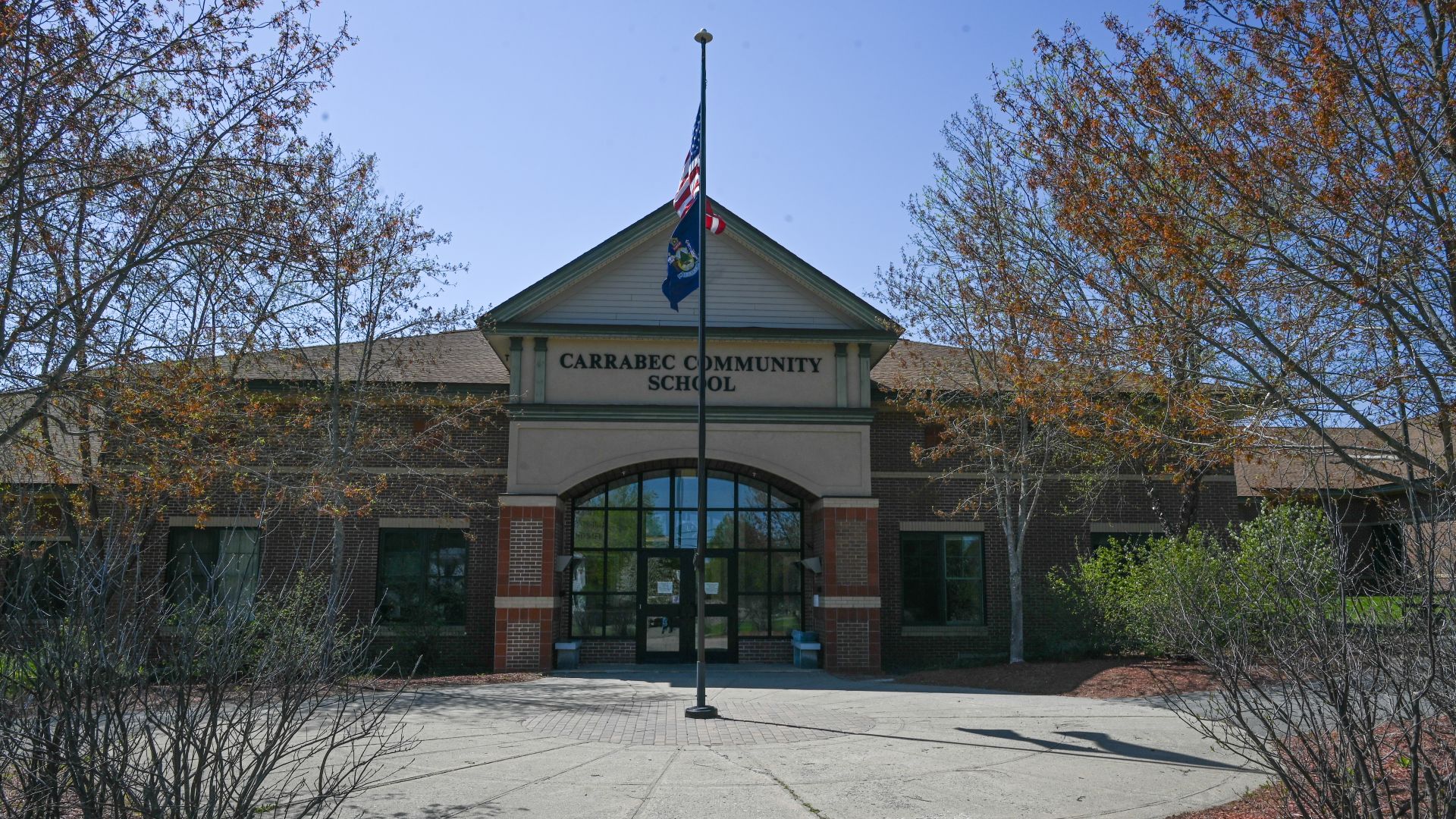
At the Carrabec Community School in Anson — where RSU 74’s administrative offices are located — Campbell pored over district budget documents. On June 10, residents across all four towns will vote on whether to approve the school budget referendum, an annual process in Maine.

The district’s budget predictions indicate that if Embden were to withdraw, the school district would lose about $2.2 million, a “huge piece of the pie,” Campbell said.

“When we’re talking that much money, we’re talking people,” Campbell said. “Two thirds of our budget supports payroll and health benefits.” 

Mark Campbell looking at papers on a desk.
Mark Campbell reviews school budget sheets in his office. If Embden were to ultimately leave RSU 74, it could take a significant part of the school budget with it – a “huge piece of the pie,” he said. Photo by Kristian Moravec.

Should Embden decide to pursue withdrawal, Campbell said, he would gather his administration to discuss what’s on the table. For now, they are waiting to see what happens on June 10.

Campell acknowledged that there are concerns about rising costs, and said what could help  would be for the state to change how schools are funded under the EPS model. Last fall, he said that he and other superintendents provided feedback for an EPS funding study by the Maine Education Policy Research Institute.

“It sounded like they had a sincere interest in helping the smaller districts – the rural districts,” Campbell said. “That gives us hope. I mean, if they heard us when we talked to them.”

Fortin made a similar point. The conflict among neighbors and between the town and school district is misplaced, he said, arguing that the issue needs to be fixed at the state level.

Yet as the cost of schooling rises, and is particularly burdensome for high valuation towns, he said withdrawal is worth considering. He also believes consolidation could save on education costs. But his priority, he said, is to cut back on taxes for Embden residents.

“The only reason we’re looking to withdraw is to get out of the high valuation and the low student attendance,” Fortin said. “After that, if you’re looking for significant savings in education, it has to be consolidation. And hopefully when they do that, they won’t punish the high valuation towns.”

Still, Fortin said that if residents vote to further investigate withdrawal and no tax savings were promised with an exit, he would not pursue a second vote, or the final decision to leave RSU 74. 

The town will decide what step to take next on June 10, the same day as the budget referendum.

Ben Hanstein contributed reporting.

Maine’s heat pump boom has been promising for rural workforce development. Can it last?

an instructor demonstrates evacuation technique.
Dave Whittemore works in Kennebec Valley Community College’s heat pump lab, where he teaches students how to install and maintain electric heat pumps, which are growing in popularity across Maine. Photo by Kristian Moravec.
logo for the rural news network.

Powering Rural Futures: Clean energy is creating new jobs in rural America, generating opportunities for people who install solar panels, build wind turbines, weatherize homes and more. This five-part series from the Rural News Network explores how industry, state governments and education systems are training this growing workforce. 

This reporting is part of a collaboration between the Institute for Nonprofit NewsRural News Network and Canary Media, South Dakota News Watch, Cardinal News, The Mendocino Voice and The Maine Monitor. Support from Ascendium Education Group made the project possible.

The sputtered drone of a vacuum pump filled the former milking barn that now houses Kennebec Valley Community College’s heat pump lab. Instructor Dave Whittemore, who held the yellow vacuum in one hand and displayed an app tracking atmospheric pressure on his phone in the other, explained in a raised voice how to do an “evacuation,” ridding the heat pump of air and moisture to avoid malfunctions down the road. 

“The longevity of the equipment is important,” said Whittemore, who teaches students how to install the increasingly popular electric heating and cooling units. “If it’s not done right, then it’s going to fail prematurely. And that’s the biggest reason that I personally try to keep up with industry best standards and I pass that on to my students.”

Six years ago, Gov. Janet Mills traveled to the college to sign a bill aimed at transforming Maine’s market for heat pumps, an environmentally friendly alternative to oil furnaces and gas boilers, and set a goal of installing 100,000 units by 2025.

The state, now a national leader for heat pump adoption, met that goal two years ahead of schedule, and Mills once again traveled to the rural Somerset County campus to announce a new target: another 175,000 heat pumps by 2027. 

Maine needs skilled workers to reach this goal, demanding training initiatives from all corners of the state to build HVAC, refrigerant and electrical knowledge in the clean energy workforce. Without a strong pipeline, the state risks delays in reaching its heat pump target, putting its climate goals at risk.

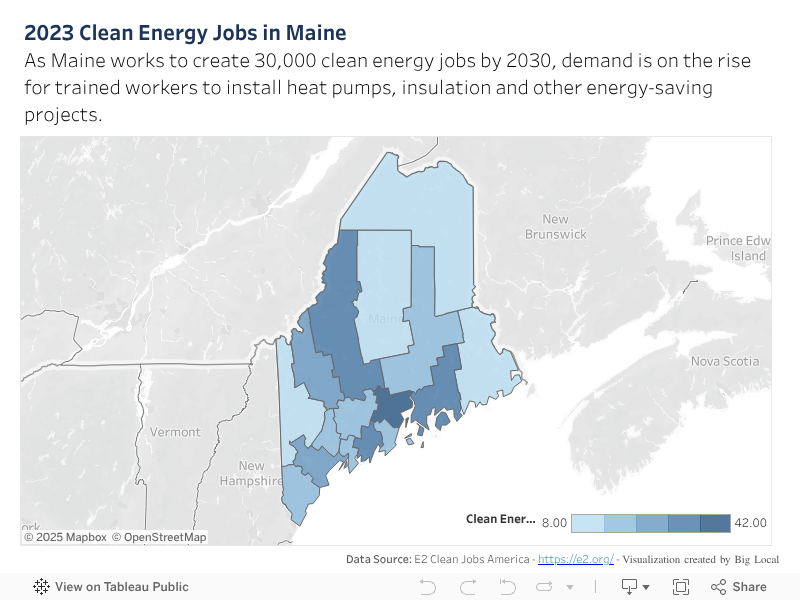
So far, rural counties have seen some of the fastest rates of clean energy worker growth, according to state data. In Somerset County, where KVCC is located, the number of clean energy workers has grown by 44% since 2020.

As part of this push, the community college launched a high-tech heat pump training lab in 2021 and has trained over 300 students. The initiative is one of many clean energy programs the school offers as part of a broader, state-supported effort to meet Maine’s goal of reaching 30,000 clean energy jobs by 2030. 

Dave Whittemore stands next to heat pumps.
Dave Whittemore stands next to two heat pump units attached to the training facility. Photo by Kristian Moravec.

Efficiency Maine, a quasi-governmental agency that oversees the state’s energy efficiency programs, has invested more than $400,000 in installation and weatherization training programs at KVCC and supports 29 similar programs at other institutions each year. 

Another key piece of state support comes through the Governor’s Energy Office’s Clean Energy Partnership, which has awarded nearly $5 million in grants for clean energy training and apprenticeship programs across the state since 2022 and has seen over 3,500 participants. Businesses have also developed their own on-the-job training programs to help meet demand.

But the state still faces a daunting challenge: It must employ more than 14,000 new workers to reach its goal of 30,000 clean energy jobs by the end of the decade. Between 2019 and 2023, the number of workers in the field grew by less than a thousand.

While the state says it remains dedicated to this goal, some in the industry worry federal funding cuts and tariffs could create challenges for the workforce development pipeline.

Efforts underway in many corners of Maine

Heat pumps have emerged as a pillar of Maine’s clean energy strategy: The units can reduce carbon dioxide emissions between 38% and 53% compared to a gas furnace, according to a 2022 study in the academic journal Energy Policy, and have been touted as a way to reduce energy costs. 

Rural areas have historically spent more on energy bills and participated less in residential energy and efficiency financing and rebate programs to lower costs, according to a state report from 2023. To help rural Mainers overcome geographic barriers in accessing cost-lowering energy initiatives, the state must bolster its rural workforce, according to a 2018 study the Island Institute produced in partnership with the Governor’s Energy Office.

The demand for cleaner energy has grown not only in response to the state’s climate goals, but also as Maine’s electricity costs rise. A Maine Monitor analysis showed that electricity costs increased at the third-highest rate in the U.S. between 2014 and 2024. 

A Maine Monitor analysis of 2023 U.S. Department of Energy and Bureau of Labor Statistics data prepared for E2 shows that two-thirds of the state’s clean energy jobs were in the energy efficiency sector, while about a fifth of jobs were in renewables.

Workforce development has become a priority for the state as the clean energy industry grows, said Tagwongo Obomsawin, the program manager for the state’s Clean Energy Partnership, noting that it can provide good paying jobs for Mainers and reduce energy costs.

“Employers are definitely a really important part of the picture, but we don’t want to leave out anyone,” Obomsawin said. “We recognize that training providers, academia, state government, organized labor and industry all have a role to play in making sure that we have a robust system that supports people in finding job opportunities, getting access to training and localizing the benefits of the energy transition.”

Heat pump training is just one of several clean energy programs offered through the Maine Community College System, which includes KVCC. The system works with industry and state leaders to grow the workforce. The network of schools also trains students in electric vehicle maintenance, fiber optics, aquaculture and more.

hands holding copper tubing.
KVCC instructor Dave Whittemore holds copper tubing used in heat pump installations. Photo by Kristian Moravec.

Dan Belyea, the system’s chief workforce development officer, said short-term training and scholarship funding are centered on needs that arise in the industry, which the schools gauge by looking at labor market data and talking to employers. Programs that are highest in demand tend to include electrical and heat pump training, Belyea said. 

In 2022, KVCC hoped to use a nearly $250,000 grant from the Clean Energy Partnership to offer programs on electric vehicles and NABCEP solar photovoltaic installation. But trouble finding instructors and low interest among students made it difficult to launch. 

Instead, KVCC doubled down on energy efficiency. It launched a building science program with the funding last fall, which had five students, two of whom were able to complete the certification. 

Other clean energy workforce initiatives have popped up across the state. Some employers run their own heat pump or solar installation training labs, and several adult education programs and nonprofits also offer classes designed to help people move into the industry.

PassivHaus, a Freeport-based organization, received $180,000 in Clean Energy Partnership money in 2022 to host training programs on the state’s energy code. The company ran 29 trainings across the state, from Portland to Presque Isle.

Naomi Beal, executive director of PassivHaus, noted that getting enough students to attend the training was easier in areas like Portland, but trickier in more rural areas.

“I always feel like it’s very important to consider when going into Greenfield or Machiasport or wherever that there are just not that many people.… So if we get five people showing up, that’s probably statistically way more interest than (a larger number of attendees) down in Portland,” Beal said. “We just try to be patient and persistent with the smaller towns and the smaller attendance.”

A need for more collaboration

In Freeport, Scott Libby, the owner of Royal River Heat Pumps, walked through his training center as he explained that all his workers go through heat pump training that starts with the basics, regardless of experience, to ensure each worker is equipped to handle the job.

“A lot of these heat pumps have 12-year warranties,” Libby said. “That’s 4,380 days. The most important day is Day 1. It needs to be installed properly.”

Libby, who has worked with the U.S. Department of Energy on workforce development and sits on a new energy efficiency workforce subcommittee being developed by the Governor’s Energy Office, said he’s aware of a number of different workforce development initiatives but that it’s difficult to comprehend how they all work together.

He said some forms of programming aren’t sufficient for what’s actually needed in the field: Students who sit through a six-week or six-month program that teaches the basics of how heat pumps work may come out with little to no hands-on experience with a power tool or climbing a ladder. 

Scott Libby writes on a whiteboard.
Scott Libby’s Freeport business, Royal River Heat Pumps, trains all of its workers, regardless of experience or former training, to ensure installations are done correctly. Photo by Kristian Moravec.

Libby emphasized the need for more collaboration between different workforce development efforts and a more systematic approach, with quality checks in place. He suggested putting more thought into designing industrial arts and home economics programs in middle and high schools to introduce students to different career pathways early on.

He also said more stringent licensing requirements could help with the quality of workers moving into the field. As it stands, there is no specific licensing required to install heat pumps in Maine, though workers need an Environmental Protection Agency Section 608 license to deal with the refrigerant used inside the unit and an electrical license to complete the wiring.

He acknowledged that new regulation could “cripple” workforce development efforts but said the move is imperative to control the level of training workers receive and make sure everyone is qualified to install heat pumps. There are hundreds of contractors listed as qualified heat pump installers on Efficiency Maine’s website, a list he said in his opinion should be much shorter.

Uncertainties lie ahead

At KVCC’s heat pump lab, Whittemore gestured at eight heat pumps mounted on prop walls used for training, listing the types of new units he hopes to get soon – ideally through donations from companies who have given units in the past.

Regulatory changes to refrigerants that went into effect this year mean the school needs to replace the heat pumps it uses to train students.

“Most of the procedures with the new refrigerants are the same, it’s just that we can’t put this new refrigerant in these existing heat pumps,” he said. “So I’ve got to get eight new heat pumps.”

The broader challenge he sees for the industry is tariffs, which he fears could lead to higher equipment prices and lower demand. This, in turn, could mean a lower need for workers. 

“I think that’s going to slow this down,” he said. 

inside the college's heat pump lab.
Kennebec Valley Community College’s heat pump lab has trained over 300 people since it launched in 2021. Photo by Kristian Moravec.

Maine has two years to reach its goal of installing 275,000 heat pumps and five years to reach its goal of 30,000 clean energy jobs. But uncertainties in building Maine’s workforce lie ahead.

The Clean Energy Partnership Project, which has funded many of the state’s clean energy workforce development programs, typically announces new grants in the summer, but the Governor’s Energy Office stopped short of committing to another round of funding this year.

“We can’t predict the future, but the existing programs that we have will continue on for at least another couple of years,” Obomsawin said.

She said a partnership the Energy Office has with the Department of Labor to provide career navigation services will continue into 2026, as will workforce development programs that received funding and are already operational. But she cautioned that it is still too early to know what impact policy changes at the federal level will have on the clean energy sector. 

Efficiency Maine said that the state is still on track to achieve its heat pump goals – at least for now. Executive Director Michael Stoddard said that the heat pump rebate program has funding from the Electric Utility Conservation Program and the Regional Greenhouse Gas Initiative for at least the next three years.

However, some smaller initiatives, such as a revolving loan to help Mainers buy new heat pump systems, face uncertainty as the federal grants funding the project are in flux. 

Libby, of Royal River Heat Pumps, has 40 years of HVAC industry experience and said funding uncertainty will make it a challenge to reach the state’s heat pump goal.

“I think it’s definitely going to be harder,” Libby said. “I mean, I’m not ready to give up on it yet. I don’t think anybody is ready to give up on it.”

Powering Rural Futures

Has Maine learned how to make heat pumps lower electricity costs for all?

Maine’s new energy-efficiency plan is projected to lower electricity bills for the state’s residents — even those who don’t directly benefit from its rebate and incentive programs. The plan, set to go into effect in July, is heavily focused on getting electric heat pumps in as many homes as possible. It comes as…

Counties and municipalities have spent about $7 million of their opioid settlement funds so far

Counties and municipalities have spent about  million of their opioid settlement funds so far

The counties and municipalities that receive a direct share of the settlement funds from opioid manufacturers, distributors and retailers have spent less than half of the money paid out so far, a Maine Monitor survey found.

Since payments began three years ago, the counties and municipalities have received about $20.3 million out of the $66.4 million they’re set to receive by 2038. The money has been used for a wide range of initiatives, from grants to community organizations providing recovery services to scholarships for residential treatment beds.

Over the past five years, nationwide settlements were reached with 10 pharmaceutical companies accused of fueling the opioid crisis as the result of a years-long, massive multidistrict litigation case. The settlements, with household names like Johnson & Johnson and Walgreens, will pay out billions of dollars over 18 years, approximately $230 million of which will go to Maine.

Maine’s share is split in three ways, including 30 percent divided up among the “direct share subdivisions” — the 39 counties, cities and towns that were either party to the multidistrict litigation case and/or have a population of at least 10,000. (The percentage each subdivision receives is determined by the settlement agreements.) That includes all 16 counties, the 21 largest municipalities, Rockland and Calais. 

Fifty percent of Maine’s share goes to the Maine Recovery Fund overseen by the 15-member Maine Recovery Council and the remaining 20 percent goes to the state and is overseen by the attorney general’s office, per the state’s memoranda of understanding.

The settlement agreements say that the money must be used for “opioid abatement” and lay out a long but fairly open-ended list of approved uses. Oversight is scant, however: outside of public access laws, subdivisions are under no obligation to publicly report how they are spending their money. And the trusts themselves have limited oversight power.

While subdivisions can spend up to 15 percent of their funds on “non-opioid remediation,” disclosure is all self-reported to the trusts. As of early May, no subdivisions in Maine had reported any spending on non-opioid remediation.

As part of ongoing efforts to shed light on how the millions from these landmark settlements are being spent, The Monitor has sent three surveys to the subdivisions since 2023. Thirty subdivisions responded to The Monitor’s latest survey from mid-March on how they are spending their funds.

Results show that spending for programs within county jails, sheriff’s offices and police departments remains a popular choice. Ten counties have used nearly a third of all funds expended so far to help pay for medication-assisted treatment, counseling services and other costs related to substance use treatment in jails. 

At least seven counties and municipalities have put the funds toward hiring mental health liaisons to work directly with law enforcement. Several others used the funds to purchase equipment for police departments, including Saco and Falmouth, both of which bought handheld drug-checking devices, and Lewiston, which purchased a vehicle for its mental health worker ride-along program.

Ten subdivisions used at least some of their funds to provide grants to local organizations working on substance use response. Cumberland County, for example, put out a request last year for proposals that “support treatment innovations and capacity building projects.”

Greater Portland Health’s proposal to launch a mobile medical van to conduct outreach among populations most at risk of overdose, including people experiencing homelessness and those recently released from the Cumberland County jail, was selected among nine proposals, according to public health director Liz Blackwell-Moore.

The only subdivision that has spent all of the money it has received so far, about $1.4 million, is York County, which decided early on to allocate all of its funds to build a new regional recovery center in Alfred.

In mid-March, The Monitor sent administrators from all of the subdivisions a survey asking how much money has been spent or allocated so far and the process for determining how the funds are spent. Using those responses — together with data compiled from two previous Monitor surveys conducted last spring and summer of 2023The Monitor created a database of estimated spending so far.

Each subdivision has responded to at least one survey, with the exception of Waterville. Gorham, Lewiston, Oxford County, Piscataquis County, Sanford, South Portland, Wells and York did not respond to the Monitor’s March survey, so data from the most recent survey they responded to was used. For all except Sanford, that was April 2024. Sanford last responded to The Monitor’s June 2023 survey.

Administrators from six subdivisions — Auburn, Calais, Kennebunk, Orono, Oxford County and Wells — said they have not spent any money yet, leaving nearly $1.6 million untouched. (Standish signed an agreement with Cumberland County to provide its entire estimated $44,100 payout to the county.)

USDA funding uncertainty puts Maine farmers in a bind

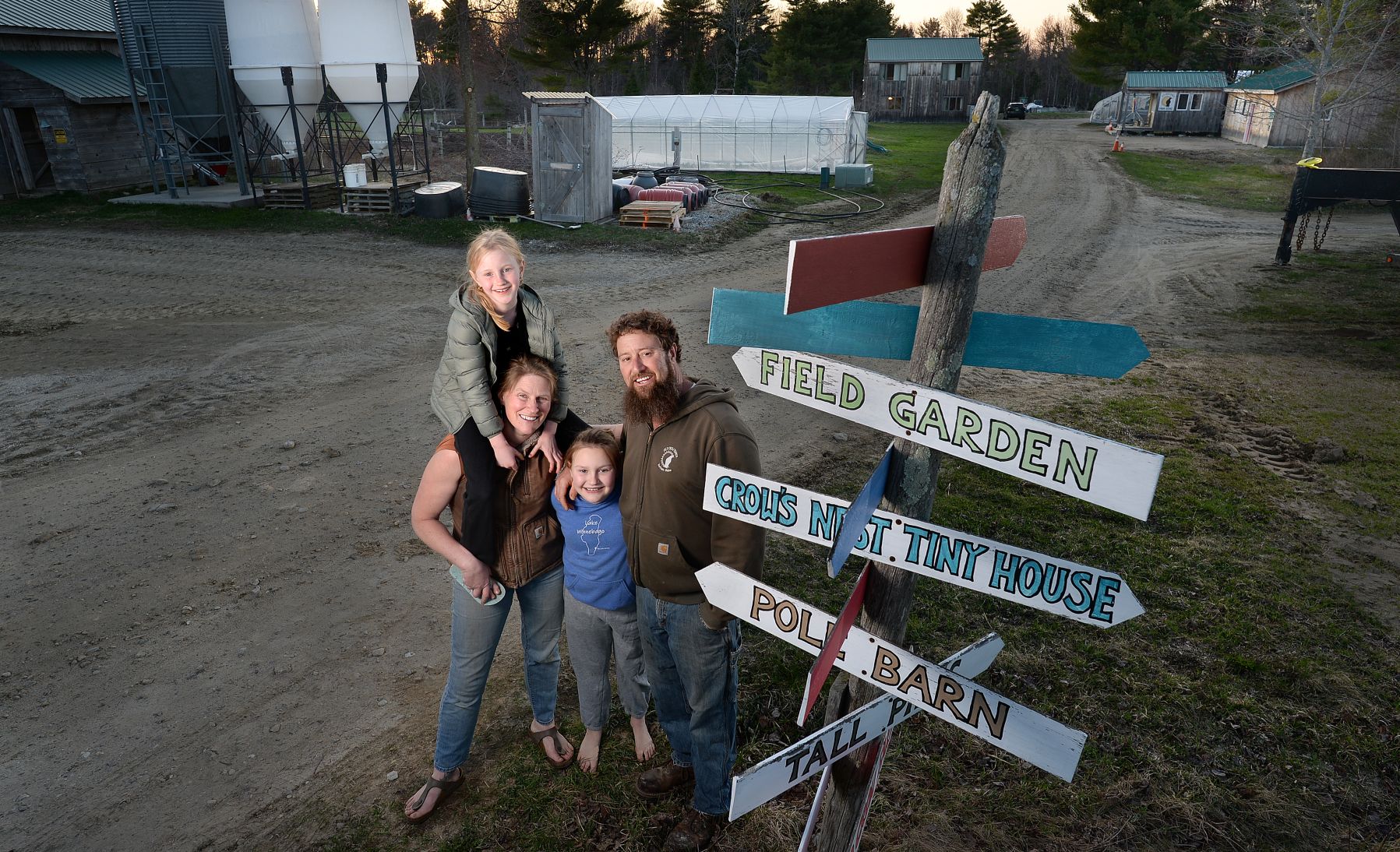
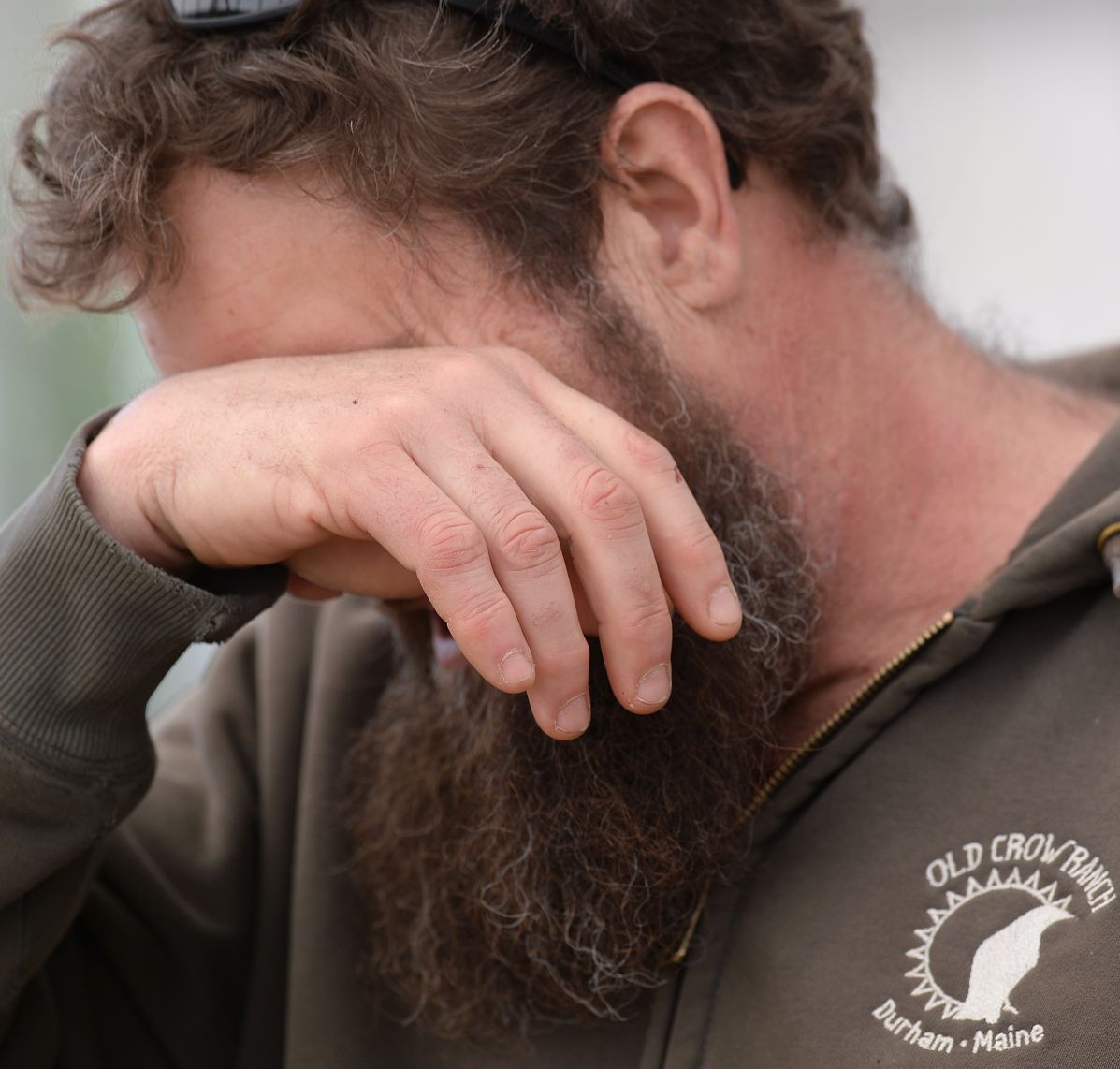
As the warm air of a spring day milled across the acres of pasture along the long dirt road leading through Old Crow Ranch in Durham, Steve Sinisi and his wife, Seren, settled onto the porch of their farm stand. Sitting just inches apart, they shared laughs and voiced anxieties about their decision to become farmers in rural Maine and spoke of failures and successes. 

One big concern loomed large: the possibility that they may not receive money owed to them by the federal government, which they were counting on when planning for the season ahead.  

Their farm, which produces pasture-raised beef, pork and poultry, is one of only two working farms remaining in town. The couple launched the farm in 2008, and worked with the Maine Farmland Trust to designate it as a “forever farm,” so the land will always be used for agriculture, even if it is turned over to new owners.

Seren, who grew up in Union, said she’s used to the feeling of just barely scraping by. She had hoped farming would bring a sense of security, but with funding freezes and uncertainty under the Trump administration’s government efficiency efforts, these warm spring days serve as a reminder of the upcoming projects they have committed to for the coming season, and raise a question of whether they can still meet them.

“I don’t know a farmer that’s gonna go plant… just not knowing,” Steve Sinisi said. “That’s not how we work. Our margins don’t work that way… We don’t just (decide) oh, I’m going to go buy 180 pigs just for fun.”

The Sinsi family poses for a photo on their farm.
Seren and Steve Sinisi at Old Crow Ranch with their daughters Addie and Vinka. Their farm is one of two remaining working farms in Durham. Photo by Fred J. Field.

Last year, their farm was awarded a $34,000 grant through the Rural Energy for America Program, which they planned to use to install a solar array. But the Trump administration has paused the funding, leaving the Sinisis to cover the costs of the project at a higher interest rate than the initial agreement would have required, which they said will be a challenge.

“We will make it work, because we are committed to farming,” Seren Sinisi said. “But it won’t be pretty.”

The Rural Energy for America Program is just one of several U.S. Department of Agriculture initiatives that have been paused or cancelled by the Trump administration as it aims to slash what it sees as wasteful bureaucracy and overhead. 

Cuts and funding freezes

The department has cut the Local Food for Schools Cooperative Agreement and the Local Food Purchase Assistance Cooperative Agreement, programs that gave schools and food banks money to buy produce from local farmers.

And it cancelled the Partnerships for Climate-Smart Commodities program, which was set to give Maine projects $3 million for efforts that would help farms build resilient practices as the climate changes. 

The administration argues the climate-smart program did not give enough funding directly to farmers, and is planning to overhaul the program into something it’s calling Advancing Markets for Producers, which will require that 65 percent of federal funds go directly to farmers. 

“The Partnerships for Climate-Smart Commodities initiative was largely built to advance the green new scam at the benefit of NGOs, not American farmers,” said USDA Secretary Brooke Rollins in a press release.

demonstrators walk through a street.
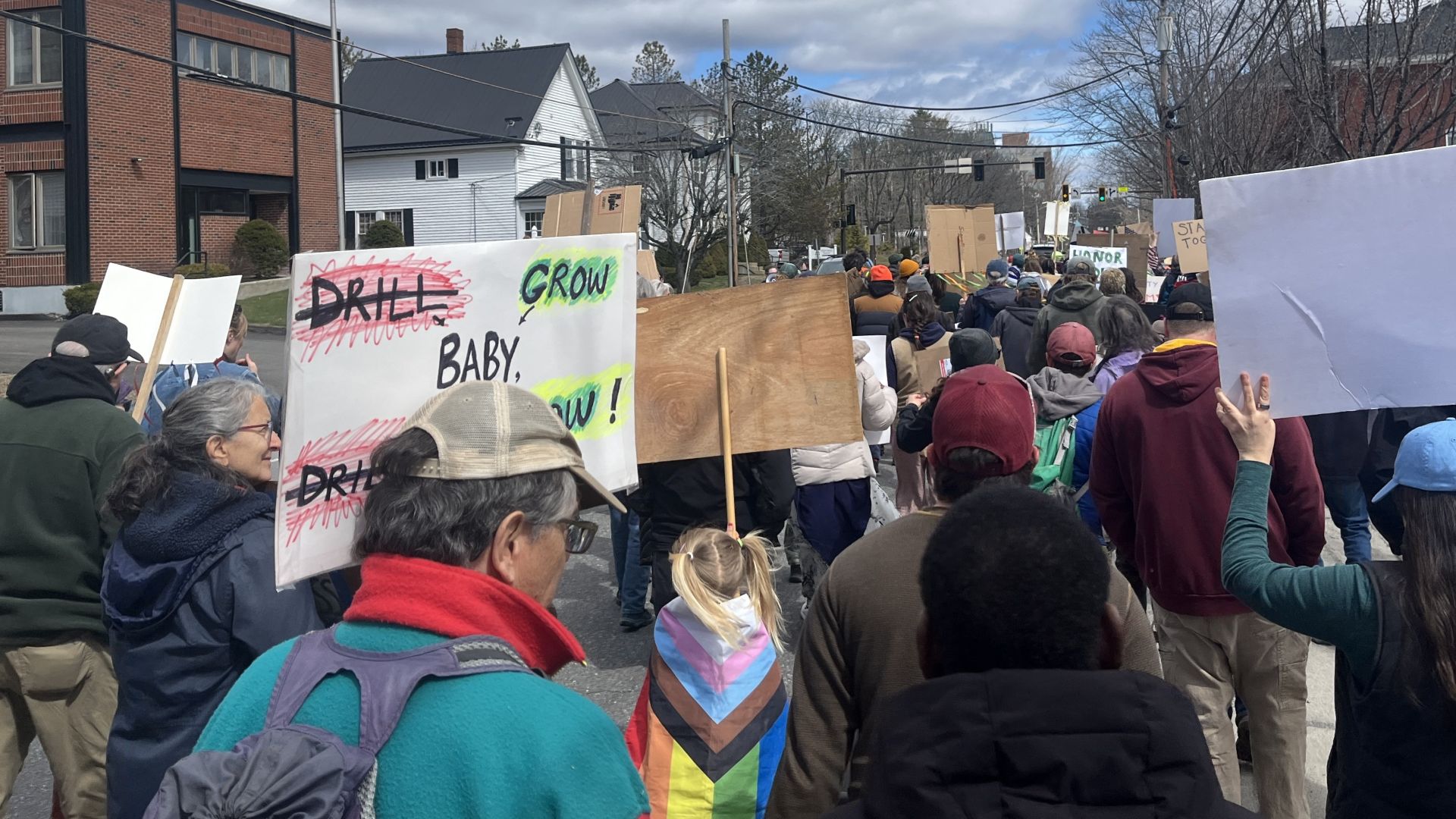
Mainers of all ages participated in a rally against USDA funding cuts on April 16 in Augusta. Photo by Adrienne Washington.

In addition to these cuts, more than $12 million in Maine contracts that were approved by the Natural Resources Conservation Service are in limbo, according to Sarah Alexander, the executive director of the Maine Organic Farmers and Gardeners Association.

“Prior to this administration, the USDA has long been viewed as a partner in helping support farm viability, access to markets, creation of markets, and the trust has really been broken,” Alexander said. “Farmers really aren’t sure if they can trust these projects and these programs moving forward, and that’s really devastating.”

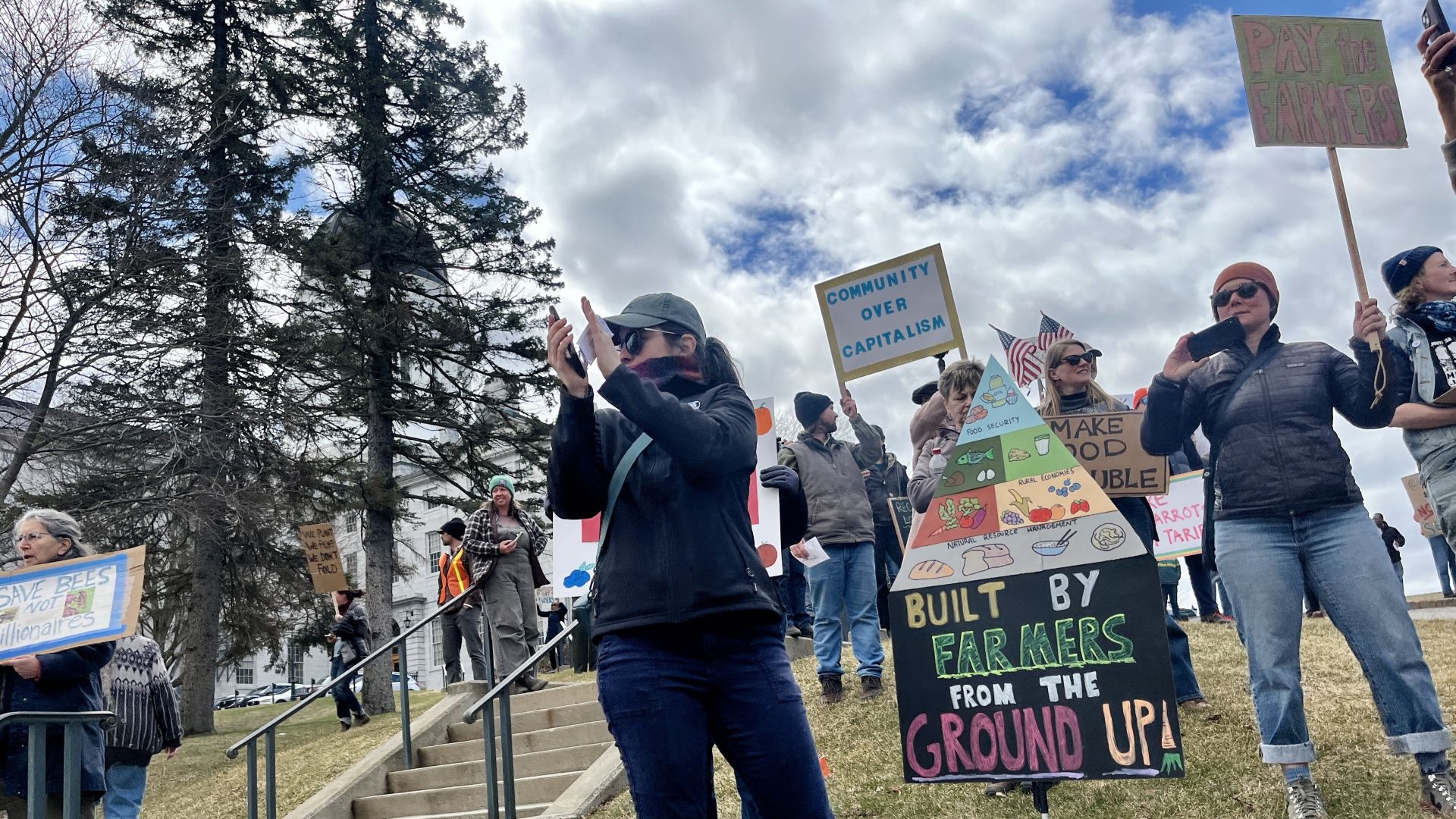
In mid-April, dozens of farmers and supporters gathered at the statehouse in Augusta to voice their frustration, emphasizing the tight margins most farms operate on and the important role government contracts can play. 

Training farmers

Wolfe’s Neck Center for Agriculture and the Environment in Freeport was one of the organizations receiving funds through the now-cancelled Partnerships for Climate-Smart Commodities program, which it used to help farmers in 22 states learn about conservation resources and develop resilient practices. 

The farm is in the third year of a five-year, $35 million agreement and has received $7 million to date. It expects to receive some additional funds for costs incurred through mid-April, but no later. 

The center’s executive director Dave Herring said they have furloughed nine staff this month in light of the cuts, and in total will lose nearly a quarter of their staff.

“Every type of farming operation, big and small … they’re being impacted,” Herring said. “This is a huge lost opportunity for farmers across the country.”

Herring said that federal grants account for nearly two-thirds of the center’s budget.

“Things like training farmers, performing research, providing technical assistance to farmers, these are at the core of our programs and the things that we do and certainly the federal government has been a really trusted and important partner up until January 20th,” Herring said. “That’s funding (and) support for them to improve their practices that they’re not going to receive.”

There were 16 programs in Maine receiving money through Partnerships for Climate-Smart Commodities, including Wolfe’s Neck Center and the New England Forestry Foundation.

The USDA has said select projects can continue if they demonstrate that enough of the funds are going to farmers. Wolfe’s Neck Center is currently evaluating whether it will apply for the new program.

‘A small lifeline’

Seth Kroeck is the owner and manager of Crystal Spring Farm in Brunswick, which cultivates organic produce for wholesale buyers like Whole Foods. The farm is home to Little Bluestem, a natural habitat where blueberries grow wild that is “critically imperiled.” 

Cold snaps are something farmers used to experience once a century, Kroeck said. But his farm has suffered from two late-frost cold snaps in just five years, destroying entire crops of wild blueberries.

The farm receives two grants from the USDA’s Natural Resources Conservation Service. The first allocated $50,000 over the course of four years to purchase wood chips to cool the blueberry crops, and the second was for $37,000 over the same period to install windbreaks and pollinator strips.

“These programs … are a small lifeline,” Kroeck said. “Farmers have one of the most high risk businesses out there, in addition to a market that supplies really low margins.”

The Sinsi family gathers around a table during a meal.
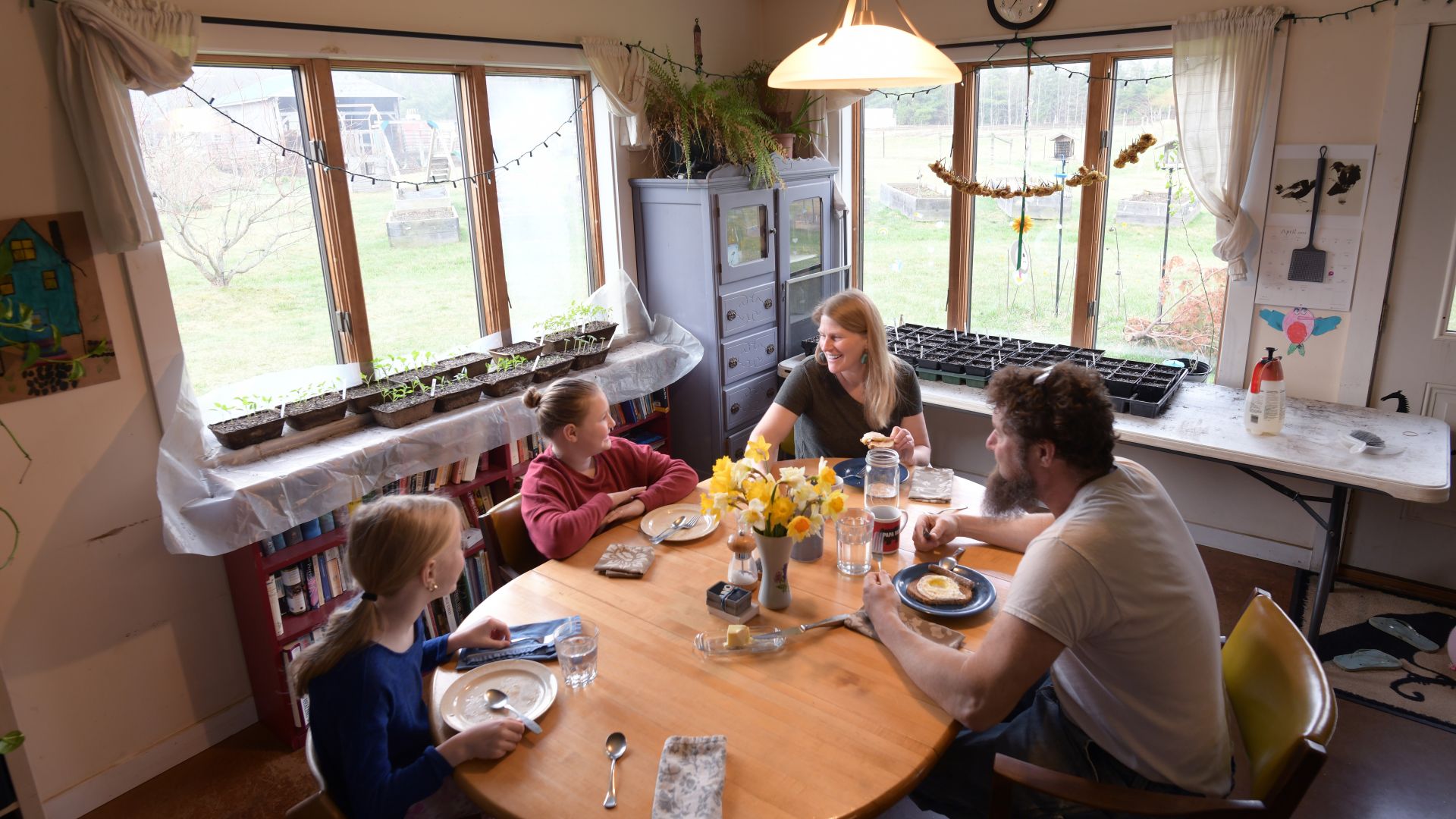
Clockwise from left: Addie, Vinka, and their parents Seren and Steve Sinisi as morning light reaches their kitchen. Photo by Fred J. Field.

Improving the soil and climate resiliency leads to higher crop production and helps the natural ecosystem of the farm, Kroeck said. The fact that the USDA grants are in limbo makes continuing this work more difficult.

“It really leaves farmers guessing, holding the bag, and trying their best to fulfill their end of the contract,” Kroeck said.

Ultimately, he said losing these funds will impact the prices Mainers have to pay at the store.

“It’s going to affect our bottom line. It’s going to affect what we need to charge for food,”

 Kroeck said. “There’s going to be no other results.”

Pushing back

Representative Chellie Pingree, who has an organic farm on North Haven, marched with farmers at the rally in Augusta earlier this month. She spoke out strongly against the cuts and said she would continue advocating for farmers in Washington.

“We’ve also lost a tremendous amount of staffing because of this unelected billionaire Elon Musk and DOGE,” Rep. Pingree said at the rally. “They’re talking and said, ‘We’re going to get rid of waste, fraud and abuse.’ Well, I don’t think anything you’ve heard about today is waste, fraud and abuse. None of it.”

A crowd of demonstrators at a rally to restore cut USDA funding.
The rally against USDA cuts in Augusta on April 16 included a tractor brigade and was attended by farmers, gardeners and supporters. Photo by Adrienne Washington.

Maine has seen 20 percent of its local USDA staff cut, according to Alexander.

Senator Angus King has cosponsored a bill that would release federal funding for all contracts previously agreed to by USDA. 

“Farmers are an original building block of our state economy, providing jobs and a secure food source for thousands of people in Maine and across the northeast,” King said in a statement. “The Honor Farmer Contracts Act would ensure that Maine’s farmers receive the federal funding from all signed agreements and contracts as quickly as possible to prevent any operations from having to shut down.”

Steve Sinsi wipes a tear from his eye.
Steve Sinisi wipes away a tear as he speaks of his late grandmother, Vinka. “Her strength, her ability to come here with nothing and build a future. We would not have a farm without her,” he said. Photo by Fred J. Field.

Sinisi, at Old Crow Ranch, said he was debating whether or not to speak out against the cuts.

But he and his wife agreed that it’s a privilege that they’re able to do so. Other farmers they know, especially migrant workers, didn’t even feel safe enough to attend the rally, let alone speak out.

“You feel like you’re going to put a target on yourself,” he said. “It’s absolutely awful.”

Sinisi said he has always been inspired by his grandmother, an immigrant who fled an abusive marriage in war-torn Croatia in search of a better life.

When she passed away, he used the money she left to him to buy a tractor, the first piece of equipment he had on the farm.

“She brought us to a place of freedom,” he said, then expressed dismay over how things have changed. “I am just so grateful that grandma is not here to see it.”

[ad number=”2″]

The Trump administration cut a key FEMA grant. What does that mean for Maine projects?

Editor’s Note: The following first appeared in The Maine Monitor’s free environmental newsletter, Climate Monitor, that is delivered to inboxes every Friday morning. Sign up for the free newsletter to stay informed of Maine environmental news.

Over a dozen plans to bolster Maine communities against the threats of climate change will have to find new sources of funding after the Trump administration moved to end a popular grant earlier this month.

The Federal Emergency Management Agency program — Building Resilient Infrastructure and Communities, or BRIC — has dished out roughly $133 million to fund local resilience projects since it was launched in 2020 under the first Trump administration.

In 2023, FEMA awarded an additional billion dollars through BRIC after the agency received a windfall in congressional funding from the 2021 bipartisan infrastructure law and saw a surge of applicants.

The program’s most recent applications included $5 million for more than 30 separate resilience projects at the state, tribal and municipal level in Maine that have been awarded BRIC grants or identified for further consideration by FEMA.

According to the agency’s April 4 announcement, any future grants and funds not yet distributed to local grantees will be returned to the U.S. Treasury or the Disaster Relief Fund, a separate FEMA program that reimburses localities after disasters strike.

“The BRIC program was yet another example of a wasteful and ineffective FEMA program,” a FEMA spokesperson said in a statement. “It was more concerned with political agendas than helping Americans affected by natural disasters.”

Some communities in Maine, however, see BRIC as a lifeline for reducing the impacts that climate change-fueled natural disasters like last winter’s inland and coastal flooding wreaked on local infrastructure and homes.

A 2024 study from insurance company Allstate and the U.S. Chamber of Commerce found that communities save $13 in disaster damages, cleanup costs and economic losses for every $1 spent on climate resilience measures. 

On North Haven, the program’s cancellation temporarily halted the island’s waterfront resilience project just as it was picking up steam. 

FEMA awarded North Haven a $150,000 BRIC grant in 2024 for its Thorofare Waterfront Project, an effort to study the impacts of sea level rise on waterfront infrastructure and homes, then design and construct a technical solution to mitigate risks of future flooding. 

After a year of public meetings and consultations a town-contracted engineering firm was set to begin drafting preliminary project designs this spring — that is, until the BRIC funding was withdrawn.

“This has brought our project… to a complete halt,” the town posted on its website earlier this month. “More information will be posted as it is available, including the Select Board’s response and next steps.”

The town announced this week, however, that the project is back on track after receiving confirmation from the state that FEMA has already committed funds to the Thorofare Waterfront Project’s BRIC grant that cannot be withdrawn.

Other BRIC grantees in Maine are also moving ahead despite the program’s cancellation. 

On Back River Creek, near Woolwich and the mouth of the Kennebec River, project organizers say plans to restore a freshwater marsh and reduce local flooding are unscathed by FEMA’s announcement.

For the past year, the Kennebec Estuary Land Trust has been working with the Maine Department of Transportation, Bath Water District and Woolwich town government to study how best to restore the depleted marsh and prevent flood waters from spilling out onto U.S. Route 1.

As in North Haven, the Back River Creek project’s BRIC grant has already been obligated by the federal government and is not in the initial acceptance phase like most other Maine projects. 

A total of 18 resilience projects in Maine have had their BRIC applications terminated with the cancellation of the program, according to a spokesperson for the Maine Emergency Management Agency — the state office that coordinates federal grants.

Of those 18 projects, however, MEMA has been able to find alternative funding for 14 of them, said MEMA spokesperson Vanessa Sperrey, keeping the projects alive despite BRIC’s termination.

The program’s cancellation comes as Maine is gearing up to provide more state assistance to connect tribes and communities with a variety of federal hazard mitigation grants.

On Tuesday, Gov. Janet Mills signed a bipartisan climate resilience bill that will create a new state office focused on supporting climate resilience projects at the local level. The legislation includes funding for a new grant navigator position and millions in state funds to provide the local matching that federal hazard mitigation grants require.

Many community officials in Maine have been overwhelmed by the multiple FEMA disaster assistance applications they’ve had to fill out over the past two years, let alone the additional funding applications for proactive hazard mitigation grants. New state assistance could help town managers and emergency managers across the state unlock funding opportunities like BRIC that are buried under mountains of paperwork and bureaucracy.

Arthur Cleaves, director of the York County Emergency Management Agency, told The Maine Monitor that the county had applied for millions in BRIC money to help with coastal resilience projects from Ogunquit to Old Orchard Beach and that he was shocked when it abruptly ended. 

“It was problematic for us… FEMA just cancelled (BRIC) out of the clear blue,” Cleaves said. 

But that isn’t keeping the county from pursuing other funding avenues. Cleaves is hopeful that other FEMA mitigation grants will continue, and if not, there’s the potential for congressional funding and a $75 million bond measure for Maine resilience projects that was recently proposed by state Sen. Donna Bailey (D-York).

“Yes, there have been some impacts,” Cleaves said. “We don’t let anything stop us. We just keep looking for other avenues.”

[ad number=”2″]