What does an $85M railroad merger have to do with Montana?

What does an M railroad merger have to do with Montana?

Last month, the host of the “Montana Talks” morning radio show spent a 10-minute segment interviewing a BNSF Railway official about the company’s opposition to a proposed merger between two rival railroads. To even the most well-informed listener, the segment may have been the first time they heard about the plan to combine the railroads, Union Pacific and Norfolk Southern, into a coast-to-coast behemoth spanning more than 50,000 miles of track and 43 states. If approved by federal regulators, it would be the largest railroad in America by tens of thousands of miles. 

The proposed merger has drawn attention from businesses and Montana’s congressional delegation in Washington, D.C., who have signed letters urging regulators to proceed with caution and conduct a “rigorous and comprehensive review.” With elected leaders expressing concern here in Montana, one would think Union Pacific and Norfolk Southern are major players in the state. They’re not. In fact, more than 90% of Montana’s railways are controlled by one company: BNSF. 

So what does this (mostly) out-of-state railroad maga merger have to do with Montana? Here’s an explanation:

While the proposed merger of Union Pacific and Norfolk Southern has gotten little media attention in Montana, it’s a big deal in the railroad world. On July 29, 2025, UP announced its intent to acquire NS for $85 billion in a transaction that would create the largest railroad in the country and the first single-rail line connecting the East and West coasts. 

UP and NS are two of the six large “Class I” freight railroads that operate in North America. Together, these six operators cover about 140,000 miles of track, with two major railroads in the west, two in the east and two in Canada (although the Canadian operators have a major presence in the Midwest). At one point, there were dozens of Class I railroads, but through consolidation, there are now only six.

Union Pacific was founded in 1862 and built the eastern half of the First Transcontinental Railroad, which was completed in 1869. Today, it operates 32,200 miles of track in 23 states, mostly west of Chicago. Last year, the company made more than $7 billion moving freight. Its primary competitor is BNSF. 

Norfolk Southern was founded in 1982 following the merger of the Norfolk & Western Railway and Southern Railway. It operates 19,420 miles in 22 states in the East. Its primary competitor is CSX Transportation. 

UP President Jim Vena, who is expected to remain as the head of the railroad if his company acquires NS, has said the merger would benefit shippers, the environment and the nation by offering cheaper freight transportation and by taking an estimated 2 million trucks off America’s highways annually. Vena has said it is possible because a single-line railroad could offer better shipping rates, especially in the Midwest, where shippers often have to deal with multiple railroads, thereby increasing prices. 

A BNSF Railway freight train is seen passing through Libby in December 2025.
Credit: Justin Franz / MTFP

The Utah & Northern Railway Company, a subsidiary of Union Pacific, became the first railroad to reach Montana when it built its line over Monida Pass on the Idaho-Montana border south of Dillon in May 1880. The railroad eventually reached Butte and Garrison. But today, Union Pacific operates only as far as Butte, meaning it serves only 125 of the state’s 3,700 rail miles, or about 3%. More than 90% of the rail mileage in the state, about 3,400 miles, is controlled by BNSF, according to the Association of American Railroads. Norfolk Southern has no track in Montana. 

In December, UP and NS submitted their application to merge with the U.S. Surface Transportation Board, the independent federal regulator that oversees railroads, which will have the final say on whether the two railroads can combine. Since then, the two railroads and their competitors have aggressively rallied support for and against it. Leading the charge against the merger is BNSF. 

BNSF has argued that the merger would be “anti-competitive,” and would give rail shippers — including Montana farmers — fewer options, thus increasing prices. For example, if a farmer near Great Falls ships grain to an East Coast community served by NS, the shipping charge could increase once NS is part of UP. For its part, UP has denied that it would increase rates.

Opponents have also pointed to the chaos that ensued after previous mergers, particularly in the 1990s. Perhaps the most notorious was the 1996 Union Pacific-Southern Pacific merger, which led to a “service meltdown” as rail yards across the country were jammed with late trains, and the railroad lost billions of dollars in profits. The railroad mergers of the 1990s were so disruptive that the U.S. Surface Transportation Board imposed a temporary ban in 2000 and later issued new requirements for combining major railroads. A quarter century later, no major railroad has attempted to merge under the revised rules. 

While UP is a comparatively small player in Montana, both it and BNSF have been lobbying stakeholders and elected officials here in favor of and against the merger. In December, both railroads reached out to state legislators with their take on the combination. Since then, a number of politicians — including all four members of the state’s Washington D.C. delegation and Montana Attorney General Austin Knudsen — have agreed with BNSF’s take and signed on to letters to federal officials, urging a rigorous review. Among their chief concerns is the impact it could have on pricing for agricultural producers, but the letters also note potential major impacts on the shipping of consumer goods, construction materials, fuel, food and more

“If approved, a combined UP-NS would handle more than 40% of all U.S. freight rail traffic… a transcontinental system spanning 50,000 route miles across 43 states,” read a joint letter from Sens. John Hoeven (R-N.D.) and Amy Klobuchar (D-Minn.), and co-signed by Sens. Steve Daines, Tim Sheehy and 14 others. “Service interruptions of this magnitude could have severe consequences, especially for agricultural producers. Time-sensitive shipments during harvest could be delayed or spoiled, export windows could be missed, and access to global markets could be sharply reduced.”

The first question for federal regulators to consider after UP and NS submitted their application in December was whether the agency had enough information to review it. In January, the board ruled it did not and rejected the initial application. The two railroads have said they will revise their applications to include the requested information and try again. If the STB does accept the application, the review is expected to take more than a year, ensuring that the issue of mega railroad mergers isn’t going away any time soon. 

The post What does an $85M railroad merger have to do with Montana? appeared first on Montana Free Press.

As AI investors eye Montana for new data centers, communities brace for water impacts

As AI investors eye Montana for new data centers, communities brace for water impacts

While Montana might not be viewed as an artificial intelligence hotbed, it is considered among the top states in the country with potential to “power the AI revolution.” An analysis CNBC published last July based on grid reliability and average market electricity price named Montana as the  No. 3 state in the country for its potential to power data centers. Despite that, only a handful of relatively small data centers have been built in the Treasure State, and several operations have come and gone.

But the state of play could change — quickly — as proposals for new data centers garner traction in energy, economic development and political circles. Big Tech’s race to deploy AI, which the Brookings Institute has described as “the transformative technology of our time,” is spurring a corresponding rush to build data centers, massive warehouse-like buildings filled with stacks of chip-laden servers that have been likened to the “backbone” supporting AI.

The push for infrastructure to support the technology is also on display in Montana, as data-center developers and energy executives work to capture a piece of a rapidly growing market. Preliminary agreements that NorthWestern Energy, Montana’s largest utility, has signed with three companies in the past 14 months have given Montanans a general idea of how much electricity these large new data centers would require, but information about their water usage is in short supply. Wary of project developers’ tight-lipped approach to discussing their proposals, environmental watchdogs warn that a hands-off strategy could turn Montana communities into “sacrifice zones” to serve the data-processing needs of some of the world’s largest companies.

Data center experts that Montana Free Press interviewed in recent weeks said the lack of transparency could be by design. Project developers have been hustling to secure hundreds of millions, or even billions, of financing dollars before local pushback and potential regulatory changes spook investors in a competitive market that some industry insiders have described as a “global arms race.”

Aaron Wemhoff, a mechanical engineer who studies data centers’ environmental impacts as part of a consortium focused on energy-efficient electronic systems, told MTFP that center developers are running up against a power supply bottleneck and opposition from nearby residents wary of environmental impacts.

“I think that is what is setting the pace of development,” Wemhoff said. “What you’re seeing is that a lot of data centers are now being built in rural locations [where] there’s a little bit less resistance and perhaps they’re getting friendlier governments.”

Whether they’re inclined to support or oppose them, many Montanans are hungry for more information, and data-center developers have been reluctant to provide it.  Montana Environmental Information Center Executive Director Anne Hedges told MTFP that these companies might be looking for “easy pickings” in Montana, but residents of Butte, Billings, Broadview and Great Falls have shown an “overwhelming interest” in the topic at educational events MEIC has co-hosted. Hedges said public engagement with this issue is like nothing else she’s encountered in the 32 years she’s worked for MEIC, an environmental nonprofit that also serves as a corporate watchdog.

“We’ve had to turn people away in a room that holds hundreds,” Hedges said, referring to last month’s talk in Billings, which turned into a standing-room-only event. “It’s fascinating from an academic perspective, but certainly from the perspective of somebody who wants to get regulations in place to protect Montanans from what the richest men in America want to do.”

The Colstrip coal-fired power plant, photographed in 2019, uses millions of gallons of Yellowstone River water to generate steam to spin its turbines. Some data center experts argue that water used in electricity generation should be part of a data center’s overall water footprint. Credit: Alexis Bonogofsky / MTFP

MEIC is concerned that NorthWestern Energy’s existing customers’ electricity bills will rise to fund power plants, substations and transmission lines to serve new data centers that might shutter in a few years’ time.Running parallel to that issue is uncertainty about what data-center development means for the rivers, lakes and aquifers that support two of the top industries in this arid state — agriculture and outdoor recreation.

Although all data centers that process large volumes of information require a cooling system, there are a variety of ways to run them. Wemhoff said there is a tradeoff involved: evaporative cooling systems require more water but less electricity. “Closed loop” or “open-air” systems typically use less water but are less efficient in that they require more electricity. 

“To me, the true water footprint is the water that’s consumed on site, but you also should include the water that’s consumed in the process of generating the electricity that the data center is consuming,” Wemhoff said. Fossil fuel plants often consume significant quantities of water, contributing to a larger water-use footprint, he added. 

Montanans still don’t have a fulsome accounting of these new proposals’ water impacts, but some information has been in circulation as companies like Quantica and Sabey approach their projected operational dates. This is what we know as of early February.

Quantica plans to build a massive data center near Broadview to provide “cutting-edge AI and data solutions” to some of the world’s largest companies. The 5,000-acre property the company purchased last year for its Big Sky Digital Infrastructure campus is outlined in white. Credit: Chris Boyer, Lighthawk

A recently formed Texas-based company called Quantica Infrastructureis planning a “high-performance computing” campus to support artificial intelligence — an industry that’s expected to garner trillions of dollars of investment by 2030. Quantica has secured a 5,000-acre property south of Broadview for the project, which it is calling Big Sky Digital Infrastructure.

The project would require a continuous supply of up to 1 gigawatt of power, which is more than all of the total average load electricity NorthWestern Energy uses to serve its 400,000-plus electricity customers on an average day. Since facilities that require a lot of power typically generate a lot of heat, the energy footprint can be a helpful proxy for cooling — and therefore water — requirements.

In a Jan. 26 email to MTFP, Quantica wrote that the company aims to minimize its water use to avoid resource conflicts. Details on its cooling system will depend on environmental assessments and its customers’ needs, the company wrote, adding that it does not intend to source water from the town of Broadview, a rural community north of Billings with fewer than 150 residents and a limited water supply

“We’re evaluating multiple approaches including zero-water air cooling, deep aquifer wells, treated greywater, and direct-to-chip liquid systems that reduce water consumption 20 to 90% versus older data center cooling technologies,” the company  wrote. Quantica is looking to move quickly on its project, which will have limited local oversight due to the absence of zoning in that area of Yellowstone County.

Quantica doesn’t currently possess any water rights, according to the Montana Department of Natural Resources and Conservation. Like other users of large quantities of surface water or groundwater, the company would therefore be required to go through an administrative process designed to ensure that existing water users in the area aren’t negatively impacted by new withdrawals, a process that can take years. Despite that, the company anticipates moving forward with site construction this year.

Quantica’s energy-procurement plan includes incorporating “traditional” grid power along with renewable and battery energy storage. It has 45,000 acres of land under lease and on-site solar, wind and battery storage infrastructure have been “quietly” under development, Quantica CEO John Chesser told the Voices of Montana radio program last September. But its near-term power source, at least temporarily, is likely to include coal given its proximity to the high-voltage transmission lines leading out of Colstrip, the state’s largest power plant. Hedges, with MEIC, said Quantica could be one of the customers NorthWestern plans to serve with the nearly 600-megawatt share of the Colstrip plant it acquired last month. 

Sabey Data Centers plans to build a campus west of Butte using government-owned land and water. The company has until late July to decide if it will move forward with the $1.2 million land purchase. Credit: Chris Boyer, Lighthawk

In December of 2024, Sabey Data Centers, a company based in the Seattle area, reached a power-procurement agreement with NorthWestern for up to 250 megawatts of power. A few months later, the company reached a tentative — and still-pending — agreement with the Butte-Silver Bow Commission to purchase 600 acres of government-owned land in the Montana Connections Business Park, an industrial area west of Butte, for $1.2 million. 

Sabey is also looking to the Butte-Silver Bow commission for water to cool its system. More specifically, it plans to use an existing water right that conveyed snowmelt from multiple drainages in the Pintler Mountains to the smelter in Anaconda for nearly a century. When the smelter was operational, as many as 80 million gallons of Silver Lake water would surge down to Anaconda, but daily use rarely tops 10 million gallons per day these days.

At an interim water policy meeting last month, Rob Corbin, Sabey’s senior vice president of energy development, told lawmakers the company will use “air-first cooling,” to take advantage of Montana’s cool and dry climate. Water-based cooling using industrial water — the Silver Lake water that Butte-Silver Bow owns — will kick in during the hottest days of the year, Corbin said, adding that there won’t be “routine” water discharge. (Even the closed-loop systems with less evaporative water loss require occasional draining and refilling.)

Despite Corbin’s assurance to lawmakers that Sabey is emphasizing “transparency from Day One,” Sabey’s governmental affairs manager did not agree to MTFP’s interview request. The company has been in communication with Montana Tech Lance Energy Chair Bob Morris, who used the facility’s energy requirements and local climate data to provide rough calculations of the facility’s anticipated water usage at a recent presentation before the Butte-Silver Bow Commission. 

According to Morris’ calculations, extra water for cooling will only be required when the outside air temperature exceeds 80 degrees, or between 30 and 60 days of July and August. He said that’s when the evaporative cooling system will kick in, which is estimated to use about 16 million gallons per year. Morris likened the total volume of water required over the course of a year — 44,000 gallons daily — to three garden hoses running continuously at full capacity, describing the usage as a “small” share of an underutilized water right.

Butte-Silver Bow Commissioner Russell O’Leary echoed Morris’ assessment of the underused nature of that industrial water, telling MTFP in a recent interview that the only current use of the Silver Lake water right is an occasional release to Warm Springs Creek to support instream flows during drought years. Otherwise, much of the Silver Lake water flows down to Georgetown Lake, which supplies farmers and ranchers with water for irrigation, O’Leary said. 

During the Jan. 27 meeting, members of the public spoke both in support of and opposition to the project. Butte “needs to look to the future,” architect Dan O’Neill offered, arguing that the city should “take what we can get.” 

Another Butte resident, Linda Trevenna, countered that Sabey appears to be dodging public scrutiny and has at times offered contradictory information.

“Why is Mr. Morris putting together the presentation for Sabey and using the words, ‘I’m assuming’ [and] ‘this is what I’ve read’? Why isn’t Sabey producing their own defined, guaranteed diagram of what they intend?” Trevenna asked.

A Sabey employee attended the 2-hour commission meeting remotely but spoke little.

Atlas Power is one of the few large data centers currently operating in Montana. The company is planning to expand its flagship operation at a facility in Butte formerly owned by CryptoWatt, which shuttered amid allegations of a Ponzi scheme. Credit: Chris Boyer, Lighthawk

At the tail end of 2024, two days after it issued a statement about its agreement with Sabey, NorthWestern announced that it had signed a letter of intent with Atlas Power Group to supply an additional 150 megawatts to its flagship facility, a cryptocurrency mining operation in Butte.

Atlas did not respond to MTFP’s multiple requests for comment. O’Leary told MTFP that Atlas uses a different cooling system than what Sabey is proposing. Atlas’ existing facility is more dependent on air circulation than water-based cooling, he said. 

“They have gigantic fans that are out on the roof of the building. They basically pull air in from the outside, run it through the system and push it back out,” he said. “It is a fairly noisy facility. That’s not what is being proposed [in Butte] by Sabey.”

Atlas’ facility is authorized to use a negligible amount of water. According to DNRC, Atlas Power Holdings has a water right that enables the company to use up to 2 acre-feet of groundwater per year, roughly equivalent to the annual water usage of four households.

Atlas purchased the water right from CryptoWatt, a company that launched a bitcoin mining operation in 2018 and later shuttered following legal allegations that the founder created a Ponzi scheme.

It is unclear if Atlas intends to use its expansion for cryptocurrency mining. Hedges said she wouldn’t be surprised if the company transitions to other types of data processing to align with market demands and find a more stable customer base.

“When you get into the bigger data centers that are using these Nvidia chips that really have high power demand and get really hot, air just isn’t as efficient,” Hedges said. “That’s why these companies are moving toward using water cooling.”

Kerri Hickenbottom, a University of Arizona professor of chemical and mechanical engineering, described the current situation as a “black box” where communities are scrambling to learn about data center impacts — and mitigation opportunities — amid exponential growth in AI, cloud computing and government document storage. 

“These data centers are just building as fast as they can and cities have really struggled with how to incorporate [them],” said Hickenbottom, who started researching data centers’ water usage when they started cropping up in the Phoenix area.

Some local governments are developing novel approaches to resource concerns, such as requiring data centers to use wastewater for their cooling needs — and to treat it themselves. Data-center developers can also spur utilities to develop more renewable power sources, she noted.

“We’re all responsible for this, too, because we’re using the data,” Hickenbottom said. “If we weren’t using the data, they wouldn’t be building more data centers.”

The post As AI investors eye Montana for new data centers, communities brace for water impacts appeared first on Montana Free Press.

To ticket or not to ticket, that is the question in Glacier National Park

To ticket or not to ticket, that is the question in Glacier National Park

Five years after Glacier National Park first introduced a ticketed-entry system to handle ever-increasing summer crowds, the park plans on eliminating the at-times controversial system. 

At least that’s what the superintendent said during a chamber of commerce meeting late last year. Since then, despite promises that details would be announced soon, the National Park Service has remained mum about what the busy summer season will look like in Glacier. 

“There’s definitely some confusion,” said Sarah Lundstrum, Glacier program manager for the National Parks Conservation Association, an independent nonprofit that supports national parks. 

The ticketed-entry system was first launched in 2021, when the park faced a perfect storm of rising visitation and summer construction projects both inside and just outside the park that threatened to wreak havoc. Former Superintendent Jeff Mow noted that it was actually the state of Montana that requested a ticketed system that year because of a major construction project on U.S. Highway 2 near West Glacier and the concern that traffic would back up for miles when the park became overloaded with visitors (which happened on multiple occasions the previous year, sometimes forcing park officials to close the entrance). 

That first year, the ticket system was only used on the Going-to-the-Sun Road between West Glacier and St. Mary. In 2022 and 2023, the system was expanded to include other areas, like Polebridge, Many Glacier and Two Medicine. Since then, the system has been tweaked further, and last year, the park used a timed-entry model, where visitors who wanted to enter the west side of the park between 7 a.m. and 3 p.m. had to get a ticket and show up at a specific time. 

“It has been a learning process, and every year has been a little bit different,” Mow, who retired from the Glacier in 2022, told Montana Free Press.

The reservations and ticketed-entry systems haven’t always been popular. In 2023, Montana Rep. Ryan Zinke called for changes to the system after meeting with local business owners who complained it was hurting tourism in the area because visitors were struggling to get tickets. But Mow said that as tweaks were made, the system became more popular as people grew accustomed to it and came to enjoy less congestion in the park. 

But in December, during a Columbia Falls Chamber of Commerce meeting, current park Superintendent Dave Roemer said Glacier National Park intended to eliminate the ticketed-entry system in 2026. According to the Daily Inter Lake, Roemer said one issue with the timed system was that more people were driving to Logan Pass at night, which is not ideal for safety or for Glacier’s wildlife. Roemer added that the park was considering instituting reservation systems for parking at Logan Pass, a common choke point, and for the Sun Road shuttles, which are popular with hikers. 

But since Roemer made those comments in December, the National Park Service has said little about its plans for this summer. MTFP has reached out to a park spokesperson multiple times since December to request details on its plans for a ticketing system, but has received the same canned response each time. 

“The National Park Service continuously reviews Glacier National Park’s pilot operation programs to determine adjustments for the following year,” the spokesperson wrote. “Visitor use data, gate counts, congestion monitoring, traffic operations, and feedback from the public and gateway communities help inform strategies the park uses to manage congestion, shuttles, parking, and visitor access. We will update the public once a decision for the 2026 season has been made.”

In previous years, Glacier Park announced its plans for the following summer as early as November or December

Glacier isn’t the only park where there’s uncertainty surrounding the ticketed-entry system, or possible lack thereof. Multiple parks across the West have not announced whether they plan to use a ticket system. In the case of Mount Rainier National Park, it announced online that it wouldn’t use it, then backtracked, stating it hadn’t made a decision, according to SF Gate. Cassidy Jones, senior visitation program manager for the NPCA, put much of the blame for the confusion around the ticketed-entry system on NPS officials in Washington, D.C., and the Trump administration. 

“The administration is really putting parks in an impossible position, and the visitors are the ones who are going to suffer for not having information,” Jones told SF Gate

Zak Anderson, executive director of Explore Whitefish and the Whitefish Convention & Visitors Bureau, told MTFP that he and other tourism officials are eager to communicate what the park plans this summer. He also emphasized that he believed Superintendent Roemer and other officials at Glacier were doing the best they could “despite a lack of communication coming from Washington.”

“​​We’re still waiting on the National Park Service, and I think that to a certain degree the park superintendents are waiting on Washington,” Anderson said. 

In-depth, independent reporting on the stories impacting your community from reporters who know your town.

The post To ticket or not to ticket, that is the question in Glacier National Park appeared first on Montana Free Press.

‘A really beautiful gift’: Missoula philanthropist sought to enhance city’s affordable housing before her death

‘A really beautiful gift’: Missoula philanthropist sought to enhance city’s affordable housing before her death

Even in her 80s, longtime Missoulian Ethel MacDonald traveled worldwide on solo bike tours. She once told her son John that she loved her trips, but “I’ll always come home to Missoula.” 

A philanthropist and supporter of many social justice causes, MacDonald was passionate about making sure others in her community had what they needed, including an affordable home. 

Before MacDonald died last October, she sold her Westside rental property at below market rate to Front Step Community Land Trust, with the proceeds going to her Ethel MacDonald Charitable Foundation. The home will remain permanently affordable as part of the community land trust, which will maintain ownership of the land to bring down the price and require future homeowners to sell at an affordable rate.

In August, she told Front Step in a recorded interview that she made the sale “for the same reason that I would want to feed a hungry family on the street. For the same reason I would want them to be safe, and to have enough clothing, to be safely warm in our cold winters. That’s the way I am. I have everything, and too many people have almost nothing.” 

John MacDonald is also working with Front Step to sell his mom’s University District home to the community land trust, and he and the organization hope others will consider doing the same to increase affordable housing options in Missoula. 

John MacDonald poses for a photo in front of his mother’s house in Missoula on Thursday, Jan. 15, 2026. Before she died last year Ethel MacDonald sold her rental house to Front Step Community Land Trust to become an affordable home. John MacDonald is planning to do the same with his mom’s home.

“It’s a novel approach to one family at a time addressing housing needs,” MacDonald told Montana Free Press. “I think it’s how she would do it.”

Ethel MacDonald moved to Missoula around 1958 and spent most of her career teaching high school English and French in Arlee before retiring in the 1990s. She bought her house in the University District in 1980 after she and her husband divorced. 

John MacDonald said his mom was active with the Jeannette Rankin Peace Center and supported several causes in Missoula, including conservation, food security and affordable housing. 

About seven years ago, a friend in the real estate industry connected Ethel MacDonald with a single father at risk of losing his home. MacDonald bought his mortgage and rented the house back to him at a below-market rate. When the tenant moved, he encouraged MacDonald to continue renting the house at an affordable price, John MacDonald said. 

After covering taxes and other costs, Ethel MacDonald directed the rental income to her charitable foundation, which she started in 2018. MacDonald was frugal, a good investor and often donated her annual IRA disbursement to the foundation, her son said. In 2024, the Ethel MacDonald Charitable Foundation donated about $23,000 to dozens of nonprofits. Upon her death, nearly $1 million went to charities through direct donations and her foundation, John MacDonald said. 

“She just lived a very simple life,” he said. “She always said, ‘I have enough, and I have everything I need, and I should give to others not as lucky as me.’” 

Last year, Ethel MacDonald approached her foundation board about the future of the rental house. Karissa Trujillo, a board member and executive director of housing nonprofit Homeword, said that when they discussed whether to keep the house as a rental or to sell it, she suggested the community land trust. MacDonald met with Front Step in April and sold the home to the organization in August. 

“She felt really good about the legacy she was leaving there and being able to bring some funding into the foundation but also still sell it at a rate that worked for Front Step to take the home into their portfolio and sell to someone who could afford to live there,” Trujillo said.

Community land trusts aim to provide affordable housing on land they own and lease to homeowners. Removing the land’s value lowers the home’s price, and the homeowner agrees to sell the home at a restricted price to keep it affordable. 

Hannah Kosel, Front Step’s stewardship program manager, said that since MacDonald was willing to sell her property at below-market value, the organization didn’t need grant funding to help acquire the home, as they have in most other cases. Kosel said MacDonald was quick to get on board with the opportunity to keep the home affordable. 

“For her to say, ‘I have the resources I need. I recognize I have some extra as well and that can go to others,’ I just thought that was a really beautiful gift of generosity and wealth redistribution in that regard,” Kosel said. 

Front Step is making some upgrades to the home before seeking applications from potential buyers, Kosel said. Front Step will select an income-qualified buyer earning up to 120% of Missoula’s area median income, currently $94,560 for a two-person household or $118,200 for a four-person household. The home will have a 75-year ground lease that includes an agreement to sell to the next buyer at an affordable price. The homeowner still receives equity, but the arrangement allows households currently priced out of today’s market to buy a house, Kosel said. Unlike other affordable housing models, no additional funding is needed to subsidize each new homeowner, they said. 

Courtesy: Front Step Community Land Trust
Ethel MacDonald sold her rental property on Cooper Street in Missoula to Front Step Community Land Trust in 2025. After updates, the home will be available for an income-qualified household to purchase for an affordable price.

“Ethel’s one-time generous donation will be able to stay with this home on a long-term scale, which is a really beautiful way to keep her legacy alive,” Kosel said. 

Front Step, which has grown to include more than 90 permanently affordable homes in Missoula, will likely see more individual home acquisitions in the future, Kosel said. 

John MacDonald said he decided to sell his mother’s University District home to Front Step after seeing many neighboring houses replaced with those unaffordable to anyone he knows. MacDonald said he owns a home in Helena and “a cabin in the woods” and doesn’t need to sell his mother’s home at full market price. 

“If I can do something to contribute, it would be great to help out,” he said. 

MacDonald said he hopes other people in his position will consider selling their parents’ homes to the community land trust to help those in need. 

“It’s a unique approach, but I think it would work,” he said, “I think people could see the benefit to the community and themselves.” 

Kosel said it would be exciting to also bring MacDonald’s home into the community land trust because it would be the first Front Step home in the University District. 

“We believe affordable housing should be in every corner of Missoula and every neighborhood,” they said. “This type of process makes it exciting to understand how to scale this program, how to bring affordability into different areas of Missoula.” 

Trujillo, with Homeword and the Ethel MacDonald Charitable Foundation, said for many Missoulians, buying a home is not an option without the community land trust. 

“It’s easy to get bogged down in, ‘I’m only one person, what can I do?’” she said. “But if 50 people took action in the way Ethel did. This one human made such a difference in not only her foundation and giving to nonprofits but in her gift of a home. If 50 more people did that, imagine the impact.” 

In-depth, independent reporting on the stories impacting your community from reporters who know your town.

The post ‘A really beautiful gift’: Missoula philanthropist sought to enhance city’s affordable housing before her death appeared first on Montana Free Press.

Everything you need to know about Montana’s rural health windfall

Everything you need to know about Montana’s rural health windfall

In late December, state and federal officials celebrated the announcement of a health care funding windfall. The administration of President Donald Trump had said it would hand Montana roughly $233 million for the first year of the Rural Health Transformation Program, a five-year, nationwide investment surge in rural health care services and infrastructure. That award amount — for a state with just over a million people — was more than the awards for most other states. 

The deluge of funding has been cheered by members of Montana’s congressional delegation, all Republicans who supported its inclusion in the budget bill last year. All told, the administration of Gov. Greg Gianforte, also a Republican, has said that Montana could receive $1.2 billion in grant money by 2031 if the Trump administration continues to fund the state’s proposed projects at the same level every year. 

So, where exactly did this massive pot of money come from, and what could Montana do with it? 

Here’s an overview of what we know at this point.

The federal rural health fund, totalling $50 billion for all states, originated as part of House Resolution 1, the sprawling tax-and-spend bill backed by Republican lawmakers and signed by Trump in early July 2025. Discussions about a fund for rural hospitals or health care providers began making headlines in June as lawmakers worked to recruit more Republican support for H.R. 1. A cornerstone of the budget package included dramatically downsizing the federal Medicaid health insurance program for low-income people, a sticking point for some Republicans, including those facing upcoming reelection bids. 

“The purpose of it was, look, we’re going to cut Medicaid funding, there’s going to be less people covered. And so obviously the folks that are hit the hardest are the small rural facilities,” said Ed Buttrey, the president and CEO of the Montana Hospital Association, in a January interview with Montana Free Press. Leaders of rural facilities, many of which have tighter margins than larger health care systems, have said they may be particularly squeezed by Medicaid enrollment cuts, as they still have to provide care to uninsured patients but don’t have other ways to cover costs. 

Explaining the thinking of congressional Republicans that backed the rural health fund, Buttrey said, “Let’s inject some money into those facilities to help right-size them, to help them with workforce, to help them with long-term sustainability so that even with the Medicaid cuts — well down past the five years of the [Rural Health Transformation] program — we are gonna hope that those facilities remain there, that they’re financially healthy and that they can serve the people locally.”

Congressional analysts have estimated that, when implemented, H.1. will strip more than $900 billion from the federal Medicaid spending nationwide over the next decade. (New Medicaid standards are expected to begin taking effect in most states by the end of the year.) The $50 billion Rural Health Transformation Fund is slated to be distributed to all states over the next five years, with 2026 being the first. Obviously, the amount of money that could be lost through Medicaid cuts is far greater than the new investment.

But how much Medicaid money could be siphoned out of Montana’s health care system because of the changes to H.R. 1? That’s hard to pinpoint. A 2025 report commissioned by the Montana Health Care Foundation, a nonprofit health policy advocacy group, estimated that Montana could lose between $4.8 and $6.1 billion in federal Medicaid funds over the span of a decade. If those projections come true, the loss would be multiple times the upper amount that one year of the Rural Health Transformation grant could infuse into the health care system. 

Buttrey, a longtime Republican state lawmaker who became well-known for sponsoring bills to renew Montana’s Medicaid expansion program for low-income adults, took the helm at the hospital association last summer. He said his goal is for Montana to use the rural health funds to preemptively protect providers from Medicaid instability — as much as possible, anyway. That could include health care providers having new tools to make sure that eligible Medicaid recipients stay enrolled, or to help create money-making ventures that can keep hospitals afloat even if Medicaid revenue falls.

“I think when you look at the Medicaid funding loss to Montana versus the opportunity we have with [the] rural health [fund], if we do things really thoughtfully and correctly in Montana, we can offset those losses. But that’s our goal,” Buttrey said. “… I mean, I’m a hopeful person.”

Lauren Miller, Montana Free Press, CatchLight Local/Report for America
Charlie Brereton, Director of the Montana’s Department of Public Health and Human Services (DPHHS), answers questions during at the Health and Human Services Interim Budget Committee meeting on Dec. 15, 2026, in Helena. Credit: Lauren Miller, Montana Free Press, CatchLight Local/Report for America

Montana’s program application, released to the public in November, included five high-level initiatives. Here they are, verbatim:

  • Develop workforce through recruitment, training, and retention
  • Ensure rural facility sustainability and access through partnerships and restructuring
  • Launch innovative care delivery and payment models
  • Invest in community health and preventative infrastructure
  • Deploy modern health care technologies to guide rural health interventions

The state health department suggested several specific projects for each initiative — many of which could be executed through contracts with Montana health care providers and industry groups. The money could be used to create a statewide bed registry, for example, so providers could more easily transfer patients depending on needs or availability. Other uses could be financing upgrades to IT systems and electronic health record systems, or helping emergency medical service teams buy new software and equipment.

But some of the state’s ideas might be harder for non-policy wonks to make sense of. The largest single funding proposal in Montana’s application suggests spending $418 million over a five-year span to create a Center of Excellence within the Gianforte administration’s state health department. That entity would aim to “rapidly create a rural health supply and demand fact base for Montana and develop recommendations to align care delivery services with rural health needs at the county and facility level.” Clear as mud? We thought so, too.

In some of its application materials and public presentations about the rural health funding, Montana’s health department has proposed “right-sizing” rural facilities and services to be more cost-efficient, while still meeting the needs of rural residents. 

In a December meeting with state lawmakers, the health department’s deputy Medicaid director, Gene Hermanson, tried to elaborate on the purpose of the Center of Excellence.

“Say there is a rural facility where, today, they provide inpatient services and they have a number of staffed beds, but their inpatient utilization rate is low. And that might be a service line where they’re losing a lot of money. Whereas the community may have the need for outpatient services that they may have to travel a long way to get to, to a bigger community. So the role of the Center of Excellence would look at that, in that situation, and would encourage a movement where that facility could increase its service lines related to outpatient service,” Hermanson said.

Reading between the lines, we wondered if this effort could push rural providers to downsize or close existing services if they’re not making enough money to keep the lights on, and instead pivot to providing services — like specialty care — that bring in more money long term.

Buttrey said the Montana Hospital Association has been “concerned” about the state’s Center of Excellence proposal for a while. Instead of a broad, one-size-fits-all approach to reduce inpatient beds, Buttrey said MHA is advocating for a case-by-case approach.

“We’ve been pushing for using the Center of Excellence [to get] a real assessment of each individual facility in their community to see where they have their assets and what the community needs. And in some cases, to say, ‘Hey, their inpatient capacity is just right. Or maybe they need a little more.’”

Jean Branscum, the president and CEO of the Montana Medical Association, an industry group that lobbies for physicians, said there aren’t “too many details” about what the Center of Excellence will be working on. But, she said, she hopes the state will encourage new ways for health care systems to work together across regions to meet patient needs. That could include creative ways to fund data sharing agreements, hire specialty providers who can travel to different communities, or incentivize medical providers to provide outcome-based health care — also known as “value-based” services that reward improvements in patient health.

“How can you create networks?” Branscum said. “So we’re not siloed.”

Probably not. The federal government put several conditions on the money, including a general prohibition on uses for physical infrastructure — like adding a new wing to a hospital. But grant money could help tackle infrastructure costs that are directly related to carrying out an initiative — like furnishing a lab to provide new services to patients that help stabilize a facility’s bottom line, or buying a new truck for an EMS crew. 

A spokesperson for the health department, Jon Ebelt, told Montana Free Press in a January email that the federal government’s award has been made in the form of statewide “cooperative agreements” with the Centers for Medicare and Medicaid Services. 

He said CMS “does not pre‑allocate the $233.5 million into initiative‑specific ‘buckets.’” Rather, federal counterparts approved the state’s general plan, allowing the state to move forward with submitting a more specific budget that details how it will spend the first-year grant funds. Montana has until Jan. 30 to submit that revised budget, Ebelt said, and the federal government is expected to review it in another 30 days.

Buttrey and Branscum said that they anticipate the state will soon open the door for contractors, including rural health providers and association groups, to submit bids for different projects within each of the state’s five initiatives. Those contract opportunities will likely come in the form of “Request for Proposals,” or RFPs. Buttrey and Branscum said those bids could open in the coming weeks, but that they’re not aware of a specific timeline.

“Individuals are eagerly awaiting the unleashing of those monies, because they have so many ideas that they think can advance and improve rural healthcare in Montana and ultimately provide better patient care,” Branscum said.

The state health department has created a Rural Health Transformation Program Advisory Committee, a group intended to provide input about how the grant funds are spent and invested in ongoing projects. The committee’s membership has yet to be published on the state’s RHTP website.

Ebelt said that group is scheduled to meet for the first time in Bozeman on Jan. 22. At that meeting, Ebelt said the group will “share project goals, next steps, and gather public feedback.” Additionally, he said, “committee members will provide targeted input on launching initiatives; however, this is not a decision-making meeting, and no funding awards will be determined.”

Ebelt directed members of the public to go to the state’s RHTP website in the coming weeks to view the advisory committee’s agenda and membership list.

The post Everything you need to know about Montana’s rural health windfall appeared first on Montana Free Press.

Can the Montana State Hospital regain federal standing without electronic health records?

Can the Montana State Hospital regain federal standing without electronic health records?

This story is excerpted from the MT Lowdown, a weekly newsletter digest containing original reporting and analysis published every Friday.

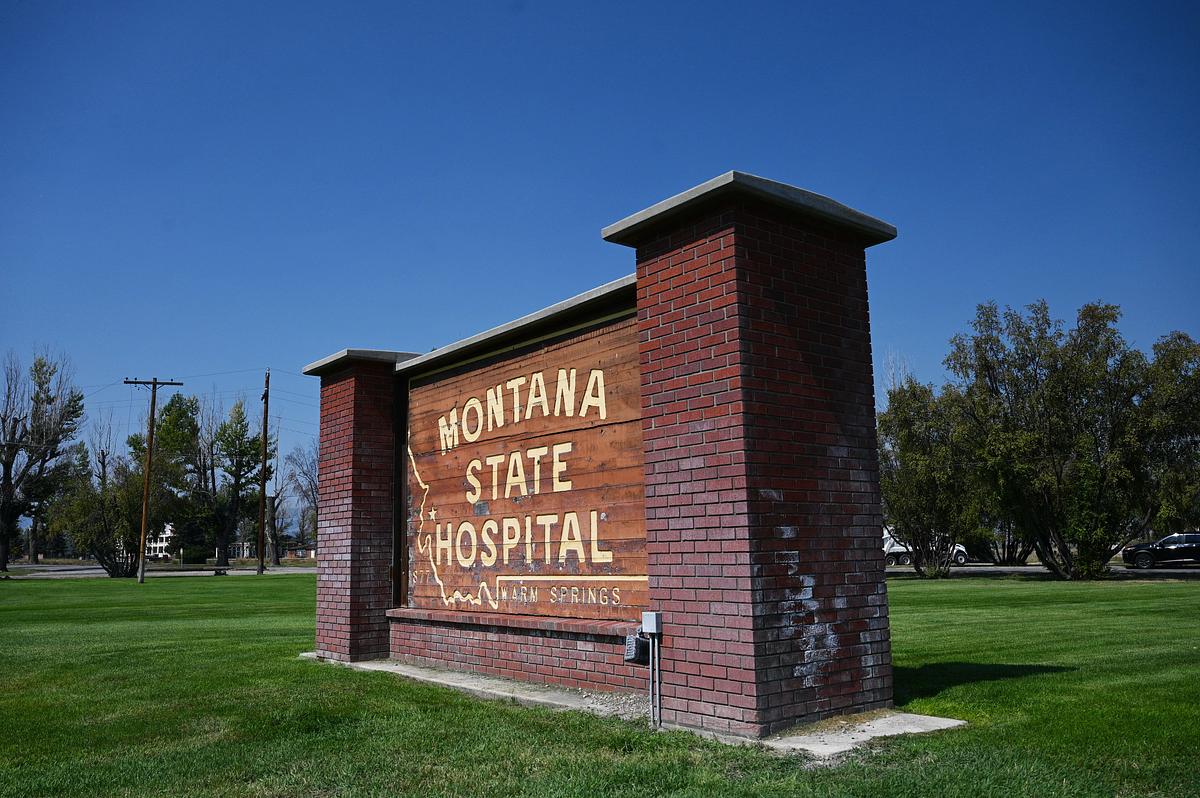
In a meeting last week, state lawmakers asked an elephant-in-the-room question: Will federal regulators recertify the Montana State Hospital in Warm Springs in 2026 if the adult psychiatric facility still doesn’t have an electronic medical record system?

The fact that the 270-bed facility — a fixture of Montana’s mental health system for more than 100 years — still operates with a largely paper-based medical record system may be news to people who aren’t reporters, health care providers or state officials. 

State lawmakers in particular have for years been fixated on the paper-record quandary. In meeting after meeting (and legislative session after legislative session), lawmakers have been flummoxed by the lack of an electronic health record — a stark reminder of how many systems need changing in the hospital’s efforts to regain certification from the Centers for Medicare and Medicaid Services after the facility lost good standing in 2022 following a series of patient deaths and injuries. 

State health department director Charlie Brereton has long said the state hospital aims to apply for recertification by the end of December. At a meeting Dec. 16 with lawmakers on the budget subcommittee that oversees his department, Brereton confirmed the agency was still operating on that timeline, even without an electronic health record, or EHR, system in place. 

“How is the EHR going? That — that hunt,” asked Rep. Jane Gillette, a Republican from Three Forks and the committee chair, briefly fumbling for words to describe the delayed transition. 

“Madam Chair, the EHR project is very much a… work stream in motion,” Brereton said, also searching for the right descriptive phrase. “We have not formally launched that [request for proposals] yet … But that is a — to be totally honest with you — a pretty slow-moving project at this point.”

“It feels like it’s glacier slow,” Gillette said. 

According to national data collected by the Office of the National Coordinator for Health Information Technology, an arm of the federal health department, the vast majority of hospitals across the country — about 96% — have adopted electronic health records. The most recent statistics were from 2021.

Officials in Brereton’s department told lawmakers earlier this year that Montana was pursuing a multi-state cooperative contract for a new EHR system, estimating that the contract would be inked by March. But that spring deadline came and went, with no EHR system materializing. Later, the department stated that its strategy had changed and that the agency would instead issue its own request for bids through the state’s typical contract system. 

Brereton did not give details on Dec. 16 about the reason for the repeatedly delayed process. In his exchange with Gillette, he clarified that the bid solicitation “has been drafted” and that his agency “is ultimately awaiting final approvals to move it forward.”

Sen. Chris Pope, a Democrat from Bozeman, questioned whether the absence of an EHR system would undermine the hospital’s recertification application.

“It’s not a formal requirement in the [CMS conditions] to have an EHR or that type of IT infrastructure,” replied health department facilities director Matt Waller. “It would aid in compliance, but it’s not a foundational requirement for us to move forward with recertification.”

The post Can the Montana State Hospital regain federal standing without electronic health records? appeared first on Montana Free Press.
 ‘It took us by surprise’: Rapidly rising floodwaters, a 1 a.m. wakeup and washed out bridges in Libby

 ‘It took us by surprise’: Rapidly rising floodwaters, a 1 a.m. wakeup and washed out bridges in Libby

LIBBY — Terry Crooks has lived along Granite Creek south of Libby since 1980, and over the years he’s experienced several floods, including ones that have taken out the bridge near his house. But this week is easily one of the worst scenarios he’s seen. When Crooks went to bed Dec. 10, as an atmospheric river swept in across the Pacific Northwest, he knew that he and his neighbors could be in for a wet few days. 

“I could hear the river when I went to bed, and I knew it didn’t sound good,” he said in an interview Saturday. 

Despite that premonition, Crooks was still surprised when he was stirred out of bed at 1 a.m. Dec. 12 by a Lincoln County Sheriff’s deputy pounding on the door. 

“Your house is surrounded by water, and it’s coming up,” Crooks recalled the deputy saying.

It was a message being delivered across southern Lincoln County early that morning as heavy rain and melting snow combined to turn usually tepid creeks into raging rivers of whitewater near Libby, a town of about 2,700 in northwestern Montana. The community is no stranger to disaster — a wide-scale Superfund site was established in 2002, following the discovery of asbestos contamination from a vermiculite mine that operated for years in the area.

Terry Crooks surveys the damage along
Lower Granite Creek Road south of Libby on Dec. 13, 2025. The bridge near his home was destroyed two days earlier in a major flooding event. Credit: Justin Franz / MTFP

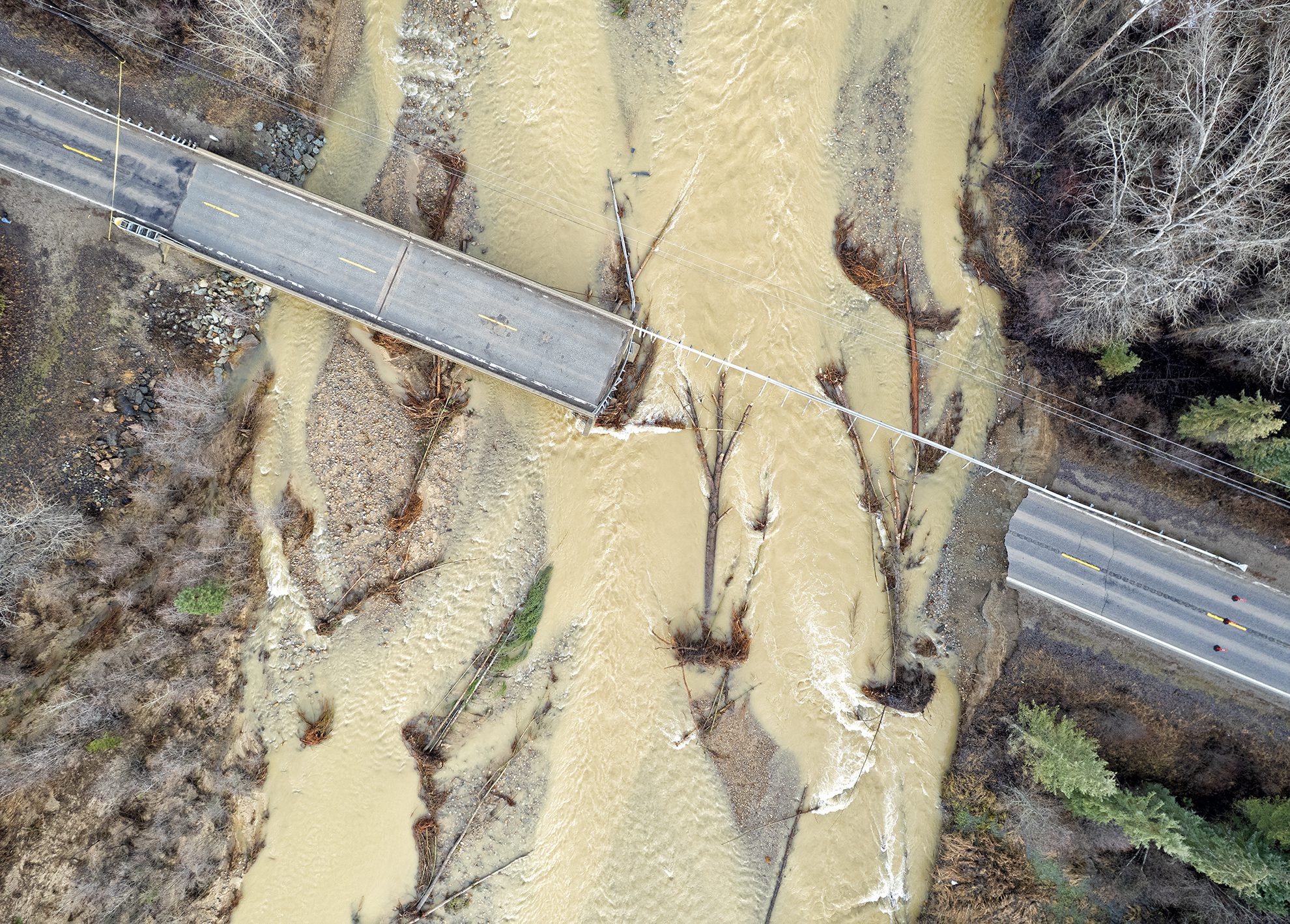
While weather forecasters predicted rain and warned of possible flooding, local officials said they were still caught off guard by the extent of the flooding, which washed out roads, inundated neighborhoods, destroyed at least half a dozen bridges, and may have damaged a dike holding back a reservoir above town. Seventy-two hours after the flooding began, officials on Saturday said they were still a long way from knowing just how extensive the damage was.

“This flooding event will have significant and long-lasting impacts on the south end of the county,” said Lincoln County Sheriff Darren Short during a town hall meeting in Libby on Saturday. “We still don’t know the full extent of the damage.”

Boyd White, head of the Lincoln County Emergency Management Agency, has been running on “caffeine and sugar” since late Dec. 10 when the first reports of flooding emerged along Granite Creek. White and other emergency responders quickly assessed the situation and began dispatching trucks with dirt and sandbags to key locations along Granite, Libby and Flower creeks, which were all quickly rising. White said that while forecasters had initially predicted the water would peak around 2 a.m., it kept rising. 

“It took us by surprise,” Boyd said during Saturday’s town hall meeting at the Dome Theater downtown. 

By daybreak, water surrounded homes south of Libby, particularly along Farm to Market Road. The flood water also damaged or destroyed multiple bridges. Before officials could close Farm to Market Road, one man drove his vehicle off the bridge, Short said. While he was able to get out to safety, locals said the car remains in the river. 

Crooks said after sheriff’s deputies woke him up early Dec. 11, he moved his car to higher ground and then started filling sandbags to protect his and his neighbor’s homes. He said that numerous neighbors lent a hand that day, including a local church group and some high school students who helped fill bags with sand and build a berm across Granite Creek Road. “It’s a tragedy,” Crooks said, “but the camaraderie really lifts your heart.” 

Jeff Gruber, a local historian and former teacher at Libby High School, said this week’s flood was similar to one in 1974, when melting snow and heavy rain sent Libby Creek and others over their banks. That flood took out several trailer homes that had been hastily built in less-than-ideal locations during the Libby Dam construction boom. Gruber’s dad was contracted to rebuild a bridge after that flood, and he recalls the National Guard being deployed to help with the cleanup. 

“All that water came down the hill at once,” he said, comparing this week’s flood to the one a half-century earlier. 

Residents grab cases of water and gather
outside of a town hall meeting about local flooding in downtown Libby on Dec. 13, 2025. Justin Franz/MTFP Credit: Justin Franz / MTFP

Levi Thompson owns a construction company and lives along Libby Creek. He said water had come up to his house on Dec. 11, and while he was pretty sure most of his property had escaped damage, he had yet to have the time to do a complete assessment. Since the flooding began, he had been running around town with equipment to help clear debris building up under bridges for the City of Libby, Lincoln County and BNSF Railway. On Saturday morning, he and his crew were heading to Troy to work on a bridge there. 

Local officials said that while they know of seven damaged or destroyed bridges and numerous washouts, they expect they will find more in the weeks and months ahead, especially along remote roads in the Kootenai National Forest that surrounds Libby and nearby Troy. Short said deputies have been patrolling the county and reporting damage as they find it. He encouraged the public to report new damage. White said the damage assessments will help the county when applying for help from the state and federal governments to rebuild. He predicted that it would be a lengthy and expensive endeavor. 

“It could be in the tens of millions of dollars, and I wouldn’t be surprised if it’s in the hundreds of millions,” he said. “It’s going to be huge.” 

While creeks in the area had dropped significantly by Saturday, additional rain is in the forecast for early next week, and local officials said they’re not out of the woods just yet. There is also concern about the stability of a municipal reservoir about 1.5 miles from downtown Libby. On the night of Dec. 12, Lincoln County officials warned residents along Flower Creek that the flooding may have compromised a dike holding back the Lower Flower Creek Reservoir. The lower reservoir is one of two that hold the city’s drinking water. The larger reservoir is held back by the Flower Creek Dam, which was rebuilt about a decade ago. City officials said the larger structure had not been damaged in the flood, despite rumors circulating on social media. 

Flower Creek Dam, Libby’s drinking water source, is seen Dec. 12, 2025.

During Saturday’s town hall, officials said they were continuing to monitor the condition of the dike holding the lower reservoir, but that they did not believe evacuations were warranted at that time. Short said while the reservoir was designed to hold about 29 acre feet of water, its actual capacity is considerably less than that because of sediment gathered at the bottom. If the dike were to break, it would likely flood Flower Creek toward downtown and possibly inundate some neighborhoods, but it would not be catastrophic, White said. To make that point even clearer to those at the town hall, White said he lives along Flower Creek and for now, he’s staying put. 

“Could there be damage? Yes,” White said. “But I don’t think we’re going to see homes washed away and piled up.”

On Sunday afternoon, Lincoln County announced that it had begun to slowly drain off the lower reservoir to reduce pressure on the dike. Officials said they planned to drain the reservoir over three days. 

A bridge on Farm to Market Road south of Libby was destroyed on Dec. 11, 2025, during flooding caused by heavy rain and melting snow. Credit: Justin Franz / /MTFP

The City of Libby has issued a boil order for all residents, encouraging them to boil water for at least three minutes before consuming it. During Saturday’s town hall meeting, officials said that order would probably remain in place for another week. 

The National Weather Service is also predicting more rain, with another atmospheric river arriving from Monday through Wednesday. Forecasters are calling for 1 to 2 inches of rain in the valleys and 2 to 3 inches in the mountains. White said that while that event will likely cause area creeks and rivers to rise again, he’s hopeful there won’t be a repeat of this week when more than 12 inches of rain fell in some parts of the Cabinet Mountains.

Meanwhile, residents like Crooks continue to watch the water and fortify the sandbag berm protecting his house along Granite Creek. 

“Only God knows when it’ll stop,” he said.

The post  ‘It took us by surprise’: Rapidly rising floodwaters, a 1 a.m. wakeup and washed out bridges in Libby appeared first on Montana Free Press.

Did reintroducing wolves in Yellowstone somehow save the park’s aspen trees?

Did reintroducing wolves in Yellowstone somehow save the park’s aspen trees?
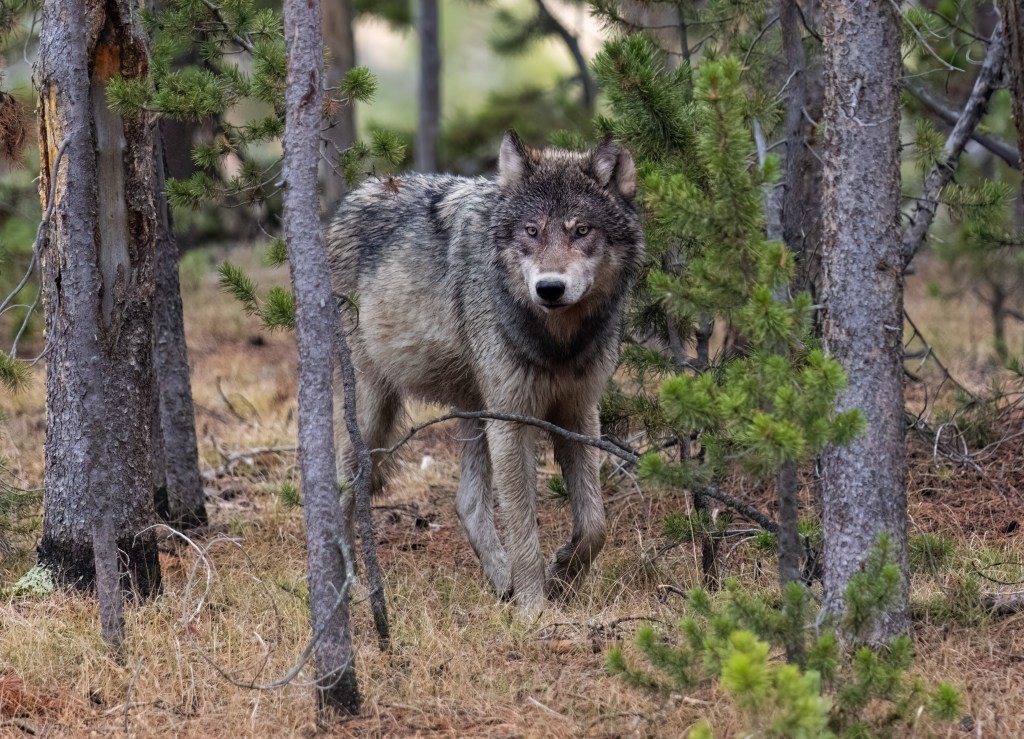
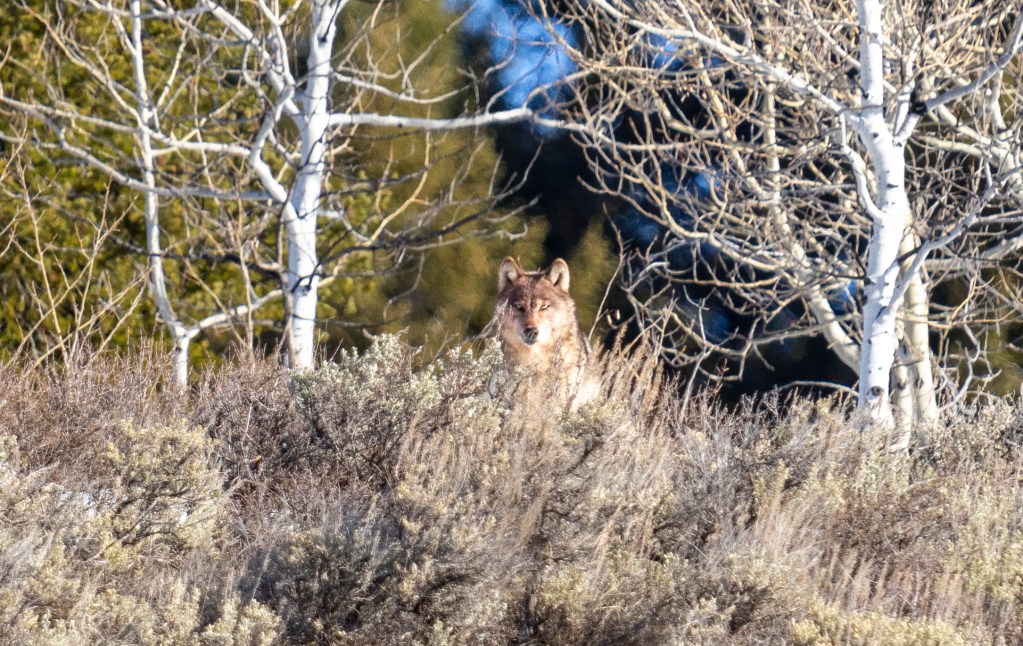
A wolf from the Wapiti Lake Pack in Yellowstone National Park stares through the trees in fall 2025. For decades, scientists have debated the concept of the trophic cascade. New research suggests it might not be that simple. Credit: Ben Bluhm

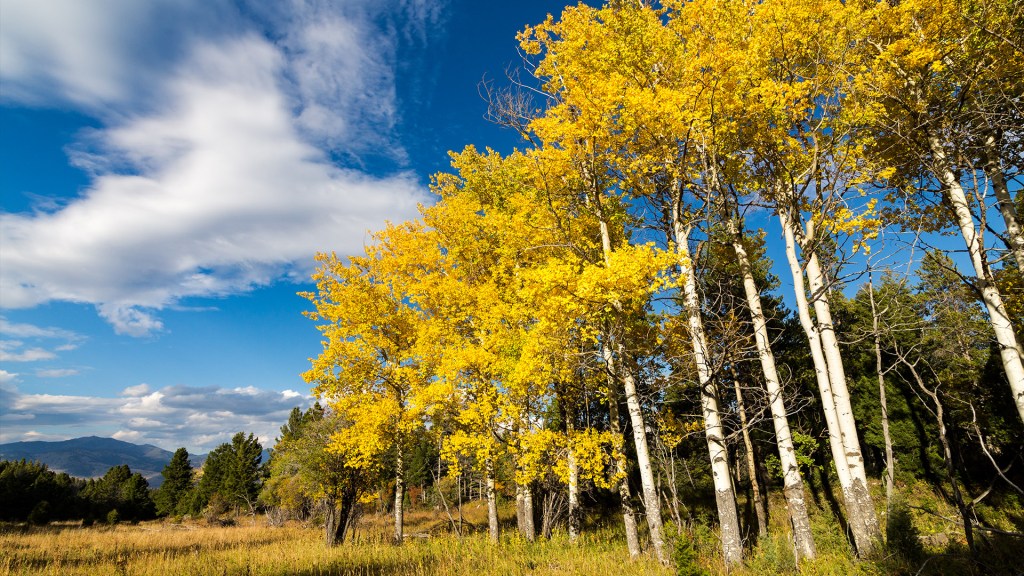
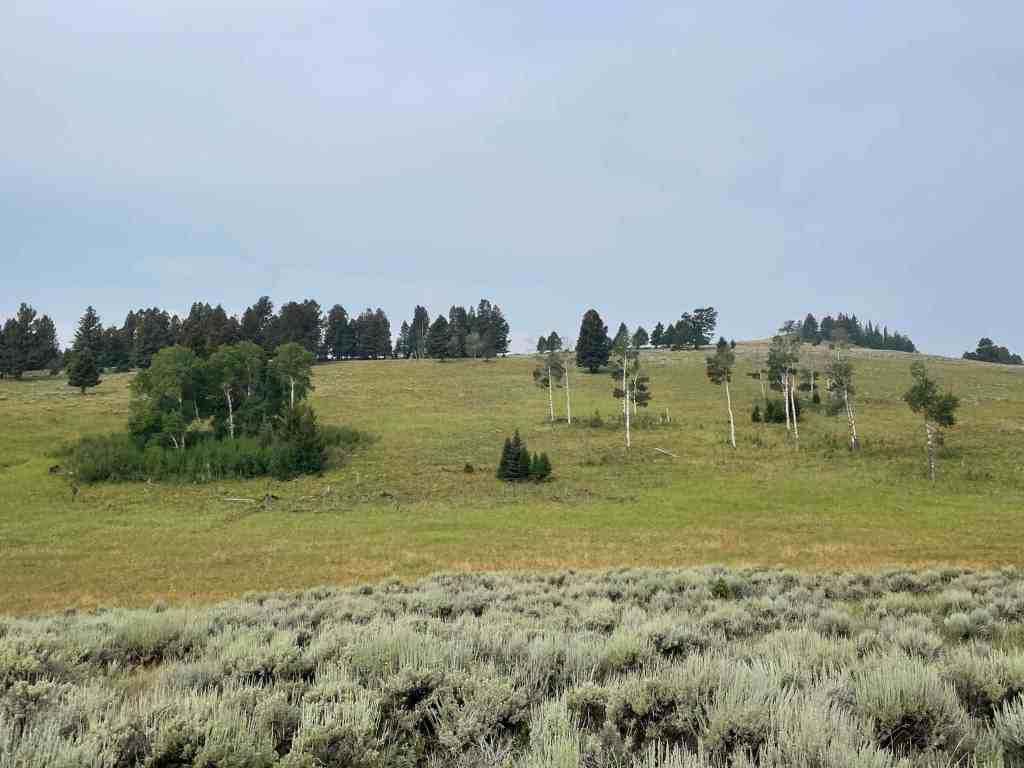
Around Crystal Creek, where the road bridges the Lamar River at the fringe of Yellowstone National Park’s Lamar Valley, a grove of aspens has new life. In 1997, the first year scientists began systematically measuring the park’s aspen population, the stand consisted of towering, century-old trees with no fresh growth in the understory.

Website for Mountain Journal
This story also appeared in Mountain Journal

Today, the scene is dramatically different. A thicket of young aspens now blankets the ground. Many of the saplings are already taller than the researchers who study them. The grove is not only denser, it expanded its footprint.

Crystal Creek has become synonymous with the ecological benefits of wolf restoration. It’s home to one of the pens where wolves were kept during their 1995 reintroduction, and it’s also a hotspot where aspen growth has surged over the past three decades. 

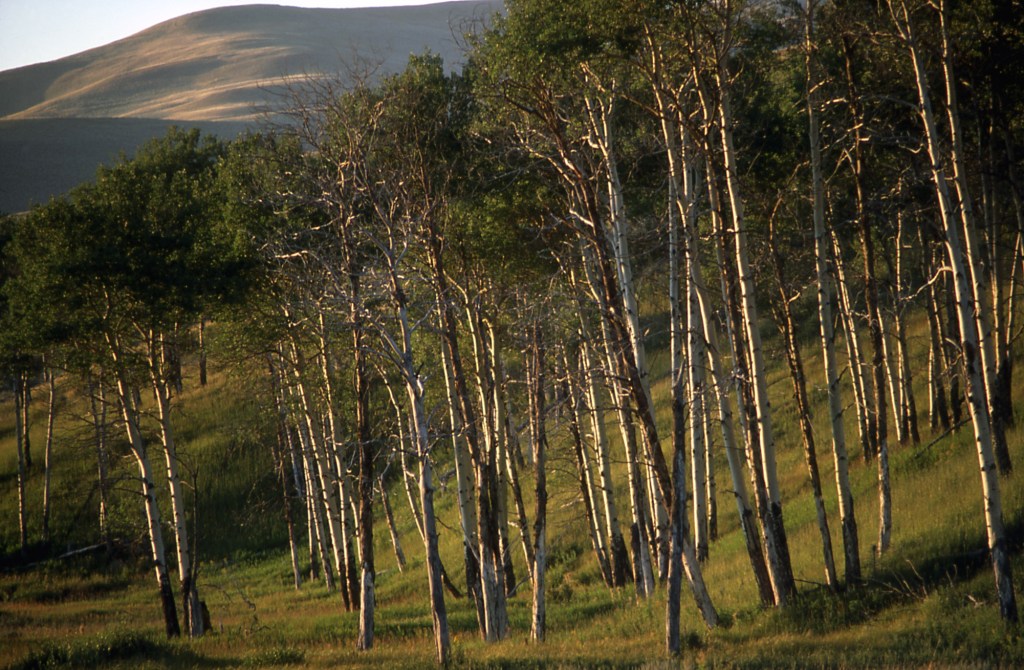
Quaking aspens grow in colonies, sending up genetically identical shoots from a shared root system. In much of the 1900s, massive elk herds devoured virtually every new aspen shoot that broke through the soil, stifling the growth of new trees.

But shortly after the 1995 wolf reintroduction, the elk population fell and some aspen sprouts slipped past the hungry herbivores. While a flood of news articles, Facebook posts and YouTube videos have attributed the change to wolves, scientific evidence for this conclusion is limited. And some scientists believe that aspen regrowth in the park has been exaggerated. 

An aspen stand in Yellowstone with few new sprouts growing. Credit: Yellowstone Forever

The idea that canines protect Yellowstone’s aspens from herbivores dates back at least a century. In the late 1800s and early 1900s, rangers in the park shot hundreds of wolves, bears, cougars and coyotes in a bid to boost deer and elk numbers. In 1926, the same year park rangers wiped out Yellowstone’s last wolf pack, biologist Edward Warren was already warning that the carnivore purge was harming the park’s aspen groves.

“There has doubtless been a great increase in the number of beaver in the Yellowstone Park of late years,” he wrote in his 222-page report. “When over two hundred coyotes are killed in a single season, as in 1922, the animals which formed part of their food are bound to profit by it and to increase in numbers. The result has been what is probably an unnatural expansion of the beaver population.”

Warren went on to describe what zoologist Robert Paine would 54 years later call the “trophic cascade.” The expanded beaver population had chomped down nearly all of the large aspen trees near the streams and ponds of Tower-Roosevelt. While thickets of young sprouts remained, most trees near beaver dams with a trunk greater than two inches had become food or building material.

Aspen stand with strong regrowth (left) and aspen stand with little regrowth (right). Credit: Dan MacNulty.

By 1955, both beavers and aspens had disappeared from the ponds and creeks of Tower-Roosevelt. Beavers had chewed down the old trees, while the soaring elk population had consumed the young ones, suggested William Barmore, a park biologist who studied the park’s elk herds. Aspens continued to survive beyond the beavers’ reach, but these groves, which Barmore described in a 1965 research report, looked very different from the ones Warren photographed.

“In most stands the only aspen age classes present were decadent, overmature trees and root sprouts from one to a few years old that were browsed off to a height of one or two feet each winter,” Barmore wrote. He noted that hungry elk chomped down on aspen shoots each winter when grass was scarce, preventing any sprouts from becoming mature trees. 

An individual aspen seldom lives more than 200 years. Without successful regeneration, entire stands disappeared as the old trees died.

Barmore believed that elk were responsible. “Sometime after 1880 the relative number of elk utilizing park ranges, particularly during the winter, began to increase,” he wrote, listing hunting and development north of the park, as well as “predator destruction,” as possible causes. “Whether the increased use of park winter ranges resulted from an actual drastic increase in the herd or from a bottling up of an abnormally large number of animals on previously marginal winter range is not known,” he added.

Decades of heavy elk browsing left a lasting impact. Studies have found that between 1921 and 1999, new aspen trees grew only on scree slopes and among fallen trees that physically blocked elk access.

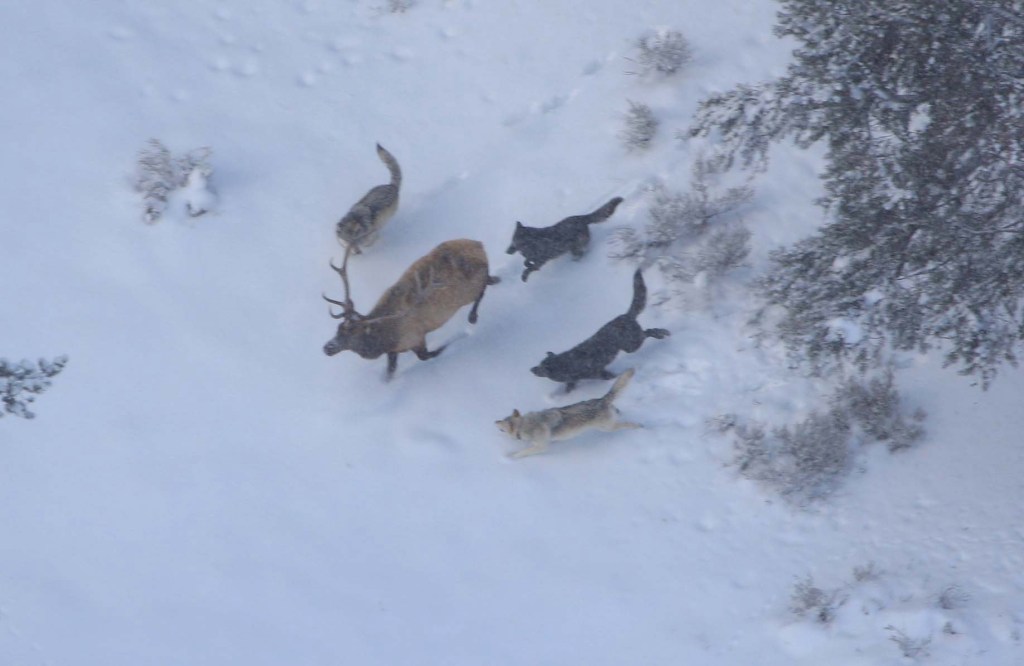
Yellowstone’s Druid wolf pack chases a bull elk in the park, December 2007. Credit: Doug Smith / NPS

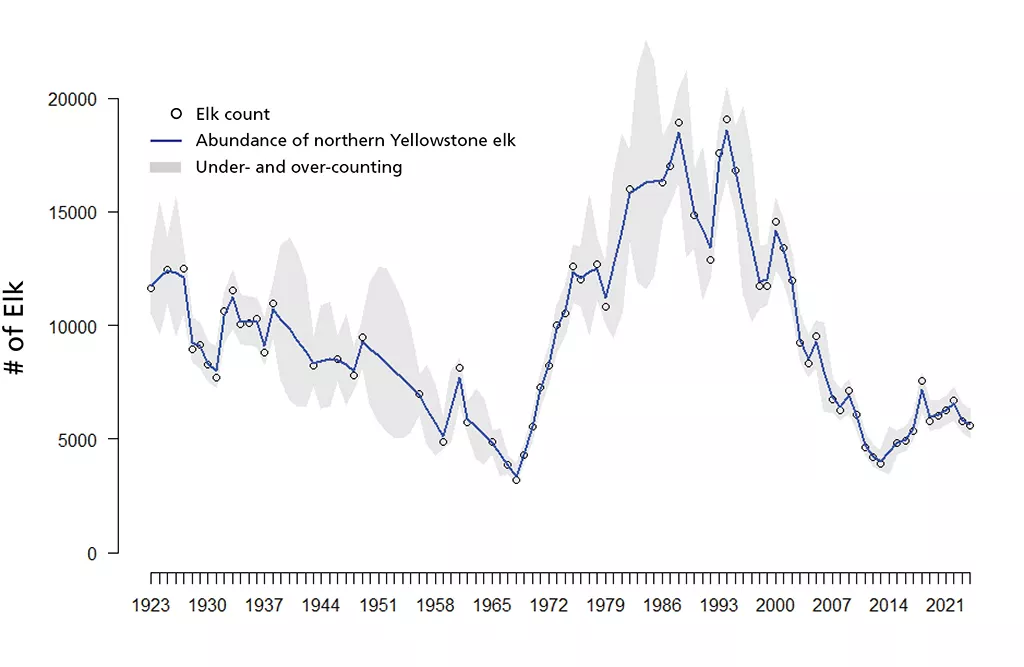
At the dawn of the 21st century, the situation began to change. The winter elk population in northern Yellowstone fell from a record high of 17,000 in 1995 to less than 2,000 by 2012. Multiple studies conducted in the early 2000s showed that some aspen sprouts were escaping elk browsing and growing tall.

A study published in July 2025 summarized more than two decades of data, finding that the number of young trees taller than six feet increased more than ten-fold between 1998 and 2021. While new aspen trees were virtually absent from northern Yellowstone in 1998, the study found, 43 percent of stands contained them by 2021.

The surge in new growth seemed to parallel the 1995 wolf reintroduction, and media coverage highlighted the connection. “Since wolves’ return, Yellowstone’s aspens are recovering,” read one Washington Post headline in August 2025. “Aspen trees are returning in Yellowstone, thanks to wolves,” read a July 2025 headline from the aptly-named Aspen Public Radio in Aspen, Colorado.

Daniel MacNulty, an ecologist at Utah State University, took issue with these conclusions. In a recent critique, he highlighted a small number of exceptional stands that drove the large increase in trees described in the study, while most aspens showed little change over the same period.

Luke Painter, the Oregon State University ecologist behind the study, agreed that the headlines simplified the data. “There are significant changes, and there are beginnings of recovery, but it’s patchy and it isn’t happening everywhere,” Painter told Mountain Journal. “But a trophic cascade does not have to be everywhere to be significant.” 

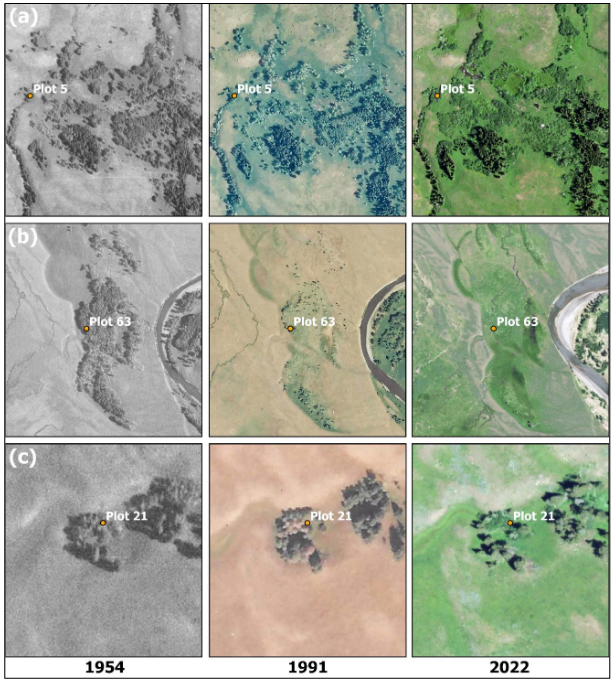
In a recent master’s thesis from MacNulty’s Utah State lab, scientists argue that the surge in young trees might be less impactful than previously stated. They used aerial photos to measure the physical area covered by 73 aspen stands on the Northern Range in 1954, 1991 and 2020. The results, which have not been previously reported by any media outlet, show that most aspen stands have continued shrinking since wolf reintroduction.

“Maybe there’s some good regeneration in the heart of the stand. But the rate of contraction actually increased after wolves were introduced.”

Nicholas Bergeron, researcher, utah state university

Between 1954 and 1991, when elk populations in Yellowstone reached record highs, the average size of the 73 stands studied dropped 54 percent. Aspen groves then shrank another 59 percent between 1991 and 2020, despite wolf reintroduction in 1995. Only seven of the 73 stands grew larger during after 1991, and Crystal Creek was one of them.

It remains to be seen whether enough young aspens are surviving to reverse the decades-long decline. “Maybe there’s some good regeneration in the heart of the stand,” said Nicholas Bergeron, author of the thesis. “But the rate of contraction actually increased after wolves were introduced.”

Painter believes aspens appear to be declining because many aspens on the Northern Range are near the end of their lives. “The older trees have been dying off at an accelerated rate since the 1990s,” Painter said in response to the thesis. “Of course it looks like the stands are shrinking. Some of them have lost all their large trees.”

Even where aspens are making a comeback, scientists debate the role that wolves have played.

A wolf peers through a stand of leafless aspen trees in Grand Teton National Park, spring 2024. Credit: Ben Bluhm Credit: Ben Bluhm

The grasslands and sagebrush steppe of Yellowstone’s Northern Range support the park’s largest elk herd. Each winter, when snow piles up in the high county, thousands of elk descend into the valleys of northern Yellowstone and adjacent lands. The herd has shrunk dramatically over the past three decades: from 17,000 in 1995 to 6,673 in 2022, according to some of the most recent data from the Park Service

“Elk have declined a lot since wolves were reintroduced, but it’s not clear that that’s due to wolves,” said Chris Wilmers, an ecologist at the University of California, Santa Cruz and the author of another recent study that assessed the impacts of large carnivore recovery across North America. “Other predators have been recovering, there’s been a lot of human hunting of elk, there’s a growing bison population that’s competing substantially with elk, and outside the park ranchers are increasingly tolerant of elk feeding in their irrigated pastures so they have less of a need to migrate into the park in the first place.”

“Most ecologists suspect that wolves and other predators have something to do with the decline of elk,” Wilmers continued. “But how much can be attributed to wolves, how much can be attributed to predators in general, how much is attributed to those other causes hasn’t been worked out yet.”

A figure from Bergeron’s thesis showing a stand with increasing aspen cover (a), decreasing aspen cover (b), and unchanging aspen cover (c). Credit: Nick Bergeron

Cougars, hunted aggressively within the park in the early 1900s, have increased in numbers since the 1980s. As well, the number of grizzly bears in Greater Yellowstone spiked from 136 in 1975 to about 1,030 in 2024 due to federal protections. Between 1998 and 2004, cougars probably killed more Northern Range elk than wolves, and grizzly bears are the main predator of elk calves, potentially contributing to their lower numbers.

“Elk population dynamics are extraordinarily complex and you really can’t pin elk numbers to any one thing,” said wildlife biologist Doug Smith, who led the park’s wolf program from 1995 until his retirement in 2022. He said that the reduced elk population boils down to three factors: carnivores, people and climate.

Human hunting, which killed more elk than wolves between 1995 and 2004, has declined, allowing more elk to survive outside the park in winter, said Smith, adding that warming winters are also luring elk into snow-free valleys north of Yellowstone. “Forty years ago, 80 percent of the elk herd wintered inside the park,” he said. “Now 80 to 90 percent winter outside the park.” 

Decades of research shows that elk generally eat aspens in winter when other foods are scarce.

The population of the northern Yellowstone elk herd over 100 years. Credit: Yellowstone National Park

Smith emphasizes that predators have been a fundamental driver of the change in elk numbers and distribution, and that wolves are one of the park’s most important predators.

The popular video, “How Wolves Change Rivers,” says that fear of wolves “radically” changed elk behavior by making them avoid aspen thickets and steep riverbanks where they might become an easy meal. Some studies from the 2000s supported that conclusion, but more recent research has sowed doubt on this idea.

A 2024 study compared the likelihood that an aspen would be eaten by elk to where wolves kill elk, where wolves spend most of their time, and eight other variables that could show whether an area was unsafe for elk. The results showed little correlation between aspen browsing and the risk of wolf predation. 

“If elk are avoiding wolves at those risky sites, they’re going back at a different time of day and still eating the aspens,” said study lead author Elaine Brice, a researcher at Cornell and a former PhD student in MacNulty’s lab. “It’s not at a big enough timescale to push them off of aspen in a way that will be meaningful for aspen growth.”

Brice’s analysis identified the single best predictor of aspen browsing: the number of elk in a certain place at a certain time. Wolves may indirectly protect aspens by suppressing elk populations, but not by scaring them away from specific patches, she said.

“Elk population dynamics are extraordinarily complex and you really can’t pin elk numbers to any one thing.”

doug smith, former project leader, Yellowstone Gray Wolf Restoration Project, Yellowstone National Park

Brice, who has also published research suggesting that the rate of aspen recovery has been exaggerated, said aspen recovery could take many decades. In addition, wildfire stimulates aspen growth, and many stands might grow back stronger after the next major fire resets the forest.

Aspen recovery might also be limited by record-high bison populations that trample and eat aspen sprouts in some areas, according to Painter.

MacNulty says the future of aspens in northern Yellowstone is far from certain. Research modeling the climate of Yellowstone indicates that most of the Northern Range might be too hot and dry for quaking aspens by the year 2100.

Regardless of what the future holds for the iconic aspen trees, a number of scientists believe the story has stepped over the data. “It’s undeniable that there has been some benefit to wolf reintroduction,” Bergeron said. “But the narrative that wolves are a kind of silver bullet that saved the aspen in Northern Yellowstone is oversimplified.”

An aspen stand in 1977 without any new sprouts growing. Credit: J. Schmidt / NPS

The post Did reintroducing wolves in Yellowstone somehow save the park’s aspen trees? appeared first on Montana Free Press.

Crow Tribe looks to ‘reset the clock’ on blood quantum requirements, expand enrollment

Crow Tribe looks to ‘reset the clock’ on blood quantum requirements, expand enrollment

A proposal by the Crow tribal chair could dramatically change who counts as a Crow tribal member under the “blood quantum” standard, a concept created by White settlers and rooted in assimilation tactics.

Blood quantum refers to the fractional amount of tribal affiliation in an individual’s ancestry. It is central to individual identity and highly controversial. 

Right now, according to the tribe’s enrollment policy, an individual must “possess one-quarter Crow Indian blood” to enroll as a member of the Crow Tribe. The proposed legislation from Chairman Frank Whiteclay would alter things so that all existing members would be considered as having 100% Crow “blood.” That would change the lives not just of the 14,289 enrolled Crow tribal members but also potentially thousands of descendants who would be more likely to qualify as tribal members and receive services.

Most tribes nationwide use blood quantum to determine eligibility for citizenship. And being an enrolled citizen of a tribe can make someone eligible for certain health care services and determine whether they can vote in tribal elections, access educational scholarships or inherit certain land. Tribal colleges must serve a certain number of enrolled tribal members to maintain their status. Tribal citizenship also influences a person’s sense of belonging.

The legislation, Whiteclay said, “will affect all of the reservation in a huge way.”

Experts say tribes nationwide will have to contend with blood quantum in the near future. Its limitations, one California Law Review article contends, “threaten to jeopardize the existence of Native nations, as you cannot have a nation without citizens.”

John Stember
An Allotment Act pin north of Browning on the Blackfeet Reservation, photographed on Aug. 27, 2025. The federal government used blood quantum to determine people eligible for land allotments.  Credit: John Stember / MTFP

Jill Doerfler, who heads the department of American Indian Studies at the University of Minnesota Duluth, said any tribe that uses blood quantum “has an expiration date.”

“That’s what blood quantum is designed to do,” she said. “So, in effect, making everyone four-fourths resets the clock. It doesn’t stop the clock, but it hits reset.”

Tribal Secretary Levi Black Eagle said the notice of the proposed legislation was sent to the tribe’s 18-member Legislature and will be added to the body’s January meeting agenda. A committee will discuss the legislation and propose amendments. And if the act passes the Legislature by a simple majority, it will return to the chair, who can sign it into law.  

Black Eagle acknowledged that the act isn’t a perfect solution to the generations-long blood quantum conundrum. 

“The United States government requires us to have some sort of metric in place to say, ‘OK, these people qualify as a legal member of the tribe,’” he said. “So we’re taking the leeway we have within that system and flexing our sovereignty.”

Whiteclay, whose term as chairman ends in 2028 and who cannot run again because of term limits, said he proposed the legislation to “break a cycle of lost enrollment” and to improve the lives of members and descendants. 

He referred to the issue of blood quantum as “death by numbers.” With each new generation, and as tribal members marry non-Natives or people from other tribes, it becomes harder for the Crow Tribe, and for any tribe using blood quantum, to maintain its membership. Whiteclay said when he took office as chairman in 2020, the tribe had about 14,600 members. Five years later, that number has declined by at least 311 people. 

The proposed legislation, Whiteclay said, will also address several other issues for community members. 

“There’s a lot of kids and people on the reservation; everything about them is Crow,” Whiteclay said. “They live here, they’re part of the culture. Everything about them [is Crow] except their blood quantum by a very small percent, a small fraction.” 

For Black Eagle, a supporter of the legislation, the issue is personal. He said that because his mother-in-law is a member of another tribe, his wife grew up being told she’d have to marry someone from a certain tribe if she wanted her children to be enrolled members. 

“It’s sad,” Black Eagle said. “It just really narrows the limits on how you want to live your life. And I don’t think us tribal members should have that in the back of our mind. I think that we should just be free to live our lives and love whoever we want and make a family with whoever we want.”

Blood quantum, Black Eagle said, is not used to define other groups of people.

“People say, ‘What pedigree does your horse have?’” he said. “Or, ‘How much does your dog cost? Does it have papers?’ That’s the kind of vein we’re in. But we’re not animals.”

While early reactions to Whiteclay’s Facebook post indicated widespread support, expanding blood quantum requirements is controversial. A popular counterargument is that broader enrollment requirements could result in more people vying for fewer resources in a federal system where resources are already scarce

“I think that we should just be free to live our lives and love whoever we want and make a family with whoever we want.”

Levi Black Eagle, Secretary of the Crow Tribe

But for Whiteclay, the issue “is bigger than ourselves.”

“We have to have that mentality that the tribe as a whole should benefit,” he said. “Not just a certain few.” 

Blood quantum controversy, Doerfler said, often reveals different attitudes towards citizenship. 

“Some people might think about every citizen as draining the nation, as taking something,” she said. “Other people might see more citizens as having more power, more leverage, more votes, more lobbying. Maybe they see more citizens as contributing something.”

One of the first deployments of the concept of blood quantum was in Virginia in the 18th century. At the time, it restricted the rights of anyone deemed more than 50% Native American. 

From 1887 to 1934, the federal government divided reservation land into allotments for distribution to individual tribal members with the goal that private ownership would assimilate Native Americans into White society. The government used the concept of blood quantum to determine who was eligible for allotments. And in 1934, with the passage of the Indian Reorganization Act, tribes began using blood quantum as a requirement for their own citizenship. 

Blood quantum was determined in different ways for different tribes. The Bureau of Indian Affairs, for example, used census rolls to assign blood quantum to some Native Americans, though their calculations were often incorrect. Doerfler said blood quantum for the White Earth Nation in Minnesota was established by anthropologists.

“They came and measured people’s heads and did a scratch test on the chest to see the reaction of the skin, took hair samples, did analysis of the hair samples and cobbled together blood quantum out of that,” she said.

That process, which serves as the basis for blood quantum for tribal members today, Doerfler said, is inherently flawed. She said she has seen blood quantum rolls of biological siblings with vastly different quantum amounts. 

“What we can see in those inconsistencies is that there is no way to measure blood quantum,” she said. “What test are you going to do to measure blood?”

Historically, tribes did not determine membership based on biological ancestry. Doerfler said some tribes adopted people into the community, or based membership on factors such as where a person lived or their relationships within a community. Identity, she said, cannot be measured in the way blood quantum suggests. 

“Sometimes, I try to get people to think about American citizenship,” she said. “How much American blood do you have? How much Montana blood do you have? Or how much Minnesotan blood do you have? It’s not a thing. You can say, ‘I was born and raised here. My parents were born and raised here.’ But there isn’t a ‘blood’ associated with that.”

The post Crow Tribe looks to ‘reset the clock’ on blood quantum requirements, expand enrollment appeared first on Montana Free Press.

The debate over the future of passenger trains in Montana

The debate over the future of passenger trains in Montana

Last year, nearly 98,500 people in Montana boarded or departed the Empire Builder, the train that rumbles across the Hi-Line as it connects Chicago to the Pacific Northwest. Passenger numbers have climbed from a COVID-era low of about 65,700, but remain well below the most recent high of 156,700 in 2010, according to the U.S. Bureau of Transportation

Is that a sign that demand for passenger trains in Montana is dropping or that the trains are in the wrong places, far from major population centers? That depends on who you ask. But despite the current state of passenger train travel in Montana, there is a growing group that wants to see another route emerge. 

In November, a coalition of counties focused on building a southern route added its 20th member. Together they make up the Big Sky Passenger Rail Authority, a rare form of government agency hoping to develop a new passenger line with twice-daily service through Billings, Bozeman and Missoula, three of the state’s largest cities that lie along Interstate 90. 

Montanans eyeing expensive plane tickets or worrying about the TSA’s new surcharge for air travelers without a REAL ID might be intrigued by the prospect of a route between the state’s major metropolitan areas.

Montana Free Press sifted through documents, attended transportation meetings and spoke to official (and self-appointed) Montana train experts to try to answer these questions. 

The Big Sky Passenger Rail Authority was incorporated in 2020 via a century-old Montana law. The agency is hoping for operational passenger service by the early to mid-2030s. 

“We put a person on the moon in the 1960s in less than 10 years. For God’s sake, we should be able to get a train running on existing infrastructure in less than that,” Dave Strohmaier, BSPRA’s president, said in a recent interview with Montana Free Press. 

BSPRA plans to run along an old route that Amtrak discontinued in 1979, called the North Coast Hiawatha. BSPRA is not currently planning to lay new sections of track in Montana, but instead intends to modify existing freight corridors to allow passenger trains to coexist. 

”What we would be picking up — by way of this expanded service in southern Montana — is connectivity to all of the major population centers in both the states of Montana and North Dakota, and layer in an additional handful of iconic national parks, like Yellowstone and Theodore Roosevelt National Park in North Dakota,” Strohmaier said.

BSPRA doesn’t have many details about scheduling, stops, ticket prices or the specific types of trains that would carry passengers. But Strohmier hopes to offer twice-daily service at each stop and feels confident the route would run through three of Montana’s largest cities. (Strohmaier also serves as a Missoula County commissioner.)

BSPRA’s ally in the state Legislature, Rep. Denise Baum, D-Billings, tried and failed to secure millions in funding for the early stages of route planning during the 2025 legislative session. U.S. Sen. Tim Sheehy, R-Montana, who delivered a virtual keynote at BSPRA’s annual conference in September, is sponsoring a bill in Congress that would eliminate the need for matching investments from local and state governments for large-scale railroad projects. (Though most of the funding would come from the federal government, the early planning phases require a local investment BSPRA is currently struggling to acquire.) The bill has not progressed since Sheehy introduced it in late September.

The most vocal opponents to a new passenger rail route, including 40-year veteran of the freight rail industry and passenger-rail enthusiast Mark Meyer, peppered BSPRA’s Facebook page with enough dissent to prompt the agency to turn off comments. 

“You have to tell people what the obstacles are, what’s going on. And Amtrak is in such sorry shape now, we really need to fix what we have, otherwise we’re going to lose it all,” Meyer told MTFP in a recent interview.

Meyer developed his most personal connection to railroads during the 13 years he traveled on Amtrak’s Empire Builder line between Seattle and Cutbank, his hometown, to visit his mother while she was suffering from Alzheimer’s. 

“It was a lifeline,” Meyer said.

Meyer now publishes opinion pieces in publications across the West about the rail industry from his home in Portland, Oregon.

He decries money that might be spent on scoping, securing and setting up the new route for a number of reasons, including the lack of details about that route and operating schedule, that he considers “imperative to determine the utility of a service.”

About $4 billion, according to the Glendive Ranger-Review’s reporting on a 2024 estimate from the Federal Railroad Administration. Here’s the breakdown:

  • $1.1 billion for five train sets, including locomotives and passenger cars.
  • $1.3 to $1.7 billion to build and maintain facilities, including stations, along the route.
  • $930 million for track development and improvement. Though track already exists to carry freight through the proposed southern route, BSPRA anticipates the need for upgrades, like new signals and areas of double-track.
  • $136 million for operation and maintenance.

That estimate doesn’t factor in current unknowns, like the exact necessary improvements on existing tracks that engineers would assess before breaking ground. 

Astute! Amtrak’s Empire Builder, inaugurated in 1929, connects Chicago to the Pacific Northwest via a route that stops at 12 northern Montana towns between Libby and Wolf Point. This is the route Meyer used to visit his mother in Cutbank. 

A trip between Chicago and Portland takes about 46 hours — about 11 of which are through Montana — via Superliner cars pulled by ALC-42 locomotives. For a full trip from end to end, a coach seat costs a few hundred dollars and a private room is between $650 and $1,000. 

The service is not doing particularly well. About two-thirds of the number of people ride the Empire Builder today compared to ridership in 2008. Though traveler numbers are up since a COVID-driven decline, they remain lower than before the pandemic. Railway Age, a train-focused trade publication, published a story in late September that revealed a host of problems facing Amtrak’s long-distance trains like the Empire Builder, including a combination of limited funding and archaic equipment that cause frequent delays. Meyer worries that a new line would face the same ridership challenges and equipment failures that plague the Empire Builder. 

“My biggest problem with the Big Sky Passenger Rail people is they’re a distraction because they’re going full-speed ahead, telling everybody, ‘Yeah, this is gonna happen in the 2030s.’ And they rarely mention the clear and present danger that affects the long-distance trains,” Meyer said.

Meyer thinks federal funds would be better spent on reinvigorating the ailing rail manufacturing industry. 

“If the stations, the track structure, the equipment and the mechanical facilities could drop out of the sky tomorrow and be in place, I’d be right on board with them. But being reality-based, I know that that’s not the case,” Meyer said. “And knowing that, you have to understand that I believe that the Empire Builder and all the other long-distance trains are going to be discontinued if we continue on the same path — we are not addressing this equipment problem.”

He believes Amtrak should reinforce its existing routes in dense areas and expand in populated areas, like the Midwest, instead of growing its already lagging long-distance rail in places like the Mountain West. 

“Let’s make sure that what we have right now is saveable before you have some pie-in-the-sky fantasy about additional trains,” Meyer said. 

But Strohmaier says the proposed southern Montana route wouldn’t face the same challenges as the Empire Builder due to the difference in geography between the two services.

“You look in North Dakota and Montana, the Empire Builder doesn’t pass through any major communities,” Strohmaier said. 

Strohmaier also believes the new route, much like the Empire Builder, could provide access to long-distance travel for rural Montana communities not in proximity to highways or airports. A 2025 study published by the Federal Railroad Administration about potentially adding passenger routes nationwide said the new routes, including the proposed line through southern Montana and North Dakota, could increase rural access to long-distance transportation from 30% to about 48%. 

Truth be told, no one really knows. Long-distance rail investment at this scale is unprecedented in the 21st century. And challenges, like rallying the rail manufacturing industry, remain for BSPRA even if it overcomes funding obstacles. 

Undeterred, BSPRA is on a slow and uncertain track toward a southern passenger route through Montana. The agency is currently finalizing the first part of the Federal Railroad Authority’s three-step process called the corridor identification program.

“The corridor identification program is the mechanism by which the Federal Railroad Administration moves projects from concept into design into being a shovel-ready project that can break ground,” Strohmaier said. 

Amtrak received a $500,000 grant from the Federal Railroad Administration to complete the first step of the process in 2023. Using those funds, they estimated the second step, drafting a service development plan, would cost about $11 million. The federal government could cover most of that, but it requires either a $1.1 million local investment, like the one Baum failed to pass in the state Legislature, or the success of Sheehy’s bill in Congress, which would shift that project planning gap to federal funding.

The third step of the corridor identification program, which includes preliminary engineering and environmental reviews, costs an amount to be determined and would require a 20% local match. 

Despite the reality that it would be a decade until the new operating route through southern Montana would hypothetically begin service, Strohmaier continues to lobby at the local, state and federal levels to secure early rounds of funding for planning the line. 

 “I would not have spent the last five years of my life doing this unless I thought it was something that we could actually achieve,” Strohmaier said.  

The post The debate over the future of passenger trains in Montana appeared first on Montana Free Press.