
Mendocino County Board of Supervisors repeal unlawful public records fees and roll out expedited email deletion policy
MENDOCINO Co., 5/9/23 — The Board of Supervisors voted unanimously Tuesday morning to repeal Ordinance 4507, which authorized county officials to violate state law as a cost-savings measure related to answering public records requests, less than a year after the controversial legislation was first proposed last June. But now they’re looking to reduce the costs associated with releasing public records through a new “email retention policy” authorizing staff to delete public records within six months of receipt. (Watch the full meeting here.)
“All email will be retained in the County email system for a period of six (6) months. After this time, emails will be disposed of unless they are specifically archived in accordance with the retention periods outlined in the subfolders described below,” Section 5.1 states.
The subsequent text indicates that some records may need to be retained for up to 10 years, or on a permanent basis. It does not, however, provide guidance on what kinds of records will need to be retained for longer than six months. Rather, the new policy gives individual staff significant discretion in determining which public records get destroyed: “It is the responsibility of each employee to determine whether an email constitutes a record to retain, and to save any such record as necessary.”
Aside from cases in which County Counsel Christian Curtis orders the postponement of document destruction related to litigation, determining which emails get deleted and on what time frame will have to be done one department at a time. Curtis himself described that as a “heavy lift” — but the policy passed unanimously and without comment from the public.
Supervisor Ted Williams (5th District) verbally acknowledged that the new email deletion guidelines are related to the repeal of Ord. 4507, which he referred to as a “public records tax.”
“This kind of gets at that,” Williams said. “If we store millions of records on a continual basis without additional capability to be able to parse and search, we’re setting ourselves up for failure.”
Later on in open session, the board voted unanimously to repeal the public records fees passed unanimously by the same board in July 2022. The supervisors did not disclose their rationale in open session, but Supervisor John Haschak (District 3) said in February that Ord. 4507 was not on “solid legal ground.” He made those statements after attending a workshop on public records presented by the Orange County Office of the County Counsel.
Local discourse around the legality of the ordinance has revolved primarily around a 2020 decision by the California Supreme Court in National Lawyers Guild vs. City of Hayward where the court ruled that the California Public Records Act does not authorize California governments to assess fees for finding or redacting public records. In the Mendocino County Counsel’s defense of such fees, Curtis argued the law allowing counties to set and adjust a master fee schedule for government services (Government Code Section 54985) could be used as a work-around.
The supervisors initially found that argument persuasive, but opted not to test it out in court after the First Amendment Coalition threatened litigation. It remains unclear whether county counsel’s argument could successfully challenge a California Supreme Court precedent set just three years earlier. The county’s plan for resolving public records requests left pending since Ord. 4507 went into effect last year also remains a mystery.
Three people spoke in favor of repealing Ord. 4507 during public comment, including Carrie Shattuck, who encouraged the board to improve transparency by posting previously released public records on the county’s records portal. (Mendocino County currently requires an additional PRA to be filed in order to access previously published documents under most circumstances.)
4th District Supervisor Dan Gjerde strenuously objected, however, stating many of the public records requests are for county emails and publishing those might make Mendocino County the “laughingstock of the state.” During a contentious exchange with The Mendocino Voice publisher Kate Maxwell, Gjerde asked Maxwell to avoid encouraging any additional requests from the public.
“If that’s the problem that you’re pointing to, it does make people think you’re not interested in transparency,” Maxwell said. “That’s the right of people to file public records requests.”
Maxwell added that public records requests for correspondence like text and email have uncovered corruption scandals throughout the region.
The First Amendment Coalition and the American Civil Liberties Union of Northern California issued a statement acknowledging the repeal of the ordinance Tuesday afternoon.
“It’s good to see that Mendocino finally did the right thing after starting off in the wrong direction,” wrote Chessie Thatcher, a senior staff attorney with ACLU Northern California. “This ordinance should never have been enacted, and the ACLU and FAC — joined by others in the community — were poised to challenge it.”
You can read the rest of their statement and our previous coverage below:
San Rafael, Calif. – Today the Mendocino County Board of Supervisors unanimously voted to repeal Ordinance No. 4507, which authorized the county to charge as much as $150/hour for staff time to locate, review, or redact documents people asked for under the California Public Records Act. The law, passed last July, received widespread condemnation from the public, journalists, and open government advocates. One local media organization, the Mendocino Voice, has been assessed fees in excess of $76,000 since the law was passed.
Mendocino was not the only county in California with an ordinance allowing illegal fees to be charged for public information. According to research by the First Amendment Coalition and the ACLU of Northern California, seven other counties — Los Angeles, Shasta, Siskiyou, Calaveras, Tuolumne, Santa Cruz, and Ventura — have passed similar laws.
The following can be attributed to David Loy, Legal Director, First Amendment Coalition:
“We’re glad the board of supervisors repealed this law. Public records belong to everyone no matter how wealthy. Democracy depends on freedom of information, but information is not public when only the rich can afford it. We hope other counties with similar laws will listen to the public and abolish these undemocratic laws.”
The following can be attributed to Chessie Thacher, Senior Staff Attorney for the American Civil Liberties Union of Northern California:
“It’s good to see that Mendocino finally did the right thing after starting off in the wrong direction. This ordinance should never have been enacted, and the ACLU and FAC–joined by others in the community–were poised to challenge it. The government must provide public information to everyone with as few barriers as possible. When the government doesn’t do that, we have problems with access and equity.”
Previous coverage:
- Editorial: Tell Mendocino County to rescind their unlawful public records fees
- Letter: We’re calling for Mendocino County to overturn the unlawful public records ordinance
- Letter from the publisher: Mendocino County wins “worst” for government transparency (opinion)
- Sunshine Week: national award names Mendocino County one of America’s “worst in government transparency”
- Mendocino County to charge fees for public records
- Free press advocates caution Mendocino County on new public records fee ordinance
- Open letter to Mendocino County supervisors: new public records fees will cost more than they save
Central Valley town seeks $20 million for flood recovery. Will Gavin Newsom fund it?

Central Valley legislators are asking for millions of dollars from the state of California to fund outstanding disaster response needs in Planada, a Merced County unincorporated town that flooded during January’s atmospheric river.
State Sen. Anna Caballero, a Democrat from Merced, supported by Assemblymember Esmeralda Soria, a Democrat from Fresno, have submitted a request for $20 million to fund repairs for flood-damaged households, rental assistance, infrastructure needs, vehicle needs and more. The funding is critical, Planada residents and community members said, because federal relief funds didn’t cover the entire scope of the damage and some residents were ineligible for aid.
Caballero “is currently making a budget request specific to the needs of residents in Planada and will continue to work to ensure that they are able to recover,” Elisa Rivera, communications director for Caballero, said in a statement to The Bee/Fresnoland. Soria also confirmed in an email statement that she supports the request.
During the Jan. 9 storm, large swaths of the majority Latino, unincorporated town of 4,000 residents was submerged under water, forcing residents to evacuate their water-logged homes. Since then, Planada residents, many of whom are agricultural workers, have been grappling with job and economic loss and mold-infested living conditions, as they try to rebuild their homes, community and elementary school.
In late January, the Biden administration approved Merced County for a Major Disaster Declaration, which made the county eligible for assistance from the Federal Emergency Management Agency. And while eligible residents did receive some federal relief, residents and Central Valley legislators say many community members were left out.
New research from the UC Merced Community and Labor Center backs that up. A report released last week finds that 83% of Planada households experienced at least one form of economic loss following the flood. The survey of 236 households found that 57% of Planada households with one or more workers who experienced job loss were ineligible for unemployment insurance, and 64% of households with flood-damaged property were ineligible for federal disaster aid.
The funding request “is a drop in the bucket” of what the community still needs, Sol Rivas, executive director of Valley Onward, said in an interview with The Bee/Fresnoland.
Community advocates, Rivas said, are trying to ensure the county, state and federal governments don’t forget about Planada.
“There’s a long-term recovery process,” Rivas said, “Our hope is that legislators see that and advocate for Planada, and move this ask forward.”

Lawmakers request $11 million for home remediation in Planada
The lawmakers’ request aims to fill huge gaps in funding for home repair, infrastructure and transportation needs.
The bulk of the budget request, or $11.7 million, would be for home remediation costs for flood-affected households.
Researchers found that of the 461 households that experienced flooding, 74% lost property inside their home such as furniture and beds. Meanwhile, 56% of the homes have issues with mold, most of which is a result of the flood.
Federal funds didn’t cover the total costs of damage to Planada households. Of the 164 Planada homeowners that received inspections, the average estimated remediation cost was $34,518 per home, according to the report. Yet the average amount of aid was only $11,628 for the 133 aid-qualifying households.
Another big chunk of the funding request, or $5 million, would be for Planada’s infrastructure needs.
Olivia Gomez, a Planada resident and community liaison for Planada Elementary School District, said the biggest need is fixing the canal infrastructure and other mitigation efforts in order to prevent a future flood, and pointed out that the region experienced similar flood damage five years ago.
“How do we really invest the money where it needs to be invested in order for this not to happen again?” she said.
Madeline Harris, a regional policy manager for Leadership Counsel for Justice and Accountability, agreed. She said state help is crucial given the additional hurdles that rural, unincorporated farmworker communities face.
“Not only are disadvantaged communities and frontline communities more vulnerable to climate change and disasters,” Harris said, “but they also are behind on investments to infrastructure to prevent this from happening, and to recover.”
Another chunk of funding, or $1.1 million, would be for vehicles. For a rural agricultural workforce with few public transportation options, cars are essential to drive to work.
UC Merced researchers found that 46% of flood-affected households lost at least one vehicle that was used to drive to work. Meanwhile, 30 households lost more than one car.
Edward Flores, faculty director of the UC Merced Community and Labor Center, said in an interview with The Bee/Fresnoland on Friday that it was a privilege to work on this research on “one of the biggest climate disasters that happened in our state right here in our backyard.” He said this type of effort — that engages public officials, community organizations on the ground, and research to inform policy decisions — “could be a model” for other communities in flood-impacted areas.
Will the governor fund Planada’s outstanding needs?
It’s not immediately clear if the state will fund Planada’s outstanding disaster needs, especially as California is expected to have an ongoing budget deficit and lower than expected revenues into the 2023-2024 fiscal year.
Less than a year ago, Gov. Gavin Newsom boasted the state had a $97 billion dollar budget surplus.
Central Valley legislators and community groups are hopeful and say the state needs to step up.
“We do know that we’re in a deficit year,” Harris of Leadership Counsel said. “We know that the governor is essentially asking legislators not to make budget requests.”
But “when there’s an emergency,” Harris said, “you have to respond to it.”
Planada isn’t the only community asking for state assistance.
Monterey County Supervisor Luis Alejo said in a tweet Thursday that it has been over a month since he met with state emergency response officials to seek rapid response assistance for undocumented residents who don’t qualify for federal assistance, but there is still “no such assistance on the ground.”
“California must do better for its flood victims,” Alejo said, “especially in disadvantaged communities.”
The post Central Valley town seeks $20 million for flood recovery. Will Gavin Newsom fund it? appeared first on Fresnoland.
Navarro River, two more Mendocino Coast watersheds to see salmon habitat restoration
MENDOCINO Co, CA, 5/8/23 — Linda MacElwee, watershed coordinator for the Mendocino County Resource Conservation District (MCRCD), still receives numerous calls every fall as a bar of sediment builds up at the mouth of the Navarro River. She explained that the state used to open up this bar, which is created by low flows and big waves and blocks fish passage into the river.
“What we have kind of come to understand is, we don’t want to open up that bar,” she said. “It means that we would be inviting fish into the system when there isn’t really sufficient flow to support them, even once they got in.”
The Navarro estuary has been a “black box” of research on salmon habitat, MacElwee explained. But this year, it was included in an $8.3 million grant proposal by The Nature Conservancy (TNC) pursuing floodplain reconnection and habitat restoration for Central California Coast (CCC) coho salmon and threatened California Coastal Chinook at three different rivers and seven different sites in Mendocino County.
The proposal came out of successful restoration work in the Ten Mile and Garcia watersheds, explained TNC North Coast Restoration Project Manager Peter Van De Burgt.
“We’ve had a pretty robust restoration program going in the Ten Mile watershed, where we have done comprehensive planning and had three rounds of construction so far,” he told The Voice. “We’ve built three separate projects there since 2018. Then last year, we built a large estuary project in the Garcia River, near the Point Arena-Stornetta Public Lands. We’re at this point where we’ve established a blueprint that we’ve seen is pretty successful.”
With this new project, TNC will expand its program in the Ten Mile and Garcia watersheds while beginning work in the Navarro, over what Van de Burgt estimates will be four years from the time of project approval. The Department of Commerce has currently recommended funding approval for the project, in addition to another $52 million for Northern California climate resiliency efforts.
These and other restoration projects revolve around hitting NOAA Fisheries’ goals for Central California Coast coho spawners returning to the rivers each year. According to recent recovery plans from NOAA, “all populations remain depressed and well below recovery targets.”
“We’re a long way off from that,” Van de Burgt said. “But we’ve seen some indicators of progress. To me, that means we just need to keep doing these active restoration projects, trying to create habitat for salmon and create the physical conditions that they need to survive and thrive. Hopefully we’ll start getting the numbers in our favor over time.”
Van de Burgt also emphasized that what’s good for fish can be good for humans. That’s part of why floodplain reconnection is a critical component of TNC’s proposal.
“One of the reasons why flooding is such a big problem in many of our communities right now is because we have systematically disconnected our entire river systems from their adjacent floodplain,” he explained. “So when we get these peak flow events, when we get storms, we end up with really high velocities and we can end up with really acute flooding. But under more natural conditions, where floodplains are connected to the channel, water will get up onto the floodplain during storms [and] we won’t have these really sudden spikes or as dramatic peaks. The general notion is that the more that we’re able to connect floodplains, the more it’s going to slow water down, retain water on the landscape for a longer period of time, and attenuate downstream flood impacts.”
He’s especially excited about the potential to aid downstream communities in the Navarro and Garcia watersheds.
For MacElwee, a greater exploration of the lower Navarro estuary in service of bolstering fish habitat is an exciting prospect. MCRCD will partner with TNC for this investigation, assessing three different gulches for the opportunity to build large wood structures to foster salmon habitat.
“There’ll be a technical advisory group that will review all of the data and the science and what the findings of those three preliminary designs look like, and make recommendations,” she explained. “Then one of those projects will get designed.”
She added, “They just give an opportunity for the fish to get off of that major highway, to get into some more protected areas and get out of the high flows. It’s important for food resources, for putting on size and weight. If they are getting what they need, especially if they have some off-channel habitat where they can rest, that actually is super helpful.”
With these projects, Van de Burgt also hopes to expand community outreach and involvement with adjacent tribes and landowners.
“For the Garcia restoration plan that we’re planning to do with this grant, a huge part of that is going to be reaching out to the local Manchester-Point Arena Band of Pomo and trying to meaningfully engage them on the project,” he said. “Hopefully we’ll forge a good relationship and a close collaboration on whatever we plan to do in that watershed in terms of restoration.”
Read more about Northern California climate resiliency funding recommended for approval.
Note: Kate Fishman covers the environment & natural resources for The Mendocino Voice in partnership with a Report For America. Her position is funded by the Community Foundation of Mendocino, Report for America, & our readers. You can support Fishman’s work with a tax-deductible donation here or by emailing publisher@mendovoice.com. Contact her at KFishman@mendovoice.com or at (707) 234-7735. The Voice maintains editorial control and independence.
Hollister Councilman Resendiz maligns colleagues again
What began as a discussion to consider a resolution to adopt an ordinance to increase the number of affordable housing units allowed by the city’s inclusionary housing program from 15% to 20%, quickly went off the rails when Hollister Councilmember Rolan Resendiz accused “the majority of the council” of taking money from developers.
Mayor Mia Casey told BenitoLink, “It is not my wish to waste precious council time on code of conduct hearings but what choice is left when an attempt to informally warn Councilmember Resendiz about the need to follow the rules of order, be respectful and adhere to our code of conduct has fallen on deaf ears?
“Councilmember Resendiz indicated Monday evening he intends to continue his disruptive and disrespectful behavior,” she continued. “I will do whatever is necessary to address the matter in accordance with our code of conduct and restore order to our meetings.”
In response to Casey, Resendiz told BenitoLink “Mia Casey warned me behind closed doors to not bring up any connection to her and the developers that she supported in public again, and if I did, she would have me censured and take me off my committees. This is an attempt from the mayor to silence my voice and not point out that her and Dolores Morales are funded by Anderson Homes.”
Casey told BenitoLink May 5 that if Resendiz “intends to continue his behavior, I warned that I would be forced to take formal disciplinary action for violations of our code of conduct. Our City Attorney was present and witnessed the conversation. Casey did not say what action she intended to take against Resendiz.”
According to the Hollister Elections financial statements website, five members of the Anderson family of Anderson Homes each donated $99 for a total of $495 to Casey’s campaign but she returned the money on Dec. 28. Bill and Michelle Lee, who are proposing a 141-unit subdivision on Fairview Road, also donated $250 each and Casey also returned the money. Casey also returned Andrew Lee’s $250 contribution.
This is the second consecutive meeting where Resendiz inferred other councilmembers violated the city’s code of conduct. Resendiz has been accused in the past of similar behavior and was ultimately censured. He did say, though, that he was not investigated.
At the April 17 meeting the council voted to give Councilmember Rick Perez a verbal warning for violating the code of conduct. Resendiz, who wanted Perez censured and removed from committees, was the lone no vote to verbally reprimand him.
During the May 1 meeting, as the council discussed and moved toward tabling the affordable housing resolution in order to hold a public meeting on the issue, Resendiz verbally attacked Casey by direct reference, as well as Perez by innuendo.
At first, Resendiz spoke calmly about the resolution, saying, “We are way overdue with adopting an inclusionary ordinance for the City of Hollister. Developers have been coming here for years and making a ton of money. This is something that should have been done years ago.”
During the “years” he was speaking of, though, Casey, Morales and Perez were not on the council.
Resendiz continued, “But the fact of the matter is, there are politics at play here. And in a few minutes, she’s gonna bang her gavel because she’s not gonna like what I have to say, but a vast majority of elected officials here are funded by developers. Their campaigns are funded by developers. They have conversations with developers. Therefore—”
Casey did pound her gavel and repeatedly said, “Point of order.”
She appeared stunned at the outburst as he began a tirade of accusations without actually mentioning the names of those seated next to him and who he was looking at.
Casey asked him to stop but he would not. She called for a five-minute recess and he continued to speak to no one in particular as she left the chambers.
During the recess, Morales called him a liar and he accused her of taking money from local businessman and former mayor Victor Gomez, which she denied. He asked if she took money from developer Bill Lee. She told him he was being ridiculous and said, “Let’s go back to government business.”
Victor and Anietra Gomez gave Morales $250 each in 2021. Bill and Michelle Lee donated $250 each that year. Michelle donated another $250 in 2022. Hollister has a $250 limit on campaign contributions to candidates by individuals or corporations per year. The ordinance does not affect contributions to separate committees in support of a candidate.
Five members of the Anderson family of Anderson Homes also donated $495 to Morales’ campaign. She reported receiving $12,744. Morales also received a number of $250 contributions from several unions and private individuals.
The Million More Voters, a separate election committee supporting her, reported a $5,000 contribution from Operating Engineers Local Union 3 of Alameda. In addition, the committee received $1,000 from Bill Lee, who is Martha’s Kitchen executive director.
Casey reported $21,704.87 in contributions, with the majority mostly coming from professionals and retired individuals.
Resendiz reported $7,215.95 in 2022 contributions when he ran for San Benito County Board of Supervisors. He received $857.55 from then-Hollister mayor Ignacio Velazquez. He also received two loans from Nelda Escamilla totaling $2,197.30, and a loan of $1,000 from The Vault (also Velazquez). And, though he accused Morales of accepting money from Victor Gomes, Resendiz received a $99 contribution from him.
Rick Perez self-financed his campaign by contributing $4,211.72.
Resendiz then left the dais for a few minutes to talk to a KSBW reporter who was there to cover the housing element story. Shortly thereafter, Casey returned to the dais to join Morales and Councilman Tim Burns, who had managed to remain clear of the fray but was overheard by this reporter to whisper to Casey, “this should be in closed session.”
After Resendiz returned, a council majority agreed to table the resolution until a public meeting could be arranged and held on an upcoming Saturday at the Veterans Memorial Building.
Resendiz voted against the motion.
Related BenitoLink stories:
Investigation finds Councilman Rick Perez violated code of ethics | BenitoLink
Public speaks out against comments from Hollister Councilman Resendiz | BenitoLink
Hollister council vote to censure members Richman and Spencer fails | BenitoLink
Hollister Council censures member Rolan Resendiz | BenitoLink
Public speaks out against comments from Hollister Councilman Resendiz | BenitoLink
 We need your help. Support local, nonprofit news! BenitoLink is a nonprofit news website that reports on San Benito County. Our team is committed to this community and providing essential, accurate information to our fellow residents. It is expensive to produce local news and community support is what keeps the news flowing. Please consider supporting BenitoLink, San Benito County’s public service, nonprofit news.
The post Hollister Councilman Resendiz maligns colleagues again appeared first on BenitoLink.
Corcoran is raising their levee, again. But the ground is sinking.

The Corcoran levee is being raised – again.
The fear is it won’t be high enough as runoff from record breaking snowpack above several rivers that feed into the old Tulare Lake gets underway.
The levee stands at 188 feet.
That’s four feet shorter than when it was last raised in 2017, after sinking several feet from its prior height.
The problem is subsidence, the land is sinking. And it’s taking the levee with it.
When California dries out and farmers can’t get enough water from river and state supplies, they turn to groundwater.
Around Corcoran, farmers have pumped the ground so hard it is collapsing – subsiding – over a large area.
The massive area of subsidence has been documented in satellite photos. It even has a name: “the Corcoran bowl.”
Because the subsidence covers such a large area, it’s hard to see the damage. Bridges, homes and roads haven’t crumbled into sinkholes. Buildings aren’t tilting sideways. Nothing so dramatic.
But the land is quietly and irrevocably sinking.
In this epic water year, the cost is coming due.
Piling up dirt – and debt
Flood water is already lapping at the west and south sections of the Corcoran levee. At the height of flooding last month, water briefly washed up against the levee’s short eastern arm, which wraps around two state prisons.
With heavy runoff anticipated to roll down the Sierra Nevadas over the next month, the Cross Creek Flood Control District is scrambling to build up the 14.5 mile levee.
The district only has about $1 million for a job that is estimated will cost $17 million to $21 million. Even so, it is pushing forward with construction.
When asked if Kings County is helping pay for the levee work, Finance Director Erik Gonzalez said it’s still up in the air.
“…funding for the Corcoran levee project has still not been settled,” he wrote in an email. “On our end, the County is hoping to work with CalOES and FEMA to ensure that the project qualifies for reimbursement by these two organizations and have requested that assistance from CalOES.”
So far, no word back.
The Cross Creek district and City of Corcoran sent an urgent plea for funding to the California Department of Corrections and Rehabilitation on April 25, noting the importance of the levee to the two state prisons.
“…we are in a more desperate situation seeking funding support for the remaining Corcoran Levee reinforcement work, and hope that you can be of assistance,” wrote Cross Creek General Manager Dustin Fuller and Corcoran City Manager Greg Gatzka.
“Finding flood protective measure funding is proving to be extremely elusive,” Fuller and Gatzka added.
The prisons gave them dirt, but it’s unclear if any money was forthcoming.
Fuller directed questions to Gatzka. And Gatzka did not return multiple phone calls.
Been there, done that
Six years ago, the mountains were also heavy with snow. Flood water wasn’t at the door but the Cross Creek district looked at its elevation maps back in March 2017 and realized it had a problem.
The levee, which had stood at 195 feet in 1983, had sunk.
It was down to 188 feet, not high enough for a potentially huge flood.
So, Cross Creek scrambled through March and April of 2017 to rebuild the levee to 192 feet. It cost $10 million, which the district didn’t have.
Contractors were issued IOUs just to get the work done.
In the end, the mostly farmworker residents of Corcoran voted to add an extra $250, on average, to their property taxes for three years to make good on those IOUs.
The Department of Corrections also paid a share of the tax burden, which was divvied up considering the protective benefit each property received from the levee based on proximity and property value.
Corrections’ share in 2017 was close to $6 million.
Now, here they all are again. Another epic snow year, a sunken levee and a big bill to pay.
Merging flood zones
No matter how high it’s rebuilt, though, the Corcoran levee may not keep the town dry.
That’s because groundwater pumping has caused the land to sink southeast of Corcoran.
The extreme topographical changes were documented in a 2017 engineering report commissioned for the High Speed Rail project, which runs along Corcoran’s eastern edge next to Highway 43.
The report noted existing and future anticipated subsidence would cause three flood zones to merge, putting the rail line in the path of potentially catastrophic flooding.
The Tulare Lake, Deer Creek and Tule River flood zones will merge, according to the report by Amec Foster Wheeler Environment and Infrastructure Inc.
“The resulting flood depth along the HSR (High Speed Rail) Alignment could potentially be more than 16 ft, and the length of the HSR Alignment within the modified flood zone could potentially be more than 20 miles.”
Those water depths and distances are based on an Army Corps of Engineers estimate of a 100-year flood volume in the lake of 1.65 million acre feet, according to the report.
The report states that because of rapid subsidence around Corcoran, “…it does not seem prudent to consider this risk to be negligible.”
New lake bottom?
Areas around Tulare Lake that had not flooded before were swamped this year after the March 10 storm drenched the region and washed down an unusually large amount of low-elevation snow.
Some farmers blamed the giant J.G. Boswell Company, which owns most of the Tulare Lake bed and its levees. They alleged the company held water off the lake bottom in order to plant tomatoes and purposely pushed it onto neighbors south and east of Corcoran.
Others say there was just such a rush of water down the Tule River and Cross Creek that breaks were bound to happen.
What’s clear is the “new” southeast area that flooded appears to be following scenarios predicted in the 2017 Amec Foster engineering report.
Under those scenarios, subsidence will cause the old Tulare Lake footprint to morph from mostly egg-shaped to more of a lopsided mushroom, with greater amounts of water at the top of the lake that will spread out to the east and south.
People are already seeing that happen on the ground.
Several years ago, water managers had to install lift stations to pump water from the Angiola water district southeast of Corcoran up and into canals that cross the lake bed. That water used to run by gravity.
And if there hadn’t been pumps moving water from Deer Creek up into the lake bed earlier this spring, it would have flooded farms and towns including Allensworth and Alpaugh, said Jack Mitchell, manager of the Deer Creek Stormwater District.
Elevation maps completed for the district bear out what the Amec Foster report predicted six years ago. The area around Angiola has sunk 24 feet in the eight years since Deer Creek had its previous surveys done, Mitchell said.
“There’s a new lake bottom,” he said.
The post Corcoran is raising their levee, again. But the ground is sinking. appeared first on Fresnoland.
With flooded fields and ruined crops, what will happen to Pajaro now?
Board Imposes Wage Increase As Strikers Whistle-Blow On High Shasta County Staff Vacancy Rates

May 3, 12:02 pm: We have updated the article to include an additional statistic about staff separations.
Yesterday, May 2, Shasta County Board Supervisor Mary Rickert said that hearing from the County’s lowest-paid staff had changed her mind on the need for a more substantial wage increase.
But despite the more than two hours of comment from members of Shasta County’s United Public Employees Local 792 General Unit Staff, the rest of the Board remained largely unmoved, voting to impose a wage increase of only 2.5% on the County’s lowest-paid workers.
It’s an amount that General Unit staff members say will not compensate for last year’s inflation increase of around 8.5%. They’ve also been impacted by a steep increase in their insurance premiums that has left many with less net take-home pay this year than last year.
Makayla Ferrington, who works for the County’s Children’s Services Department, told the Board she makes $23 dollars an hour, but nets only $2200 dollars a month after taxes and health insurance costs.
Her daily work with parents affected by poverty, she explained, has only increased her worry about how she will continue to support her two-year-old child on the low wages she receives.
The County’s General Unit staff have asked for a 15% wage increase, which would cost the County’s General Fund around $2.6 million annually. It’s a large amount, but less than the Board are expected to pay on optional changes to the elections system, including hand counting votes, which the County estimates will cost at least $4 million through the end of 2025.
But the stories of Ferrington and others did not change Board Supervisor Patrick Jones’ mind on wages. While he’s concerned about the well-being of staff, he said, he must focus on ensuring the fiscal well-being of the County.
He along with Supervisors Kevin Crye, Chris Kelstrom and Tim Garman voted to impose a 2.5% percent wage increase at an annual increased cost to the County of around $435,000.

Imposing wages is one of the County’s legal options after a series of good-faith bargaining attempts and the intervention of a state labor mediator failed to produce an agreement with the bargaining unit, which represents around 1,000 of Shasta County’s approximately 2200 staff members.
Shasta County General Unit staff serve critical service functions across almost 200 different job designations. They include legal secretaries, eligibility workers, peer support specialists, and community mental health staff, among many others.
Many of their jobs are 70% State-funded because they supply State-mandated services, which is why a Board’s staff report for yesterday’s meeting shows the total cost of a 2.5% wage increase for around 1,000 staff at more than $1.8 million but a cost to the County’s General Fund of only $435,000.
Dozens of UPEC GEN staff spoke to the Board during the May 2 meeting, calling on the County to institute a living wage that would allow staff members to pay their rent and feed their families without having to rely on government assistance themselves.
Jade Creager told the Board she’s an Eligibility Worker for the County’s Economic Mobility Branch, which helps to provide access to essential services like food, housing and medical care for the community’s most vulnerable.
She says she’s worked for the County for a little over a year and received two pay raises, but still nets less than she did when she started because of an increase in medical insurance costs.
“I’m back in my home with my parents in less than 600 square feet and I have to take care of them as well,” Creager tearfully told the Board.
“We’re worried about taking care of our families,” she continued. “And it’s not just parents taking care of their kids, it’s also us taking care of our parents when they’re getting older and they don’t have anyone else to rely on.”
Multiple staff members also used public comment to blow the whistle on staff vacancy levels that they say are contributing to a lack of compliance with State guidelines for distributing aid to those at risk, including people facing food and housing insecurity. The County did not immediately reply to a request for comment on those claims.
Recent documents received by Shasta Scout via public records request indicate that County-wide, position vacancies are currently close to 19%. That’s up from 13% in mid-2021.
Related documents also received by records request show that in the last year, more than 270 County staff members left their jobs, including 100 from the County’s Social Services department.
Almost 70% of those staff members have left departments positioned under the County’s Health and Humans Services Agency. The County has not yet responded to a request for comment on what kinds of positions are included in that department.
Jennifer Pardue, an eligibility worker in the County’s CalWORKS division, told the Board that she’s the only fully trained employee in her unit, leaving her responsible for making annual aid determinations for over 2,000 cash-aid cases, all on her own.
“Legit I can push the button, I decrease, I deny or I grant benefits to families to pay their rent. I also do CalFRESH food stamps to give those families food and MediCal. If it’s a CalWORKS case and it’s ongoing, it comes to my unit.”
“We do not have enough people,” Pardue continued, “to serve the community. For these families to pay their rent . . . we can’t even give interviews for these kinds of redeterminations if they’re late. . . “
Stories like Pardue’s illustrate the pivotal importance of Shasta County’s General Unit staff to preventing homelessness and food insecurity and protecting public health and safety.
Many staff members emphasized this point during their public comments to the Board, reminding Supervisor Jones and others that if the recession he fears comes to pass, their work will become even more imperative for County residents.
County staff member and former Redding City Council candidate Ian Hill explained it this way:
“The General Unit carries out the work for many state- and federally-mandated programs and are largely funded as such. So even during an economic downturn they weather the storm far better than most.”
“And County residents dip heavily into those programs when things get tough,” Hill continued. “Even more reason to safeguard them now by ensuring they’re staffed.”
The Board’s vote yesterday imposed what is known as a unilateral wage increase, said Allen, the bargaining unit’s elected Business Manager. But it’s important to remember, he told Shasta Scout, that an imposed wage increase is not the same as a contract.
“They have the legal right to do it. But it doesn’t get them a contract. It doesn’t settle the strike. It doesn’t change the fact that we have an ongoing labor dispute.”
Under California’s Public Employees Relations Board (PERB) rules, the ongoing lack of a contract gives workers the right to re-open bargaining with the County again in the coming fiscal year, said Allen, regardless of what happens over the next two weeks.
Union members continue to take unpaid leave to strike, forming a picket line around the County’s administrative building.
The strike is scheduled to end May 12.
If you have a correction to this story you can submit it here. Have information to share? Email us: editor@shastascout.org
Additional Resources:
Stories From the Picket Line: Shasta County Workers Speak Out As UPEC Strike Begins
‘I Had Already Walked That Road:’ How One Woman Is Helping Survivors of Violence
Stories From the Picket Line: Shasta County Workers Speak Out As UPEC Strike Begins
May 2, 7:10 am: We have updated the article to correct a state-mandated timeline for services.
May 1, 6:32 pm: We have updated the article to correct an error in an employment date and program name.
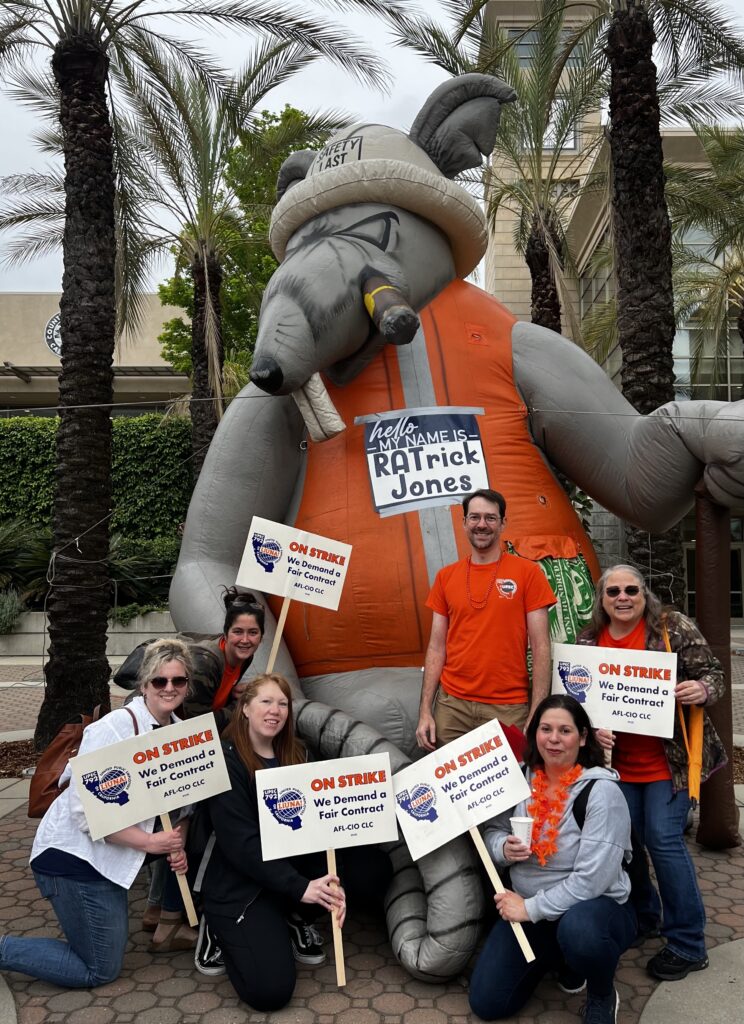
By 8:30 on May 1, nearly 300 Shasta County employees had already signed in at the picket line in front of the County’s Administrative building on Court Street.
They’re part of a bargaining unit that represents almost half the County’s staff. They’re striking after months of failed negotiations led to a Declaration of Impasse, a California labor law term that indicates recognition that future discussions would be futile.
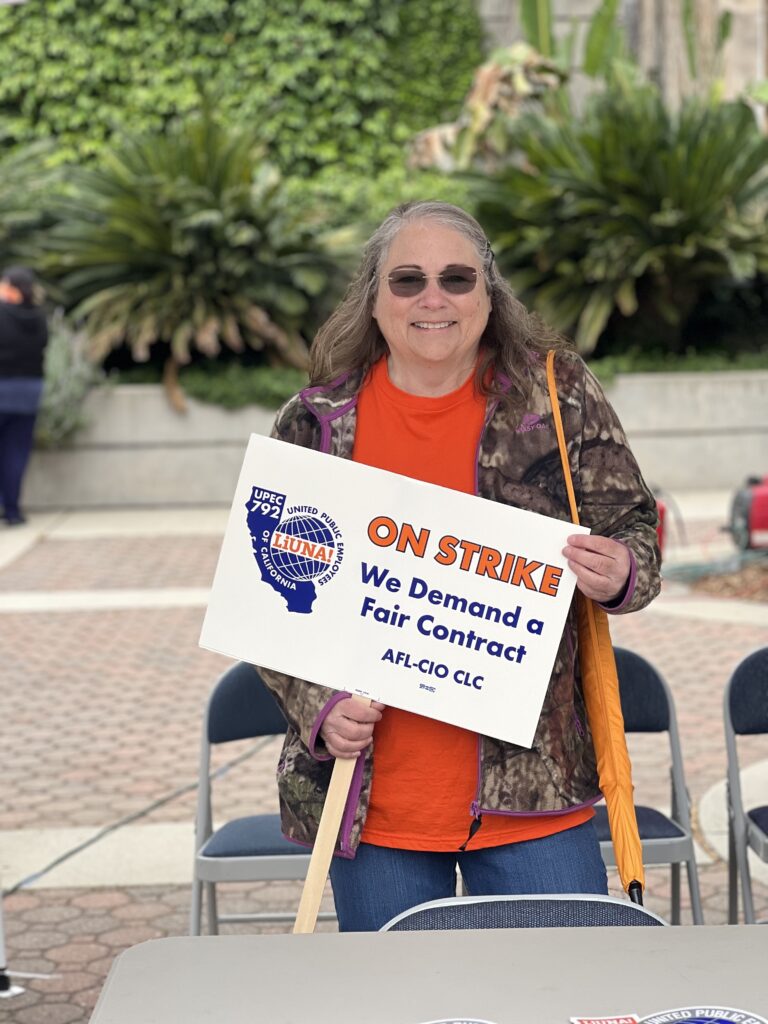
Twyla Carpenter spent her early morning at the picket line. She’s the Vice President of Shasta County’s General Unit, a bargaining unit under United Public Employees of California Local 792.
Carpenter says many of her fellow staff are college-educated and like their jobs, but are so overworked and underpaid they don’t tend to stay with the County for long.
“Once they get in here,” Carpenter said, “and they see how little their paycheck is, once they bring it home and see the high cost of medical, they find out they can’t afford to work here.”
Shasta County’s General Unit includes almost 1,000 staff, working in almost 200 different classifications that include vital services like accounting and auditing, social work, animal regulation, permitting and building inspecting, and epidemiology.
They’re asking for a wage increase of 15% over the next three years which, they say, will help their salaries keep pace with rising inflation and a recent steep increase in their insurance premiums.
We visited the picket line on International Workers Day. Here are a few of the stories we heard.
Catreena Johnson

Catreena Johnson says when her grandmother worked for Shasta County seventeen years ago, finding an opening for a County job was a rare opportunity.
Now, Johnson says, the number of staff vacancies and high staff turnover are overwhelming.
“I’m the lead worker in the call center for eligibility,” Johnson said, speaking to Shasta Scout at the UPEC Gen picket line on Tuesday morning.
“And the staffing shortages have really just shoved us into the ground. We’re drowning in work. We’re out of compliance. We can’t stop getting further behind and the State’s breathing down our necks for being out of compliance.”
Eligibility staff work in the County’s Economic Mobility Branch, helping to ensure that eligible Shasta County residents are able to access California-funded programs like CalFresh, which provides food stamps, and CalWORKS, which provides cash assistance to help families with children pay rent and other essential costs.
Those services must be provided on a strict state-mandated timeline to ensure that those most at-risk receive the help they need to prevent a further downward spiral into poverty, hunger, and homelessness, Johnson explained.
“Our direct services office, they handle the intake. They handle families coming in the day of, saying that they need homeless assistance or they’re going to sleep in their car. And we do interviews on the spot and get them what we can to help get them into a motel for the night, up to 16 nights for emergency assistance. And then once applicants are granted CalWORKs, there’s additional housing support that helps pay their monthly rent.”
Johnson said at the wages the County pays, she’s unsurprised that recruiting, hiring, and maintaining staff are so hard.
“When minimum wage is $15/hour,” Johnson explained, “and the positions we’re hiring start at $17 an hour and it takes three months of training before you even touch a live case?”
Virginia Mason
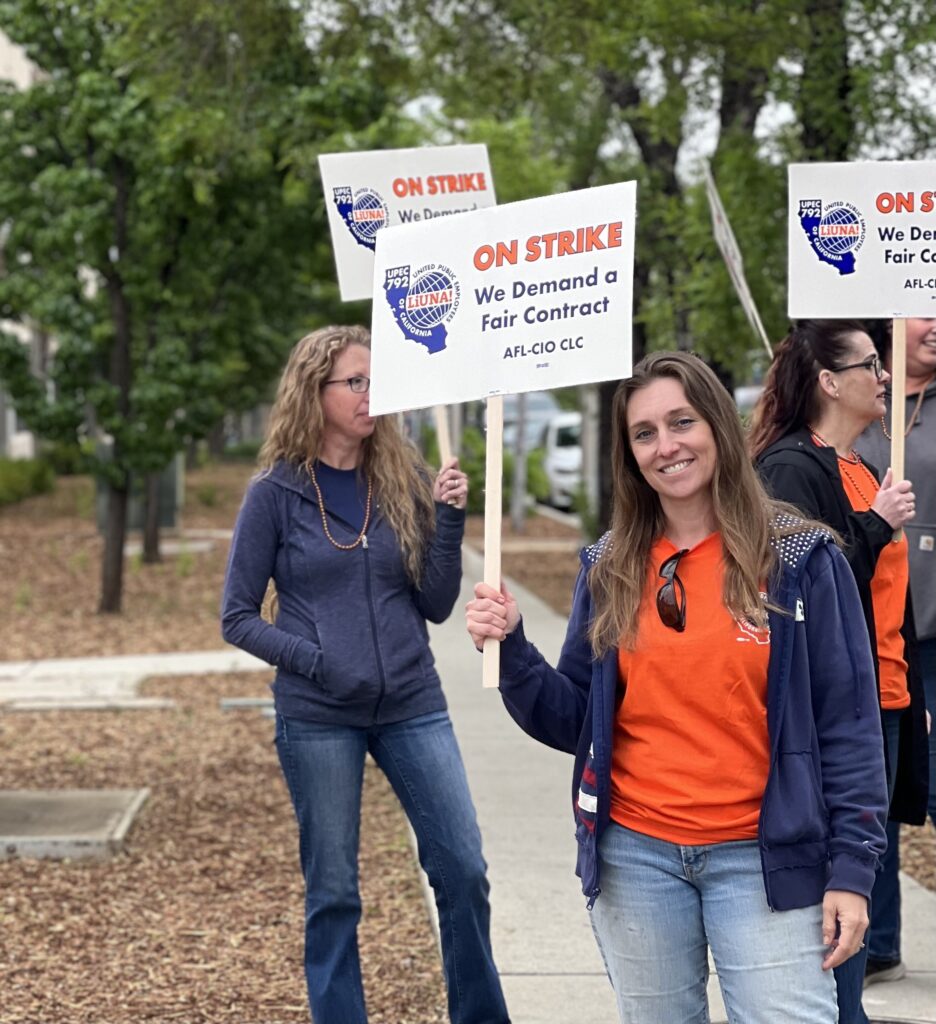
Virginia Mason came to Shasta County from Contra Costa in 2021. She says she worked the same job there with fewer requirements and for twice the pay.
As an employment and training worker, Mason says she teaches people how to write resumes and perform well on interviews. Her program also provides a number of additional services, she says, including paying for childcare, education, housing, and transportation.
“We’re trying to reduce barriers to people becoming employed,” she said.
“We’re skilled workers and we have extensive training in our field. We’re not cashiers, you can’t train us in a week to do this. Not only that, but because of the social services that we provide, we talk to people at their worst. We definitely have emotional fatigue. It’s actually a training we have to go through. So to ask us to work for the same amount of money as the people at Chick-fil-A or Denny’s without giving us the pay that we deserve . . .”
Mason says the low wages are challenging. It’s hard knowing that she has clients who have graduated her program and are now making far more than she is.
But she’s also very concerned about staff vacancies.
“Right now, with the lack of workers that we have, there’s no way that we’re meeting state timeline requirements (for our program) and we must be being fined,” Mason said.
“I would be interested to know how far behind we are, because right now the state says case-carrying workers should have between 60-65 cases, but right now our workers are carrying 90-plus cases. So we’re not being able to give the correct services and attention to our clients that they deserve.”
“We’re overloaded,” Mason continued, “but they can’t hold onto workers at these wages because of the amount of stress [we experience]. Might as well go work somewhere else.”
Mary Shaver
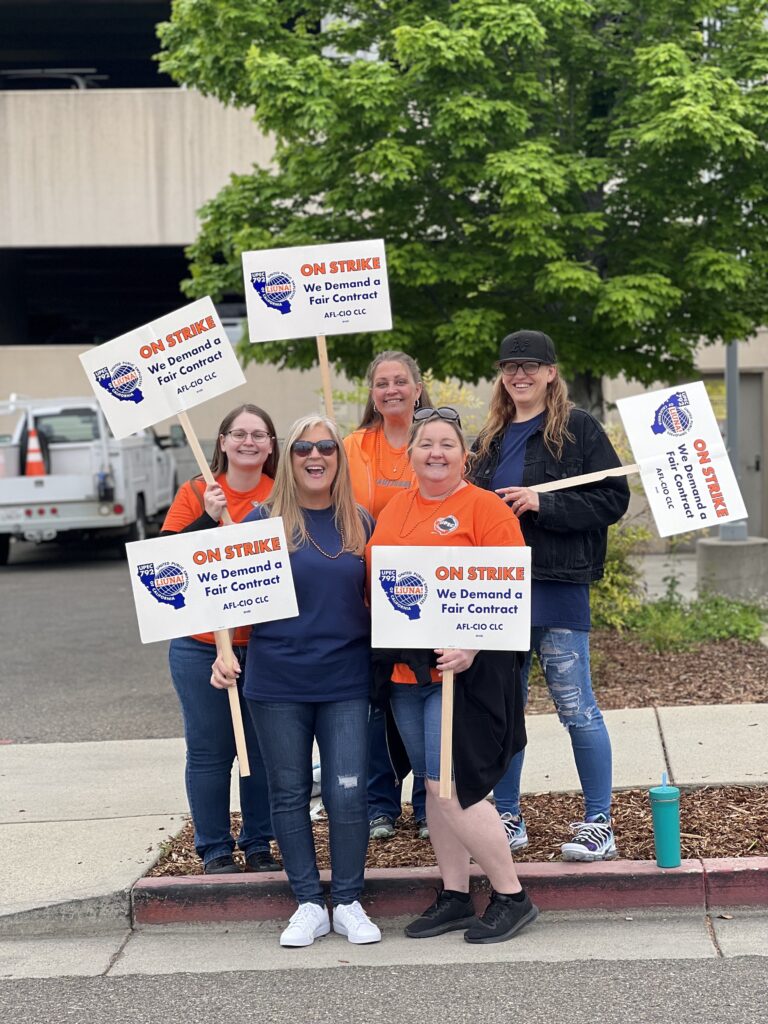
While Mary Shaver loves what she does, she says her income is no longer enough to pay her expenses.
“At this point, with inflation I’m struggling to pay my mortgage,” Shaver said. “I have two of my grown children living with me to help pay the bills.”
Shaver was a beneficiary of the County’s cash assistance program, before she began working for the County in 2010.
“Right now, I’m giving back and helping people. Some of our participants have never really had anybody to support them or be there for them. To tell them that they can make a difference, they can get good jobs. So we help people get education, work on barrier removal so they can get out and become productive members of society.”
You can read additional coverage of the Shasta County UPEC Gen Strike here.
If you have a correction to this story you can submit it here. Have information to share? Email us: editor@shastascout.org