Pondering state reparations for tribes, a council documents history of harms

Pondering state reparations for tribes, a council documents history of harms

Reading Time: 6 minutes

It started with a formal apology.

“California Native American peoples suffered violence, discrimination and exploitation sanctioned by state government throughout its history,” California Gov. Gavin Newsom said in a 2019 statement. “We can never undo the wrongs inflicted on the peoples who have lived on this land that we now call California since time immemorial, but we can work together to build bridges, tell the truth about our past and begin to heal deep wounds.”

With that came an executive order to establish the California Truth and Healing Council  for Native Americans “to clarify the record — and provide their historical perspective — on the troubled relationship between tribes and the state.”

The council’s work could set an example for the rest of the country.

There have been similar efforts internationally, in Canada, Australia and New Zealand. In the U.S., the Maine Wabanaki-State Truth and Reconciliation Commission examined harmful events relating to Wabanaki children and the Indian Child Welfare Act. There have also been instances of local governments giving land back to tribes.

But the California council, whose work is now underway, appears to be the first in the U.S. where a state is comprehensively looking to make reparations for the damage caused to its Indigenous communities.

The council is made up of 12 individuals from both federally and state-recognized tribes across California. Council members were nominated by tribes, but ultimately appointed by the state. There are more than 109 federally recognized tribes in California — and dozens more that are only state-recognized — so not every tribe has direct representation.

By 2025, the council must submit a report to the governor’s office that documents the full history of harm caused by the state. It will also make policy recommendations about reparations — which in this case may include land back and other ways to preserve California Native cultures — for past harm and prevention of further damage.

“We wanted to create a mechanism for tribes to be able to drive where the conversation was going,” said Christina Snider, Newsom’s tribal affairs secretary and a member of the Dry Creek Rancheria Band of Pomo Indians.

There have been similar efforts internationally, in Canada, Australia and New Zealand, but the council appears to be the first in the U.S. where a state is comprehensively looking to make reparations for the damage caused to its Indigenous communities. A similar panel was established in Maine in 2012, the Maine Wabanaki-State Truth and Reconciliation Commission, but it explicitly examined harmful events relating to Wabanaki children and the Indian Child Welfare Act. There have also been instances of local governments giving land back to tribes.

“We’re hopeful that giving Native people and tribes the time to think about what they really want from this process, what they want as a meaningful outcome, will be reflected in recommendations that are thoughtful and diverse and take equity into account,” Snider said.

She hopes to call private and federal partners to the table to work on solutions together once the final report is done. It would also fill huge gaps in many non-Indigenous Californians’ understanding of Native peoples’ history in the state, she said.

More than two years into the council’s listening sessions, interviews and research throughout the state, several issues have emerged, Snider said.

“A major theme here has been the idea of California Indian identity,” she said. “California Native people aren’t seeing themselves in the stories that are being told about Native people in general. Then their identity isn’t being translated into policy changes, either.”

The need for elder care, housing and mental health services have also come up frequently, Snider said. But there are also acute generational divides created in many communities by urbanization, boarding schools and other policies that separated Native families.

The council has also heard a lot of feedback around land — something Newsom’s administration is suggesting policies to address. In 2022, the state started providing funding to some tribes to co-manage parts of the coast.

Currently, Snider said, “there’s almost no access to land ownership and no access to places that are spiritually significant and where people have lived since time immemorial.”

Kouslaa Kessler-Mata, a University of San Francisco associate professor and a member of the Truth and Healing Council and the Yak Tityu Tityu Northern Chumash and Yokut tribes, sees important work underway. But the infrequent meetings of the council and shortage of resources make her feel less empowered as a council member.

“I’m concerned about how the structure of the council is set up almost to position us as puppets,” Kessler-Mata said. “We’re not central to the process. We’re just there to help signify that something is happening, which is unfortunate.”

The council was set up through the state’s executive branch, rather than the legislature, where wide support and consensus is needed to pass initiatives. That means it has a more limited budget of only about $450,000 per year through the fiscal year ending in 2025,  an annual amount roughly a third of what the legislature-established California Reparations Task Force for African Americans said it needed this year just for consultants to help with their work. The Truth and Healing Council also has fewer contracted researchers and staffers at the state dedicated to assisting the completion of its report when compared to the Reparations Task Force, Kessler-Mata said.

Kouslaa Kessler-Mata sits in a park on a stone bench. She is wearing a light blue button up shirt and jeans, is looking to the side, and holding a sheet of paper with several lines of text.
Kouslaa Kessler-Mata. (Photo courtesy of Kouslaa Kessler-Mata)

“A budget is a moral document,” Kessler-Mata said. “That absence of funding has serious consequential results in our work. We can’t achieve our objectives in a really thorough way without additional support.”

Snider said that creating the council through the executive branch meant it started faster and had more flexibility in its structure, developed after consultation with tribes. The result is that tribal leaders have more say in the process than they might otherwise, she said.

Some of the most important healing work from the process, Kessler-Mata said, has come through a partnership between the council and the Decolonizing Wealth Project, an Indigenous and Black-led organization that supports reparatory justice initiatives across the country.

In February, the Decolonizing Wealth Project awarded grants to 13 tribes and Indigenous organizations in California to help with initiatives aimed at healing and changing narratives about their history. The grants will help tribes collect oral histories, provide travel stipends for members to go to Truth and Healing Council meetings, fund work documenting impacts around boarding schools and more.

“When we heard this effort was happening in California, we knew it was important to support,” said Carlos Rojas Alvarez, director of executive affairs and strategic initiatives at the Decolonizing Wealth Project.

Alvarez said there has been a push for a federal commission to examine the full impacts of Native American boarding schools. Between 1819 and 1969, hundreds of thousands of Native American children were taken or coerced away from their families and tribes, forced to attend government-sanctioned Indian boarding schools. Among the consequences: loss of language and culture, abuse, trauma and permanent separation of many children from their families. Alvarez said he hopes the California effort will help drive momentum to address the boarding school history and related issues in other states and by the federal government.

The grants also help address a big challenge for the council: California Indians are a diverse group with different histories and needs.

“One Native person’s story in California is not the same as anyone else’s,” Snider said. “Each person has a different story, perspective and idea for what they need to make them whole.”

Some tribes involved in the process aren’t federally recognized, for example. And each tribe is a sovereign political entity. Kessler-Mata said she is one of the few council members who isn’t a tribal leader, which she feels is important because she doesn’t have a stake in any tribe’s enrollment battle or other political issues. Her goal is to stay focused on what the state can do “to advance the rights of individual Indians.”

Another challenge, Kessler-Mata said, is capturing a precise picture of the experience of California Indians. Most data on Native Americans in California is about all Native Americans who live in the state, regardless of whether they are members of a California tribe.

While the council’s final report won’t be finished until 2025, Kessler-Mata has early priorities. She wants to see the state start collecting data on California Indians to measure indicators like homeownership rates, impacts from climate change, educational outcomes and treatment in the criminal justice system. She also says the state needs to provide greater equity in funding for California Indians.

“What we really need is a multi-sector approach for people to understand what has happened and what is happening,” Kessler-Mata said. “The Golden State was created at the cost of someone else. That implicates everyone.”

The post Pondering state reparations for tribes, a council documents history of harms appeared first on Center for Public Integrity.

Parents unite against Hollister district’s plan to change afterschool programs

The Hollister School District trustees are reconsidering a plan to take over their afterschool programs, which would have severed their long-standing relationship with the YMCA and the Youth Alliance (YA), after an overwhelming public show of support for the two organizations. 

Facing a capacity crowd, with around 50 attendees outside of the building watching the meeting on cell phones, the trustees were themselves schooled by parents, teachers and people who work in the programs as they spoke during the four-and-a-half hours it took for them to decide to table the motion until next month.

At issue are the applications to the state for continued funding for the district’s Expanded Learning Opportunities Program and After School Education and Safety programs, which have been run by YA (as the CASA De Milagros program) and the YMCA since the district first approached them in 2003, after failing in its own efforts to administer the programs. 

On April 14, according to YA director Diane Ortiz, both organizations were notified that their services would no longer be needed beyond this school year. Parents, students and teachers got word of the decision on April 21.

While dozens of people spoke during three public comment periods, the main points were made by one of the first speakers, a young girl, approximately eight years old, who said, “We really like our programs. Nobody is really asking for this, and we don’t feel like they should be taken away.”

These points were repeated by speakers expressing a concern that the district was making the decision without consulting parents first, and a lack of faith among the speakers that the district could successfully replace the beloved programs.

Parent Don Foley said that the program, as outlined on the district website, was more of a wishlist than an actual plan of action.

“It took three months for my son to get his Chromebook from you, which tells me that you guys can’t really organize anything,” he said. “The fact that you guys just go ahead and do this without really looking at the community and what is best for them is silly.” 

After a presentation of the district’s plan by Director of Education Service Colleen Myers, other speakers, including Valeria Mariano, who works in the program, accused the district of merely copying the current plan with no explanation as to how they would implement it. 

“Don’t get me wrong,” she said, “it was a wonderful presentation you made. But in my head, it was just copy and paste because every single thing you talked about in that presentation we do.”

Other speakers talked about the strong connection that the afterschool program workers had made with the children and their concerns that severing that relationship would be harmful.

“Every student is met with positive attitudes from the program leaders,” said Jaime Rosales. “The program provides our students with an emotional outlet to be able to identify their emotional needs and how to communicate them better. They did provide that need for our students. Otherwise, like I say, if you don’t have anything to get into, you’re going to get into something bad.”

After the third round of speakers, a vote was called on a resolution to apply for the state funds needed to keep the programs going. Trustee Jan Grist began by assuring the crowd that the vote was only for the funds and did not have any impact on whether the YMCA or YA would be involved next year.  

Speaking in favor of the change, Superintendent Erika Sanchez said the move to keep the programs in-house would provide an opportunity to rehire teachers who lost their jobs last year; that the number of participating students could be doubled under the district’s management of the programs; and that the two organizations had been “out of compliance” by not filing invoices in a timely manner, a charge that Ortiz disputed.

Trustee Jose Perez, Jr. announced he could not support the measure without first allowing a meeting with the YMCA and YA to see if an agreement to continue their services could be worked out. Trustee Lisa Marks moved to table the resolution on those terms, and that the vote be held next month after the district had a chance to address the parents’ concerns and arrange talks with the YMCA and YA.

The motion passed unanimously.

Speaking with BenitoLink after the vote, Ortiz said, “I want to thank the families, students, teachers and community who showed up, emailed, called and voiced their concerns. It’s because of your voices that we have a meeting with the district. It’s not over yet, but the community was heard tonight. We are grateful for the love and support.”

 We need your help. Support local, nonprofit news! BenitoLink is a nonprofit news website that reports on San Benito County. Our team is committed to this community and providing essential, accurate information to our fellow residents. It is expensive to produce local news and community support is what keeps the news flowing. Please consider supporting BenitoLink, San Benito County’s public service, nonprofit news.

The post Parents unite against Hollister district’s plan to change afterschool programs appeared first on BenitoLink.

Why did Fresno County give the Clovis Rodeo pandemic relief funds?

Why did Fresno County give the Clovis Rodeo pandemic relief funds?

This story is the first in Fresnoland’s ongoing series taking a deep dive into how local governments have spent pandemic relief dollars from the federal American Rescue Plan program.

In 2020, the COVID-19 pandemic handed the Clovis Rodeo Association its first annual loss in a decade when it had to cancel its flagship event. After bringing the Clovis Rodeo back in-person with limited crowd capacity the following year, the association ended up with an even bigger annual loss.

Despite two years of deficits, the Clovis Horse Show and Festival Association, the nonprofit organization behind the rodeo, wasn’t at the brink of collapse — mostly because it had more than $1 million in cash heading into the pandemic.

But that didn’t stop the rodeo from applying to be a subrecipient of federal pandemic relief dollars through Fresno County. In June 2022, the Fresno County Board of Supervisors approved reimbursing the rodeo for 2022 expenses at the sum of $200,000, using federal relief funds.

“It’s going back to the next rodeo — the livestock, the security, the supplies,” said Ron Dunbar, the rodeo’s president. “Without that fund, we wouldn’t be able to do what we like doing, what we’re used to.”

While the county is allowed to use federal relief funds to address the negative economic impact of the pandemic on local businesses, it brings into question Fresno County’s process in awarding organizations funds through the American Rescue Plan Act (ARPA), a federal program which gave $350 billion to local governments across the country to rebuild their economies.

Fresno County officials did not assess whether organizations that applied for funding actually needed federal relief dollars in order to stay afloat, county staff told Fresnoland. County officials also did not develop a metric to evaluate organizations’ equity aims in order to evaluate their impact on underserved communities or to compare applicants with each other.

Over the last two years, the county got $194 million in ARPA dollars from the federal government. Eligible uses of the federal funds include revenue replacement for government agencies, premium pay for essential workers, upgrading water, sewer, and broadband infrastructure, and financial assistance to businesses dealing with the negative economic impacts of COVID-19. Local governments that receive funding can either use the funds themselves or disburse the funds to subrecipients — both of which Fresno County has done since last year.

The unprecedented infusion of cash for local governments had great potential to bridge equity gaps, considering it didn’t have the typical constraints of annual government budgets. Last year, President Joe Biden even put out a 301-page report on how the ARPA program was his first opportunity to advance equity through major legislation.

Fresno County received 47 applications from organizations seeking funding from its ARPA subrecipient program. In May 2022, four county staff members evaluated whether applications met eligibility requirements from the federal government, said county spokesperson Sonja Dosti. She added that the five county supervisors’ chief staffers also weighed in on the process, evaluating whether applications aligned with county guiding principles on how to spend federal relief dollars. 

They forwarded a recommended list of organizations that should get funding to the county’s Ad-Hoc Committee on ARPA, which was composed of two people: supervisors Nathan Magsig and Steve Brandau. 

The two county officials approved and sent a priority list of organizations to the Board of Supervisors, which they subsequently approved in June 2022. The Clovis Rodeo was one of the 22 organizations accepted into the program. It was also one of three event-centered subrecipients — including the Big Fresno Fair and the Turkey Testicle Festival. 

Among the 25 programs that didn’t get funding, one sought to increase education on voting, digital literacy and broadband infrastructure for underserved communities. Another program sought to boost enrollment in public programs — like CalWORKs, Medi-Cal and CalFresh — for residents in geographically isolated parts of Fresno County.

Pandemic brought down rodeo's cash totals, but not to the brink of collapse, tax documents show

After two consecutive years in deficit — losing about $265,000 over 2020 and 2021 — the Clovis Horse Show and Festival Association still had more than $930,000 in cash. That’s largely because over the five years prior to the pandemic, the rodeo earned an average of $1.56 million in annual revenue and took home an average of about $277,165 in annual profits, which it used every year to either plump its cash accounts or acquire more land or property, according to the rodeo’s tax documents obtained by Fresnoland.

Alfreda Sebasto, a spokesperson for the rodeo, emailed a statement to Fresnoland, explaining that the rodeo’s annual cash totals are not cash reserves, since they aren’t entirely retained throughout the year and are used for operational expenses required to put on the rodeo every year. Sebasto did not respond to a request for the rodeo's 2022 gross revenue and total expenses.

Fresno County’s selection process for ARPA subrecipient funding did not include comparing organizations to each other in terms of their current resources and whether that tied into their overall need for federal relief money, said George Uc, an ARPA analyst at Fresno County. Instead, the county’s process was mainly focused on assessing applications for whether they met guiding principles and priorities set by Fresno County officials, which include addressing negative outcomes exacerbated by the pandemic and its immediate impacts.

"It's not that one application is better than the other,” Uc told Fresnoland. “It was more of identifying those that wouldn't duplicate funding sources and achieve the board's principles."

Every organization that applied for funding had to explain how it would “promote strong, equitable growth, and racial equity among impacted communities in Fresno County.” In response to that equity question, the Clovis Rodeo stated it does not discriminate against anyone, strives to be a family-friendly event and has affordable tickets between $20 and $35, according to its application for subrecipient funding, which Fresnoland obtained through a California Public Records Act Request.

In its application, the rodeo did not highlight a specific community or underserved group that its programming would specifically benefit, but did note how doing “outreach to underserved audiences, local schools and all interested is a part of the Association's core mission.”

Uc said that equity was assessed across all 47 applications for ARPA funding, however, the county did not develop a metric to compare the rigor of each organization’s equity aims with each other. He added that equity was assessed by understanding how each organization would have a lasting, transformational impact if given federal relief dollars. 

County staff understood the rodeo’s equity aims as generating $15 million in revenue for the region, which helps businesses that depend on the event to make profit. He also said the rodeo is a boon for hotels, since it brings people from all over — including Merced, Bakersfield and Los Angeles — to Clovis. 

"I think looking at (the Clovis Rodeo) from travel, hospitality sectors — what it does — that's the equitable part of it,” Uc said.

A bronze statue of world champion bull rider Lane Frost, atop the bull Red Rock, greets visitors at the entrance to the Clovis Rodeo. Credit: Heather Halsey Martinez

Are county officials addressing inequities with ARPA dollars?

Fresno County’s approach to equity with ARPA dollars has been strongly criticized in the past. The California Pan-Ethnic Health Network, a statewide health advocacy organization, researched and analyzed how 12 of California’s largest counties spent ARPA funds in 2021. It gave Fresno County the lowest score, an “F,” since the county hadn’t even acknowledged racial inequities or underserved communities in its 2021 ARPA recovery plan report.

“The Board of Supervisors came up with these broad principles of how they want to use ARPA funding on their website and there's no mention of equity at all in the broad principles,” said Weiyu Zhang, an associate policy director at the California Pan-Ethnic Health Network. 

Since then, Fresno County seems to have improved its approach somewhat, Zhang told Fresnoland, because its 2022 ARPA recovery report is much more detailed in terms of highlighting racial groups in Fresno County and social vulnerability statistics. However, she added that nothing actually keeps counties in check for using ARPA dollars to address equity issues.

"There's really just the power of communities collectively calling out their elected officials to apply public pressure," Zhang said. 

That’s not to say none of Fresno County’s ARPA dollars have been used to address equity gaps. The county earmarked about $5 million for improvements to water infrastructure in Mendota and Malaga. 

Furthermore, in 2022, county officials earmarked $150,000 to improve a park in El Porvenir and earmarked another $1.6 million to improve the community center in Lanare — both of which impact two rural unincorporated communities in the county.

“It's thanks to persistence and the community being involved in this decision-making process that I believe this was able to happen,” said Mariana Alvarenga, a policy advocate with the Leadership Counsel for Justice and Accountability. “So really just applauding the community and thanking the county for really listening — but also encouraging them to be more critical in thinking about what more can be done in the county.”

Alvarenga said that includes addressing broadband issues and further unmet infrastructure needs impacting unincorporated communities. But by now, $170.9 million in ARPA dollars have already been allocated by the county's board of supervisors, leaving about $23 million up for grabs.

"It's frustrating to think about ARPA funding things like the Clovis Rodeo,” Alvarenga said. “We believe that there are more pressing needs that impact people's day to day lives that should be addressed with these funds.”

The post Why did Fresno County give the Clovis Rodeo pandemic relief funds? appeared first on Fresnoland.

Shasta County Supervisor Kevin Crye Faces Recall Attempt After Only Three Months In Office

In 2022, prompted by the political shifts in Shasta County over the last few years, Kevin Crye ran for Shasta County Supervisor as a political newcomer, beating out his well-connected political adversary, Erin Resner, by only ninety votes.

Now, after only a few months in office, he’s facing a potential recall  by community members who say his decisions have embarrassed and destabilized the County.

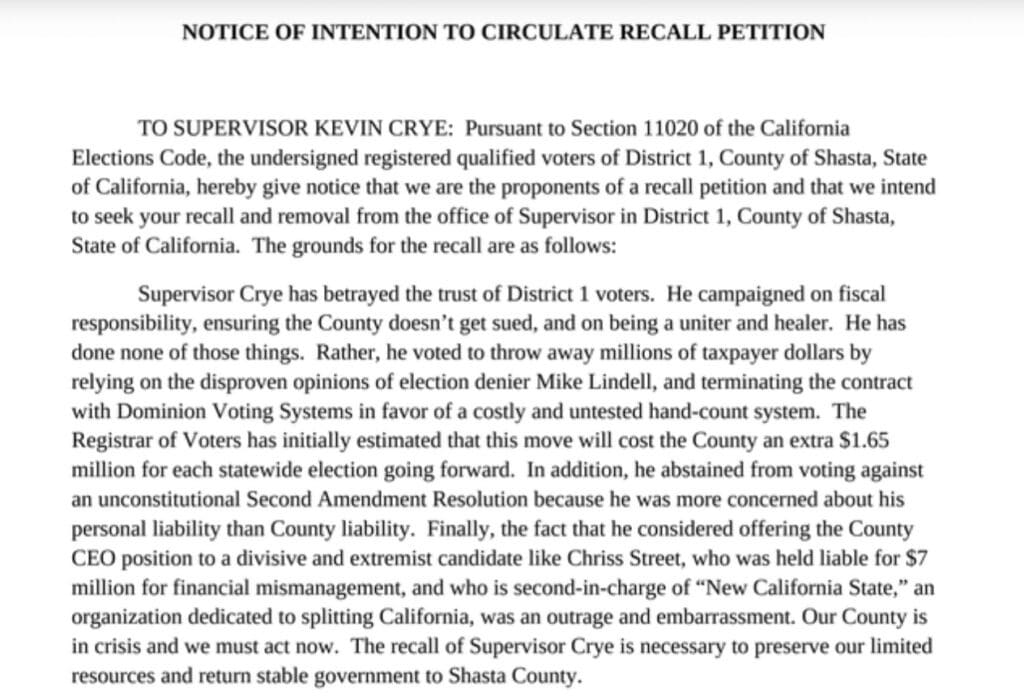
During the Tuesday, April 25 County Board meeting, community member Jeff Gorder presented a Notice of Intent to Recall Crye on behalf of the recently formed informal organization, Shasta County Citizens for Stable Government.

This Notice of Intent to Recall Shasta County Supervisor Kevin Crye was read during Tuesday’s Board meeting.

The attempted recall is primarily based on Crye’s support for changes to County election systems, decisions he’s made in tandem with two others on the five-member Board, Chris Kelstrom and Patrick Jones.

Recalling any of the three would change the Board’s majority, likely tilting future decisions in a different direction. But Crye may be the easiest target for a recall because of the narrow margin of votes with which he won office.

He represents the voters of District 1, the County’s geographically smallest and least rural District. During his campaign, he said he hoped his time in office would allow more voices to be heard and help heal a “hurting, fractured” County.

But his decisions to cancel the County’s contract for Dominion voting machines and move towards an unprecedented plan to hand count all future election votes seem to have worsened the County’s political divides.

As one of two new supervisors seated in January, Crye helped form a Board majority with a stated interest in reshaping the County around new priorities that included increasing trust in the elections process, rooting out government corruption, and reducing County staffing and costs.

The Board’s decisions since then have infuriated some community members, including those who’ve banded together as part of Shasta County Citizens for Stable Government.

Gorder says the group formed a few months ago when members of the community began meeting to discuss community concerns with recent Board decisions and actions that could be taken to address those concerns.

In a press release issued Tuesday, the group wrote that Crye’s political actions have gambled with their votes, wasted their money, and destabilized their home.

They’re concerned that Shasta County voters might be disenfranchised if plans to develop a new election system are not in place in time for the next election or don’t yield vote totals in time to comply with State law.

Some also worry about how County spending to fund that new election system will impact other County services. County Staff estimates that Supervisors’ plans to hand count votes will increase election costs by over $3 million just through the end of 2025. And that money will come from the General Fund, which means it will impact other budgeted programs and services.

Recall proponents are also angry that a majority of the Board voted to offer the County’s CEO position to Chriss Street, a controversial applicant best known as Vice President of New California, an organization which hopes to split the state in two.

The Board later rescinded that offer of employment after reviewing the results of Street’s background check. Street’s background includes being ordered by a federal judge to pay $7 million for mismanaging a trust fund.

When it comes to Crye specifically, recall proponents say his decision to consult on County election processes with MyPillow CEO Mike Lindell, who has been an outspoken proponent of claims of fraud in the 2020 election, further indicates his lack of qualification for County leadership. A few months ago, Crye traveled to speak with Lindell. He has confirmed that he’s billed his expenses for that trip to the County.

Gorder, speaking on behalf of the recall group, said while the reasons to recall Crye also apply to Kelstrom and Jones, community members have decided to focus on Crye in order to focus resources on the recall most likely to be successful.

“The positive response of District 1 voters to our informal polling and outreach efforts has been significant,” Gorder said.

“Our current effort is focused on changing the balance of power on the BOS. If we can shift one vote towards the “true conservatives,” i.e., the fiscally responsible, fact-based, commonsensical Republicans Rickert and Garman, we can bring back stable government to Shasta County.”

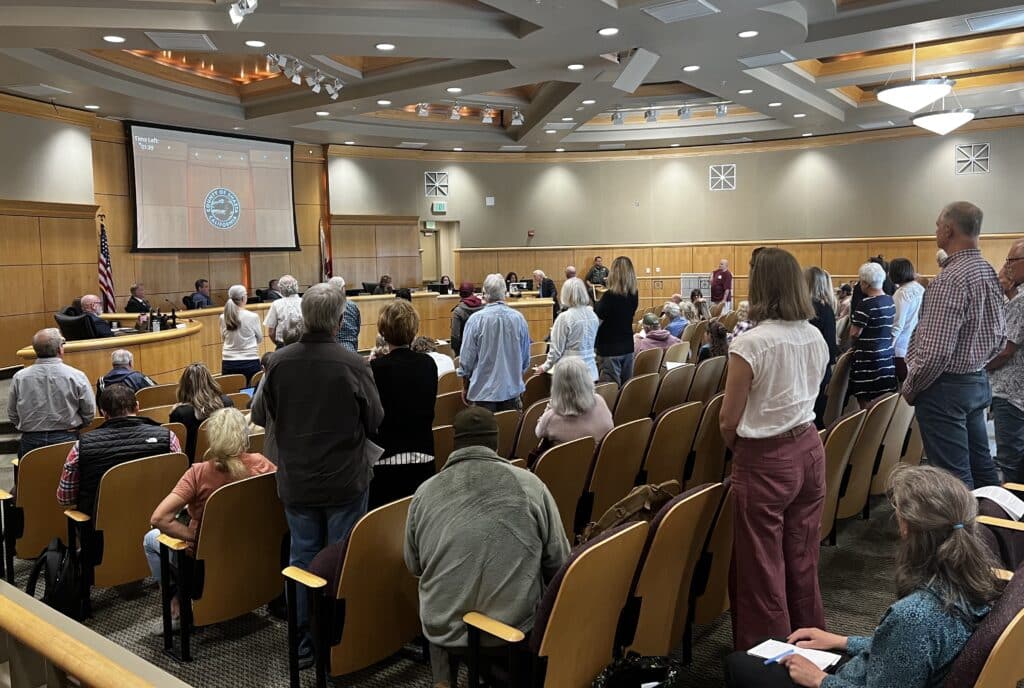
Individuals who support Kevin Crye’s recall stood as Jeff Gorder reads the Notice of Intent to Recall during a County Board meeting.

In a statement sent to Shasta Scout, Crye said the recall is “backed by liberal democrats” who have been planning it since before he was elected.

“As your Shasta County District 1 Supervisor,” Crye wrote, “I am proud of the work we have accomplished and will continue to serve the people of Shasta County.”

A statement by the Committee to Recall Kevin Crye, a subset of Shasta County Citizens for Stable Government, states that the group is made up of everyday citizens from a diversity of backgrounds, opinions, political affiliations, cultures and interests.

“The common purpose that unites us all,” the group wrote, “is that our elected officials follow the law, behave ethically and with common sense, and act responsibly as the stewards of our tax dollars.”

The Notice of Intent to Recall served on Crye this week is only the first step towards a recall election. Proponents will now attempt to gather the signatures of 20% (or 4,151) of Shasta County’s 20,757 District 1 voters. Should they succeed, an election to decide whether Crye is recalled would be held in November 2023 along with two other special elections.

According to Shasta County Clerk of Elections Cathy Darling Allen, if Crye’s recall is successful, his replacement will initially be appointed by California Governor Gavin Newsom, then later filled by County election, likely in November 2024.

Local businesswoman and former Redding City Council member Erin Resner, who narrowly lost to Crye in 2022, declined to comment on whether she would run for the position if Crye is recalled.

During his campaign, Crye referred to himself as a political outsider committed to fairness, truth, and honesty and determined to be a champion of the people’s voices.

Speaking to Shasta Scout before his election, Crye said he’s not an extremist and shouldn’t be lumped with other candidates just because he shares a similar platform or supporters. Crye’s campaign was indirectly supported by a political action committee funded by former County resident, Reverge Anselmo, who has also supported the campaigns of Jones and Kelstrom, among others.

See Shasta Scout’s campaign interview with Kevin Crye here.

If you have a correction to this story you can submit it here. Have information to share? Email us: editor@shastascout.org

Shasta Scout

Shasta Scout is a civic news media organization dedicated to telling the diverse and investigative stories of Shasta County for the region and the nation. We tell stories that build democracy.

Voices of Monterey Bay

Voices of Monterey Bay seeks to amplify and celebrate the diverse peoples of the Monterey Bay Crescent. By providing a forum where new ideas are debated, Voices serves as a catalyst to improve its readers’ quality of life.

Fresnoland

Making policy public for all residents of California’s central San Joaquin Valley.

BenitoLink

We connect San Benito County residents through trustworthy local news and information, encouraging public dialogue to foster an engaged community.

The Merced Focus

Connecting communities across California’s Central Valley with the resources, infrastructure, and networks to ensure a vibrant local free press and rebuild the journalism ecosystem in an impoverished, majority Latino and multiracial region largely uncovered by legacy, for-profit newsrooms.

California Health Report

The California Health Report partners with communities across the state to create solutions journalism that strives for social justice. Our mission is to report from communities that are disproportionately affected by inequality.