Worker who drowned at Fresno-area poultry plant remembered as ‘a great human being’
About two weeks after poultry plant worker Jesus “Chuy” Salazar died in a workplace accident, family and friends are mourning the loss of their colleague, father and grandfather.
Salazar, 66, of the Fresno County city of Sanger, died on the morning of May 7 while working at Pitman Family Farms.
That morning, according to a Sanger Police report obtained by The Bee, Salazar was assigned to check pipes around an indoor poultry waste pit — a 14-foot-wide, 18-foot-long and 18- to 25-foot-deep rectangular structure containing a mixture of chicken feathers, remains, waste, fat and water.
When a fellow employee noticed Salazar went missing, a Pitman supervisor called the police, concerned that Salazar had fallen into the pit and died, the report said. Police who responded to the scene said they saw in the pit, “a set of boots with the toes pointed upwards.”
The Fresno County Coroner’s Office said in an email statement to The Bee that Salazar’s cause of death was drowning.
Pitman Farms — the family-owned farm and poultry processing company behind “Mary’s Chicken,” a popular line of organic and free-range chickens — is one of the largest employers in Fresno County, according to state employment data. Workers at the Sanger-based processing plant cut, grind and package chickens, as well as other poultry products.
Pitman Farms did not respond to multiple requests for comment.
The California Division of Occupational Safety and Health, Cal/OSHA, is investigating the workplace fatality. The federal agency says there are many “serious safety and health hazards” in the poultry processing industry, due to the common use of dangerous equipment and hazardous chemicals, and the risk of chronic injuries.
Salazar’s family shared a statement with The Bee, authored by his son, Richard Castillo, his daughter-in-law, Lina Castillo, his daughter, Clarissa Reyes, and his grandchildren Paris, Roman and Landon.
Jesus Salazar (top, center) is photographed with his son, Richard Castillo, his daughter-in-law, Lina Castillo, his grandchildren Paris, Roman and Landon, and other family members in an undated photo. Courtesy of Castillo Family
“Losing a loved one is never easy, especially someone as remarkable as Jesus,” the family said in the statement. “He was not only a great father, but a great human being.”
‘A lot of people’ loved him at Pitman Farms
Salazar was originally from the town of Jiquilpan, Michoacán, México and eventually moved to the United States to make a living.
His children remember him as a “very hard worker.”
Prior to working at Pitman Farms, where his family estimates he worked for around two years, he worked in the hospitality industry in the city of San Jose, helping with hotel banquets.
At Pitman Farms, Salazar, affectionately known as “Don Chuy,” was the kind of coworker that looked out for others.
In the mornings when clocking in, Salazar would greet his colleagues with a spirited, “good morning! How did we wake up today?” He would offer you a soda or water from his lunch box, coworkers recalled, or offer to buy you a snack if he thought you looked famished.
He cracked jokes with his coworkers and offered words of encouragement during the workday, which workers said could sometimes last between 10 and 14 hours.
He was a good, respectful man, fellow Pitman Farms employee Karina Torres said in an interview. “Bien amiguero, bien campechano,” she said. “Very friendly, very cheerful.”
And he loved his family, Torres said. “We’d be there working and he’d talk about his children and his grandchildren,” she said. “And when he talked about them, his beautiful eyes would light up.”
Now, ‘Don Chuy’ is on everyone’s minds at work, Torres said, and as soon as a group of four or five people are together, “we start to cry.”
Some of his colleagues, family and friends gathered last Saturday in Sanger for a small memorial in his name.
“Muchas personas lo queríamos allí,” said another Pitman Farms worker who asked to remain anonymous for fear of retaliation. “A lot of us there loved him.”
Salazar’s family to hold funeral service later this month
Salazar’s family remembers him as someone who had an “infectious” love for life, and love for those around him.
One way he expressed this passion was through music and dance. He especially loved mariachi music. One song family members say he sang well was “Volver, Volver,” a Mexican ranchero song made popular by the late Vicente Fernandez.
“Everyone always asked him to sing and he did it so well,” said his daughter-in-law Lina Castillo.
The Castillo family said they’ll find comfort remembering “the sound of his voice as he sang and danced, the warmth of his embrace, and the joy he brought to those around him.”
His family will hold private funeral services for Salazar later this month.
Protecting Children and Healing Families, One Native Auntie at a Time
This story is being co-published withThe Imprint, a national nonprofit news outlet covering child welfare and youth justice.
When two aunties visit parents in need, there is no scolding, shame or surveillance. Instead, they set themselves to the immediate tasks at hand on these southern California reservations — at times simply pitching in to fold a pile of laundry, or patting a baby to sleep with Kumeyaay lullabies.
Then there are the variety of lessons with mom and dad to nurture safe parenting that fold in traditional Indigenous teachings. Establishing family routines and healthy diets are taught alongside lessons in burning sage for cleansing, growing herbal medicines in a family’s backyard, and making basic introductions in a child’s Native language.
“As a home-based program, if both of the aunties come in, it’s not necessarily a reprimand,” said auntie Elizabeth “Lizzie” Lycett. “It’s, ‘Let me take care of the child over here, so you can have your class.’”
Since its formal inception in 2019, My Two Aunties has assisted hundreds of Indigenous families in California’s San Diego, Imperial and Riverside counties. From its base on the Rincon Indian Reservation, the small program with a staff of three is among the many ongoing efforts in Indian Country to keep children out of foster care and ensure Indigenous families remain safe and intact.
Beyond parenting support, the aunties seek to repair intergenerational trauma that can result in substance abuse, domestic violence and unsafe environments for children. They equip parents with cultural tools through “Indigenous Ways Of Knowing” that they may have missed out on due to their own childhoods in foster and adoptive homes. The goals are to reduce family separation, build parents’ trust in social services and help members of tribal communities heal.
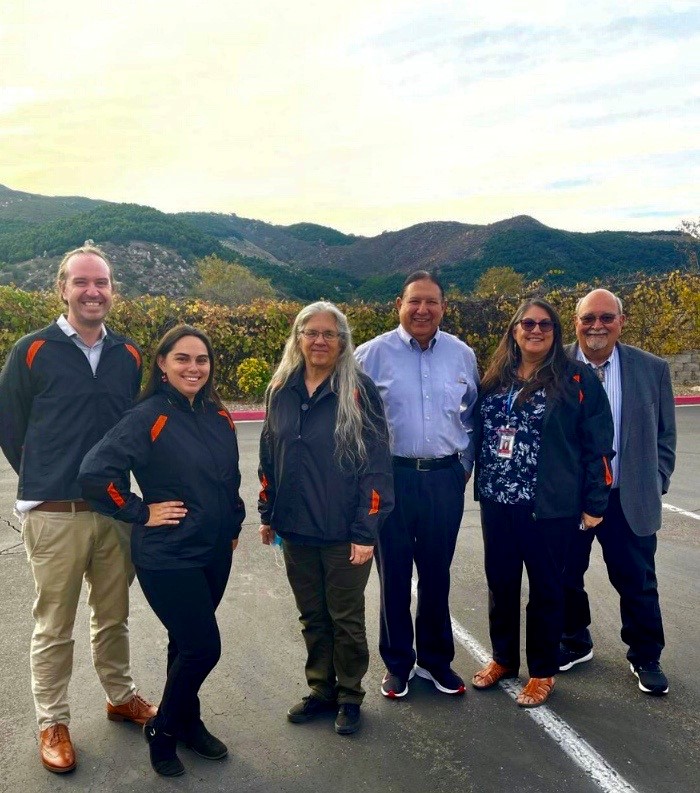
Jeremy Braithwaite, Lizzie Lycett, Cori Biggs, Art Martinez, Karan Thorne and Judge Bill Thorne working in collaboration to bring Trauma Informed Care training to the Indian Health Council staff.
, working in collaboration to bring Trauma Informed Care training to the Indian Health Council staff. Photo provided by My Two Aunties
My Two Aunties partners with nine local tribes, the local Indian Health Council and San Diego County, and is funded by California’s Office of Child Abuse Prevention and the Department of Social Services.
The key component is the “aunties,” whose role “builds upon the strengths of family legacies, patterns, and kinship traditions that have endured since time immemorial,” the My Two Aunties’ program guide states. In contrast to thefear instilled by county social workers going into the homes of parents under threat of child removal, Lycett describes her work as an abundance of acceptance and understanding. Some home visits require just one auntie; others, two.
“When you have one auntie, everything is fine and dandy,” Lycett said with a grin. “But if two come into the door, you better duck for cover.”
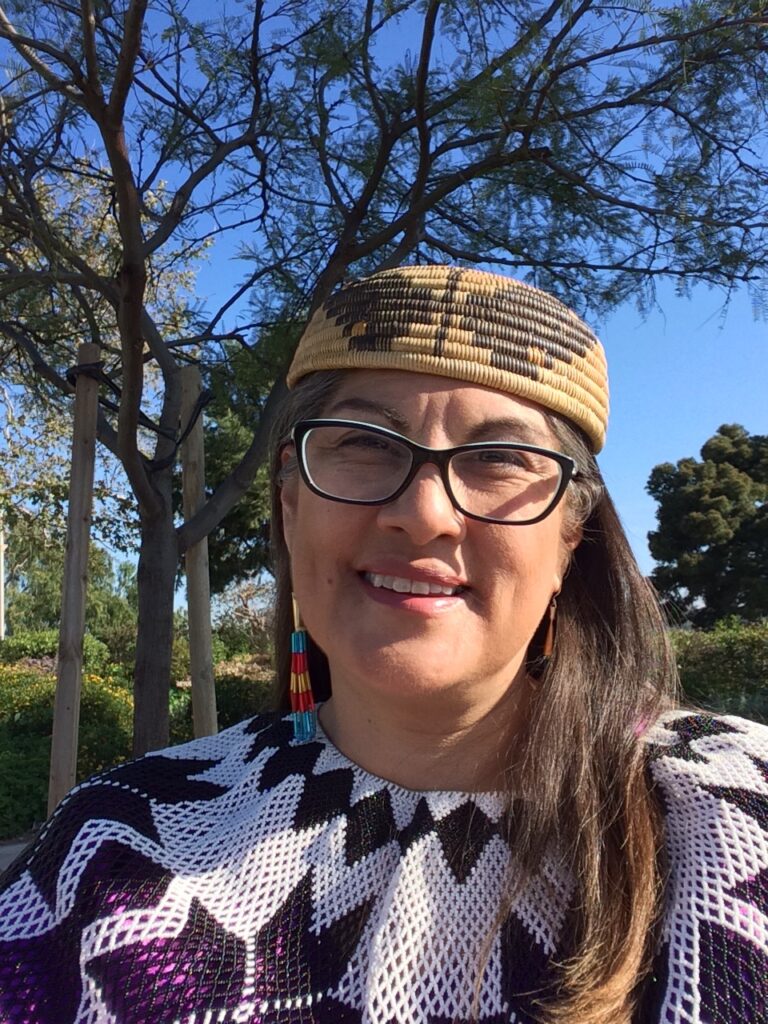
Lycett, 28 and fellow auntie Cori Biggs, 63, are descended from the San Pasqual Band of Mission Indians. Lycett has an associate degree in sociology and is studying for a bachelor’s degree in the sociology field. She has been trained in the well-regarded Family Spirit program since 2019. Biggs has a master’s degree in social work.
They aim to build relationships between children, parents and their tribes to combat the cultural erasure that happens when a child is taken from their tribal home. So in addition to training in case management, mandated reporting protocols and developing safety plans, they’re also versed in local languages, legends and Native history, including the impacts of colonization.
Aunties’ responsibilities include supporting parents at risk for abusing substances, working with pregnant moms and guiding families for one year after a child’s birth.
“WHENEVER WE’RE WORKING WITH THESE FAMILIES, THEY HAVE TO BE THE LEADER.”
— LIZZIE LYCETT, MY TWO AUNTIES
Lycett said “our first and foremost priority is the safety of our families,” and she and Biggs are mandated reporters of child abuse and neglect. If concerning issues arise that require a call to the child protection hotline, program staff may contact CPS, or encourage direct witnesses to do so. Aunties do not make foster care recommendations, however — that determination is made following an investigation by a tribal or county social worker.
Clients were not interviewed for this article to maintain their privacy, but feedback the program has received shows family members’ appreciation for the guidance and support. “Raising a Native baby to be proud of being Native is a huge thing,” one parent said in a survey response. “That’s something that I really wanted and the main reason I wanted to be in this program.”
Karan Thorne, former director of My Two Aunties
Former director Karan Thorne — a member of the Rincon Band of Luiseño Indians — retired last year after a three-decade journey to develop My Two Aunties. Thorne said that unlike the typical approach of social workers, the aunties focus on strengths within the household: “Instead of ‘What’s wrong with you?’ they ask: ‘What’s strong with you?’”
She said generations to come are being positively impacted.
“I’m seeing such great change with these pregnant women, and a lot of the babies have tribal names now,” Thorne said. “To me, that says they’re proud of their culture and where their kids are coming from.”
At a recent National Indian Child Welfare Association conference highlighting noteworthy practices across the country, the nonprofit Indian Health Council described the program as “well received” among the members it serves as a tribal health organization. “In our community it takes trust to build a relationship,” a representative said.“It appears our Aunties are able to make that connection.”
Art Martinez of the Chumash tribe isa consulting psychologist whohas worked on its curriculum and evaluations. He said the strength of My Two Aunties lies in the people it serves.
“In our ways, we never had child removal,” Martinez said. “We never had prisons, we never had jails. Why? Because we worked off a very basic understanding of living an honorable life in the way we were meant to be and the way we were meant to represent our own families.”
Martinez said he sees the program’s current caseload growing and shifting — from parents who are required by the court to participate, to parents who want to participate to reconnect with their cultural and spiritual pasts.
“IF BOTH OF THE AUNTIES COME IN, IT’S NOT NECESSARILY A REPRIMAND. IT’S, ‘LET ME TAKE CARE OF THE CHILD OVER HERE, SO YOU CAN HAVE YOUR CLASS.’”
— LIZZIE LYCETT, MY TWO AUNTIES
The My Two Aunties curriculum begins with lessons structured aroundthe growth of an acorn into an oak tree.
Lessons in the roots that strengthen families and communities involve practicing patience and staying grounded in tradition. The course evolvesthrough teachings about a balanced diet and healthy relationships, and ends in a final class symbolized by a drawing of a towering oak. The tree is surrounded by a forest fed by the knowledge of elders, ancestral medicine and spiritual practice.
The aunties’ caseloads have grown steadily over the past four years, including parents who voluntarily seek their support and services, and those referred by physicians. Clients of the child welfare system arrive at different stages — some parents are under investigation for child maltreatment, some have children placed in foster homes, and others are in the final stages of reunification. Each family receives between one and 12 visits, depending on the level of need.
In 2022, the program served 97 families and held 411 parenting classes. Those numbers have grown from 2021, when the program assisted 73 families and provided 133 parenting classes.
Nancy Spence has been director of My Two Aunties since the former director, Karan Thorne, retired last year.
During the height of the COVID-19 pandemic, families picked up workbooks and other material at outdoor drive-through sites, and dozens of mothers received pre- and post-natal check-ins through video conferencing. But new opportunities were created as well, and the program continues to connect with families through virtual visits.
“It’s an option that has proven to be very convenient for our families and sometimes increases the chances that they will participate in the program,” current director Nancy Spence said.
The work of relying on traditional teachings to reduce the number of tribal families separated by foster care began over 20 years ago in this community. At the time, the consortium of tribes served by the Indian Health Council’s Tribal Family Services had nearly 500 children in local child welfare systems.
Indian Health Council data show there are currently 30 children in out-of-home care among the populations served by the agency serves, who include members of nine federally recognized tribes in San Diego, Imperial and Riverside counties.
My Two Aunties is a key contributor to the low numbers in recent years, according to the organization.
After publishing its 2022 evaluation report, the program is now working on its next robust set of findings. The measures that are being examinedby Martinez and Jeremy Braithwaite of the Tribal Law and Policy Institute focus on the program’s ability to strengthen families: “How did families’ participation in various aspects of the program build/enhance/restore cultural resilience and how did they see this contributing to stronger, healthier families?” Braithwaite noted in an email. The evaluation centers on Indigenous Ways of Knowing methods, which the researcher described as “both culturally and scientifically rigorous.”
A final report on outcomes-to-date is forthcoming. But state data already show why the program is urgently needed in these southern California counties.
Native children make up roughly 600 of the more than 52,000 children in foster care in the state, or just 1.3%. But like Black children, they are, relative to their population size, the most likely to be reported as subjects of maltreatment and to enter foster care, according to state data.
“WHEN MY CLIENTS DON’T REUNIFY, I TELL THEM TO GET THAT ROOM READY ANYWAY. BECAUSE EVEN THOUGH HE’S IN FOSTER CARE, HE’S GOING TO AGE OUT AND COME HOME, SO YOU HAVE TO BE READY.”
— KARAN THORNE, FORMER DIRECTOR, MY TWO AUNTIES
The aunties’ care of these children’s families stands in stark contrast with the approach of county child welfare agencies — and it is more broadly defined. Some work is preventive — such as parents who have a family member with substance use disorder and need support “to ensure both the resiliency of the family and the family’s place in a Native community of wellness,” the program’s description states.
Others, even after losing their custody rights to their children, remain in the program — parents who’ve had their rights terminated are still treated as care-worthy.
“When my clients don’t reunify, I tell them to get that room ready anyway,” said former director Thorne. “Because even though he’s in foster care, he’s going to age out and come home so you have to be ready.”
The care is distinct in other ways as well. The aunties address and acknowledge the struggles Indigenous parents face that is a result of colonization, misrepresentation and social worker bias. Thorne said skepticism about Indigenous peoples’ ability to care for themselves and their familiesleads to the disproportionate numbers of child removals in Native communities. That includes conflating child neglect with poverty, in tribal communities, where as many as one-third live below the federal income level.
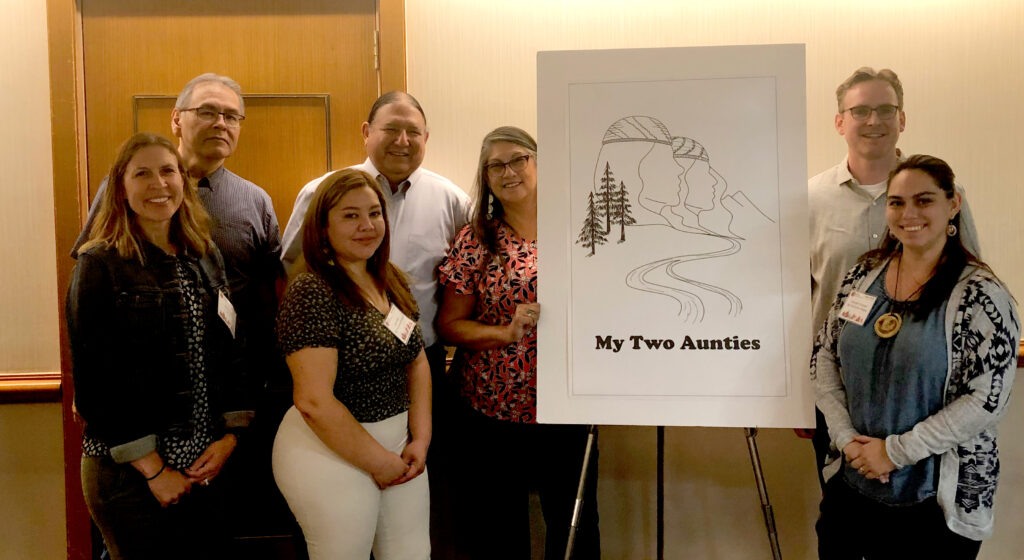
Group photo of the My Two Aunties Program Development team and the unveiling of the first My Two Aunties Logo, at the Center for Native Child and Family Resilience project gathering in April 2022. Photo provided by My Two Aunties
“You have to get to that root cause of what’s really happening with these families,” Thorne said, noting that too often, children are removed because of “conditions that non-Native social workers didn’t feel were right.”
Under the 1978 Indian Child Welfare Act (ICWA) and state law in California, child welfare agencies must make extra efforts to avoid the separation of Native families. To address historic injustice, that means making “active” — not simply “reasonable” — efforts to provide services to parents and to avoid placing children away from kin. That work is another central goal of My Two Aunties.
“ICWA says social workers have to use active efforts to help reunify families,” Thorne said. “We’re doing the active efforts to prevent those removals.”
The distrust parents have toward child welfare agencies in low-income and communities of color is not an exceptional experience in California or among tribal members. Lycett has seen it first-hand. In her initial homevisits, she routinely encounters tension that must be overcome before she can earn a family’s trust. Some of her clients have a deep-seated fear of social workers taking away their children,and they’ve been left to feel powerless.
“With historical trauma and generational trauma, these families view social services as the Big Bad Wolf,” Lycett said. “Whenever we’re working with these families, they have to be the leader.”
To counter the mistrust, the My Two Aunties model is anchored in storytelling: “native cosmologies or ways of knowing related to the seasons, nature, familial kinship relations, spirits or trickster figures.” These oral traditions “carry the weight of wisdom passed on through countless generations,” theprogram description states, imparting “important lessons about how one should act in the world.”
“RAISING A NATIVE BABY TO BE PROUD OF BEING NATIVE IS A HUGE THING. THAT’S SOMETHING THAT I REALLY WANTED AND THE MAIN REASON I WANTED TO BE IN THIS PROGRAM.”
— PARENT SURVEY RESPONSE
To that end, the program’s Cultural Family Life Skills Discussion Guide curriculum draws on the storytelling traditions of southern California tribes. Life lessons are taught through an array of human and animal characters. A lesson in humility, for example, involves Turkey Vulture — whose now-bald head was scorched after Coyote tricked it into putting its head in a fire pit.
A version of the widely told Legend of the Three Sisters is another theme. In it, three sisters are going through the forest when they pass a river, and hear infant cries. As they get closer to the river, they see babies in the water.
The first sister jumps in immediately to save them. Thorne said this represents the Indian Health Council’s work with families navigating dependency courts. The second sister jumps in next, helping kids swim ashore. This sister represents foster care preventionskills — the work coaching families to heath and wellness through culturally-relevant lessons and values. The third sister goes upstream to keep any future children from falling into the river, which represents their prevention services.
The Personal Reflection Tool is used for evaluation and a better understanding of what our clients are experiencing in their day to day lives. Photo provided by My Two Aunties
When parents are finishing their My Two Aunties visits,theyfill out a Personal Reflection Tool worksheet.
The document features a giant tree in the shape of a woman’s form, with deep roots beneath her feet and powerful branches for limbs. Around the tree are words for parents to pick from that span the emotional spectrum: Alone. Shame. Uncertain. Supported. Grateful. Rejuvenated. Positive. Stressed. Parents circle four or five primary emotions they are experiencing.
Filling out this worksheet began as a tool for evaluators to gather insights on the program’s impact, tracking any changes over time. But it has since become a routine partofaunties’ visits. Of the dozen parents who participated in the latest evaluation, eight consented to their worksheet responses being used. None circled the words “alone,” “shame,” or “scared.”
One mother describedmoving from initial feelings of insecurity to empowerment. She reported feeling more motivated and happier as visits progressed. And she was learning to look toward the future with optimism.
Reflecting on the Mighty Oak lesson of the day, she acknowledged ongoing struggles, circling: “tired” and “stressed.” But she circled three hopeful words and phrases as well: “okay,” “I got this” and “positive.”
One of the auntie’s responses is noted in the evaluation.
“I was happy there were more positives than negatives,” she stated, “which shows the client is learning how to find hope and look forward to a better future for her and her family.”
This story is the first in an ongoing series by The Imprint examining tribal child welfare best practices and the steps Indigenous communities are taking to heal from and limit the use of foster care.
RNs at Hazel Hawkins demand transparency as board considers Chapter 9 bankruptcy
Information provided by California Nurses Association
Registered nurses at Hazel Hawkins Memorial Hospital are asking the public to join them in demanding that the Board of Directors of the San Benito Health Care District be transparent about the hospital’s fiscal crisis as the board is set to consider filing Chapter 9 bankruptcy at a board meeting on Monday, May 22, announced California Nurses Association/National Nurses United (CNA/NNU) today.
“We are very distressed and disappointed to find ourselves back to square one with hospital administration, as the threat of bankruptcy looms large for the second time in six months,” said Diane Beck, an operating nurse at Hazel Hawkins. “The nurses are committed to doing all we can to ensure that our patients have access to and receive the highest quality of care. However, we are losing faith in our hospital administrators’ ability to find a path out of this fiscal crisis. We need more transparency into the finances of this hospital and a better understanding of where the money they take in is going.”
What: Nurses rally for transparency and accountability as San Benito Health Care District Board of Directors considers Chapter 9 Bankruptcy
When: Monday, May 22, 4:30 p.m.
Where: Hazel Hawkins Hospital, 911 Sunset Drive, in Hollister.
Nurses say it is imperative that Hazel Hawkins remains a full-service hospital and maintains all current service lines to best serve the people of San Benito County. Hazel Hawkins is the only hospital in Hollister, a city of 43,000 people, and serves all of San Benito County.
Last November, the board declared a fiscal emergency and authorized the district to file Chapter 9 bankruptcy. In December, the hospital administrators said they only had enough money to keep the hospital open through mid-February and issued a Worker Adjustment and Retraining Notification (WARN) notice to all employees. Against this backdrop, nurses agreed to postpone a pay raise schedule to begin in January 2023 for 90 days.
In late March, the hospital rescinded the WARN notice and nurses were led to believe that the hospital was moving towards fiscal health. However, in the last month, hospital administrators have called on the nurses to give up negotiated health and compensation benefits.
“We are doing our part to fight for this hospital and this community,” said Beck. “We have delayed raises and we are working in very difficult conditions in understaffed units in order to make sure our patients get the care they deserve. It should not fall on those who care for our community to shoulder this burden alone. If we are to recruit and retain experienced nurses we must ensure that our compensation is competitive and that our working conditions are safe. This is how we can provide the best care to our patients.”
Over the last five years, Hazel Hawkins has received more than $20 million from property taxes collected by San Benito County. Last December, the San Benito County Board of Supervisors agreed to give Hazel Hawkins a tax advance of more than $2 million, and in January the hospital was granted a $3 million loan by the state.
“We are seeing millions of dollars being poured into this hospital, but we know very little about how it is being spent,” said Beck. “We believe the taxpayers who pay into this hospital and the community that is served by this hospital have the right to demand transparency and a prudent path to solvency.”
California Nurses Association represents 120 nurses at Hazel Hawkins.
California inmates depended on community colleges. What happens when their prisons close?
As California closes three more prisons and downsizes six others, some prisoners aren’t ready to go. They are worried about the future of their education.
For more than 1,500 prisoners who attend college in these closing facilities, closures mean they could transfer to a new prison where the courses may not line up, leaving some students a few credits short of a degree. Education can offer tangible, real-world benefits to prisoners: They can earn degrees and gain merit credits that chip off time from a sentence. Research shows that prison education also reduces recidivism.
California’s shrinking prison population — the state had 160,000 prisoners in 2011, down to just 96,000 as of May 10 — has also created an unexpected problem for the state’s community college system, which has developed special programs to help prisoners earn degrees. Palo Verde Community College in Blythe, for example, draws almost half of its students from the nearby prison.
As the prisons close down, at least three community colleges stand to lose more than 10 percent of their student enrollment and millions of dollars in state funding, collectively.
Gov. Gavin Newsom has been interested in closing prisons since at least 2019. Since then, the state has closed one in Tracy and nearly finished closing another Susanville.
Last December, the California Department of Corrections and Rehabilitation said it would close a prison in Blythe and end the contract with a private prison company in California City. The corrections department also said it would close parts of six other prisons throughout the state.
In a statement to CalMatters, the corrections department said that it is committed to preventing “academic disruption” for students at the closing prisons and pointed to the work of the Rising Scholars Network at the California Community College Chancellor’s Office, which oversees various higher education programs across all of the state’s 34 adult prisons.
But local community college administrators say communication from the corrections department is limited and that they have few resources to help prisoners who fall through the cracks.
Learning in D Yard
Former prisoner David Zemp, a self-described nerd, gets wistful when he talks about prison education.
He spent seven years locked up in the D Yard at the California Correctional Institution in Tehachapi. By the time he was released in 2022, he said the prison unit looked more like a college campus than a prison.
Prisoners made their own salsa at the nearby garden and covered the white walls with murals: a dinosaur fossil, an astronaut, and at the entrance, the March of Progress in which a monkey evolves into man with a cap and gown.
“It was falling apart, but the people who were investing in it were in love with it,” he said. He earned five degrees while incarcerated, which ultimately knocked off roughly three years of his twelve-year prison sentence.
Before the start of the COVID-19 pandemic, Cerro Coso Community College taught over 35 in-person classes inside the D yard of the Tehachapi prison.
In addition to its murals that covered the walls and gardens outside, the college was also working with the prison to build portable classrooms on-site.
In December 2022, that all came to a halt. The college learned that the corrections department planned to close the D yard in Tehachapi this summer as well as the California City Correctional Center, another prison where Cerro Coso also teaches, by next year.
Dropping out in California prisons
Professors and administrators were in a bind. Almost 20 percent of Cerro Coso’s students were incarcerated at one of the two prisons. At the time, Anna Carlson, the program director for the college’s incarcerated education program, had little information about the timeline for the closures, except a promise from the California Department of Corrections and Rehabilitation that students would be able to stay throughout the spring semester.
“That just didn’t happen,” Carlson said. “Some were able to stay, and some were not.” Her office at Cerro Coso, a trailer that abuts the local school, is at the epicenter of the prison closures, fielding calls and sorting files from students and professors who are frantic or frustrated.
Throughout the spring, professors arrived at the prisons only to find that some of their students were gone.
Peter Fulks, a professor at Cerro Coso, spoke to over 100 people who are imprisoned and who told him continuing their education was consistently a top concern. Some men broke into tears because they were so worried about what might happen next, Fulks said.
Over 400 of Cerro Coso’s incarcerated students left prison before they could finish their semester. Of those students, 126 have been paroled; the rest are scattered across at least 27 different state prisons, according to data from Carlson’s department at Cerro Coso Community College.
Others dropped out of school even before they were transferred, said Fulks, resulting in an enrollment dip before the spring semester, right as news got out about the prison closures.
Bureaucratic coordination
The corrections department said in a statement that it is committed to preventing prison transfers during the semester, but that it does happen. The corrections department also said that the special credits awarded for classes — the ones which can give people who are imprisoned years off of their sentence — will transfer to the new prison, too.
Some students who leave in the middle of a semester strike special agreements with their teachers to finish the rest of the class via mail, but not every professor is willing or able to do that. Unlucky students must withdraw or take an incomplete.
In general, educational options for students vary depending on which prison they are sent to, according to the statement. Some prisons only offer classes via email, known as “correspondence-based” courses; others have partnerships akin to Cerro Coso’s model and focus on in-person instruction.
The statement said it is up to the community colleges, with the state’s help “if needed,” to ensure the students’ credits transfer.
While the corrections department later clarified that it tracks where it moves each prisoner, administrators at two community colleges told CalMatters that they don’t have access to that information and said there’s no coordinated system among community colleges to communicate which students have transferred where.
Moreover, colleges need the written consent of the student before they can communicate with one another due to privacy laws.
The California City Correctional Facility just outside of California City in May 10, 2023. This is one of the correctional facilities set to close soon in California. Photo by Larry Valenzuela, CalMatters/CatchLight Local
Correspondence classes push on
Cerro Coso Community College is more vulnerable to the effects of prison closures because its classes are primarily in-person.
Statewide, most college classes in prison are by mail, where students communicate through letters with a community college professor they have never met.
That’s the case at both Palo Verde College on the Colorado River and Lassen College near Northern Nevada, which also face looming prison closures.
Palo Verde College expects to lose about 10 percent of its student body — about 520 people — when nearby Chuckawalla Valley State Prison closes in 2025, but President Don Wallace said the college can easily make up the lost enrollment by gaining correspondence-based students from other colleges around the state.
All told, nearly half of Palo Verde’s current students are incarcerated, a number that has more than doubled since 2016. The vast majority of those students are correspondence-based.
While the college will find other students, Wallace said the transfers will have a “horrific impact” on the current ones, who he worries may never finish their education. “It’s a stop-out point,” he said. “Even among people that are not incarcerated, when they have to change from one college to another or they move from a community college to a four-year university, those are points where people quit.”
Lassen College, whose nearby prison began closing last year, has been able to continue educating about three-quarters of its 200 students at their new prisons via correspondence, said Colleen Baker, interim dean of instruction. She did not respond to questions about the fate of the 50 of students who did not continue their education via correspondence.
To Fulks at Cerro Coso, who recently defended a dissertation about prison education, the difference in prison between in-person instruction and correspondence-based classes is stark. “Correspondence success rates are extremely low, about 68 percent compared to face-to-face, which was about 81.6 percent,” he said, adding that the performance for correspondence classes may be even lower since some of the remote classes he studied had professors stop by occasionally.
But for colleges, who receive state money based in part on the number of students they enroll, correspondence classes bring in a lot more revenue. “Each one of their students counts the same as a face to face. You don’t have to pay for location, materials for students, they limit how much support they provide to students and that money goes in,” he said.
Millions lost as degrees delay
Once the prison fully closes, Cerro Coso will lose just over 900 students, more than 10 percent of its total enrollment. The college’s vice president of finance, Chad Houck, said the college did not know how much funding would be lost. Palo Verde and Lassen College will each lose an estimated $1.7 million this academic year, according to an estimate by CalMatters using the state’s funding formula. While Lassen College was able to continue educating most of the prison’s students, it lost nearly 1,800 incarcerated students who were studying at the fire training center adjacent to the prison.
But unlike Lassen and Palo Verde colleges, Cerro Coso Community College will not offer any additional correspondence-based classes as a result of the prison closures, said Houck. He said the “quality is not the same” and that neither students nor faculty prefer it. Instead, the college will focus on recruiting more students from the local prison units that will remain.
As for the incarcerated Cerro Coso students who are leaving, they will need to connect with a new college at the prison where they go next.
Carlson has few options to help them and typically must wait for the prisoners to contact her office and request a transcript. As of May 11, roughly 60 students from the D Yard in Tehachapi and the California City prison have reached out to her team to request a transcript, and most people reached out before their transfer, at the moment they knew their destination.
Carlson and her colleagues predict those numbers will go up as more people settle into their next prison, but they also know some may never finish their degrees.
Adam Echelman covers California’s community colleges in partnership with Open Campus, a nonprofit newsroom focused on higher education.
EXPOSED: A series about the effects of pesticides on communities
Several of these stories are part of “Adrift,” a three-part series byEnvironmental Health News, and palabra, a multimedia platform of the National Association of Hispanic Journalists, on pesticide use in California that finds rural communities of color and farmworkers are disproportionately exposed to some of the most dangerous chemicals approved for use in agriculture. Voices […]
Wild Rice Farm Will Sustain Both Family Agriculture And The Environment Under Land Trust Conservation Agreement
The Noel Ranch property. Photo courtesy of the Shasta Land Trust.
For more than twenty-five years, the Noel family have farmed wild rice in the Fall River Valley in Northeastern Shasta County.
Their 318 acres of land will now be permanently protected through a collaboration with the Shasta Land Trust and the California Department of Conservation.
Ted Noel, the property’s owner, told the Shasta Land Trust he’s pleased that the conservation agreement allows the property to continue to be used as a working wild rice farm while benefiting wildlife.
“The property is important for migrating waterfowl,” Noel said, “with our rice fields acting as a surrogate wetland for bird species migrating up in the spring, and down in the fall.”
Birds traveling along the Pacific Flyway use flooded rice fields as migratory habitat along the way. In the winter, those migrating birds include sandhill cranes, mallards, widgeons, gadwalls, and a variety of geese.
Paul Vienneau, Executive Director of the Shasta Land Trust, told Shasta Scout by phone this week that the Noel family approached his organization in hopes of having their family property conserved, in order to continue using it for agricultural purposes, while ensuring it won’t be developed in future.
The Shasta Land Trust is a nonprofit organization dedicated to conserving the beauty, character and diversity of significant Northern California land. Since its founding in 1998, the Land Trust has completed almost thirty conservation agreements, allowing over 44,000 acres of Shasta County land to be preserved for environmental benefit.
Similarly to all conservation easements, Vienneau explained, the land will continue to be privately owned by the Noel family. What’s changed is that the Shasta Land Trust has purchased development rights to the property, using California Department of Conservation funds.
“If you pulled this project (on County documents),” Vienneau said, “you’d see the Shasta Land Trust listed on the title. Technically, we now hold an interest in this property. The landowner can continue to farm it, ranch it, live on it, sell it, lease it, or give it up as part of an inheritance. The only thing they can’t do is (use it) for commercial development.”
And neither can anyone else. Once in place, the conservation easement remains with the property regardless of who owns it, Viennneau said.
The newly-conserved Noel Ranch property includes almost 10% of the shoreline along Shasta County’s Fall River. The property contains what is known as emergent wetland habitat which benefits over 160 species of birds. The property also falls within a designated Audubon Society Important Bird Area, providing critical habitat for birds migrating along the Pacific Coast Flyway, according to the Land Trust.
The Noel Ranch easement, like many the Shasta Land Trust has been focusing on, is agriculturally focused. The easement on the property was purchased with funds provided through the California Strategic Growth Council’s Sustainable Agricultural Lands Conservation (SALC) program. Some SALC grants, like the one used for the Noel Ranch, support the permanent protection of of croplands and rangelands to protect them from being converted to non-agricultural uses, such as housing developments.
He said ranchers in the Shasta County area are well aware of the work of the Land Trust and routinely approach the organization asking to be considered for a conservation easement.
Once a property is chosen to be conserved, the Land Trust will apply for State grant funds and utilize them to put the formal conservation easement in place. The funds pay the property owner for the value of the land, as determined by an outside auditor.
The Land Trust currently has about fifteen properties on a waiting list to be considered for easements, but only has the resources to apply for 2–3 grants for conservation a year. Choosing which properties to prioritize, Vienneau said, involves a formal internal decision-making process.
“We go through a process internally through a Lands Committee composed of community members and Board members. They make a recommendation to the overall Board who then gives the go-ahead on which easements to write grants for.”
Conserving the Noel Ranch is part of Shasta Land Trust’s larger efforts across the ecologically important area known as the Fall River Valley watershed. The organization has now worked to conserve over 8,200 acres of this watershed, which was originally stewarded by the Pit River Tribe.
It’s a special and ecologically important area, Vienneau said. And because the Fall River Valley is relatively small, investing in conservation easements also provides an opportunity for the Shasta Land Trust to increase environmental connectivity throughout the space.
“It’s kind of what we deem to be a very unique valley. It has a high concentration of farming capacity . . . and incredible habitat for migratory birds”
“It’s also one of the most famous fly-fishing areas in the country,” Vienneau continued. “It very rarely changes temperature throughout the year, so it’s phenomenal for fly fishing.”
If you have a correction to this story you can submit it here. Have information to share? Email us: editor@shastascout.org
Battle of the berms: Farmers build maze of levees to protect land as ‘Big Melt’ heads for Tulare Lake
Growers and water managers in the Tulare Lake area have been moving mountains of dirt to beef up levees and build entirely new ones as they brace for snowmelt this summer.
A string of storms in March battered the region, blowing out levees and overwhelming infrastructure as flood water plowed through homes, dairies and crops. The mad scramble to move dirt is in part to repair that damage but also to fend off future damage in the face of an historic snowpack that’s already swelling valley rivers.
“It’s turning into ‘Whoever has the biggest berm wins,’” said Craig Andrew, manager for Sandridge Partners, one of the largest landowners in Kings County.
Sandridge built a large berm around its raisin facility about a mile southeast of the tiny community of Stratford on Highway 41, he said. Other farmers are taking dirt from Sandridge to build berms around their farms and dairies.
Berms are going up all around the Stratford area as locals fret about the South Fork of the Kings River potentially going above its current flow of 2,500 cubic feet per second. In fact, water is already standing against the levees that protect Stratford.
Growers are spending, “millions of dollars,” building berms to protect themselves, confirmed Mark Grewal, a water manager in Kings County.
“These levees are gigantic,” said Grewal. “They’re million dollar plus levees.”
It’s mostly private companies and landowners doing the levee building, he said.
Vahid Salehi has been building up levees to try and hold off increasing flows from the Kings River. Salehi is the president of Pistacia Global, which manages about 8,500 acres of almonds and pistachios throughout Kings, Tulare and Fresno counties.
The problem areas have mostly been on properties next to the North Fork Kings River, said Salehi. There, multiple sections of crops have been inundated with water. Salehi and his workers have been excavating and moving dirt so they can bring in pumps to redirect the water.
While it hasn’t cost the company millions, it’s still expensive, said Salehi. He estimates costs from roughly the last month of labor and equipment at about $50,000.
“There’s a lot of issues and maybe budget-wise infrastructure problems,” said Salehi. “There’s just all sorts of problems.”
Pistacia Global’s Kings River properties are within the jurisdiction of the Kings River Conservation District, which oversees river infrastructure and flood operations, among other things.
For the most part, Salehi is able to do what he wants when it comes to moving dirt. But there have been some instances where KRCD has stopped construction, he said.
Salehi was moving dirt on the river trying to build up some of the lower parts of the banks when KRCD told him to stop. The construction would put pressure on other parts of the river, KRCD staff told him.
“We have a good relationship with them, we try to be friends with everybody. So we haven’t tried to challenge it so much,” said Salehi. “The river has its own rules and they try to enforce those rules.”
KRCD staff have also been moving dirt building up levees. The district manages 140 miles of levees on the Kings River that start upstream of Highway 43 and run through the main river channel, the North Fork and the South Fork down to the town of Stratford.
Landowners are allowed to do what they want on their own property, said Charlotte Gallock, director of water resources and chief engineer for KRCD. But the district has jurisdiction on anything within 15 feet of the river levee, she said. Any work in those areas needs to be coordinated with the district and permitted by the Central Valley Flood Protection Board, she said.
There are three locations where levees have been sloughing dirt and have had to be rebuilt, said Gallock. Two were on the main river channel near Lemoore and the third was on the South Fork, she said.
The biggest area of concern is the South Fork, said Gallock. The district has already raised some sections of levees, in one area by about three feet and another by a foot. There will probably be more levee raising to follow.
“We’re moving forward with those projects in those areas of concern and we anticipate those will be done pretty swiftly,” said Gallock.
Kings County and the Office of Emergency Services have helped to get levee building materials down to the district, she said.
KRCD has seven workers patrolling the levee system during the day and eight patrolling at night. It’s a 24 hour surveillance system, said Gallock.
“They’ll look to see if there’s water somewhere where it shouldn’t be,” said Gallock.
The berm building frenzy has sometimes run afoul of Kings County rules.
“Some berms have been placed in the public right of way, we are either removing the berms if they create a safety issue or if acceptable, we work with the property owner to secure an encroachment permit,” wrote a Kings County spokesperson in an email.
Meanwhile, the Tulare Lake, once the largest freshwater lake west of the Mississippi until it was drained more than 150 years ago for agriculture, continues to refill. Flood water is creeping close to Stratford and Corcoran where it’s being held back by the Corcoran levee.
But managers at Westlake Farms five miles south of Stratford are taking matters into their own hands. The company hasn’t taken any water yet but workers are building a levee around its headquarters, said Ceil Howe III, COO of Westlake Farms.
The company owns about 2,000 acres of pistachios, olives and field crops.
The levee building is, “just a precautionary practice,” said Howe III.
“We just have to take care of ourselves,” said Howe III. “It’s just tough times for everybody. It’s just unfortunate. Mother Nature wins and it’s just a tough deal.”
Allensworth, a farmworker town of about 500 people in California’s San Joaquin Valley, sits at the edge of an area called the Tulare Lake Basin, a patchwork of scrub brush and irrigated farmland that’s part of the most productive agricultural region in the nation. Last March, California’s barrage of atmospheric rivers overwhelmed the area, flooding pistachio orchards and swamping communities, and Allensworth found itself all but surrounded by a shallow sea. Residents were told to evacuate. They were also told that this flood was just the beginning.
California is fighting a slow-motion disaster, one that could become its largest flood in recent history. As the near-record snowpack in the Sierra mountains melts, the water making its way through the foothills is pooling in the basin, reviving a lake that had long disappeared. This process is expected to accelerate over the coming weeks and months, and it could take up to two years to subside. And while the return of Tulare Lake could devastate everyone in the region, historically disenfranchised communities like Allensworth are uniquely vulnerable.
“It’s a horrific situation,” said Denise Kadara, an Allensworth community leader and the vice chair of the Central Valley Regional Water Quality Control Board. “We’re here like sitting ducks, waiting for the water to come and flood us out.”
Most Allensworth residents have chosen to stay in their homes despite the high risk of flooding as the Sierra snowpack melts. Many have stacked sandbags around their homes in preparation. Photo by Beth LaBerge/KQED.
Part of Allensworth’s problem stems from the politics of water: For over a hundred years, water in the Tulare Lake Basin has been controlled and hoarded by a handful of powerful landowners, usually at the expense of everyone else. The Basin’s water management system still favors those powerful landowners, leaving the town with little recourse when floodwaters approach.
‘I don’t need a whole bunch of people to break the law’
That was evident one windy night in March, when Allensworth residents Takoa Kadara and his father, Kayode, called an emergency town meeting. The goal was simple: to keep the water massing in the basin from pouring into people’s homes.
At the time, water was flowing toward town through culverts that run under railroad tracks to the east. The culverts are on private property, and the tracks that run on top of them are owned by BNSF Railway, one of the top freight transportation companies in the nation. The last time community members tried to block the culverts with rocks, gravel and plywood, a BNSF employee called the police, then removed the makeshift dam they had built.
Now the group wanted to protect the community, but knew they might be at risk of breaking the law. Residents only saw two options: act illegally, or not at all, and they couldn’t come to an agreement.
“If you guys disagree with this solution, then let’s go home,” Kayode Kadara said.
“No, it’s not, ‘let’s go home!” his son, Takoa Kadara, said, “let’s come up with another solution.”
“I’ll just say it like it is,” said one resident, who declined to give his name. “If I’m gonna break the law, I don’t need a whole bunch of people to break the law [with me]. Ten minutes? We’re gone.”
Allensworth residents have tried to block the culverts legally—many, many times. But BNSF wouldn’t give them permission to do it, and so far, the town hasn’t been able to find a government agency with the power to override the corporation’s decision, or persuade it to reconsider. Their local stormwater district doesn’t have jurisdiction over the railroad’s property, and representatives from several state agencies, including Caltrans, CalFire and the Department of Water Resources, said they couldn’t do anything either, even though community members said those agencies agreed that the water spilling through the culverts is a problem.
Floodwater from the Tulare Lake lingers across the train tracks from Allensworth, California, on May 4, 2023. One of the main flooding threats residents face are from culverts that run under the tracks, sending water toward the town. Photo by Beth LaBerge/KQED.
BNSF did not respond to requests for comment, but in an interview with the Los Angeles Times, a company spokesperson claimed that blocking the culverts could damage their tracks.
When Allensworth was put under a mandatory evacuation order back in March, the Kadaras and most of their neighbors refused to leave. Who would defend their town if they did?
“The water flowing is natural,” said Denise Kadara. But added it’s also determined by men who say “‘This is where they want the water to go.’”
The history behind today’s water politics
To understand the power dynamics in the Tulare Lake Basin—and how Allensworth ended up on the losing side of it—we have to go back to when the town was founded and Tulare Lake was still alive. In 1908, Lt. Col. Allen Allensworth was a formerly enslaved person who had become the highest ranking Black military officer of his time. As Jim Crow tightened its grip throughout the South, he moved to California to create what he hoped would become the “Tuskegee of the West,” a thriving Black community and college town. Founded by a dream team of Black doctors, professors and farmers, the community of Allensworth became the first town in California to be founded, financed and governed by Black Americans.
Subscribe to FERN’s Newsletter
Allensworth picked a spot near Tulare Lake, which used to be the largest lake west of the Mississippi. Accounts from the late 1800s describe it as shallow, thick with tule reeds, and ringed by marshland. Herds of elk waded through the shallows, and millions of migratory birds flocked to its shores every year.
But by the time Lt. Col. Allensworth got there, the lake was rapidly disappearing—it had been for years.
“Geologists call that end of the San Joaquin Valley one of the most engineered landscapes in human history,” said Mark Arax, a journalist and expert in the Central Valley’s history and water politics. “[The] human hand has altered that land in a way that few places have been altered.”
Allensworth’s residents weren’t the only people who’d settled along Tulare Lake. A group of white landowners had settled there, too—some of them descending from slave-owning families.
“Many of them were Southerners who’d come from the Confederate states,” said Arax. “They arrived here and they started grabbing the snow melt out of those rivers, and then diverting that onto their farmland.”
In the 1920s, two particularly bold landowner families, the Boswells and the Salyers, made a move on the lakebed itself. The soil at the bottom was dark and unusually rich; it’d be the perfect place for a farm, if the lake wasn’t in the way. So they drained it and diverted the water for irrigation. According to Arax, those diversions ended up drying up the lake completely.
Meanwhile, Allensworth couldn’t get enough water to sustain itself, no matter how hard the community tried. White farmers diverted a river they relied on. A white-owned company refused to dig the community’s wells, but it was more than happy to dig wells for a white town nearby. By the 1920s, a lot of Allensworth’s original settlers had moved away. And by the 1940s, the white landowners in the Tulare Lake Basin had become some of the most powerful farmers in the country, and had successfully seized control of the water for themselves.
Those long-established power dynamics are still at work in the region. Today, Allensworth is a farmworker town where the tap water isn’t safe to drink. Many of its neighbors are large corporations and wealthy farmers, and they control many local agencies—like water and reclamation districts—which make decisions about who gets water in dry years and what to do when the floods come.
“You have these quasi-government agencies, but they’re controlled by the biggest landowners,” says Arax. “It’s a no man’s land in a lot of ways, and that’s the way it’s operated. It resorts to its own devices all the time.”
Kayode Kadara, left, shows photos to California Gov. Gavin Newsom during a meeting with community leaders to talk about flood preparedness in Allensworth, California. AP Photo by Marcio Jose Sanchez, April 25, 2023.
The Tulare Lake Basin also has a long history of levee sabotage. Historically, when the basin has flooded, some farmers cut levees and blocked canals to protect their land, but it also threatened the town with flooding. This is still happening today. Denise Kadara remembers getting the news from their local stormwater manager in March that a levy on the west side of town had been intentionally breached, prompting calls to evacuate.
As communities like Allensworth brace for the snowmelt this spring—and the floods they know are coming—this history of water theft, sabotage, and discrimination is always in the backs of their minds.
Although residents at that March meeting decided against blocking the railroad culverts, they haven’t stayed quiet. Allensworth’s community leaders have been calling every government official they can think of, trying to find someone who can help them. And in the past few weeks, Takoa and his family say some politicians and government agencies have started to respond.
CalFire’s emergency response team blocked the levee that was allegedly sabotaged, as well as other breaches, and saved the town from flooding. California Gov. Gavin Newsom visited the community in April and promised to send more resources. Allensworth residents are used to the system in this basin working against them, but they hope that’s finally changing. How state agencies act may be the only thing standing between Allensworth and catastrophic flooding.
“We need all the help we can get, from every agency, and every person that wants to help and believes in communities like ours,” Denise Kadara said.
This article was produced in collaboration with KQED’s The California Report. It may not be reproduced without express permission from FERN. If you are interested in republishing or reposting this article, please contact info@thefern.org.
You made it this far so we know you appreciate our work. FERN is a nonprofit and relies on the generosity of our readers so that we can continue producing incisive reporting like this story. Please consider making a donation to support our work. Thank you.
San Benito County endorses ‘comprehensive program’ to address homelessness
After receiving a presentation May 9 from Graham Kraus, CEO of the California State Association of Counties (CSAC), the San Benito County Board of Supervisors voted unanimously to endorse CSAC’s Accountability, Transparency, Housing, Outreach, Mitigation & Economic Opportunity (AT HOME) plan.
Graham described the creation of AT HOME as the “first comprehensive program to address homelessness in the state of California.”
“The most basic thing about government is to clarify who’s supposed to be doing what,” he said, “and in homelessness that doesn’t exist in California, and it doesn’t exist in any other state in the country. Given the crisis level that this issue is at in California, that needs to change.”
Graham said California’s inability to define who does what is “leading to confusion on the part of the public, and there is no real accountability within the state government.”
“Money is flowing in one direction to counties and cities and the work that is being done is completely disconnected from that flow of dollars,” he said.
Graham added that in coming up with the program, CSAC analyzed years’ worth of investments, policy changes and work done at the local and the statewide levels. In addition, he said CSAC got input from counties on what works, what doesn’t and the challenges to making progress.
Graham said the AT HOME plan aims to streamline the process to focus on homelessness with local accountability, which he said is the uniqueness of the plan because no one with the state is held accountable.
The plan includes a single, locally developed, countywide plan with one “fiscal agent where the dollars flow through” that aligns responsibilities for who is doing what with the dollars to address local homelessness issues. The county would have the unique authority to address the overall approach to homelessness, he said.
He said the county’s and cities’ responsibilities would have to be clearly defined.
“We’re recommending a framework that would include cities being responsible for citing, standing up, and funding homeless shelters and transitional housing, permanent supportive housing, and doing encampment cleanup and sanitation where there are encampments in incorporated areas,” he said. “If these issues exist in the unincorporated area, then the county would be responsible.”
If the county were to adopt that framework, it would significantly change the process in San Benito County as the county is the lead in operating the homeless shelter on San Felipe Road, providing transitional housing and offering other programs aimed at addressing homelessness.
BenitoLink reached out to Enrique Arreola, Deputy Director at the county’s Community Services and Workforce Development agency to ask how this framework could change services within the county but at the time of publication he had not returned the call.
Graham added another change CSAC is advocating for is ongoing funding from the state rather than the current one-time grants process.
He said rural counties “need to have maximum flexibility because your infrastructure is different” and “there needs to be flexibility so you can put something in place that makes sense for your community.”
Graham said CSAC has been working with the governor and state legislature, and has held meetings with the White House and other federal entities to advocate for the program.
A bill was drafted and released May 9, and sent to Gov. Gavin Newsom in an effort to replace the language in the governor’s current homelessness accountability bill (AB 799).
By endorsing AT HOME, he said the county would add its voice to the coalition, giving it the strength and unity to address homelessness statewide.
“This is certainly not perfect, but it is the only comprehensive plan that is on the table to address homelessness in California,” he said.
Supervisor Kollin Kosmicki said it is important that CSAC take the lead to bring about a “consistency from county to county.” He said, however, the problem is more than a shelter issue.
“The biggest issue here is a drug addiction issue,” he said. “This is a mental health issue. And yes, it’s an economic issue to a certain extent, but it’s largely a drug addiction and a mental health issue and that’s where the focus of any plan on homelessness should be.”
Supervisor Bea Gonzales said the CSAC plan would give the county “teeth to address more in terms of public services, whether it’s drugs, alcohol, mental illness, we’ll be able to allocate how and where the funds need to be put so we can address our own individual problems.”
While Supervisor Angela Curro agreed that drug addiction factors into the homelessness problem, she pointed out that many homeless individuals are not willing to seek help or go into homeless shelters or obey the laws of the community.
“The only way we’re going to address homelessness is with nonprofits, with individuals that have the ability to connect with people and transition them out,” she said. “But how do we help fund that? That would be through the AT HOME program, in my opinion.”
Resident Elia Salinas said that while the government has been unsuccessful in dealing with homelessness and has only assured job security for those in charge of programs, there is a local organization that is delivering results.
“We have a nonprofit here in town with Linda Lampe and Our Father’s House who actually takes people off the streets and helps them.”
We need your help. Support local, nonprofit news!BenitoLink is a nonprofit news website that reports on San Benito County. Our team is committed to this community and providing essential, accurate information to our fellow residents. It is expensive to produce local news and community support is what keeps the news flowing. Please consider supporting BenitoLink, San Benito County’s public service, nonprofit news.
Madera hospital closure has greatly impacted migrant farmworker and Punjabi Sikh communities, survey shows
Madera residents from Punjabi Sikh and Indigenous migrant farmworker communities have been heavily impacted by the Madera hospital closure, according to results from surveys conducted by two community-based organizations.
“All of the surveys were conducted in a language other than English,” said CBDIO’s Executive Director Sarait Martinez. “I think that is the importance of our survey, because it is beyond the political conversations and many times our voices are not included in those conversations.”
The survey results reveal the following:
91% of survey respondents indicating the Madera hospital closure had a direct impact on them.
About 80% of all respondents said they were “highly concerned” about the closure’s impact on their health and family.
More than three quarters of all survey respondents said other hospitals are too far, they’ve experienced longer wait times if they do get to a hospital in a neighboring county and they’ve experienced limited access to preventative and diagnostic health exams locally in Madera.
Of the 151 Indigenous migrant farmworkers surveyed, more than 60% said they did not even know about the Madera hospital closure, and just over half said they do not have reliable transportation to access medical care in a neighboring county — demonstrating the compounding impacts of shrinking health infrastructure, language barriers and lack of affordable transportation options.
Of all survey respondents, about 17% said they didn’t know where to go in the case of a medical emergency. For those who said they have accessed care at a hospital outside the county, a majority of respondents said they received emergency services, specialty care, primary care and even got diagnosed for illnesses.
Naindeep Singh, the executive director of the Jakara Movement, speaks at a press conference about the major impacts of the Madera hospital closure on May 11. He emphasized how community voices need to be centered in conversations about what’s next for the Madera hospital and the county’s overall health infrastructure. Omar Rashad | Fresnoland
Naindeep Singh, the Jakara Movement’s executive director, said both community-based organizations are hoping Gov. Gavin Newsom will sign AB/SB 112, a bill that would create a loan program for distressed nonprofit and public hospitals — and potentially help with reviving the Madera hospital.
He added that community voices, including those from Punjabi Sikh and Indigenous migrant farmworker communities, need to be included in ongoing conversations about health care in Madera and the future of the hospital.
“What we have is actually an opportunity to bring communities that have been traditionally shut out to actually come together and make sure that we’re raising our voices as a united Madera,” Singh said.
He also called for a task force to be convened, to study the deeper issues impacting health access in rural communities and hospitals across the state — an effort that he said should go beyond the popular discussion around Medi-Cal reimbursements.
Mohammad Ashraf, a cardiologist whose office sits across from the dormant Madera Community Hospital, also spoke at the press conference, emphasizing the need for Madera residents to sound the alarm on health infrastructure needs in the county. That also extends to making sure Gov. Gavin Newsom signs AB/SB 112.
“This is really bad and we can do something about it if we work together,” Ashraf said. “The government will help, but government is slow. They take their time, but it’s our problem, it’s our issue.”