All remaining lawsuits against Betabel project and county dismissed
The two-year legal battle to stop theBetabel Commercial project concluded June 9 when attorneys for the three petitioners filed to dismiss the non-CEQA (California Environmental Quality Act) claims against the project and the county over zoning issues.
The petitioners were the Amah Mutsun Tribal Band, the Center for Biological Diversity and Protect San Benito County. The non-CEQA claims were the only ones remaining after Superior Court Judge Patrick Palacios dismissed the CEQA claims May 24.
“The [non-CEQA] claims didn’t make much sense as the property has a Regional Commercial designation in the General Plan for this very kind of use,” said Betabel attorney Peter Prows, adding, “All claims are gone. There won’t be another suit.”
Prows said the dismissal will take effect immediately, adding that the petitioners can still appeal the dismissal of the CEQA claims.
“The project can proceed in the meantime,” he told BenitoLink on June 14. “I don’t expect those appeals to be successful as California Supreme Court authority squarely holds these claims are time-barred [past CEQA statute of limitations]. We’ll also be filing a motion to recover our attorney fees against the petitioners”
He said the lawsuits against the county and Board of Supervisors were also dismissed.
The county did not respond to BenitoLink’s request for comment on whether there will be a lawsuit to recover court and legal costs.
Rider and Victoria McDowell, owners of the Betabel property, have stated all along that their incentive to remain steadfast was that the project would eventually become a funding mechanism for the charityCancer-A-Gogo to honor their teenage son who died from brain cancer.
Rider McDowell did not respond to BenitoLink’s request for comment.
Supervisor Kollin Kosmicki is the only supervisor to take a position against the project. Kosmicki has been adamant that the project did not need to be rushed and suggested that a compromise between the developer and opponents would be a better approach. He questioned the concept of using cancer research “as the pitch to sell this project to this county, to soften the blow with regard to land-use concerns to sell this to the public. We’re setting a really dangerous precedent by allowing this to be considered.”
The Center for Biological Diversity and Protect San Benito County, formerly known as Preserve Our Rural Communities or PORC, filed the lawsuit against the county and the project on Dec. 9, 2022. The commercial project is located along Hwy 101 on the northern tip of the county.
In their lawsuit, both Protect San Benito and the Amah Mutsun Tribal Band argued, “The project’s EIR [environmental impact report] fails to adequately identify, evaluate, and/or require mitigation for all significant direct and cumulative environmental impacts the project will cause.”
Andy Hsia-Coron, one of the founders of PORC and Protect San Benito, did not respond to BenitoLink’s request for comment on whether he intends to appeal the decision or come back with another lawsuit.
In March, the California Department of Justice filed a motion to intervene in the case but Judge Palacios denied it at the May 24 hearing. Deputy Attorney General Yuting Chi attended the May 24 hearing on Zoom but did not comment during the hearing. After the judge’s ruling, the attorney general’s office did not respond to BenitoLink’s request for comment on why it got involved or whether it will take any future action.
We need your help. Support local, nonprofit news!BenitoLink is a nonprofit news website that reports on San Benito County. Our team is committed to this community and providing essential, accurate information to our fellow residents. It is expensive to produce local news and community support is what keeps the news flowing. Please consider supporting BenitoLink, San Benito County’s public service, nonprofit news.
San Juan Bautista gets a new full-time deputy sheriff
Attention San Juan Bautista: There’s a new sheriff in town! Well, a new full-time deputy sheriff anyway: Deputy Desi Villanueva has been with the San Benito County Sheriff’s Department for two years, after having previously worked at the Merced Police Department.
“I realized I wanted to work for a sheriff’s office a lot more,” Villanueva said. “I was so excited to come here. Hollister is a great place for me because I really appreciate small towns. And obviously, when the assignment came up for San Juan Bautista, I jumped at it as fast as I could.”
Villanueva first became interested in law enforcement because he liked the structure, and he found that he got considerable satisfaction from getting the chance to help people.
“I like that people trust us,” he said. They pretty much call us when all else fails or when they can’t get the help that they need. We can then exercise every resource we have, and I really like being able to solve problems, especially here on patrol.”
“Our new deputy is awesome,” said San Juan Bautista City Manager Don Reynolds, “and he’s really excited and enthusiastic about working for our town. He’s a lot more visible than we had in the past, and we’re so excited to have him on board.”
Villanueva was officially stationed in San Juan on May 24 but has worked in the city before that, both on regular patrols and for events like the recent Rib Cookoff. Currently, he will be scheduled to patrol at least on Wednesdays through Saturdays from 2 p.m. to midnight.
“There’s a lot of extra days that I will be working,” he said, “so you might see me here on a Sunday or on a Tuesday. We want the San Juan deputy to be visible and out on the street. I don’t want people just to see a patrol car. I want people to see me working, so I am going to be walking around as much as I can.”
One reason for the constant patrolling is to monitor some of the more common problems in San Juan, such as tourist traffic and visitors who might not understand how small the town is.
“We see them coming in here speeding,” he said, “and we have a lot of traffic and parking issues. I’m working with code enforcement to combat some of these problems, pretty much like any normal law enforcement agency. But things can be a lot different because we’re very small.”
Villanueva is also hoping his presence on the street will make people more comfortable about approaching him with law enforcement concerns.
“The businesses all have my cell number and can flag me down if there is a problem,” he said, “but anyone can come up to me and talk on a personal level. 100% of my effort, time, and energy is going to San Juan, and I am here to help solve its issues and make sure everything that the residents need me to do is handled the best I can.”
While he intends to be a visible presence in town if he is needed and cannot be found, Villanueva said that residents could reach him through existing channels by either calling 911 for emergencies or 831-636-4080 for non-emergencies.
“If there’s anything that the people of San Juan want done or they want us to look at something,” he said, “call in and let us know. That’s what I’m here for, to help people combat the problems that they have.”
We need your help. Support local, nonprofit news!BenitoLink is a nonprofit news website that reports on San Benito County. Our team is committed to this community and providing essential, accurate information to our fellow residents. It is expensive to produce local news and community support is what keeps the news flowing. Please consider supporting BenitoLink, San Benito County’s public service, nonprofit news.
Back from the Dead: Shasta County Fountain Wind Project Could Be Approved Under New California Bill Designed To Fast Track Renewable Energy
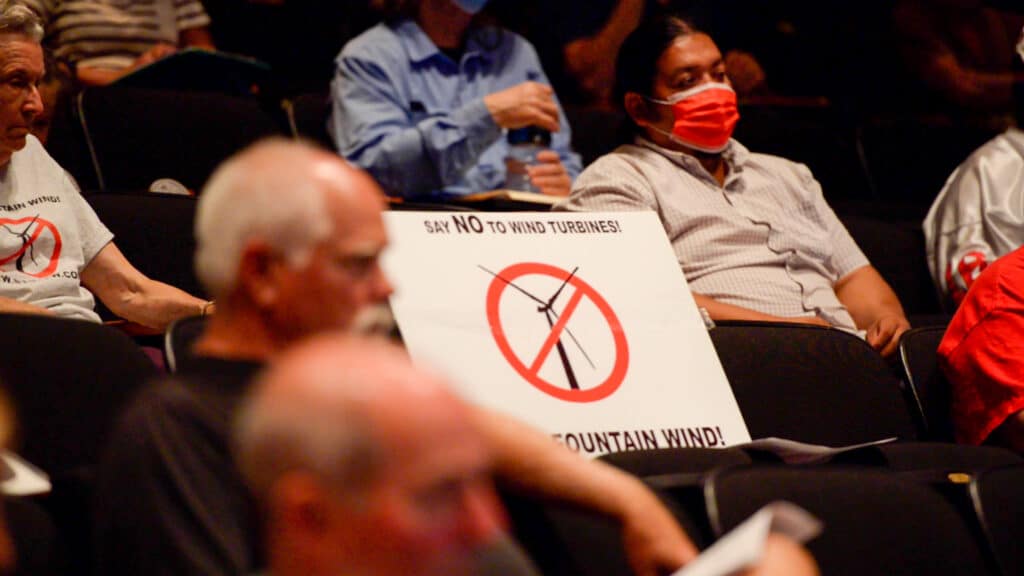
Protest sign at the June 2021 Shasta County Planning Commission. Photo courtesy of the Pit River Tribe Documentary Project.
In October 2021, Shasta County supervisors voted 4–1 against providing a permit for the Fountain Wind project, denying Houston-based corporation ConnectGen the right to erect forty-eight massive turbines up to 610 feet tall throughout the mountain ridges of Eastern Shasta County.
For the Pit River Tribe and a diverse coalition of Intermountain residents who mounted a strong resistance to the project, it was a stunning and momentous victory, the culmination of years of arduous organizing and researching. For ConnectGen, it represented the frustrating defeat of a project they argued was critical to reduce the impacts of climate change, which has already contributed to catastrophic fires and droughts throughout the state.
But the community coalition’s victory against the project, which some activists compared to David slaying Goliath in the Old Testament, proved to be short lived. This February, ConnectGen was able to file yet another Fountain Wind application, this time under a recently passed state law designed to ramp up the construction of new renewable energy sources.
State officials say that ConnecGen still needs to submit more required documents about the project before the new “opt-in” licensing process can begin. But assuming ConnectGen completes their application, Shasta County won’t have the power to veto the project the third time around.
That’s because under the recently passed AB 205, the Fountain Wind project won’t be evaluated by the county, but by state officials at the California Energy Commission (CEC), who have the power to override the county’s previous decisions. Fountain Wind is eligible for the AB 205 process because it would generate more than 50 megawatts of power (ConnectGen states it would produce about 216 megawatts, enough to power 86,000 California homes).
AB 205 also gives the state the authority to green light the project even if it breaks county law, as long as the CEC determines that the benefits outweigh the costs. That means ConnectGen could still build Fountain Wind even though the county has enacted a ban against giant wind turbines in the proposed project area, located about six miles west of Burney and just south of State Route 299.
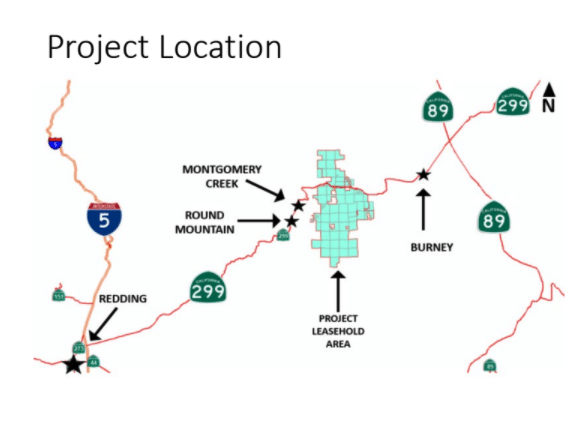
A map of the Fountain Wind project location, courtesy of Shasta County Department of Resource Management.
Shasta County supervisors passed the new zoning amendment banning large-scale wind turbines in the unincorporated areas of Shasta County in December. It’s similar to measures other counties have implemented to restrict certain types of renewable energy development.
A significant reason Shasta County officials passed the ban was the testimonies from pilots and community researchers who argued that massive turbines impede aerial firefighting and can increase the threat of catastrophic wildfires to local communities.
Although ConnectGen’s new application for Fountain Wind is still incomplete, the studies they’ve submitted to the state so far suggest the latest version of the project would be about half the size of ConnectGen’s first proposal in Shasta County. In July 2021, Shasta County rejected that original project, which would have erected seventy-two turbines on 4,500 acres of leased land belonging to Shasta Cascade Timberlands, LLC in Eastern Shasta County. Just one month later, the County also rejected Fountain Wind’s second, much smaller, application, for a 48-turbine wind farm, similar to the size of the project now being proposed at the state level.
Shasta County rejected the two ConnectGen proposals only after many months of public meetings and environmental review. It was soundly opposed by the Pit River Tribe, who condemned the project because it would irrevocably damage sacred mountain ridges where the Tribe hold ceremonies, fasts, and gather plants for medicines and basketmaking.
In addition to expressing fears about increased fire risk, other Shasta County residents also told the County that building the turbines would imperil the natural springs they use for water. Many also expressed frustration that the North State’s natural resources already produce significant renewable energy that, like Fountain Wind, benefit corporations and other regions rather than locals.
Joseph Osa, a Montgomery Creek resident, was an organizer for the Stop Fountain Wind coalition. Speaking to Shasta Scout for this story, Osa said that he feels “disheartened” that the project has been resurrected by ConnectGen and could be constructed in Shasta County despite past denials.
In Shasta County, where concerns about disenfranchisement have contributed to dangerous public outrage and dysfunctional government meetings, Osa said the County’s previous decision to deny the Fountain Wind permit provided a rare and encouraging example of Shasta County government officials listening and responding to rural residents.
“If you attended those planning commission meetings, you saw (the officials) expressed concerns, asked questions based on their professional expertise and their knowledge of the local area. They really understood how this was going to impact us because they live here,” Osa said. “The (state isn’t) going to have those insights.”
Fountain Wind will be the very first energy project to be evaluated by the State under the new AB 205 process, making it a significant litmus test for how the CEC will flex its new muscle to authorize renewable energy infrastructure.
The law that gave the CEC its new powers to approve Fountain Wind emerged from growing tension between California’s drive to meet climate-friendly renewable energy goals and the often more locally-focused environmental, cultural and social priorities of the state’s small communities. Fountain Wind is one of several high-profile recent examples of communities rejecting or resisting large-scale renewable energy projects, including Humboldt County’s denial of the Terra-Gen wind farm in 2019.
California is likely to support a mega-project like Fountain Wind because it’s designed to alleviate the increasingly dire impacts of fossil fuel emissions on the world’s climate. Despite that, Tribes and local communities often resist them because their massive footprint can also cause damage to the local environment, endangered species, Tribal cultural sites, and property values.
Governor Gavin Newsom pushed for the passage of AB 205 in June in order to “streamline” the construction of green energy projects despite objections that it would usurp local decision-making power. According to the report, Newsom anticipates the bill will not only help California reach its clean energy goals, but also prevent the state’s recurring summer blackouts.
Newsom is not the first to focus on this issue. In 2018 Governor Jerry Brown signed SB 100 into law, committing California to generating 100 percent of its energy from renewable sources by 2045. “California is committed to doing whatever is necessary to meet the existential threat of climate change,” Brown said at the time.
While there is scientific consensus that it’s essential the world eliminate its reliance on fossil fuels, how to go about implementing that transition is a source of debate, especially since California’s energy appetite continues to grow. To reach its clean energy goals while satiating the state’s power hunger, one state analysis concluded that California will need to produce 6,000 megawatts of new renewable energy annually for several years, which would mean building the equivalent of 30 Fountain Wind projects each year.
While ConnectGen has not yet completed their state application, the CEC has already reached out to County officials for input about the plan, Paul Hellman, Director of the County Department of Resource Management, told Shasta Scout by email May 26. The County’s full response to the State is pending, Hellman said, but County officials have already told the CEC that they believe it would be “not appropriate” for the State to approve Fountain Wind under AB 205 for a variety of reasons, including the past rejections by local decision-makers.
He also noted that the ban against large wind turbines was a targeted regulation, and the county is interested in other proposals for renewable energy developments that are a fit for the unincorporated areas. Several small- and large-scale green energy facilities have been developed in Shasta County in recent years, he added.
If CEC approves the Fountain Wind energy project, it would contradict a local decision that was based on years of legally required environmental studies, public meetings, and consultations with the Pit River Tribe. Radley Davis, a Pit River Tribal Citizen who was also part of the coalition that opposed Fountain Wind, said the CEC shouldn’t even consider the Fountain Wind project because it was denied after such an extensive review.
Although he doesn’t speak for the Tribe’s government, Davis said he helped interview elders, review old ethnographic reports, and gather evidence of how the project would harm the Pit River people’s spiritual and cultural ways of life. Many other local residents with technical expertise also submitted extensively researched comments pointing out potential flaws with the project, Davis said.
“It’s like literally a do-over. It just doesn’t make any sense,” Davis said of the new application. “It’s incredible that the state can exercise such power; they don’t need permission from the Tribe or the County.”
CEC officials state they are closely examining the environmental studies and comments from the County’s review of the wind energy project. Because they’re aware of Pit River people’s concerns about the cultural impacts of the project, the agency has already begun consultations with the Tribe, far earlier than is required, wrote Louey, the CEC spokesperson.
Under AB 205, the CEC will conduct an entirely independent project review and then make a decision whether to license the project within 270 days, a timeframe that is relatively short considering the massive scale of the project. If ConnectGen completes their application, there will be some opportunities for public comments, according to Louey. These will include, at a minimum, a public meeting within thirty days of the application being accepted and a public meeting upon the release of the agency’s environmental impact statement on the project.
Ally Copple, a public relations consultant for ConnectGen, declined to respond to questions for this story, saying only that the corporation would not have any updates about Fountain Wind or comments about the AB 205 process until the public comment process begins. Copple did not respond to a follow-up question regarding whether ConnectGen intended to complete its application and when that might occur.
In 2021, ConnectGen officials were adamant that the County had made the wrong decision in denying the project. They told Shasta Scout while providing comments for previous stories that studies conducted during the environmental review indicated the project wouldn’t increase fire danger.
ConnectGen officials also argued that they modified the project significantly in response to community input and that the negative impacts of the Fountain Wind project are dwarfed by the dire need to transition away from fossil fuels and slow down climate change.
Despite the well-established need to transition from fossil fuels to cleaner energy, the CEC would have to provide significant justification in order to overturn the County’s previous decision on Fountain Wind, according to Hellman. The State would have to conclude that the Fountain Wind project would provide an overall positive economic benefit to the County, although it’s not clear what metrics they would use to do so. The CEC would also have to confirm that ConnectGen has cooperatively entered into legal agreements to provide benefits to community-based organizations or local Tribes.
In 2021, ConnectGen pledged to invest around $2 million into the local community impacted by Fountain Wind, including a $250,000 allocation for a Pit River Tribe jobs programs and $1 million for Round Mountain and Montgomery Creek community programs. However, the Pit River Tribe and several community members rejected the offer, stating the proposed benefits were paltry considering the potential damage and risk the $300 million Fountain Wind project could pose to the area.
Many also expressed frustration that ConnectGen’s engagement with the community seemed, in their eyes, like an attempt to pacify resistance rather than to truly work together to integrate renewable energy safely and respectfully into the area.
These perceptions of unfairness and disenfranchisement are common among local residents who resist or stop the construction of large renewable energy infrastructure in their communities, according to recent research. Scholars who have examined numerous case studies similar to Shasta County’s rejection of Fountain Wind contend communities may support renewable energy in general, but resist local projects because they aren’t designed with community knowledge, ways of life, or hopes for the future in mind.
These scholars suggest the development of renewable energy sources is not just a technological endeavor, but also a challenge to build new kinds of collaborative relationships among investors and state and local communities. One study recommends weaving community input and decision-making into the earliest stages of conception and design, working with residents to build renewable energy projects that fit their communities’ needs and landscapes.
It’s a new way of planning and development that appeals to Joseph Osa, the Montgomery Creek resident who helped organize the resistance to Fountain Wind.
“The energy projects should fit the local environment,” Osa said. “The state could help the counties zone areas for different types of energy projects to where they’re suited and encourage that development. Then the (environmental review) process might go much faster.”
If you have a correction to this story you can submit it here. Have information to share? Email us: editor@shastascout.org
For Medically Fragile Kids, Access to Palliative Care Depends on Family Resources
Hay – yes, hay – is sucking the Colorado River dry
2023 Indigenous Pride Month events
First A Racial Slur, Then Protest: First Amendment Rights Take Center Stage In Shasta County Board Meeting
Alex Bielecki is a frequent public speaker during Shasta County’s public meetings.
But at the Board’s last meeting, as Bielecki spoke to the Board about whether to amend County zoning codes to allow for tiny home permitting, he veered into racist speech.
“I’m not a fool. I’m not a n*****,” Bielecki, a White man, told the Board, using a racist slur as he explained how he came to his position on the topic. His statement was met with immediate gasps from the public, to which Bielecki responded with an emphatic, “That’s right!”
In the front row, Nathan Pinkney, a Black man who’s become well known in Shasta County for his local political activism, immediately spoke up.
“Shut the hell up,” he said loudly to Bielecki as several other voices in the room yelled out similar sentiments. “Shut up.”
“Make me,” Bielecki responded, flashing his middle finger at Pinkney.
Since the May 30 meeting, Shasta County Supervisor and Board Chair Patrick Jones has come under fire for allowing Bielecky’s use of the racial slur in the public forum. A decision, he says, which was dictated by the First Amendment’s free speech protections.
His intentionality about protecting Bielecki’s First Amendment rights stands in sharp contrast to a decision he made later in the meeting, to have Pinkney removed from the Board room after he verbally protested Jones handling of the racist slur incident.
Jones said the decision to have Pinkney removed from the meeting was based on a Board’s policy against disruptive behavior. But Pinkney’s right to attend the meeting is also protected by the First Amendment, and California’s Brown Act.
Those two decisions by Jones, first to allow racist speech by a White man during public comment, then to remove a Black man for protesting that speech from the Board floor, have triggered widespread community outrage in Shasta County.
On Wednesday, May 31, several local justice groups, including the United Way of California, the Shasta Equal Justice Coalition, and Shasta County Citizens Advocating Respect (SCCAR), released statements about the events, calling on community leaders to promote the and of civil discourse that protects community members from hate and violence.
Some of those statements said the decision to allow the use of a racist slur in a public meeting was wrong.
But David Loy, an attorney with the First Amendment Coalition who spoke to Shasta Scout by phone yesterday, says Jones was right to have protected Bielecky’s freedom of speech when he used the racist slur during public comment.
“No matter how offensive or hateful it may be,” Loy say, “If he’s talking about a particular agenda item, and he’s on topic to that agenda item, then the Board is not allowed to censor or silence him simply because of the way he discusses it or the viewpoint he expresses.”
“The First Amendment does not have an exception for so-called hate speech,” Loy continued, “or speech which is profoundly offensive.”
While Bielecky’s use of a racist term was obviously “vile, despicable and revolting,” Loy said, it’s also speech that’s clearly protected by the Constitution and important to allow in public settings.
The First Amendment doesn’t allow the government to define or outlaw hate speech, Loy said, in part because what is considered hate speech can change depending on who is in power.
“It’s very dangerous to give the government the power to define speech,” Loy explained. “Because it gives the government power to silence dissent, critique and protest.”
That’s where Jones likely went wrong, Loy said, by silencing Pinkney’s protest against the hate speech under the guise of keeping order.
The details of situations like these are very important, Loy said, because First Amendment rights in public meetings hinge in part on the balance between the public’s right to free speech and their right to conduct public business without disruption.
In order to remove someone from a public meeting the Board chair has to first warn the individual, and give them an opportunity to stop disrupting the meeting, Loy explained, which Jones did.
But officials also have a responsibility to protect the public’s right to be at the meeting, unless the disruption they are causing is actually making it impossible for the government to do business.
“Under Government Code section 54957.95,” Loy said, “A person can be removed from a meeting (but only) for actually disrupting, impeding or rendering infeasible the orderly conduct of the meeting.”
“That’s a pretty high burden,” Loy added, saying removing Pinkney from the meeting was only appropriate if his protest from the floor of the Board room was significant enough to actually disrupt the public’s business.
“From a First Amendment perspective,” Loy explained, “People have a right to attend and participate (in public meetings) and a First Amendment right not to be excluded unless they disrupt the meeting. Not every minor interruption rises to the level of a continual and substantial interruption that makes it impossible to run the meeting.”
Furthermore, Loy explained, if Pinkney was removed from the Board room for a level of disruption that others have engaged in without being removed, he’s also had his First Amendment rights violated in a second way, known as “viewpoint discrimination” or “unequal enforcement.”
Viewpoint discrimination comes in when policies are unequally enforced by public officials, which has the effect, intended or not, of providing unequal protection for certain people, viewpoints, or kinds of speech.
“If they’re routinely tolerating other forms of outburst . . . that’s a very troubling set of facts,” Loy said. “It suggests the possibility that (Board rules are) being selectively enforced against someone who objected to racist speech . . . which would constitute unequal enforcement.”
“If you’re going to have rules,” Loy continued “they have to be a) valid and b) equally applied across the Board.”
It’s also important to remember that while speech may be protected legally, that doesn’t make it acceptable ethically or morally, a distinction drawn by Shasta County Deputy CEO Mary Williams, who responded to a request for comment sent to newly appointed County CEO, David Rickert.
In her emailed statement, Williams said Shasta County is committed to both protecting free speech and fostering an environment of safety and respectful communication.
“We firmly condemn the use of profane and discriminatory language during public comment sessions,” Williams wrote, alluding not to the legality of the speech, but its appropriateness in civil discourse.
“We believe in creating an atmosphere where all participants can express their views in a respectful manner,” Williams continued. “We encourage individuals to engage in civil discourse while exercising their right to free speech.”
Jones did not take a similar stand during the public meeting, focusing on free speech protections but failing to address the racist speech as destructive and reprehensible.
His failure to do so was a serious mistake, says Susan Wilson, who sits on the Board of Shasta County Citizens Advocating Respect (SCCAR).
“Any and every member of the BOS should have acted immediately to caution Alex Bielecki regarding the use of the word in the Chambers in the BOS meeting,” Susan wrote to Shasta Scout by email.
“It is my sincere hope that the members of the BOS and their staff have a discussion about how to address this issue if it should come up again, and to take steps to keep it from coming up again if possible. This is an ideal time for David J. Rickert, our new Chief Executive Officer, to help our Board of Supervisors develop some standards of decorum for their meetings.”
Shasta County’s Board policies already prohibit the use of “threatening, profane or abusive language which disrupts, disturbs or otherwise impedes the orderly conduct of the Board meeting.” Those policies also allow the Board Chair to remove from the chamber any person who is disruptive to the meeting.
But Board policies don’t take precedence over California’s Brown Act, or the First Amendment, First Amendment attorney Loy emphasized. And those policies may not be valid if they violate individual rights to free speech and public meeting access.
Instead of stopping public speech which is offensive, Loy said, the Board’s recourse is to stand up to it with verbal rebuke.
“The Chair, the Board, the (public) is free and encouraged to share their point of view,” Loys said.
“Speak back to the commenter saying you may have the right to say that but we don’t think you should. That’s how the first amendment works,” Loy continued.
The Shasta Equal Justice Coalition called for that kind of active response to racist speech in their statement about the incident, which was released Wednesday, May 31.
Failing to challenge racist speech in public settings, the SEJC’s statement said, limits Shasta County’s progress towards justice.
“The SEJC envisions a Shasta County where there exists equity and justice for every community member, inclusive of all identities, backgrounds, or circumstances.”
“That possibility is constrained when derisive speech . . . . remains unchallenged. Particularly in public forums where critical decisions about public safety, education, and well-being are discussed.”
If you have a correction to this story you can submit it here. Have information to share? Email us: editor@shastascout.org
Still telling stories, Elwood Dryden turns 104
Elwood Dryden was born in 1919. The well-known local businessman and former owner of the Sugar Plum Farm Restaurant turns 104 on June 1.
“I remember when the county was only 3,000 people,” Elwood said during an interview at his Ridgemark home in Hollister in mid-May. He looks back at his childhood in San Benito County with fondness, when neighbors helped each other and he “pretty much knew everyone.”
His grandfather, John Dryden, came from England and then from the Midwest to San Jose in 1885. John Dryden stayed there for three years, moving to San Benito County to become foreman of the Brewster Ranch. Within three years, he had bought his own place on Riverside Road and began raising chickens and managing his orchards.
On Elwood’s kitchen table is a small collection of mementos. A book with a bio about his grandfather, photos of him with his parents, another with his 4-H lamb. One photo is of three young men: Kenny Sugioka, Roy Stickler and Elwood. He said that they met at San Benito High School and became friends. Back then many of the rural schools would host dances. So they put together a small band to provide the music for local events, playing popular tunes of the time.
Both Kenny’s and Elwood’s families had orchards and so they had a lot in common. The Dryden family grew mostly apricots and prunes.
Elwood soon started college in Hollister. In those days, the college was right downtown in the same area as the San Benito High School. As he became an adult, the slow-paced life of orchard work and music was disrupted by World War II.
Elwood said this was when his friend Kenny moved away. Japanese American families like the Sugiokas, were being sent to internment camps in other states during the war. It became hard to keep track of him, moving from place to place, but somehow they managed.
His friend Roy Stickler moved to Hollywood and pursued a career in the film industry.
For a while Elwood took jobs in other parts of the state. He has fond memories of working among the redwoods of Northern California and in Yosemite, where he developed a great love for fishing and the outdoor life.
Then he moved to San Jose for a job with Permanente Cement Company and met his wife, Catherine, at a company dance. Eventually, he and Cathy returned to San Benito County to work at the packing house on Riverside Road and sell fruit to stores.
In the 1960s, he started a small fruit stand along Highway 156 between Fairview Road and Pacheco Pass, near Barnheisel Road. “We opened the little fruit stand and we had drinks and that’s about it,” he said. The stand centered around an “Apricot Freeze” made with apricot syrup, ice and milk. Customers could get “all you can drink.”
“Then they wanted food and we added hamburgers,” Elwood said about the customers traveling between “the valley and the coast.”
His son David Dryden said, “They just kept adding to it. I think there were at least three additions and it eventually became a restaurant.”
They called it the Sugar Plum Farm Restaurant and it was known especially for its apricot and boysenberry tarts. “Everyone in town had their favorite dish and we still run into people who say, ‘I miss your chicken or Swiss steak,’” said Kim Dryden, David’s wife. “It was open breakfast, lunch and dinner.”
Elwood closed the restaurant in 1998, but it has been memorialized with a miniature model at [Bonfante] Gilroy Gardens. Elwood and Cathy had three children; Barbara, Dave and Diane. Cathy passed away in 2003. Today, he has seven grandchildren and 11 great grandchildren.
Elwood and Kenny Sugioka stayed in touch through letters and phone calls. Kenny settled in North Carolina and became a professor at Duke University’s School of Medicine. Although Kenny has since passed away, they were able to remain friends and even visit one another.
Inevitably, when speaking to a 104-year-old gentleman, one feels compelled to ask, “To what do you credit your long and healthy life?” At first Elwood mentioned that he never smoked and was always very moderate when it came to drinking alcohol. But after a little more thought, he said he loved spending time outdoors, especially fishing. He said he watched very little television. “If it’s junk, I just turn it off,” he said.
Daughter-in-law Kim Dryden, credits his mental alertness to his lifelong interest in news and current events. He has continued to read the Wall Street Journal and has kept up with local and national events. “He doesn’t live in the past and stays up to date,” Kim said.
We need your help. Support local, nonprofit news!BenitoLink is a nonprofit news website that reports on San Benito County. Our team is committed to this community and providing essential, accurate information to our fellow residents. It is expensive to produce local news and community support is what keeps the news flowing. Please consider supporting BenitoLink, San Benito County’s public service, nonprofit news.
When help can’t come for days, Mendocino County ‘islands’ must build self-sufficiency
Can retiring farmland make California’s Central Valley more equitable?
Last year, Fairmead received a grant to help plan for farmland retirement in order to recharge groundwater under California’s Sustainable Groundwater Management Act, or SGMA. But the community’s vision for the future is bigger than that: The locals also want to see improved air quality, a community center and reliable domestic wells.
The West is not just facing an energy transition, it is also at the beginning of a major transition in land and water use. In California’s Central Valley, groundwater regulations will require retiring between 500,000 and 1 million acres by 2040. (Retirement, or “fallowing,” refers to taking lands out of agricultural production.) The planning and decision-making now underway across more than 260 regional Groundwater Sustainability Agencies will determine how SGMA plays out across different groundwater basins: whether landowners will be compensated for retired lands, what the lands will become and who will manage them, and how counties will replace the revenues they currently collect from agricultural lands and use to help provide services to residents in need.
“The side effects of agriculture have a huge impact on the environment and on everyone.”
But while groundwater sustainability is SGMA’s focus, it’s not the only thing on Central Valley residents’ minds: They also need jobs, as well as clean air and water. Many Central Valley towns have diverse demographics; Fairmead, for example, is over 70% Latino — mostly immigrant and predominately Spanish-speaking — but there are also Black, Asian, Indigenous, mixed-race and white individuals. The median household income is less than half of the state’s average, and the residents are disproportionately exposed to environmental hazards.
Workers package cantaloupe on a farm in Firebaugh, California, nearby Fairmead. Agricultural jobs lost from fallowing farmland would need to be replaced to support Central Valley residents.
David Paul Morris/Bloomberg via Getty Images
“The side effects of agriculture have a huge impact on the environment and on everyone,” said Ángel Fernández-Bou, a climate scientist at the nonprofit science advocacy organization Union of Concerned Scientists, which is researching the Central Valley’s land-use transition. He and others spoke to High County News about how SGMA can help create a healthier and more sustainable post-agriculture Central Valley:
Improved air and water quality: Locals are in dire need of better air quality. “When they spray, they spray all kinds of pesticides,” said Nelson, who is also president of the organization Fairmead Community and Friends. “The Central Valley has a lot of problems with people with asthma and COPD because they grow so much stuff out here. The environment is bad to breathe, plus it’s super-hot.”
Around 200 million pounds of pesticides are used in California each year, and the geographical pattern of their application is one of environmental inequality: According to the Pesticide Action Network, majority-Latino counties see 906% more pesticide use than counties with fewer than 24% Latino residents. Fernández-Bou calculated that creating “buffer zones” by retiring the farmland in a one-mile radius around the Central Valley’s “disadvantaged communities” — a term used by the state of California for municipalities with median household incomes lower than 80% of the state’s — would decrease pesticide use by 12 million pounds, and also combat the health effects of pesticide drift.
Agricultural inputs also affect the water quality. When the nitrate from fertilizers leaches into aquifers, it can cause chronic health effects and conditions, such as blue baby syndrome. A long-term study by the Environmental Working Group found that 69 Central Valley water systems serving at least 1.5 million residents — the majority of them Latino — exceeded federal standards for nitrate. The impact is likely even higher, given the numerous domestic wells. Creating buffer zones would reduce nitrate leaching into aquifers by over 200 million pounds, per year, Fernández-Bou calculated.
The impact of land fallowing on dust is less clear. The Public Policy Institute of California has raised concerns about increased dust blowing off fallowed lands and affecting farmworkers and nearby communities. But Fernández-Bou took a more optimistic view, saying that dust is most often a problem when farmers till fallowed fields; left alone, he said, cover crops or weeds will grow roots that hold the soil in place.
A tractor kicks up dust as it plows a dry field on in Chowchilla, California, near Fairmead. Fallowing more crop land could increase dust, but climate scientist Ángel Fernández-Bou said that dust is most often a problem when farmers till fallowed fields; left alone, he said, cover crops or weeds will grow roots that hold the soil in place.
Justin Sullivan/Getty Images
Workforce transition: For many Central Valley residents, the biggest question concerns jobs, wondering how they’ll make a living once farmland is retired. Transitioning away from agriculture is “a hard pill to swallow,” said Eddie Ocampo, director of the organization Self-Help Enterprises. “Everyone is for economic diversity, but there’s going to be a gap, and those who are the most vulnerable are going to be the most affected.”
Under Fernández-Bou’s buffer-zone model, an estimated 25,682 agricultural jobs would be lost. Communities are only beginning to think about what will replace them. One option is renewable energy: California’s SB100 requires the state to be 100% renewable by 2045 — a timeline similar to SGMA’s land fallowing — and the Central Valley is being eyed for significant solar production. “We’re going to see long-term sustained demand for solar construction and maintenance jobs,” said Andrew Ayres of the Public Policy Institute of California. Community colleges in the Central Valley are working to develop training programs for these jobs. Another initiative plans to re-train farmworkers to install water recycling systems.
“Everyone is for economic diversity, but there’s going to be a gap, and those who are the most vulnerable are going to be the most affected.”
Access to drinking water: Like Fairmead, many of the Central Valley’s low-income rural communities lack urban water infrastructure and must rely on shallow domestic and municipals wells to meet their drinking water needs. Because SGMA prioritizes access to drinking water, many people believe it could improve the health of those wells. “Generally speaking, SGMA implementation is going to be good for rural groundwater wells,” said Ayres. Recharging groundwater, he said, “can buoy those community wells.”
Dialogue: The planning process itself, said Ocampo, has been beneficial for the Central Valley. Developing successful land-repurposing plans, he said, requires the participation of diverse interests — agribusiness, environmental justice organizations, land trusts and under-represented communities. “A lot of stakeholders realize that the more diversity of opinion there is, the more multi-beneficial and inclusive the outcome will be,” said Ocampo.
Planning for groundwater sustainability gives historically agricultural communities the chance to envision myriad new economies and land uses that will shape the future of the Central Valley. Habitat restoration, parks, regenerative agriculture, community centers and cooling centers are all on the table.
“I would say the possibilities are endless,” said Fernández-Bou. “But please don’t bring bad stuff to the valley.”

 We need your help. Support local, nonprofit news! BenitoLink is a nonprofit news website that reports on San Benito County. Our team is committed to this community and providing essential, accurate information to our fellow residents. It is expensive to produce local news and community support is what keeps the news flowing. Please consider supporting BenitoLink, San Benito County’s public service, nonprofit news.