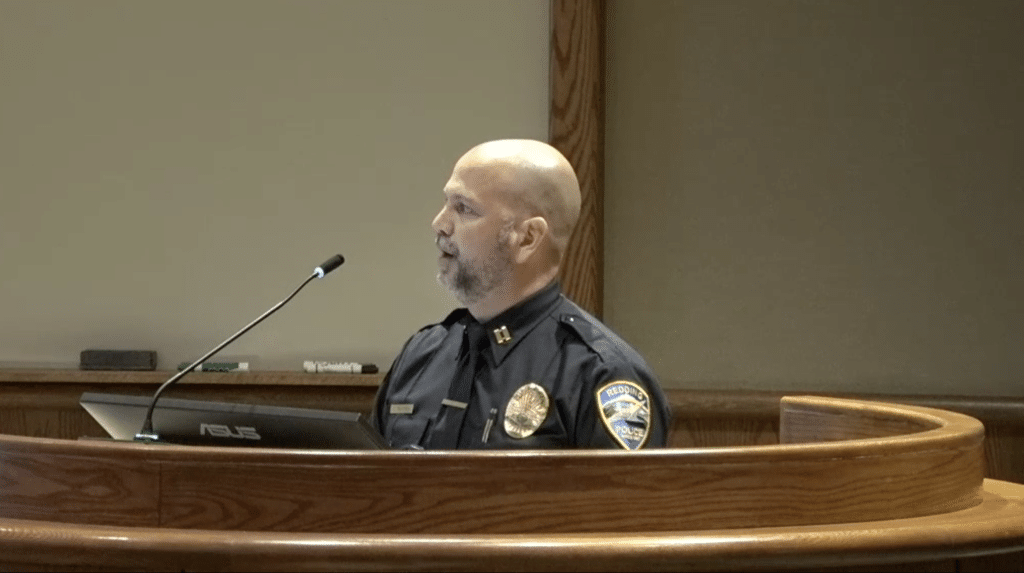
In response to this year’s presentation, an organization known as the Shasta Equal Justice Coalition (SEJC) is asking that RPD also provide quarterly reports on the use of this equipment. In a letter to the council, SEJC noted that “neither law enforcement officers nor the public can make informed decisions about the impact of using such weapons on human life without access to additional information.”
SEJC formed in response to George Floyd’s murder in 2020. The organization focuses on issues of equality within the local criminal justice system. Four members of the organization’s Steering Committee – Eddie McAllister, Denise Peters, Myriam Kalmogho and Tom O’Mara — have signed off on an open letter to the Redding City Council, which proposed changes in how the police disclose information to the public about the use of military equipment.
The department’s stock of military weapons also includes “less than lethal” ammunition, which are also known — in even more technical terms — as “kinetic energy launcher and projectiles.” More simply put, rubber bullets and “bean bag” weapons. Though they are known as “less than lethal,” these kinds of weapons have killed and maimed civilians when deployed in the West Bank, Indian-administered Kashmir, and here in the United States during racial justice protests in the summer of 2020. However, “when used properly,” as RPD wrote in its annual report, LLW weaponry can be a means of de-escalation and are “less likely” to result in death.
Slides shared by RPD documents items owned by the department that California law defines as “military equipment”.
Though AB 481 was a transparency measure intended to inform the public about the militarization of the police, the law requires very little to be disclosed about the effects of these weapons – whether they be positive or negative – on community safety.
That gap in the law is what led SEJC to issue its open letter to the City Counsel of Redding. SEJC is suggesting that the council require the police department to go beyond the requirements of state law and publish online quarterly reports on the use of all of RPD military equipment, including data on “the sex, race, gender, and age of suspects” the equipment was deployed in response to, and whether or not charges were ultimately filed against the suspect.
The organization is also advising that RPD’s reports on military equipment should detail “situations in which such weapons can be employed,” situations “for which weapons should be prohibited” and independently sourced information about the adverse effects of the weaponry.
SEJC’s letter acknowledges that this kind of data would come at a financial cost, as does the purchase and maintenance of military grade weapons. During the same meeting that RPD presented their 2025 annual AB 481 report, the Council authorized the police to buy up to eight more Def-Tech 40mm kinetic energy launchers, at a taxpayer expense of $2,225 each.
SEJC’s letter also referenced a statement made after RPD’s latest military equipment presentation by Council member Dr. Paul Dhanuka. Responding to the sole public commenter on the issue, who took issue with the city’s acquisition of this weaponry, Dhanuka said he was challenged to know the right way forward.
“(This is) truly one of the most difficult moral issues, and unfortunately I don’t have the answers,” Dhanuka said, slowly, appearing almost at a loss for words. “We try to balance public safety and security with human rights… but sorry I don’t have the perfect answer.”
Do you have a correction to share? Email us: editor@shastascout.org.
Bard Poet and Literature Professor Rebecca Cole Heinowitz, 50, Drowns in California River Accident
As Trump comes after research, Forest Service scientists keep working
The research and development team at the U.S. Forest Service employs about 1,500 people full-time, a small but mighty faction inside an agency that, until recently, was 35,000 strong. The research it conducts spans everything from managing visitors at recreation hotspots to understanding the pulse of life and land on the 193 million acres the agency manages.
Since President Donald Trump took office, his barrage of executive actions in the name of curbing waste have imperiled the basic functions of federal agencies. At the Forest Service, the result is a climate of fear and uncertainty that’s stymieing the scientists working to fulfill the agency’s mission — sustaining the nation’s forests and grasslands for the public’s long-term benefit — just as the summer research field season ramps up.
“Science and research are critical to maintaining public lands,” said Jennifer Jones, the program director of the Center for Science and Democracy at the nonprofit Union of Concerned Scientists. Federal scientists intimately understand the ecosystems of the public lands they study. Their institutional position and on-the-ground knowledge make them uniquely suited to translate study findings into effective management. “If we lose a few months — a few years — of science and science-led management of those natural resources, it could take decades and generations for ecosystems to recover if they’re poorly managed,” she said.
Forest Service workers describe the last few months as an emotional roller coaster. First came the freezes of congressionally approved spending, followed by confusing resignation offers for federal employees, firings that were reversed almost as quickly as they were ordered and promises of further workforce culling through planned downsizing. The Trump administration has even called for eliminating Forest Service research stations, according to reporting by Government Executive; three of the five stations are located in the West.
“If we lose a few months — a few years — of science and science-led management of those natural resources, it could take decades and generations for ecosystems to recover if they’re poorly managed.”
Spring and summer are usually an all-hands-on-deck time of year for field- going scientists. As the snow melts and the days lengthen, researchers head outdoors for fieldwork they’ve been planning for all winter. This year, however, they are grappling with uncertainty regarding funding, labor and logistics. “I don’t know what I’m going to do on Day 1,” said a Forest Service aquatic biologist, who requested anonymity, citing fear of retribution for speaking publicly, just four weeks before their field season was set to begin. “I wish I had a plan. I just show up every day and see if there’s any news.”
Most of the planned field projects in that scientist’s district have been suspended indefinitely. Still, one study, with the Fish and Wildlife Service, may happen: a survey of the movement of threatened bull trout along a western Montana river. The goal is to see how local populations are faring so that future recovery efforts can target problem sites.
But whether the team can execute it is another matter. The biologist needs a minimum of two extra hands to help install fish traps and tag captured trout, and at least $10,000 to install transponders for tracking the fish. But that support is now uncertain, so the biologist is making contingency plans, building their own fish traps and calling in favors to see if other groups can help with personnel or equipment. “We’ll have to get really creative — and beg and borrow from other agencies,” they said. In theory, the project could be delayed until next year, but the team is acutely aware of the ticking clock of the trout’s survival. “The sooner you intervene, the better your results,” the biologist said.
Research also helps federal agencies cultivate community relationships. One Forest Service scientist leading an effort to map aquatic biodiversity across the West is hounded by job insecurity: If they lose their job, no one will be left to analyze and interpret the two years’ worth of field samples that state and tribal collaborators have already gathered. “When I can’t be accountable to my partners in holding up my end of the research, that doesn’t have a good look,” said the researcher, who requested anonymity because they weren’t authorized to speak publicly about their work. At the time of the interview, the scientist had no plan B to salvage the project if they’re let go.
Forest Service research often involves repetitive environmental monitoring and inventorying. This allows scientists to catch anomalies, such as the initial appearance of an invasive species. The eradication of the invasive European grapevine moth from California’s wine country in 2016, for example, was due to early detection and rapid action. Still, it took federal and local agencies seven years to eliminate the berry-munching pest.
“If you just stop a program in the middle, that’s insane,” said Elaine Leslie, a former agency chief for biological resources at the National Park Service who is currently on the executive council of the Coalition to Protect America’s National Parks. “That is waste and fraud, right there. Years and years that people have spent protecting things are about to go down the tubes.”
In response to an email from HCN asking about federal cuts to science, a spokesperson for the U.S. Department of Agriculture, which houses the Forest Service, sent a general statement that did not address concerns about what the changes mean for research. Instead, it read in part, “We have a solemn responsibility to be good stewards of Americans’ hard-earned taxpayer dollars and to ensure that every dollar is being spent as effectively as possible to serve the people.”
A bull trout in Quartz Lake, Glacier National Park, Montana. Credit: Jim Mogen/USFWS
All this translates to a chaotic period for agency employees. Delays and uncertainty are eating into the valuable hours of the limited field season. Getting field-ready takes time: hiring seasonal staff, training new recruits, setting fieldwork schedules and ensuring that everyone is paperwork-compliant. “From A to Z, there’s a lot to do before you ever put a boot in the field,” Leslie said. “Everybody’s behind, because of this debacle.”
“We have a solemn responsibility to be good stewards of Americans’ hard-earned taxpayer dollars and to ensure that every dollar is being spent as effectively as possible to serve the people.”
“You never know where the leaps and bounds are going to come from,” said the aquatic biologist researching bull trout. So, field season after field season, “you just have to keep looking.”
Bring up Memorial Day to a friend, and the conversation will likely lead to a chat about family getaway plans, barbecues or swimming pools. In fact, many will observe the federal holiday not only as the unofficial first day of summer, but instead, as what Commander in Chief John A. Logan of the Grand Army of the Republic intended it for in 1868.
Logan wrote that Memorial Day was designated as the day “… for the purpose of strewing with flowers or otherwise decorating the graves of comrades who died in defense of their country during the late rebellion…”
He never once mentioned summer fun.
Still, there are honor-bound citizens and United States veterans who will pay tribute to those who died serving in the U.S. Armed Forces by attending a parade or ceremony. Veterans are also likely to attend, as well as the VFW members and Honor Guards participating.
VFW honor guards will continue to serve their fallen brothers and sisters after the last Monday of May passes; Memorial Day comes 365 days of the year for these volunteer veterans.
Post 9242 Commander Bernie Ramirez told BenitoLink that Hollister’s VFW Post Honor Guard participates in more than 10 funerals a month. They are actually one of the five VFW Honor Guards within 50 miles of Hollister (San Juan Bautista’s Leslie L. Garratt Memorial VFW Post 6359 also has an honor guard). “We have a total of fifteen honor guard members,” Ramirez said of Post 9242, “and it takes four to seven members to do military honors.”
The guard primarily serves San Benito County veterans, but also assists in ceremonies in Santa Cruz, Monterey, and Santa Clara counties. VFW Post 9242 member and Honor Guard member Adam Mendolla said they have assisted as far to Fresno and Santa Ana.
“We do that for the families that request it,” he said, noting that requests come from those who have ties to San Benito County or a Post 9242 member.
Members of the VFW Post 9242 Honor Guard fire three volleys during an honor service. Photo provided by Bernie Ramirez.
Mendolla said the honor guard serves not only for the funerals of soldiers who died while serving, but also for those of U.S. veterans who died as civilians—or even those who served in the military during peacetime and/or on American soil.
“Everyone that has served this country—here at home, abroad, or in combat, and no matter what branch of service they were in—deserves full military honors,” Mendolla said, explaining that the service includes full military honors such as the firing of the three volleys, the playing of the melancholy bugle call “Taps,” and the folding and presentation of the U.S. flag to the next of kin.
“They all left their homes, families and friends to serve this country and were ready to do their part if called upon,” he said.
And these services are available and can be given to any U.S. veteran who has passed away—for free—according to Ramirez.
“When a veteran passes, the family can tell the funeral home that they are a veteran,” he said. “The burials and the honor guard are at no charge. We do it as an honor. And the ceremonies are not always at burials. We’ve done them at churches and private residences.”
Members of the VFW Post 9242 Honor Guard serving at a memorial service of a U.S. veteran. Photo provided by Mimi Mendolla
Regardless of the veteran, the VFW Post 9242 Honor Guard treats every funeral with the same level of dignity and respect.
“Sometimes we go to funerals where there’s only five family members, and sometimes there’s a lot of family,” Ramirez said. “We’ve also done it for homeless veterans—and it’s all the same honor for us.”
For more information on the Hollister VFW Post 9242 Honor Guard, visit its social media pages on Facebook and Instagram. To request services, contact your local funeral home, email vfwpost9242@gmail.com or call Bernie Ramirez at (831) 902-7811.
We need your help. Support local, nonprofit news!BenitoLink is a nonprofit news website that reports on San Benito County. Our team is committed to this community and providing essential, accurate information to our fellow residents. Producing local news is expensive, and community support keeps the news flowing. Please consider supporting BenitoLink, San Benito County’s public service nonprofit news.
Visit just about any downtown on a weekend and you will likely happen upon a farmers market. Or, you might grab lunch from a food truck outside a local brewpub or winery.
Very likely, there is a community-shared kitchen or food entrepreneur incubator initiative behind the scenes to support this growing foodie ecosystem.
One food entrepreneur incubator, Hope & Main Kitchen, operates out of a school that sat vacant for over 10 years in the small Rhode Island town of Warren. Its business incubation program, with over 300 graduates to date, gives food and beverage entrepreneurs a way to test, scale and develop their products before investing in their own facilities. Its markets also give entrepreneurs a place to test their products on the public and buyers for stores, while providing the community with local goods.
Food has been central to culture, community and social connections for millennia. But food channels, social media food influencers and craft brews have paved the way for a renaissance of regional beverage and food industry startups across America.
In my work in agriculture economics, I see connections between this boom in food and agriculture innovation and the inflow of young residents who are helping revitalize rural America and reinvigorate its Main Streets.
This represents a stark contrast to the 2000s, when 90% of the growth for younger demographics was concentrated in the largest metro areas.
The COVID-19 pandemic and the shift to remote work options it created, along with rising housing prices, were catalysts for the change, but other interesting dynamics may also be at play.
One is social connectedness. Sociologists have long believed that the community fabric of rural America contributes to economic efficiency, productive business activity, growth of communities and population health.
Maps show that rural areas of the U.S. with higher social capital – those with strong networks and relationships among residents – are some of the strongest draws for younger households today.
Another important dynamic for both rural communities and their new young residents is entrepreneurship, including food entrepreneurship.
Rural food startups may be leveraging the social capital aligned with the legacy of agriculture in rural America, resulting in a renewed interest in craft and local foods. This includes a renaissance in foods made with local ingredients or linked to regional cultures and tastes.
According to data from the National Agricultural Statistics Service, U.S. local sales of edible farm products increased 33% from 2017 to 2022, reaching $14.2 billion.
The new ‘AgriCulture’
A 2020 study I was involved in, led by agriculture economist Sarah Low, found a positive relationship between the availability of farm-based local and organic foods and complementary food startups. The study termed this new dynamic “AgriCulture.”
We found a tendency for these dynamics to occur in areas with higher natural amenities, such as hiking trails and streams, along with transportation and broadband infrastructure attractive to digital natives.
The same dynamic drawing young people to the outdoors offers digital natives a way to experience far-reaching regions of the country and, in some cases, move there.
A thriving food and beverage scene can be a pull for those who want to live in a vibrant community, or the new settlers and their diverse tastes may be what get food entrepreneurs started. Many urban necessities, such as shopping, can be done online, but eating and food shopping are local daily necessities.
Governments can help rural food havens thrive
When my colleagues and I talk to community leaders interested in attracting new industries and young families, or who seek to build community through revitalized downtowns and public spaces, the topic of food commonly arises.
We encourage them to think about ways they can help draw food entrepreneurs: Can they increase local growers’ and producers’ access to food markets? Would creating shared kitchens help support food trucks and small businesses? Does their area have a local advantage, such as a seashore, hiking trails or cultural heritage, that they can market in connection with local food?
The farm store at Harley Farm Goat Dairy in Pescadero, Calif., draws people headed for hiking trails or the coast in the Santa Cruz Mountains. Smith Collection/Gado/Getty Images
Several federal, state and local economic development programs are framing strategies to bolster any momentum occurring at the crossroads of rural, social connections, resiliency, food and entrepreneurship.
For example, a recent study from a collaboration of shared kitchen experts found that there were over 600 shared-use food facilities across the U.S. in 2020, and over 20% were in rural areas. In a survey of owners, the report found that 50% of respondents identified assisting early-growth businesses as their primary goal.
The USDA Regional Food Business Centers, one of which I am fortunate to co-lead, have been bolstering the networking and technical assistance to support these types of rural food economy efforts.
Many rural counties are still facing shrinking workforces, commonly because of lagging legacy industries with declining employment, such as mining. However, recent data and studies suggest that in rural areas with strong social capital, community support and outdoor opportunities, younger populations are growing, and their food interests are helping boost rural economies.
Dawn Thilmany receives funding from the United States Department of Agriculture, Economic Development Administration, and Colorado state agencies focused on agriculture, economic development and food systems.
Sonoma-Mendocino geothermal energy project could accelerate demand for clean energy workers
Robert Davis pours concrete into a wooden form during the Sustainable Construction Technology lab at Mendocino College. Davis is currently in his second semester. (Ray Saint Germain/Bay City News)
Powering Rural Futures: Clean energy is creating new jobs in rural America, generating opportunities for people who install solar panels, build wind turbines, weatherize homes and more. This five-part series from the Rural News Network explores how industry, state governments and education systems are training this growing workforce.
MENDOCINO CO., 5/21/25 — A plan to nearly double the amount of electricity drawn from naturally occurring heat deep below Mendocino and Sonoma counties could create thousands of new jobs in the region.
The Sonoma-Mendocino GeoZone project still faces a long list of legal, regulatory and financial hurdles before construction, but the developer is already thinking ahead to hiring.
Sonoma Clean Power CEO Geof Syphers said the not-for-profit power producer is committed to hiring local workers for at least 30% of the jobs it creates. Meeting that goal, he said, will depend on building partnerships with local education and workforce development programs, along with a long-term commitment from California to streamline geothermal energy.
“We’ve been building partnerships with schools and trades and landowners and public officials, permitting agencies,” Syphers said. “But what really needs to happen before the permitting phase begins is we have to change state laws.”
Clean energy makes up a small but growing slice of Mendocino County’s employment, accounting for just under 600 jobs in 2023, according to an analysis of federal data by the nonprofit Environmental Entrepreneurs, which advocates for state and local policies benefiting the environment and economic interests.
Mendocino County workforce and education officials are taking note, gradually ramping up programs to train students to weatherize buildings, install and maintain solar projects and take on other related construction roles.
Noel Woodhouse, an instructor who runs Mendocino College’s sustainable construction and energy technology program, said the program has already evolved since launching in 2011 and will continue to do so. He’s confident that his students’ skills in clean tech, solar and sustainable building would easily transfer to geothermal construction — especially since the non-credit certificate program could rapidly train a large number of students in a short time.
“Our students come out of our program with experience in heavy equipment machinery and ready workers for that type of project,” Woodhouse said.
(L-R) Second semester student Manuel Marin Meza listens as instructor Noel Woodhouse talks to him about using a compound miter saw during the Sustainable Construction Technology lab at Mendocino College. Marin Meza is working toward a forklift certificate. (Ray Saint Germain/Bay City News)
Clean energy jobs pull in a wide range of professional skills, from plumbing and electrical work to pouring concrete and operating equipment.
“What I love is the people who work in oil and gas know exactly how to operate 100% of the equipment on a geothermal job site, and it’s the same wages,” Syphers said.
Geothermal energy is harnessed by drilling deep below the earth’s surface to access naturally occurring heat. The steam flows to a turbine to drive a generator that in turn produces electricity — a process that can occur 24 hours a day.
Mendocino County, along with neighboring Sonoma and Lake counties, sits on one of the country’s prime geothermal zones. The world’s largest complex of commercial geothermal power plants, known as The Geysers, is located in the Mayacamas Mountains near where the three counties connect. Owning the majority of the units there, Calpine Corporation generates about 725 megawatts of electricity using geothermal energy. Sonoma Clean Power’s GeoZone proposal aims to build another 600 megawatt geothermal power plant.
A steam line runs down to a generating unit at The Geysers along the border of Sonoma and Lake counties. Calpine Corporation, the largest geothermal power producer in the U.S., owns and operates 13 power plants at The Geysers, the largest complex of geothermal power plants in the world, with a net generating capacity of about 725 megawatts of electricity — enough to power 725,000 homes, or a city the size of San Francisco. (U.S. Department of Energy via Bay City News)
The labor needed to develop 600 megawatts of new geothermal energy capacity will require hundreds of white-collar workers and thousands of construction workers during the building phase, and the project will create about 1,000 permanent jobs, Syphers said.
“Today, about 400 people from Sonoma, Lake and Mendocino work at The Geysers,” Syphers said. “If we can roughly double that for permanent jobs, that’s very exciting to me.”
Connecting students to skills and employers
As director of employer partnerships for Mendocino College, Pamela Heston-Bechtol’s job is making connections between students and employers. She combs through job postings at least once or twice a week and distributes opportunities to respective departments.
“It’s giving our students as much exposure as possible to be able to see themselves in those jobs by inviting industry to our advisory committees and inviting our students to job shadowing,” Heston-Bechtol said.
The Mendocino County Office of Education also offers career technical education programs with various pathways for youth. Eric Crawford, the office’s director of career and college programs, and Natalie Spackman, a workforce development coordinator with North Bay Construction Corps, together work with high school seniors interested in construction trades to complete a 14-week program.
“At the end of the instruction, they get a tool belt, and then they go out for boot camp for two weeks, and they work with contractors for 80 hours on a live build site and find out what it’s really like to do the work,” Crawford said, noting that this helps students determine which type of work interests them most.
At the completion of camp, the contractors are invited to interview students and potentially offer them jobs.
(L-R) Hannia Fernandez and Jaime Gonzalez work on a concrete form during the Sustainable Construction Technology lab at Mendocino College. (Ray Saint Germain/Bay City News)
The newest career technical education program set for Ukiah High School, called Roots of Success, will train high school students specifically for green energy fields. However, Spackman said that basic training in construction gives students skills that transfer to a variety of work, especially given the state’s regulations for the trades to go green.
“No matter where they go, contractors ultimately work for their customers — what’s in demand?” she said. “The skills that they’re learning, that’s going to translate.”
Leaders from both the high school and college workforce development programs agree that while there’s plenty of work for their students and a growing demand for clean energy workers, trades training is hindered by a severe shortage of teachers.
Crawford said anyone with three years of experience in a specific field can get a designated subject teaching credential and become qualified by the state of California. Woodhouse said that Mendocino College’s minimum qualifications include an associate degree and experience in the field.
Other challenges, Woodhouse said, are those stacked against the students in a county with high rates of substance abuse and poverty. To address those, he highlighted support systems at the college that include a food pantry, mental health services and transportation, among others.
A student perspective
Sustainable Construction Technology lab tech Kevin Vasquez at Mendocino College. (Ray Saint Germain/Bay City News)
Kevin Vasquez says participating in the Mendocino College program changed the course of his life.
When he was 11 years old, Vasquez received a message at school that his father wouldn’t be able to pick him up. He had been deported.
“I felt violated that they took my dad from me,” he said. “I started drinking alcohol, trying to escape.”
The quiet habit morphed into an addiction that left him aimless and jobless in his 20s. Yet he remembered his father, an immigrant from Mexico who had worked tirelessly in stone masonry to give him a better life. He knew he needed to make something of that life, but he needed help first.
He went through rehabilitation, where a counselor suggested he check out Mendocino College’s construction program. For Vasquez, that program sparked light in the darkness.
“It got me back out there, doing what I love, which is building with my hands,” said Vasquez, who now offers help to other students as a lab tech.
For Vasquez, the prospect of GeoZone tapping into more renewable energy within the county brings an exciting opportunity to put his skills to use at a potential union job.
(L-R) Garrett Dinyer talks to Sustainable Construction Technology lab tech Kevin Vasquez during a lab at Mendocino College. Dinyer is a food truck owner and chef from Fort Bragg and is taking the class to gain personal skills. (Ray Saint Germain/Bay City News)
Mendocino County’s hiring contractors are small, and while they offer great one-on-one experiences, Woodhouse said, they’re not unionized.
Syphers shared that Mendocino County workers won’t need to be union members to work on the GeoZone project.
“You don’t have to be a union signatory to get hired through a union and then work on these projects,” he said. “That gives you an option to decide later if you want to become a signatory and be part of the union.”
The construction phase for GeoZone is projected to be six or seven years out, but Syphers said those years will be spent cultivating relationships with local schools, unions and smaller contractors.
Ultimately, he hopes the state will streamline permitting and make long-term commitments to invest in geothermal work.
“That’s how we actually get unions to open apprenticeship centers in Mendocino County,” Syphers said.
While the Biden administration helped streamline the geothermal process nationally, most of California’s geothermal opportunities are not on federal land, he pointed out. Sonoma Clean Power has worked with California Assemblymembers Diane Papan, D-San Mateo, and Chris Rogers, D-Santa Rosa, to introduce assembly bills 526, 527 and 531, which all aim to advance geothermal energy development.
“Everyone universally agrees California is the best place in the United States to do this if the permitting changes,” he said, noting that the state requires a full environmental review that can take anywhere from two to eight years. “This region has enough geothermal potential to support areas beyond Sonoma and Mendocino. That’s really, really valuable for the state.”
Athletes from more than two dozen area schools competed at the 20th annual Unified Gifted Games held on May 9 at Andy Hardin Stadium at Hollister High School.
According to Sam Sauer, a Gilroy Unified Adult Transition Program teacher, 25 schools attended the games.
“I first participated back in 2010, ” Sauer said. “That was my first Gifted Games, and I have seen it grow significantly over the past 15 years or so.”
According to Sauer, this year’s event included many different sports and activities, such as softball, the long jump, and the football throw, as well as inflatables.
“We are having an amazing time, as always,” Sauer said. “We love this event and look forward to it every year.”
“I think this event is awesome,” said Hollister High Behavioral Support Supervisor Vanya Robles Davidson, adding that everyone was “having a terrific time.”
Mateo Sotomayor in the wheelchair race. Photo by Adam Bell.
Cristina Vasquez’s son, Mateo Sotomayor, participated in the wheelchair race.
“We love it,” Vasquez said. “I hope we can do it more times in the year. My son was very excited and trained a lot.”
Luke Kahie. Photo by Adam Bell.Posting of the Colors by Post 9242. Photo by Adam Bell. Freida Agawo playing baseball. Photo by Adam Bell. Leilani Telles and the Javelin Throw at the Unified Gifted Games. Photo by Adam Bell. Unified Cheer and Baler Cheer Performance. Photo by Adam Bell. The students doing 50-Yard Dash. Photo by Adam Bell. The students and the wheelchair race. Photo by Adam Bell.
Trump canceled two Fort Bragg nonprofit grants, two national foundations stepped up to fill the void
FORT BRAGG, CA., 5/12/25 – After being informed by the President Donald Trump administration that their National Endowment for the Arts grants were terminated earlier this month, two local nonprofits will still be able to implement the programs they planned – with the help of national foundations stepping up to fill the void.
In January, the Larry Spring Museum and Art Explorers were told they would receive $10,000 grants from the NEA.
Dedicated to the science experiments and outsider art of Larry Spring and artists working in the fields of art and science, the Larry Spring Museum was set to receive a grant to expand its Redwood Time project, which examines the narrative of settlement and resource development on the Northern California Coast. The grant will fund an artist in residency with artist Ursula Brookbank and an artist workshop with Anne Beck.
Art Explorers, an art gallery and studio for adult artists with disabilities, was awarded a grant to launch Film School, which will offer filmmaking workshops to its artists culminating in a film about Fort Bragg.
The grants were part of the NEA’s Challenge America program, which funds art projects in underserved communities, including rural areas like Fort Bragg, and populations such as individuals with disabilities.
It takes on average 25 to 40 hours to write a NEA grant. Thousands of nonprofits across the country apply and less than 300 organizations are selected.
Jerry Turner at the Art Explorers studio in Fort Bragg, Calif. in February 2025. For 25 years, Turner has been with Art Explorers, a nonprofit that supports adult artists with disabilities. (Maria Trombetta via Bay City News)
Art Explorers board member Adele Horne called the grant “a really big deal” due to its competitive nature.
However, the excitement of the grant awards was short-lived.
In March, the museums received emails from the NEA that funding may be delayed due to staff having to review executive orders signed by Trump that could possibly impact the grants.
On May 2, the Larry Spring Museum and Art Explorers received emails stating that “the NEA is updating its grantmaking policy priorities to focus funding on projects that reflect the nation’s rich artistic heritage and creativity as prioritized by the President. Consequently, we are terminating awards that fall outside these new priorities.”
Both grants were determined to fall out of scope of Trump’s priorities, which include art projects that “empower houses of worship” and “make America healthy again.”
That’s when two national arts organizations stepped up to the plate.
On Wednesday, the Andy Warhol Foundation for the Visual Arts and the Helen Frankenthaler Foundation announced that they would jointly award $800,000 to 80 nonprofits across the country that found their programs in jeopardy due to NEA grant uncertainty.
The Larry Spring Museum and Art Explorers were among the chosen organizations. Each would receive $10,000 to implement the programs they proposed to the NEA.
“We’re thrilled,” said Maria Trombetta executive director of Art Explorers. “We are deeply grateful to these foundations for providing this generous support at such a critical moment for so many organizations.”
The response was similar for the Larry Spring Museum’s Executive Director Anne Maureen McKeating. “We are deeply grateful that the Frankenthaler and Warhol foundations have elected to ensure that visual art projects that lost their funding—many of which serve remote communities like ours—can move forward without further interruption.”
There was no time like the present, according to Elizabeth Smith, executive director of the Frankenthaler Foundation. She hopes that other organizations will step up to fund organizations that are seeing funding dwindle away by the power of the president’s pen.
“In times of crisis—whether in response to natural disaster, global pandemic, or financial disruption—foundations do their best work when they come together to assert shared values,” she said.
Local Activism Highlights Missing and Murdered Indigenous People in what is now known as Shasta County
Participants of prayer walk, led by Jack Potter. Photo courtesy of Danita Quinn.
“James Wright,” Danita Quinn (Pit River, Wintu, Yana) called out to a group of demonstrators as she held up a poster with a yearbook photo of a little boy’s face. In 1986, when Wright was only 17, he disappeared without a trace. Today, the Pit River community continues to keep James’ memory alive, referring to him as “Little Man.”
Recently, when his mother Florence contacted the Shasta County Sheriff’s Office to inquire about his investigation, Quinn told Shasta Scout, officers said there was no longer a case. The Sheriff’s Office did not respond to a request for comment.
James Wright Jr. Photo courtesy of Danita Quinn.
“He’s a cold case, if anyone wants to hold him.” Quinn said, as she distributed Wright’s portrait and others amongst a group of about 50 demonstrators behind Redding City Hall on May 5, a day designated for bringing awareness to missing and murdered Indigenous people (MMIP).
During Tuesday’s MMIP event, several of those present at Redding City Hall were direct family members of the missing or murdered featured on posters, many of whom were locals to Shasta and the surrounding counties before they disappeared.
Quinn was the organizer of a five mile prayer walk from Redding City Hall to the Redding Rancheria. She was joined in her efforts by Jack Potter of the Rancheria’s Tribal Council and Morning Star Gali (Pit River, Ajuwami Band) who is the founder of Indigenous Justice. After reaching their destination Tribal members engaged in a sacred fire ceremony and traditional dance and congregated over dinner.
Tuesday’s MMIP walk in Redding was one of three events held locally this week. On May 4, community members also organized a candlelight vigil for the missing at the Sundial Bridge. And on the morning of May 5, before the Redding walk, a similar event was held in Burney. The area now known as Shasta County includes the ancestral lands of the Pit River Tribe, the Nor-El-Muk Wintu Nation, the Wintu Tribe of Northern California, the Winnemem Wintu Tribe and the Redding Rancheria.
The MMIP Legacy in Shasta County
“Jessica Alva was a friend of ours who was killed in 2019,” Gali told Shasta Scout. According to Alva’s autopsy report, her death was suicide by hanging. Her community maintains that she was strangled by her physically abusive partner. Gali also named other local missing indigenous women including Melody Turner, Heather Cameron-Haller, and Angela McConnell.
Explaining that local law enforcement can be slow to act, Gali said it often falls on the members of a local tribe to search for answers on their own.
“In the case of our loved one Nick Patterson, when he went missing… Shasta County unfortunately provided lots of roadblocks and really impeded the search efforts,” she said. “It really came down to the families and the local tribal community that had to coordinate search efforts to look for Nick in the snow.”
Patterson’s remains were only recently recovered, 5 years after he was last seen alive.
“It doesn’t seem that there was a willingness to do more in terms of a young Native American man that went missing under very suspicious circumstances”, Gali continued. “But when non-Native American people have gone missing, especially here in Redding, we’ve seen those resources activated in a way that our community just doesn’t experience.”
In a May 7 statement from the Sheriff’s Office, Public Information Officer Timothy Mapes pushed back on that perspective, telling Shasta Scout that the Department treats all missing persons reports “with the utmost seriousness” and conducts missing persons investigations “without bias or discrimination”.
“Every report is evaluated and acted upon with the same urgency and commitment to public safety,” Mapes emphasized.
Despite the fact that California is home to the largest Native population in the United States, it wasn’t until 2018 that James Ramos, the first Native lawmaker, was elected to the California State Assembly. Ramos, who’s now the chair of the California Legislative Native American Caucus, was the author of AB 1863. That bill implemented Feather Alerts, a specific tool through which Indigenous communities can alert the public when a Native person goes missing.
Until recently, law enforcement were given broad leeway in determining if a missing Indigenous person met the criteria of a Feather Alert. This meant that local law enforcement and California Highway Patrol Officers had the power to deny a family’s request for a Feather Alert for any reason, including the officer’s assessment of their social or behavioral history. A 2024 amendment to the Feather Alert process now explicitly ensures that Tribal members with mental health or addiction issues will be included in Feather Alerts.
Gali is concerned that bias amongst North State law enforcement is also exacerbating the MMIP crisis. Shasta Scout’s reporting on the initial disappearance of Patterson (Pit River, Atwamsini Band) documented his family’s fears that the Shasta County Sheriff was not taking the investigation into his disappearance seriously. According to his aunt, officers suggested that Patterson could have voluntarily taken off on his own, despite the fact that his loved ones felt it was unlike him to go totally incommunicado.
Five years later, Patterson will soon finally be laid to rest, but Gali feels that “there’s definitely many more questions than answers.”
California Attorney General Rob Bonta says that the Department of Justice is committed to prioritizing the families of Native people who disappear or are murdered.
“Trust is earned, and we’re doing our best to earn it by showing our respect, by listening, by learning, by being the best advocate and ally that we can be,” Bonta said on a podcast in 2023, “by standing up for the rights and dignities of all people, including certainly our Indigenous people.”
On May 7, the California Assembly Democrats addressed the crisis and proposed solutions on May 7. A recording of the livestream is available here.
Justice for Jessica Alva poster. Courtesy of Justice for Jessica Alva Facebook page.Informational graphic for Nick Patterson. Courtesy of North-Cal Alliance fro the MissingHeather Cameron-Haller. Image Courtesy of Justice for Heather Cameron-Haller Facebook page. Angela McConnell. Image courtesy of Indigenous Justice.
Do you have a correction to share? Email us: editor@shastascout.org.