Hopland tribe to celebrate new housing development for homeless members
A completed multifamily residence on the Hopland Rancheria in Hopland, Calif., on Tuesday, July 1, 2025. The Hopland Four-Plex, a multifamily development with two two-bedroom units and two three-bedroom units under one roof was completed earlier this year. The development is overseen by Northern Circle Indian Housing Authority (NCIHA) and the housing authority will manage the property. The development is designated for homeless members of the Hopland Band of Pomo Indians. (Madi Ferranti via Bay City News)
MENDOCINO CO., 7/16/25 — Hopland this weekend will celebrate the completion of a housing development dedicated to homeless members of the Hopland Band of Pomo Indians.
This Saturday, Northern Circle Indian Housing Authority will hold a ribbon-cutting ceremony at the Hopland Band of Pomo Indians’ Rancheria to celebrate the completion of a new fourplex dedicated to chronically homeless people of the Hopland tribe.
The fourplex is for tribal members experiencing chronic homelessness, which is defined as a person who has a mental or physical disability and has been homeless for at least a year or has had four or more episodes of homelessness in the past three years.
Moriah McGill, deputy director of the Northern Circle Indian Housing Authority, a tribal housing group based in Ukiah that serves eight federally recognized tribes in Northern California, said in an interview that this weekend’s event is a celebration of the hard work that went into the project.
“This event is a tribute to the dedication, commitment, and tenacity of the project team — and most importantly, a celebration of homecoming for four chronically homeless families of the Hopland Band of Pomo Indians,” McGill said. “We extend our deepest gratitude to the Hopland Band of Pomo Indians for trusting us to build this project in alignment with their vision, values, and future.”
The fourplex is a multifamily development with two two-bedroom units and two three-bedroom units. The project received funding from both federal and state sources.
The ribbon-cutting ceremony for the new Hopland fourplex will be held Saturday from 11:15 a.m. to 1 p.m. at the tribe’s rancheria, 13000 Nokomis Road in Hopland. The event will feature guest speakers, and lunch will be provided.
The event is open to the public, but space is limited. To RSVP, call Karen Hamaker at (707) 468-1336, ext. 126, or email khamaker@nciha.org.
In Northern California, Lynette Craig is still fighting to find justice for her Native son in a broken system
Photos of Nick Patterson, an Indigenous man who went missing in 2020, on a poster board made by his family. Photo by Madison Holcomb
When Lynette Craig went to pick up her son Nick Patterson’s remains at a mortuary in Modoc County, she wasn’t sure how to feel. It was earlier this spring, and over a year since his partial remains were first recovered.
“He was a big boy,” she said. “It was just weird to me, because my big old boy fit in this little box. It made me mad, but at the same time, it was good to hold him again.”
Craig is a member of the Pit River Tribe, whose ancestral homeland is located in Northern California. When she got her son’s remains back, she was glad she could finally bury him, an important aspect of tribal tradition that allows the deceased to journey on to what’s next. The long-awaited moment came after what she says has been a years-long struggle with local law enforcement to push Nick’s case forward.
Nick, a member of the Atwamsini band of the Pit River Tribe, went missing more than five years ago in January 2020 when he was just 26. While some of his remains were finally found last year, the reason for his disappearance and death remains unsolved, leaving his family and friends still searching for answers.
Lynette Craig (center) sits with members of the search party who looked for the remains of her son, Nick Patterson, on June 28 in the Lookout Fire Hall. Photo by Madison Holcomb
His mom’s battle for the truth captures determination fueled by the profound grief of a mother who lost her child. But it is also emblematic of the structural challenges Native people often face when working with law enforcement and the ongoing systemic negligence that’s been documented in response to Missing and Murdered Indigenous People (MMIP), whose cases are seven times less likely to be solved than those of non-Native people.
Craig said she’s seen the effects of the MMIP crisis in her own Tribe. She recalled going to a funeral of an Indigenous child who went missing decades ago, Little George Montgomery. His body was dismembered, and all that was left was his skull, which was placed in a small box for his wake.
“I just remember thinking, ‘Oh my God, that’s horrible. Nothing like that will ever happen to me,’” Craig recalled. “But now I have my own box.”
It wasn’t until Nick’s disappearance that Craig truly realized the gravity of the MMIP crisis, particularly in California, home to the largest Indigenous population in the United States.
“That’s one thing that kind of disturbs me, is it had to hit home first for me to realize and to really pay attention to what’s really been going on,” she said.
California has made efforts in recent years to allocate resources toward the MMIP crisis, awarding millions of dollars to tribes to support MMIP investigations, including a grant to the Pit River Tribe last year.
The state also established the Feather Alert system in 2022. Similar to the AMBER Alert, the system helps locate missing Indigenous people by prioritizing visibility for their cases. California State Assemblymember James Ramos, the first and only Native lawmaker in the assembly, also pushed a bill in 2020 that directed the state Department of Justice to increase law enforcement collaboration for MMIP cases.
But the related issues are complex and take time to solve. For example, a component of the Feather Alert system that allowed for subjective decision-making initially led to a high rate of request denials by law enforcement agencies. The issue was addressed last year by an amendment, which aims to reduce law enforcement’s discretion in which cases to flag for alerts.
The struggle to get answers from law enforcement
A flyer for a prayer walk for Nick Patterson rests on a table in the Prairie River Tribe building. Photo by Madison Holcomb
Craig describes her son as a respectful and generous person. He played basketball, was an active member of his Tribe, gave enormous hugs and loved The Rolling Stones. Nick swore his purpose in life was to be a big brother, and he was known to always have his hand out to help others.
“Whenever anybody seen Nick Patterson come in, they had a smile on their face,” Craig remembered. “They genuinely cared about him.”
He was last seen on Jan. 5, 2020. A few days after he went missing, Craig filed a missing person report with the Shasta County Sheriff’s Office, which has jurisdiction over the area where her son went missing. She says she felt the office did not take Nick’s case seriously or handle it with enough urgency from the start, explaining that they asked if Nick just needed some time away or if he was out drinking, even after Craig assured them that it wasn’t like him to disappear without telling anyone.
Craig said she requested that the sheriff use cadaver dogs to search for Nick, but the department claimed they couldn’t use the dogs until 30 days after the missing person report was filed. Later, while attending MMIP conferences, Craig was told that there is no waiting period to be able to use cadaver dogs. Neither the Shasta Sheriff’s Office nor the California Commission on Peace Officer Standards and Training list any such restriction in its policies.
A few months after Nick was last seen, in March 2020, the COVID-19 pandemic hit. Around the same time, the Shasta Sheriff’s Office transferred Nick’s case to the Modoc County Sheriff’s Office, which oversees the area where Nick resided at the time he disappeared. Craig claims the Shasta Sheriff’s Office wouldn’t release Nick’s official investigation records to Modoc — something neither the Shasta nor Modoc Sheriff have confirmed nor denied.
“Ever since he went missing, I’ve hit every roadblock, every obstacle that there is,” Craig said. “It’s just stupid, like, unimaginable.”
The Shasta Sheriff’s Office refused to answer a list of specific questions for this story, including requests to learn more about the department’s reportedly dismissive behavior toward Craig when she filed the missing person report and the alleged 30-day rule to use cadaver dogs, as well as claims about whether the investigative files were ever transferred to Modoc.
Instead, the Shasta office repeated a vague general statement about the case that’s been provided to the press in the past.
“The Shasta County Sheriff’s Office treats all missing persons reports with the utmost seriousness and responds to them without delay, as required by California law,” Public Information Officer Tim Mapes said in an email statement. “We do so without bias or discrimination, regardless of a person’s gender, race, ethnicity, religion, or background. Every report is evaluated and acted upon with the same urgency and commitment to public safety.”
Many Native people distrust law enforcement for a variety of historical reasons, chief among them America’s history of government-endorsed violence against Native people and subsequent forced assimilation.
Federal laws enacted in the years that followed the massacres of tribal communities across Northern California furthered the harm against Indigenous people, laying the groundwork for the Missing and Murdered Indigenous People crisis occurring today. Public Law 280, for example, has sometimes allowed crimes against Native people to go unaddressed since it required tribal police to share criminal jurisdiction with state police, causing overlap and confusion.
Despite these substantial issues, tribal communities, like others, remain reliant on the help of police when seeking justice. Craig said the complexity of navigating that relationship is something she came face-to-face with while working on Nick’s case.
“I wasn’t sure what I was gonna have to do to keep his case under investigation but be able to do it in a way where I wasn’t gonna be stepping on their toes, because I still need their help,” she said.
Modoc Sheriff Tex Dowdy, himself a member of the La Jolla Band of Luiseño Indians, said since his office took over Nick’s case in March 2020, “numerous leads have been followed, and multiple interviews have been conducted” in the investigation.
But Craig, who still thinks not enough has been done to solve Nick’s case, said it became increasingly clear to her over time that she would have to take matters into her own hands to make progress in finding the truth.
Over the last few years, Craig has gathered records to aid in Nick’s case, facilitated communication with experts and officials and organized a grid search, which occurred this past June, to look for more of Nick’s remains — in effect, taking on the duties of an investigator, without training or compensation.
Lynette Craig covers her face with her hands while talking with Modoc County Deputy Sheriff Erik VonRader at a grid search to look for remains of her son, Nick Patterson. Photo by Madison Holcomb
In 2023, Craig consulted the National Missing and Unidentified Persons System (NamUs) website and read that dental records and/or DNA samples are pivotal for identifying people in missing person cases.
It occurred to her that neither of the two sheriff’s offices had contacted her to collect this information, although, according to a Shasta County Sheriff’s Office policy, this information should have been collected shortly after Patterson’s missing person information was reported to the state’s Department of Justice. Craig checked Nick’s file on the DOJ site and saw there were still no dental records or DNA included.
Reading through the information on the NamUs site to learn how best to help Nick’s case was one of many emotionally challenging parts of her efforts to find him, Craig said.
“When I tried to register Nick for NamUs, I still had high hopes that I would find my son alive, safe and in one piece,” she said. “When I started reading on the website about human remains, what it was all about, it took me probably two weeks to finally sit down long enough to register with NamUs.”
Craig took the initiative to contact the California DoJ’s Office of Native American Affairs to request a family reference sample, which is used to help identify missing persons through DNA. Extra steps had to be taken to get the kit sent to Nick’s dad, who was in prison at the time.
“I needed these tests done because I knew that Nick wasn’t around anymore,” she said. “There was no way to identify Nick if we did find him.”
Craig also tracked down Nick’s dental records, but it wasn’t without struggle. She said Nick rarely went to the dentist because of how good his teeth were, and his orthodontist, who was based in Oregon, sold his practice. She was eventually able to get a hold of the records so that they could be included in Nick’s file.
Finally, on April 24, 2024 — more than four years after he went missing — a skull and humorous bone were found by a civilian in Lookout, a small and remote area in Modoc County. After the Modoc Sheriff’s Office retrieved the bones, they were sent to a California DoJ evidentiary lab in Chico to be analyzed and tested and were eventually determined to belong to Nick.
Craig wasn’t notified of the remains until about three months later, after lab testing concluded. In the end, it was the dental records that she had worked so hard to acquire that allowed the skull to be identified as Nick’s.
As a cousin told Craig, without her efforts, “They wouldn’t even be able to identify him.”
A month after the skull and humorous bone were identified, the Modoc County Sheriff’s Office conducted its first official search in the area where the bones had been found. Investigators discovered additional bones — vertebrae — they believed also belonged to Nick. They notified Craig about the additional remains.
After picking up Nick’s box of remains, Craig opened the box to place a beanie, something Nick often wore, on his skull for burial. She noticed the vertebrae were missing, something which neither the mortuary nor sheriff’s office had informed her about.
She contacted the sheriff’s office and was told Nick’s vertebrae had been lost somewhere between the evidentiary lab in Chico and the sheriff’s office. An internal investigation was ongoing, the sheriff’s office told her, to find out what happened to the bones. Craig said she thinks if she hadn’t opened the box of Nick’s remains, they never would have told her the vertebrae were missing. They still haven’t been located, and it’s not clear if they were ever DNA-tested to ensure they belonged to Nick.
“I’m sick and tired of figuring out how to show these guys how to do their job,” Craig said. “My frustration is the only thing that’s pushing me.”
Dowdy did not answer specific questions from Shasta Scout about the missing vertebrae, instead responding vaguely that “continued investigative efforts will bring clarity to these concerns in due time.”
Lynette Craig (left) speaks with Missing and Murdered Indigenous People (MMIP) Yurok Tribe investigator Julia Oliveira at a grid search for Nick Patterson on June 28. Photo by Madison Holcomb
Despite Nick being found, the challenge continues
As a member of the Pit River Tribe, Craig had specific needs and concerns when it came to handling Nick’s remains. She said her Tribe believes that the deceased need to be buried quickly in order to travel to the next life. Because she wasn’t allowed to pick up Nick’s remains until this past May, more than a year after they were found, she worried that his spirit was stuck between here and the next life. This was another source of intense emotional distress.
“There’s been nothing at all I can control during this whole thing,” she said. “That was kind of one of the things that I thought I could.”
Noting his own tribal affiliation, Modoc Sheriff Dowdy said that he has approached the case with “great care and reverence” but did not explain why it took so long for Craig to get access to Nick’s remains for burial.
“Once specific Native American customs were brought to our attention,” Dowdy wrote, “we acted promptly and respectfully to ensure those traditions were honored.”
Members of the Pit River Tribe and more look for the remains of Nick Patterson at a grid search in the Lookout area on June 28. Photo by Madison Holcomb
Nick’s cause of death still hasn’t been officially determined. For various reasons, Craig said she thinks her son was murdered, though law enforcement hasn’t shared any evidence to back that idea.
In late June, dissatisfied with the Modoc Sheriff’s Office’s prior efforts, Craig organized a grid search to try to look for more of Nick’s remains. About 20 people were involved, including family, members of the Pit River Tribe and the Modoc County Sheriff’s Office. The search went on for around seven hours, and cadaver dogs were used to try to find human remains. A few bones were found, but they still need to be tested to see if they’re human.
Amanda Geopfert, a member of the Madesi band of the Pit River Tribe who attended the search for additional bones, said the mishandling of Nick’s remains has reinforced her belief that law enforcement hasn’t done enough for his case.
“I feel like every step of the way, the system has failed their family and failed Nick, even as far as losing his remains,” Geopfert said.
Amanda Geopfert, a member of the Pit River Tribe, participated in the grid search for Nick Patterson, an Indigenous man who went missing in 2020. Photo by Madison Holcomb
Craig said she was glad to see the search happen because it reinforced her belief in the community’s continued support for Nick.
“It’s awesome to see everybody still interested in the case, still wanting to know what happened, where he’s at,” Craig said. “That helps me. He hasn’t been forgotten, and it’s still an issue.”
Craig’s process through grief and growth
Over the five years since Nick went missing, his case has taken over Craig’s life. But it’s also been a major learning experience for her, she said. Not only has she navigated records requests, DNA sampling and communication with officials and experts, but she’s also had to learn how to be there for her family in new ways. She said she’s been careful not to overshare information about certain details in Nick’s case to avoid traumatizing or disturbing family members. And she’s also had to learn to not act on emotions.
“With this, I have to make sure that when my daughter calls, that I’m not freaking out and being all upset because I have to be there for her,” Craig said. “I have to be able to do stuff like this.”
She feels like the process has affected her very perception of time.
“It feels like it was just the other day that he first went missing, and sometimes it feels forever and ever,” she said. “I’ve never missed anything so much in my entire life.”
Not long after Nick disappeared, Craig said she met with a psychic to learn more about his disappearance. Since then, she said Nick’s spirit visited her in the times she’s needed him most. The first time she saw him, she said he told her that if she wants to see him again, then she has to go where he’s at — a sign to her that he’s passed into the afterlife.
She said seeing Nick’s spirit has been a helpful part of the mourning process.
“At first, I didn’t understand why this had to be such a long, drawn-out process, why we’ve had to do everything we’ve done,” she said. “But I do know now that if I would have found everything the first couple weeks, it would have been too much for me.”
A piece of a complex crisis
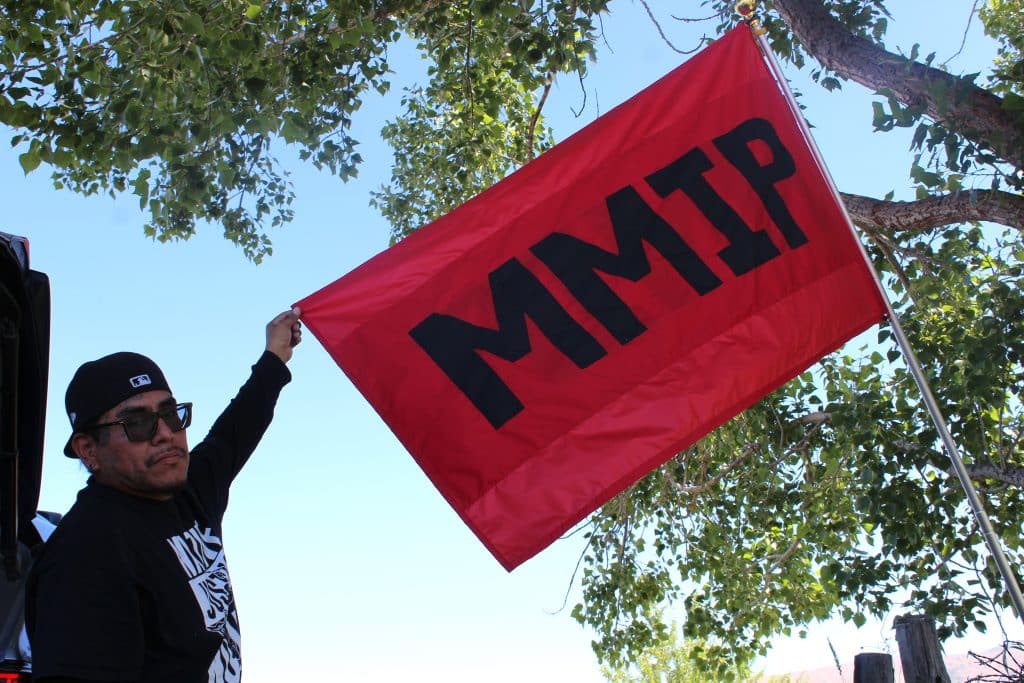
A member of the grid search to look for the remains of Nick Patterson holds up an MMIP flag. Photo by Madison Holcomb
Indigenous people go missing at a higher rate than the general population and are more likely to be victims of violent crime. Northern California has been identified by researchers as an epicenter of the MMIP crisis, ranking among the top areas of the country for missing and murdered Indigenous people.
After attending several MMIP conferences over the years and doing in-depth research, Craig said she’s been able to observe up-close how deep and complex the crisis truly is. She considers herself among the lucky ones because she has at least some answers.
“There’s families out there that can’t even file a missing persons report because law enforcement won’t listen to them, or they’re being threatened,” she said. “Remaining grateful and thankful for the stuff that I do have is something I gotta remind myself of constantly. There’s been a lot done in [Nick’s] name. He’s doing good things for people, and he’s not even here still.”
Local tenant preference policy debated by county planners
This article was written by BenitoLink intern Ariana Rivera. Lea este artículo en españolaquí.
San Benito County officials are working on a policy to prioritize local residents for affordable housing units. The county Planning Commission is still ironing out details before the proposal goes before the Board of Supervisors.
The debate surrounding the local preference plan stems from the board’s attempt to define who qualifies as a resident and how to decide between multiple eligible residents. The planning commissioners indicated their ultimate goals were to preserve community ties, remedy displacement and mitigate potential gentrification.
On June 18, the commissioners unanimously agreed to continue the item to their August meeting when they are expected to discuss adding seniors as a preference, removing a one-year residency requirement and other criteria.
The local tenant preference is intended to fall under local affordable housing regulations—projects in which the county plays a part in development approval or developmental assistance, and projects with four or more attached or detached units.
Tenant applicants who meet the requirements would be given priority when landlords are looking to fill available units.
County officials have been considering the preference policy since April.
Suggestions that sparked debate at the June 18 meeting included the addition of a one-year residency requirement and the removal of the weighted point system associated with the list of preferences.
The commissioners, who are appointed by the county board, discussed the legal challenges that could come with the addition of a residency requirement because of the potential violation of federal and state fair housing laws, and the privileges and immunities clause outlined in the U.S. Constitution.
Assistant County Counsel Sean Cameron said that any privileges and immunities provided to people within a jurisdiction must apply to all, irrespective of how long they’ve lived within a jurisdiction.
Commissioner Robert Gibson said that not having the one-year residency requirement defeated the purpose of a local tenant preference.
“It’s called the local tenant preference, but if you’re a local after the first day I don’t see a purpose for it. It seems useless at that point,” Gibson said.
San Benito County is not alone in attempting to keep locals from being displaced by rising housing costs.
Senior Planner Stephanie Reck said that she spoke with Santa Cruz County staff, who mentioned a similar durational residency provision, and their legal counsel has flagged similar concerns. Reck said Santa Cruz staff said though they have a one-year durational preference policy for local tenants, it was adopted as a resolution, which expresses the city’s stance but is not legally binding like an ordinance.
The local plan gives preference to:
Involuntarily displaced households affected by natural disasters or a “no fault” eviction
Neighborhood residents
County residents
Workers employed in the county
Residents with high rent or household costs
Residents with children in a local school district
Agricultural employees working in the county
A housing applicant earns a “point” for each preference that is met. The applicant would then be a higher priority candidate for the next available housing unit.
During their April meeting, the commissioners expressed discomfort about assigning additional weight to individuals who satisfied multiple preferences.
“We’ve been talking for years about local preference and all of a sudden then if you’re one of these [people who meet a preference] you’re extra special,” Gibson said at the meeting. “I don’t like that.”
At the commission’s June 18 meeting, Reck sought the board’s input on alternative scoring systems.
Following his statement on the value of the preference point system, especially when deciding between two eligible county residents, Commissioner Richard Way withdrew his initial request to remove it. Much of the board shared Way’s sentiment.
San Benito High School District financial advisor Jeff Small, who works for Capital Public Financial Group, asked the commissioners to consider an exemption for housing intended for local school staff.
The BenitoLink Internship Program is a paid, skill-building program that prepares local youth for a professional career. This program is supported by Monterey Peninsula Foundation AT&T Golf Tour, United Way, Taylor Farms and the Emma Bowen Foundation.
We need your help. Support local, nonprofit news!BenitoLink is a nonprofit news website that reports on San Benito County. Our team is committed to this community and providing essential, accurate information to our fellow residents. It is expensive to produce local news and community support is what keeps the news flowing. Please consider supporting BenitoLink, San Benito County’s public service, nonprofit news.
Public Lands in Shasta County Not at Risk of Being Sold in ‘Big Beautiful Bill’ — For Now
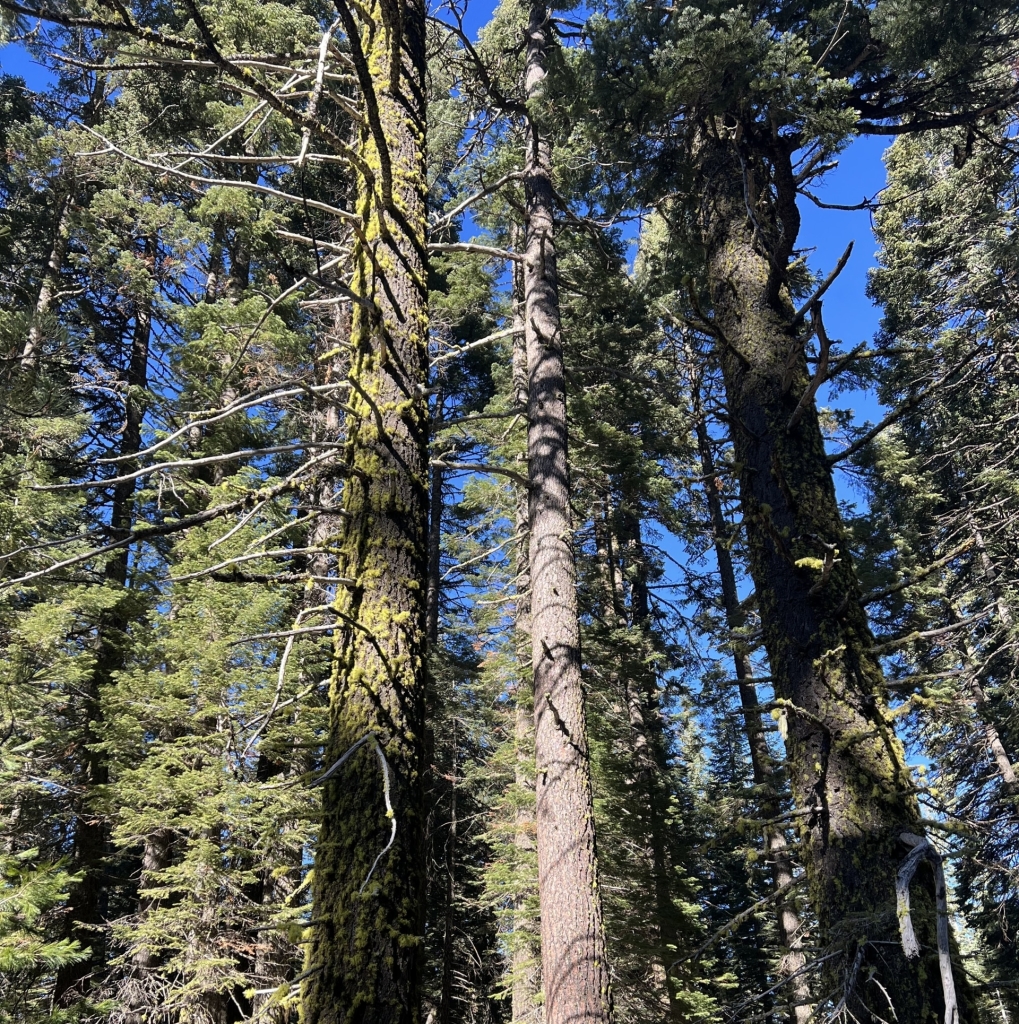
Evergreen trees stand in sunlight in the Lassen National Forest. Photo by Annelise Pierce.
A controversial federal plan to sell up to 3.3 million acres of public land in the West — including in northern California — has been removed from the so-called “Big Beautiful Bill” making its way through Congress. But Senator Mike Lee (R–Utah), the one who proposed the land sell-off, has already announced plans to revive the effort.
The original provision, a source of bipartisan disagreement, called for the U.S. Forest Service (USFS) and Bureau of Land Management (BLM) to sell millions of acres of public land in 11 U.S. states in the West. It didn’t specify exactly which lands would be sold, but made more than 250 million acres eligible for sale.
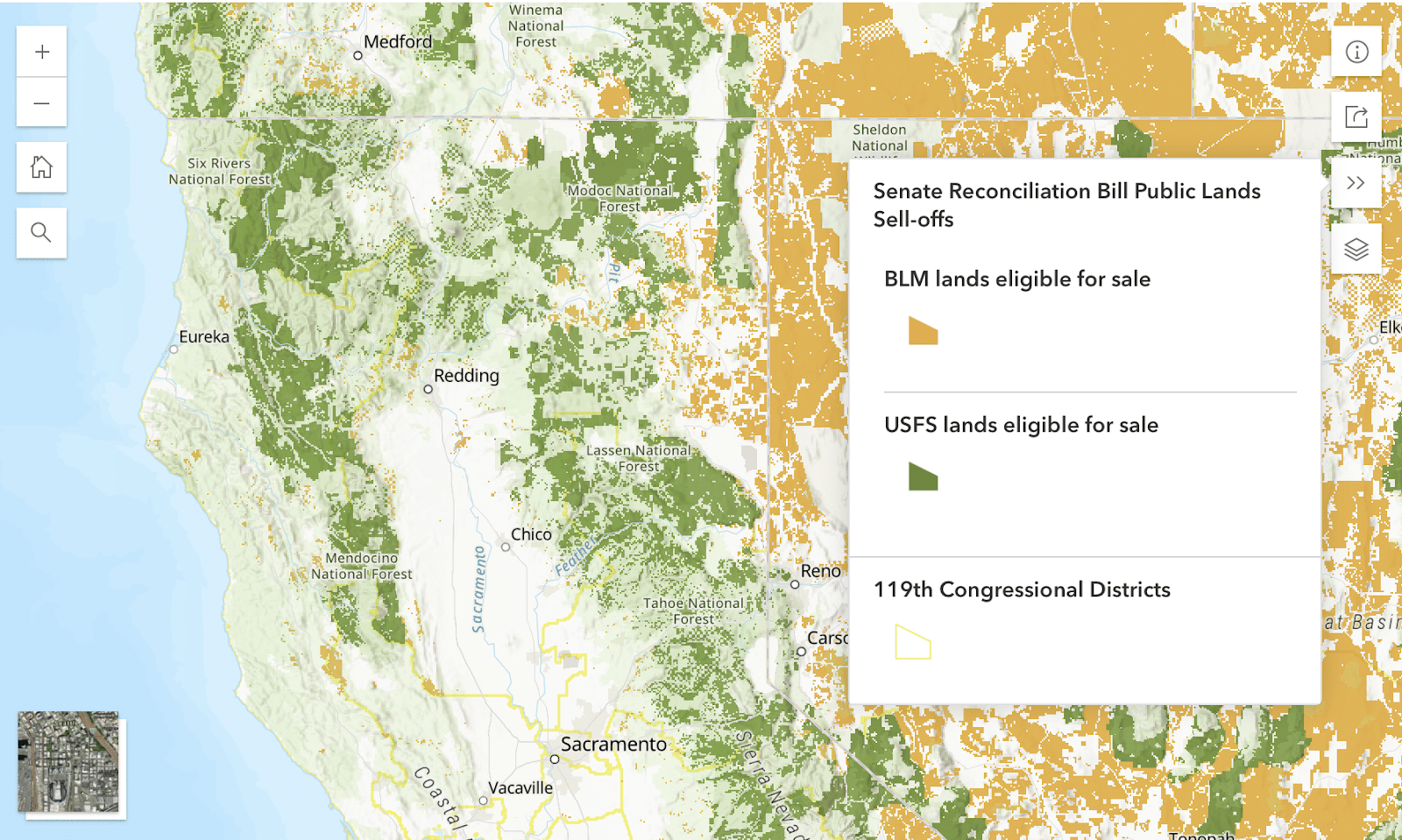
In California, more than 16 million acres of land could’ve been put up for sale, including major portions of the North State, such as land surrounding Mount Shasta, Lassen Volcanic National Park, Modoc National Forest and Whiskeytown National Recreation Area.
Screenshot from The Wilderness Society’s map showing which lands were eligible for sale in northern California under the original provision. The map has since been taken down while the provision is updated.
The “Big Beautiful Bill” is currently in the Senate, where Republicans have a self-imposed deadline to send a final version to President Donald Trump by July 4. The public lands provision was removed on June 23, after Senate Parliamentarian Elizabeth MacDonough ruled that aspect of the bill couldn’t move forward because it violated the Byrd Rule, which prevents extraneous provisions in budget reconciliation bills.
In response, Senator Lee posted on the social media platform X that he is planning to make changes to the provision to allow it to be included under chamber rules, including removing all Forest Service land that would’ve been eligible for sale and significantly reducing the amount of BLM land included. He also hopes to propose limiting the scope of eligible land to only include public land within five miles of population centers. So far his statements are informal only.
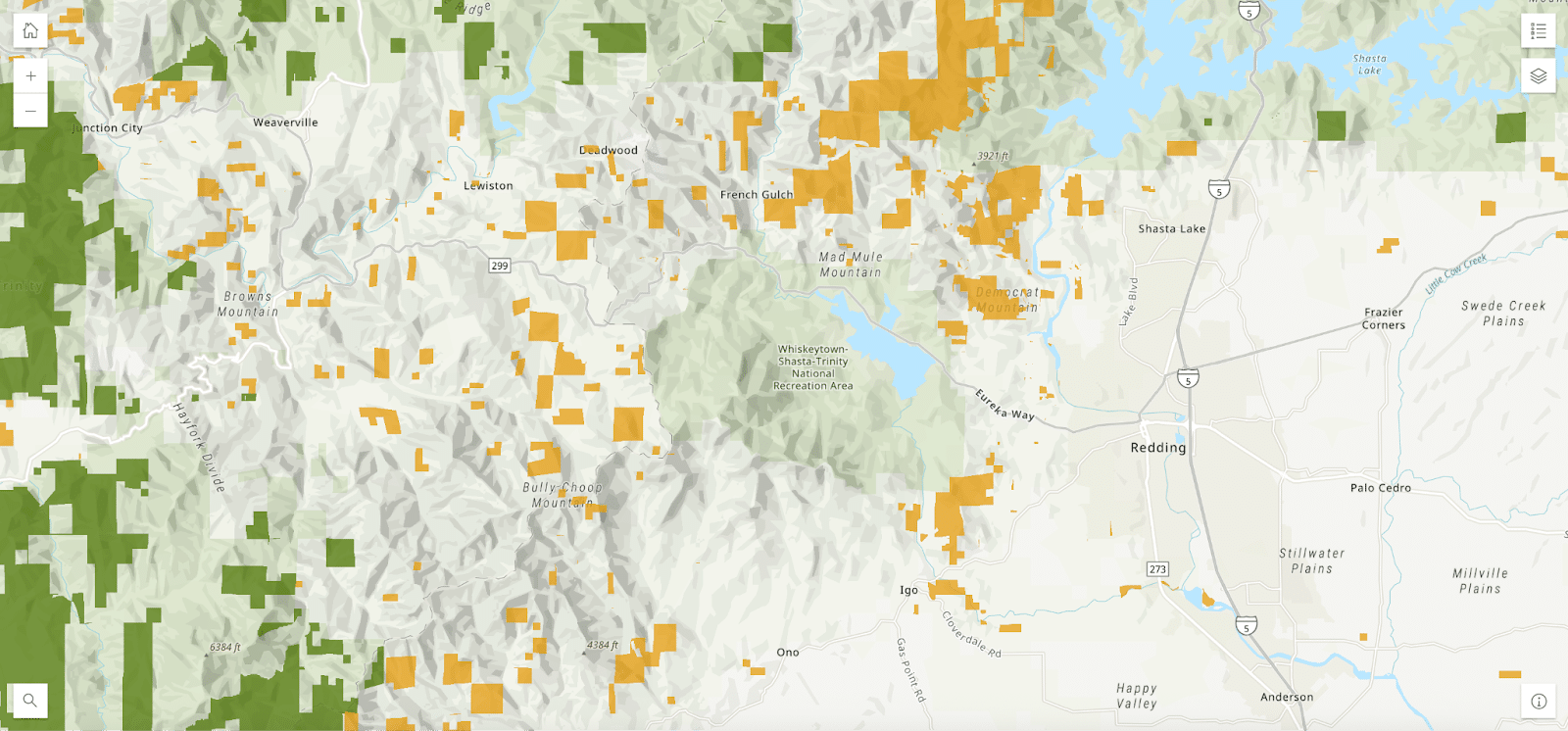
While this would spare much of the California land that would’ve been eligible for sale, it still puts at risk portions of land near Whiskeytown National Recreation Area which are BLM-owned.
Screenshot from The Wilderness Society’s map showing which lands were eligible for sale near Whiskeytown National Recreation Area under the original provision. The map has since been taken down while the provision is updated.
While the land surrounding Mount Shasta is not currently under threat, the local ecology center is still concerned about what new proposals might occur going forward. Nick Joslin, the center’s policy and advocacy director, said even though the land surrounding Mount Shasta will likely be safe if Lee’s proposed updates are incorporated, he’s still worried about the threat of any public lands going on sale.
“Ultimately, public lands are there for the public to use, and the idea that they would somehow be privatized and sold off to fill budget gaps that are related to tax cuts for the wealthy should be concerning for anybody who enjoys using public lands,” Joslin said.
Not only are these lands important for the public to enjoy, he emphasized, they’re also significant to the wildlife and ecosystems that depend on them. Joslin said intact landscapes are important for biodiversity, meaning that if the lands are privatized and major sections of trees are cleared out, then biodiversity would be threatened among animal and plant species. The increased threat of logging if the lands are sold off would also prevent trees from being able to sequester carbon dioxide from the atmosphere, he said.
Joslin noted that concern has been voiced from both sides of the political spectrum, saying public lands are a “chance to see that we actually do agree on a lot of things.”
“What’s alarming is seeing these decisions get put forth by an administration that seems clearly detached from what the public actually values in these lands,” he said.
Among those who support the sale of the North State’s public land is Rep. Doug LaMalfa, a Republican whose district includes much of far northern California, including Shasta County. Speaking on the House floor on June 23 about the public lands provision, LaMalfa said the land that would’ve been sold in the original provision, which is only about half a percent of the total amount of land the federal government owns, is a very small portion, and that much of it is mismanaged.
“Northern California, my area, we’re tired of the lands not being managed, going up in smoke, burning out the wildlife, burning out the watersheds,” LaMalfa said, “which means all that ash, and then later on erosion, ends up in our waterways, in our water supply.”
He said it’s important for conversations to be had about what to do with the land owned by the government, adding that “people on the left” have been telling lies about the provision in the “Big Beautiful Bill” in hopes of deliberately misleading people into thinking that entire national forests and mountain ranges are at risk of being sold.
According to a map created by the Wilderness Society showing which lands were eligible for sale under the original provision, entire national forests and mountain ranges weren’t included, but major sections of them in some areas were. The map has since been taken down until “legislative language is clarified.”
A revised version of the public lands provision has not yet been announced, but the Republicans’ self-imposed deadline to pass the bill is fast approaching.
Do you have a correction to share? Email us: editor@shastascout.org.
Will Amazon build a delivery logistics center in Ukiah?
UKIAH, CA., 6/19/25 – Amazon is eyeing Ukiah as a possible location for a new delivery center, the North Bay Business Journal reported earlier this month.
Amazon is looking to expand its rural delivery reach by investing $4 billion across the country to speed up local delivery times.
The company claims building a rural delivery center can increase delivery speeds by 50% to the surrounding area.
According to the NBBJ, Amazon has been looking at a 56,280-square-foot warehouse in the Friends of Liberty Industrial Park in an unincorporated area just north of the city.
A conveyor belt moves packages at an Amazon Innovation Center in Dortmund, Germany on Wednesday, April 16, 2025. (Lena Mucha/Amazon News via Bay City News)
The industrial park is owned by Ross Liberty of Ukiah. Liberty owns Factory Pipe and is an active member of a community group opposing the city of Ukiah’s proposed annexation of 9,000 acres of adjacent land.
Mendocino County Planning & Building Services Director Julia Krog told the NBBJ that Amazon has not submitted any paperwork signaling interest in becoming a tenant.
Liberty declined to comment, and Amazon told NBBJ that “nothing is finalized.”
Yurok Tribe Celebrates Largest Land Back Deal in California History
A project 23 years in the making, the Yurok Tribe and Western Rivers Conservancy jointly achieved the largest land back deal in California’s history this May. With over 47,000 acres of ancestral lands, the area doubles Yurok’s land holdings. It includes critical habitat for salmon and other wildlife along the eastern side of the lower Klamath River watershed, just a few miles up from the mouth of the river.
“One of the biggest takeaways from all of this is that things can change if you put in the work, and these initiatives take time,” said Barry McCovey Jr., director of the Yurok Fisheries Department and a citizen of the Yurok Tribe. “This is a 23-year process to get this land returned. And so it took many, many people over those years working on this and fighting for it.”
Within the over 73 square miles of land along the lower Klamath River, the Yurok Tribe will now be permanent managers, focusing on ecosystem health for fish, wildlife and the broader forest.
In 2002, the potential to buy 47,907 acres along the lower Klamath River and Blue Creek from Green Diamond Resource Company opened up, according to Nelson Mathews, president of Western Rivers Conservancy. By 2009, Western Rivers Conservancy and the Yurok Tribe teamed up to purchase the land.
Today, 14,790 acres of that area are protected as Blue Creek Salmon Sanctuary, providing critical cold water habitat for migrating salmon and steelhead. This is particularly important following the removal of the Klamath dams as the salmon begin to find their way back to historic spawning habitat in the upper river. The other 32,307 acres comprise the Yurok Tribal Community Forest, managed with sustainable forestry practices.
An aerial mage of Blue Creek. (Photo by Thomas Dunklin, courtesy of Western Rivers Conservancy)
“One of the really special things I think about this land being passed back to tribal management, which it never should have been taken from, is that I know that we are managing and restoring far beyond the human scope of understanding,” said Tianna Williams-Claussen, director of the Yurok Tribe Wildlife Department, and a citizen of the Yurok Tribe, from the village of Wehl-kwew’. “This is not something done for humanity. This is something that’s done for the world, for all of our wildlife and fisheries communities.”
Western Rivers Conservancy paid $56 million for the property and transferred $3.3 million generated from carbon credits to the Yurok Tribe, according to a press release, with overall project costs totaling $70 million. Western Rivers Conservancy cobbled together funding through private capital, loans, tax credits and carbon credit sales.
The Yurok Tribe is now full manager of the property.
“This project exemplifies the power of partnership, showcasing how conservation efforts and the land back movement can come together to benefit the rivers, fish, wildlife and people of an entire landscape,” said Mathews, in a press release. “After more than 20 years of close collaboration with the Yurok Tribe, we have together achieved this magnificent conservation success while ensuring these lands and waters are in the hands of those most deeply committed to their future health and sustainable use.”
The land returned to the Yurok Tribe includes 25 miles of the mainstem river and all nine miles of Blue Creek. Blue Creek provides critical habitat for fish including coho salmon, fall and spring chinook, winter steelhead, pacific lamprey and green sturgeon. The forested area, consisting of redwoods and mixed conifers, is also home to key wildlife, including the Humboldt marten, marbled murrelet and Northern spotted owl.
For Williams-Claussen, this land being returned to her people feels particularly impactful. She grew up along the river and in the forests. Though she grew up fishing, she has seen the river degrade so much that she can’t take her own daughter fishing because she fears that the river can’t support it.
Williams-Claussen hopes that with the undamming of the Klamath River and this land return that will be focused on restoration, one day her and her daughter will be able to fish in their ancestral homelands once more.
“Even though the lands were taken from us through various ways, we never lost that connection, and we never ceded our obligation to be caretakers for the land, to live in reciprocity with it, both caretaking and then receiving the abundance from the lands itself,” Williams-Claussen said. “And so it’s a weird way to live estranged from something that is so integral to your heart and your well-being, to not have access to it, to not be able to take care of it. And receiving these lands back is a big step towards repairing that damage.”
Editor’s Note:This story has been updated to reflect accurate spelling of Nelson Mathews’ surname.
WILLITS, CA., 6/15/25 — Despite its small size, Willits has always carried more than its weight in the nation’s zeitgeist. The town was the first to truly embrace sustainability, championing permaculture and carbon sequestration, and has been a bastion of civic responsibility. The latter came to the fore Saturday during the “No Kings” protest, which challenged President Donald Trump’s policies regarding a range of issues. Looming over this particular protest was the takedown of Senator Alex Padilla, handcuffed outside a Thursday press conference, and the assassination of a Minnesota state representative, her husband, and the wounding of a Democratic state senator and his wife.
But before all that, Willits’ Indivisible group, guided by a steering committee of seven people, had been planning the “No Kings” event for weeks.
Willits resident Melinda Clarke came up with the idea of a parade, in an ironic nod to the Trump-mandated military parade the same day in Washington, D.C. Fellow volunteer Kate Black organized the parade monitors. Black joined organizer Kim Bancroft to walk the parade route beforehand to identify potential problem points and notify business owners that a lot of people might be marching past their doors. The parade route began at the old Howard Hospital grounds, now Babcock Park, and marched north on Main Street to Commercial, turned right, ending up at Willits City Park.
Black had taken nonviolence training in May, and she called for monitors to direct traffic and guard the route. Twenty people signed up, and Clarke sewed special vests for the monitors to wear. And that turned out to be a very good thing, as the steering committee was about to be thankful that they had prepared so well.
In a screenshot from the video “No Kings Protest,” protesters march along Main Street during the “No Kings” protest in Willits, Calif. on Saturday, June 14, 2025. (Larry Silverman via Bay City News)
A massive surprise
The group spearheads democracy vigils every Friday evening. “Usually about 40 or 50 people show up,” Bancroft said. She expected more than that number to protest Saturday, thinking perhaps 100 or 150 would come. Those assigned to count marchers at Noyo Theater counted 520 people, while another group who hadn’t wanted to make the trek waited at the City Park, jumping the number of participants to over 550. The monitors were kept busy stopping marchers at driveways and intersections so drivers, many honking their horns in support, could turn into Safeway or service stations.
“We were stunned,” Bancroft said. “And there were all these people I knew but had never seen at a demonstration. The chiropractor and the grocer and the waiter, and I’d go, ‘You’re here, too!’ It was just so wonderful.”
Bancroft said a lot of people were talking about Padilla and the politically motivated murders in Minnesota. She believed that people came out in droves to drive awareness of the dangers of political division and policies that harm communities such as Willits. She added, “This time there were a lot of young people.” She estimated that of over 500 people at least 100 were age 50 and under. “It was great spirit and happiness, and everyone was so surprised to see so many of us. People cherished in the community were coming out to step up to support democracy.”
Filming the march
No one was more surprised by the turnout than Willits resident Larry Silverman, who arrived at the route with his video equipment to film a small town’s protest against Trump’s policies. “This is a tenth of the population of Willits!” he said Saturday afternoon. Silverman, a retired TV producer, writer and director, also had been planning this day for quite a while. He came early with his video equipment and prepared to film.
Why video? “I am doing it as an encouragement for people who have not yet taken that extra step to get involved,” he said. “And to keep the spirits up of those people who have been involved and have been demonstrating. This is going to be a long haul, at least a couple of years. We all need just a little encouragement to keep going.”
Silverman thinks the finished product, with a sound track of songs by Joan Baez and Janis Ian, will do that job. He produced a shorter video of Willits’ May Day protest and sent that video to Baez and Ian. “It happened so fast,” he said. “I sent them an email on Friday night, and by Saturday afternoon it was a done deal. They liked [the May Day video] and clearly our goals are the same.” Silverman hopes to have Saturday’s video featured on MSNBC, on the “Rachel Maddow Show.” “We don’t know what the producers will decide to do, but they’ll receive the footage.”
Two protesters stand with their American flags at the “No Kings” protest in Willits, Calif. on Saturday, June 14, 2025. (Kate Black via Bay City News)
Willits Indivisible is on a growth spurt
Perhaps the turnout for the parade should not have been so surprising.
The Willits Indivisible group started only a few months ago with an impromptu meeting at Brickhouse Coffee, a coffee shop where many thinkers, artists and activists spend their mornings. Organizers expected around five to eight people but about 25 showed up.
According to Black, at the next meeting the now nascent steering committee “nabbed the [public] library, but so many people came we had to transfer to Recreation Grove Park, where we had the next two meetings with over 100 people attending.” The group now has a membership of over 250 people. Black said that for safety reasons, location and times of meetings are announced only by email and word of mouth to members rather than publicized widely.
The group has done its own nonviolence training and plans to do more. It has 10 subcommittees, such as a postcard writing group, a fact-finding committee, and one dedicated to the midterm elections. Said Black, “I came to the group out of a sense of frustration, wondering what to do to try and stem this wave of repression and also reaching out for support to not feel so isolated, stunned and upset watching what feels like our democracy and constitutional rights being shredded right before our eyes.”