Fresno County is increasing transparency to approve proposed $5.3 billion budget, after blowback
Fresno County residents can expect more transparency in this year’s county budget hearing process, after years of criticism over its truncated budget process.
Last year, the county passed their $5.2 billion budget in about 92 minutes.
The Fresno County Board of Supervisors will begin budget hearings later this month on their $5.3 billion proposed budget, with the addition of eight scheduled presentations from county department heads.
Freshman county supervisor, and former Fresno City Councilmember Garry Bredefeld campaigned to introduce the changes leading up to his election win last year, and even during open sessions at board meetings.
“I’ve very clearly said I needed, in order to support this budget, to have department heads from what most would consider some of the more critical departments — and departments that have a lot of resources that the public access a great deal — to come before the board and make a presentation so that board members and the public can address, question, inquire about what’s taking place in those departments,” Bredefeld told Fresnoland in an interview.
In recent years, the county’s budget hearings have had presentations given by staff on an “as-needed” basis. The hearings would also be presented through categories on the budget — like “General Fund” and “Capital Projects” — instead of by county departments.
This year, eight of the county’s 20 departments are scheduled to give public presentations: behavioral health, district attorney, probation, public defender, public health, public works and planning, sheriff, and social services.
Fresno County Communications Director Sonja Dosti told Fresnoland that the county administrative office selected the eight departments based on “primary services that the County delivers.” She added that these departments have also “experienced impacts based on federal or state cuts.”
Bredefeld, an ex-city councilmember, says that these changes make the county’s process much more similar to the city’s.
“That, to me, is the important part of any budgetary process,” Bredefeld said. “I think the City of Fresno historically has done that in a very lengthy process, which is good, and the board is doing that now as well.”
The City of Fresno’s public budget hearings take place in late spring, with each department making a presentation. The process is much more lengthy than the county’s.
The county budget hearings will have the same rules for public comment as it does for its normal board meetings: three minutes maximum per person, and a 15 minute cap for each department. However, the board’s chairman has the discretion to extend public comment.
Bredefeld, who has said in the past that he would like to see the county’s public comment policy changed, said he’d support time extensions during the budget hearings.
“The main thing is that the public has the ability and the right to comment,” Bredefeld said. “If it needs to be extended beyond 15 minutes, I will certainly support that. I would assume the board would support it as well.”
But in order for an extension on public comment to be warranted by the chair, enough members of the public will need to show up during the budget hearings. Bredefeld said he hopes changes to the county’s budget process motivate residents to look more closely at the proposed budget this year, and participate in the hearings.
“I would love that,” Bredefeld said. “I don’t think the public has been engaged, but I think maybe that’s because they haven’t had these kinds of public presentations in the past. The city has every department present before council, and the public is certainly more engaged there. So it’s my hope that the public will be more involved with the county budget as well.”
This article was produced in collaboration with High Country News. It may not be reproduced without express permission from FERN. If you are interested in republishing or reposting this article, please contact info@thefern.org.
Many communities have foods that define them: Los Angeles has tacos, Green River, Utah, has melons, while New Mexico’s Hatch Valley is famous for its green chiles. Historic power dynamics — from colonization to migration — have always influenced how and why people began growing, cooking and consuming these symbolic dishes and crops. Today, these foods and those who prepare, raise and sell them carry cultural power; people travel hundreds of miles to buy a juicy Crenshaw or sweet canary melon from a family-run stand in Green River. And yet the farmers themselves often struggle to stay afloat. They lose access to markets as large companies buy up smaller, locally run grocery stores.
Most grocery stores across the West trace back to a few major corporations. Whether you’re visiting King Soopers in Colorado, Smith’s in Utah or Fred Meyer in Oregon, you’ll find the same Kroger-brand products. The original names of the once-locally owned grocers might remain, but the shops are now just part of one of the nation’s largest grocery corporations.
A handful of companies control the production and distribution of most of our food, and the West plays a leading role in that system. The U.S. headquarters for the world’s largest meatpacker, JBS S.A., is in Greeley, Colorado, while Driscoll’s, the largest berry producer, is headquartered in Watsonville, California. These companies rarely confront the riskiest parts of agribusiness, raising the cows and growing the berries. Instead, they produce, brand and ship them.
This global food system has profound impacts on the West’s farmers, workers and consumers. It’s getting harder for family farms to turn a profit, and those who seek alternatives to the consolidated corporate market must navigate complicated policies and finances in order to sell directly to consumers. Berry-pickers and meatpacking workers — often immigrants — face exploitation and unsafe conditions, with workplace protections varying from state to state.
Meanwhile, food insecurity has increased across the West, and yet Republican-led states, including Utah and Idaho, opted out of a federal summer grocery program for kids last year, in part because of anti-welfare politics.
Beyond its connection to this international system, the West has deeply rooted myths and policies around water and land that create and sustain other layers of power. In the 1800s, settlers stole land from Native people and killed off bison as they drove tens of thousands of cattle westward. Ever since, the cowboy and his glorified cattle have held cultural power that politicians are rarely willing to tarnish.
As “The Big Four” meatpackers have consolidated most of the beef industry, the economic power of ranchers has dwindled. Only 2% of U.S. beef comes from cows that graze on public lands, and yet multigenerational ranching families and large landowners continue to influence and benefit from antiquated federal grazing policies.
Most land in the Eastern U.S. is privately owned, but the federal government owns nearly half of all land in the West. Ranchers graze cows on huge swaths of public lands, paying fees well below the actual cost of managing those lands. Over the past century, grazing policies have changed little even as cows destroyed native vegetation and degraded waterways. State and federal policies often put the health of livestock above that of the region’s arid soils or the lives of large carnivores like wolves and bears.
Ranchers and Big Beef also intersect and overlap with those who control water in the West. Agriculture consumes nearly 80% of the water diverted from the drought-stricken Colorado River Basin, primarily to grow alfalfa and other cattle-feed crops. An investigation by ProPublica and The Desert Sun found that most of the water consumed in California’s Imperial Valley goes to just 20 farming families, with one of them using more than the entire metropolitan area of Las Vegas. Only four of those families use the majority of their water rights to grow foods people consume, like broccoli or onions. The rest use their water to grow hay for livestock.
Many of these families have senior water rights, and that increasingly means power in the arid and rapidly growing West. Together with livestock associations, irrigation districts and their political allies, they have sought to influence food and water policy.
Yet in some parts of the West, other interests are gaining power. In the Northwest, years of advocacy from tribes and environmental groups led federal agencies to decommission dams on rivers like the Elwha and Klamath. The farmers might worry about their ability to continue irrigating, but tribes are reclaiming their traditional foodways as salmon return.
And the Northwest’s rivers aren’t the only places where tribes are reasserting their culture and food sovereignty: Indigenous-run restaurants, farms and cooking classes are springing up across the West.
Farmers markets, mutual aid efforts and community gardens are creating new forms of cultural, social and economic power, often led by and benefiting those who are excluded and marginalized, including queer, immigrant and Black farmers. Their efforts encourage people to take back intrinsic food traditions while they act in resistance to the global, capitalist food system.
Still, the corporate structures of our food system are so deeply entrenched that they can be hard to fully comprehend or even notice. In this region, food is power, and that power is not equally shared. Before that can change, however, we need to understand the complexities of this system, tracing its roots to the growth of retail giants and the consolidation of Western agricultural production.
The grocery giants
A handful of powerful corporations dominate the U.S. grocery market. Over the last few decades, these firms have consolidated their control, leaving a shrinking share of the market for local, independent grocers. Grocery giants and their supporters claim that economies of scale enable them to offer lower prices to consumers. But critics say that these conglomerates’ size gives them too much power, not only over their consumers, but also over suppliers and workers.
Corporate consolidation in U.S. grocery
Breaking down the big grocery firms
Note: Walmart, Kroger, Costco and Albertsons were the four largest firms in grocery by market share in 2023, according to industry reports. To estimate the footprint of these grocery giants, HCN used USDA data on SNAP-authorized grocery stores. While not every retail location accepts SNAP, we cross-referenced the data with corporate reports and found our totals closely matched the store counts listed by the largest firms.
Walmart & Costco: The West’s superstore empires
SNAP-authorized Walmart & Costco stores in the West
Note: Includes SNAP-authorized Sam’s Club
stores, which are owned by Walmart. Store totals
are for the 12 Western states.
The illusion of competition
Confronted by Walmart’s growing power, traditional grocers like Albertsons and Kroger responded with a spate of mergers and acquisitions starting in the early 1990s. Albertsons now owns over 1,300 stores in the West, though few of the shoppers patronizing Safeway and Haggen may realize that those stores are owned by the same firm. In December of 2024, the Federal Trade Commission blocked a proposed merger between Albertsons and Kroger after a number of Western states sued, arguing that it would further limit competition and raise prices for consumers.
Farmers markets — a bright spot in the grocery landscape
The rise in the popularity of farmers markets since the mid-1990s has been a positive counterpoint to the relentless march of corporate consolidation. Nationally, the number of farmers markets more than quadrupled from 1994 to 2019.
Get big or get out: Consolidation in agricultural production
The small family farm holds a special place in the American imagination. Today, however, a modest and diminishing portion of our nation’s food is grown on smallholder farms. Production is shifting to larger-scale factory farms in every Western state and across nearly every commodity.
Production shifts to larger farms
Marked growth for select goods
Giants of agricultural production
Net loss of 600,000 U.S. farms 1982-2022
The trend towards consolidation in the food system has made it increasingly difficult for smaller farmers to compete and stay in business.
Concentration in meatpacking
The meatpacking industry is concentrated to an extraordinary degree, with an estimated 81% of U.S. cattle and 65% of hogs processed by “The Big Four” meatpacking corporations as of 2021. Critics say this market stranglehold gives The Big Four too much control over both ranchers and consumers.
The above hourglass power dynamic is not unique to meatpacking; it’s also conspicuous in the seeds, agricultural chemicals and food retail markets. The concentration of power in these industries allows a handful of companies to dictate prices and production methods, trapping Western consumers in a food system that prioritizes corporate profits over sustainability, diversity and equity.
Help us keep digging!
FERN is a nonprofit and relies on the generosity of our readers. Please consider making a donation to support our work.
Don’t miss FERN’s latest revelations, developments, and initiatives. Sign up for our newsletter and we guarantee you’ll never miss one of our stories.
Redding Rancheria’s harm reduction initiative shows early signs of promise
Photo by Next Distro.
The Redding Rancheria says since launching its Harm Reduction Program at the Tribe’s Churn Creek Recovery Center eight weeks ago, the number of people they’re serving each week has grown from about seven each week, to 20. Clients of the program are picking up clean syringes, food, and clothing — all at no cost.
Staff have also safely disposed of more than 600 used syringes that were turned in as part of the program, ensuring the used needles are kept out of public space and parks.
The Tribe is using a harm reduction approach to reducing substance use. Harm reduction is designed to meet the needs of people, right where they’re at. It’s an approach that facilitates an environment in which people can continue using substances more safely, if that’s what they choose.
As the Redding Rancheria pointed out in a recent press release, harm reduction is rooted in compassion, connection, and taking care of people. “This principle drives the program’s approach of creating a welcoming, judgment-free space,” the Tribe wrote, “where relationships are built and individuals learn they have options.”
Data shared by the Center for Disease Control indicates that users of clean needle exchanges are “five times more likely to enter drug treatment and about three times more likely to stop using drugs than those who don’t use the programs.”
The new initiative is led by Recovery Director Katherine Haley, who states, “We understand there are countless reasons why people who use drugs may avoid treatment and generally healthcare. Our goal is to change that by creating an environment where individuals feel safe, respected, and cared for.”
The Safe Project points out that harm reduction is a well-known approach to reducing risk in many scenarios, not just substance use. For example people wear seat belts while driving, bike helmets while riding, and sunscreen while spending time at the beach. All of these are harm reduction efforts designed to make something with inherent danger, safer. In the substance use setting, harm reduction includes clean syringes. It also includes the use of Naloxone to reverse overdose and the use of medically-supervised medications as an alternative to illicit drugs.
A common criticism of harm reduction is the belief that it incentivizes people to continue to use, but research has shown that people who are using substances will do so even without access to clean needles, at greater risk to themselves and others. Reuse of needles can cause life-threatening skin infections and spread blood-borne diseases like HIV.
Fostering a safe space can be a catalyst for change, the Rancheria says, noting that “research shows it can take at least seven positive contacts before someone with a substance use disorder accepts treatment,” and emphasizing that positive contact helps bring more people into the fold of eventual recovery, if they so choose.
Multiple participants in the Rancheria’s new harm reduction program have also sought out medical treatment during their visits and some have working with caseworkers to find more permanent housing.
The Redding Rancheria’s Recovery Center provides “drop-in” style harm reduction services every Friday from 1 p.m. to 4 p.m at 3110 Churn Creek Road.
Disclosure: In 2024, Shasta Scout received a $2500 grant for office supplies from the Redding Rancheria.
Do you have a correction to share? Email us: editor@shastascout.org.
‘There really is no escape’: Faith leaders help immigrants face court as ICE arrests rise
(RNS) — San Diego Auxiliary Bishop Felipe Pulido noticed the way a father held his young daughter and stood close to his wife and teenage daughter in the courtroom. The love and care they had for each other was palpable on Tuesday (Aug. 12), when Pulido accompanied the asylum-seeking family for an immigration court hearing.
“As an immigrant, I got emotional because of that connection I have with my own family — I put myself in his shoes,” said the Catholic bishop, who was born in the Mexican state of Michoacán before immigrating to Yakima Valley in Washington as a teenager. He finished high school there, worked picking produce and eventually was ordained a priest.
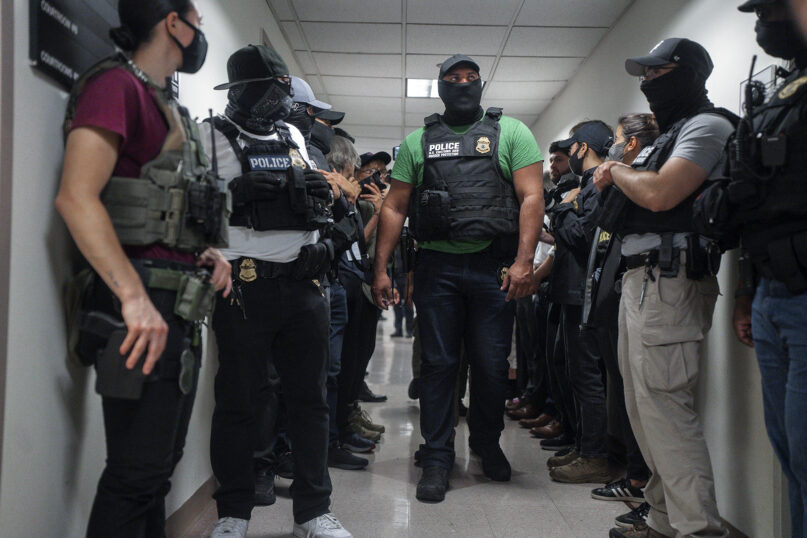
Immigrants are facing court appointments with newly heightened levels of fear as the Trump administration has begun sending agents to detain migrants as they leave the courtroom. If immigration judges dismiss their cases, they can immediately face expedited removal proceedings without a chance to make their case for asylum. Previously, a 10-day response time to the dismissal was allowed.
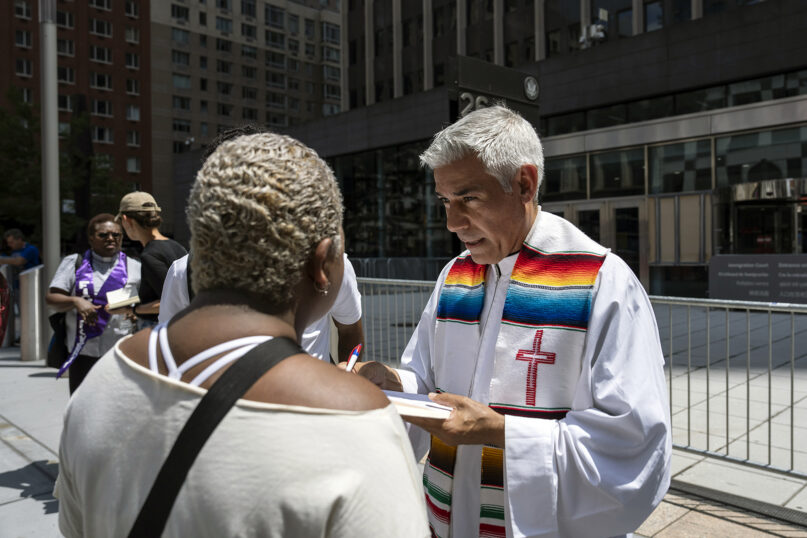
Guided by their faith, clergy like Pulido and other representatives from religious groups are accompanying immigrants to court appointments to provide comfort and information and, in cases where their worst fears are realized, to pick up the pieces of a shattered American dream.
The Rev. Noel Andersen, national field director at Church World Service who is ordained in the United Church of Christ, holds a weekly call on faith-based court accompaniment. He told RNS that through accompaniment, “Faith leaders bear witness and speak out against the ways masked ICE agents are abducting our community members.” Accompaniment is taking place “in every major city and in some rural areas, just about everywhere there is an immigration court,” he said.
When it was time to leave their San Diego hearing, Pulido said, the family saw half a dozen United States Immigration and Customs Enforcement agents, and the mother told him she was scared. The bishop stuck close to the family, talking and reassuring them as they walked by the agents, he said. The judge had given them another hearing in December.
Pulido was present because the San Diego Catholic Church has partnered with Episcopal, Lutheran, Jewish and Muslim clergy, as well as lay people, to provide accompaniment for immigrants at the courthouse every day in August. They have more than 50 volunteers, and as more sign up, they’re planning to continue the ministry.
It was only when they’d gotten through the ordeal safely that the family asked Pulido which church he was with. The Catholic family were stunned to learn a bishop had accompanied them that day, he said.
Pulido said he was inspired by Pope Francis’ words last year when he attended “baby bishop camp,” an orientation for new bishops in Rome, to get involved in the court accompaniment ministry. “Be a sign of hope for the homeless, for the migrants, for those who are in prison,” he recalled Francis saying.
He said he believes sometimes ICE agents choose not to detain migrants even after their cases are dismissed because his priests are walking with them, though they have also witnessed detentions.
Pulido isn’t the only Catholic bishop who has gone to immigration court. In Orange County, where priests and deacons are also accompanying the faithful in immigration court, Bishop Kevin Vann attended the July bond hearing of Narciso Barranco, an immigrant without legal status and father of three U.S. Marines who was filmed being beaten in the head by immigration agents during his June arrest.
El Paso, Texas, Bishop Mark Seitz was also in immigration court on Tuesday, said Scalabrinian Sister Leticia Gutiérrez, the director of the diocese’s migrant hospitality ministry.
Seitz witnessed the detention of three people — “the sobbing, the anguish of the wife of one of them,” said Gutiérrez in Spanish. Seitz told her, “I saw Jesus walking through the hallway, sister, defenseless.”
Gutiérrez, who has organized a precise system for the diocese’s immigration court accompaniment in the last two months, arrives at immigration court at exactly 7:50 a.m., four days a week, and stays until the final cases have concluded.
Before ICE agents arrive (about 20 minutes after she does), Gutiérrez and a priest who is a retired immigration lawyer introduce themselves to migrants arriving for court and provide them basic legal advice and information — and try to sit with them in their anxiety.
While some of the diocesan team members observe the court sessions, ICE agents have also allowed them a protected zone in the waiting room, so when immigrants leave their court appointments, Gutiérrez helps them arrange their affairs, sometimes taking up to 30 to 40 minutes before they walk toward the agents. She encourages them to call their families one last time and share their Alien Registration Number, and then to write phone numbers on their bodies so they can call family if they’re detained.
If they’re willing to share personal information and their keys, she offers to let their family know if they’re detained, send another team to visit them in detention, connect them with a lawyer when available and move their vehicle so it doesn’t incur fines before their family can pick it up.
Many people are in shock when judges dismiss their cases, Gutiérrez said. “It’s incomprehensible for many of them, who say, ‘I paid taxes. I already have an apartment. I have a car … why are they going to detain me?’”
At that point, Gutiérrez said, “There really is no escape. You have to pass, no matter what, by the immigration agents. So it’s like Jesus, who goes directly to the cross.”
The Rev. Chloe Breyer, an Episcopal priest and director of the Interfaith Center of New York, told RNS witnessing detentions was “harrowing.”
“ All I could do is get their name in this tiny millisecond between when they left the courtroom door and when they were picked up by these officers,” she said.
“ We’re witnessing a kind of public display of lawlessness,” Breyer added. She, like Gutiérrez, said there seemed to be no “rhyme or reason” behind which immigrants were detained and which were able to leave.
The Episcopal Diocese of New York has publicized that three of their parishioners have been detained in courthouse arrests and has held a training on court accompaniment for over 80 clergy, said Mary Rothwell Davis, the diocese’s vice-chancellor for immigration and refugees. On July 8, Bishop Matthew E. Heyd witnessed immigration court detentions.
Breyer said she has gone to immigration court about half a dozen times in the last six months, along with rabbis and other Christian leaders. She has worked with the New Sanctuary Coalition, through which she shows up to accompany immigrants who happen to be there that day, and also with specific clients at the request of their lawyers.
In Los Angeles, Isaac Cuevas, director of immigration and public affairs for the Catholic Archdiocese of Los Angeles, has trained about 180 priests, deacons and religious sisters in court accompaniment. While they make an effort to match parishioners who request accompaniment for immigration court with someone who has gone through the program, the vowed religious largely create their own schedules for going to courts in the area.
“If people are in need, then we try to come forward and answer that call however possible,” said Cuevas, emphasizing that they do so not by civil disobedience, but through prayer, solidarity and recommendations to seek legal advice.
Another LA group, Clergy and Laity United for Economic Justice, observes courts daily.
In Arizona, Alicia Contreras, executive director of Corazón AZ, part of the grassroots multi-faith Faith in Action federation, said faith leaders in the state attend immigration court when community members request accompaniment. It is part of the group’s broader work, including know-your-rights and family defense planning, when a family makes plans for children, pets and bills in the event of a crisis. Corazón AZ has partnered with Puente, another Phoenix organizing group that maintains a more regular presence at the courthouse.
Corazón AZ has sent Disciples of Christ, Episcopalians, Presbyterians, Catholics, Unitarian Universalists and volunteers without a specific tradition to the courthouse. The majority have been lay people.
“If I can offer a word of prayer, if I have brought folks a rosary or just sat with them, give them a gentle touch on their back, a hug when they need it, this goes a long way to calm the nerves,” Contreras said. She reminds immigrants to breathe. “We are not in control of a lot, but we are in control of our breathing.”
Fear can also cause immigrants to “black out” during their hearings, leaving them unable to remember what happened, Contreras said, explaining that faith leaders can help explain what happened afterward. In the worst cases, fear can lead community members to skip their court dates, a guaranteed way to enter deportation proceedings, she said.
Court accompaniment is an expression of faith, Contreras said.
“I know that their higher power, or in my faith tradition, God, does not want this for them,” said Contreras, a Catholic. “God is not putting the barriers, and God also is not wanting us to look away.”
California hospitals brace for impacts from ‘Big Beautiful Bill’ Medicaid cuts
A hospital room. Photo by Martha Dominguez de Gouveia, courtesy of Unsplash.
In 2023, the only general hospital in Madera County closed due to financial distress. The Central Valley health care center mostly served low-income patients and relied on government-funded programs like Medi-Cal, the state’s Medicaid program, to partially fund that care.
That’s problematic because government programs like Medicaid often pay providers below the cost of care, making it difficult for hospitals that serve a high number of Medicaid patients to continue providing all services and to even keep their doors open. The closure of the Madera Community Hospital, which has since reopened, caused a domino effect: clinics affiliated with the hospital closed, so people needing care tried going to a nearby children’s hospital, which was only designed to treat children with its smaller beds and equipment, or to hospitals in Fresno, which started seeing more patients in emergency rooms.
With recent federal cuts to Medicaid, health care officials in California are worried more hospitals could face the same fate.
“We don’t want to see that situation repeat itself again, if we can help it at all,” said Jan Emerson-Shea, spokesperson for the California Hospital Association (CHA). “We’re very concerned because of the impact.”
The federal budget reconciliation bill, also known as the “One Big Beautiful Bill,” was signed in July and includes significant cuts to Medicaid. Experts say these cuts will not only impact those who lose Medicaid coverage, but may also severely affect hospitals that serve a large proportion of low-income people, something that’s more common in rural areas.
They explained it like this: The millions of people who could lose coverage due to cuts will still need medical care. Since hospitals are legally obligated to provide care to people regardless of insurance coverage, they will treat those uninsured people — but won’t get paid for it. The resulting revenue loss may lead hospitals to reduce overall services to make up for the lost costs, or in dire situations, close entirely if they can no longer support the facility’s operations or staff.
Peggy Wheeler is the vice president of rural health care and governance at the CHA, a non-profit that provides advocacy and representation for the majority of California hospitals at state and federal levels. Like her colleague Emerson-Shea, she’s concerned about the impacts of Medicaid cuts on hospitals throughout the state, especially rural ones, like those in Shasta.
“This is not a short-term problem,” she said. “This is a really long-term problem, and it’s going to take long-term thinking, long-term and innovative approaches to how we are going to adjust to the new health care system. I think that our hospitals have weathered a lot of storms, but this one feels a bit different.”
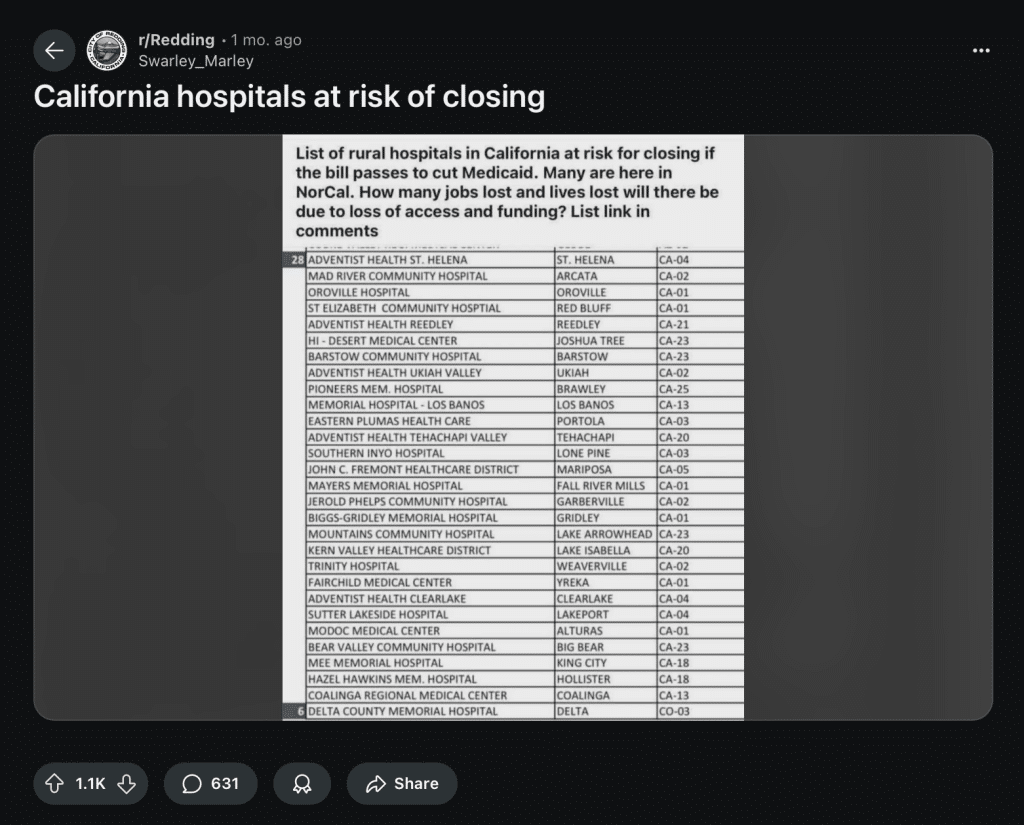
A few weeks before the bill was passed, a letter from several U.S. senators to President Donald Trump and other government officials about the risks of Medicaid cuts to rural hospitals was widely circulated online. The letter names more than 300 hospitals nationwide at risk of closing or having to reduce services due to cuts, including Mayers Memorial Hospital in Shasta County and several others in the North State. It was based on research provided by the Cecil G. Sheps Center for Health Services Research at the University of North Carolina.
CHA officials said this list isn’t entirely accurate because of how the hospitals were calculated to be at risk, noting that several hospitals they believe to be at risk weren’t included. Wheeler explained that the researchers only looked into two characteristics, one about how many years a hospital has been in negative margins and another about how many Medicaid patients they see, when other factors should’ve also been considered to make final calculations.
Nonetheless, she said the point of the letter was still an important one to make.
“In general, what the senators did was call attention to an issue that is real,” Wheeler said. “The One Big, not-so Beautiful Bill is going to be problematic for these hospitals that, for the most part, operate around the margins providing care, not getting appropriately reimbursed for the cost of care.”
Shasta Scout reached out for comment to five hospitals in the North State that were on the list — some didn’t respond, but the ones that did explained that they’re not able to comment on how the Medicaid cuts will affect their services because they’re still assessing impacts.
Mayers Memorial posted a statement on Facebook about the federal budget bill, stating that it is “closely following the many changes and examining the potential effects” of the bill.
Screenshot of Reddit post about list of rural hospitals at risk of being severely affected by federal Medicaid cuts.
‘Nobody’s going to escape this’: Officials say impacts will be widespread
The federal budget bill will reduce Medicaid spending in rural areas by $155 billion over 10 years, causing 10 million people to become uninsured, according to the nonpartisan Congressional Budget Office. Wheeler of CHA emphasized that most, if not all, rural areas in California will be impacted by the Medicaid cuts because they tend to have higher percentages of low-income people that rely on Medicaid than hospitals in urban areas.
But her biggest point of emphasis was that those impacts on rural hospitals will cause a wide range of trickle-down effects, not only in rural communities but also in surrounding areas. “Nobody’s going to escape this,” she said.
CHA officials explained how hospitals often act as anchor institutions to other businesses and services in less populated areas, with rural hospitals often being one of the biggest employers in communities. If hospitals close, many people lose their jobs, resulting in additional economic impacts to the community as people stop going out to eat and spend less at stores, they said.
Wheeler said people may also move away from rural areas if they lose their job or don’t have close access to a hospital or crucial service.
“When people have to start leaving their community to get those other services, they start to make decisions about whether they can stay in rural [areas], and then that has an impact, not only on hospitals, but every business in that community loses out,” she said.
The shift, she pointed out, can also lead to significantly higher wait times in emergency rooms that remain open.
“We cannot tinker with one part of [the system] and not expect that it will have an impact on another part,” Wheeler said.
It’s important to note, she explained, that these trickle-down effects will impact both uninsured and insured people alike — hospital closures hurt nearly everyone in the community, and insurance doesn’t prevent long wait times in emergency rooms.
Donnell Ewert, former director of the Shasta County Health and Human Services Agency, also weighed in on the issue. He said about 37% of the population in Shasta County is on Medi-Cal, meaning hospitals in Shasta County will be significantly affected. Like Wheeler, Ewert said this problem will impact everyone, not just uninsured people.
“Even if [people aren’t] on Medicaid … if their hospital closes, they’re still out of luck,” he said. “They’re still gonna have to drive 55 miles to come down to Redding or drive to Reno or whatever to get care.”
Amid fears and outcry over the federal budget bill a few months ago, the Rural Health Transformation Program (RHTP) was added by lawmakers to help mitigate the impact of Medicaid cuts in rural areas. RHTP will allocate $10 billion a year to rural hospital-related services throughout the country for five years.
Wheeler said the funds, which require an application process, would bring money into the state to help rural health care. But CHA spokesperson Emerson-Shea said this funding isn’t necessarily specific to rural hospitals — it’s for any kind of health care provided in rural communities, including telehealth. It also restores only a little over one-third of the estimated loss of Medicaid funding in rural areas.
Many California hospitals have already been struggling for years. According to an analysis by health care consulting firm Kaufman Hall, one in five hospitals in the state were already at risk of closing as of 2022, largely due to financial strain resulting from the COVID-19 pandemic.
Wheeler said CHA will continue working with hospitals in the state and try to bring their voices to the table when advocating for state and federal support.
“It’s going to be a challenging time for all of us, but we’re going to do this together,” she said.
Madison Holcomb is a recent graduate of the University of Illinois Urbana-Champaign. She’s reporting for Shasta Scout as a 2025 summer intern with support from the Nonprofit Newsroom Internship Program created by The Scripps Howard Fund and the Institute for Nonprofit News.
Do you have a correction to share? Email us: editor@shastascout.org.
Tribal nations scramble to save clean energy projects as federal support vanishes
Cody Two Bear, who is Standing Rock Sioux, served on his tribal council during the Dakota Access Pipeline protests in 2017. Growing up in a community powered by coal, the experience was transformative. “I’ve seen the energy extraction that has placed a toll significantly on tribal nations when it comes to land, animals, water, and sacred sites,” said Two Bear. “Understanding more about that energy, I started to look into my own tribe as a whole.”
In 2018, Two Bear founded Indigenize Energy, a nonprofit organization that works with tribes to pursue energy sovereignty and economic development by kickstarting clean energy projects. Last year, with nearly $136 million in federal funding through Solar for All, a program administered by the Environmental Protection Agency, the nonprofit launched the Tribal Renewable Energy Coalition, which aims to build solar projects with 14 tribal nations in the Northern Plains.
But when President Donald Trump took office in January, those projects hit a wall: The Trump administration froze Solar for All’s funding. That temporarily left the coalition and its members earlier this year without access to their entitled grant (it was later released in March). However, the EPA is considering ending the program entirely.
The coalition is back on track with its solar plans, but now tribes and organizations, like the ones Two Bear works with, are bracing for new changes.
When President Trump’s One Big Beautiful Bill, or OBBB, became law last month, incentives for clean energy projects like wind and solar tax credits and clean energy grants were cut — a blow to the renewable energy sector and a major setback to tribal nations. Moves from federal agencies to end programs have shifted the project landscape as well. The current number of impacted projects run by tribes is unknown. According to the Alliance for Tribal Clean Energy, at least 100 tribes they have worked with have received funds from federal agencies and the Inflation Reduction Act; however, those figures could be higher. “Without that support, most of, if not all of those projects are now at risk for being killed by the new unclear federal approval process,” said John Lewis, the Native American Energy managing director for Avant Energy, a consulting company.
The Cheyenne River Sioux Tribe, for instance, has planned solar projects reliant on federal tax cuts. The projects were designed to power a community health clinic, schools, and a radio station that broadcasts emergency notices during winter storms. However, with the passage of the OBBB, the tribe must now begin construction by July of next year or lose credits, a feat that doesn’t account for the time it takes to secure capital in various stages, seek a complete environmental review, and navigate long permitting timelines through the Bureau of Indian Affairs.
“Some of these projects, at a minimum, have stalled, or they’re having to be reworked in some way to fit within the current parameters that have been laid down by the administration,” said Verrin Kewenvoyouma, who is Hopi and Navajo, and a managing partner at Kewenvoyouma Law that assists tribes with environmental permitting, cultural resources, and energy development. “We have clients that are looking at creative solutions, trying to keep them alive.”
In June, the Inter-Tribal Council of Michigan, a joint organization representing 12 federally recognized tribes in the state, joined a class-action lawsuit against the Environmental Protection Agency, alongside a tribe in Alaska, arguing that the agency illegally froze access to promised project funds from the Environmental and Climate Justice block grant program. The now-defunct program promised $3 billion to 350 recipients to fund projects addressing pollution and high energy costs. Plaintiffs hope the program will be reinstated so that pending projects can be restarted.
Tribes are now seeking philanthropy, short-term funding, and conventional financing to cover delays and gaps in project costs. After the Guidiville Band of Pomo Indians in California lost access to a $3.55 million BIA award to the tribe for solar microgrid development in March, the BQuest Foundation, which specializes in covering expenses needed to continue housing or climate-related projects, gave the tribe $1 million to resume the project’s timeline.
Currently, the self-funded Alliance is covering tribal projects that have experienced a sudden loss in tax credits, rescission of federal funds, and uncertainty of direct pay. “We’re helping try to navigate this challenging period and continue on their self-determined paths, whatever it looks like for them — to energy sovereignty,” said Shéri Smith, CEO of the organization. At the moment, the Alliance is offering a mix of grants from $50 to $500,000, and loans up to $1 million, which will be converted to grants should a tribe default.
“Tribes need to build up internal capacity to carry that out and to have control of their energy situation, for their at-risk members, and members in general,” said John Lewis. “ At such a critical stage, access to affordable, reliable electricity is paramount. The country is getting hotter. The world is getting hotter. It’s warming.”
West of San Juan Bautista, on a hill turned gold by the summer sun, stands a barn built in the early 20th century. Just beside it, a group of archaeology students kneel in the dirt, sifting through layers of San Benito County’s past.
One unearths what appears to be a button from the late 19th or early 20th century. Another finds a splintered redwood plank with rusted nails still in it, and carries it to Gabriel Sanchez, an archeologist and assistant professor at the University of Oregon.
“That’s most likely American, right?” Sanchez asks, and, around him, about a dozen students nod. It’s the nails, Sanchez explains, that give it away. If the plank dated back to the Mexican period—before the mid-19th century, when California was still part of Mexico—the nails would have been produced by blacksmiths, not machines.
But the plank, while curious, isn’t why they’re here.
Archaeology students from the University of Oregon and 16 members of the Amah Mutsun Tribal Band are searching for the remains of a two-story adobe once owned by Manuel Larios, a 19th-century Californio, one of the first Spanish settlers in California.
University of Oregon archaeology students and members of the Amah Mutsun Tribal Band carefully dig through layers of soil in search of artifacts from the 19th‑century adobe. Photo by Juan Pablo Pérez Burgos.
Larios owned 48,000 acres east of what is now Hollister, as well as a smaller 4,000-acre property known as El Ranchito in the area that would become San Juan Bautista and surrounding San Benito County.
Larios, Sanchez says, is “integral to the history of San Benito County,” because he lived through the three eras that shaped modern California.
Born in 1798 during the Spanish period, he enlisted in the Spanish army as a young man. In the 1830s, under Mexican rule, he acquired his San Juan Bautista ranchito after the secularization of the missions, when the government stripped the Franciscan order of its land and sold it off. By the time he died in 1861, California had become part of the United States.
The land is now owned by the San Benito Agricultural Land Trust, which acquired the property in 2023, including the century-old barn visible from Hwy 156. During early efforts to stabilize and restore the barn, there were signs that an older structure might lie nearby, land trust Vice President Bob Connolly told BenitoLink.
Suspecting it could be the long-lost adobe in Manuel Larios’ ranchito, the organization reached out to Sanchez, who specializes in California history, and to the Amah Mutsun Tribal Band, which identifies as descendants of the Indigenous people who survived the missions of Santa Cruz and San Juan Bautista.
“We’re collaborating because the adobe affects all of us,” Connolly said. “It brings the past to the present.”
Members of the Amah Mutsun Tribal Band work alongside University of Oregon students during the excavation near San Juan Bautista. Photo by Juan Pablo Pérez Burgos.
Sanchez visited the site with a ground-penetrating radar and, a few feet from the barn, detected a rectangular shape which suggested there was a human-made structure underneath. “You usually don’t find rectangular things that occur naturally in the world,” he says.
So, in early July, he returned with a group of students and members of the Amah Mutsun Tribal Band to excavate.
For the Amah Mutsun, finding the adobe would mean bringing their history to light.
“Who would have been on the rancho working?” Sanchez says. “It would have been the Mission Indians. And who were the Mission Indians? It was the local Mutsun people, people from the surrounding areas, all the way to the Yokuts from the Central Valley.”
Gabriel Sanchez, archaeologist and University of Oregon assistant professor, uses ground-penetrating radar to search for the foundations of Manuel Larios’ adobe. Photo by Juan Pablo Pérez Burgos.
To Alec Apodaca, a staff member with the Amah Mutsun Land Trust, the nonprofit which protects and stewards the tribe’s cultural heritage, the adobe, if found, could help people today understand the world the Amah Mutsun once inhabited.
“When people made those adobes, they collected signatures of the environment,” Apodaca said. “When they made those adobe bricks, it preserved those seeds. So if we find that adobe—and if the conditions are right—we can extract those seeds and analyze them.”
The tribe also sees the excavation as an opportunity to train its members in archaeological methods and reconnect with their history. Unlike burial grounds or sacred sites, the barn and its surroundings are a place to practice excavation in a respectful way. Because the land holds layers from each of California’s historical periods, it allows for study without the fear of disturbing sacred sites.
The group plans to return to the barn in September to continue excavating. The hope is to uncover the adobe and, through it, tell the story of the Indigenous people who lived in what is now San Benito County, and whose lives are often left out of the history books.
“Through archaeology,” Apodaca said, “we can actually tell their story.”
The team of University of Oregon students and Amah Mutsun Tribal Band members plan to return to the site in September. Photo by Juan Pablo Pérez Burgos.
We need your help. Support local, nonprofit news!BenitoLink is a nonprofit news website that reports on San Benito County. Our team is committed to this community and providing essential, accurate information to our fellow residents. Producing local news is expensive, and community support keeps the news flowing. Please consider supporting BenitoLink, San Benito County’s public service nonprofit news.
The Cottonwood Militia says no one should fear its name. History tells a more complicated story.
Cottonwood militia founder Woody Clendenen sits in a barber chair where he cuts hair as a customer dozes nearby. Photo by Nevin Kallepalli.
For years now, Woody Clendenen’s little barbershop on Main Street has doubled as an informal press briefing room for the Cottonwood Militia. While cutting customers’ hair, the cofounder of the Cottonwood Militia has also been known to give interviews to curious national reporters from the likes of Harper’s Magazineand CNN.
Despite national media attention, Clendenen and his partner Dan Scoville — the other founder of the local militia — still feel largely misunderstood by the Shasta County community where local press has rarely spoken to the group.
At the barber shop, a patron chimed in over the hum of Clendenen’s clippers flush against his nape. “Well, what was your opinion about the word ‘militia’?” the patron asked Shasta Scout whilestrapped into one of two barber chairs. “Did you think of your rednecks and your camo?”
“It’s been tarnished by the media for years,” Scoville added.
The negative connotation most Americans have when it comes to the term “militia,” according to Scoville and others in the barber shop that day, is related to intentional suppression of citizen self-reliance by the U.S. government. Nowadays, most Americans no longer grow their own food, tend to their own wounds or, according to Pew Research, live in a household with a firearm.
The Cottonwood Militia has guns and know how to use them, but leaders describe a mindset that is more defensive than offensive. “The militia stance on weapons is that the gun is the last line of defense,” Scoville explained.
Modern life is a far cry from the harsh conditions that required early white settlers to fend for themselves, as they slowly inched their way across the continent after landing in Plymouth Rock. Assembling a militia today, many members feel, continues to be not only a constitutional right but a patriotic duty.
Founders say the group is prepared for combat but is mostly focused on survival skills and disaster preparedness. They engage members in tutorials on how to communicate via radio and are prepared for a regional shut down to the power grid. They also provide basic medical training, along with arms training, and coordinate their communication via Signal chats when local wildfires or protests occur.
Signage on the wall of the Cottonwood Militia’s community building. Photo by Madison Holcomb.
The Cottonwood Militia bylaws include a quote pulled from the U.S. military oath of enlistment, emphasizing that members “stand ready to defend our nation from all its enemies, be they foreign or domestic.”
Both founders spoke with reverence of the long tradition of militias throughout the 18th and 19th centuries, which, in Scoville’s words, “helped build America, because there was no military force, or not a very good one at first.”
It’s true that early militias were pivotal to building present-day America. But the complex history of early militias also includes paid involvement in the forced removal of the earliest inhabitants of this land. Across California, including what is now known as Shasta County, the mass killing of Native people was carried out in large part by volunteer militias commissioned by the California governor.
Clendenen acknowledges that militias may have been involved in some past violence against California’s Indigenous people, something he strongly opposes, but isn’t convinced they played a major role in destroying Native life. Regardless, he said, that history should have no bearing on the way today’s militias are viewed by the public.
“That has as much to do with us as the fact that there were white plantations that had slave owners and holding us as a modern society responsible for that. You know what I mean?” Clendenen said.
The militia and law enforcement
The Cottonwood Militia’s community building on Main Street. Photo by Madison Holcomb.
The Cottonwood Militia began in 2009 at a “barn meeting” for local residents of Cottonwood, California. Founders say the community had been experiencing an uptick in crime made worse by a delayed response time from the county sheriff, whose deputies could take hours to reach the small community on the outskirts of Shasta County.
In its early days, the local militia served as an enhanced neighborhood watch whose members subdued suspected criminals through citizens arrests while waiting for officers to reach the rural town of roughly 6,000. In time, according to militia founders, the group grew into an unofficial auxiliary of the official police force, with — they claim — the blessing of multiple municipal law enforcement agencies and officials, including the California Highway Patrol, the FBI, the Shasta County Sheriff, and certainly, some county supervisors.
“We’re not police officers or anything like that, but we do try to help our community,” Scoville explained, framing the group as a peace-keeping force that only intervenes when a crime is committed. They see their presence as support to deputized police officers, especially in situations that require crowd control.
Shasta County Sheriff spokesperson Michael Johnson confirmed that he met with the militia when he first assumed his role in 2024, as he would with any interest group, but did not elaborate on the nature of the department’s relationship with the militia beyond that. A lieutenant with CHP’s Northern Division probed Shasta Scout on what the news agency knew about the militia before suggesting that reporters contact the Redding-based CHP office where Shasta Scout was unable to reach a local lieutenant despite repeated attempts. As for the FBI, a representative from the local field office said the organization has “no comment” on the group and a public records request yielded no related records.
Redding Rancheria Tribal Chairman Jack Potter participates in a 2020 Shasta protest over the murder of George Floyd. Photo by Annelise Pierce.
In Shasta, militia members with radios and ear pieces can be seen at local protests, from a 2020 courthouse demonstration connected to the Black Lives Matter movement to a recent one-person sit-in at a county board meeting. Most recently, militia members showed up to a No Kings Protest on June 14. Beforehand, the group discussed plans to surveil the upcoming demonstration in person while emphasizing their central commitment to freedom of speech and expression.
“We’re founded on being able to protest our government,” Clendenen reminded militia members who showed up to the regular weekly meeting, a subset of the larger group. They ranged vastly in age and gender, mirroring the racial makeup of Shasta County — that is, mostly but not exclusively white. Clendenen advised group members that their purpose isn’t to stop protests from happening but to make sure nothing “gets out of hand.”
From the founders’ viewpoints, only lawbreakers should feel unease when militia members show up to conduct citizen patrols, monitor public events or have conversations with those at homeless camps about missing goods. “We know all the outlaws and thieves in our area,” Clendenen said. “I mean, we get new ones every now and then, but we know them.”
Clendenen said the militia offers the unhoused one-way bus tickets to “anywhere but Cottonwood,” adding, “If we go down to look for some stolen stuff in some of the homeless camps — if you show up with 10 guys, and I’m the littlest one and the oldest, they’re very polite. We never have any problems.”
The statement illustrates how the militia treads the line of vigilanteism, relying on the strength of the larger group and their connections in the community to respond to perceived threats. In 2020, Carlos Zapata, a producer on the documentary series Red White and Blueprintwho self-identified at the time as a member of the militia, warned that it wasn’t going to be peaceful much longer unless COVID restrictions were dropped.
During a 2020 George Floyd-era racial justice protest, individuals who identified as militia members showed up at what they said was at the behest of local law enforcement in response to rumored threats of violence — including a bus full of “antifa” agitators headed to Shasta — that turns out to have never existed. Militia members pushed protesters towards a line of police in riot gear that night. The night eventually ended peacefully.
Cottonwood Militia leader Dan Scoville stands amid protesters in Redding after George Floyd’s murder. Photo by Annelise Pierce.
In 2020 and 2021 several militia members made vague threats to a Shasta Scout reporter both in person and by phone, noting that they were being watched and should be careful what they do. In 2022, Clendenen compared journalists to Nazi war criminals saying “there’s a day coming when the media will have to pay.”
And in late 2024, after protestor Jenny O’Connell-Nowain was arrested for protesting at a public meeting, militia members lined up at the back of the chambers as the meeting resumed. When asked if a county official requested the militia presence that night, Clendenen took a beat, then answered cryptically.
“I’ll just say we found out about it,” he said.
Bags of reloaded ammunition for sale sit in front of flags and political signage at the Militia Community building. Photo by Madison Holcomb.
In the grand scheme of public safety, Clendenen believes that militias and rightwing organizations more generally, have a cleaner track record than protesters on “the left” who he accused of burning “over 50 cities” in 2020. Reporting shows the vast majority of Black Lives Matter protests were nondestructive, with notable exceptions in Seattle, Portland and Minneapolis.
But Clendenen doesn’t trust media reports, which he accused of covering for the alleged crimes of protestors on the left. “Nobody can name a protest from the right where there are any cops attacked,” he said.
When some members of the Cottonwood Militia showed up to local BLM protests in tactical gear five years ago, it was hard to decipher civilians in tactical vests and gloves from what could have been a member of the National Guard or a DHS officer. Today, the porousness between vigilante and law enforcement has gone in the other direction, with the recent conduct of Immigrations and Customs Enforcement (ICE) marking the agency as “vigilantes” in the eyes of some California politicians.
Those blurred lines led California lawmakers to introduce both a state and national bill calling for agents to be required to clearly identify themselves. Senator Alex Padilla told Shasta Scout that it’s important for the safety of both law enforcement officers and community members.
“You don’t know how an individual or a community is going to respond when they’re not sure if it’s law enforcement or not,” Padilla told Shasta Scout.
Screenshot of California Senator Alex Padilla discussing citizenship legislation on July 25, 2025.The full briefing can be viewed on YouTube.
As Clendenen carefully groomed the hairline of one customer at the barbershop, Shasta Scout asked if the militia would consider coordinating with ICE in future. He paused briefly. “We’d help if they asked,” he chuckled, adding that he can’t imagine ICE actually doing so.
He said that he’d heard that individuals in Texas were being given awards for their assistance with such work, a rumor that has yet to be corroborated. That mention prompted one customer to joke to Clendenen just before he left the barber shop, “It might be a good retirement gig for you!” as the little barbershop on Main Street filled with laughter.
Frontier democracy or lynch law?
“Protecting the Settlers” illustration by J.B. Browne, from Indians of California, 1864.
The emblem of the privately organized California State Militia, the larger umbrella group under which the Cottonwood Militia is founded, is a minuteman. It’s the name given to colonial Americans who organized to fight the British. Like contemporary militia members, many minutemen had their own complicated relationship to state authority, having both fought for the crown in previous wars against the French, then against Britain in defense of what would become the United States.
After American independence, “militias participated in all the major wars in American history, beginning with the American Revolution,” Brendan Lindsay, a historian at Sacramento University, told Shasta Scout. Today, the Cottonwood Militia sees itself within that same tradition.
When California became a state in 1850, Lindsay explained, militias played a key role in American settlement, particularly at a time when the new state’s funds were scant. “There was no money to actually have a regularly organized California militia,” Lindsay said, mentioning that the California National Guard didn’t form until 1903. Instead, the Golden State legalized the activities of volunteer soldiers — with a caveat.
“But, big capital B-U-T, only if authorized by the governor,” Lindsay emphasized. As officially state-authorized groups, the volunteer militias of California’s past had a more formalized relationship with the government than the Cottonwood Militia has today.
Part of that formalized relationship, as Lindsay has examined closely in his scholarship, was the militia’s role in perpetrating the genocide of California Indians. This kind of violence has a long legacy. As early as 1637, the New World’s first settler militias attacked Native communities shortly after crossing the Atlantic.
Exploitation of natural resources by settlers and gold miners provoked Native-led resistance — the targeting of outsiders encroaching on their land. In response, settlers appealed to the governor to deputize volunteer militiamen from their communities to embark on various “expeditions,” or more aptly, massacres, including the Shasta Expedition of 1854.
At the behest of white communities and backed by the early California government, these militias destroyed entire Native communities, submitted receipts to the state government, then received compensation.
It’s a dark chapter rarely discussed by modern militia groups which have seen a resurgence over the last 30 years. Flashpoints that reignited interest in armed self-defense began with the early 1990s standoffs in Waco and Ruby Ridge, the 1995 Oklahoma City Bombing, and the events of Sept. 11, 2001. More recently, both BLM and COVID-related protest movements have continued to reinforce the idea that self-sustenance, including self-defense, is core to American survival.
Clendenen told reporters that he wasn’t aware of militias’ historic involvement in Indigenous massacres, emphasizing that he’s “not for any of the atrocities that were committed against the Native Americans,” and adding that “both my grandmas were Cherokee.”
“I would guess that the government itself probably was responsible for more of the bad things that happened to the Natives than any militias,” he said.
Lindsay’s research — peer reviewed and based on the archived state receipts, newspaper reports and witness testimonies — indicates otherwise. But Clendenen expressed skepticism about academics, who he believes shouldn’t be immediately trusted at face value. “Historians are kind of like having an expert witness in a trial,” Clendenen said. “You know, you can get an expert witness on all sides.”
A Bible inscribed with the words California State Militia sits on a shelf at the headquarters of the Cottonwood regiment. Photo by Madison Holcomb.
Interpreting the Second Amendment
From the early militias that formed the first chapters of the Ku Klux Klan to young Black Panthers in the inner cities of Oakland and Los Angeles, Americans have organized and armed themselves to both inflict and resist terror throughout the nation’s history.
Like all constitutional rights, the Second Amendment is nonpartisan, but the choice to purchase a firearm often reflects the political atmosphere of the moment. In the midst of social unrest of the 2020 pandemic lockdown, American firearm sales hit an all time high. And in response to dehumanizing rhetoric and policy changes under Trump 2.0, some communities of vulnerable transgender people have started to arm themselves and engage in combat training.
The individual right to bear arms is only one part of the Second Amendment, which also includes a provision for militias, stating that “a well regulated Militia, being necessary to the security of a free State, the right of the people to keep and bear Arms, shall not be infringed.”
How to define such a militia is the subject of debate between amateur and professional constitutionists alike. As Scoville noted, “Some liberal law organizations like the Southern Poverty Law Center that are far, far left, they say, oh, the militias became the National Guard.”
His comment is a reference to the Dick Act of 1903 that streamlined the nation’s citizen militias into two official categories: the “organized militia,” now known as the National Guard, and the “unorganized militia” or any mass of able bodied males aged 17–25. Under that legislation, only the government can call upon either group for response in times of insurrection and invasion.
Scoville disagrees that American militias can be defined so narrowly saying the Founding Fathers wouldn’t have put the power to activate militias into the hands of the government. “They would never let the federal government rule over the militia, because what they were afraid of most was the federal government,” he explained. Clendenen feels similarly, noting that he believes “the supreme law of the land is the Constitution and the Bill of Rights.”
In Scoville’s interpretation of the Constitution, the fundamental right to bear arms is inseparable from the right to organize a military-style platoon of armed community members who can decide unilaterally when to act. And in a time of war, Clendenen confirmed for reporters, the Cottonwood Militia would activate without the approval of a state or federal authority or any other authority higher than itself — except for maybe the sheriff, he hinted.
“Absolutely, we would heed the call [to battle even] if the president or governor didn’t ask us to,” Clendenen said.
Mary McCord, the executive director of Institute for Constitutional Advocacy and Protection at Georgetown, is an attorney who scrutinizes the legality of local militias like the Cottonwood regiment. Speaking by phone with Shasta Scout, she agreed with Clendenen and Scoville that the Constitution is the highest law of the land.
But all laws, both state and federal, “are valid,” McCord emphasized. “There’s no concept within our law where people get to decide which one they want to abide by and how they want to abide.” As long as, she said, state laws are not in conflict with the Constitution.
That’s an issue that’s decided by the Supreme Court and in fact, the Supreme Court has weighed in twice on the legal boundaries of the militia. “The Supreme Court has been clear since 1896,” McCord said, “in a case called Presser v. Illinois, that the Second Amendment does not protect private paramilitary organizations” from being outlawed by individual states.
Like all states, California does impose limitations on armed groups. State penal code defines a “private paramilitary” broadly as two or more persons who assemble “for the purpose of practicing with weapons,” and engage in “instruction or training in guerrilla warfare.” It also prohibits such organizations from engaging in combat training.
“If you’ve trained as a group, and you’re going to go out there to be the military force fighting against this, whatever, terrorist attack, then I would say there’s also likely a violation of [California’s] constitutional provision,” McCord concluded.
The Shasta County Sheriff’s Office did not answer Shasta Scout’s question about whether the Cottonwood Militia might be defined as an illegal paramilitary according to Penal Code § 11460, violations of which could lead to up to a year in prison, a $1,000 fine, or both.
Going back even farther to the language of the Second Amendment itself, McCord remarked that the “well regulated” part of a “well regulated militia” has always meant “regulated by the government — not just, oh, we have a commander, so we’re well regulated, right?”
Reading materials at the Cottonwood Militia community building. Photo by Madison Holcomb.
Legal or not, thousands of people have cycled through Shasta County’s local militia workshops in the past decade, founders say, though Clendenen was unwilling to confirm the exact number of current members.
The number of active citizen militias across the country is also hard to quantify. Some groups are informal and hyperlocalized and others even operate criminally underground. There are well known white nationalist militias, but there are also militias that have no race or gender barriers.
As for the Cottonwood Militia, the organizational bylaws state that members shall defend the unalienable rights of all citizens regardless of “race, color, religion, sex, or natural origin”.
“Anybody can come into our group, if you believe in the Constitution,” Scoville said. “We don’t care if you’re purple. It doesn’t matter.”
Like the local group, many militias take it upon themselves to defend their families against both natural and political threats, some of which are undeniable, like climate disasters, and others more speculative and potentially tied to racial biases, such as foreign terrorist attacks and so-called “invasions” by undocumented immigrants.
Earlier this summer, fire season was underway in Shasta County, with evacuation orders set for the Buckeye region north of Redding. During the weekly militia meeting — held directly across the way from Clendenen’s barber shop — alerts from the nonprofit Watch Duty app went off while members discussed wildfire response plans. If the flames had advanced south toward Cottonwood, they may have sprung into action amid the inferno: coordinating with each other via radio when power lines went down and providing food and water to families in containment zones and evacuating livestock.
The group is also focused on providing mundane essential needs shared by any small town in America’s heartland: a farmer’s market, homesteading courses on preserving food and foraging native plants, children’s day camps that relieve working and often single parents while sharing militia values.
Food items donated for times of emergency. Photo by Madison Holcomb.
As attendees filled the militia hall in the minutes before the June 20 meeting, a woman who runs the militia’s summer camp for girls recounted a delicious rabbit stew she and the girls had made from a recent hunt. Next to her sat a family of three adolescent children, their father and a wobbling German Shepherd puppy still learning how to use its oversized legs.
Clendenen led parts of the meeting. He has recently moved to Texas but commutes back to California for half of every week to care for his infant grandson who recently received a liver transplant, and cut hair part time at the barber shop he used to own. He’s officially retired from his role in the regiment, as militia rules require members to be California residents, but he remains deeply involved alongside Scoville and attends meetings during his days in Shasta.
Throughout the room, elderly couples, teenage couples and others from the Shasta community made polite small talk on a summer night. As Clendenen has often joked, militia meetings can feel more like a bingo night at a Catholic church. But public safety was top of mind, and not just the fire that kept triggering notifications on leaders’ cell phones.
Scoville prefaced the evening’s agenda by reiterating that the militia is committed to lawfulness and nonviolence, “so long as there remains a legitimate civil order in our society.” He then announced the resurrection of the militia’s citizen night patrol in Cottonwood and encouraged everyone to be observant of license plates and perpetrator descriptions should a crime occur. He recalled the story of a local nursery that had been robbed a few weeks prior — for the seventh time, he said — since the owner opened the business five years ago.
Scoville struck a careful tone, reminding members to wait for law enforcement before acting. In response, one expressed serious doubt about the competency of law enforcement. “They’re all just useful idiots with guns and badges. Maybe we should think of a way to stop the bad guys ourselves. I mean, I’m young enough to bust some heads!” he declared with a smile. Another woman uttered a quiet protest in response, reminding him of the militia’s official stance against vigilante violence.
Members seemed more agreeable when it came to a bigger existential threat. “We got this war going on in Israel and Iran,” Scoville told the group of about 25, just two days before President Trump issued a command destroying key parts of Iranian nuclear facilities. He mused aloud about how the bombing might provoke new threats on American soil.
“If they drop that bomb into that bunker, they’re not gonna have anything left, other than most likely terrorist acts. We must be prepared,” Scoville said.
The crowd buzzed about the possibility of an Iranian retaliation led by suicidal militants lurking in America’s shadows. “They don’t care if they get killed, they’re good,” one man suggested, describing what he believes to be the Iranian people’s attitude toward their own mortality. Another woman joked, “they got a lot of virgins!” referring to the trope of Islamic martyrs receiving 72 virgins in heaven.
Scoville interjected in a more serious tone. “I don’t think [the president] wants to drop this bomb, I think he doesn’t want any civilian lives to be killed,” he said.
But if he does, Scoville concluded, “I think it’s going to be best for our kids in the future.”
This story is part of “Aquí Estamos/Here We Stand,” a collaborative reporting project of American Community Media and ethnic/community news outlets statewide.
Do you have a correction to share? Email us: editor@shastascout.org.
Feds award $93 million to key San Joaquin River restoration project near Dos Palos
They hope to form a new state. Shasta’s top elections official is paying attention.
A “Vote Here” sign hangs on the wall of the Red Lion Hotel in Redding for an election held by New California State. Photo by Madison Holcomb
Last Saturday, less than a thousand people cast votes on an issue they hope will soon determine the fate of 40 million Californians.
New California State (NCS), a movement attempting to separate from California to form its own state, held the July 12 election in order to approve a provisional constitution. According to NCS, participants representing more than 50 of California’s 58 counties voted, with some making long drives to reach one of the 26 NCS precincts.
In Shasta County, ballots were cast in an unassuming conference room at the Redding Red Lion Hotel. One especially noteworthy voter was Shasta County Clerk and Registrar of Voters (ROV) Clint Curtis, the public official tasked with running the county’s official California election process. Many of the same local activists who have consistently cast doubt on the integrity of the Shasta Election Office over the last several years helped administer the event.
While less than 0.003% of California’s population voted in the NCS election, those who did overwhelmingly passed the movement’s draft constitution. NCS hopes to present the results to Congress in an attempt to leave behind the “tyranny and corruption” of California’s government by establishing a 51st state.
Speaking to reporters at Saturday’s NCS event in Shasta, voters expressed dissatisfaction about the relatively small representation that rural voters have in the California State Senate and Assembly, the perceived “invasion” of immigrants, legal recognitions afforded to transgender Californians, vaccine mandates, unregulated Artificial Intelligence (AI) and the state’s tenuous financial solvency, among other issues.
In Shasta, the NCS voting process was filmed and shared with the public via livestream. While reporters were not allowed access to the voting room, the NCS livestream of the space confirmed the involvement of Curtis, Shasta’s recently-appointed ROV, who can be seen marking a ballot and turning it in.
He declined Shasta Scout’s request to speak about his involvement in the event. Although Curtis has spoken to reporters in the past, staff said Monday that he doesn’t do media interviews. It’s a change from the stance Curtis took during while seeking the ROV position and at a campaign event shortly after his appointment, when he said that he and other staff wouldn’t “hide behind an office.”
Given Curtis’ refusal to speak with reporters this week, it is unclear how he voted on the constitution. Nevertheless, his participation signals interest in the partisan NCS movement. And Curtis is not the only person on the county’s payroll who’s participating. Chriss Street, a county contractor who’s been championed by county board Chair Kevin Crye, is the chief financial officer of NCS.
Why is NCS approving a constitution?
In efforts to create a 51st state, NCS drafted a constitution that was approved by the movement’s leaders on July 1. The group held the election last week to seek the approval of voters around the state who are aware of the NCS movement. Officials hope to produce a document that meets the demands of Article IV of the U.S. Constitution, which requires that every state protect its citizens from invasions and domestic violence while providing a “republican form of government.”
A speculative map of the boundaries of the future state includes almost all of California, with the exception of the counties of San Francisco, San Mateo and partitioned portions of Los Angeles, Sacramento, Santa Clara, Alameda and Marin.
Left: ballot presented to voters at the NCS election on July 12. Right: proposed map of New California State on NCS website.
NCS President Paul Preston told Shasta Scout that NCS plans to present the constitution to Congress in September — either via House Speaker Mike Johnson or President Donald Trump — but it would be up to a member of Congress to actually introduce a bill to ratify statehood, he said. If a member of Congress decides to introduce a bill seeking to make NCS a state, the legislative branch would scrutinize the new constitution to make sure that it meets federal standards before voting on the issue. Multiple states have followed a similar process in the past.
Preston claims that NCS has been working with Mike Johnson’s office, saying that members of the Trump administration have expressed significant support for transmitting the new constitution to Congress, although he declined to specify which members of the administration the group has interacted with so far. Spokespeople for Trump and Johnson did not respond to Shasta Scout when asked whether they have been in communication with NCS, but Preston said he’s confident that Congress will review and approve the statehood bill.
“They’ll look at the constitution on its merits,” Preston said. “There may be some negotiations to tweak something, you know, and it would be on them to come to an agreement.”
Notably, the current NCS constitution includes sections that appear to contradict past Supreme Court decisions regarding certain civil and constitutional rights. For instance, the NCS constitution defines marriage as a “covenant between one man and one woman,” something which conflicts with the Obergefell v. Hodges case, which guarantees the right to marriage to same sex couples in every state.
Asked specifically about the question of marriage equality, Preston said NCS would push Congress to allow the proposed state to define marriage only in heterosexual terms, and “see if they accept it or not.”
The West Virginia Model
The process through which states have been admitted to the union over the past 249 years has varied, depending on factors such as whether the proposed state was previously a territory or was split off from a pre-existing state.
NCS officials have said their attempted path to statehood is modeled on the birth of West Virginia, which became a state in 1863 after approval from both the state of Virginia and the federal government. In contrast to West Virginia, NCS will not be seeking the approval of California’s government, a step the movement is bypassing because officials view the state legislature to be tyrannical.
NCS leaders say they see similarities in their motivations to seek statehood and those of early West Virginians. In the 1860s, West Virginia’s struggle to statehood came out of a desire to remain part of the Union instead of seceding along with the rest of Virginia during the Civil War.
Officials with NCS claim that California is heading down a similarly treasonous path of secession as Virginia once did, prompting NCS supporters to create their own state in order to remain loyal to the nation rather than submit to what they perceive as California’s insurrectionist leaders. Preston cited COVID-19 and vaccination policies, the sanctuary state designation and bail reform as some examples of how NCS believes an insurrectionist California has tyrannically undermined the rights and safety of the people.
Unlike Virginia in 1861, California has not seceded from the Union, or even expressed interest in seceding. And there is no indication, at least publicly, that the U.S. Congress or the president have officially recognized the legitimacy of the NCS movement, as they did for West Virginia, prior to presentation to Congress.
Representation Matters
NCS President Preston calls California “a self-professed representative democracy, which is a dictatorship,” and referred to true representational democracy as “mob rule.”
In reality, California, like all states, currently operates as a republic, meaning that voters elect representatives to make decisions on their behalf. Because assembly and senatorial districts in California are determined by population size rather than geography, more populated parts of the state have more senators and assembly members in the state legislature, as compared to sparsely populated rural areas like Shasta. It’s a structure that’s designed to give each individual voter the same level of representation regardless of the geographical size of where they live.
In contrast, under New California’s proposed structure, each county would have one senator, regardless of population numbers. That would mean the 2.5 million people in Riverside County would have the same number of senators as the 8,500 people who live in Modoc. The model would redistribute power away from diverse urban voters to rural — and in the North State — largely white communities. It’s one way to address the overarching issue of representation that vexes many rural conservative California voters whose voice, they feel, is drowned out by an overwhelmingly urban and liberal California population.
“When you compare [us] with the mighty power of L.A., San Diego and the Bay Area, they pretty much direct the state’s actions,” said Jim Burnett, a retired engineer who voted at last Saturday’s NCS election. “We’re not represented here in Shasta County and most of rural California.”
Annelise Pierce contributed reporting for this story.
Do you have a correction to share? Email us: editor@shastascout.org.



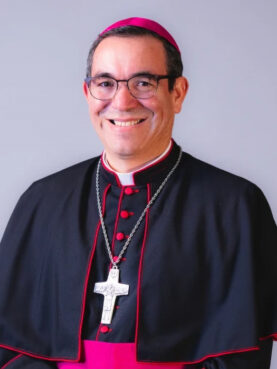 When it was time to leave their San Diego hearing, Pulido said, the family saw half a dozen United States Immigration and Customs Enforcement agents, and the mother told him she was scared. The bishop stuck close to the family, talking and reassuring them as they walked by the agents, he said. The judge had given them another hearing in December.