Affordable housing complex opens in downtown Waterbury
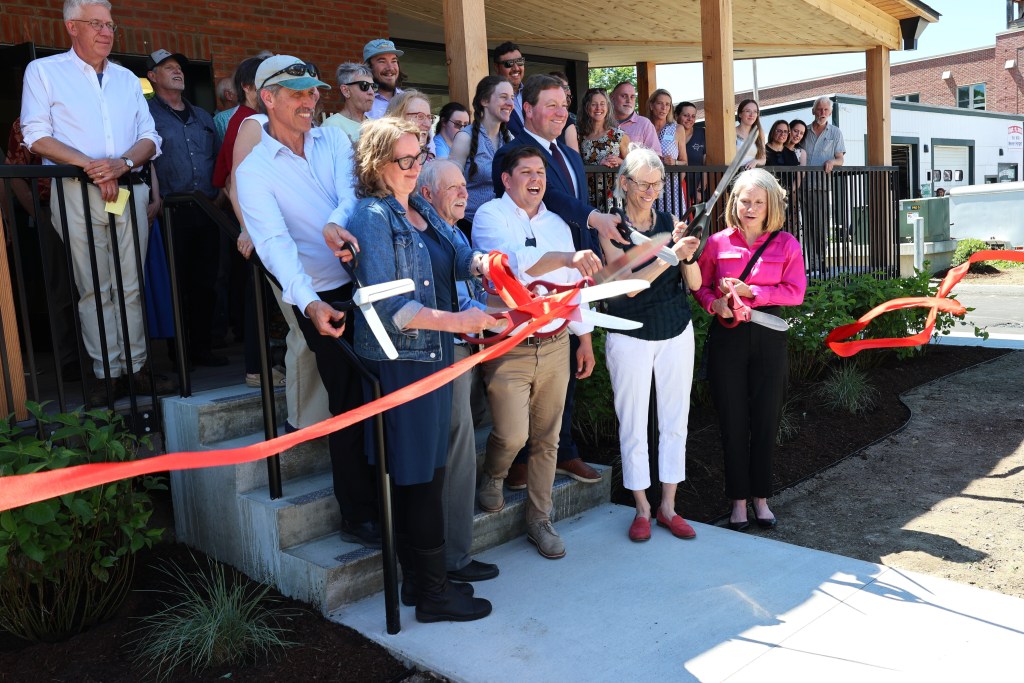
Local and state officials celebrate the opening of the Marsh House Apartments, a 26-unit affordable housing complex in the heart of downtown Waterbury, on June 3, 2026. Photo by Carly Berlin, Vermont Public/VTDigger
This story, by Report for America corps member Carly Berlin, was produced through a partnership between VTDigger and Vermont Public.
A new affordable housing complex will soon be home to more than two dozen residents in the heart of downtown Waterbury.
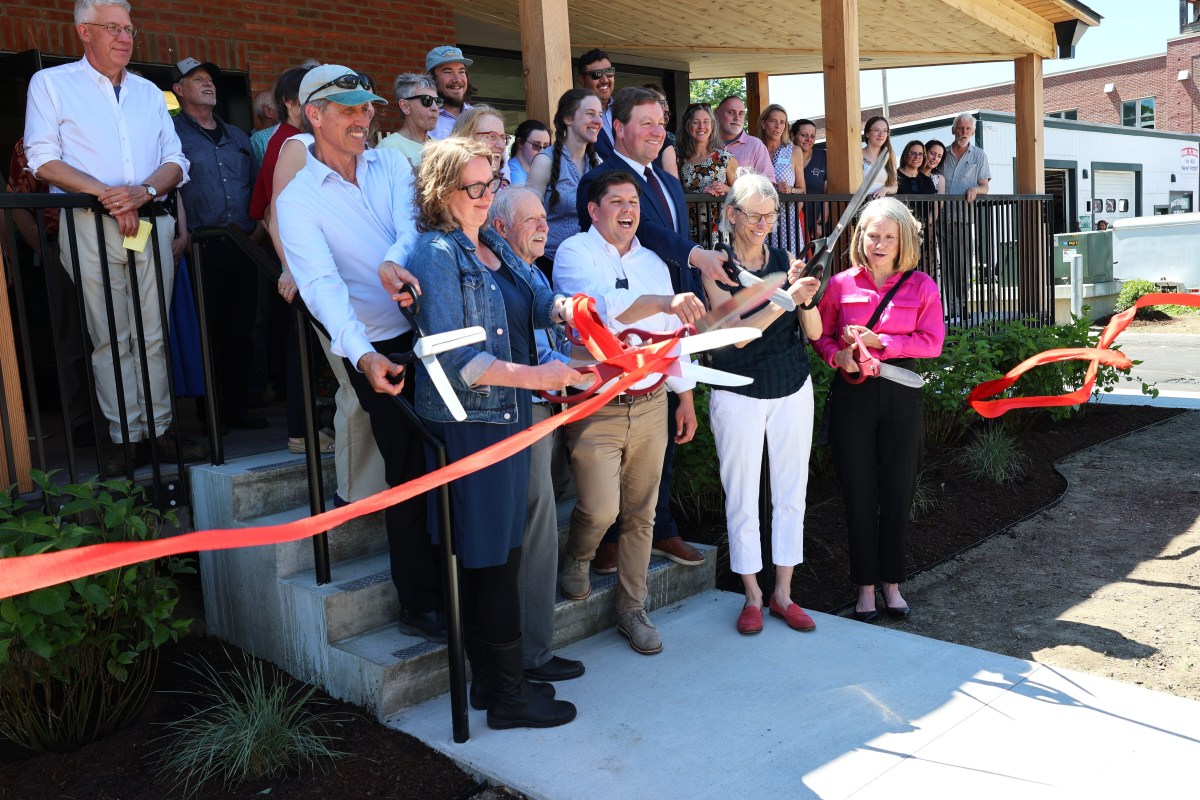
Local and state officials celebrated the opening of the Marsh House Apartments on Wednesday afternoon. The newly constructed building, co-developed by the central Vermont nonprofit Downstreet Housing & Community Development along with Evernoth, has 26 mixed-income apartments.
Housing Commissioner Alex Farrell said the three-story apartment building — situated along the town’s main commercial stretch — should serve as a model for other towns.
“A lot of communities have some consternation, some discomfort, some fear with the idea that homes that are in a building like this could be next to homes that are in buildings like that,” Farrell said, pointing to the single-family homes and small apartment buildings that line a residential street behind Marsh House. “But thank you, Waterbury, you’re proving with a building like this that it looks great, that this is just what we need in Vermont.”
Three of the new apartments are reserved for people with intellectual or developmental disabilities, and five are set aside for people experiencing or at risk of homelessness. The organizations Upper Valley Services and Good Samaritan Haven are slated to provide support for these residents.
Monthly rents for the new studio, one-bedroom and two-bedroom apartments range from $960 to $1,980, according to Downstreet. Tenants have already begun to move in.
They include a single mother and her children who had recently become unhoused, said Angie Harbin, executive director of Downstreet. A neighbor offered the family a temporary place to stay, and got in touch with the housing agency.
“Because there was a home available, we were able to help that family move from crisis into housing,” Harbin said.
The apartment building is named after the family of James Marsh, who is believed to be the town’s first permanent settler in the 18th century. His son later lived at the site of the new apartments, according to the Waterbury Roundabout. Later, a home at the property was turned into municipal offices, which were heavily damaged by flooding during Tropical Storm Irene in 2011.
Local and state officials celebrate the opening of the Marsh House Apartments, a 26-unit affordable housing complex in the heart of downtown Waterbury, on June 3, 2026. Photo by Carly Berlin, Vermont Public/VTDigger
The office building was ultimately torn down and the site was used as a parking lot. Voters in Waterbury’s downtown utility district overwhelmingly approved the lot’s sale to the affordable housing developers in 2022. And while some neighboring residents showed up at local hearings to express their concerns about the look of the apartment building and noise associated with construction, the project eventually scored its local approvals.
Only a portion of the parking lot for the new apartments lies in the flood zone, Harbin said, and the building itself is elevated and lacks a basement. Flooding did not impact the property in 2023 or 2024, Harbin said.
The new apartment complex is situated along a bus route. It has all-electric utilities and a rooftop solar array.
The project cost $15.3 million to build, or about $588,000 per apartment — in line with the steep cost per unit of new affordable housing construction in Vermont. Public funding came from federal low-income tax credits, an earmark by former Sen. Patrick Leahy, the Vermont Housing and Conservation Board, and Covid-era relief funding set aside by the town of Waterbury, among other sources.
Although they’re often called mobile homes or trailers, that’s really a misnomer because their owners can’t easily relocate them. Typically, the people who own them rent the land underneath the houses from the owners of manufactured home parks. Sometimes, an owner will rent their home to someone else while paying to rent the land as well.
Manufactured homes tend to be far more affordable than other single-family homes because they have lower upfront and monthly expenses. A typical one costs around US$120,000; smaller ones, known as single-wides, cost around $87,000.
I’m studying poverty, inequality, collective action and rural housing as a sociology Ph.D. candidate. In 2025, I began to conduct in-depth, on-the-ground research documenting the experiences of residents in manufactured home parks in rural Wisconsin whose park was either for sale or had been sold to a private equity firm. So far, I’ve interviewed 15 people as part of an ongoing study that is forthcoming and not yet published.
I’ve found that in this region, as is occurring in the rest of the country, rents tended to spike soon after those firms bought the parks. Those rent hikes are, in turn, creating a crisis for many low-income residents who may suddenly need to move, but have limited options.
Getting priced out
Nationally, rents in these parks have increased by 45% over the past decade. This increase, which is not adjusted for inflation, mirrors overall rent growth. But it shows how manufactured housing is becoming less affordable at the same rapid pace as the broader rental market.
In 2025, I interviewed a man I’m calling Anthony Perez. (I’m using pseudonyms to protect the privacy of everyone who spoke with me, which is a standard social science research method.) He had worked as a logger in northern Wisconsin until a debilitating back injury ended his ability to continue in the profession past his early 50s.
In anticipation of having a low income for the long term, Perez chose to invest his life savings in a manufactured home.
“There was a trailer for sale, and it was decent,” he said. “I had a little savings and workers comp, so I bought it for $9,000, thinking I could afford to live there on my disability income.”
That plan broke down when a private equity firm bought his park and instantly raised his monthly rent from $350 to $500, now costing him more than half of the $800 a month in Social Security Disability Insurance benefits he received.
With no other housing options, Perez decided to stay and fight alongside his neighbors, all of whom were facing the same rising rents and uncertainty about their ability to remain in their homes. Together, the residents have started organizing meetings to conjure up strategies to resist the changes imposed by the new ownership.
“They’re bullies,” Perez said. “So we here residents have to make some noise and get some power in a group to push back.”
Many mobile home communities are located in rural areas with scant affordable housing stock. AP Photo/Joshua A. Bickel
Rising anxiety
Perez was among the many residents I met who lived in fear of losing their home and with limited options of where to go.
Johanna Hansen, a retired high school teacher who also invested her life savings in her manufactured home, lived about 40 miles (64 kilometers) west in another manufactured home park that a private equity firm had recently put in an offer for.
“I own my home, but I don’t own the land that it’s on,” Hansen said. “I always feel that insecurity of not knowing what will happen a year from now – or with the current sale, maybe even sooner than that.”
If the monthly cost of renting her lot rises by more than $100, Hansen says she will have to sell her home and move.
“Had I known the park was going to be sold to an investment group, I wouldn’t have bought in the first place,” she said. “But now I’m stuck.”
Repeating a similar mistake
In my view, today’s threat to mobile home parks echoes the loss of another affordable housing option: single-room occupancy units.
And like the single-room units that have largely disappeared, that housing is at risk of being lost, too.
The author would like to thank University of Wisconsin-Madison Sociology professor Jessica Calarco for her supervisory role and support on this project.
Erin Gaede does not work for, consult, own shares in or receive funding from any company or organization that would benefit from this article, and has disclosed no relevant affiliations beyond their academic appointment.
Oklahoma Treasurer Using Unclaimed Property Office As Commuting Hub
Oklahoma Treasurer Todd Russ is using a newly created unclaimed property office in western Oklahoma as a commuting hub to get back and forth to his office in the Capitol during the work week, according to GPS data from a state vehicle.
Russ opened the Clinton office in June 2025 as part of a plan to give rural residents a place to ask questions about the state’s unclaimed property program, other than Oklahoma City. In December, he established another satellite office in Muskogee. One of the treasurer’s main job responsibilities is to administer the state’s $1.4 billion unclaimed property program.
But Russ also appears to be using the Clinton office as a commuting hub, with hundreds of trips in a state vehicle to and from the unclaimed property office and the Capitol in Oklahoma City in the past year.
Clinton is 85 miles from Oklahoma City. Russ lives in Cordell, about 15 miles south of Clinton.
Russ, a Republican who was first elected treasurer in 2022, is running for re-election. He faces term-limited State Auditor and Inspector Cindy Byrd in the June 16 GOP primary.
Oklahoma Watch obtained GPS logs and fuel purchases tied to a 2024 Ford Expedition used by the treasurer’s office. More than 100 trips show the SUV reaching speeds exceeding 90 miles per hour. The logs recorded more than 960 trips in the past year.
State law requires an elected official or employee to obtain authorization from the Office of Management and Enterprise Services to use a state vehicle for commuting. Russ’ office does not have authorization, according to responses to an open records request made in September and verified again on May 27.
Russ’ office did not answer detailed questions about the state vehicle and its use.
“The treasurer’s office has one fleet vehicle assigned to it, which supports four offices around the state that provide localized services to citizens, similar to other constitutional offices and statewide elected officials,” spokeswoman Lara Blubaugh said in a May 29 written statement. “The vehicle is used by the treasurer and staff to access each of those sites as part of the constitutional duties of the office.”
The GPS logs for the Ford SUV show most of the trips made to and from locations in western Oklahoma and the Oklahoma City area, even after the treasurer’s office opened an unclaimed property satellite office in Muskogee in eastern Oklahoma late last year.
Other statewide elected officials who responded to Oklahoma Watch said they either commute to Oklahoma City in their personal vehicles or use state vehicles in limited circumstances.
A spokeswoman for State Superintendent Lindel Fields, who lives in Tulsa, said he has a state car and occasionally uses it to commute to save money when several people from the agency are joining him on official business. But most of the time, Fields uses his personal vehicle to drive back and forth from Tulsa to the agency’s headquarters in Oklahoma City, said spokeswoman Tara Thompson.
Byrd, who lives in southeastern Oklahoma, said she hasn’t used a state vehicle to commute since she took office.
“When I took office in 2019, I asked my general counsel at the attorney general’s office whether I could use a state-owned vehicle for the 120-mile commute between the Capitol and my home in Coalgate,” Byrd said in a written statement. “I was told state statute did not allow for this. As state auditor, I have never used a state-owned vehicle.”
Neither Attorney General Gentner Drummond nor Insurance Commissioner Glen Mulready responded to requests for comment by deadline about their use of state vehicles for commuting. Labor Commissioner Leslie Osborn lives in the Oklahoma City metro area.
Speed Logs
More than 10% of the trips logged in the treasurer’s SUV recorded top speeds in excess of 90 miles per hour at some point during the drive.
Russ’ office did not respond to questions about the top vehicle speeds recorded by the GPS data. A review of Oklahoma Highway Patrol records showed no tickets associated with the 2024 Ford Expedition.
Users of state vehicles agree to abide by safety and appropriate-use rules and have access to reporting tools to monitor and review their fleet data, said OMES spokeswoman Christa Helfrey.
“When vehicles are assigned to agencies, the agency submits a Driver Responsibility Certification, which outlines their responsibilities regarding vehicle operation and oversight,” Helfrey said in an email. “Through this certification, agencies acknowledge and agree to manage matters related to driver safety, compliance with state laws and the appropriate use of state vehicles.”
Unlike most vehicles in the state fleet, the treasurer’s office Ford Expedition has no obvious markings that show it is a state vehicle. The only designation is a small windshield decal.
Todd Russ
The treasurer’s office put more than 26,000 miles on the SUV in the past year. State fuel card records tied to Russ and the treasurer’s office show more than $3,700 in fuel purchases, mostly at gas stations along Interstate 40 between Clinton and Oklahoma City.
On one day in August, the vehicle went from Clinton to the studios of Oklahoma City TV station KOCO-TV, where Russ gave an interview about the state’s 529 college savings program, according to station logs filed with the Federal Communications Commission. It then went to the Capitol for several hours. The SUV made a stop at a Walmart in far western Oklahoma City before returning to the Clinton unclaimed property office that afternoon, based on the GPS logs.
Oklahoma Watch staff spotted Russ eating lunch at a Charleston’s restaurant in Oklahoma City in February and saw him driving the vehicle as it left the parking lot. GPS logs from the vehicle show a stop there before heading back to Clinton later that afternoon. The vehicle started the day in Clinton and went to the Capitol in the morning.
The treasurer’s office is paying $1,300 a month for the Clinton office and $600 a month in rent for the Muskogee unclaimed property satellite office. Before it opened, the treasurer’s office paid $3,700 for new carpet and garage door openers at the Clinton office, according to the lease agreement. It also spent more than $27,000 in office furniture from Oklahoma Correctional Industries for the Clinton office and the main unclaimed property office in Oklahoma City, according to state vendor records.
Russ’ office declined to provide information about the number of office visits or calls fielded by the part-time employees in either the Clinton or Muskogee unclaimed property offices since they opened last year.
“A vast majority of Oklahomans who use our services are located in rural counties and previously did not have access to these services without driving to Oklahoma City,” said the May 29 written statement from Blubaugh. “The treasurer changed that. Government should not just be available to those who live in Oklahoma County; it should be available to all Oklahomans.”
Russ barely noted the existence of the Clinton office last year. The Clinton Daily News had a report on its front page on June 12, 2025. But the treasurer’s office didn’t put out any statewide press releases at the time about the office or any plans to open additional satellite offices.
“Every dollar in unclaimed property belongs to someone who currently or previously lived in Oklahoma, and our job is to return it,” Russ said in the June 12 newspaper article. “This new Clinton office is a major step in making those resources more accessible to our rural communities, providing the local experience and great service all Oklahomans deserve from their state government offices.”
The Muskogee office, by contrast, had a ribbon cutting in December with the local chamber of commerce and state Rep. Chris Sneed, R-Fort Gibson, who represents the area. The Muskogee Phoenix and Tulsa station KOKI-TV Fox 23 both covered the opening.
Sneed said in an interview he helped Russ and his staff look for possible locations for an office in eastern Oklahoma. Other potential locations included Okmulgee, Sallisaw and Tahlequah, Sneed said.
State flight logs show Russ and three staff members took the state plane last year from Wiley Post Airport to Muskogee. The June 3, 2025, flight was to scout locations for the eastern Oklahoma unclaimed property office, according to the trip forms signed by Russ and his three staffers.
GPS logs for the Ford Expedition show a trip to Oklahoma City’s Wiley Post airport on June 3, 2025. The vehicle started the day in Clinton and ended up there after stops at the Capitol and the airport.
Russ’ office did not respond to questions about state plane use for that location-scouting trip.
Russ is a former state lawmaker who spent 12 years in the House. Members of the Legislature get per-diem travel reimbursements for every day they spend in session at the Capitol if they live farther than 50 miles away.
Other than certain law enforcement, wildlife or emergency management employees, statewide elected officials and state employees are not allowed to use state vehicles for commuting. However, the governor can designate essential employees who are allowed to use a state vehicle for that purpose.
“The Legislature’s purpose is to prevent state employees from using state-owned vehicles for their personal or private use,” the opinion said. “A state employee may travel to or from the employee’s place of residence in a state-owned vehicle in the performance of the employee’s official duty.”
Oklahoma Watch’s audience development director, Shaun Witt, contributed to this report.
Paul Monies has been a reporter with Oklahoma Watch since 2017 and covers state agencies and public health. Contact him at (571) 319-3289 or pmonies@oklahomawatch.org.Follow him on Twitter @pmonies.
Oklahoma’s cotton gins are regulated as a public utility, similar to electric co-ops or natural gas companies, so the state determines their rates for services.
Council board member David Arthur is general manager for Cotton Growers Cooperative, a gin facility in Altus. In the past decade, he said drought has hit the industry, and the higher rate will help cushion some rough patches.
“By having a slightly higher ginning rate in our good years, if you will, we hope to isolate and minimize some of the losses that we will have in those bad years,” Arthur said.
Oklahoma’s cotton gins are regulated to protect farmers from monopoly practices, according to the Oklahoma Corporation Commission. ( Oklahoma Corporation Commission)
When the rates were last increased, the industry was different. There were more gins, and transportation was harder.
Then, 79 gins operated in the state. Now, there are fewer than a dozen. Because there are fewer facilities and erratic weather, Arthur said ginning seasons are longer. They now stretch into May, which would have been unheard of in the 1980s, and puts more stress on equipment.
“There are fewer and fewer gins as we go through the years,” Arthur said. “They tend to close for various financial reasons, but we are starting to see where freight, especially as fuel prices go up here recently, where it is becoming much more economical to have a gin close to home.”
Over the years, the industry has kept pace with technological and other efficiency changes, he said. But in the past decade, it’s been tougher to recover from drought.
Since the rough droughts of 2011 and 2012, he said the gins have been playing catch-up.
“Forty-five years is a very long time for price increases in other commodities, other services, other industries and we finally just felt like it was not only were we due, we were maybe overdue,” Arthur said.
Because of the uptick in rates, cotton producers will see a higher processing bill. While some producers process their cotton in neighboring states, Arthur said they risk losing certain in-state cooperative protections.
Even with recent rate increases, Oklahoma still costs less than some neighboring states, including at unregulated gins in Texas.
At his cooperative, Arthur said there has been increased demand, while some gin operators are seeing the opposite. Some producers want their cotton processed quickly so they seek out-of-state gins.
“I hesitate to bring this up too loudly, but a longer wait is better than not having the services at all,” Arthur said. “And unfortunately, as Mother Nature and climate change, drought conditions tend to persist, there will be fewer of us left to carry the torch.”
Nebraskans are taking a hard look at data centers
This story is made possible through a partnership between Grist and The Flatwater Free Press, Nebraska’s first independent, nonprofit newsroom focused on investigations and feature stories.
Standing before the Otoe County Board and a room of neighbors, Wynee Benedict ticked through a long list of concerns.
Do we have enough water for them? Who pays for their power? What if they create a heat island?
The source of Benedict’s worries: data centers. Since learning earlier this year that their county, south of Omaha and a little east of Lincoln, could become home to a new data center, Otoe residents have been abuzz with questions and concerns like Benedict’s, leading some residents to call for a temporary ban on the industry.
That’s effectively what the board did last month, voting to suspend the permits needed for a new data center for up to a year, according to commissioner Chuck Cole. The pause is intended to give county officials more time to study how the developments fit into the county’s future plans and to update its regulations accordingly.
Around the country, opposition to data centers is growing. The massive, resource-guzzling buildings needed to power artificial intelligence and our digital infrastructure have emerged as a galvanizing issue. Local governments from California to Maine have adopted or are considering temporary bans. And at least 14 states so far this year have weighed statewide moratoriums.
Elsewhere in Nebraska, Madison County set requirements for data centers to get a special permit, which allows added oversight and public input. In Gage County, the planning and zoning commission will hold a hearing on a data center moratorium later this month.
And more will likely follow suit thanks to a recent change in state law forcing counties to make a decision on certain development projects within a specific amount of time, said Jon Cannon, executive director of Nebraska Association of County Officials. The goal, according to the bill’s supporters, was to prevent counties from needlessly delaying projects. But the law could have an unintended consequence.
“I think that you’re likely to see a number of counties that say, ‘We need to get our regulations in order,’ and … they may put moratoriums on a lot of things, not just data centers,” Cannon said.
Data centers are just the latest in a long line of controversial developments, like wind and solar, that counties in Nebraska and other states have grappled with. And much like those other developments, attitudes toward data centers could vary from county to county, Cannon said. He advises developers to communicate with residents in rural Nebraska early and transparently about large projects.
“When people are aware of something coming to town, because, ‘Oh, my neighbor told me that he just signed this big contract for a right of way’ — when people find out that way, they get very excited, and not in a good way,” Cannon said.
From an environmental standpoint, it’s hard to know how much data centers are impacting Nebraska. There’s no centralized information source for their location, ownership, and water usage.
This school district has received death threats for standing up for immigrants. It’s not backing down
WINOOSKI, Vt. — The day’s class started with a writing prompt: Do you feel safe in school? Why or why not? The students — whose families hail from across the globe and speak languages including Arabic, Nepali, Spanish and Somali — wrote their responses before reading them aloud.
“I feel safe in school because I saw the school doors are locked every time,” one student said, “and I heard ICE is not here.”
“If ICE comes to school, they are not allowed to go in,” said another.
“ICE can’t come in,” said a third teen.
The sense of security students feel in this multilingual learner class at Winooski High School is hard-won. Since the start of the second Trump administration, the federal government has investigated schools for diversity, equity and inclusion efforts, rescinded a policy protecting students on school grounds from Immigration and Customs Enforcement arrests and threatened school districts with the loss of federal funding. Administration officials have also encouraged states to challenge a decades-old Supreme Court decision guaranteeing undocumented students’ right to public schooling, which conservative activists say takes resources from American children.
While many districts have chosen to go quiet or self-censor out of fear of being targeted, the Winooski school system and its superintendent, Wilmer Chavarria, have taken the opposite approach.
Last year, this small district of about 800 students was the first in Vermont to pass a sanctuary policy aimed at protecting students from immigration enforcement while at school. Then, months later, Chavarria refused to sign a document from the Trump administration saying it is complying with the federal ban on DEI efforts in schools.
Student artwork is displayed prominently in the atrium at Winooski High School in Winooski, VT. Credit: Oliver Parini for The Hechinger Report
That’s happened even as the district has been affected directly by federal policies. In June of last year, Chavarria, a naturalized citizen, was detained for several hours by immigration officials at the Houston airport while on his way back from visiting family in Nicaragua. Over Thanksgiving break in November, a second grader was detained with his mother by federal agents conducting immigration enforcement. After weeks in a detention center, they left the country. In early December, the Winooski School District was the target of racist messages and phone calls after a video of a student raising the Somali flag on a pole outside the high school went viral on social media.
While there have been no direct threats by the Trump administration to pull Winooski’s federal funding, which accounts for 6 percent of the district’s annual budget, Chavarria said he is preparing for the possibility.
“When somebody wants us to lose funding, we’re going to lose it anyways. The difference is, did we lose it while bending the knee, or did we lose it while standing up for our values?” Chavarria said. “Either way, the outcome will be the same.”
Nestled along the Winooski River on the outskirts of Burlington, Winooski is the smallest school district by land area in Vermont. This 1.5-square-mile community is the most diverse district in a state that ranks among the whitest in the nation. Nearly 60 percent of students here are people of color, more than a third are learning to speak English, and about 71 percent of students live in poverty.
The Winooski School District, where more than one-third of students are learning to speak English, is the most diverse school system in Vermont. Credit: Oliver Parini for The Hechinger Report
For more than three decades, the town and neighboring region have been a federal refugee resettlement community, accepting hundreds of immigrants annually who are fleeing conflict from Bhutan, Somalia, Bosnia and Syria, among other countries. Last year, the Trump administration decreased the admissions cap for refugees into the U.S. from 125,000 in 2025 to 7,500 in 2026, the lowest limit for refugee placement since the program’s inception.
Since then, the number of refugees resettling in the state has been reduced to a trickle. So far, about 50 refugees, all from South Africa, have relocated to Vermont this year.
Chavarria, 37, joined Winooski schools in 2023 after serving as director of equity and education support systems in another Vermont district. Born in Nicaragua, he didn’t learn English until high school, a background that resembles many of the Winooski students he serves. His actions on behalf of immigrant students have built him widespread support in the community.
“Wilmer has been a brave voice in a time in our country where that’s being punished,” Robin Merritt, a parent of three children in the district, said as she dropped them off on a Tuesday morning in April. “I can’t speak for everybody, but most of the public is pretty proud of his leadership.”
The sanctuary schools policy is a key reason. The guidance formally outlined Winooski’s policy reaffirming that staff will not share student data with immigration officials. It also restricts agents’ access to campus without a signed judicial warrant, among other steps. In May, after advocacy from Chavarria and others, the Vermont Legislature passed a law modeled after Winooski’s policy requiring all schools in the state to have immigration enforcement protocols.
Letters of support hang on the walls of the Winooski School District. The district received a deluge of racist threats in December after raising the Somali flag on school grounds in December. Photographed on April 7, 2026. Credit: Oliver Parini for The Hechinger Report
In an emotional district meeting last February, more than three dozen teachers, students and Winooski residents spoke in support of it.
“I want to know the district has my back,” one staff member said.
“We are scared. Passing this will help us feel safe and at ease while at school,” a high school student told board members.
Most school board members supported the policy from the outset. But Nicole Mace, the board president, said she worried it would make Winooski a target of federal officials, who have at times singled out sanctuary communities for policies that impede immigration enforcement.
She was not at the meeting where the policy was approved, in a 4-0 vote. But in the year since, she said she’s learned how much it has meant to families in the district.
“The risk is around us no matter what, and for the district to take a very clear and unwavering position of support for our families and students couldn’t be done with little tweaks in the policy or putting our heads down and hoping that we could just ride this out,” said Mace.
Ignacia Rodriguez Kmec, policy counsel at the National Immigration Law Center, an organization that advocates for the rights of immigrants, said clear policies like this one not only protect students, but also staff, who may not know what immigration agents are allowed to do on school grounds. Her group advocates for all school districts to have such policies, in the same ways schools plan for earthquakes and tornadoes and other emergency situations.
“You want to be able to show that you support all families, including immigrant families, that they ideally should participate and not be afraid of coming to school,” she said.
A 2022 study found that children from families with mixed citizenship status were more likely to earn A’s and less likely to report problems with their teachers and peers if they attended a school that had a “safe zone” policy restricting immigration enforcement on campus.
“I really see the impact in the classroom,” said Caitlin MacLeod-Bluver, who teaches English and history at Winooski High and was Vermont’s teacher of the year in 2025. “When kids feel seen and heard and valued in our district and community, it shows up in the work they’re doing.”
Caitlin MaCleod-Bluver, Vermont’s statewide teacher of the year in 2025, serves on the Winooski School District’s team of rapid response volunteers who help out when students or their families are dealing with immigration enforcement. Credit: Oliver Parini for The Hechinger Report
MacLeod-Bluver is part of a group of teachers in the district who have volunteered to drive or walk students to and from school when they are worried about immigration enforcement in town.
A desire to reassure immigrant families was also the impetus for Chavarria’s decision to raise the Somali flag on school grounds on Dec. 5, three days after President Donald Trump referred to Somalians as “garbage” in a Cabinet meeting. When a video of the flag went viral on right-wing social media, staff had to temporarily take down the district’s website and social media accounts and unplug school phones because of death threats, hundreds of which were turned over to Vermont State Police and the FBI.
White House spokesperson Abigail Jackson said at the time that the threats came from individuals who had nothing to do with the Trump administration. “Aliens who come to our country, complain about how much they hate America, fail to contribute to our economy, and refuse to assimilate into our society should not be here,” she told The Associated Press. “And American schools should fly American flags.”
Despite the onslaught, the staff kept the Somali flag up, beside the U.S. and Vermont flags, through the following week to show support for Somali students, who make up about 9 percent of the school system’s student population.
Chavarria — who with his husband stayed at a hotel for a few days following the episode after receiving death threats — said he believes if more school leaders publicly and vocally pushed back on Trump administration policies, Winooski wouldn’t be as big of a magnet for people’s hate.
“It does feel like we are alone in an ocean,” he said. “It is very, very scary. It is draining. It is demoralizing. It’s like a nightmare that you wish one day ends, because you feel like nobody else understands it because nobody else is being attacked the way we are.”
Last spring, the superintendent’s brother and sister-in-law had to leave the U.S. after the Trump administration ended a Biden-era program that allowed eligible Nicaraguans to stay in the country for a two-year period with a sponsor. The family, who had lived with Chavarria as their sponsor, still had time left on their visas when the program was abruptly canceled. When Chavarria was stopped at the Houston airport while he was on his way back from visiting family in Nicaragua, immigration officials searched his devices and interrogated him for nearly five hours, about his marriage and work and citizenship, before releasing him.
“When I get asked, I advise people that your status doesn’t matter if you’re brown,” said Chavarria, who has filed a lawsuit against the Department of Homeland Security over agents searching his personal and school devices while he was questioned.
Inside the Winooski school building this spring, there were visible traces of the challenges of the last year. Since the deluge of death threats in December, doors separating hallways are locked, requiring a staff member to let students through sections of the building throughout the day. Along the entryway’s walls, dozens of posters and cards from families, students and supporters both near and far carry messages such as, “You belong here,” “You make our community a better place” and “Somali students we stand with you.”
A table with “Know your rights” and “Conoce tus derechos” emblazoned across a banner sits off to the side, with documents translated into more than half a dozen languages telling families how to organize their documents and talk to children about ICE, along with papers they can hand immigration agents explaining their Fourth and Fifth Amendment rights.
Students work through a journaling prompt in a multilingual learner reading class at Winooski High School. Credit: Oliver Parini for The Hechinger Report
Still, outside of school walls, the district has not been able to keep all students safe. In the weeks following the second grader’s detention in November, teachers wrote letters of support appealing to immigration officials and organized a fundraiser for emergency resources and legal fees. Erin Hurley, a multilingual teacher who taught the boy, said detention center officials denied her request to send his school work to him.
During phone calls, the mother told Winooski staff that her son wasn’t doing well at the detention center in Dilley, Texas, due to lack of edible food, clean water and medical care. After seven weeks in Dilley, and despite having a lawyer fighting for their release, the family decided to self-deport.
In the last year, Hurley and other staff members at the school district have volunteered to be temporary guardians for several students whose parents worry about being detained.
“I feel so disgusted that our country has come to this. These families make our community so much brighter. They contribute to Vermont so much,” Hurley said.
A high school student in Winooski — whose family members are Nepali immigrants and whose name is being withheld to protect her privacy — saw videos of the arrests and protest online. She said she appreciated that the Winooski School District sent out a message alerting families about the incident. The sanctuary schools policy has made her and her mother feel safe while she is at school, the student said. And she hopes other districts in Vermont pass similar policies — a requirement under the new state law, starting next year.
“Right now, it’s only Winooski. Even if they don’t have a lot of students or staff of color, I think it’s really good to make it a sanctuary school, still. Because there might be one or two students that it would be really helpful,” said the student.
Becky Savage teaches a multilingual learner reading class at Winooski High School in Winooski, VT. Credit: Oliver Parini for The Hechinger Report
Back in Winooski High School’s multilingual learners class, their teacher, Becky Savage, turned to a new topic: Astronauts aboard Artemis II had just released photos from the far side of the moon, the farthest any human has ever traveled from Earth. She pulled the images up on screen for the class to see.
They had a million questions. Is that photo artificial intelligence? How do the astronauts have access to the internet? Why didn’t they land on the moon?
For a few minutes, their thoughts were 250,000 miles away. Then, it was time to practice reading and writing in English again.
Contact staff writer Ariel Gilreath on Signal at arielgilreath.46 or at gilreath@hechingerreport.org.
Thousands to lose Medi-Cal and food aid in Santa Clara County
New rules and work requirements for Medi-Cal and food stamps imposed by the federal government could strip benefits from thousands of people in Santa Clara County.
As of Monday, work requirements for people receiving food stamps, known as CalFresh in California, have expanded to include adults ages 18 to 64, raising it from the prior cap of 54. It also requires individuals previously exempt from work requirements — homeless people, veterans and those aged out of foster care — to work 80 hours a month. In addition, new work requirement hours will be imposed on individuals receiving Medi-Cal starting Jan. 1, 2027. These changes are the result of H.R.1, the federal spending bill passed last summer, that severely cut Medi-Cal and CalFresh benefits.
CalFresh and Medi-Cal recipients can also volunteer, participate in job training and enroll in education as part of the work requirements.
About 665,500 people are poised to lose their CalFresh benefits statewide due to these expanded work requirements, according to the Legislative Analyst’s Office. In Santa Clara County, where more than 132,000 people relied on CalFresh last year, about 55,000 people are expected to lose their food benefits due to the changes.
For those on Medi-Cal, the University of California, Berkeley Labor Center estimates nearly 3 million fewer Californians will have Medi-Cal in 2028 due to the various rule changes, with 129,000 losing benefits in Santa Clara County. About 460,000 county residents were enrolled in Medi-Cal last October, the latest data available.
“The work requirements were not put in place to encourage people to work. The work requirements were put in place so that people would be thrown off of Medicaid,” Bob Brownstein, strategic advisor for nonprofit Working Partnerships USA, told San José Spotlight. “The budgeting is done based on the assumption that the work requirements are going to reduce the cost. If everybody met the requirements, there’d be no savings.”
The new Medi-Cal rules also call for renewals to happen every six months rather than annually, a change that increases the burden for people dependent on health care services such as cancer survivor Julie.
Related Stories
Julie, a county resident who asked to only use her first name for privacy reasons, was diagnosed with breast cancer in 2024 and has been cancer free since last year. But her life still revolves around doctor appointments to monitor any recurrence, a regimen of medications and regular blood work.
Though people with disabilities are exempt from work requirements and can continue to renew benefits once a year, Julie is unsure if she falls under that category. Because Medi-Cal is her lifeline, she will do whatever it takes to keep the benefits, she said. But she worries the new rules will make it harder for her to maintain continual service.
“Something that she’s worried about is not receiving their notice (of renewal in the mail) on time,” Julie told San José Spotlight in Spanish through a translator.
Jamie Winslow, 43, anticipates the new rules and work hours reporting will complicate a process that’s already challenging to navigate.
After losing her job last year, she enrolled in CalFresh and Medi-Cal, which was a long application process requiring various documents, she said. She simultaneously applied for unemployment. Since her son is younger than 14, she is exempt from the new work requirements.
Regardless, Winslow said work requirements add an extra burden to people with families.
“If you’ve got kids, 20 hours (a week) is really tight if you are also responsible for getting them to school and picking them up,” she told San José Spotlight.
Six months into her food benefits, Winslow had to complete a form to report a change in income. Despite her meticulous review of her application, a missing document led her benefits to stall in May, and Winslow is unsure when they will be reinstated.
“They haven’t been able to process (my paperwork),” Winslow said. “They said ‘We’re just behind.’”
Winslow’s monthly food benefits — a mere $24 a month — is not enough to cover even a week’s worth of food. She relies on the food bank every week.
“Whenever people fall off of CalFresh, our lines get longer,” Second Harvest of Silicon Valley CEO Leslie Bacho told San José Spotlight. “We cannot possibly replace CalFresh. The value of that benefit is $32 million a month across just the two counties we serve. We are going to be doing our best to meet the increase in need.”
The food bank provides 11 million pounds of food monthly to roughly 500,000 people across Santa Clara and San Mateo counties.
Betzabel Estudillo, chief engagement officer with Nourish California, a statewide nonprofit pushing anti-hunger policy initiatives, said these work requirements add more red tape for people who are already vulnerable and were previously exempted. That includes homeless people who may not have the technology or the ability to report their hours worked.
“Seventy four percent of people subject to the time limits already work, but they face unstable hours because of the labor market,” Estudillo told San José Spotlight. “These cruel (work) requirements are going to cause these populations to lose benefits, because it is very challenging for people who are unhoused or veterans to find stable employment.”
Contact Joyce Chu at joyce@sanjosespotlight.com or @joyce_speaks on X.
Will Doctors Trade 5 Years In Rural Hawaiʻi For Free Med School?
Ambitious financial aid program aims to reduce the doctor shortage in remote and underserved parts of the state.
Programs aim to get rural North Dakotans moving, eating healthier
Chronic disease and metabolic dysfunction affect large numbers of North Dakotans.
Several new programs coming soon to rural areas aim to reverse that by getting people moving and making healthy, whole foods more accessible.
“What I want people to know is that moving is the most important thing we can do to stave off chronic disease, and to change the trajectory of it if you’re starting to experience it,” said Pat Traynor, interim commissioner at ND Health and Human Services.
“That is a huge, huge problem for us as humans, and there’s a huge cost to it over time,” Traynor said.
Of the $199 million in Rural Health Transformation Program (RHTP) grants coming to the state over the next year, a total of $3.5 million is dedicated to three programs encouraging movement, healthy eating and community cohesiveness.
That includes $2.5 million for rural areas to establish community walking programs, $700,000 for piloting before-school physical education programs at schools, and another $300,000 for establishing or scaling up community garden programs.
These address two pillars of the Make North Dakota Healthy Again program, ND Moves Together and ND Eats Well.
“We want to make it contagious, making walking and eating well contagious,” Traynor said. “And let’s do it together, so we’re socially connected, because we have a crisis of friendship, a crisis of loneliness, we have anxiety and depression. The number one preventer of all these things is social connection.”
Poor lifestyle choices, including an overreliance on cheap, convenient ultra processed food, largely sedentary lifestyles, bad sleep habits, and a lack of activity outside in the sunlight, are considered leading culprits in the rise of these diseases.
Total personal healthcare costs amounted to around $8.6 billion dollars in North Dakota in 2020, the last year with the most complete data.
Just 30 minutes of walking per day and as little as two strength sessions per week can reduce the prevalence of some of these chronic diseases by between 30-50%, Traynor said.
Trending in the wrong direction
A look at the numbers shows how unhealthy many have become.
A total of 9.8% in North Dakota have diabetes, and another 32.2% have prediabetes, according to American Diabetes Association numbers.
Around 31% of the adult population in the state is obese, a rate that could reach 54% by 2030, the New England Journal of Medicine projected in 2023.
Cardiovascular disease is the leading cause of death in the state and around 30% of all North Dakotans have high blood pressure, North Dakota Health and Human Services figures show.
The second leading cause of death is cancer, which accounts for 17% of all deaths in the state in the most recent data.
On the mental health side, 18% reported their mental health was “not good” eight or more days in a month, data from 2025 shows. Around 25% reported some form of mental illness over the past year including depression, anxiety and hopelessness.
Support rural news by donating now.
Because we don’t receive network funding, our independent journalism relies on supporters like you.
A total of 35 applications for community walking programs were submitted, Traynor said, with around 20 expected to be selected.
One hopeful applicant is First District Health Unit, which serves seven counties in the north-central part of the state.
Holly Brekhus, Minot-based executive director of the unit, said their proposal centers on finding a coordinator who will then utilize the public health nurses in each community to create walking programs across the area.
“In those small communities, everyone knows the county nurse, so they’re familiar, they know who lives there, they know what other organizations are in the community, so they would be our team leaders in each of these communities,” Brekhus said.
Proposals must include at least one community walk once per week and another two that can be individually done and logged, she said, with nurses also able to provide nutrition guidance and ensure people are getting their normal health screenings.
“It would kind of vary by community,” Brekhus said. “If it’s a tight-knit group, and they want to walk together three times a week, great.”
Communities, no matter where they are, will likely need to collaborate with schools and other organizations that have indoor space that could be utilized for walking programs, particularly in deep winter or during other inclement weather periods, she said.
Gardening together
For the community garden program, 45 applications have come into HHS, with around 10 to be selected as pilots.
Gina McKee, who runs Prairie Wild Garden Company, has submitted a grant request. Earlier in the year McKeee had been contracted to set up the Towner Community Garden project through a grant from the local soil conservation district to use a vacant lot in the town.
Now that this has been established, a RHTP grant could help cover some operational costs and double the amount of raised beds, potentially add a high tunnel to allow a prolonged growing season, expand a pollinator section of the garden, and increase the ability to raise awareness in the community about the garden, McKee said.
She’s hopeful the grant will come through, particularly since the grant materials requested already established plots of outlines for programs that could be scaled up soon.
Raised beds ready for planting at the Towner Community Garden. If selected for a grant as part of the Rural Health Transformation Program, the garden could double the number of beds and other improvements. Photo provided by Gina McKee.
“It was excellent timing with the grant availability,” McKee said. “Had we not started yet, and already had some funding, it probably wouldn’t have worked for us this year.”
McKee said she hopes to work with NDSU Extension, which could hold educational workshops and training at the site, and sees potential collaboration with other groups like 4H.
Julie Garden-Robinson, a nutrition and food safety professor at NDSU Extension, was already selected for an RHTP grant for just over $500,000 as part of the ND Eats Well Together pillar.
Garden-Robinson is already familiar with many in rural communities across the state for the weekly column Prairie Fare that often runs in newspapers she’s been penning for 28 years.
The grant will help NDSU Extension expand on existing outreach programs about nutrition and healthy eating and increase the ability to collaborate on projects across the state, like the community garden program.
This will be done by holding events and training from the Pre-K level to college age, public health officials, teachers, other adults all the way through retirees, she said.
Recent changes to the federal dietary guidelines require updates to curriculum, she said, which is another part of what the grant will help facilitate.
Participants gather water for a 4H group working at a community garden in Williston last year. As part of North Dakota’s program for using federal Rural Health Transformation Program funding, community gardens like this could see expansions and improvements. Photo provided by NDSU Extension.
“We’re excited to have this funding because there’s a lot of things that we never could do because we have limited funding,” Garden-Robinson said.
Zero-hour PE programs
Another grant will support around 10 pilot programs for establishing “Zero-hour PE” initiatives at schools.
This would allow for the creation of structured 30-45 minutes of physical activity before school for middle and high school students with a component for tracking that activity through fitness tracking wearable devices.
So far, 23 applications have been submitted, Traynor said.
“We know physical activity improves academic performance as well as gets people hooked on activity that otherwise wouldn’t have this opportunity, because they might not be in a sport,” Traynor said. “It’s for everyone, but it also gets kids that otherwise wouldn’t be in an organized thing.”
One question that naturally arises is how this would conflict with busing or other transportation for kids going to school.
Traynor said funding for these programs will be available to ensure kids in rural areas can get to the sessions outside of the normal busing operations.
Recently hired to oversee the granting process and build out the Make North Dakota Healthy Again programs over the next five years is Nicole Benson, a Grand Forks native who helped get a segment of her city certified as a “Blue Zone” last year.
Blue Zones are areas around the world where people have been found to avoid some of the chronic diseases plaguing other parts of the world and where they have higher lifespans and healthspans. This includes parts of Sardinian, Okinawa, Greece, Costa Rica, and Loma Linda in California where healthy eating, movement and social connectedness are built into the lives of residents.
“We’ll really be focusing on nutrition, movement, building resiliency, and a lot of that has to do with social connection and mental health,” Benson said.
Benson said over the course of the five years the types of grants will likely morph as innovative ideas come in from communities across the state about how they’d like to use the funding.
“I think we’re just scratching the surface of what’s to come,” Benson said.
She sees deeper collaboration with school districts and potentially early childhood centers, both for increasing wellness of students and staff, as well as partnering with faith organizations to support well-being and elevate what’s already being done.
“One of the lessons I learned from the Blue Zones project in Grand Forks is that people were already doing amazing things,” Benson said. “So part of it is understanding what is already happening and to support those initiatives, to amplify and build upon those things.”
The North Dakota News Cooperative is a nonprofit news organization providing reliable and independent reporting on issues and events that impact the lives of North Dakotans. The organization increases the public’s access to quality journalism and advances news literacy across the state.
Growers Say Oklahoma’s Cannabis Bonanza is Going to Pot
For Zachary Bomar, co-owner of Lost Brothers Cannabis Co., the promise of Oklahoma’s cannabis boom was straightforward: opportunity.
After 15 years in the oil field, Bomar entered the industry in 2020 following layoffs, investing his savings alongside his three brothers in what he described as “the next oil boom.”
The brothers entered the industry as cannabis cultivation spread rapidly across Oklahoma.
At first, the expectation seemed justified.
“The vision was make some good money,” he said, noting that early on, “that’s what it seemed like everybody was doing.”
But that reality has shifted sharply.
“The flooding of the market — too many grows, too much product,” Bomar said, pointing to oversupply as the defining factor reshaping the industry. The result has been a steady collapse in wholesale prices, even for high-quality product.
Prices topped $3,000 per pound at first. Now, Bomar sells his product for about $1,100 per pound, which he said is enough to pay the bills.
Unlike many states, Oklahoma initially imposed few limits on licenses, production or qualifying conditions for medical marijuana patients. The result was an economic ecosystem that stretched far beyond growers and dispensaries into real estate, construction, banking, security and local government budgets.
State data showed more than $670 million in retail medical marijuana sales in 2025, along with more than $1.1 billion in reported wholesale transactions within the regulated supply chain, illustrating the scale of Oklahoma’s cannabis economy even as the market contracts. In addition to business activity, the industry generated approximately $47 million in excise taxes and more than $60 million in state and local sales taxes during the 2025 budget year.
However, as the market contracts under falling prices and increased enforcement, the question is no longer simply whether cannabis businesses will survive. It is what happens to the network of jobs, properties and local economies that grew up around them.
That question has taken on new urgency since Gov. Kevin Stitt called this year for shutting down Oklahoma’s medical marijuana industry entirely, arguing the system had become out of control and a threat to public safety. The political shift followed years of criticism over illegal grows, interstate diversion and the rapid expansion of loosely regulated cultivation sites across rural Oklahoma.
For businesses tied directly or indirectly to cannabis, the debate is no longer theoretical. It carries implications for property values, employment, local tax revenue and entire categories of secondary businesses that grew alongside the industry.
Industry participants said uncertainty surrounding future regulation has itself become an economic force, discouraging investment and long-term planning.
The Physical Footprint
“I know when it first started, we were lacking a lot of warehouses, so that was high, high, high in demand,” said Krystal Deak, a commercial real estate agent with Cummins-Setters Commercial Partners and CEO of Vertical Consulting.
But the downturn has already altered deal flow. Deak worked with both leases and business sales as the industry expanded.
“Leasing was great, selling was great,” she said. But as regulatory changes and market contraction took hold, “it’s just kind of gone downhill.”
As the possibility of ending the state’s experiment with medical cannabis looms, the market for properties now used for cannabis may disappear altogether.
“So if they’re going to shut all these down, there’s going to be a large amount of warehouses that are going to be available,” Deak said.
There already are, said appraiser Darin Dalbom. His firm appraised dozens of cannabis-related properties during the industry’s early expansion.
“There’s lots of sellers,” Dalbom said. “A lot of sellers out there, very few buyers.”
The collapse, he said, has been driven by a combination of oversupply and enforcement. As wholesale prices fell, growers’ margins tightened, and demand for specialized facilities evaporated.
In many cases, owners are abandoning cannabis use altogether, stripping out specialized equipment and reverting buildings to standard industrial space. Many of the facilities were heavily customized for cannabis production, making them difficult and expensive to repurpose for other industries.
Some properties, particularly large-scale rural grow operations, may have little market appeal at all.
As an example, he cited one rural Oklahoma grow facility consisting of 24 purpose-built structures with low ceiling heights and specialized lighting and climate-control equipment.
In a more urban community, such a facility might become home to some other kind of industrial user. But for one 60 miles outside Oklahoma City, the demand just isn’t there.
“This one sits there vacant,” he said.
Supply and Demand
At a system level, Oklahoma’s cannabis economy has been defined by a fundamental imbalance between supply and demand.
At the market’s peak, Oklahoma had nearly 14,000 licensed cannabis businesses, including an estimated 9,400 growers, according to state officials and national reporting. The scale of the expansion transformed not only the marijuana industry, but also the businesses that supplied it, from warehouse owners and construction firms to electricians, security contractors and local banks.
A 2023 study prepared for the Oklahoma Medical Marijuana Authority found that the state’s regulated cannabis supply exceeded patient demand by approximately 64 to 1, one of the most extreme mismatches observed in any state market.
Even when accounting for total consumption, including illicit use, the study found Oklahoma’s licensed industry could supply the state’s cannabis demand dozens of times over.
For Oklahoma State University economist Brian Whitacre, that imbalance helps explain both the boom and the contraction that followed.
“We really just let anybody who wanted to open one up,” he said, describing the state’s early approach as very hands-off, with low barriers to entry and few limits on production.
Growers purchased equipment, paid utilities and hired workers, who in turn spent money locally in what economists describe as a multiplier effect.
“There’s a lot of other industries that are potentially impacted,” Whitacre said.
In some rural areas, Whitacre said, grow operations became significant customers for local water systems and utilities.
“Growers are paying their water bill on a regular basis,” he said, adding that some operations contributed “a pretty significant amount of money” to rural water associations.
His research also found effects in local housing markets. Counties with high concentrations of growers saw housing values rise after legalization, in some cases driven by outside investors purchasing land for cannabis operations.
“People were showing up with suitcases of cash, saying, ‘we would like to buy your property,’” Whitacre said.
Where the Excess Goes
The oversupply also raised a practical question: where was all the excess cannabis going? Law enforcement officials said much of that excess production has long flowed outside the regulated market.
Mark Woodward, spokesman for the Oklahoma Bureau of Narcotics and Dangerous Drugs Control, pointed to a persistent gap between production and documented sales.
“We know what’s going on,” he said. “It’s going all over the country, supplying probably just about every state.”
Productinside a grow house at Lost Brothers Cannabis Co. in Oklahoma City. (Brent Fuchs/Oklahoma Watch)
According to Woodward, the economics are straightforward. Illicit operators can produce cannabis at a fraction of the cost of licensed businesses, avoiding taxes, compliance costs and labor standards.
That allows them to undercut legal producers and, in some cases, to infiltrate the regulated market.
“The legitimate dispensaries were going broke because the dispensary across the street was making money selling untaxed black market marijuana that they bought cheap,” he said.
Some transactions, Whitacre said, occur through gray-market channels in which legally purchased cannabis is later resold informally, while others bypass the regulated system altogether.
“I think it’s a combination of those,” he said.
The Broader Economy
For industry representatives, the effects of that contraction extend far beyond growers and dispensaries.
Matthew Phillips, a board member of the Oklahoma Cannabis Industry Association, said the industry is often misunderstood as a narrow sector when, in reality, it is a network of interconnected businesses.
“I think that is actually the smaller part of the industry,” he said, referring to growers and dispensaries.
That network includes suppliers, legal and accounting firms, compliance companies and trades such as HVAC, electrical and plumbing, along with specialized services that exist almost entirely because of cannabis demand.
Some of those dependencies are highly concentrated. Phillips pointed to testing laboratories, compliance firms and legal offices that operate almost entirely within the cannabis sector.
“If the industry was to go away, those analytical testing labs are also effectively out of a job,” he said.
As the market contracts, those effects ripple outward.
In smaller communities, Phillips said, cannabis businesses became embedded in local economies.
“All those employees are eating, shopping, living in the local economy,” he said, pointing to downstream effects on grocery stores, gas stations and other local businesses.
Landlords are often among the first to feel the effect, particularly when struggling businesses fall behind on rent before closing.
“By the time they’re shut down, they may be two, three months behind,” he said.
Phillips also noted that the state itself has built regulatory infrastructure around the industry, including employees dedicated to licensing, compliance and enforcement.
“Well, industry goes away, that’s a couple hundred people that no longer need to be employed by the state,” he said.
Whitacre said proposals to eliminate the industry altogether raise difficult economic and legal questions because of how deeply embedded cannabis has become in parts of Oklahoma’s economy.
“We created this large industry and now there’s this idea, well, let’s just make it go away,” he said. “I don’t see how that’s done easily.”
Many operators, he noted, invested their life savings in businesses created under a legal framework approved by voters and licensed by the state.
“It seems like there has to be some kind of payment to the places that you said, ‘we’re going to allow you to exist and now we’re not going to allow you to exist,’” he said.
Phillips said that even if the legal cannabis industry were to be shut down, it wouldn’t eliminate the demand.
“The industry doesn’t go away,” he said. “There’s still going to be people buying it. It’s just not going to be at a dispensary.”
The State’s View
State regulators said the industry remains in transition.
According to the Oklahoma Medical Marijuana Authority, Oklahoma has nore than 2,000 licensed growers and more than 1,300 dispensaries.
OMMA officials also pointed to ongoing enforcement and compliance efforts, with 60 staff members dedicated to compliance and 25 assigned to investigations and enforcement.
While the agency confirmed that its 2023 study accurately reflected an oversaturated market at the time, officials said they are now conducting additional research to better understand current conditions. In follow-up responses, OMMA described the market as “a novel industry that is still undergoing significant and rapid change,” citing price fluctuations, enforcement activity and evolving federal policy.
Rather than offering updated estimates of the current supply-demand balance, the agency said it has commissioned additional research to track how the market evolves over time.
For operators like Bomar, that uncertainty is not theoretical.
It shows up in the price per pound, the monthly payroll and the question of whether the business can keep going.
What once looked like Oklahoma’s next oil boom has, for many, become something else entirely — a market still adjusting and a system still figuring out what remains after the growth is gone.
Stephen Martin is an Oklahoma City-based journalist and contributor to Oklahoma Watch. Contact him at smartin0170@gmail.com.