Riding an ATV/UTV in Wisconsin? Buckle up, with updated laws
Reading Time: 3minutes
Riders of all-terrain vehicles in Wisconsin have some new requirements after new rules took effect at the start of this month.
Changed rules include include prohibitions against towing objects with people onboard, restrictions on window tinting — and a seat belt requirement.
The Wisconsin Department of Natural Resources said under the new law “ALL occupants of a UTV including the driver and passengers have to wear a seat belt.”
These regulations were approved by a unanimous vote of the Wisconsin Natural Resources Board, which updated the administrative codes.
Wisconsin has seen a surge in ATV and UTV activity in the past few years and an accompanying increase in fatal crashes.
As of January, the DNR reported more than 528,000 registrations for the trail-ready vehicles. The Wisconsin ATV/UTV Association says it has more than 40,000 members and about 130 local chapters across the state.
Randy Harden, the group’s president, said the association was included in talks with lawmakers about the regulation updates. The old ATV/UTV regulations were inconsistent, and behavior seen on trails was also part of the reason for the updated regulations.
A previous version of the law required seat belts, and Harden says its intention was always for it to apply to everyone in a vehicle. But when a rider in southwest Wisconsin challenged a ticket in court, it revealed an inconsistency in the way the policy was worded.
“The judge looked at the wording that was drafted, and it said all passengers must wear a seat belt, (but) didn’t say the driver,” Harden said. “This (new rule) corrects that and says all passengers and the driver must wear a seat belt.”
Last year, there were at least 300 ATV or UTV crashes reported to the DNR, resulting in 277 reported injuries.
“The majority of our serious injury and fatal crashes occur because of occupants choosing to not wear a seat belt or helmet,” said Lt. Jacob Holsclaw, DNR off-highway vehicle administrator.
In 2025 alone, the DNR reported a total of 41 deaths. In 32 of those fatal crashes, the people involved were not wearing seat belts. Only four of those deaths were in vehicles other than a UTV, DNR data shows.
It was the second-deadliest year for Wisconsin UTVs and ATVs on record.
With changes on June 1, 2026, UTV/ATV riders have new requirements on eye protection, towing and window tints. (Courtesy of DNR)
While the new seat belt requirement is clear, advocates are realistic about its use.
“Will everybody do it? Absolutely not,” Harden said. “Does everybody wear their seat belts in the car? No, but that doesn’t mean you stop trying, and that’s really what this effort is.”
The DNR says enforcement will be handled through normal patrols by conservation wardens, sheriff’s offices and police in some areas.
“Officers will often use education and even citations if operators are found in violation of the new laws,” the DNR said in an email with WPR.
DNR data for 2024 shows 115 citations for operators not wearing seat belts.
Towing, tinting rules among other requirements
Under the new restrictions, it is now illegal for a UTV/ATV to tow people on a roadway or trail. The restriction has exceptions for private lands and on ice while going under 10 miles per hour, the DNR says.
“It excludes if your machine breaks down,” Harden said. “That’s a common sense exclusion,” he said.
Other changes include making it mandatory for riders younger than 18 to have a DOT-approved helmet and requiring eye protection if the machine does not have a windshield. The new law also limits window tinting.
The DNR says there are now fines for causing intentional damage to an ATV/UTV, which could be up to three times as much as the cost to repair it.
Play it again, Sam: A Vermont picture palace reels in new money with old movies
A coming-attractions poster for the 1950 film “Sunset Boulevard” looks over the lobby of Brattleboro’s historic Latchis Theatre. Photo by Kevin O’Connor/VTDigger
BRATTLEBORO — Ever since the Latchis Theatre debuted the day after the Great New England Hurricane of 1938, its operators have aimed to take the town by storm with one splashy film premiere after another.
Consider “That Certain Age,” a now forgotten musical comedy “rushed from Hollywood by airplane” for the grand opening before its release anywhere else, the local newspaper reported at the time.
Or “The Wizard of Oz,” screened after a 1939 downtown parade that featured the horse-drawn carriage Judy Garland rode through Munchkinland.
Or “Gone with the Wind,” which arrived with the advertised claim, “Brattleboro will be the first town in the country of less than 10,000 population to see it.”
“A lot of the history of cinema has taken place right here,” Jon Potter, the Latchis’ current executive director, said in a recent interview. “We hearken back to a golden age, and part of the experience is a trip back in time.”
This summer, the Latchis is offering the latest sequels to “The Devil Wears Prada,” “Toy Story” and “Spider-Man.” Yet operators say 2026’s biggest draw so far is an Oscar-winning best picture — not the reigning “One Battle After Another,” but 1942’s “Casablanca,” which sold a near-capacity 400 tickets in a recent one-night-only return.
“Things are in a transformative moment,” Potter said. “Our movie audience is half of what it was before the Covid-19 pandemic, so we are doing more special events than ever of all shapes and sizes.”
The Latchis is set to host David Lubin, author of the new book “Ready for My Close-Up: The Making of Sunset Boulevard and the Dark Side of the Hollywood Dream,” as part of a June 14 showing of the 1950 film.
“Democracy Now!” host Amy Goodman will arrive June 19 with her new documentary “Steal This Story, Please!” as part of a program moderated by her brother, VTDigger podcast host David Goodman.
And the “Classics at the Latchis” series that has ranged from 1942’s “Now, Voyager” to 1983’s “Terms of Endearment” will continue June 21 with a Father’s Day presentation of 1973’s “Paper Moon.”
“There aren’t too many places that are a first-run movie theater and also an event space,” Potter said, “and that can be a challenge.”
A horse-drawn carriage that transported Judy Garland in “The Wizard of Oz” arrives outside Brattleboro’s historic Latchis Theatre in 1939. Photo courtesy of the Brattleboro Historical Society
The Latchis’ main auditorium can’t rely solely on films, as for every “Casablanca” is a current box-office bomb that detonates upon arrival. But the theater also can’t limit itself to live performances, since it’s the only cinema in a half-hour radius.
As a result, the Brattleboro landmark has a history of promising something for everyone.
The Art Deco picture palace opened in 1938 as a memorial to Greek immigrant-turned-impresario Demetrios Latsis. (An Ellis Island registrar misspelled that original surname, resulting in what’s now on the marquee.) The four-story building was billed as “a town within a town” for its cinema, 30-room boutique hotel, restaurant and sidewalk of shops.
The block provided entertainment and escape during the Depression and World War II, then saw audiences scatter with the arrival of Interstate 91 and the internet. The Latchis became a nonprofit organization in 2003, only to face $500,000 in flood damage from 2011’s Tropical Storm Irene and up to $1,000 in daily losses at the height of the 2020 pandemic.
To make ends meet, the Latchis now rents its main auditorium and three smaller screens for private events. It mixes in live stage shows: the Windham Philharmonic played there last week and a new production of the opera “Tristan und Isolde” is set for August. It’s also plugging into technology for simulcasts from New York’s Metropolitan Opera and London’s National Theatre.
Theater manager Luis Negron came up with “Casablanca” when brainstorming a film for Valentine’s Day.
“It’s not only about love,” he said, “but also people were so ready to see heroes winning.”
Even so, Negron was surprised when fans arrived with the lyrics to “La Marseillaise,” the French national anthem that’s heard in the movie.
“When it played, some people stood up and started singing,” he said. “And every time a Nazi appeared, they booed.”
“It turned a little bit into Rocky Horror,” confirmed Potter, referring to the 1975 cult picture show.
The Latchis isn’t sure how locals will respond when it screens 1951’s “A Streetcar Named Desire” in September. But with the latest “Star Wars” spinoff reporting a 70% drop in U.S. ticket sales from its first to second week, the Brattleboro theater is willing to try something different.
“We’re just opening the doors to what we can do here,” Potter said. “There are lots of reasons to stay home, so you have to give people a reason to come out.”
Are less-thirsty crops a solution to Colorado’s growing water problems?
Colorado State University’s crop-testing station near Akron grows varieties of black-eyed peas, testing for drought tolerance, fertilizer needs and more. (Michael Booth, The Colorado Sun)
Editor’s note
Where Colorado will find the water it needs to thrive is a more urgent question than ever amid historic drought, undeniable climate change and unprecedented interstate conflicts over limited river supplies.
The Colorado Sun is embarking on a “solutions journalism” series asking who in the state is doing their share to save precious water. Our solutions-oriented reporting will assess whether specific water conservation projects can free up water at a large scale, or whether local conservation is always overwhelmed by uncontrollable natural conditions or immovable market realities.
The Colorado Sun series “Can Colorado do more with less water?” will create a body of work showcasing what may or may not be possible in creating water solutions across the state. From Akron to Aspen, we’re looking for signs of success or failure that will help lead us to water security.
AKRON
Surveying miles of sprouting Eastern Plains farm fields, the logic around Colorado’s deepening water crisis might sound simple.
Colorado each year sinks deeper and deeper into a crisis of water shortages.
Up to 90% of the water available in the state each year is used for agriculture.
It takes 44 inches of water a year in Burlington to grow alfalfa. Only about 10 inches of water drops on Burlington in a year.
It only takes 15 inches of water to grow a healthy crop of black-eyed peas in Burlington.
So.
The numbers point to seemingly obvious questions: Why couldn’t a lot of eastern Colorado farmers switch crops to black-eyed peas, and sell their saved irrigation water to thirsty Front Range cities, or get paid to leave it in the Colorado and South Platte rivers for others to use?
Could that help calm the intensifying interstate and urban-rural wars over shrinking water supplies?
Expand the questions across Colorado: Could Mesa County farmers leave more water in the Gunnison River by growing obscure but nutritious sainfoin as cattle forage? Would San Luis Valley farmers try easily quenched rye grass to help the dwindling Rio Grande and hold the soil against unhealthy winter dust storms? Can they grow camelina for bio jet fuel in Fruita? Take advantage of oil-producing sunflower varieties that thrive like weeds in Lincoln County?
Yes.
But.
Colorado’s farmers can and do grow anything and everything across the state’s wide range of climate and precipitation. They will experiment with any crop and adapt on the fly.
But they need a market come fall. A farmer adventuring with black-eyed peas in April needs to know that a bumper crop from one farm won’t blow the whole limited market for the nutritious legume most popular in the American South and Middle East. Dairy farmers in Texas want more alfalfa than sainfoin. Some Colorado farmers still have unwanted hemp bales sitting in barns from a years-ago fad.
“These folks are ready, they’re hungry for a solution, because using less water and recovering our aquifers in the San Luis Valley, it’s required, but it’s also our future. We don’t have a future if we can’t recover these aquifers,” said Heather Dutton, manager of the San Luis Valley Water Conservancy District and a fifth-generation farm kid who grew up in the valley. “So there’s no fighting alternate crops down here. It’s just waiting for these markets to be developed. We need them faster, we need them right now rather than tomorrow.”
It’s not magic — it’s weather and agronomy and cash flow, Dutton said. Colorado’s water solutions lie with alternative crops, and irrigation nozzles that save 2% of flows, and welcoming local food markets … all of the above.
“There’s no silver bullet, it’s all silver BBs,” Dutton said. “We’re going to have to do all of this. That’s the long game.”
The Colorado Sun’s Solutions Journalism project is launching today with the state farm economy because that’s where the water is. That does not mean we are asking only farmers what their solution or sacrifice will be — far from it. In this series, we are heading to Aspen, Aurora, Akron, Alamosa and Adams County. Who is doing their part to save Colorado water? What are luxury homes doing? What are data centers doing? What are landscapers doing?
This story first appeared in Colorado Sunday, a premium magazine newsletter for members. Experience the best in Colorado news at a slower pace, with thoughtful articles, unique adventures and a reading list that’s perfect for Sunday morning.
We start with farms because one of the most common reader questions goes like this: If we need to use less water, and farms are using up to 90% of the water, can’t we just grow something else?
Colorado farmers, ranchers, researchers and economists are more than happy to discuss the answers, in detail, right after they point out an important fact: 100% of Coloradans eat food. It’s a shared responsibility.
First, the problem:
Long-term climate change, shorter-term drought and continued growth in the Western U.S. are combining for a growing mismatch between our water demands and our annual water supply. Lake Powell, a key to the clean water plumbing system for 40 million people in seven states, will catch only 13% of its usual runoff this year. U.S. officials plan to release only 6 million acre-feet from Lake Powell for downstream states in 2026, down from 7 million to 9.25 million in prior years. Annual flows in the San Luis Valley’s streams are down an average of 18% from 20 years ago.
(An acre-foot covers nearly a football field-size piece of land in 12 inches of water. It’s nearly the equivalent of a year of natural precipitation on the Eastern Plains, or the consumption of two to four urban households for a year.)
Meanwhile, cities like Aurora, Thornton, Colorado Springs and other growing Front Range cities, buy up farm water and spend years arguing with rural communities over whether taking that water will dry up local economies and irreparably alter a way of life.
Colorado officials have tried a number of grant and mitigation programs to shift water from farm use to virtual water banks that could satisfy federal compacts with Lower Basin states. They’ve also tried alternatives to traditional farm irrigation that would capture water savings to be used by willing city buyers while not permanently drying up the land.
“Growing something different” remains at the heart of many of those efforts.
LEFT: Michael Jones, owner of Jones Family Organics farm, monitors sifting of harvested rye berries on Sept. 6 in Alamosa County. RIGHT: Harvested rye berries sit in a sifter at Jones Organics farm. (Jeremy Sparig, Special to The Colorado Sun)
Catching an answer in the rye
The San Luis Valley is the southernmost snow-driven irrigation system in the Western Hemisphere, Dutton notes. Anyone making long-term economic plans in the valley needs to know how perilous that fact is, given how climate change has already cut into Colorado’s snowpack. Meanwhile, the state engineer periodically shuts down wells in the valley in order to meet interstate compacts to raise depleted aquifer levels.
Many farmers are well aware that a cereal grain like rye uses only a third to a half of the irrigation water required for other popular valley grains. Dutton joined forces with Sarah Jones of Jones Farms Organics in Hooper after a 2023 spring dust storm eroded topsoil and blanketed the valley. Jones Farms was trying rye as a winter cover crop that could hold down and enrich soil meant for potatoes in other seasons.
Add in Alamosa-based Colorado Malting Company, supplying grains to distillers and brewers, and now there was a team of experts who could apply to the Colorado Water Conservation Board for a water-saving grant. The board provided about $400,000 for education, marketing and other support.
“We set out to work with 10 farmers and have them plant 1,200 acres of rye for the water savings, and the improvement to soil health and wind erosion,” Dutton said. “Of that, we said, we’ll commit to selling 300 acres of harvest. And we will use some of the grant to grow the market.”
Marketing rye means expanding possibilities beyond the tang of an intense marble rye soaking up mustard and pastrami at your local deli. Rye can be mixed with wheat flour to lighten the blend in bread, become the base flour for cookies and pastries, be distilled into whiskey, and more. Dutton and partners found 100 potential customers for a new local rye supply.
“And farmers being farmers, the first year, right out of the gate, they grew over 4,000 acres, because they’re like, wait a minute, this makes a ton of sense,” Dutton said.
Valley farmers were able to produce a healthy rye crop using about a third of the water usually applied to other popular crops. And when the Rye Resurgence Project went out to sell its committed share of the acreage, they averaged 62 cents a pound, when rye historically has sold at 30 to 40 cents a pound.
Nonfarm citizens of the valley have also reaped some of the benefits of the slight change in mindset. They hear about water shortages and climate change in a sea of other world problems, Dutton said, and they wonder what to do. Buying a muffin made in Alamosa made from local rye flour is not everything, but it’s more than nothing.
“On the larger stage in this country, there’s so much going on, and people feel overwhelmed in a lot of different ways,” Dutton said. “And so to recognize that as an individual we can make a difference. … It’s really complicated, but it doesn’t mean that it’s impossible.”
Freshly baked chocolate chip cookies made from low-water rye flour at Moon Raccoon Baking Co. on June 3 in Denver. Bakery owner Zoe Deutsch says the rye flour adds a nutty and earthy flavor to the cookies. (Kathryn Scott, Special to The Colorado Sun)
Yes, they do know beans about it
For all the recent political and social drama about the urban/rural divide, city and country Coloradans still have a few things in common when it comes to water and the land.
When it rains over the city, a homeowner looks gratefully at the sky and thinks, “I can turn off my sprinklers for a week.”
When it rains over the plains, a farmer thinks the same.
Growing corn in Burlington takes 26.2 inches of water across a season. If it rains and snows the expected 8.1 inches by late summer, a farmer only has to add 18.1 inches of irrigation to raise a decent crop. Sugar beets, though, need a total of 33.7 inches.
Eastern Colorado farmers know corn if they know anything, said Joel Schneekloth, who retired this spring from his longtime job as a crop and water specialist for the northeast at the Colorado State University Water Center. Between demand for corn as feed and silage, and as an ethanol fuel stock for plants in Nebraska and Colorado, farmers know in the spring that they are likely to at least have cash flow in the fall to get them through another year.
So Schneekloth and his team face a bumper crop of questions when they suggest northeastern farmers try a less-thirsty, drought-resilient plant like black-eyed peas. Also known as cowpeas, the nutritious legume has been a staple in southern states, in Africa and in the dry Middle East.
Black-eyed peas get peak production with only 15 inches of total water in a season, Schneekloth’s charts show.
“It just does not show water stress like other crops do,” Schneekloth said. “They don’t wilt in the heat of the day. Part of that is the genetics. They’re a sub-Saharan crop.”
TOP: Jason Webb, associate director of CSU’s Eastern Plains agricultural research station near Akron, drops black-eyed pea seeds into a planter’s hoppers from the back of a GPS-guided tractor. ABOVE: CSU intern Hailey Loutzenhiser keeps the tractor on pace while Webb pours black-eyed pea seed packets into the hoppers. The tractor’s path over the small test plots is precision-guided and Loutzenhiser only needs to take over steering for turnarounds. VIDEO: Webb selects black-eyed pea varieties from around the world to pour into planting hoppers for trial plots. His clipboard shows him a grid the tractor follows, with numbered squares that match the numbers on the packets. (Michael Booth, The Colorado Sun)
Not only did they take less of the precious local water supply, but in theory it should be easier to get vital crop insurance on black-eyed pea stands, he added. Premiums could be cheaper because it’s less likely a drought will force the farmer to cash in on the policy.
Saves water, smoother taste than pinto beans (in Schneekloth’s expert opinion), and gives farmers valuable risk options. … What’s the limitation?
For one, said Schneekloth’s colleague at the CSU Akron crop test station, Sally Jones-Diamond, the gears from hundreds of years of agriculture bureaucracy turn slowly. The U.S. Department of Agriculture’s risk management office doesn’t yet see black-eyed peas as a “common” crop, even though CSU is planting test patches of black-eyed peas from around the world right next to USDA experimental crops at their Akron shared station. Specialty crops require specialized written insurance agreements, Jones-Diamond said.
“One day if they get their act together, and they get black-eyed peas added, then yes,” she said, farmers could get a price break on their risk. “But not as of now.”
For another hindrance, look at equally slow-turning markets.
Many cultures have a tradition of a black-eyed pea stew for good luck on New Year’s Eve, but the other 364 days of the year can be brutal. Peru grows a lot of cowpeas and because of cheap rural labor can ship it all over the Western Hemisphere at prices lower than what U.S. farmers need.
“We could grow the heck out of them,” Schneekloth said. “As the old saying goes, one pickup load meets the market. One pickup load plus a 5-gallon bucket tanks the market.”
Healthy growth of kernza in a test plot for the U.S. Department of Agriculture, which experiments alongside Colorado State University plots near Akron. Kernza is a low-water crop that produces both seeds for flour and grass for animal forage; on June 4. (Michael Booth, The Colorado Sun)
Another farming wild card: Political whim
Troy Waters can talk about alfalfa and winter wheat seeds all day. But one of his favorite conversation pieces in the back pocket of his Carhartts is a humble Mediterranean plant called false flax, which grows well at his multigeneration family farm in Fruita.
The hierarchy at the Waters farm, which has long made a better living by growing crops for seeds to sell to other farmers, starts with water watchdogs’ favorite villain: alfalfa. The extremely nutritious and extremely thirsty bales can always raise welcome cash from local cattle ranchers or well-off dairy operations in Texas or Saudi Arabia. But Alfalfa can take up to 3 acre-feet of irrigation water in a season of multiple cuttings.
Winter wheat takes significantly less water, and has added benefits of putting out roots to hold soil in damaging winds. But, like corn, it’s an enormous commodity crop with international competition and razor-thin profit margins in a good year.
False flax is scientifically known as camelina. Run a healthy camelina crop through a press, and you get cattle forage, plus oil that can be mixed at 50% with kerosene to make a biodegradable and sustainable jet fuel.
“In this valley, we could apply a little over an acre-foot of water less to camelina than we did to winter wheat,” Waters said.
Waters took a gamble in 2024 and planted 235 acres of camelina, to grow seed stock for a national renewable energy company called Vision Bioenergy Oilseeds, based in Idaho.
“I actually stuck my neck out. I did find out, we can raise it in this county, it yields really good, and I found out it takes a lot less water than winter wheat to raise a good crop,” Waters said. “The problem with it is, our current political climate changed a bit.” Fast-moving economic waves also rock the planning.
Major energy producers are now forming partnerships to grow camelina on large-scale farms, partly in response to growing demand from European nations mandating cleaner jet fuel mixes. But to plant camelina at scale, farmers need thousands of available acres, and expensive new equipment to handle camelina’s tiny seeds.
“The seed company needs at least 2,000 acres to send out a train, otherwise it’s not worth it,” said Greg Peterson, director of the Colorado Ag Water Alliance. “And OK, we need a weigh station in Fruita, we need storage in Fruita. You can’t even go to a bank to get a loan for a grain silo anywhere, they’re not interested in funding that.”
One of the primary biofuel seedoil companies is backed by ExxonMobil, and the other is backed by Shell, Waters noted. “You tell me, with the price of oil right now, where are these companies going to throw their money? Drilling for more oil, or for a seed crop they’re still trying to convince farmers to raise?”
“The company I contracted for was willing to come in here and contract for 5,000 acres, and that’s a lot of acres in this valley for seed production,” Waters said. “But the whole industry’s kind of pulled back its horns a bit, and they don’t need any more. They overproduced in 2024. It just doesn’t pay.”
LEFT: Colorado State University’s Sally Jones-Diamond shows the scale of a black-eyed pea seed planted in a row of test plots at the Akron agricultural station. RIGHT: Corn shoots in a center-pivot irrigation field near Wiggins. Corn yields grow with added irrigation water, and some farmers want alternative crops that use less water. (Michael Booth, The Colorado Sun)
Widespread solutions will require deeper partnerships
Short of a central, Soviet-style planned farm economy, Coloradans interested in saving agricultural water will have to continue seeking piecemeal demonstration projects and solutions.
A typical, marginal Colorado farm this spring is facing fuel prices up 25%, fertilizer prices up more than that if they can get it at all, volatile tariffs playing havoc with international demand, and drought water allotments as low as 10% of normal. They need risk partners to try for the kinds of water savings the public tends to demand, said Peterson..
“I don’t want to come off as doom and gloom,” Peterson said. “I’m finding money to do alternative crop projects all the time. It’s just that I need 10 more people like me helping.”
State agencies often have money for water experimentation, in $50,000 to $100,000 increments, Peterson noted. He helped a farmer in Conejos County find grant support to grow sainfoin as cattle forage in the southern end of the San Luis Valley instead of alfalfa.
That experiment happens to coincide with impacts of climate change mentioned in a recent Colorado School of Mines study, where higher spring temperatures mean snowpack runoff is happening earlier. That matches up well with when sainfoin needs its first water, Peterson said.
“But the saying with sainfoin is that year one, it sleeps; year two, it creeps; year three, it leaps,” he added. “Unless we figure out the economics right, you’re going to have to subsidize it until then.”
Colorado’s city water agencies have billions of dollars in revenue each year. Many Colorado counties facing buyups of their local agriculture water by cities are demanding more ethical treatment: Guarantees that dried-up land will be planted with sustainable local grasses, or requiring the city governments to backfill lost local tax revenues from unproductive land.
Those water agencies will likely become more involved in the kind of water-saving partnerships that could give farmers the assurances they need to experiment, Peterson said.
“I wouldn’t be surprised if in the next few years we’re ready to start making those asks,” Peterson said. “We have the data.”
In Fruita, Troy Waters and the son-in-law he hopes will continue the family farm are open to more options. What they are asking Front Range residents to understand is the basic economics of their lives.
“We farmers don’t farm just for the fun of it,” Waters said. “We’ve got to make a living. So we can farm the next year.”
New Air Quality Findings Keep Red Hook High School Closed Through End of School Year
Red Hook High School will remain closed through the end of the school year after new air quality testing on Friday evening revealed above-average levels of soot and char, the School District announced Saturday.
Under the direction of Red Hook Schools Superintendent Janet Warden, the district announced Saturday that Red Hook High School will remain closed through the end of the school year. (Photo by Claire Greenburger).
Virtual learning will continue through June 16, the last day of school, the district said. Efforts have been made to move classes to Bard College but the district could not conceive a plan to do so, given the number of classes and the total number of students, approximately 550 in all, that need to be accommodated.
“This is not the news we hoped we would be conveying as we awaited our air quality testing results, and we share in your disappointment that these measures must be taken,” the district said in a Facebook announcement that was not signed by any district official. “We will continue to keep families apprised of all developments as this important work of finishing the school year successfully continues.”
The district has employed an outside cleaning company, Advanced Disaster Recovery Inc. of New Hampton, N.Y., following a 10:15 a.m. bathroom fire on Friday, May 29, for which a 16-year-old student has been charged with arson.
Cleaning and remediation crews from Advanced Disaster Recovery Inc. have been working at the high school for more than a week. (Photo courtesy of Red Hook Central School District)
Soot and char are two of the most common residues left behind after a fire. Soot consists of microscopic carbon particles and other byproducts of incomplete combustion that can be carried throughout a building by smoke and air currents. Char is the blackened, carbonized material left on surfaces that have been exposed to heat or flame. Both can settle on walls, ceilings, floors, furnishings and inside heating and ventilation systems.
According to the U.S. Environmental Protection Agency (EPA), fine particles from smoke can remain indoors long after a fire has been extinguished, affecting indoor air quality if they are not properly removed. Those particles can become airborne again when disturbed by foot traffic, cleaning or air circulation, increasing the potential for occupants to inhale them.
Because of that, post-fire remediation typically involves more than removing visible smoke damage or odors. Environmental professionals often conduct extensive cleaning, replace materials that cannot be adequately decontaminated and perform air-quality testing to verify that smoke-related particles have been reduced before a building is reoccupied, consistent with EPA guidance on indoor air quality after smoke events.
Plans for Regents exams, which had been scheduled to run starting Tuesday, June 9 and run through June 18, are being revised. They will still be held on the same dates and times, but at alternative locations, the district said. Bus service will be provided, and new details will be communicated on Monday.
The district has not announced if any changes are being made for graduation exercises, which are scheduled for 10 a.m. on Saturday, June 20, on the Linden Avenue Middle School lawn.
The district did not announce the specific air quality test results on Saturday but said that deeper analysis of tests made on Tuesday, June 2 showed five of 13 areas tested had above-average levels of soot and char.
As a result, the outside cleaner will be escalating remediation measures in preparation for retesting all areas, the district said. The firm also is conducting further analysis of problem areas, the district said. It did not indicate where those areas are inside the school.
The deeper analysis, the district said, “has also offered important information for evaluating which items located within the building may be able to be returned to students.” Many students have personal belongings that they have not been allowed to retrieve.
Prom is still scheduled for Saturday, June 13. Freshman orientation slated for Tuesday, June 9 has been postponed.The district has posted additional details on its Facebook page and on the website.
8 Mendocino coast beaches where your dog is welcome
MENDOCINO CO., 6/6/26 — On the Mendocino coast, the question isn’t whether you can bring the dog. It’s to which beach. The rules change every few miles: off-leash at a couple of spots, a 6-foot leash at most, and a few stretches closed to dogs entirely to protect harbor seals and a threatened shorebird.
Here are eight, Elk to Ten Mile, with the rule you’ll actually find when you get there. The off-leash beaches come first.
1. Noyo Beach, Fort Bragg
Rule: Off-leash
This is the one the locals send you to. It sits beneath the Highway 1 bridge at the end of North Harbor Drive, where the Noyo River meets the ocean — a small pocket beach where dogs run off-leash. It’s tucked out of the worst wind, so it holds up even when the open coast is blowing.
FILE – Seaside Beach in Newport, Calif. on Tuesday, Nov. 1, 2022. (Sarah Stierch via Bay City News)
2. Seaside Beach, about 10 miles north of Fort Bragg
Rule: Off-leash, north of the Ten Mile River only
A wide, pale-sand beach owned and run by the Mendocino Land Trust. Dogs are off-leash here — but stay north of the Ten Mile River at the south end. South of the river is closed: it’s nesting habitat for the western snowy plover, a federally protected bird. Keep dogs out of the river itself, too. Stay on the north sand, and it’s one of the best off-leash runs on the coast.3. Big River Beach, Mendocino
Rule: 6-foot leash onlyBelow the village, where the Big River meets the sea. Easy to reach by car off Highway 1 or down the bluff trails, with room for a long walk and an estuary to follow afterward. The currents at the river mouth are dangerous — this is not a swimming beach.
4. Mendocino Headlands State Park
Rule: Leash
The grassy bluffs that wrap the village, laced with paths and ocean on three sides. Leashed dogs are welcome on the headland and the paved path. The cliff edges are unfenced and can crumble, so keep the leash short to prevent accidents to you or your pup.
Van Damme State Park in Mendocino, Calif., on Friday, Feb. 2, 2018. The park spans 40 acres and features redwood forests, beaches, coastal bluffs, riparian habitats, and a rare pygmy forest. (Brian Baer/California State Parks via Bay City News)
5. Van Damme State Beach, Little River
Rule: 6-foot leash only
A sheltered cove just south of Mendocino, popular with kayakers and abalone divers. Dogs are allowed on the beach and in the campground on a conventional-length leash. As at every California state park, dogs must stay off the inland trails — here that means Fern Canyon, the Old Logging Road and the Pygmy Forest.
6. Pudding Creek Beach and the Haul Road, Fort Bragg
Rule: LeashCross the restored Pudding Creek Trestle off Elm Street — a 515-foot former lumber-railroad bridge, reopened to walkers and bikes in 2007 — and you can walk a leashed dog for miles on the old Haul Road, the abandoned logging route that now follows the bluffs. It connects to the Fort Bragg Coastal Trail to the south and runs about three miles north toward Cleone. Flat ground, easy on an old dog.
A coastal terrace prairie in bloom at the MacKerricher State Park in Fort Bragg, Calif., in June 2025. (Rowena Forest via Bay City News)
7. MacKerricher State Park, Cleone
Rule: Leash, with closures — read the signs
The big one: boardwalks, tide pools, a headland and more of the Haul Road. Leashed dogs are fine on the beach, the boardwalks and the Haul Road as far as Cleone. Two areas are closed to dogs even on leash — the Seal Rocks harbor-seal pup nursery, and the Inglenook Fen–Ten Mile Dunes natural preserve north of Ward Avenue, which is snowy plover habitat. The closures are posted; follow the signs, and you’ll have no trouble.
8. Greenwood State Beach, Elk
Rule: Leash
A driftwood-and-sea-stack beach in the small town of Elk, down the southern coast at 6150 Highway 1. Day-use only, leashed dogs, rarely a crowd. No cell service in Elk, so plan ahead.
Bodie enjoys a morning run on a beach in Mendocino County, Calif. (Cathy Cmkovich/DogTrekker via Bay City News)
Before you go
A few habits matter more here than in most places.
Carry a leash everywhere, even to the off-leash beaches — rules and conditions shift, and a leash is your reset. Honor the closures; the plover and the seals were here first, and the closed zones are small. Bring bags and pack out what your dog leaves, because the wind scatters everything.
And watch the surf — Mendocino’s sneaker waves and rip currents are no joke, so keep small or older dogs clear of the heavy water.
Get those right, and the open beaches stay open. And that benefits everyone.
Finn and Pete play in the surf on a beach in Mendocino County, Calif., on August 2011. (Maureen Lyons/DogTrekker via Bay City News)
Photo Gallery: 2026 Athens Pride Fest
ATHENS, Ohio — The 2026 Athens Pride Fest drew hundreds of residents to uptown Athens for the annual pride parade and street fair.
The Independent was there and captured photos of drag queens, local officials, activists and more:
Attendees of Athens Pride Fest 2026 were able to visit the street fair before and after the parade. Photo taken on June 6, 2026 by Eric Boll.The Southeastern Ohio Rainbow Alliance was selling pride-themed merchandise as a fundraiser at the 2026 Athens Pride Fest. Photo taken on June 6, 2026 by Eric Boll.Petitioners were gathering signatures for the Ohio Equal Rights Amendment and the Ohio Right to Marry Amendment at Athens Pride Fest 2026. Photo taken on June 6, 2026 by Eric Boll.Athens Ohio Roller Derby marched in the parade ahead of their double header bout against Shock & Awe Roller Derby and Divergence Roller Derby. Photo taken on June 6, 2026 by Eric Boll.Wenda Sheard, an Athens County resident running as a Democrat to represent the 94th district in the Ohio House, marched in the 2026 Athens Pride Fest parade. Photo taken on June 6, 2026 by Eric Boll.Pastor Chad Huebner of the Christ Lutheran Church posed for the camera at the 2026 Athens Pride Fest parade. Photo taken on June 6, 2026 by Eric Boll.A dog with a progress pride flag pinned in its harness as it participated in the 2026 Athens Pride Fest parade. Photo taken on June 6, 2026 by Eric Boll.A participant of the 2026 Athens Pride Fest parade carried a banner reading “Yay for Gay!” Photo taken on June 6, 2026 by Eric Boll.Athens Mayor Steve Patterson waved a traditional pride flag as he drove his truck as part of the 2026 Athens Pride Fest parade. Photo taken on June 6, 2026 by Eric Boll.
City races to repair sewer failure after wastewater enters river
The Oakridge City Council met to unpack a local emergency relating to an incident that surfaced the morning of June 3. The council unanimously ratified the emergency declaration connected to […]
Blueprints confirm ICE involvement in South County facility
Detailed blueprints show an ICE facility with detention and processing space is planned in South Santa Clara County.
The 111-page document obtained by this news outlet, dated Sept. 17, 2025, illustrates plans for a U.S. Immigration and Customs Enforcement (ICE) facility with detention areas, detainee processing areas, interview and holding rooms, spaces for mothers with infants, visitation rooms, weapons and ammunition rooms, tactical equipment storage, offices and a fitness center planned at 7240 Holsclaw Road. Certain pages of the document bear the logos for ICE and the U.S. Department of Homeland Security (DHS).
The planned facility is located in an unincorporated area right outside Gilroy.
San José Spotlight obtained the blueprints after first reporting on public records that gave an incomplete picture of the planned facility. The records originally suggested there would be a 4,000-square-foot detention center with office space. The total square footage of the project is roughly 20,000 square feet, with construction already underway and workers spotted on-site with fencing around the property.
A screenshot of part of the blueprints for the ICE facility planned near Gilroy.
Santa Clara County leaders are reviewing their legal options to stop the project, which they said is being built in an area not zoned for such a facility and without any notification or procedures in accordance with local laws.
“We oppose any effort to build an immigration detention facility anywhere in our county or across the Bay Area,” County Counsel Tony LoPresti told San José Spotlight. “Our County Counsel’s Office has a long track record of protecting our immigrant community against unlawful attacks by the federal government. Our office has been evaluating this project closely since activity began on the site in recent weeks. We are in touch with the Attorney General’s Office and are reviewing legal options. We will seek to prevent any effort to disregard or flout any applicable law to build a detention facility.”
Community organizers said they’ve been monitoring the site for months. They’ve also been holding meetings on how to oppose the facility and protect their undocumented neighbors.
Related Stories
“We oppose any expansion of ICE regardless of what it is,” Rebeca Armendariz — a former Gilroy councilmember and organizer with Bay Resistance, the ICE OUT Coalition and Community Agency for Resources, Advocacy and Services — told San José Spotlight. “Hundreds of community members, from the Central Coast to the Bay, have already been activated and we are going to mobilize. If ICE is listening — get out.”
ICE previously denied plans for a facility at the location. After San José Spotlight asked about the project blueprints, the agency described the project as an “ICE office” and denied it being a detention facility.
“The new Gilroy office will enable ICE to support local operations and enhance coordination with regional partners to ensure the enforcement of federal immigration laws at the operating standards of other offices nationwide,” an ICE spokesperson told San José Spotlight.
When reached for comment, a DHS spokesperson repeated a prior statement circulated to media.
“As with any transition, we are reviewing agency policies and proposals,” the spokesperson told San José Spotlight. “As Secretary (Markwayne) Mullin said in his confirmation hearing: ‘I will work with the community leaders and make sure that we are delivering for the American people what the president set out … We want to work with community leaders. We want to be good partners.’”
Representatives for Long Beach-based Environ Architecture, a firm identified in the blueprints, did not respond to requests for comment.
A DHS representative previously declined to confirm the plans, but generally said it will be expanding detention space nationwide.
The revelation of the facility has sent shockwaves through neighboring regions. Monterey County officials in May voted to review their land use policies to block any future proposed site within their jurisdiction. They also voted to join any lawsuit Santa Clara County files against the Gilroy project — and to send a letter to federal authorities opposing it. Most recently, the Gilroy City Council unanimously approved a resolution opposing the facility at its Monday meeting.
“Santa Clara County will vigorously fight in court any proposal to build the machinery of mass deportation in our community,” District 1 Supervisor Sylvia Arenas, who represents the area where the project is planned, told San José Spotlight.
Advocates have raised similar alarms in Dublin, where federal officials are preparing to transfer ownership of a former East Bay prison. The move raises concerns that Dublin might also be the site of a facility for federal immigration enforcement.
Santa Clara County has historically been a leader on local jurisdictions’ resistance to federal immigration crackdowns. The county led a coalition, which included San Francisco, suing to stop attempts to cut funding to cities and counties who declare themselves sanctuaries for people without citizenship. The county has also taken steps to coordinate real-time responses to ICE operations and ban immigration authorities from using county property for enforcement activity.
“Any type of ICE facility — whether it be a processing center or a large-scale warehouse-style detention center — in Santa Clara County endangers our neighbors and threatens our shared values of welcoming and belonging,” District 2 Supervisor Betty Duong told San José Spotlight. “We oppose all efforts to fast-track this administration’s deportation machine, and we will fight together with and for our community to protect the well-being of all those who call the Bay Area home.”
Contact Brandon Pho at brandon@sanjosespotlight.com or @brandonphooo on X.
Story updated June 4 at 9:24 a.m. Original story published June 4 at 8:30 a.m.
‘It’s devastating’: Drawdown at Flaming Gorge hits local recreation economy
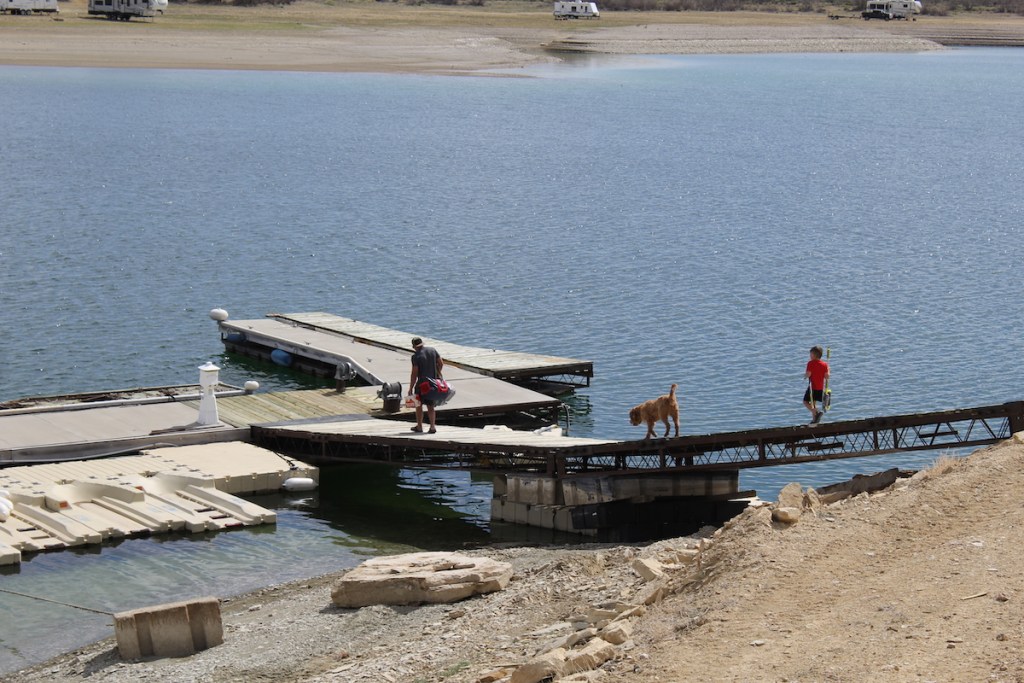
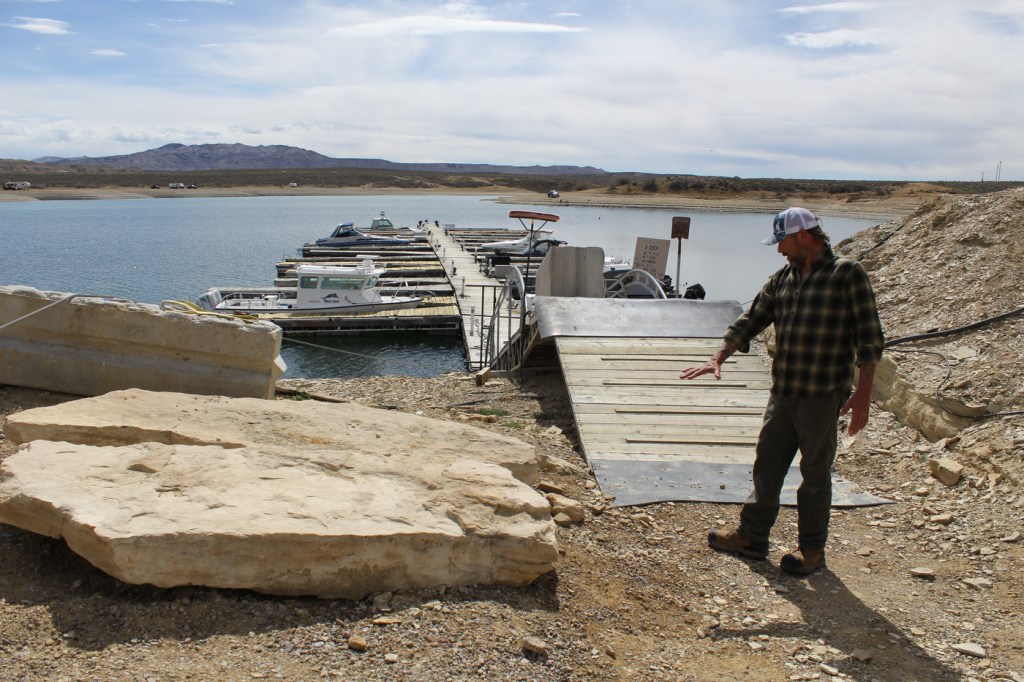
As campers with boats flocked to Buckboard Marina at the start of Memorial Day weekend, Tony Valdez was busy issuing refunds and repairing broken boat ramps. One older Green River man, who walked with two canes, left with his money refunded for the season after discovering he could not safely make it down to the boat slip. Due to dropping water levels at Flaming Gorge Reservoir, the ramp is now buckled, angling up and down like a pitched roof.
“It’s devastating, not just to me, it’s all the marina owners,” said Valdez, who owns Buckboard Marina, south of Green River. “It’s a big loss, and this is a big loss to the community.”
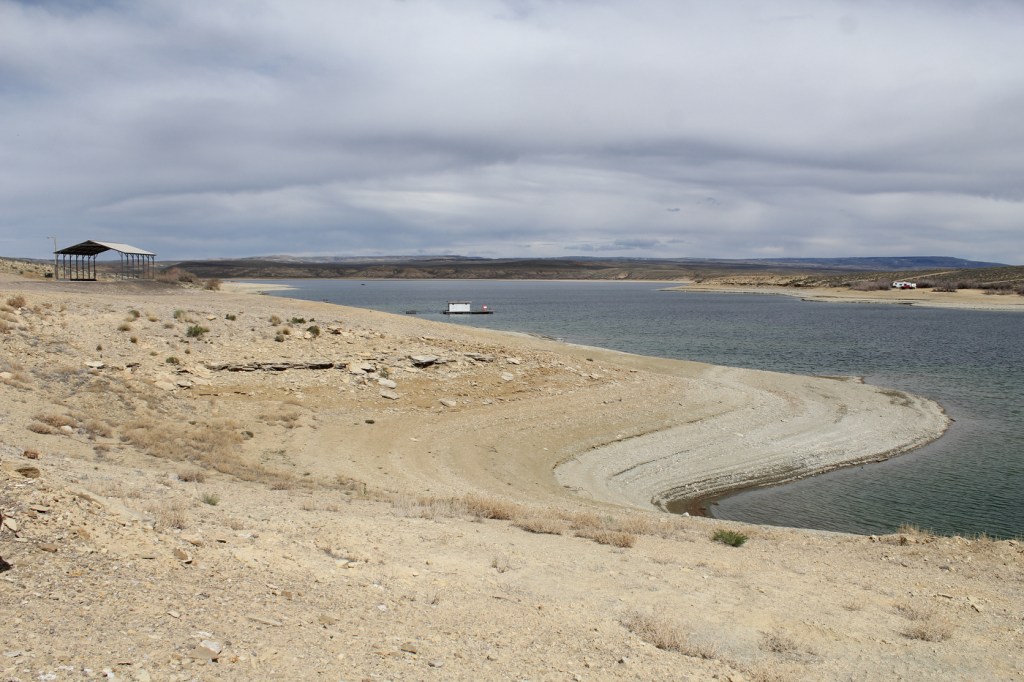
Along the cliffs and shoreline, darker and lighter lines of rock and sand trace the water’s elevations, showing where the water hits when the marina is full, where it hovered this spring and where it dropped after an initial “flush.” Valdez estimates the reservoir has dropped by 7 feet since April.
But that’s not the worst of it. Valdez anticipates that by the end of this summer, the reservoir will be as low as it’s ever been.
Why the drain?
For all its charm as a beloved recreation spot and its utility as a local economic driver, Flaming Gorge Reservoir owes its existence to a legal compact that essentially regards it as an insurance policy in times of drought.
Its primary purpose, according to federal officials and Colorado River Compact scholars, is to serve as a backup water bank to help maintain the Colorado River system. Specifically, Flaming Gorge and a handful of other reservoirs in the upper Colorado River Basin states of Wyoming, Colorado, Utah and New Mexico are key to ensuring a minimum flow of 7.5 million acre-feet of water, on a running 10-year average, at Lees Ferry just downstream of Lake Powell, a massive man-made reservoir straddling the Utah-Arizona border.
Today, after more than 20 years of drought intensified by human-caused climate change, the Colorado River is in crisis, putting at risk massive agricultural irrigation operations that consume about 80% of its water. This past winter saw historically low snowpack in the Upper Colorado River Basin — a primary source for the river’s flow.
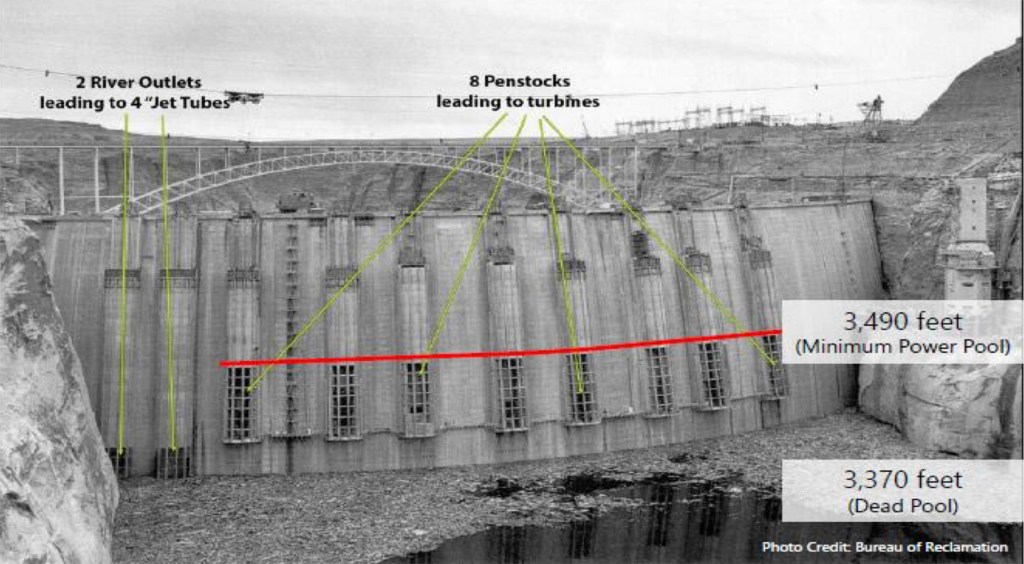
This annotated 1963 photo of the Glen Canyon Dam shows the minimum level of Lake Powell, below which would render the dam’s power generation components inoperable. (Bureau of Reclamation)
Combined with record heat in March, Lake Powell is at risk of dropping below Glen Canyon Dam’s “minimum power pool,” the point at which it can no longer produce hydroelectric power, according to water officials. If it falls even lower, the dam, which holds back Lake Powell, could be at risk of structural damage or unable to allow water to flow downstream.
The situation triggered a drought response operations agreement that calls for restricting releases from Lake Powell and an order to draw extra water from Flaming Gorge upstream. In total, water managers will release about 1 million additional acre-feet of water from Flaming Gorge in April 2026 through April 2027.
“These actions are expected to lower [Flaming Gorge’s] elevation by roughly 35 feet over the next year to approximately 59% of capacity,” the bureau said in April.
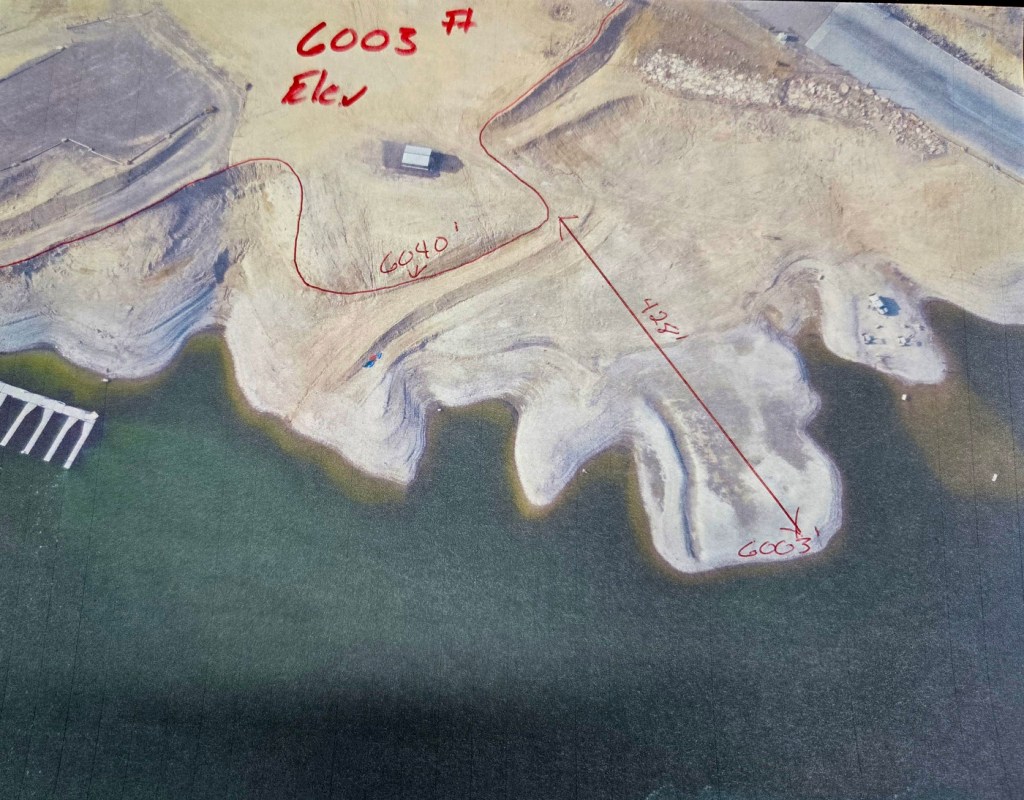
“The elevations are real critical,” Valdez said. At Buckboard Marina, high water has hovered between 6,030 and 6,040 feet above sea level over the past 50 years, he said. Dropping 35 feet could expose 400 feet of shoreline in some places, including marinas with boat ramps, he said.
Click to enlarge: Dropping water levels in the Flaming Gorge Reservoir by 35 feet could expose over 400 feet of shoreline in some places, including marinas with boat ramps, according to Buckboard Marina owner Tony Valdez. (Hannah Romero/Green River Star)
If the water elevation continues to retreat, it could reach a point where boats can’t be brought in or out.
“By September, this thing is going to be down to 6,000 feet. That’s it,” Valdez said. “Next year, if it goes below that, there’s no more marina here.”
Setting a course
Water managers set a course in April to “stabilize” Flaming Gorge’s outflow to about 1,100 cubic feet per second, representing the rate needed to achieve the 1 million acre-feet of extra water release, according to the bureau. On top of that, there are two previously planned “flushes” from the Gorge. The first, in early May, temporarily increased the outflow to about 8,600 cubic feet per second to enhance the proliferation of razorback sucker larvae, and a second 72-hour flush beginning June 8 will temporarily increase the outflow to about 4,600 cubic feet per second to discourage the proliferation of smallmouth bass.
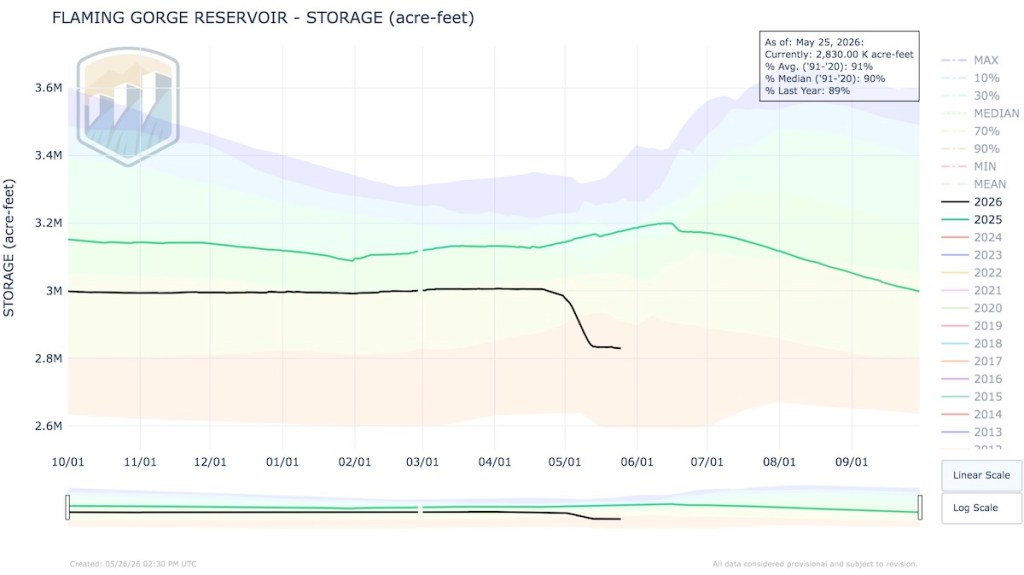
So far, Flaming Gorge has dropped from about 3 million acre-feet in April (or 82% capacity) to about 2.83 million acre-feet as of May 25. Meanwhile, water managers warn, “This release plan is subject to change depending on evolving river conditions and weather forecasts.”
Click to enlarge: This chart depicts water storage levels at Flaming Gorge Reservoir. (Bureau of Reclamation)
Those evolving conditions include forecasted versus actual flows from streams feeding the system. For example, those “unregulated” or natural flows are forecasted to be much lower than normal: 70,000 acre-feet of water into Flaming Gorge during May (28% of average), 175,000 acre-feet in June (45% of average) and 84,000 acre-feet (42%), according to the Bureau of Reclamation.
Water officials caution that water flowing from the Flaming Gorge Dam could change, and that those recreating on the Green River below should monitor release schedules at this website. The bureau also noted, “Water will be colder than usual and will run high and swift during periods of elevated releases.”
Water floats recreation economy
Buckboard Marina went through a similar drop in water a few years ago. The Bureau of Reclamation began pulling water from the Flaming Gorge in 2021, and by 2022, the marina’s water level was at an all-time low. While the reservoir recovered somewhat in 2023 thanks to a good year for moisture, Valdez said, the reservoir has continued to decline since then.
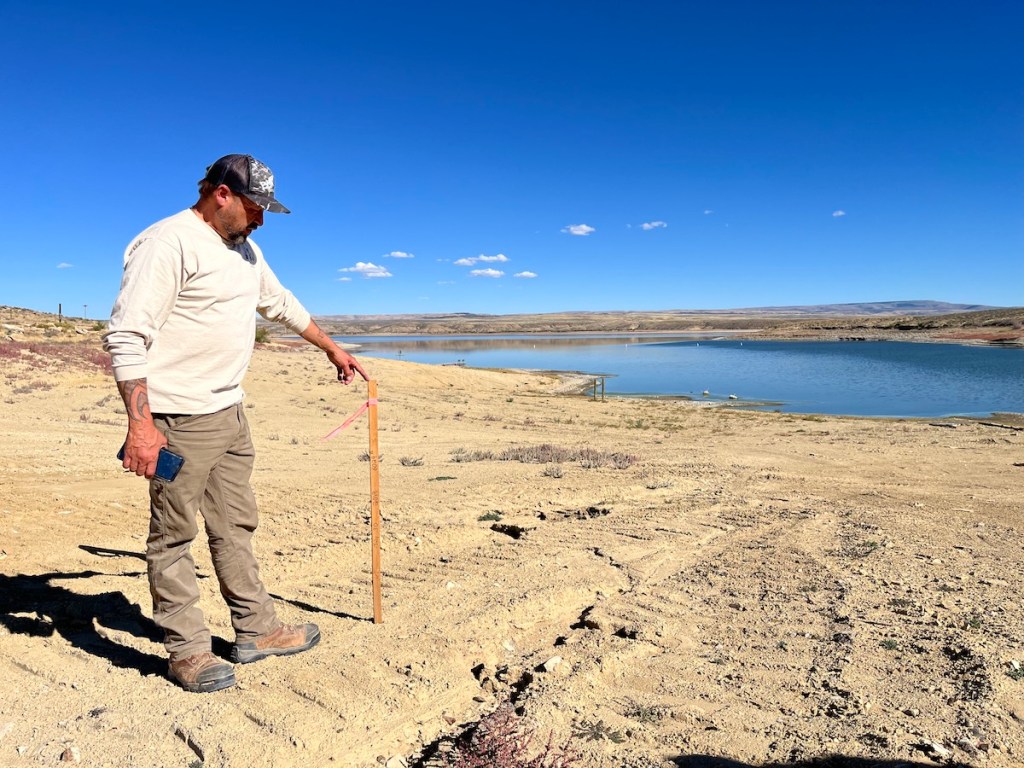
Buckboard Marina owner Tony Valdez stands next to a stake that indicates the extent of dropping water levels at Flaming Gorge Reservoir on Sept. 26, 2022. (Dustin Bleizeffer/WyoFile)
Kokanee salmon and trophy-sized lake trout draw tens of thousands of visitors to Flaming Gorge each year, supporting a recreational economy in southwestern Wyoming and northeastern Utah. But as the lake is drawn down, water recedes from shallow shorelines and fish are forced into a smaller space, essentially shrinking the fishery toward the dam side of the reservoir.
One of Valdez’s primary concerns is that water levels could drop below the ideal elevation for kokanee to spawn in the reservoir.
“I think people don’t realize the economic value it brings,” he said. “It is a big deal when you lose your kokanees.”
Valdez has already lost money this year just from people being concerned about water levels. He estimated that the marina lost roughly $30,000 in cancellations when discussions about releasing water began as early as February.
Other problems also start to arise as the water drops. The marina will lose access to drinking water at 6,010 feet, below their floating pump that supplies potable water. It’s only 7 feet away from the current level.
“That’s scary to me,” Valdez said.
The marina can truck in water from Rock Springs, but it costs about $1,200 to bring in 8,000 gallons, which lasts about two weeks. For Valdez, it feels “asinine” to lose water at a marina.
“Why would we run out of water on a lake?”
Water levels also impact the location of the fuel dock and fuel lines extending to it. If the reservoir sinks too low, it could cost up to $100,000 to adapt, he said.
Drawing down water levels quickly — as happened in early May — can damage marina structures. After the 2021-22 drawdown, Valdez said he spent about $130,000 in repairs.
Buckboard Marina owner Tony Valdez shows a boat ramp that now angles up steeply before dropping down after the reservoir’s water levels dropped several feet. (Hannah Romero/Green River Star)
This time, he’d hoped to keep up. He and a group of 10 men worked to keep pace with the dropping water levels, repairing and modifying ramps. It wasn’t enough.
“The drop was dramatic enough to break all of our approaches, our bridges, our stuff, so it broke a lot of the welds, broke a lot of the structured steel, because it just vertically dropped too fast for the weight,” he said.
When structures go from water to land that quickly, the weight is too much for them to hold up, Valdez said.
“I’m re-rigging everything, and this is only a temporary fix ’til September, because that’s when the season ends.”
The marina should remain mostly functional until the summer season ends, he said. But with extra water releases set to continue through the winter, the lake could drop another 10 to 12 feet by the spring.
“We’re getting into numbers that I don’t even want to talk about,” Valdez said. “I mean, there’s no marina.”
What’s next?
“The guy with the boots on the ground that watches this every day,” as Valdez describes himself, can see what water managers can’t, and he questions whether official numbers and estimates match reality.
“It’s hard to watch this when it’s out of your hands.”
Valdez is critical of the 1922 compact, doubting the legal rationale of sending Wyoming water to places like Arizona. He also wonders about the role of local industries — refineries, coal-fired power plants and trona mines — that use large amounts of water, and the idea of adding more industrial facilities that require even more water, like data centers.
“We don’t have the water to give away,” Valdez said.
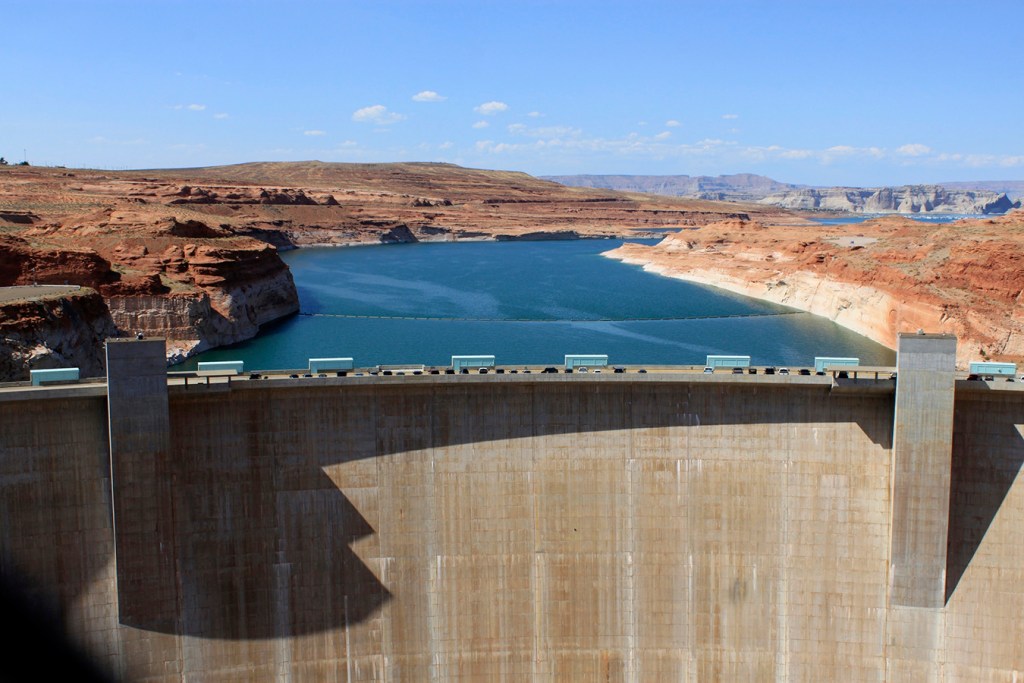
The Glen Canyon Dam is seen Aug. 21, 2019, in Page, Ariz. Projections show that Lake Powell on the Utah-Arizona border could drop low enough this year that it stops producing hydroelectric power. If levels drop even lower, the dam is in danger of structural failure. (AP Photo/Susan Montoya Bryan, File)
Bryan Seppie, general manager for the Joint Powers Water Board for Sweetwater County, Rock Springs and Green River, agrees. “The poor hydrology this past winter has affected most all water users in some form or another,” he said.
His board monitors the Colorado River system closely. Just upstream from Flaming Gorge, the Bureau of Reclamation reduced releases from Fontenelle Reservoir due to poor inflow projections. Although the water will still be enough for river users, the low summer flows will have a negative impact.
“Low river flows typically result in higher water temperatures, which generally leads to higher levels of moss/algae and overall lower water quality,” Seppie said in an email.
What about recovery?
Valdez wonders: What’s the plan to allow the reservoir to bounce back?
Wyoming State Engineer Brandon Gebhart and his staff have warned for months that although Flaming Gorge can serve as a backup to Lake Powell this year, it drains the Gorge’s ability to play a similar role next year, or the year after. It takes time for Mother Nature to replenish the bank.
“The big thing that nobody is talking about is the recovery,” Valdez said. “Where is the recovery of our water?”
This year’s drain on Flaming Gorge began at a low point. The reservoir hadn’t fully recovered after the last major pull. Rather than starting at a high point of 6,040 feet, the marina was at about 6,024 feet, he said.
“There’s no recovery plan,” he said. “We can’t just let them keep taking. I mean, where’s this end?”
Rings line the shore of Flaming Gorge Reservoir, showing the drop in the water level at the popular recreation spot that spans the Wyoming-Utah border. (Hannah Romero/Green River Star)
If there is no grace period for the reservoir to replenish and officials want to take even more in the near future, starting from such a low elevation point, it will be “devastating,” Valdez said.
“The water going down is not the end of the world, it’s the recovery in a timely manner that really matters,” he said. “I can’t preach recovery enough.”
Watching people come to the marina and seeing how happy they are still motivates Valdez to keep going. Despite the drawdown, there’s nowhere else he’d rather be.
“We’re not going to run away. We’re not going to give up,” he said. “We’re going to fight.”