Ballot provision to raise Oklahoma’s minimum wage fails
A sign outside the Raise the Wage Oklahoma watch party on election night. Voters rejected State Question 832, which would have increased the state’s minimum wage to $15 by 2029.(Lionel Ramos / KOSU)
A state question to raise Oklahoma’s minimum wage failed on Tuesday. About 55% of voters rejected the measure.
State Question 832 asked voters whether Oklahoma’s minimum wage should be decoupled from the federal minimum wage of $7.25 an hour, bringing it to $15 by 2029. The last time the national number increased was in 2009.
“We wanted to win really, really bad,” said Amber England, the spokesperson and senior advisor for the initiative. “But what we know is that the election result tonight is not indicative of the will of Oklahoma people, right? This was put on a ballot designed for us to fail.”
State Chamber President and CEO Chad Warmington wrote in a Tuesday evening press release that his organization “applauds” voters’ decision to reject the wage increase. The business policy group has led advocacy against the State Question since its proposal in 2023.
“Oklahomans sent a clear message: we can grow our economy, create opportunities, and keep life affordable without one-size-fits-all mandates that make it harder for businesses to hire and grow,” Warmington wrote.
The question would have started wage increases in 2027, raising the wage to $12. Then, it would have risen by $1.50 each year through 2029. In 2030 and beyond, the state minimum wage would have been tied to the U.S. Department of Labor’s Consumer Price Index for Urban Wage Earners and Clerical Workers (CPI-W) to increase in line with the cost of living.
The organizers of the question began working on a proposition in 2023 and collected signatures in 2024. After the petition was verified as meeting the signature threshold, advocates hoped it would be placed on the November 2024 ballot.
Gov. Kevin Stitt, who has the authority to decide when ballot measures go to the ballot, instead decided to put it on the June 2026 ballot, nearly two years after the measure’s intended election date. Stitt called the move a cost-saving measure, saying he wanted to avoid paying nearly $2 million for a statewide special election. Advocates, however, pointed out that Stitt had previously called a special election in March 2023 for a state question on legalizing recreational marijuana.
Still, England said the conversation about paying Oklahomans a living wage is not over, and neither is the fight to make it happen.“And I think ultimately we will prevail because you can’t put this conversation back in a box,” she said. “Just because they put us on a ballot designed for us to fail does not mean we’re going to stop.”
Because of the gap between when the measure was drafted and when it will be voted on, the ballot language may have confused some voters. The question asked about increasing the minimum wage to $9 in 2025, and adding $1.50 each year after, even though 2025 is over and the minimum wage is still $7.25. But if the proposal were approved, state policy would have jumped into the middle of that schedule, starting with increasing the wage to $12 once 2027 begins.
Supporters of the question argued that too much time has passed without a wage increase, and Oklahoma workers in essential jobs are struggling. Opponents said that most Oklahoma jobs already pay above the minimum wage, and that a wage increase could lead to job losses as employers look to cut costs.
How a change to mail-in voting could impact Alaska’s most rural voters
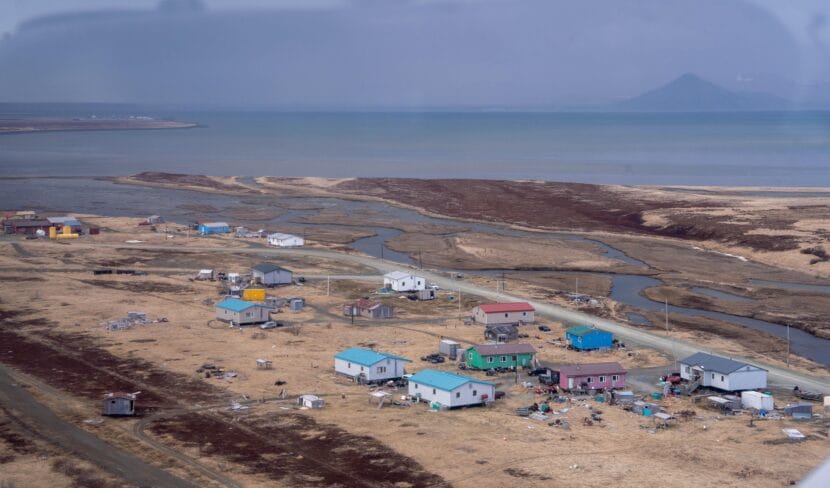
Platinum, Alaska on May 29, 2026. (Samantha Watson/KYUK)
Platinum, on the Bering Sea coast, is a small town — it has fewer than 50 residents. But when it comes to local elections, administrators make sure that traveling even small distances within town doesn’t get in the way of voting.
“We’ll go to elderly homes and present the ballots, because they, hard to get around for them,” explained Lou Adams, the acting tribal administrator for Platinum Village Traditional Council. She said that organizers present ballots in English and Yup’ik to make voting materials accessible to everyone.
According to Adams, almost everyone votes. But it was a different story when it came to the last general election.
“There was hardly any involvement because of the ballots came in really late,” Adams said.
Adams said that all of Platinum’s residents have to vote absentee by mail because the village is too small to have a polling place. Over 4,000 Alaskans vote this way, living in what the Alaska Division of Elections designates as Permanent Absentee Jurisdictions.
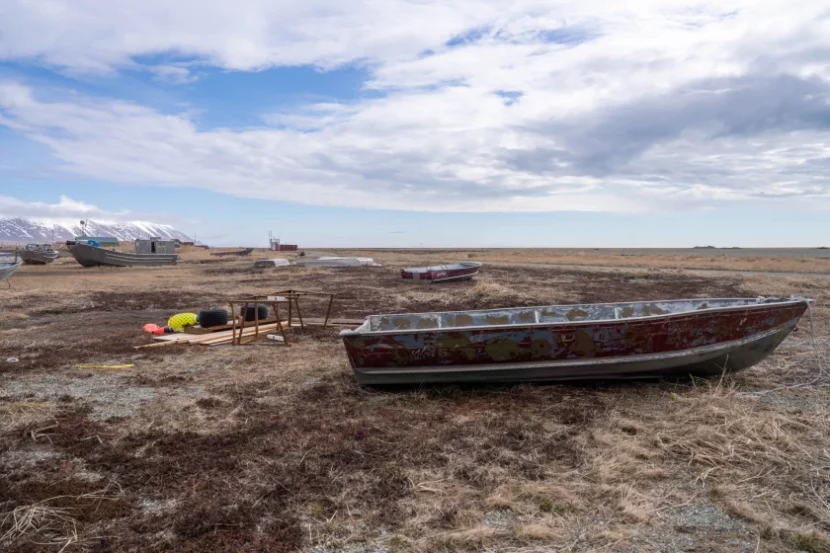
In Platinum, voting by mail can be tricky. The village doesn’t have its own post office. To get their mail into or out of town, the community dispatches people in pairs by snowmachine or boat to the neighboring community of Goodnews Bay.
“When it’s frozen, we have to either take the mountain trail or the coast trail, depending on the ice situations,” Adams explained.
Boats outside the Platinum airport on May 29, 2026. (Gabby Hiestand Salgado/KYUK)
If the weather is bad, or the bay is half-frozen, residents can go weeks without mail.
“The longest is about maybe almost two months,” Adams said. “Because if it’s not freezing right, and it doesn’t freeze right away and it takes longer, so we have to wait on that.”
A ‘no excuse’ voting state
People across Alaska vote by mail for all kinds of reasons. Some because of disability, or because of the lack of in-person voting opportunity. Others might just want to, or they might find in-person voting unreliable due to low staffing. In the last general election, over 70,000 Alaskans voted absentee by mail. And in November, when the general election happens, weather can create all kinds of delays.
Richard Moses is an Alaska-based campaign and election lawyer. He’s represented parties involved in ballot recounts and has seen the late arrivals firsthand.
“One of them was from out in Western Alaska. It was postmarked prior to Election Day, and still arrived like, it was seven or eight days after the deadline,” Moses said.
For Alaska voters residing inside the United States, the state allows mail-in ballots to be counted as long as they are postmarked by Election Day and arrive no later than 10 days after a general election.
But a U.S. Supreme Court decision could change that. The court is currently considering a Republican Party challenge to a Mississippi law that counts mail-in ballots similarly to how Alaska does. In their court brief, Republican party lawyers said that delayed counting violates federal law that nationally sets an election day.
Alaska’s attorney general filed a brief with the court that did not take a side, but did explain the challenges Alaskans face when voting.
Moses, who has represented both Democrats and Republicans, said that it could affect Alaska significantly if the state’s law were to be struck down.
“We live in a state where diphtheria serum had to be delivered 1,000 miles on a dog sled, not that long ago, actually, and so any change to the electoral process in any way is going to be groundbreaking here,” Moses said.
‘It’s not good to mess with these things’
Michelle Sparck runs the non-partisan effort “Get Out the Native Vote.” It operates under the Alaska Federation of Natives, which filed an amicus brief in the aforementioned case. The brief said that discounting late-arriving ballots would disenfranchise many Native voters, in Alaska and other places, who are often in remote communities.
“It’s not good to mess with these things, especially during an election year,” Sparck said.
Under the proposed change, voters could still still vote by mail, they would just have to send their ballots in earlier. In Alaska’s rural areas, voters can request their ballots 45 days early. But Sparck pressed that a lot can change in the weeks before an election.
“When everybody has the luxury until 8 p.m. on Election Day to make their decisions, it’s not fair to put the burden on us to vote as soon as possible,” Sparck said.
If a change went into effect before this November, Alaska political watchers say that it could affect the consequential senate race between Democrat Mary Peltola and Republican Dan Sullivan.
Yute Commuter Service airplane on the runway in Platinum on May 29, 2026. (Gabby Hiestand Salgado/KYUK)
Peltola faces headwinds in a state that went to President Donald Trump by 13 points in the last election. Analysts say many of Peltola’s supporters live in rural areas that could be impacted by a mail-in voting change.
In Platinum, where Adams said that a change could be detrimental when paired with the community’s inconsistent mail, counting late-arriving ballots is about more than just election outcomes. It’s about the principle of having a vote.
“It’s kind of disheartening,” Adams said. “You want your, your vote to be counted. That’s why you vote, so you can maybe make a difference.”
Adams said that the community is hoping to get a polling place. Until then, voting will continue to rely on boats, snowmachines, and bush planes.
Law enforcement uses tear gas after hundreds in Senatobia protest following police shooting of toddler
Audio recording is automated for accessibility. Humans wrote and edited the story.
Law enforcement officers used tear gas to disperse a crowd Tuesday in the north Mississippi city of Senatobia as people protested the police shooting Sunday that killed a 1-year-old boy and wounded an adult, ABC24 reported. National civil rights attorney Ben Crump is part of the legal team representing the child’s family.
“A 1-year-old child is dead because police officers in Mississippi opened fire on a car in a crowded Walmart parking lot,” Crump said in a Tuesday statement. “ … We intend to seek justice for baby Kohen and the life that was stolen from him.”
The toddler, Kohen Wiley, was in the car with his mother and a family friend in the parking lot of a Walmart in Senatobia. Police and Tate County sheriff’s deputies were responding to an alleged shoplifting, and they tried to stop the car. State officials said the driver drove in the officers’ direction and nearly hit one, leading an officer to fire at the car.
Before the shooting, Kohen’s mother said she tried to tell officers that a child was in the car, according to Crump’s statement. Family members told local media that the woman and family friend did not shoplift and were buying diapers.
Kohen later died from his injuries at a local hospital, and the family friend was critically wounded.
Local media also reported crowds gathered outside Senatobia City Hall as officials met. Hundreds of people gathered at the Walmart on Tuesday, and police deployed tear gas in the parking lot of the store.
Crump is representing the family with Memphis civil rights attorney Van Turner.
On Monday, Tate County Sheriff Luke Shepherd declined to comment about the shooting.
WAPT reported on Tuesday the officer involved in the shooting was put on administrative leave.
The Mississippi Bureau of Investigation, which investigates all law enforcement shootings, will present findings to the attorney general’s office. From there, the attorney general’s office will review the officer’s use of force and present evidence to a local grand jury about potential criminal charges.
Crump has represented other Missisisppi residents, including the family of Demartravion “Trey” Reed, the 21-year-old Black man found hanging on Delta State University’s campus in September last year. Officials ruled his death a suicide, but questions from family, community members and beyond remained about whether there was any foul play.
Crump and attorney Vanessa Jones said in October they planned to launch an independent investigation. They have yet to reveal the results of the second autopsy, which was performed by Dr. Matthias I. Okoye.
Crump has also represented Mississippi residents in law enforcement-related deaths, such as the family of Dexter Wade, who was hit by a cruiser driven by an off-duty Jackson police officer on Interstate 55 and whose body was buried in the Hinds County pauper grave for months before family learned he was there.
Update, 6/16/2026: This story was updated to include media reports that law enforcement deployed tear gas on a crowd protesting at Walmart in Senatobia Tuesday evening.
Hawaiʻi’s Imperiled False Killer Whales Are Going Hungry
The endangered whales’ numbers are still trending in the wrong direction. Researchers just found a new piece of the puzzle as to why.
‘Wild West’ comes alive in annual Pawnee Bill show reenactment
A racing chariot circles the arena at Pawnee Bill’s Original Wild West Show on June 13, 2026. (Sabrina Thaler / KOSU)
Trick riders shot pistols from horses, performers cracked flaming whips and cowboys raced chariots across a Pawnee arena on Saturday at Pawnee Bill’s Original Wild West Show, an annual reenactment of the historic Western spectacle that toured the world in the late 19th and early 20th centuries.
The event, co-sponsored by the Oklahoma Historical Society, pays tribute to the legacy of Gordon Lillie, or “Pawnee Bill,” whose Wild West Show honored the drama and mythology of the American West. His wife, May Lillie, also starred in his performances.
An announcer at Saturday’s performance welcomed audiences “to the real West: the West that is not a figment of your imaginations, but full of cowboys and Indians and Mexicans, pioneers and trappers, heroes and villains.”
“It is really important in this day and age to connect with our past and honor our past, and celebrate the history of Pawnee Bill and May Lillie, and the international recognition they brought here to our great state of Oklahoma,” Chantry Banks, director of museums and historic sites for the Oklahoma Historical Society, said. “It also honors an idea of the West that was, or maybe even never was, but a beautiful ideal of what of what we picture the ‘Wild West’ being.”
A visitor rides horseback at the Pawnee Bill Ranch and Museum before the evening’s Wild West Show. He is led by Kevin Webb, who portrays Pawnee Bill.(Sabrina Thaler / KOSU )
Just after 8 p.m., about 30 minutes into the Wild West Show, the National Weather Service issued a tornado warning affecting Pawnee, Fairfax and Ralston amid thunderstorms throughout northeastern Oklahoma. Shortly after, emergency sirens rang out within earshot of the show’s arena. By 8:30, organizers canceled the event midway through the performance.
Gordon Lillie, born in Illinois in 1860, got his “Pawnee Bill” nickname during the time he spent working with the Indigenous Pawnee people of the Great Plains as a young adult, according to the Oklahoma Historical Society’s Encyclopedia of Oklahoma History and Culture. Lillie worked as a teacher with the Pawnee agency, and then as a secretary and interpreter for a U.S. Indian agent working in modern-day Oklahoma when it was known as “Indian Territory.”
After a stint working with Buffalo Bill Cody’s Wild West show, Lillie launched his own show in 1888. Between 1908 and 1913, Pawnee Bill and Buffalo Bill’s shows merged to form a singular show, according to a display inside the museum at the historic site.
Ahead of the Saturday evening show, visitors enjoyed a day on Blue Hawk Peak, home to Gordon Lillie’s historic mansion and the Pawnee Bill Ranch and Museum. Visitors purchased food and crafts from local vendors while performers demonstrated magic tricks, gunfighting and traditional Native American dance.
Brenda and Wayne Cantwell sat on the patio in front of the museum, performing 19th-century old-time American music as visitors walked in. As Wayne Cantwell sang and played banjo, his wife played percussion by knocking a rhythm instrument — carved and painted to look like a chicken — against a wooden platform.
Wayne Cantwell works as a professional musician and teacher of old-time Celtic fiddle, clawhammer-style banjo and mountain dulcimer. He has performed at the Pawnee Bill Ranch for twenty years. Brenda Cantwell, his wife, has joined him for the past five.
Brenda and Wayne Cantwell use painted rhythm instruments, nicknamed Doug the Donkey, Little John, Big Dan and Henry (left to right), in their 19th-century old-time musical performances.(Sabrina Thaler / KOSU)
“We specialize in music of the 19th century, and we try to keep that music alive,” Brenda Cantwell said. “The banjo style that you’re going to hear is the way it would have been done in the 19th century.”
Just yards away from the Cantwells, father and daughter Mike (Cherokee/Muscogee/Osage/Yuchi) and Heaven Pahsetopah (Cherokee/Muscogee/Osage/Yuchi/Pawnee) spent Saturday afternoon performing a series of intertribal Native American dances for visitors. Mike is a veteran cultural educator who has been performing professionally for 50 years and at the Wild West Show for 14 years. Both Buffalo Bill and Pawnee Bill included Native American dance in their original shows, he said.
For a small crowd of families stationed on the lawn next to the museum, the Pahsetopahs presented the Eagle Dance, which originated from the Taos Pueblo in New Mexico, along with several intertribal dances that Mike Pahsetopah said might be performed at powwows. He also taught basic words and phrases in Plains Indian Sign Language. Their cultural education work, he said, can help to combat negative stereotypes about Indigenous people.
“Today, there was a kid that was like, ‘I’ve never seen a Native American before,’” Heaven Pahsetopah said. “And we’re like, ‘we’re everywhere.’ I mean, we wear regular clothes and they don’t know that. They think we live in teepees and stuff, still.”
Heaven Pahsetopah performs the Eagle Dance at the Pawnee Bill Ranch and Museum ahead of the Wild West Show.(Sabrina Thaler / KOSU)
The Pahsetopahs’ dancing was more familiar to Callie West, a lifelong Pawnee resident who said she had seen Mike Pahsetopah perform several times since she was a child.
West is a volunteer with the Friends of Pawnee Bill Ranch Association. She helps to preserve the gardens on Blue Hawk Peak, and at Saturday’s event, she oversaw a kids’ station with crafts and games outside the museum.
She recalled that during her childhood, the Wild West Show and its accompanying festival lasted for four or five days.
“It’s so different than when I was a kid,” West said. “But I appreciate that they put so much effort into making sure that this still happens. It is such a historical, important piece of who Gordon was, of who Pawnee Bill was.”
A rural hospital paid for the children of 2 top executives to become doctors. It won’t say how many other people have gotten similar help.
Buchanan General Hospital paid for the children of two of its top executives to become doctors through a program that was designed to provide loans for medical training, such as medical school or nursing school. However, the payments are listed as grants, not loans, on the nonprofit hospital’s tax filings, and the hospital has declined to answer questions about the discrepancy or say whether others received similar benefits.
The total amount of financial aid received by the two is also unclear because of how the transactions are recorded in the tax documents.
Hospital officials, members of its board and the two recipients did not answer questions about the program, so it is unclear how many other beneficiaries the hospital’s tuition program has or what conditions were placed on the funds given to Dr. Tyler Ruchti, son of CEO Robert Ruchti, and Dr. Lindsey Boyd, daughter of CFO Kimetha Boyd.
The hospital’s tuition assistance program is designed to recruit clinicians to work in the rural, 111-bed facility. Under the program, Buchanan General pays for a student’s medical training in exchange for a commitment to return and work at the Grundy hospital for several years, according to Sam Bartley, public relations specialist for the hospital. If the new doctor fulfills those obligations, the loan is forgiven. If not, it must be repaid with interest.
The hospital’s Internal Revenue Service Form 990 filings, however, show the payments to Ruchti and Boyd listed under Schedule L: grants to interested persons, a designation that does not require repayment.
Boyd is in the final year of her residency; Ruchti is currently working at a hospital in Ohio.
Bartley declined to provide details about the agreements with Ruchti and Boyd.
However, Dr. Seth Lowe, who participated in the program from 2015 to 2024, shared his contract. He was required to return to Grundy within 30 days of completing nine years of training to become a cardiac anesthesiologist. When he did not accept the hospital’s job offer, he had to repay the hospital $336,000 in 30 days, the contract said.
The hospital’s loan program has been in place for 30 years, according to Bartley. He declined to say how many people have used the program. He did say that the hospital typically requires loan recipients to repay the assistance within 30 days if they decline a job offer from the hospital.
Members of the hospital board of directors did not respond to requests from Cardinal News. The hospital has not disclosed the eligibility requirements or selection criteria for its tuition assistance program.
There is no cap on the amount of funding that can be awarded each year or the number of participants, Bartley said. Every applicant is assessed by the hospital’s board, which then approves or denies the application.
Bartley declined to answer multiple questions about the program and how it is administered, stating that the nonprofit hospital is a private corporation.
Cardinal News asked why the allocation was labeled as “cash” on the IRS filings for several years beyond the students’ graduation dates. Cardinal News also requested copies of the hospital’s conflict-of-interest policy, information on how the policy is implemented and enforced, the total number of individuals who have participated in the tuition program and a breakdown of how many of them accepted employment at the hospital after completing their education.
Cardinal News also asked Bartley to facilitate interviews with people who had used the tuition assistance program and later accepted positions at Buchanan General Hospital. Bartley did not respond to those requests.
“We find ourselves still asking how this line of questioning benefits the healthcare needs in our underserved communities. It appears you are looking to put Buchanan General Hospital in an unfavorable light,” Bartley said by email.
Brian Mittendorf, an accounting professor at Ohio State University’s Fisher College of Business who reviewed the tax filings at the request of Cardinal News, confirmed that the funds to the executives’ children were reported as grants.
Errors in nonprofit tax filings are not uncommon, he said; it’s possible that a mistake was made in Buchanan General’s tax filings spanning from 2016 to 2024, even though the documents were prepared by a public accounting firm headquartered in North Carolina.
Rising sums were listed as grants for nine years
The Internal Revenue Service requires organizations to disclose potential conflicts of interest, including payments to family members of leadership — such as Ruchti and Boyd. Lowe’s name is not listed on the hospital’s tax documents, nor are the names of any other recipients of the tuition assistance program.
Ruchti’s name appeared in tax documents from 2016 through 2025, the most recent available filing.
How we ensured fairness in our reporting
Cardinal News first contacted Buchanan General Hospital’s public relations department on Dec. 3, 2025, regarding the hospital’s tuition assistance program. A second call followed on Dec. 9.
On Dec. 10, Cardinal News emailed Dr. Lindsey Boyd requesting comment but received no response. The same day, Cardinal News attempted to call Dr. Tyler Ruchti. He did not answer or respond to a voicemail requesting comment.
On Jan. 8, 2026, Cardinal News emailed Buchanan General Hospital CEO Robert Ruchti and Chief Financial Officer Kimetha Boyd requesting comment. Neither responded.
On Jan. 8, Cardinal News emailed members of the hospital’s board of directors individually requesting comment. None responded.
On Jan. 19, Sam Bartley, public relations specialist with the hospital, emailed Cardinal News, addressing initial questions. Bartley requested that all future inquiries be directed to him.
On Jan. 20, Cardinal News requested an interview. Bartley declined the request via email on Jan. 22. By Jan. 26, Cardinal News had submitted a detailed list of follow-up questions.
On March 6, Cardinal News requested to speak with an employee who had successfully completed the program and accepted a job at Buchanan General Hospital. A Cardinal News editor later sent two additional requests to Bartley, but he did not respond.
On May 28, Cardinal News emailed Mercy Health in Ohio in a final effort to reach Ruchti. The hospital declined to answer questions about Ruchti or connect him with Cardinal News.
On June 1, Cardinal News emailed Bartley and Dr. Lindsey Boyd. Neither responded to requests for comment.
During Ruchti’s first year of medical school in 2016, Buchanan General’s tax records show a payment, listed as a grant, of $2,276 for tuition assistance.
The 2017 filing lists a grant of $55,317, and the 2018 filing lists a $112,376 grant. The payments continued to increase through his final year of medical school in 2020, when tax forms show $240,838 was directed toward tuition assistance.
The payments continued through 2024, as Ruchti completed an internship and a residency.
It’s unclear how much in total assistance Ruchti received. The grants are listed in the annual tax documents as though each year was a separate payout to him; approached that way, the nine years’ worth of grants added together total more than $1.7 million.
But the total could also be cumulative, Mittendorf said. “They’re reporting these as if they’re individual amounts each year,” he said. “But the way it is stated, it’s almost like an accumulation, not year to year.”
According to Bartley, the sum in the 990 documents represents both tuition and interest. Tax forms describe the type of assistance as “cash” and the purpose of assistance described as “tuition.”
The 990s do not provide a breakdown of how much money represented tuition and how much represented interest, and Bartley declined to provide those details.
The tuition assistance should be listed on the tax forms under “loans to interested persons,” Mittendorf said. “And it should say the amount of the loan, the purpose of the loan and the original amount borrowed and how much is left that they still owe.”
None of these details are included in the tax forms through 2024.
Bartley said the cash assistance is paid directly to the educational institution. He declined to provide information about Boyd’s and Ruchti’s education, saying that the information was irrelevant.
Ruchti graduated from Lincoln Memorial University Debusk College of Osteopathic Medicine in 2020 and is currently employed by Mercy Health in Ohio, according to Mercy’s website. During his first year of medical school, tuition came to about $44,322. By the time he graduated, tuition had increased to about $51,140, according to the school’s catalog.
Medical training continues years beyond medical school graduation through internships, residencies and fellowships. Buchanan General holds the loan during this time. While repayment is deferred, interest continues to accumulate, according to Bartley.
Ruchti started an internal medicine internship in Florida, followed by an emergency medicine residency at East Carolina University, which he completed in 2024. Throughout those years, the growing balance in the tax forms continued to be listed as a grant and described as cash for tuition.
In 2024, the amount listed — now described as medical school tuition and interest — was approximately $316,850, still categorized as a grant.
“They claim they gave a grant of $316,000 of cash that year to that individual,” Mittendorf said. “I don’t think that’s what they mean to claim, but that is what the financial statement is saying. … They are reporting it as a grant whose value accumulates, but grants are individual amounts.”
Ruchti is currently listed as clinical faculty for the emergency medicine residency program at Mercy Health in Ohio and was issued a medical license by the Ohio Board of Medicine in March 2024. According to the American Board of Physician Specialties, Ruchti has not completed his board certification yet, which is required under Virginia administrative code for emergency medicine physicians.
Ruchti did not respond to phone calls seeking comment.
Mercy Health declined to confirm Ruchti’s status at the Ohio hospital. He is listed as clinical faculty in the hospital’s emergency medicine residency program. It is unclear whether he is completing a fellowship, which would likely extend his loan period.
Similar questions surround the funds attached to Boyd’s name. She first received funds for medical school from Buchanan General Hospital in 2019 when $44,760 appeared in the tax documents as tuition assistance listed as grants to interested persons.
Boyd graduated in 2022 from Edward Via Virginia College of Osteopathic Medicine, according to her profile with Wake Forest University School of Medicine, where she’s currently a resident. That year, tuition for a fourth-year medical student totaled $49,800; the same year’s tax form showed that $213,715 was directed toward Boyd’s education and was described as cash for tuition.
The 2024 filing shows a grant of $252,539.
As with Ruchti’s awards, it’s unclear whether the amounts are individual or cumulative.
Boyd is in her fourth year of residency at Wake Forest. She holds a resident training license, which is up for renewal in November.
She did not respond to email requests for comment.
“What we can take from this is the reporting is inconsistent,” Mittendorf said. “They [the tax filings] show that no one owes them money who is a family member of one of these interested individuals. At the same time, Schedule L seems to indicate there’s some sort of transaction there.”
Buchanan General Hospital in Grundy. Photo by Lakin Keene.
Lowe said he was offered a noncompetitive salary
After nine years of medical training, Lowe was required to return to Grundy to fulfill his contract. He began coordinating with Buchanan General Hospital, but when the salary offer came through, Lowe hesitated. It was much lower than what he had expected.
Buchanan General offered him an annual salary of $325,000, Lowe said.
Cardiac anesthesiologists earned an average of $452,000 to $600,000 in 2024, according to a study published in the National Library of Medicine. Lowe declined to provide his starting salary at his current workplace in North Carolina.
“Their offer was such a huge slap in the face,” he said. He added that he could take a job as a traveler — a healthcare professional who takes short-term contracts to help medical facilities fill staffing gaps — and make three times that amount while working in the same region.
The hospital wouldn’t budge, he said. His options were to work at Buchanan General for four years at what he described as a noncompetitive rate or pay back a loan that had been accruing 8% interest every year for nine years.
Under his 2015 agreement, Buchanan General would lend him $188,000 to cover four years of medical school, along with $4,600 a year for textbooks.
The moment the contract is broken, the hospital requires that the loan be paid back within 30 days. Every additional month would add 1.5% interest to the loan.
Lowe said he was expected to return to Grundy immediately after completing a fellowship.
In 2024, when he decided he could not work at Buchanan General, Lowe owed the hospital $336,000 for his medical school tuition.
As a newly credentialed anesthesiologist, Lowe didn’t have the money. He wanted out of the contract, but said he felt trapped. That’s when his mother stepped in.
Lowe grew up in Grundy, where his mother was a teacher and his father worked in the coal mines before he died when Lowe was a teenager.
Lowe’s mom drew on the money his father had left them in order to pay the hospital back.
Now, Lowe is working for a hospital in North Carolina and offering financial support for his mother in Grundy.
Hospital is silent on its conflict of interest policy
Mittendorf, the Ohio State professor, also applies his accounting expertise to improve nonprofit research and programming. He said understanding Buchanan General Hospital’s conflict of interest policy is critical to clarifying what is represented in the tax filing and regaining trust in the community.
“Are you offering these things to everyone or are you offering only to select individuals? And how do you determine that?” Mittendorf said. “We want to know, as the public or as an outside individual, that these transactions are all engaged to support the organization and a charitable mission. Not to support particular individuals. You’d want a conflict of interest policy built around that.”
Bartley did not respond to requests to see the hospital’s conflict of interest policy.
The money used for Rutchti and Boyd’s education isn’t reflected on the hospital’s balance sheet either, Mittendorf said.
“If it were just a loan that got put as a grant, we should still see it on the balance sheet, and they’re not showing one,” Mittendorf said.
The hospital’s assets do equal its liabilities, indicating the transaction was recorded in some form, but it is unclear what was recorded or where. The amounts may be small relative to the hospital’s overall budget and could have been grouped into a broader category. The hospital has had a negative net income since 2023. In 2024, the hospital’s total revenue was $30.4 million, but expenses reached $32.3 million.
Mittendorf said that because these payments involve a potential conflict of interest, they should be clearly disclosed.
“Those are the sorts of payments they want to be very cautious and careful about tracking,” Mittendorf said.
The hospital’s nonprofit status means it is exempt from paying federal and some state and local taxes, can issue tax-exempt bonds and can receive tax-deductible contributions. It also must meet the Internal Revenue Service Community Benefit Standard and publicly and extensively report the range of benefits and services it provides to its community.
That 2024 rule set legally enforceable limits for several of these substances, known as “forever chemicals” because of their persistence in the environment. The chemicals regulated were PFOA and PFOS — legacy PFAS — plus PFHxS, PFNA and HFPO‑DA (GenX), and for mixtures of those three with PFBS.
Last month, current EPA Administrator Lee Zeldin announced plans to roll back key parts of that rule. The agency moved to rescind the drinking water standards for PFHxS, PFNA, GenX and the PFAS mixture standard that includes PFBS. Zeldin also said the agency also intends to give water systems more time to comply with the maximum contaminant levels for PFOA and PFOS.
A: We’re incredibly disappointed. For communities like Wilmington and across North Carolina, this feels like a slap in the face.
This administration is largely focused on two legacy PFAS and not on the broader, current PFAS problem. Meanwhile, places like Fayetteville are already exceeding proposed drinking water limits for multiple PFAS. Their water quality report acknowledged those exceedances but still framed the water as “okay” because the standards aren’t fully in effect yet.
That kind of messaging creates a dangerous disconnect. People are drinking contaminated water, but utilities are able to hide behind the idea that they’re “technically in compliance.” We went through the same thing in Wilmington nine years ago — being told our tap water met all guidelines when, in reality, there were no meaningful standards in place.
Q: EPA has highlighted $2 billion dollars in funding to help address PFAS. Doesn’t that meaningfully support communities?
A: That money is important, but it’s not new — and the way it’s being framed is misleading.
The funding being touted now comes from the Bipartisan Infrastructure Bill. It was passed earlier in the Biden administration and designed to last five years. This is the final year of that funding window. EPA is essentially passing through money Congress already allocated, then taking a victory lap for it.
At the same time, this EPA has gone to Congress proposing deep cuts to its own budget and substantial reductions to those very funds. Publicly they say, “Look at all the money we’re providing,” while privately they’re not fighting to extend or expand it.
Communities deserve that funding — and more of it. We shouldn’t confuse simply disbursing old money with real leadership on PFAS.
Q: Utilities often argue that meeting strict PFAS standards is too expensive. What should their role be?
A: Right now, many utilities are operating from a cost‑and‑liability mindset instead of a public health mindset. That’s a problem. Rather than asking for weaker standards, utilities and their lobbyists should be in Washington, D.C., demanding the funding they need to protect public health.
When the banking or airline industries are in trouble, we see huge bailouts. Safe drinking water is far more fundamental than a stock price, yet water utilities aren’t pushing nearly as hard for substantial, ongoing investment. Their job is to act as stewards of public health and the environment. That means fighting for the money to meet strong standards — not lobbying to avoid them.
Q: EPA has identified roughly 15,000 PFAS chemistries, yet most of the health and regulatory focus is still on a handful like PFOA, PFOS and GenX. Given that gap, how should we be planning?
A: Wilmington is a case study in why we can’t just chase each contaminant at the tap.
Our utility spent close to $92 million on treatment to remove PFAS. Those upgrades still don’t address 1,4‑dioxane. Now they’re looking at another major investment to deal with that one chemical. And we’re not even seriously addressing microplastics yet.
We don’t have enough money to treat our way out of this one pollutant at a time. The only sustainable solution is to control pollution at the source. PFAS and similar chemicals should never be allowed into drinking water supplies to begin with.
Right now, polluters offload their cleanup costs onto communities. The hardest‑hit are the ones with the fewest resources. That’s the real injustice.
Q: You’ve raised concerns about the Chemours Consent Order. What’s going on there for private well owners?
A: There’s a serious loophole.
Some homeowners have PFAS levels above 10 parts per trillion linked to Chemours, but the specific PFAS in their wells aren’t on the short list of chemicals covered by the consent order. Those residents are told they don’t qualify for treatment, even though their contamination is clearly related.
That list of chemicals should have been set up as evergreen — regularly updated as science reveals more about what Chemours released. Instead, nine years after this crisis broke, we’re still finding people who fall through the cracks because the list hasn’t kept pace with the science.
We’ve connected at least one homeowner in this situation with the Southern Environmental Law Center. But the fact that residents have to fight case by case to be recognized under a narrow chemical list is a structural failure.
Q: Are there other communities that illustrate how these policy gaps play out on the ground?
A: One example is a group in Brunswick County working with the local NAACP and EarthRights International.
Brunswick County approved heavy development, and many longtime residents saw their wells degraded — issues like turbidity and wells going dry. On top of that, some of those residents are receiving letters from Chemours and test results showing PFAS contamination in their wells.
So they’re dealing with both development‑related harm and chemical contamination, and the county has resisted hooking them up to public water. It’s an untenable situation that shows how planning decisions, environmental regulation and equity are all intertwined.
A: We’re opposing the commission’s current 1,4‑dioxane and PFAS minimization plan — and calling for much bigger reforms.
At the Wilmington hearing, hundreds of people showed up, and dozens gave comments. Almost all opposed the minimization plan. Our petition, which now has around 10,000 signatures, goes further: We’re calling for the commission to be abolished.
The rules require industrial facilities and wastewater plants to sample their discharges and develop pollution reduction plans, but they do not mandate actual reductions or impose penalties for facilities that fail to cut their discharges.
SELC attorneys called the proposed rules “polluter-written” and ineffective. The attorneys urge the EMC to abandon its monitoring-only approach and adopt enforceable, “health-protective” water quality standards, according to a news release.
The EPA will accept written comments on the proposed PFAS drinking water rule until July 20, 2026, at www.regulations.gov under Docket ID: EPA-HQ-OW-2025-0654.
Wyoming judge strikes down ultrasound requirement, two other abortion laws
A Wyoming judge struck down three abortion laws on Friday, the latest instance of the courts here rejecting attempts by state lawmakers to curtail the procedure in the Equality State.
Retired District Judge Thomas T. C. Campbell ruled the laws violated a 2012 amendment to the Wyoming Constitution that protects individuals’ rights to make their own healthcare decisions. The Wyoming Supreme Court in January cited the same provision when it struck down two statewide abortion bans, and a different judge noted the amendment in April when he blocked enforcement of the state’s new “heartbeat” bill.
Friday’s ruling concerned three laws passed by lawmakers in 2025. One created a mandatory ultrasound requirement and a 48-hour waiting period for patients seeking abortions. The second enacted a set of new and more stringent regulations that critics said were intended to make operating an abortion clinic in Wyoming unfeasible. A third involved abortion restrictions within a larger law governing the prescription of off-label medications.
Campbell temporarily blocked enforcementof all three laws last year after the plaintiffs in the case — which included abortion providers and abortion rights advocates — filed suit in state court. But his final determination that the laws are unconstitutional did not come until Friday.
‘No competent evidence’
In his 34-page decision, Campbell wrote repeatedly that the state, which had defended the laws in court, failed to provide evidence backing its claims. He noted the state alleged that the ultrasound law serves as a way to protect women from the consequences of undiagnosed ectopic pregnancies. But the judge found that the state “offers no competent evidence that such instances are occurring with any measure of regularity.” Additionally, he wrote, the state “offered no cogent evidence illustrating that a waiting period is necessary for any purpose.”
Meanwhile, the plaintiffs showed that the ultrasound rule would not significantly lessen the risk for ectopic pregnancy complications and that waiting periods have no medical utility, the judge wrote. They also offered “ample evidence” that the ultrasound requirement lacked a compelling government interest, according to Campbell’s ruling.
“The Plaintiffs provide concise evidence undermining the medical necessity of an ultrasound prior to undergoing a chemical abortion,” he wrote. “The Plaintiffs request for relief is underscored by their evidence that abortion is inherently safe. They provide Wyoming Department of Health data indicating zero complications or deaths resulting from abortion in Wyoming. They also specifically cite clinical guidance explicitly proclaiming that ultrasounds are not medically necessary for women seeking chemical abortions.”
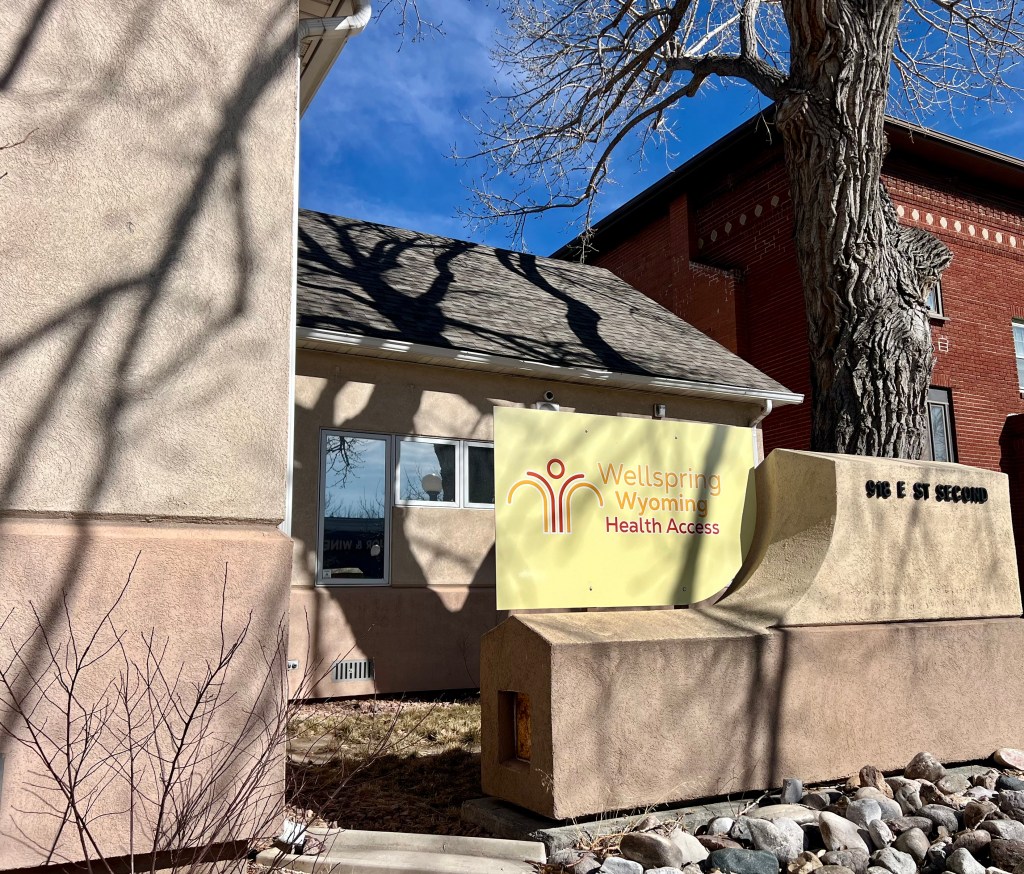
Wellspring Health Access is pictured in February 2025 in central Casper. It is the only facility to provide in-clinic abortion services. (Joshua Wolfson/WyoFile)
Campbell also took issue with what he termed a lack of evidence by state lawyers defending the law that required abortion clinics be regulated as “ambulatory surgical centers,” which come with more stringent, and costly, regulations. The state contended the law constituted a compelling interest because it closed a legal loophole, but did not provide evidence showing that “consistency of laws forms a compelling government interest,” he wrote.
He also rejected the state’s arguments that the law helped to ensure women’s health.
“Of course, it is conceivable that preserving women’s health could independently invoke a compelling interest,” he wrote. “However, outside of sweeping generalizations, the State again provides no evidence or a causal link of how a surgical abortion facility, operating outside the regulatory framework of an [ambulatory surgical center], negatively impacts women’s health and welfare.”
As for the off-label medication law, which abortion advocates fear would discourage doctors from prescribing common abortion medications, the judge agreed with the plaintiffs, who maintained it was a solution in need of a problem.
Abortion opponents stymied by constitutional amendment
State lawmakers have made several attempts to limit or ban abortion in Wyoming since 2022, when the U.S. Supreme Court struck down the landmark ruling Roe v. Wade. Since then, the same group of plaintiffs has repeatedly succeeded in convincing the courts that the laws violated a 2012 amendment to the Wyoming Constitution. Voters enacted the amendment after a push by conservatives who feared Obamacare would lead to government infringement on healthcare autonomy.
The amendment protects adults’ rights to make their own healthcare decisions. The Wyoming Supreme Court in January concluded that “a woman has a fundamental right to make her own health care decisions, including the decision to have an abortion.”
In the aftermath of that ruling, Gov. Mark Gordon called on the Wyoming Legislature to pursue a constitutional amendment that would settle the matter. But lawmakers instead chose to pass a law that made abortion illegal once fetal cardiac activity is detected, which can occur by the sixth week. That law is also tied up in the courts while a legal challenge proceeds.
Still, anti-abortion advocates in the Legislature promised to continue their attempts to end the practice here.
“We will not quit, we will not give up and we will not stop the fight to protect innocent life,” Speaker of the House Chip Neiman said in a video posted to the Wyoming Freedom Caucus’ Facebook page. “It’s really too bad. It’s quite a testimony, quite a statement about our judiciary that, I think once again, they’ve acted to thwart and to ignore the will of the Legislature and have complete disregard for innocent life in Wyoming.”
Neiman, a Republican who is now running for the state senate, said he expected Wyoming Attorney General Keith Kautz, who advocated against abortion after he retired from the Wyoming Supreme Court, to fight Friday’s ruling, presumably by appealing to the high court.
Meanwhile, the president of Wyoming’s only abortion clinic, Casper’s Wellspring Health Access, hailed Friday’s decision, while also alluding to the likelihood of more legal battles ahead.
“These politically motivated laws, which unfairly target abortion providers, harm the people we serve by creating unnecessary barriers to essential health care,” Julie Burkhart said in a statement. While we know the fight against these laws is far from over, this outcome strengthens our determination to continue providing comprehensive reproductive health care, including abortion, to the people of Wyoming.”
The University of Wyoming has conducted repeated polls on abortion in Wyoming. The latest, which was released in November 2024, showed that about 10% of Wyomingites backed a total ban on abortion, with another 31% favoring abortion restrictions with exceptions for rape, incest or when a woman’s life is in danger. Another 20% preferred those exemptions and others once the need for an abortion had been clearly established. About 39% said abortion should remain a personal choice.
Breaking: California sues Shasta County over Measure B
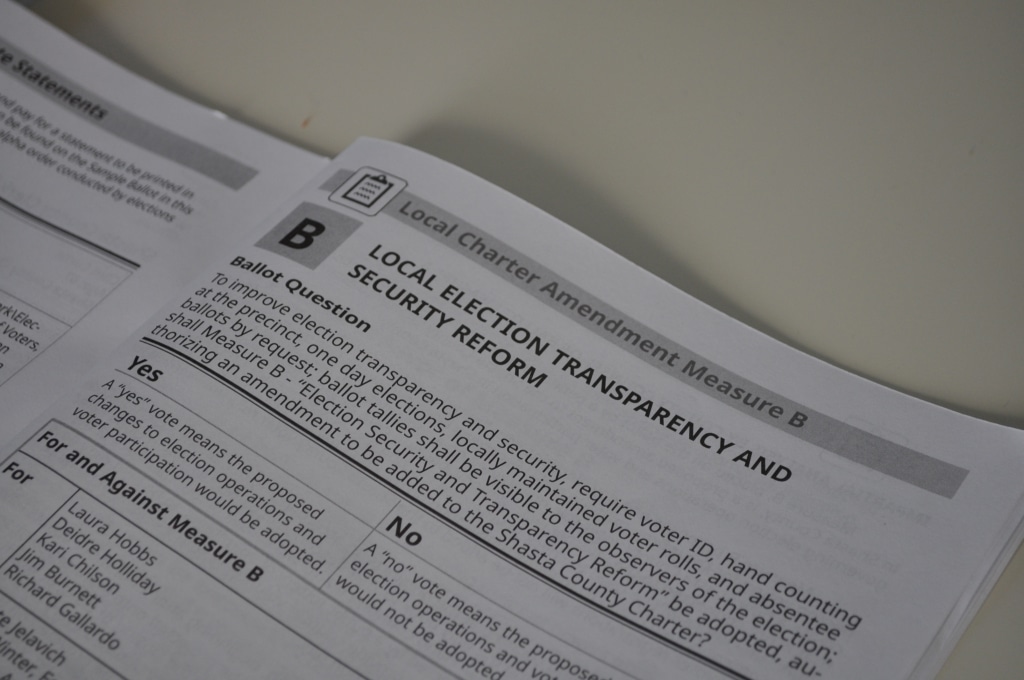
Shasta County’s Voter Information Guide for the June 2 Primary Election contains information on Measure B. Photo by Moe Shimizu
Update June 12, 2026 4:45 p.m.: This story has been updated to reflect responses from Shasta County and from a former litigant against Measure B.
“There can be no serious dispute that Measure B—a voter initiative to establish a county-specific elections system in Shasta County—is unlawful.”
That statement is the opening line of a lawsuit that was filed today in California’s Third District Court of Appeal by California Attorney General Rob Bonta and Secretary of State Shirley Weber against Shasta County.
Measure B is a ballot initiative that was just approved by a majority — 56% — of the county’s voters in the June primary. It seeks to reform local election procedure by mandating voter ID, eliminating most mail-in voting and imposing a one-day election process. If implemented, it would also disconnect county voter rolls from the oversight of the state and require a full hand count of ballots rather than relying on machines, among other changes. The measure appears to be illegal to implement in the state of California.
Earlier this week, as votes were being tallied, the AG’s office told Shasta Scout it stood at the ready “to take appropriate action to protect voters’ rights and enforce state election laws.” Election results are still unofficial, but the vast majority of ballots have been counted, the local elections office said.
The lawsuit names Registrar of Voters Clint Curtis as a respondent and the five central election activists behind the measure as the real parties of interest. They include Laura Hobbs, Deidre Holliday, Kari Chilson, Jim Burnett and Richard Gallardo. Hobbs is employed by Curtis as an analyst at the elections office and helped preside over the election that determined the outcome of the measure she was pivotal in creating.
“That’s the way it works,” Curtis told a reporter today at the elections office, remarking on the lawsuit shortly after the news broke. “The courts are doing what they do,” he added, acknowledging that the proposed federal SAVE Act could present further complications to the impending court proceedings.
Shasta County declined to offer a comment this afternoon. The board of supervisors will be discussing the litigation during closed session during its meeting on Tuesday, June 16.
Measure B proponents have claimed that the county’s status as a charter allows for local election control. The state’s lawsuit contradicts that, saying despite Shasta County’s charter status, such changes to local elections would exceed county authority “because charter counties are not granted any degree of home rule over voter registrations or elections.”
Even if elections were in the bounds of Shasta’s rights as a charter county, the lawsuit said, Shasta cannot enforce laws “that are inconsistent with or impede statewide regulation of the integrity of the political or electoral process.”
The state’s action is only the latest in a number of legal challenges to the measure, all of which have either been pushed back by a Shasta County Superior Court judge, or withdrawn.
Last year, Shasta County’s attorney Joseph Larmour attempted to halt the measure in its tracks, but a judge determined that Shasta’s case against Measure B did not meet the criteria to prevent it from moving forward. Later, community member Jennifer Katske filed two lawsuits against the measure. She was unsuccessful in the first and voluntarily withdrew the other. She reacted to the state’s announcement by continuing to emphasize her concerns about the measure.
“I warned that Measure B would lead to costly litigation and divert public resources away from the real needs of our community,” Katske told Shasta Scout after hearing the news. “Unfortunately, those concerns are now becoming reality.”
Earlier this week, Measure B proponent Burnett said he and others expected a lawsuit, but are prepared to follow through in hopes of succeeding against the state or other challengers. Shasta Scout was not immediately able to reach ballot proponents for comment today.
This is a developing story.
Do you have a correction to share? Email us: editor@shastascout.org.
Texas takes over voter registration in Val Verde County amid struggles with registration
The secretary of state is using a law that was originally written to focus on problems in Harris County.