
Spilled yogurt and missing signatures: How Klickitat County handles your ballot
Federal cuts to food programs set to affect Gorge residents
Underwood zoning decision shows strong “us and them” feelings over land use
Reviving local languages, one word at a time
North Bonneville more than doubles mayor’s salary for last months of his term
Goldendale hospital’s cash levels drop to uncomfortable lows
Sowing Resilience
How Our Most Vulnerable Are Being Pushed to the Brink— and Finding Nourishment and Connection
Judy Dobkevich hands fresh strawberries to her husband, Michael Dobkevich, at the Port Townsend Farmers Market. The Dobkevichs use food access programs to help supply their pantry with fresh fruit and vegetables. Photo by Heather Johnson

Sowing Resilience: Rural communities across the country are grappling with food insecurity. Schoolchildren, seniors, grocers and even farmers face a food crisis compounded by government cuts and soaring costs. These 10 stories reveal how communities are navigating — and reimagining — the systems that have left them hungry.
News by Scott France
The bounty that the seas and network of small farms produce masks an omnipresent reality in Jefferson County — food insecurity.
Nearly 4,960 county residents lack consistent access to nutritious food each day—just under 15 percent —a rate similar to the state average, according to an Associated Press analysis of U.S. Census Bureau and Feeding America data.
However, people and organizations across the county are working to meet the needs of the food insecure by building upon and refining approaches as government assistance dwindles.
Farmers markets, food banks, small farms, a cafe providing food for recovering alcoholics and a program geared to feeding non-white People of the Global Majority (PGM) are pitching in to help fill the need and the bellies of county residents.
Grace Thompson washes freshly harvested carrots at Kodama Farms. Thompson and her brother, Ben Thompson, own and operate the 45-acre farm. Selling primarily at the Chimacum Farmers Market, the Thompsons estimate that 10-25% of their revenue comes from food access program recipients. Photo by Heather Johnson
The Jefferson County Farmers Markets in Chimacum and Port Townsend participate in multiple federal food security programs: the Supplemental Nutrition Assistance Program Market Match (which doubles the value of SNAP purchases at farmers markets); Senior Farmers Market Nutrition Program (SFMNP); and the Women, Infants and Children (WIC) program. SNAP, SFMNP and WIC are funded through the U.S. Farm Bill.
The farmers markets also partner with the Washington State University (WSU) Jefferson County Extension and Clallam County Extension offices. Sallie Constant, Farm to Food Bank Coordinator for WSU Extension says that she is “not only connecting people in food access, but also educating, as well as working on systems, environments and policy stuff that can make it easier for folks and food banks to more consistently access that produce.”
“We are reaching people who really need fresh food, and don’t otherwise have access to it,” Constant said “We’ve been a supporting partner helping source fresh produce from local farms to help fill the pre-packed box option for people who don’t have access to a farmers market, especially in the farther flung communities like Brinnon and Forks.We’ve gotten a lot of interest from the Brinnon and Forks food banks where they don’t have much supply of fresh produce,” Constant said.
This year, the SFMNP is serving 1,070 seniors in Clallam and Jefferson Counties, a 62% increase over 2023.
Many older rural residents live alone, with poor mobility, fixed incomes and limited access to grocery stores. SFMNP enables seniors to pick up a $50 benefit card at a farmers market in either Port Townsend or Chimacum, as well as an additional $30 towards farmers market produce courtesy of community donations and small grants. This $80 may be used to buy a fresh local produce share at the food bank nearest their home from July through September. The share includes six weeks of fresh, seasonal, local and Washington state produce, three weeks of fruit and three weeks of veggies.
An alternative for Jefferson County seniors is to sign up for a program that allows them to pick up the equivalent value of a fresh produce share at a local food bank. The Jefferson County Food Bank Association (JCFBA) operates food banks in Port Townsend, Chimacum, Quilcene and Brinnon, as well as a pop-up site in the Coyle.
“I want to foster ways in which community members are empowered to buy from local farms, and bring home local food, regardless of their income,” said Amanda Milholland, executive director of the Jefferson County Farmers Markets.
As a result of recent federal legislation dubbed the One Big Beautiful Bill Act, SNAP recipients will see decreases in their benefits of between $25 and $146 per month beginning in September, according to Milholland. She noted that state and federal funding of the SNAP Market Match program will drop by 60% in 2026, and support for the program’s administration will end, leaving a gap of tens of thousands of dollars per year for staff time and printing vouchers, cards and tokens.
According to the Food Research and Action Center, a Washington, D.C. organization that fights hunger, “SNAP is not only a poverty alleviation tool — it also acts as a powerful economic multiplier. Every $1 in SNAP benefits generates up to $1.80 in economic activity. In rural America, where small businesses operate on thinner margins, that support is often the difference between staying open and closing down.”
Nourishment Through Food and Connection
More than 20 seniors gathered outside the Port Townsend Food Bank well before the 11:30 a.m. opening time on a recent Saturday, the designated day for seniors. “The food bank is about food security, as well as socialization and survival,” said Ellen O’Shea, a regular food bank recipient. “We share resources with each other.”
Steve Levi (left) and Kathy Ryan volunteer at the Recovery café, cooking free meals for community members. They source ingredients from local farms when possible. Photo by Heather Johnson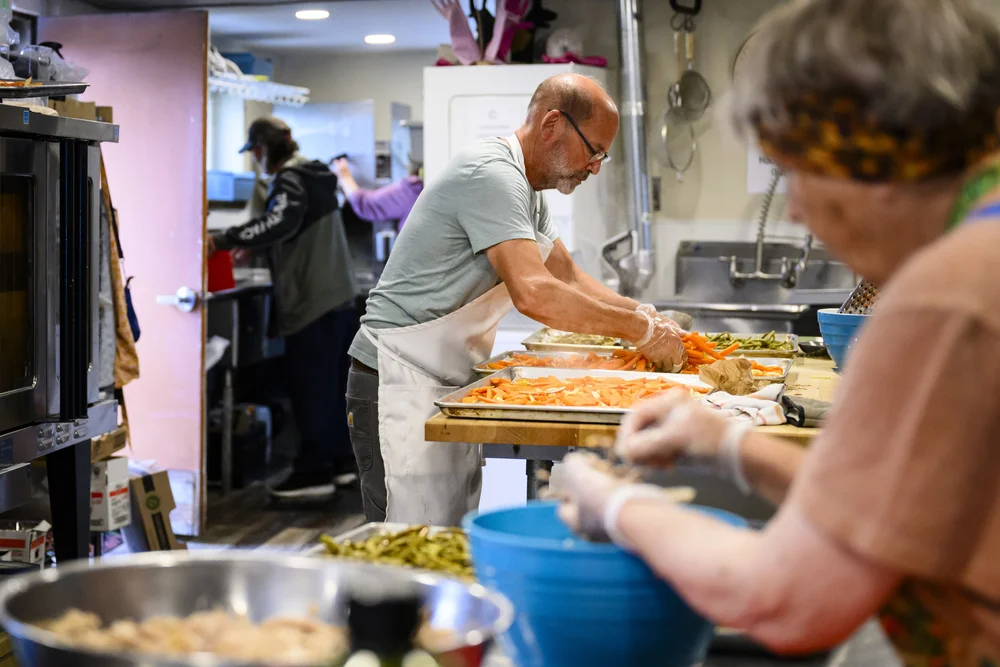
“There’s such knowledge and understanding here that older people have lots of health issues,” O’Shea added. “So they can choose from fresh fruits and vegetables and protein. My husband and I find it hard to afford protein. It’s hard to be at this stage of our lives where we need good food, and if we can’t get it, we’re not going to survive.”
The food bank fills several rooms with tables and racks of food at the Mountain View Commons building, where clients can walk through and select what they want. The food bank dedicates one room for clients with special needs, such as those who are homeless and don’t have cooking equipment, or need some other assistance. A volunteer accompanies the individuals through the room to ensure that they are getting the food that suits their situation, as well as any other necessary items such as propane, utensils or personal hygiene products.
Toby Sheffel volunteers at the food bank and receives its food. “I have MS, which is debilitating, making it a big deal to go to the grocery store, and this is so convenient,” Sheffel said. “A lot of us get therapeutic benefits working here. It has helped my MS through the exercise, positivity and love everyone has.”
Jefferson County Food Bank Growers network provides huge support to the food bank association. The most recent data available indicates that the network supplied over 13,700 pounds of produce through the first nine months of 2024, according to Patricia Hennessy, executive director of JCFBA. Additionally, JCFBA receives fresh food from gardens tended by individuals, schools and local farms, including grocery stores, restaurants, bakeries, small farms and organizations including the PT Gleaners. The Gleaners are teams of volunteers who pick fruit from backyard sources to give to schools, food, banks, nonprofits and senior centers. Additionally, Hennessy estimates that 25% of food bank customers are proxy shoppers who collect food for homebound family, friends and community members.
To reach the many seniors who are either homebound, unaware of the benefits for which they qualify or have been reluctant to take advantage of them, JCFM has developed a Food Access Ambassador Program. Seniors are trained and paid a small stipend to reach out to their peers and help them access the application or explain how the program works.
“It helps reduce some of the stigma of food access programs if your friend tells you about it,” Milholland said. “Some food ambassadors have gone to low-income housing and signed up everybody in the building for the program.
“There are people who are living in remote areas or don’t have access to transportation that are able to get this fresh produce they couldn’t have before,” added Milholland. Although Clallam County has a mobile food service that goes to several senior low-income housing centers and community centers where food can be picked up, Jefferson County does not have the resources to provide that service, she said.
Emotional Element of Food Insecurity
For some people, food insecurity can prompt an emotional response. “There is a lot of stigma in asking for food,” said Joey O’Bryan, an advocate with the Recovery Cafe in Port Townsend. The cafe’s mission is to foster a beautiful, safe, warm, drug- and alcohol-free space for everyone, O’Bryan added. It serves approximately 65 meals a day, Tuesday through Friday, to people in recovery.
Oceana Sawyer prepares bags at the Nourishing Beloved Community distribution site at Finnriver Farm & Cidery. The program packs and distributes food purchased and donated from local growers and producers, with a goal of producing food by and for people of the global majority (PGM). Photo by Heather Johnson
Brian Richardson, program manager at Recovery Cafe, said that the meals are an equalizer and an engagement tool to build community. “We’re getting a surge of seniors, and more women with mental health challenges,” Richardson said. He is appealing to community members for donations.
Oceana Sawyer started Nourishing Beloved Community in 2024 to build food literacy through growing food and hosting Sunday potlucks for People of the Global Majority (PGM), non-white people of African, Asian, Indigenous, Latin American and mixed-heritage backgrounds. The organization purchases food from PGM growers and producers.
Sawyer says that food acquisition and the shopping experience are frequently not safe or comfortable for many of these people. “Our number one hurdle is getting people to take food,” she said. “There’s shame about receiving food.”
Sawyer informed The Beacon that it recently lost its primary source of funding, a Washington State Department of Agriculture Food Resiliency grant. She is appealing to community members to think of NBC when considering organizations worthy of their donations.
Cuts are happening across the US for a variety of reasons. The U.S. Department of Agriculture will stop collecting and releasing statistics on food insecurity after October 2025, saying the numbers had become “overly politicized.”
The decision comes in the wake of federal funding cuts for food and nutrition safety net programs nationwide.
A Relentless Need for Funding
Sixty percent of the food that the Port Townsend Food Bank receives is what Hennessy calls “food rescue,” which comes from supermarkets, restaurants, bakeries, etc. “My call to the community is, ‘Cash is king,” Hennessy said. “$250 feeds a family of four for a week.”
Milholland is concerned that the country is relying heavily on nonprofits to run vital programs. “How do we make sure that people have access to food? If we as individuals have enough, what can we do to make sure that our neighbors also have enough, and it’s not just on the shoulders of those who work at nonprofits to figure out how to get there?”
Associated Press data reporter Kasturi Pananjady contributed to this report. This reporting is part of a series called Sowing Resilience, a collaboration between the Institute for Nonprofit News’ Rural News Network and The Associated Press. Ten nonprofit newsrooms were involved: The Beacon, California Health Report, Capital B, Enlace Latino NC, Investigate Midwest, The Jefferson County Beacon, KOSU, Louisville Public Media, The Maine Monitor and MinnPost. The Rural News Network is funded by Google News Initiative and Knight Foundation, among others.
Who pays for wildfire damage? In the West, utilities are shifting the risk to customers
Every spring, investors flock to Omaha, Nebraska, for Berkshire Hathaway’s annual shareholder meeting, where Warren Buffett holds court. Insiders call it Woodstock for Capitalists, and CNBC covers it with the fervor of Fox Sports on Super Bowl Sunday.
Last year’s meeting held particular weight. Investors were watching closely to see if Buffett, the company’s 93-year-old CEO, would name Greg Abel, Berkshire’s vice chairman, as his successor, and how the company would weather the billions in wildfire lawsuits threatening its energy utilities. Buffett dodged the succession question, but the meeting revealed something just as consequential: the company’s strategy to avoid wildfire liability.
Two months earlier, the Utah legislature had passed a law allowing utilities to charge their own customers to build a fund for future fire damages. The state also has a 2020 law on the books that capped the amount fire victims could sue utilities for damages. Combined, the two laws mean that if homes in Utah burn down due to a power company’s faulty electrical line, the financial damages residents can seek are limited — and they may already have been paying into the fund that covers them. For utilities, the result is reduced costs.
At the shareholder meeting, Abel singled out Utah as “the gold standard” of utility protection — a model he urged other states to adopt. “As we go forward,” he told the crowd, “we need both legislative and regulatory reform.”
Berkshire Hathaway Energy, or BHE, Buffett’s $100 billion energy arm, operates a vast power grid that stretches across the West. BHE subsidiaries such as Rocky Mountain Power and PacifiCorp are responsible for maintaining more than 17,000 miles of transmission lines that serve roughly 10 million customers across 10 states. In recent years, BHE has been slapped with lawsuits in Oregon worth nearly $10 billion for fires caused by its faulty equipment. For BHE, the Utah laws were a significant win, shielding the company from that kind of liability in at least one state. Across the West, BHE-owned utilities and their lobbyists are now trying to replicate that success, securing laws that both cap wildfire damages and shift costs onto customers.
“It’s infuriating to me that they are creating these situations,” said Stephanie Chase, a research and communications manager at the Energy & Policy Institute and a former consumer advocate in the Washington State Attorney General’s Office. “They’re not doing a good job at maintaining their power lines. Then when they start fires, they don’t want to pay for them.”
BHE’s infrastructure is aging, and maintaining it is expensive. Climate-proofing measures, like running power lines underground, can easily cost more than $1 million per mile, according to the Institute for Energy Research, and would put the cost of sending all BHE-owned equipment into the ground at well over $17 billion. Other resilience measures, such as trimming branches that grow over power lines and inspecting equipment in rural areas, are also expensive.
“Vegetation management is not one of the things that they receive a return on investment,” said Chase. State regulatory agencies typically set utility prices using a formula known as the rate base, which excludes routine maintenance like vegetation. By contrast, utilities earn a return when investing in new infrastructure, Chase added. “Utility companies have a much bigger incentive because they’re receiving a return on equity on any funds that they put into capital expenditures: building a new plant, building construction, building new lines,” she said. BHE did not respond to multiple requests for comment.
Earlier this summer, the Wyoming legislature passed a law that limits damages that can be awarded to victims of a utility-caused fire, so long as the company followed its own wildfire plan. In July, Idaho also enacted a similar law, shielding utilities from negligence if they prove they adhered to their wildfire plan. According to state regulatory filings, at least one representative for Rocky Mountain Power and other utilities operating in the state lobbied lawmakers in March and April to get the law passed.
One state senator who voted against Idaho’s law, Bruce Skaug, told Grist that it leaves little regard for residents who may have legitimate grievances. “We don’t want to bankrupt utilities,” Skaug said. “At the same time, if they burn down your house, you shouldn’t have any trouble getting the claim through a jury trial.” Yet, the law could do just that, he said. Skaug hopes to tweak the law to better protect residents during the next legislative session, which begins in January.
PacifiCorp is also running the same playbook in Washington. The company has petitioned state regulators to start tracking the cost of insurance increases and wildfire liability, which Chase calls a “stepping stone to getting those costs included in customer rates.” From there, utilities could begin to press regulators or legislators for permission to pass those costs on to customers.
In Utah, Rocky Mountain Power’s lobbyists benefited from a friendly legislature. Carl Albrecht, a co-sponsor of the two bills, spent decades working for utilities — including 23 years as CEO of a small electric cooperative — and takes several thousand dollars in political contributions from the energy utility industry and Berkshire Hathaway each year, according to campaign finance disclosures. Perhaps most crucially, Utah hasn’t had any major wildfires in recent memory.
That’s not the case in Oregon. In September 2020, fires enveloped hundreds of thousands of acres across the state, burning down 4,000 homes — including a state senator’s — and killing 11 people. In the aftermath, PacifiCorp became the state’s arch-villain — and a chance at the perks it won in other states vanished.
Soon the public learned that at least some of the half-dozen fires burning across Oregon that Labor Day stemmed from downed power lines owned by PacifiCorp. A subsequent investigation by the Federal Energy Regulatory Commission, an agency that oversees energy markets and transmission, found that the distance between vegetation and power lines did not meet safety standards and that some of these violations were so severe that “at least 45 percent of PacifiCorp’s BES lines” should not have had any power running through them at all.
Public outcry turned into class action lawsuits against PacifiCorp, which turned into a costly lesson for BHE. Since 2020, juries have awarded more than $300 million to several dozen plaintiffs. Yet the fate of thousands of other claimants remains unresolved as the lawsuits drag out in court. In the end, the company may be on the hook for around $8 billion more in potential damages.
But the lawsuits may not bring much relief to the victims.
“Warren Buffett is not just going to dump billions in to settle,” said Bob Jenks, executive director of Oregon Citizens’ Utility Board, a consumer advocacy group. More likely than meeting the claimants’ demands, Jenks predicted that “the company will go into bankruptcy.”
Despite its pariah status in Oregon, PacifiCorp has been trying to secure the same protections that it has in Utah. Earlier this year, when state representatives introduced utility-friendly bills in the Oregon legislature, they were dead on arrival. “I didn’t expect the degree of anger at PacifiCorp that’s out there,” Jenks said. “I understand. Your house burns down, and PacifiCorp is playing hardball and doing everything they can to prevent liability.”
The notion of offering some financial support to utilities in the form of ratepayer funds isn’t inherently problematic, experts acknowledge. For example, utilities in California rely on wildfire funds to pay for damages caused by their fires. As in Utah and other states, ratepayers contribute to the pot. But unlike other states, a government entity called the California Earthquake Authority — and not the utilities — oversees the distribution of that fund when it’s needed. After a tree felled a PG&E power line in 2021 and sent the Dixie Fire burning across Northern California, the fund has provided $445 million in support to the utility. As a result of the program, utilities like PG&E can avoid bankruptcy, but aren’t allowed to pass on the costs directly to their own customers.
So far, catastrophic fires haven’t hit states where PacifiCorp has won liability caps since they’ve taken effect. But with the track record of BHE subsidiaries and rising temperatures drying out Western forests, experts believe that it’s only a matter of time.
“The risk is there,” Jenks said. “Climate change has made our forests so much drier than they used to be, and we don’t have the same June rain. Our forests weren’t designed for this.”
This story was originally published by Grist with the headline Who pays for wildfire damage? In the West, utilities are shifting the risk to customers on Sep 19, 2025.