This newspaper publisher is challenging her fellow Republicans to do better for rural Texas
Suzanne Bellsnyder used to work for Republicans in Austin. Now she’s challenging them to do better for rural Texas, where she lives and operates two newspapers and a growing Substack newsletter.
Stephens County moves to enforce wind farm lighting requirements following executive session
By Tony Pilkington/Breckenridge Texan
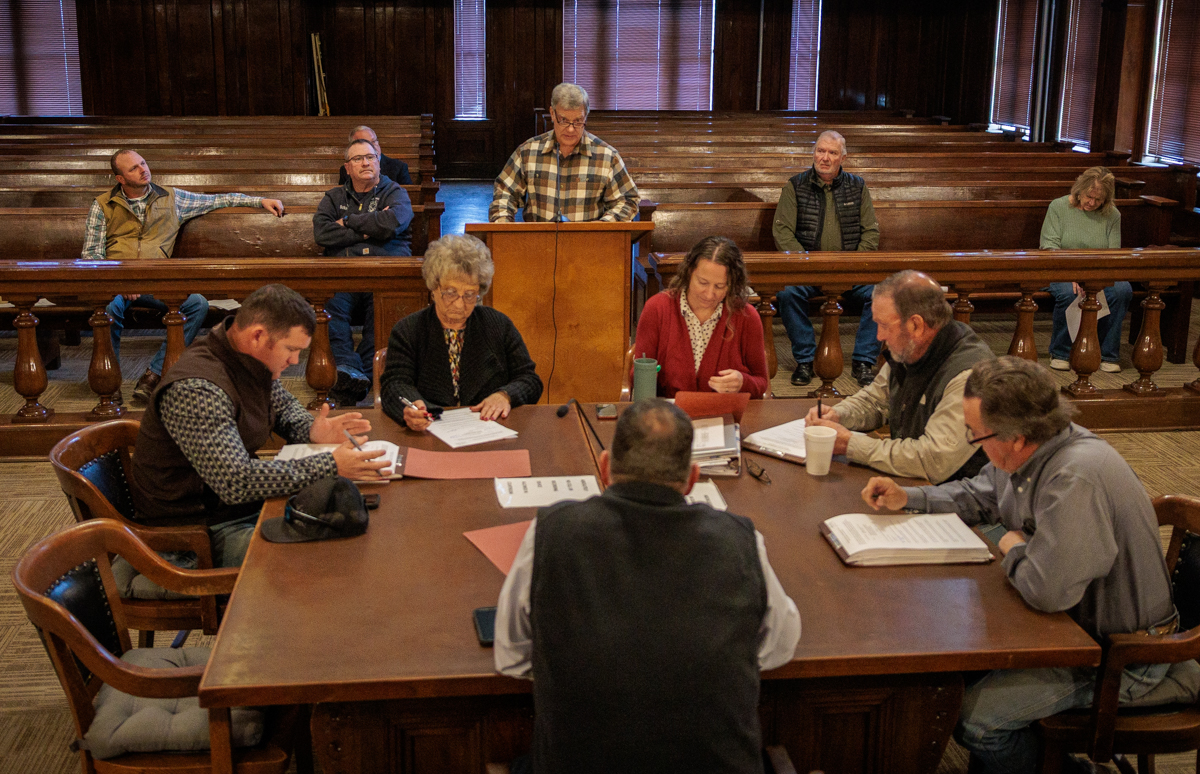
Stephens County Commissioners voted at their meeting on Monday, Jan. 12, to hire legal counsel to notify NextEra Energy that it is in violation of requirements governing the red warning lights at the La Casa wind farm, according to David Fambro, commissioner for Precinct 1 in the southeast part of the county, where the wind farm is located. The vote took place following an executive session with Jake Lederle, the attorney hired by Stephens County to represent the County in the original wind farm negotiations.
The red warning lights mounted on the wind turbines are part of an Aircraft Detection Lighting System (ADLS), which is sensor-triggered. Under normal operation, the lights should activate only when an aircraft enters a specific area or range and remain off most of the time. However, speakers during the public comment section of the Monday’s meeting, local residents said the lights are currently blinking continuously.
NextEra agreed to install the ADLS lighting system on the wind turbines as part of their tax abatement agreement with the county. In the Dec. 22, 2025, commissioners meeting, County Judge Michael Roach said that he had been assured that the system would be working — that is, that the lights would be off unless an aircraft was in the area — by Jan. 1 and that if it was not working, the County would send a letter to NextEra telling them that they are in violation of the agreement. In order to qualify for the County’s tax abatement, NextEra must be in compliance.
“We came out of Executive Session today (Jan. 12) and agreed to hire counsel to notify them they’re in violation of the ADLS,” Fambro said following the meeting. “So they should be receiving a letter… it’s on record that that’s what we did today.”
Fambro said the tax abatement agreement provides a limited window for compliance. “So from the date they receive the letter, they have 30 days to amend it, for them not to lose their abatement,” he said.
Asked whether any alternative agreement could be reached, Fambro said the issue must be fixed. “I don’t think there’s any agreement to come to, other than to fix it,” he said.
Concerns about the lighting system were raised earlier in the meeting during public comments from residents who live near the wind farm.
Steve Dempsey, who lives in the southeastern part of the county where the windmills are located, said the ADLS is intended to limit when the turbine lights are activated.
“The ADLS system is not working as it’s supposed to,” Dempsey said. “This last week, (the lights were blinking) all night long; they’ve been doing that for some time. I’d like to see the Commissioners Court address that with NextEra, tell them they’re in breach of contract.”
Dempsey said he read the contract between NextEra and Stephens County and couldn’t find any grace period for getting the ADLS system working. “According to this, the way I interpreted it, it should be working now, and it’s not,” he said.
Precinct 2 Commissioner Will Warren, who was presiding over the meeting because County Judge Michael Roach was absent, told Dempsey that he agreed, that they had something in the works, and that they would let them know later on.
In an interview after the meeting Dempsey reiterated what he said in the meeting, “It’s an ADLS system, commercial system, and it’s supposed to trigger a sensor for the lights, that they will come on when an aircraft is in a certain area, gets in a certain range, so they should be off the majority at the time,” Dempsey said. “But they’re constantly blinking.”
He said he has not received any information directly from NextEra on when the system will be operational.
“NextEra doesn’t talk to us,” he said. “They told me a long time ago, they’re through talking to me. So we have to go through the court to get any information.”
Zola George talks to the Stephens County Commissioners about how the blinking red lights on the wind turbines can be seen from his property in southeast Stephens County all night long. He asked the commissioners to enforce the contract that requires NextEra Energy to have a system in place that turns off the lights when no planes are in the area.(Photo by Tony Pilkington/Breckenridge Texan)
Zola George, another resident whose property is next to the wind turbines, spoke during public comments and described the impact of the lights on nearby homes.
“The turbines are towering and spinning, surrounding my home, and the only thing worse than that is the monotonous, constant blinking red lights I and the citizens of Stephens County see from dusk till dawn,” George said.
George thanked the commissioners for including the ADLS requirement as condition for the tax abatement granted to NextEra.
“Installing workable ADLS system was a very important condition and requirement for NextEra to have received the tax abatement you gave them,” he said. “Not surprisingly, they have failed to comply and have also given different stories as to when it is expected to be fully operational. … Please take immediate action to shut off those obnoxious red lights; your southeast Stephens County property values have suffered enough.”
Following the meeting, Fambro told the Breckenridge Texan that the county officials expected the aircraft detection lighting system to work from the beginning, even though the project is unusual.
“This is only the second ADLS system that has been done in the state of Texas, if I understand correctly,” he said. “So whenever we set everything up in the abatement process, what we said is we wanted ADLS. Our expectations were that ADLS would work (from) day one.”
However, Fambro said representatives from NextEra told him that the windmills have to be up and operational in order for them to be able to set up the ADLS. Additionally, he said that other states that have laws requiring ADLS have built-in grace periods ranging from 30 days to nine months, something the Stephens County officials were not aware of.
Cutline, top photo: Stephens County resident Steve Dempsey informs the county commissioners that the Aircraft Detection Lighting System that NextEra Energy agreed to install on the wind turbines in the southeastern part of the county are not operational. He said the contract between the county and NextEra does not provide any type of a grace period.(Photo by Tony Pilkington/Breckenridge Texan)
Local junior high kids don ‘drunk goggles’ to experience how alcohol can impair their vision, coordination
By Carla McKeown/Breckenridge Texan
Breckenridge Junior High students gathered on the blacktop behind the school cafeteria Tuesday morning for a chance to glimpse how alcohol can impair their vision, coordination, motor skills and other abilities during a program hosted by the Stephens County Agrilife Extension Service.
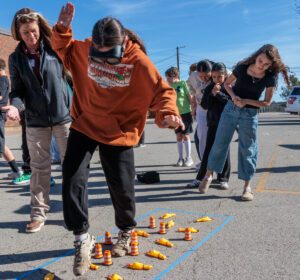
JerriAnn Cornett, with the AgriLife Extension Service, left, oversees a Breckenridge Junior High student as she attempts to navigate around small objects while wearing goggles that simulate drunkenness.(Photo by Tony Pilkington/Breckenridge Texan)
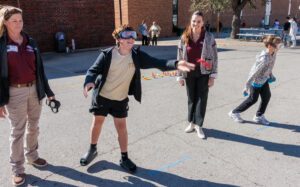
Donning “drunk goggles,” the sixth, seventh and eighth grade students attempted to walk a straight line, toss bean bags at a target, and navigate around small objects on the ground.
As they took a look through the eyewear specifically designed to simulate being at the blood alcohol content level for being legally drunk (.08%), most of the students reacted immediately: “Why is my body doing this?” “What the heck?” “Oh, gosh!”
Although the overall atmosphere during the drunk goggles program was lighthearted, with students struggling to walk straight or even give a “high five” to the presenters, most of the students walked away from the activity surprised by how much they were affected by the simulation.
The program was facilitated by Stephens County Extension Agent Sumer Russell; Edward Jimenez, a program coordinator with the Texas A&M Agrilife Extension’s Watch UR BAC (Blood Alcohol Concentration) campaign that teaches Texans about the dangers of misusing alcohol and other drugs; and JerriAnn Cornett, with the Extension service’s Disaster Assessment and Recovery program.
In addition to offering the kids a look through the goggles, the program also included a presentation in Bailey Auditorium about the dangers of illegal drugs, alcohol and vaping, focusing on impaired driving.
Edward Jimenez, a program coordinator with the Texas A&M Agrilife Extension’s Watch UR BAC campaign, left, talks to BJHS students as they attempt to walk a straight line while wearing “drunk goggles.”(Photo by Tony Pilkington/Breckenridge Texan)
Jimenez said that junior high is a good age to start talking to kids about the dangers of abusing alcohol and drugs. “There’s a lot of curiosity with kids this age,” Jimenez said. “If we get a chance to tell them and to show them how drugs and alcohol affect them, you know, hopefully it makes them think. When those opportunities, when those temptations, or whatever you want to call them, present themselves to them and they (turn down offers of drugs or alcohol and) say,’I’m good. I’m good.’ And that’s the one thing we want them to say, ‘I’m good,’ because they know better.”
Jimenez said part of the program is giving the young people the words they need to turn down alcohol or drugs if they are offered such substances from their friends or others.
“Sometimes they don’t know what to what to say. They ask us, ‘How do I respond to this?’” he said.
Jimenez said he tells the students that there are many ways to say “no.”
Some of the examples of what they can said when offered, for example, an alcoholic drink, include:
I’m good with what I have; I don’t need that.
I have practice. I don’t want to do that.
I’m in band. I don’t want to mess with that.
“We give them the tools to be able to take care of themselves, because they don’t know, they don’t really understand,” Jimenez said. “Everything is new, everything’s fancy, everything’s cool. But we give them that idea that this is what it’s like, this is how it can affect you.”
But, the program isn’t just fun and games — tossing a bean bag while wearing “drunk goggles” — or a boring lecture with facts and statistics.
Jimenez brings a personal element to the anti-drinking and driving campaign. In 2006, he was driving his son and some neighbor children home from a swimming pool when they were hit by a drunk driver. Jimenez’s 7-year-old son and a 14-year-old neighbor were killed in the crash.
So, he shares that personal experience with the students to give them a first-hand account of how dangerous drinking and driving can be.
But, his interest in the topic goes back as far as high school, when one of his school projects was an anti-drunk driving commercial that he presented to the school.
AgriLife Extension will continue working with Breckenridge schools to bring related programs to the students, including the “When Sean Speaks” program later in the school year.
JerriAnn Cornett, left, and Sumer Russell, second from right, with the Texas A&M AgriLife Extension Service, let Porter Easter, second from left, and Wyatt Burns, Russell’s son, right, toss bean bags while wearing the “drunk goggles” as part of a recent anti-drinking and driving program.(Photo by Tony Pilkington/Breckenridge Texan)
Cutline, top photo: Breckenridge Junior High students attempt to walk a straight line while wearing “drunk goggles” during a recent program at the school. Edward Jimenez, left, a program coordinator with the Texas A&M Agrilife Extension’s Watch UR BAC campaign, talked to the students about some of the effects of drinking alcohol and about the dangers of drinking and driving. (Photo by Tony Pilkington/Breckenridge Texan)
U.S. Rep. Monica De La Cruz wants legal status for migrant workers in struggling construction industry
South Texas builders said a growing number of ICE arrests at construction sites have made it difficult for work to continue.
Texas’ newest state park gives visitors a sneak peek ahead of planned 2026 opening
Palo Pinto Mountains State Park will be the first to open in North Texas in about 25 years.
Texas to receive $281 million in federal funds for rural health care
Texas will get the biggest portion of the first rollout of the $50 billion Rural Health Transformation Program, which was created in tandem with legislation slashing Medicaid funding.
Probes into racism in schools stall under Trump
LUBBOCK, Texas — The meeting of the local NAACP chapter began with a prayer — and then the litany of injustices came pouring out.
A Black high school football player was called a “b—h-ass” n-word during a game by white players in September with no consequence, his mom said. A Black 12-year-old boy, falsely accused last December of touching a white girl’s breast, was threatened and interrogated by a police officer at school without his parents and sentenced to a disciplinary alternative school for a month, his grandfather recounted. A Black honors student was wrongly accused by a white teacher of having a vape (it was a pencil sharpener) and sentenced to the alternative school for a month this fall, her mom said.
“They’re breaking people,” said Phyllis Gant, a longtime leader of the NAACP chapter in this northwest Texas city, referring to local schools’ treatment of Black children. “It’s just open season on our students.”
Just last year, there was hope that the racial climate at Lubbock-area schools might improve. The federal government had launched civil rights investigations after several alleged incidents of racial bullying shocked the community and made nationalheadlines. In fall 2024, a resolution seemed to be in sight: An investigator from the Department of Education’s Office for Civil Rights was planning to visit the area, community members said, for what they hoped would be a final round of interviews before the agency put in place a set of protections negotiated with the Lubbock-Cooper school district.
Then the 2024 presidential election happened — and the visit didn’t. In March, the Trump administration closed seven of the Education Department’s 12 regional civil rights enforcement offices, including the one in Dallas, which had been investigating complaints about Lubbock. Emails from the lawyer representing the families to the federal investigator bounced back — like hundreds of other OCR employees, she had been terminated.
Since then, race relations in school districts in and around Lubbock have taken a turn for the worse, many parents and educators say. Black residents — who make up about 8 percent of Lubbock County — didn’t expect the federal government to bring a halt to racist incidents, but the possibility of an agreement between the government and school districts provided a sense of accountability. Now, parents and students say racial epithets are more common in public, and Black teachers fear drawing attention to themselves. Gant says the NAACP chapter fields frequent calls from parents seeking help in addressing racial incidents they no longer bother to report to the Education Department.
Since President Donald Trump took office, the agency has not publicly announced a single investigation into racial discrimination against Black students, instead prioritizing investigations into allegedanti-whitediscrimination, antisemitism complaints and policies regarding transgender students.
All told this year, the Education Department under Trump has dismissed thousands of civil rights investigations. During the first six months of this year, OCR required schools to make changes and agree to federal monitoring in just 59 cases, compared with 336 during the same period last year, a Washington Post analysis found.
“In many of our communities where people feel isolated and like they didn’t have anyone to turn to, OCR mattered and gave people a sense of hope,” said Paige Duggins-Clay, a lawyer at the Intercultural Development Research Association, an education policy and legal advocacy group that helped file some of the OCR complaints against Lubbock schools. “And it matters that they’ve essentially destroyed it.”
In an email, Julie Hartman, press secretary for legal affairs for the Department of Education, wrote, “These complaints of racial bullying were filed in 2022 and 2023, meaning that the Biden Administration had more time to investigate this than the Trump Administration has even been in office. The Trump Administration’s OCR will continue vigorously enforcing the law to uphold all Americans’ civil rights.” She did not respond to a question about whether the agency had opened any investigations into discrimination against Black students.
Related: Become a lifelong learner. Subscribe to our free weekly newsletter featuring the most important stories in education.
Some white residents have noticed the change too. Lubbock County, located at the bottom of the Panhandle, is home to more than a quarter million people. It is the urban seat for a sprawling county that encompasses several suburban and rural school districts and hosts Texas Tech University at its center.
Tracey Benefield — who has two children in Hutchinson Middle School in the Lubbock Independent School District, which borders the Lubbock-Cooper district — is from a family that has lived in the area for generations. She says her son has witnessed multiple incidents of racial bullying over the past year.
“My son was walking down the hall with his friend who’s Black, and some kid shoulder-checked him and called him the n-word. That’s been one of many,” she said. “Things have absolutely gotten worse. The attitudes have always been there, but people acting on their attitudes is completely different.” Lubbock district officials did not directly respond to questions about Benefield’s assertions.
She thinks OCR’s retreat, among other changes within the federal government, has had an impact. “People are more emboldened,” she said. “People have always had racist ideas, but now there’s no consequences for being racist.”
Prior to Trump’s election, the concerns of parents and civil rights groups were quite different: Many were frustrated that Office for Civil Rights cases could linger for years as overworked investigators tracked down details and testimonies. Some were starting to advocate for more OCR staff and speedier resolutions. The outcry from residents, along with the media attention, prompted the Lubbock-Cooper and nearby Slaton school districts — where Black students make up about 3 percent and 5 percent of the student bodies, respectively — to adopt policies of mandatory in-school suspension for students caught making racial slurs and spurred training for staff.
But for many, the changes weren’t coming quickly enough.
Black parents and teachers in Slaton, Texas, say there has been no decrease in racial bullying incidents and mistreatment of Black staff since complaints were made several years ago to the Department of Education’s Office for Civil Rights. Credit: Mark Umstot for The Hechinger Report
In 2022, Tracy Kemp’s eldest son, Brady, then an eighth grader, was one of nine Black students whose pictures were put on an Instagram page called “LBMS Monkeys,” which stood for “Laura Bush Middle School Monkeys.” (Brady is being referred to by his nickname and his last name is being withheld to protect his privacy.) Kemp was part of a group of parents in the Lubbock-Cooper school district who filed OCR complaints that August over what they said was a toxic racial atmosphere that subjected their children to repeated racial bullying. White students would sometimes play whipping noises on their phones when Black students walked through the halls, according to the complaints. Despite a school district investigation that included reaching out to the FBI, those responsible were never caught.
Lubbock-Cooper officials said via email that they “responded swiftly and appropriately” to the 2022 incident at Laura Bush Middle School. “Efforts of the district to ensure all students feel valued, supported, and a sense of belonging have contributed to the positive, nurturing environment our campuses strive to maintain,” wrote Sadie Alderson, the district’s executive director of public information.
Kemp stayed in the Lubbock-Cooper district for another year, but even though the page was taken down, the taunting and bullying didn’t let up, she says. Her middle son was in sixth grade at LBMS that year and was called racial epithets on the school bus and in the hallways. (His name is being withheld to protect his privacy.) When Brady, who had graduated from the middle school and started at Lubbock-Cooper High School, tried to start a Black Student Union there, she says, a white student ripped the page with signatures from his notebook. Kemp says the principal told her there was nothing he could do. The final straw came one day when the ninth grader didn’t stand for the Pledge of Allegiance. The teacher told him he was a criminal who was breaking the law, Kemp says, and the harassment started up again, this time on Snapchat, with the same language as the “monkeys” Instagram page.
In July 2023, Kemp moved with her family to New Mexico and commuted 75 miles each way until she found a job closer to her new home. Leaving Lubbock-Cooper, she said, was life-changing for her kids’ mental health.
“In eighth grade, you’re going through puberty, you’re learning about yourself, you’re growing and you have all these different feelings. And now you add into the mix, ‘These people don’t like me because of my color’ — that’s a whole different type of aspect to have to deal with,” said Kemp. “And on the flip side of that, I also have to encourage my child that not every white person feels this way, because I don’t want to teach my child hate either.”
Brady, now a 12th grader, also says he’s happy the family moved. “Honestly, it’s a lot easier,” he said. “There’s no arguments, there’s nothing to worry about, really. I just focus on school more than anything.”
Ja’Maury was 12 years old when he was accused last year of touching a white girl’s breast at school, something he denies. He was interrogated alone by police and assigned to the detention school in Lubbock, Texas, for 30 days. Credit: Mark Umstot for The Hechinger Report
Others who have stayed say they’ve paid a price. Last December, Ja’Maury, a then-12-year-old whose last name is being withheld to protect his privacy, learned of rumors that he’d touched a white girl’s breast during school. He went straight to administrators at the school, Commander William C. McCool Academy, to tell them the truth. But the assistant principal believed the girl’s story and radioed a police officer, who interrogated him and threatened him with jail unless he confessed, according to Ja’Maury and his grandfather, Mike Anzley. Alone in a room of adults, Ja’Maury broke down and admitted to something he says never happened.
“He was yelling and threatening to send me to juvie if I didn’t say I did it. I was scared,” Ja’Maury recalled in an interview. “It was a white person’s word against a Black person’s word.”
Ja’Maury was assigned 30 days at Priority Intervention Academy, Lubbock Independent School District’s detention school, where children are sent for offenses determined to be too severe for in-school suspension. Constantly anxious, he reverted to sleeping in his grandfather’s bed like he did as a toddler. At the detention school, he said, he was so afraid of defying adults that he twice wet his pants rather than challenge a teacher who said he couldn’t leave class to use the bathroom.
“He had never been in trouble before,” said Anzley. He’d always taught Ja’Maury to trust adults, and said he was devastated by the adults at McCool betraying that trust. “I had to make him distinguish right from wrong in a whole new way.”
Anzley filed a formal grievance with the district and, according to a copy of the findings shared with The Hechinger Report, administrators agreed to wipe the incident from his discipline file, issue a formal apology and provide training in discipline and due process to both McCool administrators and the officer who interrogated him.
McCool administrators did not respond to requests for comment. Amanda Castro-Crist, executive director of communications and community relations for Lubbock ISD, wrote in an email that the district could not discuss individual students because of federal laws protecting student privacy, but that it “is proud to serve a diverse student body.”
Raised in the church, Ja’Maury was taught to trust and respect his elders. But his grandfather says that adults at his school in Lubbock, Texas, let him down and he was punished for something he didn’t do. Credit: Mark Umstot for The Hechinger Report
Gant, the 62-year-old NAACP leader, says that growing up in Lubbock she never experienced the kind of racism she sees now. An accountant who runs her own business, she got involved in community activism about 20 years ago after enduring identity theft and a costly, time-consuming effort to clear her name. “I’m a strong, faith-based woman,” said Gant. “Who else will someone call? Who will go to their meetings for free, come with the facts and the research and not make them feel like they owe anything?”
Gant noted changes the districts have made in the wake of the OCR investigation and parent activism, including the new suspension policies. Administrators in Lubbock-Cooper sometimes even proactively contact her about a parent concern, she said. In Lubbock ISD, Gant credits the director of student and parent resolution, Brian Ellyson, with listening to parents and helping them resolve conflicts in a principled manner.
Ellyson was one of two Lubbock school officials at the September NAACP meeting, held in an independent living center on the south side of town equidistant between Laura Bush Middle School and McCool Academy. Parent after parent described their children’s mistreatment.
Leshai Whitfield said her son was sent to a detention school after a teacher complained that he’d pushed her; she said her son was only trying to leave the classroom because of a fight between two other students. Naquelia Edwards said her son has been repeatedly called the n-word and disciplined for fights while white students went unpunished. Jessika Ogden, mother of the 11th grade honors student who was wrongly accused of having a vape, said she believes her daughter was racially profiled. She filed a grievance against Lubbock Independent School District’s Coronado High School to keep her daughter from being sent to the district’s detention school, which she says she eventually won. But her daughter missed school while the case was being resolved, Ogden said, as she refused to send her to the detention school. “Had I not fought for my daughter, she would have suffered that punishment, missing more class, more credits,” Ogden said.
In interviews, more than a dozen Black high school students in Lubbock said they regularly heard other students use the n-word. “Slurs happen all the time – it don’t matter what time of day it is,” said a 10th grader from Coronado High School, whose name is being withheld to protect her privacy.
Gant says the absence of an actual agreement between the federal government and any of the districts means the environment in schools hasn’t fundamentally changed. Those agreements come with teacher training, data collection and penalties for failing to comply. In-school suspension for racist behavior may keep some of it in check, but the changes are cosmetic, she and parents say.
Phyllis Gant, a longtime leader in the Lubbock NAACP, says she has been fielding more parent complaints about racist incidents in schools in and around the Texas city this year. Credit: Mark Umstot for The Hechinger Report
Emails obtained by The Hechinger Report through public records requests show that Kulsoom Naqvi, the OCR investigator based in the Dallas office, conducted staff surveys, data requests and several rounds of interviews throughout much of 2024, but the work came to a halt that fall. Naqvi, who is not technically separated from the Education Department because of ongoing litigation over the mass firings at the Education Department, said she could not comment on the case.
“Given the pace that things were moving, I felt confident that we were going to get a resolution before the end of the year,” said Duggins-Clay, the lawyer who helped file some of the complaints. “Had the election not happened, we would have gotten to a negotiated resolution.”
Alderson, the spokesperson for Lubbock-Cooper, said that the investigation is still open, but the current superintendent, hired in June, was not aware of any communication from an OCR investigator. She said the district had sought mediation with OCR in spring 2024, but Naqvi had denied that request and had not given Lubbock-Cooper a timeline for resolving the complaints.
Just over 20 miles away from downtown Lubbock, in the neighboring town of Slaton, which had its own series of racist incidents and ensuing complaints to OCR, residents say the racial atmosphere has deteriorated even further this year and the school administration has been completely unresponsive. School officials promised to work with local authorities to paint over part of a mural in the center of town that depicts Black men picking cotton under the watch of a white farmer, teachers say. But that never happened. Parents say the n-word is used regularly by white students without consequence in the district, where just 5 percent of students are Black.
“I’ve witnessed kids on my campus calling Black kids ‘monkeys,’” said a Slaton teacher who grew up in the town and spoke on condition of anonymity out of fear for her job. “I’m sorry to say that it’s gotten worse. I feel like more of the extremists have come out.”
Parents say their children continued to be bullied because of their race even after Slaton administrators pledged in 2022 to discipline students for slurs. One mom said her second grader was called an “African monkey” the next year by other kids in his class at Cathelene Thomas Elementary. She says she told the principal, who said, “‘Would you be offended if they called him a cat or something different?’” the mother recalled. “I got up and left. I didn’t even know what to say.”
After a series of racist incidents in schools in Slaton, Texas, in 2022, Black residents had hoped a mural at the center of town depicting of Black men picking cotton would be painted over. The mural is still in place. Credit: Mark Umstot for The Hechinger Report
After that she started homeschooling her kids. She asked to remain anonymous because her children still participate in community events and she is worried they will face retribution.
Cathelene Thomas Principal Margaret Francis did not respond to requests for comment. Superintendent Shelli Conkin said in an email that federal law prevented the district from discussing student-related matters and did not respond to additional questions. “Since I became superintendent in 2023, Slaton ISD has experienced many positive developments that highlight our commitment to students and staff,” she wrote, including facility upgrades, a district fundraising effort and a four-day school week.
Anzley, meanwhile, is still fighting for justice for his grandson. After the district declined to discipline the girl for making the accusation, he said, and with OCR no longer seeming like an option for redress, he’s hoping to find a lawyer to file a civil rights lawsuit on behalf of his grandson.
The district’s apology and commitment to better train administrators did not undo the damage to Ja’Maury, he and his grandfather said. “People kept on messing with me about it, saying I was a pedophile, saying I was a pervert,” said the middle schooler. “After that I almost hated life, I didn’t even want to live no more after that. That was horrible.”
Last spring, four months after Ja’Maury had been back at McCool, he got into a fight with a boy who called him the n-word on the school bus, he said. This fall, Anzley decided to transfer Ja’Maury from the top-rated school he once loved — which is 9 percent Black — to Dunbar College Preparatory Academy, which is 45 percent Black and received an F rating this year from the Texas Education Agency. Ja’Maury says he feels safer there; Anzley says the move was necessary for his grandson’s mental health but that he preferred the learning opportunities at McCool.
“None of this is new, because the very name Lubbock is the name of a Confederate soldier,” said Gant. “It’s heartbreaking, but it doesn’t surprise me. The aggression of it has been heightened under the Trump administration.”
She added, “The districts know that OCR has been dismantled so there’s no urgency to fix these issues. It’s on the community, and it’s on the parents to be factual, vocal and not quit.”
Texas Democratic candidates unite in the Rio Grande Valley to court Latino voters
State Rep. James Talarico faces an uphill battle in his U.S. Senate bid while 15th Congressional hopeful Bobby Pulido aims to flip the district, but he must first win his primary.
The Stats on Abortion Access in Rural America
Editor’s Note: This post is from our data newsletter, the Rural Index, headed by Sarah Melotte, the Daily Yonder’s data reporter. We will be taking the next edition off as we head into Christmas. Subscribe to stay in touch with us during the New Year.
Compared to their urban and suburban counterparts, a greater share of the rural population lives in states with the most restrictive abortion legislation, according to my analysis of data from the Guttmacher Institute, a research organization that focuses on reproductive rights. After the Supreme Court overturned Roe v. Wade in June of 2022, it became harder for women to access reproductive care, but the burden often disproportionately hurt rural women.
About 46% of nonmetropolitan, or rural, Americans live in states with either ‘most restrictive’ or ‘very restrictive’ abortion legislation, representing 21.3 million people. Approximately 35% of metro Americans live in these states, representing roughly 99.1 million people.
State-level abortion legislation is complex; it’s rarely as simple as an outright ban or permit. Abortion policies can include stipulations like waiting periods, ultrasound requirements, gestational duration bans, insurance coverage bans, telehealth bans, and more. To deal with some of this complexity, the Guttmacher dataset groups states into one of seven categories that broadly captures the state’s access to abortion:
Seventeen states make up the ‘Most Restrictive’ category, and 13 of those states have enacted full bans with few exceptions. Those states include Alabama, Arkansas, Idaho, Indiana, Kentucky, Louisiana, Mississippi, Oklahoma, South Dakota, North Dakota, Tennessee, Texas, and West Virginia. The rural population in those states equals about 15.8 million people.
Rurality Exacerbates Access Challenges
In the Post-Roe landscape, pre-existing rural challenges are exacerbated by restrictive abortion legislation, a change that has led to increased maternal mortality, particularly for women of color. The new state of abortion in America means people often have to travel much further to get the care they need, often out of state.
An ABC special that featured women who had to travel for abortions highlighted the story of Idaho resident Jennifer Adkins, who was excited when she found out she was pregnant with her first baby. But a 12-week ultrasound showed that continuing her pregnancy would put her life in danger. With financial help from family and friends, Adkins had to travel to the nearest clinic in Oregon to receive the care she needed.
My previous analysis of abortion data showed that rural travel to abortion clinics increased from 103 miles on average in 2021 to 159 miles on average after Roe v. Wade was overturned. But travel distance varies by state, with women in parts of rural South Texas having to travel up to almost 800 miles to receive care.
In rural Louisiana, where all the bordering states have also issued abortion bans, the distance to a clinic has increased by almost 400 miles since Roe was overturned. The average rural Louisianan is about 492 miles away from the nearest abortion clinic. The data for that analysis came from the Myers Abortion Facility Database.
In 2024, approximately 12,000 Texans traveled to New Mexico to receive an abortion, according to the Guttmacher Institute data. Nearly 7,000 Texans traveled to Kansas, and another 4,000 traveled to Colorado. Texas enacted a near total ban on abortions in July of 2022. In Idaho, which enacted an abortion ban in August of 2022, 440 people travel to Washington and 140 travel to Oregon for abortions in 2024. (Visit the Guttmacher’s interactive map of abortion travel by state to explore the topic in more detail.)
Abortion and Rural Voters: More Complex Than You Might Think
Every time I write something about how rural people suffer from GOP policies, I get comments and emails from readers saying some version of, “They voted for this.” I take issue with this response for many reasons. It’s unkind, and it erases the thousands of rural voters who don’t support these policies. While some people are going to say you get what you deserve, here’s another way to look at it.
In a previous analysis of voting data from the nine states that had abortion on a ballot measure in 2024, I found that support for Trump didn’t always line up with support for abortion restriction. In 2024, approximately 73% of rural voters supported Trump, but only 61% voted to restrict abortion access.
While 61% is still a majority vote, the 12-point gap between support for Trump and support for abortion restriction demonstrates that abortion access is a complicated issue for many Americans across the geographic spectrum. This data shows a rural voting base that is willing to split with the broader Republican platform on key issues.
“All voters are complex,” said Nicholas Jacobs, rural sociologist. “People voted for [Trump], even if they wanted more access to reproductive care or were disappointed that a national standard was lifted by the courts.”
A newsletter about role of higher education in society — plus Open Campus developments.
Declining numbers of international students coming to study in the U.S. hurts local economies, according to new data released this week.
International students’ economic contributions declined by $1.1 billion this fall, costing the U.S. nearly 23,000 jobs, NAFSA and JB International found. Those figures are based on a 17% decline in international student enrollment.
Much of that decline was among graduate and non-degree students, according to the data. A slight increase in undergraduate enrollment this fall bolstered the overall numbers. There are still more than 1 million international students in the U.S.
It’s been a tense time for international students at colleges in the U.S. In the spring, President Donald Trump’s visa revocation and sudden reversal left many reeling, as our Jessica Priest reported in Texas. Trump has also limited visa interviews, told some universities to cap their international student enrollment, imposed travel restrictions on visitors from 19 countries, and made H1-B visas — which allow educated foreign citizens to work in “specialty occupations” — more expensive.
The U.S. must adopt policies to attract and retain international students and realize that job opportunities for them after graduation “are essential to our standing as the top destination for global talent,” said Fanta Aw, NAFSA executive director and CEO.
“Otherwise, international students will increasingly choose to go elsewhere—to the detriment of our economy, excellence in research and innovation, and global competitiveness and engagement,” Aw said in a release earlier this week.
Our reporters have been detailing the declines in international students on the campuses they cover — including DePaul University in Illinois and IU Indianapolis.
A separate report on international students released this week by the Institute of International Education found that their numbers were decreasing even before Trump took office: International student enrollment dropped by 7% in the 2024 school year, according to the report.
These declines matter — not just for college’s bottom lines, but for the broader economy. International students contributed $42.9 billion to the U.S. economy and supported more than 355,000 jobs last year, according to NAFSA.
The pre-Trump slump “suggests colleges face other headwinds, such as a slowing global economy, growing competition from nontraditional education hubs, and lingering unease because of the China Initiative,” in addition to current political turmoil, Karin Fischer, the Chronicle of Higher Education’s international education reporter, wrote in her newsletter this week.
India remains the country that sends the most students to the U.S. Marcello Fantoni, Kent State’s vice president of global education, travelled there last spring to talk with prospective students, our Amy Morona reported at Signal Ohio. He told them Kent State is still welcoming — one of the few things he can control amid the broader federal policy changes.
Still, he said Trump’s actions influenced how the students he spoke with viewed America.
“There is damage done there, and it will take a long time to be fixed,” he told Amy. “A long time.”
We’ve built a reporting network that’s meeting the moment — and we can’t do it without your support.
From now until the end of the year, all donations of up to $1,000 will be matched by our generous supporters. Donate to Open Campus today.
Elsewhere on Open Campus
Shay Wiltshire, an intern at Land Rover and scholarship recipient, removes the splash shield from underneath a car on Nov. 6, 2025, at the Land Rover service center in Fort Worth. Credit: McKinnon Rice | Fort Worth Report
From Fort Worth: McKinnon Rice at our partner Fort Worth Report visited students who received paid, two-year auto technician internships through a partnership between Autobahn Fort Worth and Tarrant County College.
It’s a growing field in the area and offers opportunities to make good money without much college: “A technician hired after an internship starts out earning $24 to $30 per hour, based on their performance, and the wage grows as skills do — highly skilled technicians can make as much as $250,000 to $300,000 per year,” McKinnon wrote.
Keep in touch
We’re a nonprofit newsroom that relies on the support of readers like you. Donate today.
Interested in reaching readers who care about higher education in communities across the country? Get in touch or request our media kit.