Extensive Toxic Algal Bloom Observed in Hudson River, New Tool Tracks Water Quality In Real Time
Potentially the most extensive harmful algal bloom in the Hudson River in nearly 40 years was observed, according to local science advocacy nonprofit Riverkeeper.
The Cary Institute of Ecosystem Studies said this is the largest cyanobacteria bloom on the river they have seen in almost 40 years.
Riverkeeper’s Science Director Dr. Shannon Roback told Radio Catskill that their staff have observed “uncharacteristic algal blooms” in the Hudson River, potentially “the most extensive, harmful algal bloom in the Hudson River Estuary in living memory.”
Roback says Riverkeeper observed the most dense conditions around the Kingston area, with conditions stretching from the Village of Catskill to the Town of Hyde Park.
She says that there’s conventional knowledge that the Hudson River isn’t susceptible to harmful blooms because the water is free flowing. However, a combination of hot temperatures, nutrient enrichment, and more stagnant water has created the ideal environment for a photosynthetic bacteria known as cyanobacteria to thrive.
“Cyanobacteria release[s] cyanotoxins, which are acutely toxic to human health. They can pose risk to people who recreate in the water or drink the water, to pets, to wildlife, and they can cause a variety of health problems,” said Roback.
Riverkeeper’s new online water quality portal helps the public find water quality conditions in their area and understand the historical trends behind the most recent algal bloom outbreak.
“We can really see how different water quality conditions are now while this bloom is occurring compared to historic baselines,” said Roback.
Launched in partnership with New York Senator Chuck Schumer, Riverkeeper announced the tool as an opportunity for New Yorkers to learn where they can swim and boat safely, check how clean their drinking water is, and understand the general health of the region.
The new tool has helped Riverkeeper understand the latest algal bloom stretch in real time. The nonprofit regularly collects algae chlorophyll and cyanobacteria for the water quality portal.
“We tried to design the tool to be useful for everyone,” said Roback. “I think a lot of people will be using this and really looking for their home and trying to understand water quality – whether that’s recreational water quality, whether that’s how healthy the fish are, or whether that’s [knowing] do I have PFAS in my drinking water.”
New York State Department of Environmental Conservation (DEC)’s Public Information Officer Lori Severino said that harmful algal blooms are common this time of year and recommends the public avoid contact with any floating mats, scums, or discolored water. The DEC encourages residents to continue to:
Know It: naturally occurring harmful algal blooms, ‘HABs,’ vary in appearance from scattered green dots in the water, too long, linear green streaks, pea soup or spilled green paint, to blue-green or white coloration.
Avoid It: People, pets and livestock should avoid contact with water that is discolored or has algal scums on the surface.
Report It: If members of the public suspect a HAB, report it through the NYHABs online Suspicious Algal Bloom Report Form. If possible, attach digital photos of the suspected HAB in the web form.
Sullivan County officials warn that the New York State Office of Temporary and Disability Assistance is anticipating the state’s HEAP funding to be flat for this year.
The Home Energy Assistance Program, known as HEAP, helps low-income New Yorkers with heating and cooling their homes.
At a Health & Human Services Committee meeting on Sept. 11, Sullivan County Health and Human Services Commissioner John Liddle said when the federal budget is enacted, key HEAP services would be significantly limited. That could have serious consequences for keeping seniors safe.
“Our HEAP client population tends to skew towards seniors and so those folks, if they’re unable to keep their furnaces up and repaired and ready to go for the winter season, they’re at much higher risk for a fire, which puts our local firefighters at risk,” said Liddle.
Clean & Tune, Weatherization, and Home Energy Repair/Replace benefits may not be available this year. Only primary and emergency benefits would be available.
Liddle says the flat budget line from last year to this year is tied to depleted post-pandemic funds.
“Based on previous years where there’s been significant amounts pumped into programs post pandemic, those rollover funds have been exhausted by New York State,” he said.
The potential cuts to energy assistance come as several lawmakers, including New York District 19 Representative Josh Riley, launchinvestigations into utility companies over exorbitant rate hikes. New York Senator Peter Oberacker also called for an investigation into skyrocketing utility bills in July.
The HEAP application period is scheduled to open on November 1st.
Image: Temperature controls for heating and cooling (Photo Credit: avantrend on Pixabay)
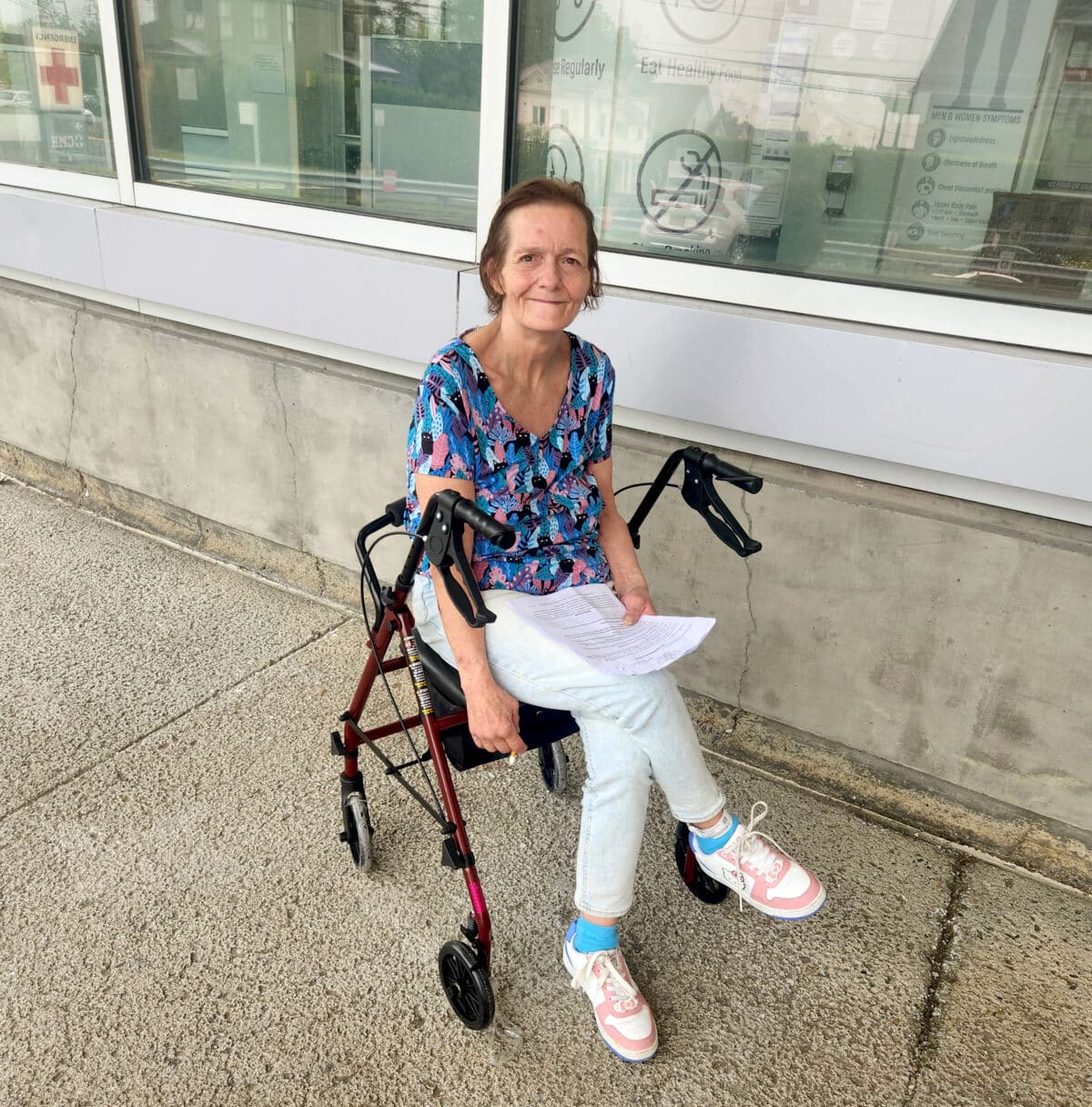
Bari Senecal, 60-something, waits outside the emergency department the morning of August 7 at Columbia Memorial Hospital in the city of Hudson, New York, sitting on her aluminum-frame rollator. Brought by ambulance from the outskirts of Columbia County the night before, she waits for a car service to drive her back. The sky above is hazy with smoke blown in from far-away Canadian forest fires. She drags from a cigarette while she waits.
“I fell three stories,” Senecal explains. “I was on top of the scaffold and this new kid we hired didn’t put the braces on correctly.”
“I do construction,” she adds.
Like 70 million Americans—7.5 million of them in New York State—Senecal qualifies for Medicaid, the state and federally-funded public health insurance program that provides for the care of low-income patients. She also qualifies for Medicare, a health care program intended for those 65 or older or those living with a permanent disability. She’s what’s known as being “dual-eligible.”
Bari Senecal waits for her ride home outside Columbia Memorial Hospital in Hudson, New York. (Rokosz Most)
At Columbia Memorial, 63% of patient service revenue is reimbursed through a combination of the two programs. But reimbursement by the federal government comes up short.
“We still provide care in our communities but we run a deficit every year,” says Dorothy Urschel, CEO of Columbia Memorial Health. “For many, many years, we’ve been reimbursed at well below cost.”
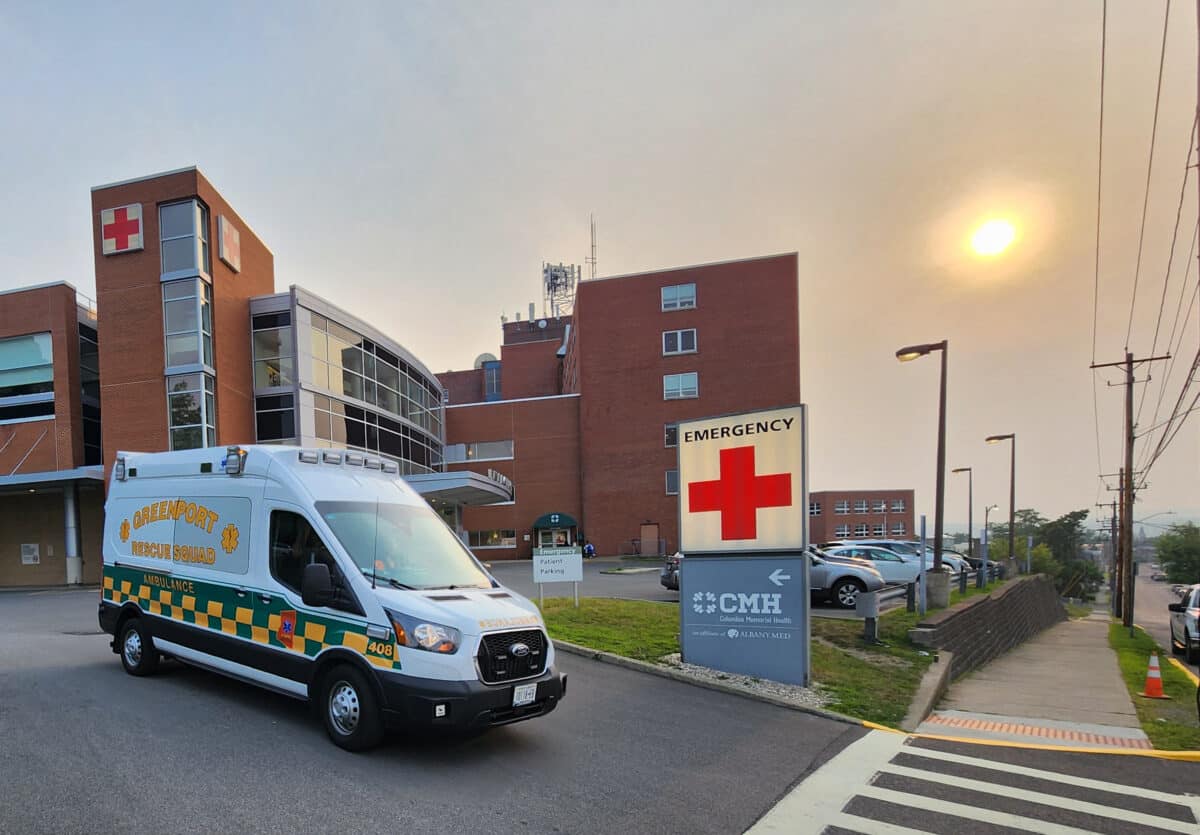
The hospital has the only emergency room serving the more than 110,000 residents scattered among 1,306 square miles in two predominately rural counties separated by the Hudson River south of Albany–Greene County to the west, Columbia County to the east.
Distance from grocery stores and gas stations, distance from schools and bus stops. It also means distance from hospitals.
“When you drive in my community,” says Urschel, “you’re in Hudson-proper and then you’re in farmland. That could mean that a farmer requires health care and he’s 35 minutes away from the hospital. We already have transportation issues. So many of our patients carpool, they get driven or they walk to their appointment.”
What health services are available to rural people are often patchwork. Family care in a strip mall. Medical imaging services in a converted farmhouse. A urologist with an office on a main street one or two towns over.
“Because they can’t get to a local facility, they do not receive the annual preventative care that they should be receiving,” says Urschel.
As a result, when people finally do arrive at Columbia Memorial’s emergency room, they often show up with higher levels of sickness and compounding ailments.
Like other rural hospitals across the country, Columbia Memorial is bracing for the loss of Medicaid-covered patients and funding because of the Republican reconciliation bill, dubbed the “One Big Beautiful Bill Act,” which was signed into law on July 4 by President Donald Trump. According to the nonpartisan Congressional Budget Office, the bill will cut $911 billion in federal Medicaid spending over the next decade and result in an estimated 10.3 million people losing their Medicaid health insurance. Rural areas are expected to lose $137 billion in federal Medicaid spending over the next decade, representing what Larry Levitt, vice president for health policy at the Kaiser Family Foundation, has called “the biggest rollback in federal support for health coverage ever.”
Add in cuts to the Affordable Care Act, the public health care option made available to all 50 states as an alternative to private insurance, and the number of people expected to lose their insurance rises to 16 million. This puts enormous strain on rural hospitals already underpaid by the reimbursements offered by federal health care programs, limited in the services they can provide, frequently understaffed and serving primarily those community-members in or near the verge of poverty.
Although the Senate added $50 billion in funding for a new “rural health transformation program,” it is hardly expected to offset the losses in the bill, which could vary widely from community to community across the country. What’s more, the fund will be temporary, whereas Medicaid coverage is ongoing. Trump-appointee leading the Centers for Medicare and Medicaid Services, Mehmet Oz, will determine how half of the fund will be distributed.
“All of us are trying to assess the impact of the bill,” Urschel says. “As you evaluate this, it could be certainly a devastating impact … but we are not cutting any staff. We are not doing that. Our strategy, along with the ultimate health system, is to continue to offer health care and advance health care in the community.”
Urschel points out that the hospital received a $5-million state grant to expand mental health services at the hospital, increasing the existing 22 inpatient psychiatry beds by 19 additional beds.
Yet, striking the right balance of staffing and providing the services patients need has been difficult for years. As the hospital is the largest employer in either Columbia or Greene County, any cuts to Medicaid could be felt as a one-two punch, with the effects of scaled back services, hours cut or jobs lost rippling throughout the local economy and social fabric. In 2023 more than 30% of residents in Columbia County relied on Medicaid for their healthcare; among children, the numbers jump to more than 40%.
In 2020, Columbia Memorial closed its maternity ward. While Urschel says the decision was based on lack of volume, rather than the motivation of economic stress, over the last two decades, 29 other hospitals in New York have likewise discontinued their labor and delivery services.
Without a hospital to give birth at in either Greene or Columbia counties, pregnant women in Hudson now drive 40 miles north to Albany Medical Center or 26 miles south to Northern Dutchess Hospital to give birth.
A recent study from the Journal of the American Medical Association found that more than half of rural counties now have no hospital-based obstetric services whatsoever.
Obstetrics is one of the most expensive services offered by rural hospitals, and as a result maternity wards are often the first services closed by struggling hospitals.
According to the American Hospital Association, nearly half of all births in rural communities are covered by Medicaid, making maternity care even more vulnerable to the recent Medicaid cuts.
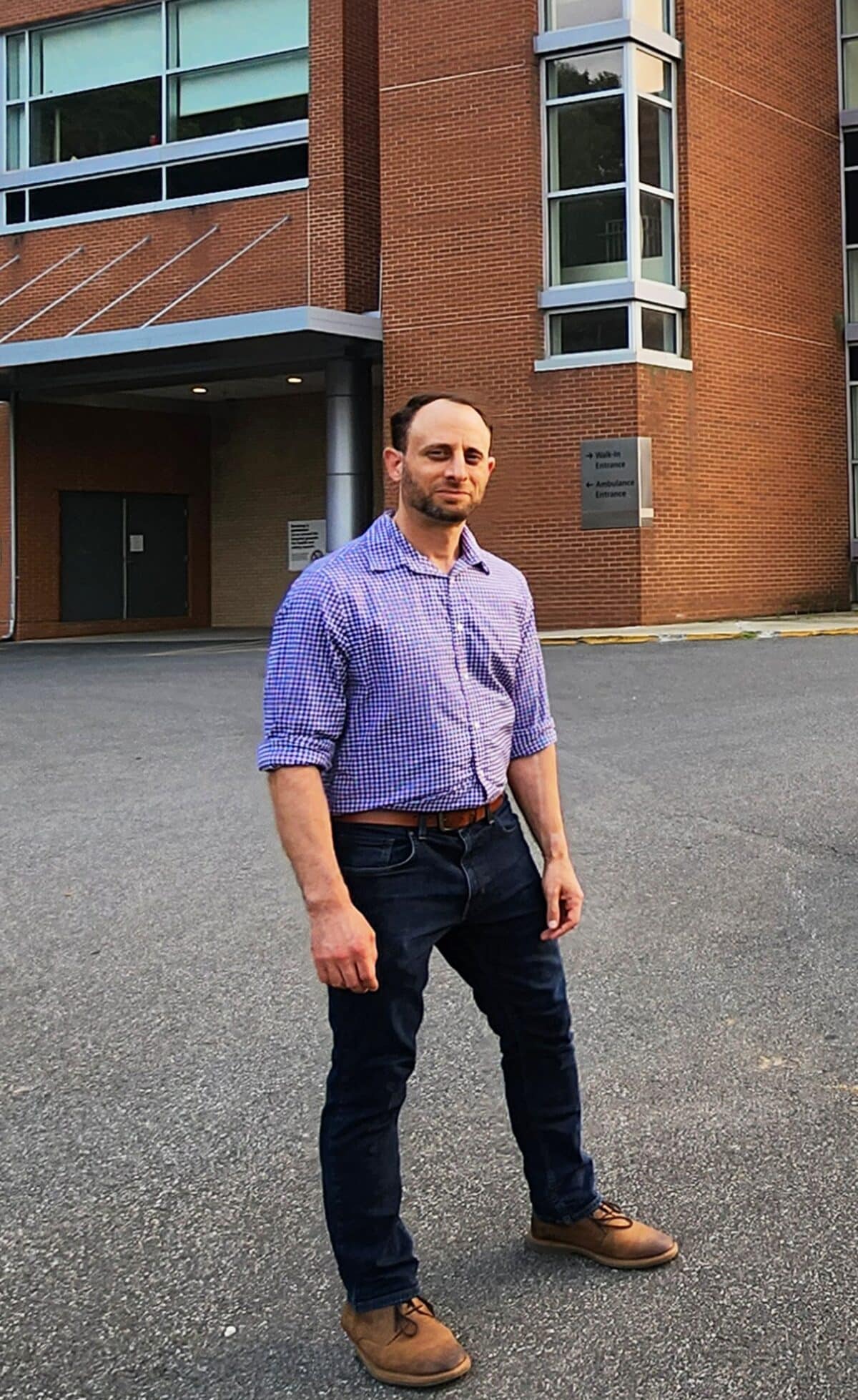
Michael Chameides, deputy minority leader of the Columbia County Board of Supervisors, poses in front of emergency admissions to Columbia Memorial Hospital.(Rokosz Most)
Hector, a nurse at Columbia Memorial who has worked at the hospital for decades, says that seeing the maternity ward go was a wake-up call to the community for services they assumed would always be there. He suspects that inpatient care will be the next shoe to drop. “The ER is always going to be open, but as far as [inpatient] services, there’s going to be changes.”
“A lot of people like to talk about how they were born in the City of Hudson,” says Michael Chameides, deputy minority leader of the Columbia County Board of Supervisors. “But if you’re born in a hospital, you’re no longer born in Hudson.”
For Chameides, the tragedy of the situation facing rural health care systems is that the cuts from the federal government are coming at a time when local communities need those funds the most.
“It’s not that health care was great before,” he says. “Health care was and is a big problem and we need real fixes to the system but they’re just gutting everything. And that’s going to be terrible for the health and safety of our community and the surrounding communities.”
A county committed to “taking care of each other”
Two months into Trump’s second term, Chameides introduced a resolution at a board of supervisors meeting that called on the state’s congressional delegation—two senators and 26 representatives—to oppose any proposed cuts to Medicaid but also to resist all cuts that could threaten a slew of other social services, most prominent among them the Supplemental Nutrition Assistance Program, formerly known as food stamps.
“The vote counts [in Congress] were going to be so close that if our state delegation opposed these devastating cuts,” Chameides recalls, “they wouldn’t happen.”
Less than a month later, on April 9, the Columbia Board of Supervisors, which is controlled by Republicans, passed the resolution unanimously.
Still, by June, when Congress voted on the bill, and with near unanimous Republican support in the House, Trump loyalists in the New York congressional delegation like Reps. Elise Stefanik and Claudia Tenney refused to align themselves with Democrats in order to scuttle the bill. (Tenney, who represents the most Republican district in New York—the 24th—introduced legislation to enshrine Trump’s birthday as a federal holiday.)
“Ultimately they’re pretending as if they’re not doing what they’re doing,” he says, “which was make massive cuts to health care and it’s terrible to see.”
That Chameides could rally unanimous bipartisan support to oppose Trump’s health care cuts speaks volumes about the pragmatic character of leadership in a rural county.
“What I see is that people in the county are generally really committed to taking care of their communities and taking care of each other,” says Chameides. “Ultimately, the county cannot solve the health care crisis on our own. Ultimately, we need federal support, but since we’re not getting it the state does need to step up and show up for working people in the way the federal government is not.”
The delayed-release capsule of federal changes
Five miles east of Hudson, on Highway 217, two dark blue Harvestore silos and a concrete grain silo stand next to a 250-year-old Dutch barn, and between them a greenhouse and a farm store called The Barn at Miller’s Crossing. Across the highway the land has been cleared and there’s a rolling field of sunflowers—acres of bright yellow heads bobbing up and down in the breeze.
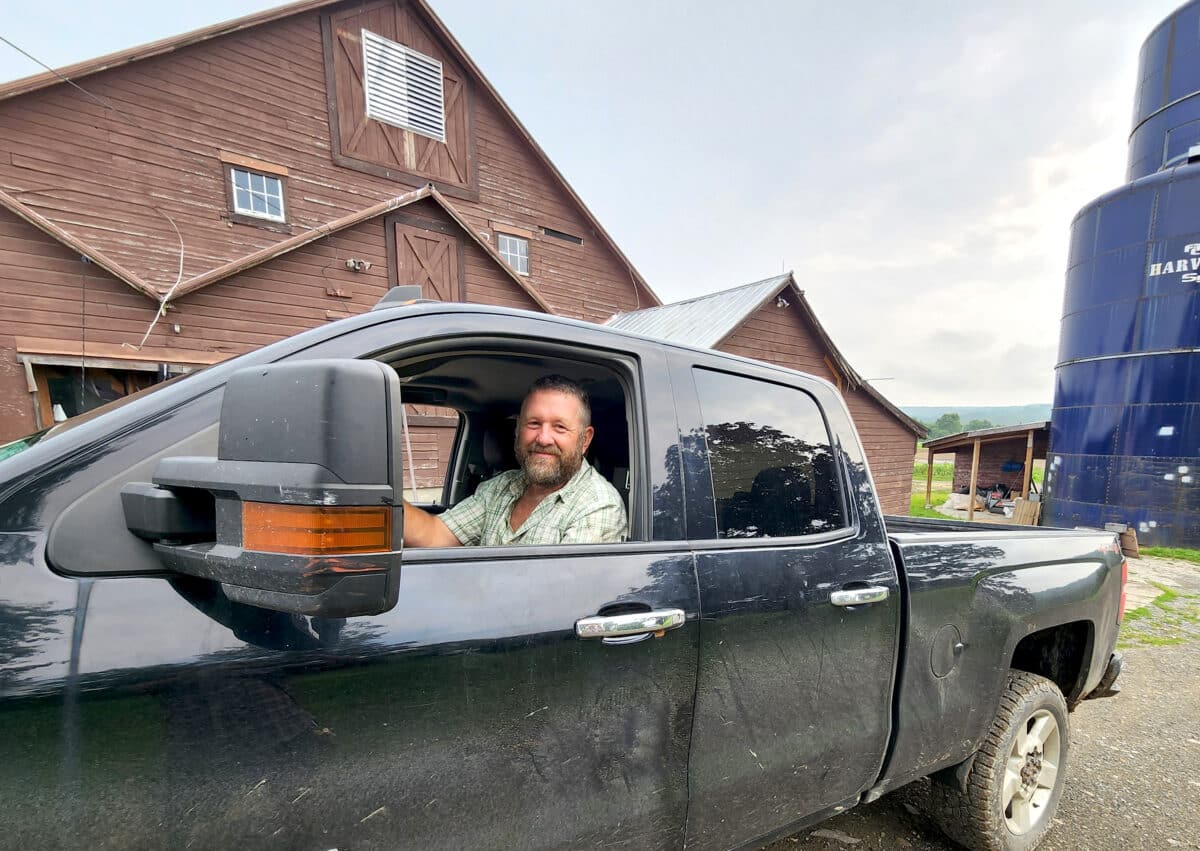
“They’re actually for oil,” says farmer Chris Cashen, speaking from his truck. “We also grow produce and grain, beef and pork and vegetables.”
Chris Cashen’s sunflower field outside Claverack, New York. (Rokosz Most)
His grandparents bought land around here in the late 40s.
Growing up on the border of Claverack, population just under 6,000, when locals catch sight of a medevac helicopter, they know someone is being flown to the Albany Medical Center in the state’s capitol, the closest level one trauma center to Columbia County.
Cashen has heard about the cuts to Medicaid, but on his list of priorities to worry about, the budget of the federal government is far down on the list.
“Just having a regular family doctor consistently has been a real challenge for us. We’ve had four doctors in four years. They’ve all moved on. They won’t stick around,” he says. “So you’re advocating for yourself just to get an annual physical and some blood work to make sure that as I get older and my wife gets older and our kids grow up and go through stuff, we’ve got some baseline.”
Chris Cashen, outside The Barn at Miller’s Crossing in Claverack, New York. (Rokosz Most)
Should Cashen ever become a big consumer of medical care, he allows he might feel differently. “If I were to put myself in the position of, oh, I just got diagnosed with something really tough and now I need to go get some services and then I find out that things have been cut, that would be a problem.”
The GOP, politically astute as to the devastation which the cuts will cause to financially vulnerable communities nationwide, wrote the bill to take effect like a delayed-release drug capsule.
The implementation of the cuts are staggered so that the worst side-effects of the budget changes won’t be felt until after the mid-term elections in 2026 are safely past.
Only then will the concrete data exist to measure the effects of the cuts to Medicaid, Medicare and the Affordable Care Act on the rural population and how the new work requirements will impact Medicaid enrollment.
Democratic party elected officials fear new Medicaid work requirements in the law, whereby all Medicaid recipients must biannually show proof that they are working 80 hours a month before they can receive benefits, will act as an additional barrier to enrollment.
These requirements were tried in Arkansas in 2018- and then abandoned after 18,000 people lost their health coverage and $26 million dollars were added in administrative costs. No meaningful impact on employment was demonstrated.
Additionally, $500 billion in cuts to Medicare are also coming, as United States senator from Massachusetts Ed Markey pointed out in a letter he sent to president Trump, the Speaker of the House Mike Johnson and the Senate Majority Leader John Thune. The half-trillion loss is the result of a budget trimming mechanism baked into the cake, as it were. The process known as sequestration, whereby a certain percentage of federal spending is automatically cancelled, is triggered when deficits are run up and are improperly offset. Those cuts will affect all Medicare recipients.
Neither Trump’s cuts to health care, nor his slash-and-burn campaign ostensibly carried out to find savings across every federal department come anywhere close to making up for the $3.4 trillion his budget added to the national debt. By passing tax cuts primarily benefiting the wealthiest Americans, with no plan on the horizon to make up the shortfall, sequestration will be triggered.
“There are some rural hospitals around the country,” says Chameides, “that have already started closing, anticipating what this is going to mean.”
Hospitals face more uncertainty
Markey’s letter to the Republican trifecta provided a list of 338 rural hospitals in danger of either closing or drastically scaling back services. The 338 hospitals on the list shared two things in common: They had experienced three consecutive years of negative total profit margins, and they were in the top 10% of institutions with patients on Medicaid.
Rural hospitals facing disaster are identified individually according to which state will see the losses. Kentucky, Louisiana and California top the list with 35, 33 and 28 rural hospitals identified as at risk of closure. New York has 11 rural hospitals on that list. Columbia Memorial is not one of them, however Garnet Medical Health Center Catskills, also in the Hudson Valley, is on the list.
An estimated 1,796 hospitals remain in rural America, but those numbers obscure the level at which the services they offer may have already contracted. According to the Government Accountability Office, over the last decade more than 100 rural hospitals have closed across the country, 50 of them in just the last eight years.
In New York, as in every other state, as federal funding relied upon runs dry, it will be up to the governor and legislature to either make provisions for struggling rural hospitals or stand by and watch them collapse.
This article was produced in collaboration with High Country News. It may not be reproduced without express permission from FERN. If you are interested in republishing or reposting this article, please contact info@thefern.org.
It’s hard to remember now — a lot has happened since — but there was a time, back in February and March, when things got rather heated along the traditionally friendly, extremely long and largely unguarded Canada-U.S. border.
In response to President Donald Trump’s tariff threats and talk of annexing Canada, provincial liquor authorities stripped American booze from store shelves. Canadian tourism to the United States plummeted. And British Columbia’s premier, David Eby, threatened to place tolls on commercial trucks traveling from the U.S. through B.C. to Alaska along the Alaska Highway. Doing so would further increase the state’s already high cost of living and possibly disrupt its food supply chain.
The Alaska Highway, or AlCan, was built in 1942 to keep the state supplied and defended in the event of a Japanese attack. Mile Zero is located in the very small city of Dawson Creek on the eastern edge of British Columbia, near the Alberta border. To reach it, Alaska-bound trucks can enter Canada at any of several border crossings in northern Washington, Idaho and Montana; I-5 hits the border at Blaine, Washington, while I-15 arrives at Sweetgrass, Montana. Various highways funnel traffic toward Dawson Creek, the options thinning as drivers head north, until there’s just the one road and the AlCan begins. From there, it climbs north and west to Beaver Creek, Yukon, Canada’s westernmost community, and then crosses the international border, plunging deep into Alaska’s sparsely populated interior before officially dead-ending in the town of Delta Junction — 1,387 miles from Dawson Creek — where it joins the older Richardson Highway to Fairbanks.
I’ve lived alongside the Alaska Highway, where it passes through the Yukon capital of Whitehorse, for most of the past 16 years. The tolls have yet to be implemented — although Eby’s government has created the legislative framework to do so — but I was fascinated by the threat, and by the paradox of a road built for Alaska’s defense transformed into a glaring weakness by unpredictable foreign relations. I pictured Alaska as a balloon bobbing at the end of a very long string, with Canada, an unexpected adversary, wielding a pair of scissors.
Getting fresh food to Alaska has been a challenge since the first settlers began scratching in the creek beds for gold. It was just too far from the continent’s more populated areas, separated from the contiguous United States by cold, stormy seas and, on the few precarious overland routes, avalanche-prone mountain passes. During the Klondike Gold Rush in the late 1890s, authorities feared that the hordes of prospectors would starve, and stories from that time — almost legends at this point — depict entrepreneurial types struggling to bring unbroken eggs all the way to the Yukon gold fields or herd reluctant cattle over Alaska’s Coast Range. Thirteen decades later, the challenges remain. Alaska’s food prices are second only to Hawai’i’s. One recent federal study found that prices in Anchorage were 36% higher on average than those in the Lower 48. A 2023 report commissioned by the Federal Emergency Management Agency (FEMA) described Alaska’s food supply chain as “unique and vulnerable to disruption.”
Stay in the Loop!
Don’t miss FERN’s latest revelations, developments, and initiatives. Sign up for our newsletter and we guarantee you’ll never miss one of our stories.
I wasn’t the only one surprised by Eby’s apparent willingness to threaten that supply chain — to hit Alaskans in the gut. “It’s going to be a big deal,” Alaska state Sen. Robert Myers, R, who also works as a commercial trucker, told the Alaska Beacon. “Fresh produce — the vast majority of our fresh produce … gets trucked up. If you want to get something up here fast, you put it on a truck, not a barge.”
The truth is, Canada doesn’t have nearly as much power over Alaska’s food supply as Myers or I assumed. The supply chain was never just a long thin string. It’s actually more of a tangled ball of yarn, and the Alaska Highway, it turns out, is just one thread.
There’s no doubt that trucking is the fastest long-haul option. No railroad connects Alaska and the Lower 48, and air freight is financially viable for only a few high-end commodities — non-Alaskan seafood, say, and time-sensitive produce like cherries. It takes around 40 hours of nonstop driving to cover the more than 2,200 highway miles from Seattle to Fairbanks via the AlCan. Even factoring in some halfway-decent rest time for the driver, that’s still a lot quicker than the several-days-long container-ship-to-port-to-truck relay that moves goods to Fairbanks from the Port of Tacoma through Anchorage. But I wanted to confirm that assumption, and to know how much food actually came up the highway every year. I had visions of digging up delightful trivia: How many thousands of gallons of milk bounced over potholes to Alaska each year? How many loaves of bread?
I reached out to the Yukon Department of Highways and Public Works, which oversees the highway weigh station in Whitehorse that I’ve cycled and driven past countless times. The department replied apologetically that it didn’t have the data I wanted; it tracks cargo by weight, dimension and destination, but not by content. U.S. Customs and Border Protection couldn’t help either, I was told, because freight traveling through Canada to Alaska was considered neither an export nor an import, but rather “domestic in-transit freight,” and its contents were not inventoried at the border. The Canada Border Services Agency directed me to Statistics Canada, which didn’t keep data on such in-transit goods either.
These agencies did, however, share a few data points. Customs and Border Protection told me that in fiscal year 2024, 8,298 commercial freight-hauling trucks entered Alaska from the Yukon. That’s fewer than 23 trucks per day — not nearly enough to account for the roughly $2 billion worth of food that enters the state annually to feed its nearly 750,000 residents. Meanwhile, Statistics Canada was able to give me details on the foods that Canada exports directly to Alaska, as opposed to those it simply allows to pass through. In 2024, that list included salmon (fresh, frozen and smoked), cattle and buffalo, honey and seed potatoes, dried peas and lentils, cranberries and cumin, and an assortment of grains — durum wheat, barley, oats and malt. (It also included “caviar substitutes, prepared from fish eggs other than sturgeon,” and even Communion wafers. You’re welcome, Alaska.)
I also contacted several grocery chains with multiple stores in Alaska, to see if they could tell me how much food they were bringing up the highway. I emailed the Alaska Commercial Company, Fred Meyer (via parent company Kroger), Carrs-Safeway (via parent company Albertsons), and Three Bears, but no one responded with the data I was looking for. It wasn’t until I talked to a woman named Kelly, who works in deliveries but wasn’t authorized to speak to me by her employer, a major grocery chain, that I realized the highway was something of a red herring. “I can’t speak for every grocery store,” she said, but “our stuff comes up on the barge, the vast majority of it.” They used to do more trucking, she explained, but despite its slower pace, shipping had proven consistently more reliable. Highway delays caused meat and milk to spoil, in particular, so they basically phased that out.
Rachel Lord, the advocacy and policy director for the Alaska Food Policy Council, confirmed Kelly’s comments. There are exceptions, she told me in a Zoom call from her office in Homer, but most of the state’s imported food now comes by container ship from Tacoma.
I told Lord that I had been struggling to find solid data on food imports, and she laughed. “It’s not you, it’s all of us,” she said. The data as I envisioned it — so many thousands of gallons of milk, so many loaves of bread — doesn’t yet exist in any coherent way. “It’s not there.”
It’s commonly said, for example, that 95% of Alaska’s food is imported. “There are no data citations you can pull for that,” Lord said. “It was mentioned by somebody at some point in some report, but there were no data citations associated with that, right? It’s a feeling, it’s probably fairly accurate, but it’s not — it’s just made up. But we can say the vast majority of the food that Alaskans buy at a store is imported from outside. That is solid.”
Hillary Palmeris an Alaska-based program manager at Dewberry, a national design, planning and construction firm. She was the Alaska lead on the 2023 report commissioned by FEMA, so she has about as firm a grasp as anyone of just how vulnerable Alaska’s food supply chain is, and where its weak points lie.
According to Palmer’s report, roughly 4% of Alaska’s imported food comes via the AlCan. Walmart hauls a good chunk of that 4%, trucking its fresh meat and produce from Washington to seven of its nine Alaska locations. (Walmart’s Ketchikan and Kodiak stores are not on the road network.) “They haul with two drivers,” Palmer told me, “so that one can be sleeping while the other is driving.” Walmart has also developed specialized equipment to help protect the trucks’ chassis from frost heaves and other cold-weather damage to the road. Walmart’s team knows where the reliable refueling stops are located along the most remote stretches of the highway, and the drivers haul their own backup fuel, just in case.
But the retail behemoth is an outlier. Most of the rest of the state’s imported food comes by sea — and that brings its own logistical challenges.
In broad strokes, Alaska’s food supply chain currently looks like this. It’s important to remember that imports from the Lower 48, Canada, Mexico and elsewhere are only one piece of the picture — a big slice, but not the whole pie. “A huge amount of, especially rural Alaska, has subsistence wild foods that they rely on,” Rachel Lord says. That means salmon, of course, and caribou, and other fish and game, as well as foraged berries and plants and more. (Palmer’s report found that 65% of all the state’s residents, and 98% of the rural ones, engage in some form of subsistence food-gathering. Rural Alaskans, for whom rates of food insecurity can be twice as high as those living closer to cities and major roads, each harvest on average 300 pounds of wild food each year. Altogether, Alaskans consume somewhere between $450 million to $900 million worth of wild foods every year.)
And there’s been a surge of new farms in the state as well: The number grew by 30% from 2012 to 2017 in Alaska, while the United States as a whole saw a 3% decline. “We can’t grow avocados, but we can grow a lot,” said Lord — everything from livestock feed to fruits and vegetables, the latter sometimes supported by greenhouses or hydroponic systems. Alaska-raised meats and aquaculture products, like oysters, also are available, and there’s even a handful of vineyards.
But the traditional subsistence foods that nourished Alaska Natives for thousands of years before the gold-seekers arrived are beset by climate change and other man-made stressors, such as industrial fishing and habitat destruction from mining. And while the state’s agricultural sector is growing, it’s a long way from being able to replace all food imports; 43% of the state’s farms are less than 10 acres in size.
Which brings us back to the imports, what bush Alaskans sometimes call “store food.” Imports generally depart from the Port of Tacoma in Washington and spread out in three directions. Unalaska, in the Aleutian chain, receives direct shipments from Washington and then serves as a transport hub for southwest Alaska. Southeast Alaska, too, has a direct line to Tacoma, with shipments to Ketchikan, Juneau and beyond. But the vast majority of shipping crosses the Gulf of Alaska and heads for the Port of Alaska in Anchorage, where more than half the state’s population lives. Two large container shipping companies, TOTE and Matson, do the hauling, with deliveries arriving twice a week, and a complex network of barges, trucks and planes takes it from there, spooling out across the state’s vast interior.
“We are a ship-to-shelf state,” Lord said. “So when food comes into the port and goes out, it is, I’ve heard, anywhere from three to seven days’ worth of food. That is an extreme vulnerability.” (Kelly, the longtime grocery worker, agrees. “I have seen people on Facebook say, ‘Oh, surely they have stuff in the back room,’” she told me. “Well, we have a couple days’ worth.”)
In the Lower 48, by contrast, food is collected in regional distribution centers — whether it came from U.S. fields, off trucks from Mexico or elsewhere in the Americas, or by ship from Europe or Asia — before being doled out to individual stores, according to Benjamin Lorr, the author of The Secret Life of Groceries. Alaska lacks that middle step; even Hawai’i, in comparison, keeps up to two weeks’ worth of food in its warehouses at any given time.
Keeping Alaska’s supply chain healthy is a shared effort — a civic project. And … it seems to me that the biggest threat it faces is not some Canadian political bluster, but a failure to understand, and support, the role of public works and collective interventions in keeping the state fed.
Once the food has made its way to Alaska, whether by sea or by land, it faces a whole new tangle of logistical challenges. While a solid majority of Alaskans live along the state’s sparse road network, mostly concentrated in greater Anchorage, its semi-rural suburbs in the Mat-Su Borough, and in greater Fairbanks, 82% of the state’s communities are not reachable by road. The systems that carry food across all that land and water are vulnerable in myriad ways. Many small, fly-in communities are eligible for a subsidized air freight program administered by the U.S. Postal Service. Bypass Mail, as it’s called, is a lifeline — but it’s also, as Mike Jones, an economist at the University of Alaska Anchorage, explained, susceptible to delays and spoilage. As the food gets transferred from larger air carriers to much smaller ones, making its way from, say, Anchorage to Nome and then on to an array of often-icebound coastal villages, it sits in hangars and on airstrips. And sometimes it freezes. Or thaws. Or just goes off.
I’ve visited a few of those communities, with their thinly stocked store shelves and stratospheric prices. I’ve even been an ad hoc fruit-and-veg mule myself, hauling strawberries and kale salads and other produce onto passenger flights for the people I was visiting. I thought I understood the difficulties. But the system was even more precarious than I’d imagined.
The list of potential obstacles that Alaska’s incoming food must clear before it lands on anyone’s plate was dizzying. Palmer’s report grappled with everything from earthquakes, tsunamis and avalanches to cybersecurity, fuel availability and wildfires.
It struck me that, for a state where many residents pride themselves on their self-sufficiency — and Alaskans in general are some of the most quietly competent and resourceful folks I’ve ever met — their food supply was unusually dependent on public infrastructure. Down South, private sector producers might rely mainly on a functioning road network to get their food to private retailers. But in Alaska, so much more was in play, across ocean, land and air.
Keeping Alaska’s supply chain healthy is a shared effort — a civic project. And I might be biased, given my position on the other side of the border, but it seems to me that the biggest threat it faces is not some Canadian political bluster, but a failure to understand, and support, the role of public works and collective interventions in keeping the state fed. The Alaska Highway was, famously, completed in a matter of months. But the unglamorous task of maintaining port pilings and shipping berths, of filling potholes and keeping remote airport weather stations online, of caring for the herds of wild ungulates and schools of fish that feed people far from the nearest big-box grocery store — that work never ends.
Help us keep digging!
FERN is a nonprofit and relies on the generosity of our readers. Please consider making a donation to support our work.
Adirondack educators are finding new ways to serve students—and do more with less
By Brenne Sheehan
In 1997, Julie Bisselle landed her first full-time teaching position at Westport Central School. At that time, scoring a teaching job was cutthroat—more than 40 applicants applied.
A native of Watertown, she had never heard of the tiny Champlain Valley town, which at the time had 279 students K–12. While she never particularly imagined herself working in such a rural area, she decided to give the interview a shot.
“I called my father, who did shift work, and asked him what day he could drive me down to this town,” she said.” I knew it was kind of near Vermont, and they knew Vermont, so my entire family drove me to my job interview,” Bisselle said, who added she planned to change into interview clothes as a nearby gas station, only to discover there weren’t any to be found.
Since that time almost 30 years ago, Bisselle has set her roots in Westport, meeting her husband and having four children of her own. During her tenure, she has switched from teaching third, fourth and fifth grades to kindergarten for 20 years and fourth grade for the past three years.
Bisselle also faced an experience common among Adirondack educators: adjusting to a shrinking number of students. In her first few years, Westport Central School experimented with mixed-grade classrooms—at one point, she taught a combined fourth and fifth grade class. And in 2019, her school merged with Elizabethtown Central to form Boquet Valley Central School District.
Public school enrollment in the Adirondack Park’s 52 school districts has dropped an average of 41% since 1980, according to New York Department of Education data.
Boquet Valley has had a nearly 50% decline in students from its communities of Elizabethtown, Lewis and Westport since 1980.
Adirondack schools that have been hit the hardest during the past 45 years include Newcomb Central School, which went from 183 students to 49 (a 74% drop), and Clifton-Fine Central School District, which lost 570 students, going from 815 to 260, a 70% decline. Since 1980, three school districts in the Adirondack Park have dissolved: Inlet, Piseco and Raquette Lake. All three are in Hamilton County, which had a total of 380 students county-wide in K–12 in 2024.
If trends of the past 19 years continue, the Adirondack Park could lose 6,660 more students by 2034.
A combination of factors
Dave Little, the executive director of the Rural Schools Association of New York, said drops in enrollment are not the fault of Adirondack schools. Instead, it is a combination of external factors: a lack of affordable housing, an aging population and a greater outward migration of people out of Upstate New York.
“If you’re from a rural area and you’ve gone out of state to go to college, you’re probably not coming back because you’re going to pay off student loans and your pay is going to be lower working up here,” Little said. “We lost what we lost in rural New York during the Great Recession, all of those local businesses that people could come home to.”
Shrinking schools like Minerva, which has lost almost 55% of its enrollment since 1980, now rely on just one teacher per core subject—math, science, English and social studies—for grades 7–12. At relatively larger schools like Lake George, where enrollment has dropped almost 50% since 1980, staff often take on new certifications to meet shifting student needs and avoid staffing cuts.
Issues of enrollment, retention and inequitable funding will continue to amplify as enrollment shrinks, said Little—leading to fewer teachers, fewer students and, in a worse-case-scenario, fewer schools.
With a Zillow median home price of $521,870, school district Superintendent John Luthringer has seen firsthand how the high cost of living has limited the ability to attract young families.
And schools are not just losing students, they are losing educators, too. As affordable housing becomes less available, teachers hired at Boquet Valley have had to step out of their position because they are not able to find a place to live, according to Superintendent Josh Meyer.
Making do with less
Rural schools are underfunded, Little said, in part because New York relies more on local property taxes than most states—leaving rural Adirondack districts heavily dependent on state Foundation Aid, which is tied to factors like enrollment rather than the school district’s needs.
Board of Regents member Roger Catania argued funding formulas often overlook a basic reality: every district has a minimum cost to operate, no matter how small. This gap comes in a state that spends more on education than any other in the country.
Graphic by Brenne Sheehan
“There are people who just don’t see funding for rural schools as being worth it,” Catania said. “We don’t always calculate that in our rural school districts. This needs to be a part of more conversations about Foundation Aid, and the way our state funds public schools.”
But for Catania, who joined the Board of Regents in 2022 after advocating for the needs of rural schools in the North Country as a former Lake Placid superintendent, the future of Adirondack schools is optimistic. While enrollment goes down, community efforts to combat stemming issues of housing and affordability are proliferating. And schools are doing everything they can to stay open and provide quality education to students.
Catania added that even by the numbers, rural schools in the park are performing well.
NYSED’s Core High School Weighted Performance Index is a 250-point formula that scales the performance of students in combined subjects of English language arts, math, science and social studies grades 7–12. And, in 2024, school districts within the blue line scored an average of 121.3—about 30 points higher than the state average. The average high school graduation rate for Adirondack schools is 89.4%, which is 3% higher than the state average.
“A lot of our school districts in this region in particular are doing well with low-income students,” Catania said. “I think that has a lot to do with the community-like nature of small schools.”
The quality of Adirondack education does not just speak in numbers and assessments—superintendents, teachers and community members across the park are proud of their local rural schools. But despite making the most of what they have, Adirondack schools feel they are too often overlooked at the state level. Rural educators feel they should play a bigger role in state-level decision-making, especially when it comes to the 2022 state electric school bus mandate (see page 5 for more), foundation aid and other sweeping regulations.
“Just because we’re in an area that doesn’t have a lot of people doesn’t mean that those students don’t deserve a good education too,” said Robert Kirker, the only 7–12 English teacher at Minerva. “I’m really proud of the work that we do, because I think we graduate a lot of students that would get lost in a larger school. They would just be numbers, but here they get personal attention and get that diploma, where they might not be successful otherwise.”
Graphic by Brenne Sheehan
Seeing smallness as an asset
When a student at Minerva needs money to attend one of the school’s senior class trips to Ireland or Iceland, the community comes together and sets up a GoFundMe. When a student at Long Lake is having a hard time, their classmates show up with what Long Lake Superintendent and Principal Camille Harrelson calls a “culture of kindness.” Students at Lake George are almost always involved in one of the school’s large sports programs consisting of 37 sports, and students at Boquet Valley have the chance to compete in the district’s traveling robotics team.
When it comes to serving students, small schools are able to provide more for their students with intimate, one-on-one education, according to educators.
For Bisselle, teaching at a rural school allows her more flexibility than larger public schools—she can make snacks for students, develop her own curriculum and plan unique field trips such as cross-country skiing and archaeological site visits for her fourth graders.
For Kirker, even though he is not able to provide a wide variety of electives for his students because of his stretch across six grade levels, he is able to modify his curriculum to the needs of his students. So while he teaches required material for supplement state-mandated Regents testing, he is able to develop flash fiction units and special readings.
“I really like both the kind of relationships I can have with students at a small school, but also the freedom that I have to control what I do in my classroom. And that’s not something you always have depending on where you work.”
Teachers in these rural schools are willing to put in the work—wearing many different hats to meet additional needs. For Kirker, that means serving in several different positions in Minerva’s teacher’s union and advising the culture club, Quizbowl team and literature magazine. For teachers at Lake George and Minerva, it could mean acquiring additional certifications to teach a new subject or a special needs class to avoid the expenditure of a new employee position.
Graphic by Brenne Sheehan
Building strength through shared services
A response many districts are taking to address declining enrollment is “regionalization.”
The term conjures images of multi-merged districts, long bus routes and a lost sense of central community. But for many Adirondack districts, regionalization is about sharing resources while keeping their individual schools.
For Turina Parker, the superintendent of the Warren-Hamilton-Washington-Saratoga-Essex BOCES, which consists of 31 school districts in and around the park, regionalization often manifests within her organization’s training programs and professional development.
“One of the answers to declining enrollment is constantly looking for ways to optimize our service to students,” Parker said. “It’s one of the things that we continue to take a look at for all of our districts: How do we capitalize on the opportunities that are available and in front of us, and how do we continue to work together to provide opportunities for all of our students? I think it’s a question that we continue to ask and answer with innovation.”
For many Adirondack schools, this means sharing sports teams, clubs and special education programs with neighboring districts. Lake George combines its football team with Bolton and Warrensburg. Long Lake and Indian Lake central school districts share all sports, as does Minerva and Johnsburg.
Putnam Central School District, the smallest district in the Adirondack Park and serving only K–6 grades, sends its upper-level students to Ticonderoga Central School District by paying for their tuition. For professional development, staff in Indian Lake, Johnsburg, Long Lake, Minerva, Newcomb, North Warren, Schroon Lake and Warrensburg team up to share costs of training events and other resources.
“Sharing services and staff, shared field trips, that’s what I think of when I think of regionalization,” said Harrelson, of Long Lake. “I think people are afraid that it means that they’re going to merge all of us into one big conglomerate school district. And that’s just not the discussion that was had at the tables that I was at.”
Regionalization distinguishes itself from a district merger, which Boquet Valley did in 2019 between the Elizabethtown-Lewis and Westport districts. Despite some community opposition, Meyer, the district’s superintendent, remains a proponent of the merger. Operating as a combined high school has allowed them to offer a wider array of courses to students in grades 7–12 and lower their cost-per-pupil spending.
Graphic by Brenne Sheehan
“This was not a unanimous decision. There were plenty of negative voices that the districts potentially could be better off on their own,” Meyer said. “I think that both districts would have really struggled anyway without merging, both financially and in terms of enrollment.”
Sometimes, communities reject mergers. This was the case for Minerva, whose school board unanimously voted against a merger with neighboring Johnsburg. Minerva Superintendent Candice Husson said many in her community feared the merger would erase their local identity, because Minerva students would likely have to attend school in Johnsburg’s building.
“Ultimately our board voted not to move forward, because they just are very worried about losing this central piece of our community,” Husson said. “And then, if the school goes away, what happens to the community if we don’t have the school? We just have something special here, and they weren’t ready to sacrifice what we’re able to offer our students just to have more students in one building.”
At top: Photo illustration by Kelly Hofschneider
Don’t miss out
This article first appeared in a recent issue of Adirondack Explorer magazine.
Subscribe today to get 7 issues a year delivered to your mailbox and/or inbox!
New York school districts must begin to enforce their own local version of the cell phone ban on day one of the upcoming school year — for ICSD, Sept. 4.
The new law bars public school students from accessing their smartphones and other internet-enabled devices through the duration of the school day. While the state dictates the main elements of the ban, school administrators must determine how it will be implemented locally.
School districts will determine how students’ devices will be stored, alternate methods for students and families to contact each other, exceptions to the policy and enforcement strategies.
The state law allows for certain exceptions. Devices used for translation by students not yet fluent in English, internet enabled medical devices and simple, non-internet enabled phones are still allowed, among other things.
The first day of school represents the date upon which enforcement must begin, but districts also had an Aug. 1 deadline to submit their localized policies to the state for review. As of Aug. 21, the Ithaca City School District is among the handful of districts that have not yet done so, according to a state database. The database shows only a generic, placeholder policy for ICSD.
Ithaca City School District Board of Education members were meant to discuss and vote on the policy during their Aug. 12 meeting, but opted to postpone the vote another two weeks. During the meeting, board members questioned whether the district’s proposed strategy for storing students’ phones would be sufficient.
The draft policy does not specify a particular method of storing or handling student devices, only that “options will include, but are not limited to the following: school-issued secure pouches/containers, secured lockers, and/or administrative office storage.”
Administrators said the policy is separate from the district’s implementation plan, which would outline specific details such as storage options. A draft of the written implementation plan was not included in the public documents for the Aug. 12 meeting.
At the meeting, administrators outlined a plan that would allow students to remain in physical possession of their devices so long as they are stowed in a special pouch provided by the district. District leaders said they had already purchased about 2,000 of the pouches, which block cell signals and have a velcro closure.
School board member Todd Fox said he didn’t think the velcro alone would be enough to stop students from using their phones during the school day.
“I’m trying to be pragmatic,” Fox said. “[These pouches] seem like an adult solution to a kid’s problem. Kids are going to be like, ‘Are you kidding me? I’m not using this.’ I feel like the district’s gonna spend all this money on these things, and no one’s ever going to use them.”
An administrator said the sound of the velcro closure would at least allow school staff to detect when a student opens a pouch. The district’s proposal also includes an escalating set of disciplinary measures for students who violate the ban.
Administrators said the district had considered purchasing more sophisticated signal-blocking pouches with a magnetic locking mechanism, but ultimately decided against it. The mechanism is similar to the magnetic anti-theft tags employed by some clothing retailers.
“What we’ve also learned is that students are incredibly clever,” one administrator said. “In at least one district, a student, I think, for the total cost of maybe $6, ordered a magnet unlocking device online and had themselves a nice side business unlocking other students’ pouches.”
Signal-blocking, magnetic locking pouches from one popular manufacturer cost about $30 each. ICSD administrators said the signal-blocking velcro pouches they purchased cost about $20 each.
School districts will receive some state funds to implement the ban based on the number of middle and high school students within the district. ICSD will receive a little over $10 per student.
An administrator said ICSD wanted to provide a way for students to securely store their phones while blocking distractions, as opposed to taking possession of the phones during the school day. Several school leaders said they felt the district would be taking on too much legal liability by taking possession of students’ phones and other devices.
Other school districts in the county plan to take different approaches: Trumansburg Central School District is asking students to store their silenced phones in their personal lockers. Students in Dryden will store their powered-off phones in district-provided magnetic locking cases that cost about $14 each, but do not block cell signals.
Newfield Central School District previously banned smartphones in 2023. At the time the policy was implemented, students were asked simply to power off devices and keep them out of sight through the school day. Teachers have permission to confiscate devices should students violate the policy.
Ithaca Teachers Association President Kathryn Cernera said she felt it was important to make clear that the responsibility to enforce the policy ultimately should lie with administrators, not teachers. The draft policy states that “teachers and staff are expected to play a limited but important role” in enforcement.
Several teachers said they felt the best solution would be to physically separate students from their devices during the school day. Some said that they weren’t certain that the velcro pouches would comply with the spirit of the law.
Guidance from the New York State Education Department states that the intent of the law is to “restrict access by students to devices for non-permitted reasons” and that it was the department’s understanding that “only using backpacks/bags would not be sufficient.”
School board president Sean Eversley-Bradwell said he felt the velcro pouches were not perfect but were preferable to the alternatives he and fellow board member Emily Workman had considered.
“I don’t think right now we have a perfect solution,” Bradwell said. “What I do feel compelled to say is that any policy could be revised and updated as we go throughout the year.”
Bradwell and Workman are members of the board’s policy committee, which was responsible for developing the draft cell phone ban policy alongside district administrators.
ICSD board members are set to take a final vote on the cell phone policy during their Aug. 26 board meeting.
Goodman Mountain: A civil rights pioneer’s enduring legacy in the Adirondacks
From family retreat to public trail: A mountain’s transformation into a civil rights memorial
The little peak near Tupper Lake has gained an unfortunate measure of fame lately due to its closure since early Junein deference to a young bull moose that took up stubborn residence in proximity to the mountain’s hiking trail.
The moose has since been euthanized due to its deteriorating health, and the trail remains closed with the Department of Environmental Conservation unsure when this 2,174-foot mountain—part of the Tupper Triad hiking challenge—might reopen .
But Goodman Mountain has to be considered among the most significant in the annals of Adirondack nomenclature, connecting a tragic moment in American history with happier circumstances in the mountain wilderness.
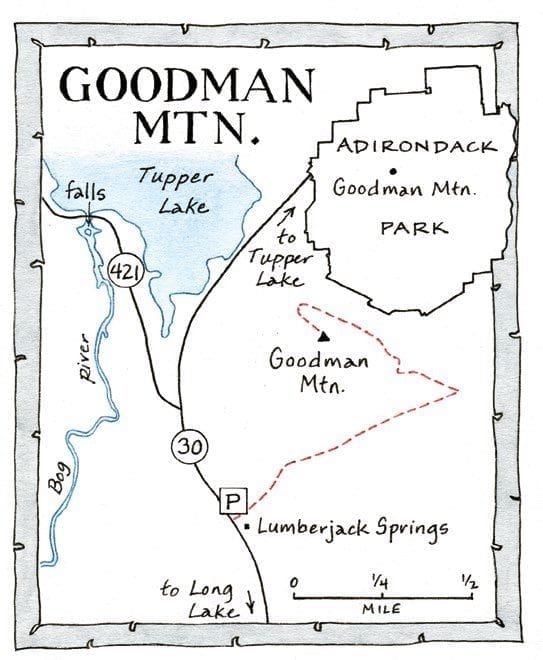
Map by Nancy Burnstein
The story goes back nearly a century when a New York City contractor named Charles Goodman—whose firm worked on projects including the New York subway, George Washington Bridge and Lincoln Tunnel—assembled a work crew of stone masons in 1933 and built a granite cottage on 644 acres south of Tupper Lake.
From the shoreline, the mountain previously known as Litchfield, now known as Goodman,dominated the view and became a family bushwhacking favorite, as Goodman’s grandsons David, Andrew and Jonathan tacked lids from soup cans onto trees to mark the route.
”We saw deer, bear, everything,” David Goodman told The New York Times in 2002. ”But we never, ever saw a human being other than a Goodman.”
The Goodmans painted their name on the bare rock of the summit where, for all they could tell, they were on top of the world. The paint has faded over the years, but not the name.
In 1964 the nation was stunned when Andrew—who had left the comforts of New York wealth to venture south to help register Black voters—was one of three young men murdered by the Ku Klux Klan—aided by the Neshoba County Sheriff ’s Department—on a deserted country road in Mississippi and buried in the red clay of an earthen dam.
Goodman was not yet 21, but his activism had taken him to Washington, D.C., at age 14 to participate in the 1958 Youth March for Integrated Schools, as well as West Virginia to advocate better working conditions for coal miners and to Western Europe to study the detrimental effects of agribusiness on small farmers.
The slow pace of integration was a constant frustration to him, and in part he blamed white Northerners for being so “shockingly apathetic.”
His death, along with fellow activists James Chaney and Michael Schwerner, added much-needed urgency to the fight, and the publicity surrounding the disappearance of the young freedom fighter is credited with helping to pass the 1964 Civil Rights Act, even before the bodies of the three men had been found. The story was later dramatized in the 1988 film, “Mississippi Burning.”
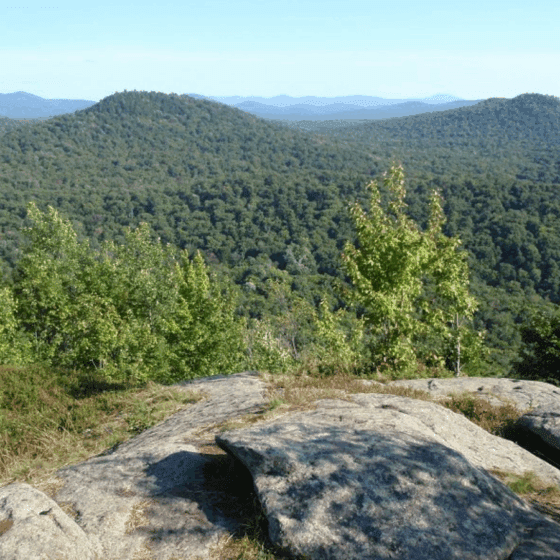
View south from the summit. Photo by Phil Brown.
Preserving a legacy
Back in Tupper Lake, the late village historian Bill Frenette did not want the memory to fade like the name painted onto the summit rock so many years ago. In 2002, he successfully petitioned the U.S. Board on Geographic Names to have the name officially appear as Goodman Mountain.
Next, advocates, including Frenette and David Goodman, approached the Department of Environmental Conservation about the possibility of a formal trail to the summit. “I immediately thought it was a great idea, and a wonderful way to celebrate a life that had been cut very tragically short,” said then-DEC Commissioner Joe Martens.
The ceremonial opening of the trail in 2014 coincided with the 50th anniversary of Andrew Goodman’s death. “It was a great and beautiful day,” Martens recalled, “and probably 40 or 50 people showed up for the event, and most of them hiked up the mountain with me. So it was one of those nice things that I did when I was commissioner that I’m very proud of.”
Today, hikers are greeted with a trailhead kiosk outlining Andrew’s story, as well as some interesting details from even farther back in time when the area was a popular watering hole in the 1800s for horse-drawn wagons and stagecoaches.
A short, separate little trail leads to the Lumberjack’s Spring, whose springhouse was restored by the Goodmans—one of many community improvements they bestowed upon the community.
Oddly, the first half of the 1.5-mile trail to the top is pavement covered with a patina of duff—this was the historic highway from Long Lake to Tupper Lake before the improved highway was built closer to the lake.
The second half of the hike is steeper and rockier, the reward being expansive open views of the lakes and mountains to the south.
In its trail description, Protect the Adirondacks also advocates using the time to take a broader view of the fight for social justice as well: “Goodman’s remembrance on the mountain urges hikers to reflect on the history of racism in the outdoors, the historical links between police forces and racism, and the countless Black activists and peoples whose memories do not have the privilege of living on publicly.”
That’s what those who petitioned for the name had hoped. As Frenette told the Times, “I would like to think people will look at it and say, ‘That’s Goodman Mountain,’ and have it ring a bell that it’s the mountain loved by the wealthy kid who gave up his life to help people in Mississippi.”
Photo at top: David Goodman at the Goodman Mountain trailhead. Photo by Phil Brown