
WJFF Radio Catskill
In rural Northern New York, drag culture breaks down barriers
Performers defy small-town stereotypes, blend artistry, resilience and community one show at a time
By David Escobar
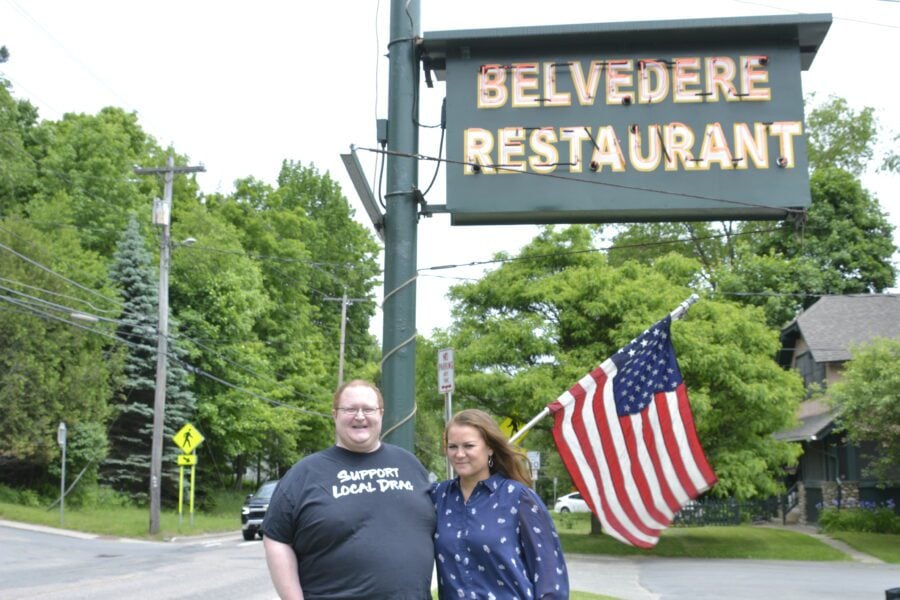
Everything about the Belvedere Restaurant feels like a time capsule of Saranac Lake’s storied history. With antique wood-paneled walls inside, a towering neon sign out front and classic Italian offerings on the menu, little has changed since it opened in 1933.
But every few months, the dining room transforms into a stage for something unexpected in a small Adirondack town—a drag brunch featuring local and traveling performers.
Aside from a handful of Pride Month celebrations in June, dedicated spaces for drag performances are rare in the North Country. So artists like George Connelly, a drag queen who performs under the name Victoria Bohmore, have been creating their own—in bars, restaurants and theaters across the region.
“Doing [drag] out in a small rural community, or a small town like this, I think is more important,” said Connelly. “It gives you the chance to have a safe space, have an opening at a bar where there aren’t typically gay bars.”
Connelly has headlined the recurring drag brunch since moving to the Adirondacks during the COVID-19 pandemic. With support from the Belvedere’s owners, the Maryland native has brought drag into a brighter spotlight in his new hometown.
Defining drag in a small town
Connelly began his career in drag more than 20 years ago while working as a bartender in a Baltimore gay bar. During one of the establishment’s employees-only drag shows, a resident drag queen helped him prepare an outfit and encouraged him to perform for the first time.
“She saw something with me on stage and was like, ‘You should really do this more often,’” he said.
Soon after, Connelly began performing as his newly created drag persona, Victoria Bohmore, which he said allowed him to escape the staleness of his 9-to-5 desk job on Capitol Hill.
“It really is a creative outlet,” Connelly said. “Drag has a chance to kind of let loose, and, you know, get rid of that stuffiness and I can do that on a microphone in public being in drag.”

He first brought his extravagant wigs and beaded dresses to Saranac Lake during the Belvedere’s inaugural drag brunch for Winter Carnival in 2022.
“This place was sort of traditionally thought of as not inclusive, and kind of old school,” said Chrissie Wais, who manages the Belvedere with her partner John Levy. “We’ve lost some customers over it, but I think we’ve gained more because we did something different and new in the community.”
Wais and Connelly met through a shared job in Washington, D.C. The pair have since worked together operating a fundraising and event company based in Saranac Lake. When she bought the Belvedere in 2022, Wais said she and Connelly wanted to try experimenting with ways to promote the restaurant, which was the inception of the Belvedere’s first-ever drag brunch.
After the event sold out, Connelly and fellow performers continued producing drag shows around the region, despite occasional community pushback.
“The keyboard warriors have gotten a lot louder,” he said. “I can count on one hand the amount of times we’ve had a protester show up at a show. It’s very rare.”
Encountering misconceptions
Connelly said online hate comments have seldom escalated into in-person protests in the North Country. However, drag performers have become polarizing figures nationwide, partly due to misconceptions about what it means to do drag.
Related reading: Pride and prejudice in a small Adirondack town
“Some people think because I am a drag performer that I want to be a woman because I dress up like a woman,” said Watertown-based drag queen Michael Cameron.
Cameron has been performing as Amber Skyy for 25 years. In his experience, some drag performers use the art form to explore and embrace their gender identity, but he said doing drag does not mean a person is transgender. Drag is also not inherently connected to sex.
The term “drag” dates to the 19th century, originating in British theater as a way to describe women’s clothing worn by men. In its most basic form, drag queens are cisgender men who perform dressed as women. The performers have long existed in American media—from Tony Curtis and Jack Lemmon’s characters in the 1959 film “Some Like It Hot” to Robin Williams’ titular role in “Mrs. Doubtfire.”
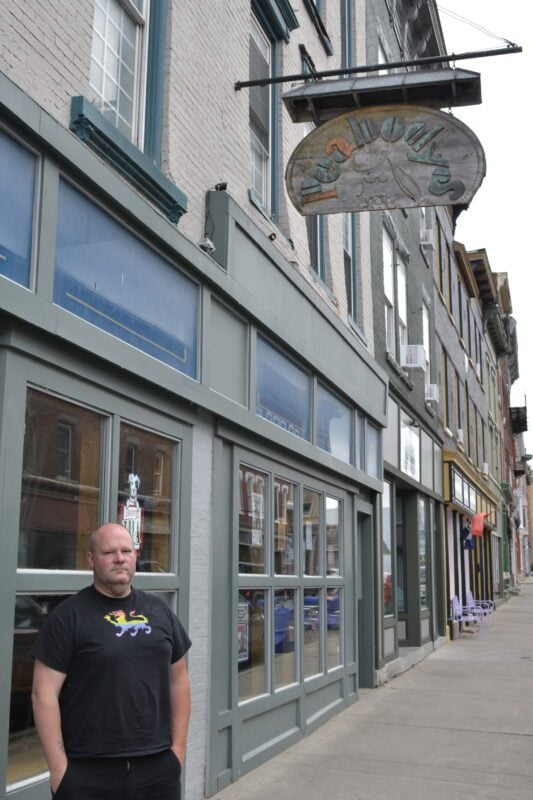
Similar to the actors in those films, Cameron likened his drag persona to a character.
“It’s like putting on a musical or a play,” said Cameron. “I can be Amber Skyy for eight to 10 hours, and then she’s back in the closet until the next time.”
Drag as defiance
During his career, Cameron has won numerous drag pageant titles in New York and used his shows to raise money for charities. He said the culture around drag performers has shifted positively compared to when he started in 2000.
“Most of the performers like myself were very skittish of who we told and very secretive about certain things,” he said. “When it came time to go to the store to shop for costumes, outfits and stuff like that, it wasn’t as comfortable for me.”
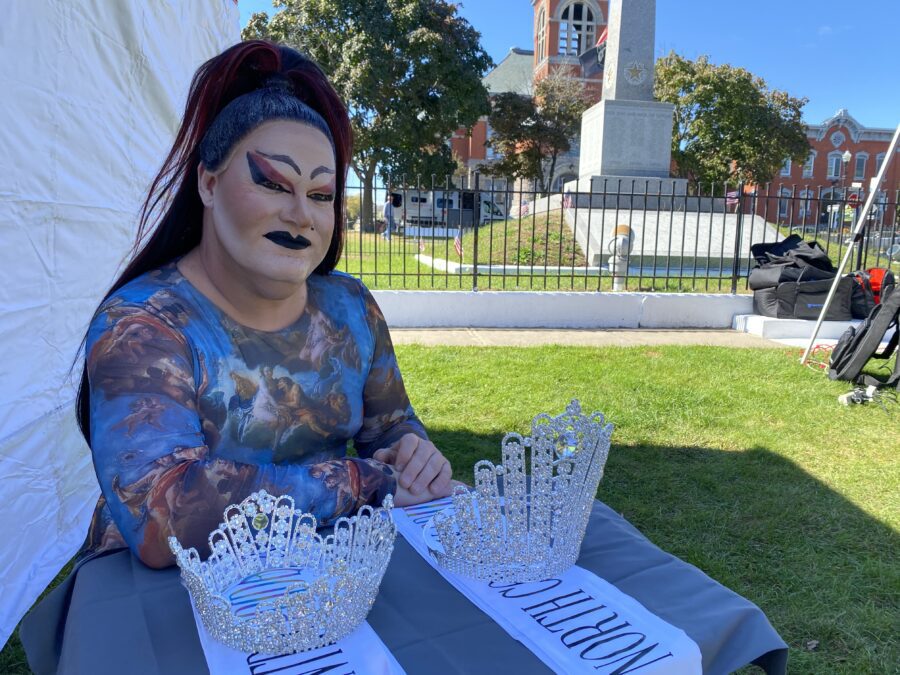
Sean Brace, who performs as Mhisty Knights, shares a similar sentiment.
“I don’t feel as weird as I used to years ago walking down the street [or] heading to a bar in drag as I used to,” Brace said. “ I feel like it’s gotten more acceptable.”
Alongside Cameron, Brace has been a staple of the North Country drag scene for about two decades. A native of Peru, New York, Brace said most drag performers work day jobs to support themselves. The basics of drag—wigs, costumes, jewelry, heels and makeup—are a significant investment.
“I know some queens that just do thrift store [clothes], which is great,” Brace said. “And there are some queens out there who will gladly, because they have the [resources], spend thousands upon thousands of dollars on dresses and wigs.”
A diverse drag scene
Brace said the North Country drag community is also diverse in style. Some performers prefer cracking jokes on a microphone, while others focus on costume-making or lip-syncing.
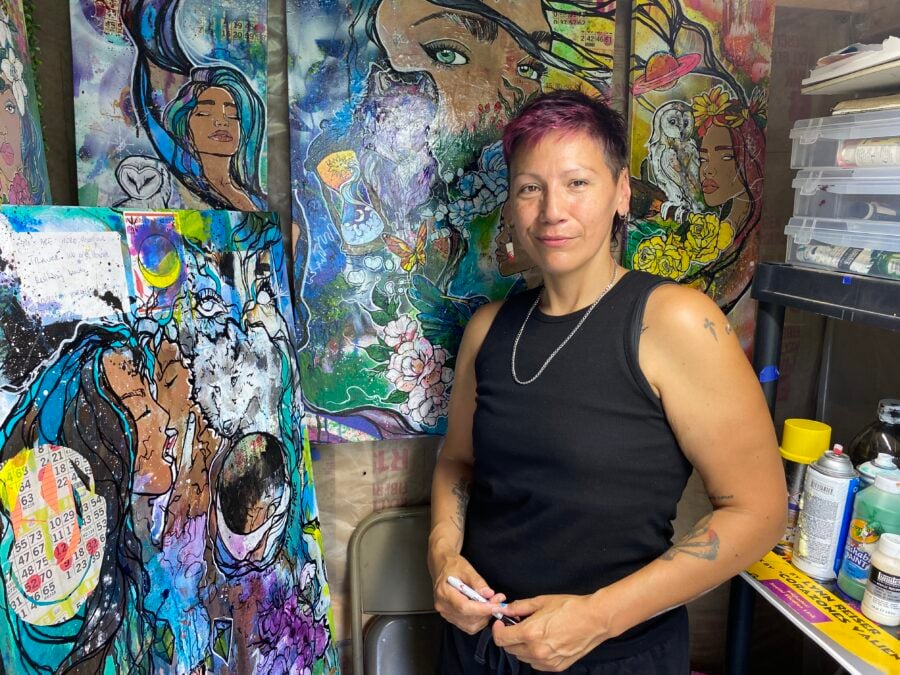
Kit Thomas said their drag persona defies definition.
“He’s mysterious. He’s electric,” said Thomas. “But once I get into Hunter Down, I feel like such a star.”
Thomas, who grew up in Akwesasne, started performing as Hunter Down in 2010 while living in North Carolina. Their persona is considered a “drag king,” when a performer wears men’s clothing and performs stylized forms of masculinity. Since moving back to the St. Regis Mohawk Reservation in 2021, Thomas has been one of only a few drag kings in the region.
“It’s usually four to six other queens and then one king,” said Thomas. “There’s various reasons why it could be like that. Maybe there’s not enough talent. Sometimes prejudice comes into play.
Thomas said drag kings are less represented in pop culture than drag queens, whose art form has been popularized by the television series “RuPaul’s Drag Race.” Performing in drag has helped Thomas express their Two-Spirit identity, a term used to describe Indigenous individuals who embody both masculine and feminine spirits or roles within their communities.
“Being a king is an art, and it has so much respect,” said Thomas. “I want to pay homage to the kings before me, the people who put in the work for me to be able to do what I do.”
Shifting opinions in rural communities
Across the North Country, drag shows are typically smaller and less frequent than in urban areas, but Thomas said the performances carry more weight in building community and acceptance for the region’s LGBTQ+ population.
“We’re making space for not only queens and kings, but for the queer community. And it’s much needed up here,” said Thomas. “It’s more needed, I think, in the smaller, closed-minded towns. So that’s why I keep doing drag in places like Potsdam, Malone, Plattsburgh and now Cornwall, Ontario.”
For Brace, every pageant, brunch and nightclub show is a chance to create joy for fellow LGBTQ people in the North Country. Even on the hardest days—when he does not feel like applying makeup or gluing down a wig—he said he cannot imagine hanging up his drag heels anytime soon.
“I may switch from heels to flats or barefoot. If I get to the walker stage, then I might have to figure out something else,” he said. “But as long as there’s people asking, ‘Hey, do you want to do this? Do you want to do that?’ I will gladly do it.”
David Escobar is a Report For America Corps Member. He reports on diversity issues in the Adirondacks through a partnership between North Country Public Radio and Adirondack Explorer.
Photo at top: Drag queen Ganivah Cache performs at a drag brunch at the Belvedere Restaurant in Saranac Lake on June 28, 2025. Photo by David Escobar.
‘There really is no escape’: Faith leaders help immigrants face court as ICE arrests rise
(RNS) — San Diego Auxiliary Bishop Felipe Pulido noticed the way a father held his young daughter and stood close to his wife and teenage daughter in the courtroom. The love and care they had for each other was palpable on Tuesday (Aug. 12), when Pulido accompanied the asylum-seeking family for an immigration court hearing.
“As an immigrant, I got emotional because of that connection I have with my own family — I put myself in his shoes,” said the Catholic bishop, who was born in the Mexican state of Michoacán before immigrating to Yakima Valley in Washington as a teenager. He finished high school there, worked picking produce and eventually was ordained a priest.
Immigrants are facing court appointments with newly heightened levels of fear as the Trump administration has begun sending agents to detain migrants as they leave the courtroom. If immigration judges dismiss their cases, they can immediately face expedited removal proceedings without a chance to make their case for asylum. Previously, a 10-day response time to the dismissal was allowed.
Guided by their faith, clergy like Pulido and other representatives from religious groups are accompanying immigrants to court appointments to provide comfort and information and, in cases where their worst fears are realized, to pick up the pieces of a shattered American dream.
The Rev. Noel Andersen, national field director at Church World Service who is ordained in the United Church of Christ, holds a weekly call on faith-based court accompaniment. He told RNS that through accompaniment, “Faith leaders bear witness and speak out against the ways masked ICE agents are abducting our community members.” Accompaniment is taking place “in every major city and in some rural areas, just about everywhere there is an immigration court,” he said.
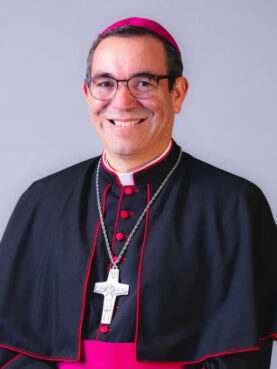 When it was time to leave their San Diego hearing, Pulido said, the family saw half a dozen United States Immigration and Customs Enforcement agents, and the mother told him she was scared. The bishop stuck close to the family, talking and reassuring them as they walked by the agents, he said. The judge had given them another hearing in December.
Pulido was present because the San Diego Catholic Church has partnered with Episcopal, Lutheran, Jewish and Muslim clergy, as well as lay people, to provide accompaniment for immigrants at the courthouse every day in August. They have more than 50 volunteers, and as more sign up, they’re planning to continue the ministry.
It was only when they’d gotten through the ordeal safely that the family asked Pulido which church he was with. The Catholic family were stunned to learn a bishop had accompanied them that day, he said.
Pulido said he was inspired by Pope Francis’ words last year when he attended “baby bishop camp,” an orientation for new bishops in Rome, to get involved in the court accompaniment ministry. “Be a sign of hope for the homeless, for the migrants, for those who are in prison,” he recalled Francis saying.
He said he believes sometimes ICE agents choose not to detain migrants even after their cases are dismissed because his priests are walking with them, though they have also witnessed detentions.
Pulido isn’t the only Catholic bishop who has gone to immigration court. In Orange County, where priests and deacons are also accompanying the faithful in immigration court, Bishop Kevin Vann attended the July bond hearing of Narciso Barranco, an immigrant without legal status and father of three U.S. Marines who was filmed being beaten in the head by immigration agents during his June arrest.
El Paso, Texas, Bishop Mark Seitz was also in immigration court on Tuesday, said Scalabrinian Sister Leticia Gutiérrez, the director of the diocese’s migrant hospitality ministry.
Seitz witnessed the detention of three people — “the sobbing, the anguish of the wife of one of them,” said Gutiérrez in Spanish. Seitz told her, “I saw Jesus walking through the hallway, sister, defenseless.”
Gutiérrez, who has organized a precise system for the diocese’s immigration court accompaniment in the last two months, arrives at immigration court at exactly 7:50 a.m., four days a week, and stays until the final cases have concluded.
Before ICE agents arrive (about 20 minutes after she does), Gutiérrez and a priest who is a retired immigration lawyer introduce themselves to migrants arriving for court and provide them basic legal advice and information — and try to sit with them in their anxiety.
While some of the diocesan team members observe the court sessions, ICE agents have also allowed them a protected zone in the waiting room, so when immigrants leave their court appointments, Gutiérrez helps them arrange their affairs, sometimes taking up to 30 to 40 minutes before they walk toward the agents. She encourages them to call their families one last time and share their Alien Registration Number, and then to write phone numbers on their bodies so they can call family if they’re detained.
If they’re willing to share personal information and their keys, she offers to let their family know if they’re detained, send another team to visit them in detention, connect them with a lawyer when available and move their vehicle so it doesn’t incur fines before their family can pick it up.
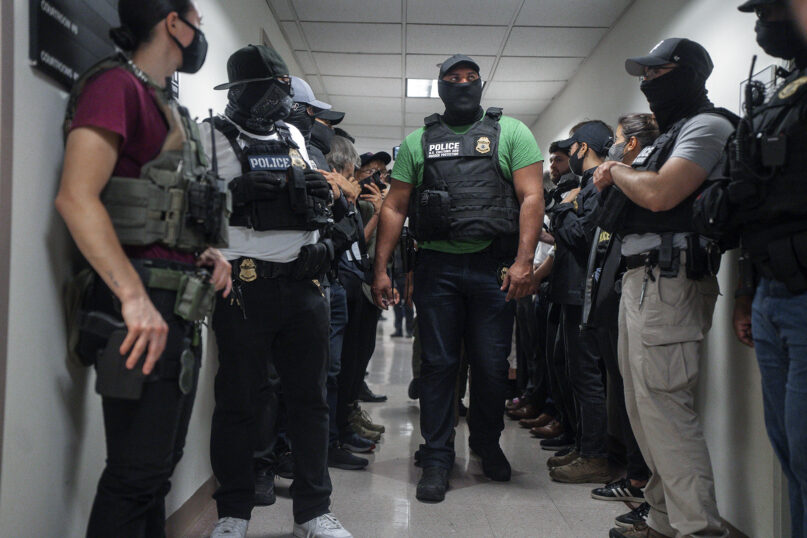
Many people are in shock when judges dismiss their cases, Gutiérrez said. “It’s incomprehensible for many of them, who say, ‘I paid taxes. I already have an apartment. I have a car … why are they going to detain me?’”
At that point, Gutiérrez said, “There really is no escape. You have to pass, no matter what, by the immigration agents. So it’s like Jesus, who goes directly to the cross.”
The Rev. Chloe Breyer, an Episcopal priest and director of the Interfaith Center of New York, told RNS witnessing detentions was “harrowing.”
“ All I could do is get their name in this tiny millisecond between when they left the courtroom door and when they were picked up by these officers,” she said.
“ We’re witnessing a kind of public display of lawlessness,” Breyer added. She, like Gutiérrez, said there seemed to be no “rhyme or reason” behind which immigrants were detained and which were able to leave.
The Episcopal Diocese of New York has publicized that three of their parishioners have been detained in courthouse arrests and has held a training on court accompaniment for over 80 clergy, said Mary Rothwell Davis, the diocese’s vice-chancellor for immigration and refugees. On July 8, Bishop Matthew E. Heyd witnessed immigration court detentions.
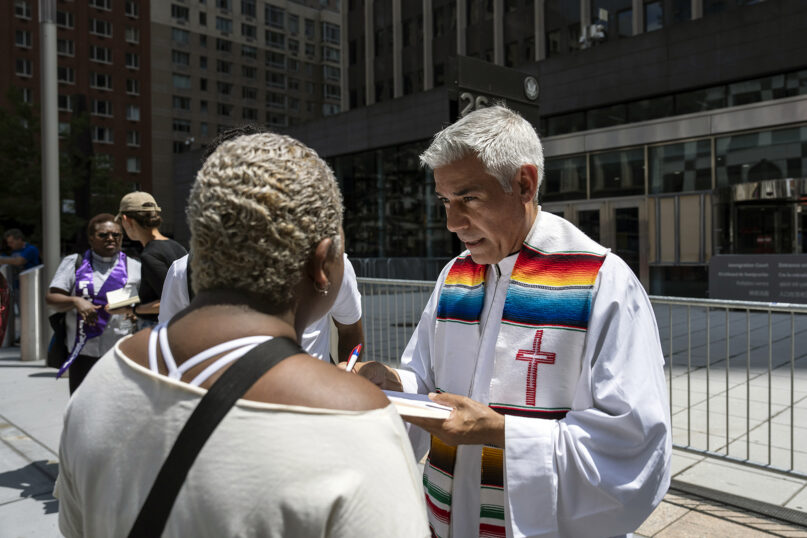
Breyer said she has gone to immigration court about half a dozen times in the last six months, along with rabbis and other Christian leaders. She has worked with the New Sanctuary Coalition, through which she shows up to accompany immigrants who happen to be there that day, and also with specific clients at the request of their lawyers.
In Los Angeles, Isaac Cuevas, director of immigration and public affairs for the Catholic Archdiocese of Los Angeles, has trained about 180 priests, deacons and religious sisters in court accompaniment. While they make an effort to match parishioners who request accompaniment for immigration court with someone who has gone through the program, the vowed religious largely create their own schedules for going to courts in the area.
“If people are in need, then we try to come forward and answer that call however possible,” said Cuevas, emphasizing that they do so not by civil disobedience, but through prayer, solidarity and recommendations to seek legal advice.
Another LA group, Clergy and Laity United for Economic Justice, observes courts daily.
In Arizona, Alicia Contreras, executive director of Corazón AZ, part of the grassroots multi-faith Faith in Action federation, said faith leaders in the state attend immigration court when community members request accompaniment. It is part of the group’s broader work, including know-your-rights and family defense planning, when a family makes plans for children, pets and bills in the event of a crisis. Corazón AZ has partnered with Puente, another Phoenix organizing group that maintains a more regular presence at the courthouse.
Corazón AZ has sent Disciples of Christ, Episcopalians, Presbyterians, Catholics, Unitarian Universalists and volunteers without a specific tradition to the courthouse. The majority have been lay people.
“If I can offer a word of prayer, if I have brought folks a rosary or just sat with them, give them a gentle touch on their back, a hug when they need it, this goes a long way to calm the nerves,” Contreras said. She reminds immigrants to breathe. “We are not in control of a lot, but we are in control of our breathing.”
Fear can also cause immigrants to “black out” during their hearings, leaving them unable to remember what happened, Contreras said, explaining that faith leaders can help explain what happened afterward. In the worst cases, fear can lead community members to skip their court dates, a guaranteed way to enter deportation proceedings, she said.
Court accompaniment is an expression of faith, Contreras said.
“I know that their higher power, or in my faith tradition, God, does not want this for them,” said Contreras, a Catholic. “God is not putting the barriers, and God also is not wanting us to look away.”