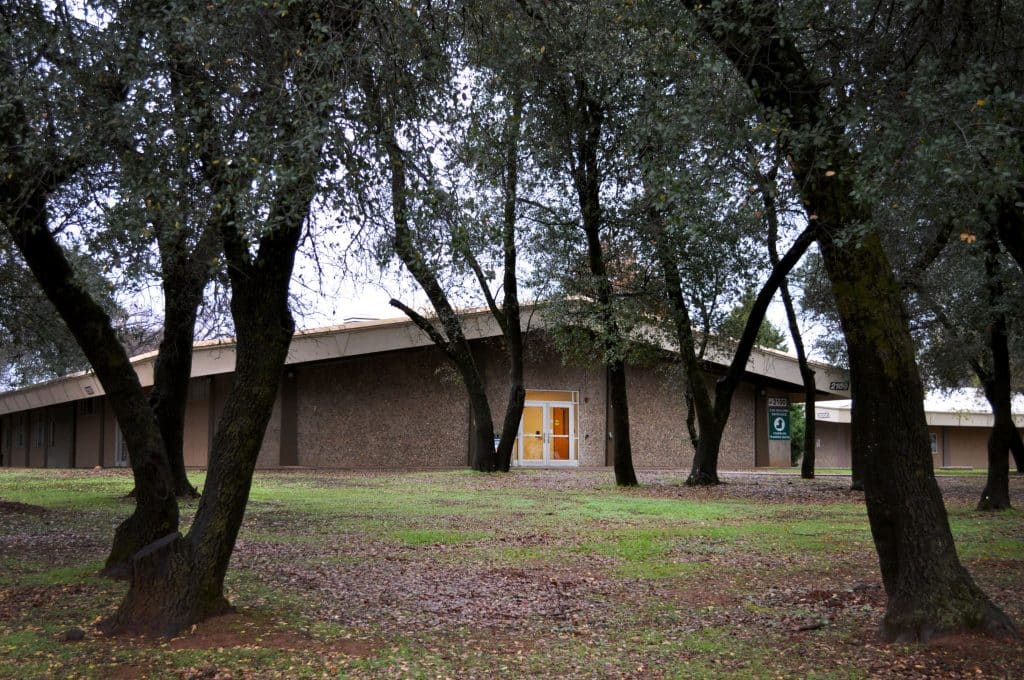
North American Mental Health Services celebrated the grand opening of its new Hollister clinic on Dec. 9 after opening its doors to the public in August.
The clinic site, located at 901 Sunset Drive, joins a growing number of NAMHS clinics in Northern California offering in-office and online psychiatry and psychotherapy to the public.
“We are honored to serve the Hollister community and continue our mission of improving access to compassionate, patient-centered mental health care,” NAMHS said in a press release. “This new clinic represents our commitment to changing lives and strengthening the future of our communities.”
NAMHS—founded in 2011 in Redding and originally named Native American Mental Health Services—began by providing care for Native American communities and tribes, according to its marketing director, Kimberly Maricle.
It adopted its current name after expanding its services, and continues to provide care for Native American tribes under its former name.
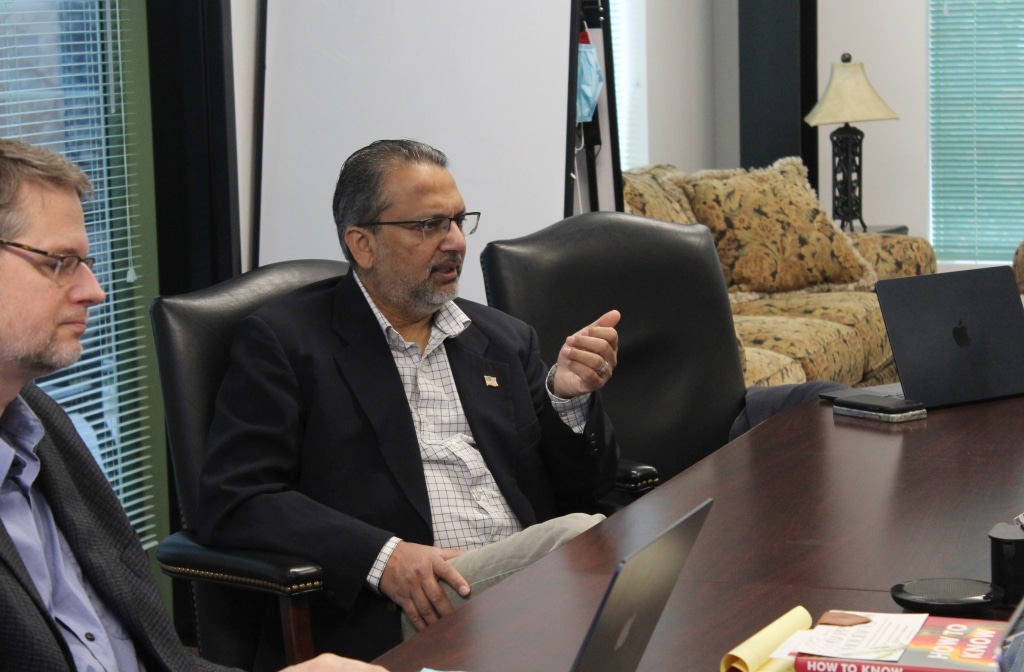
Dr. Thomas Andrews, left to right, Josh Kampa, San Benito Chamber of Commerce, Adrin Sahagun, San Benito County Chamber of Commerce, and Kendra Baron, CEO San Benito County Chamber of Commerce, chatting at the clinic grand opening. Photo by Adam Bell.
Maintaining a desire to reach underserved communities, NAMHS now has clinics near or in several rural regions including Redding, Red Bluff, Monterey, Fairfield, Eureka and Salinas, where mental health services are scarce.
“We actually prefer to open where there are no services,” Maricle said.
That includes services for homeless patients, who Maricle said make up a large part of the organization’s clientele. In those cases, she said, “We go beyond just the therapy and the medication management.”
“We try to [connect patients] with one of our partners—a shelter or another nonprofit—that can help them get a roof over their head first,” Maricle said. “Then, in tandem, we can help them deal with whatever’s going on.”
NAMHS will provide services for clients with mild to moderate mental health care symptoms, she said, in an effort to relieve San Benito County Behavioral Health of its overflow of referrals.
“Counties see more extreme cases than we do,” she said. “So we get referred a lot from counties with their mild cases.”
Geraldine Arce with Behavioral Health agreed, adding the County “looks forward to possibly collaborating through Central California Alliance for Health with NAMHS to help serve the mental health services needs of our county.”
While Arce said the county provides mobile crisis services, therapy, substance use treatment, psychiatric support and case management services, it primarily serves Medi-Cal clients and the indigent population and does not accept private insurance.
NAMHS accepts Medi-Cal, Medicare, and soon, TriCare, as well as most private insurance. Prospective patients with private insurance may contact NAMHS to check their eligibility for medication-management and therapy coverage.
We need your help. Support local, nonprofit news!BenitoLink is a nonprofit news website that reports on San Benito County. Our team is committed to this community and providing essential, accurate information to our fellow residents. Producing local news is expensive, and community support keeps the news flowing. Please consider supporting BenitoLink, San Benito County’s public service nonprofit news.
A group of community members are hoping to start a new medical school in Shasta. Here’s what we know
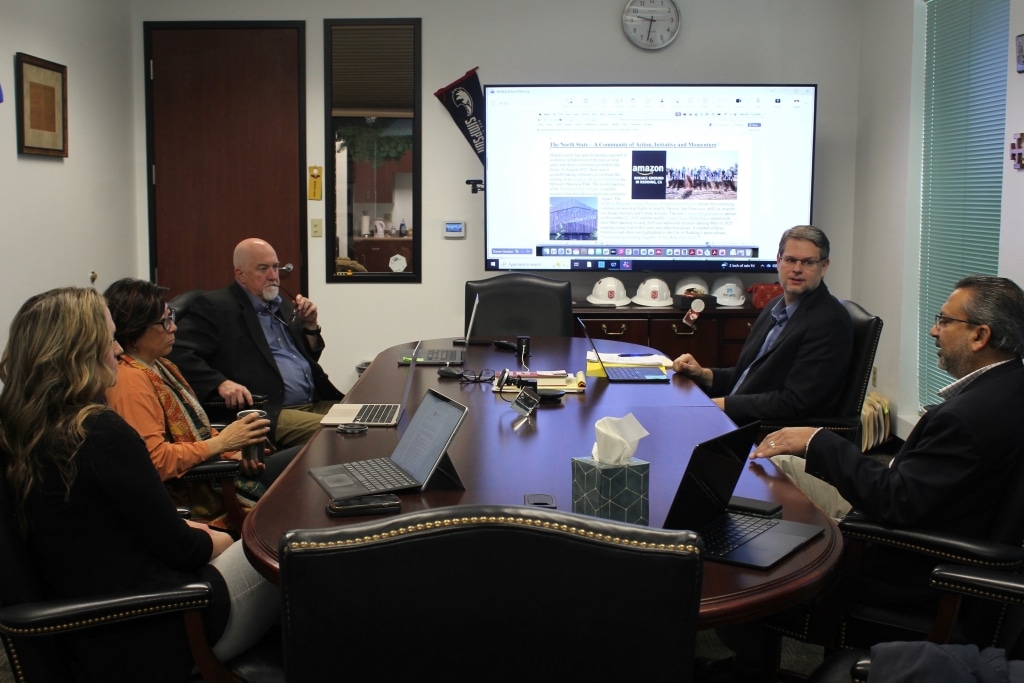
(From left) Shasta HHSA Director Christy Coleman, neuroscientist Dr. Irene Salter, Simpson University President Dr. Norm Hall, Simpson Dean of Education Dr. Darren Gorden and Redding Vice Mayor and gastroenterologist Dr. Paul Dhanuka discuss their plan to establish a new medical school in Redding at a meeting on Dec. 17. Photo by Madison Holcomb
Efforts are being made to open a new medical school in Shasta County, though it’s uncertain exactly what that might look like.
A group of community members started officially meeting about five months ago to develop ideas for a North State medical school, citing a local health care crisis attributed to a lack of physicians and providers in the area.
The group — the Rural Northern California Medical Education Consortium, as they call it — is composed of eight physicians, educators, health care leaders and community partners. It includes Simpson University President Dr. Norm Hall, Redding City Council Vice Mayor and gastroenterologist Dr. Paul Dhanuka, Shasta Health and Human Services Director Christy Coleman and former Shasta Community Health Center CEO Dean Germano, among others.
The consortium’s leaders see a medical school as a long-term strategy to strengthen rural health care in the North State and retain physicians in the region.
“This will become an institution for generations to come,” Dhanuka said in an interview with Shasta Scout.
Currently, the consortium hopes to open the school as part of Simpson University. But it takes years to open and establish a medical school, so the future — including if such a school will come to fruition — is still uncertain.
How did the idea for a new medical school come about?
For years, Shasta County has faced a health care provider shortage and in June, Shasta Health Officer Dr. James Mu declared a public health crisis — which is not the same as a health emergency — due to the lack of physicians. His declaration came after the Shasta Board of Supervisors hired political commentator and activist Chriss Street as the county’s health care consultant early this year in an effort to find solutions to the provider shortage. Street’s recommendation was to open a medical school in the county.
But conversations around starting a new medical school began even before he was hired. Dhanuka said he spoke with several community members about their frustrations with the provider shortage in Shasta while he was running for the Redding City Council in 2024, and a plan to set the concept of a medical school in motion became part of his campaign. He presented the idea of a medical school to the Redding council along with Street shortly after he became a council member.
Dhanuka said the lack of medical schools in the North State is an issue that hits close to home: He said while his daughter had an impressive GPA and received an almost perfect score on the Medical College Admission Test, or MCAT, she couldn’t secure a spot at a medical school in California because of a low number of spots compared to schools in other states. He also said California has fewer medical school seats than many other states — a problem he linked to the North State’s provider shortage, along with there being no medical schools nearby.
While it’s true that there are no medical schools in California north of Sacramento, the state actually has the third-most medical students in the country — though California has lower ratios of medical students per 100,000 residents than most states. And overall, there are significantly more medical schools in the eastern half of the U.S. than the western.
Dhanuka also feels that opening a medical school in Shasta will encourage prospective medical students to stay in the North State, as well as help inspire younger generations in the region to pursue a medical degree.
“When they see they can achieve these things right here in our community,” he said, “they may not have to go outside the area, because a lot of young people here find it difficult to afford to go out for further education. Whether it’s professional or technical, it’s very expensive.”
After speaking with community members about the provider shortage issue and the potential solution of opening a new medical school, Dhanuka started discussing the idea with local health care and government leaders. He also connected with Simpson University President Dr. Norm Hall to discuss opening the medical school as part of the university, something Hall supports — though the university president said he’d be open to considering other options that don’t involve Simpson, if need be.
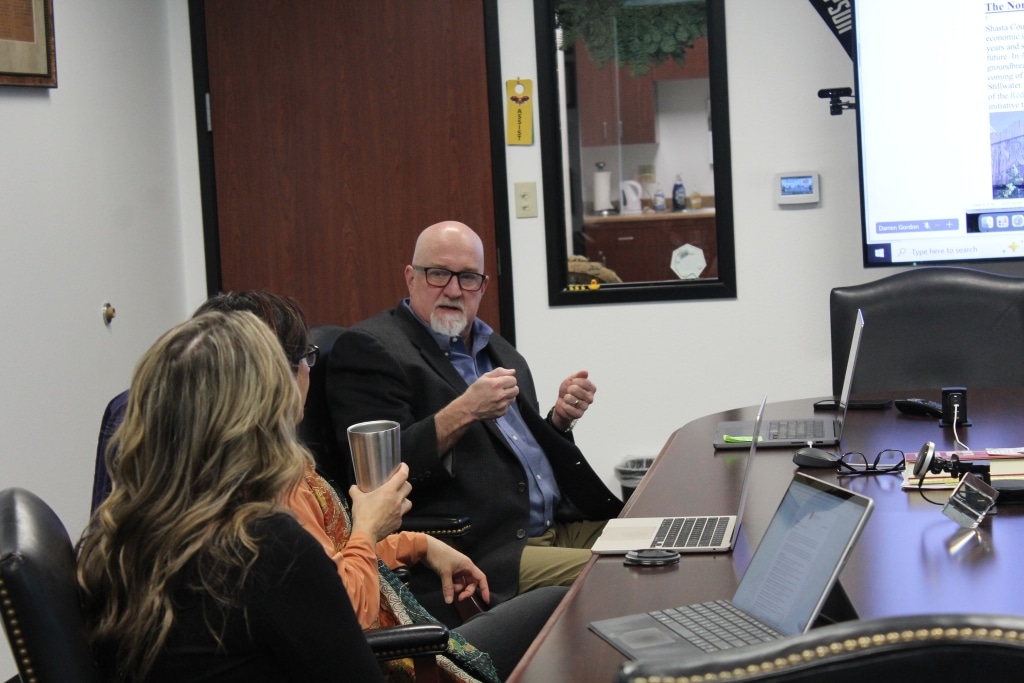
Simpson University President Dr. Norm Hall talks with Dr. Irene Salter and Christy Coleman. Photo by Madison Holcomb
“Whether it’s Simpson University or not, I’m committed to the North State,” Hall said, “and I’ll bring whatever expertise I can to bear on that.”
Simpson University has been a primary focus in the consortium’s plan for the medical school because it’s the only four-year university in Shasta, Dhanuka said, a requirement to receive accreditation. Hall added that the university has other benefits, including a successful nursing program, the upcoming launching of a doctor of psychology degree program and what he described as connections and “expertise” with federal grants.
The consortium is also considering other options, including partnering with the University of California Davis to bring a branch campus to Shasta.
Dhanuka formed a group of interested community members, and they started meeting in July of this year to develop their plan. The Rural Northern California Medical Education Consortium was formed over the following months. Street, the county health care consultant, is not involved with the consortium or the project.
Is a medical school the answer to Shasta’s provider shortage?
Dr. Irene Salter, a neuroscientist, educator and leadership coach — and Shasta Scout board member — is also involved in the consortium for the new medical school. She said people living in the North State who are interested in becoming a physician have to travel elsewhere, oftentimes to other states, in order to receive their medical education, making it less likely for them to return to Shasta to work.
“What if instead, we could educate our own and keep them here?” Salter said. “Then they have this long term commitment to our community.”
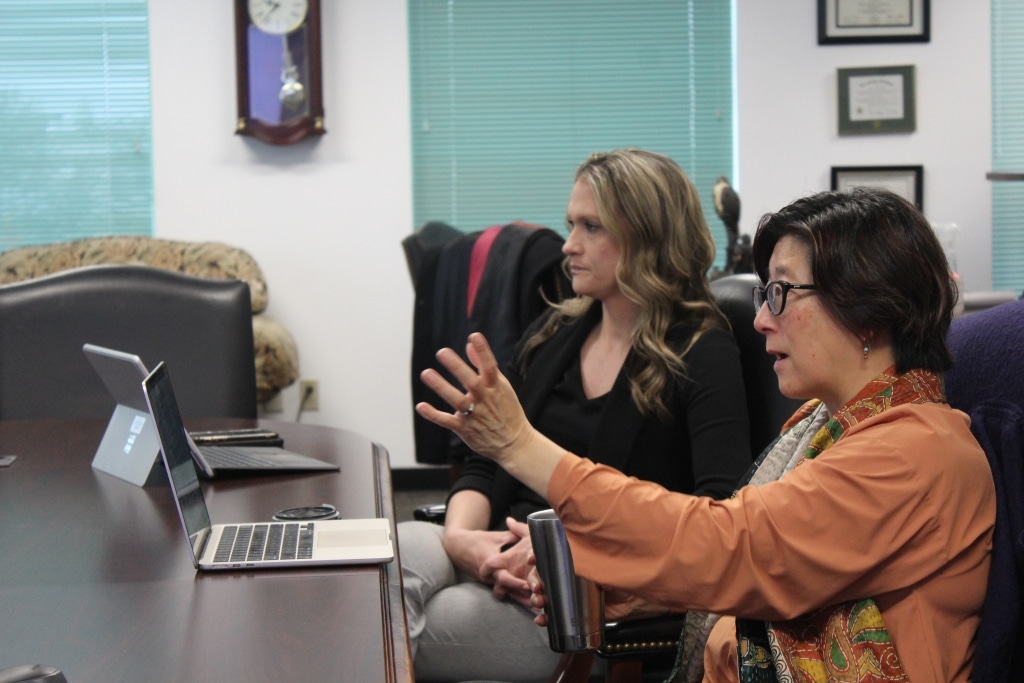
Dr. Irene Salter engages in conversation at a meeting about a new medical school in Shasta. Photo by Madison Holcomb
But the state or region where a physician went to medical school isn’t the only, or even the primary, determining factor of where they’re likely to settle down after their training.
It’s actually more likely that a physician stays in the state where they completed residency, not medical school. According to the Association of American Medical Colleges, almost 60% of physicians stay in the state where they completed residency. However, it’s most likely that physicians who complete all of their training in one state, including both medical school and residency, stay in that state.
While California does have more residency programs, as well as medical schools, than most other states, there are significantly more medical residency and fellowship programs in the eastern half of the U.S. than the western. For example, only about 20% of some of the most popular residency programs and crucial areas of medical practice — internal medicine, family medicine and surgery — are located in the western half of the country.
So why not add more residency programs out west? It turns out it’s not that simple.
Despite the cap on Medicare-funded GME that ensures residency training, the number of medical school graduates has significantly increased over the last two decades, meaning more people are getting a medical education than there are Medicare-funded residency slots. In 2022, more than 3,300 medical school graduates did not receive residency slots.
When confronted with research that shows physicians are more likely to settle down where they did residency, not medical school, Dhanuka demurred, saying, “That data gets quoted a lot, but it’s not the hard reality.” He explained that residency and fellowship programs must be sponsored by institutions, like medical schools, and that the entities go hand-in-hand, citing the fact that physicians are more likely to stay in the area where they completed both medical school and residency.
Dhanuka said he sees the medical school as a long-term solution for Shasta’s provider shortage, but that the consortium is also working to expand residency and fellowship programs in the area. The medical school would also sponsor more residency and fellowship programs in the North State once it’s established, he said.
Shasta Supervisor Matt Plummer was initially involved in conversations about establishing a medical school in the county because he wanted to address the medical provider shortage problem. He still feels the idea of a medical school is worth looking into as a long-term strategy, but acknowledges that it won’t be a viable solution if there aren’t similar investments made into the residency programs and clinical rotations that will help students stay in the North State.
Plummer is advocating for further conversations with UC Davis establishing a medical school in Redding as a branch campus, something the consortium is considering. But Dhanuka said the UC system is a large institution with a lot of state involvement, meaning the process of getting a UC Davis branch established here might be slow, and it wouldn’t have as much of a focus on rural northern California as a brand new medical school launched here would.
Shasta HHSA Director Christy Coleman is also involved in the consortium as a representative from the county. She said since the county is very focused on improving the health of Shasta residents, especially when it comes to mental and behavioral health, the county supports the consortium’s efforts.
What’s the current vision for the medical school?
Since it takes several years to open and establish a medical school and conversations are in very early stages, there are still a lot of uncertainties when it comes to the specifics of a potential project.
What is proposed is that the school would have a rural, community focus, aiming to transform rural and tribal health care in the North State region by training generations of physicians and, hopefully, retaining many of them in the process. The project organizers hope building a school and expanding residency and fellowship programs would also lead to overall improvements in health care access across the North State.
Consortium leaders plan to form a nonprofit entity and pursue large federal grants as a jumpstart for funding.
Among many remaining questions, the consortium has not yet decided whether to launch a Doctor of Medicine (MD) or Doctor of Osteopathic Medicine (DO) school, determined how much funding it’ll take to open the school, decided whether the school will be part of Simpson University or not and planned for when the school might open.
The press release explained that in general terms, establishing a medical school takes around seven to 10 years, and that a minimum of $30 million to $50 million would need to be raised in startup funds. As part of the launch process, proper accreditation would also need to be secured, a monumental task in itself.
Dr. Paul Dhanuka converses with other members of the Rural Northern California Medical Education Consortium, a group hoping to establish a new medical school in Redding. Photo by Madison Holcomb
Dhanuka said some people in the community have been skeptical about Shasta having enough of the needed professionals to provide faculty options for the medical school to successfully operate. While staffing may be a challenge, he feels there’s enough talent in the area for the school and residency programs, and that the school itself will likely attract people from all over the nation. Overall, Dhanuka feels that the school would act as a hub for the North State that would bring major impacts in a variety of ways, including to the local economy.
As next steps, along with gaining nonprofit status, the consortium plans to develop a formal feasibility study and multi-year strategic plan for the project, then seek letters of support from various entities, including hospitals, clinics, tribal nations, regional stakeholders, educational institutions and economic leaders.
Meanwhile, consortium members are organizing site visits to rural medical schools in other parts of the country to learn about how they operate. In February, Simpson President Hall plans to take a small group to the University of Pikeville-Kentucky, which hosts a medical school that was created to address a physician shortage in central Appalachia, according to the consortium’s press release.
Do you have information or a correction to share? Email us: editor@shastascout.org.
State audit of Mendocino County finds strained finances, faulty oversight
MENDOCINO CO., 12/19/25 –A state audit of Mendocino County released Thursday found that the county is facing persistent budget deficits, has not had sufficient oversight of spending, and had faulty processes that led to ballot errors in the 2024 primary election.
The state Legislature passed a bill last year requiring the California State Auditor to perform an audit of Mendocino County by the start of 2026. The audit cited media reports that “indicated that Mendocino has struggled financially and that errors occurred in the county’s administration of the 2024 presidential primary election.”
On the issue of the county’s finances, the nearly 100-page report audit found that Mendocino as of this month had $30.6 million in uncollected taxes, penalties, interest and fees related to default properties, and also “will continue to face persistent deficits if it does not take additional action to address its budget deficit, such as raising tax rates.”
Mendocino County also “has not exercised sufficient oversight of staff spending that would best protect it against waste, fraud, and abuse,” according to the audit, which alleged that the county District Attorney’s Office may have violated state laws when $3,600 in public asset forfeiture funds were spent on an end-of-year event at a steakhouse for staff and their guests.
The audit also highlighted problems with the county’s administration of the 2024 primary election, in which its ballot printing vendor issued incorrect ballots to nearly every one of the more than 50,000 voters in the county. Shortly after resolving that error, another problem was found in which some voters were not placed in their correct districts, so more corrected ballots had to be sent out.
The Mendocino County Board of Supervisors plans to hold a public workshop in mid-January to discuss the audit and its recommendations, though the board’s response to the audit noted that some of the recommendations involve independently elected county officials.
District Attorney David Eyster’s response to the allegations involving his office said its use of asset forfeiture funds was legal since the use of those funds is “within the prosecution core functions and discretion afforded to elected district attorneys statewide.”
The response said, “The District Attorney and his staff will continue to evaluate the audit’s recommendations, implement improvements where appropriate, and ensure that all financial and operational practices remain firmly within the bounds of law.”
County Auditor-Controller/Treasurer-Tax Collector Chamise Cubbison in her response said she largely agrees with the audit’s recommendations and noted her office “was understaffed for most of the reviewed period and experienced several changes in leadership, the loss of decades of institutional knowledge and changes in leadership styles and priorities.”
The county elections office in its response to the audit said it is working with contractors to remedy errors in time for elections in 2026.
Board allocates nearly $1 million in opioid funds to support two Shasta College programs
A building on the campus of Shasta College. Photo by Nevin Kallepalli
Yesterday, Shasta College made a successful pitch to the board of supervisors, which voted 4-1 to provide $889,000 over three years toward two college programs focused on opioid use prevention. The first is the community college’s Alcohol and Drug Studies program. The other is STEP-UP, a program that helps provide financial and logistical assistance to recently incarcerated students, a significant number of whom have been affected by substance use disorder.
The money to support those programs will come from the nearly $40 million Shasta County has or will receive as the result of a number of opioid settlement cases. According to the stipulations of the settlements, which have been given out to many jurisdictions nationwide, the money must be spent on any one of a number of approved opioid prevention and treatment needs.
In Shasta, decisions about how local opioid funds will be allocated has been an ongoing process over the last year, with several youth organizations and healthcare providers bidding for their share of the funds. In addition to Shasta College, the board has allocated $4 million toward organizations focused on substance use prevention among youth, and $2.2 million toward the Good News Rescue Mission’s forthcoming drug treatment program.
The agenda item promoting the use of opioid funds for Shasta College was sponsored by Supervisor Chris Kelstrom, who said he was inspired to support the college’s work after a past conversation with a STEP-UP graduate, who participated in the program as an alternative to jail time.
“She went through the STEP-UP program, she got some college credits and totally cleaned up. Now she’s a very productive member of society … ever since then, STEP-UP has kind of been my favorite program,” Kelstrom said.
During yesterday’s board meeting, Dean of Students Sandra Hamilton and STEP-UP program manager Robert Bowman collaborated on a presentation describing the two programs, and outlining how they would use opioid funds.
Shasta College’s Alcohol and Drug Studies program was founded two years ago. It offers certificates in both alcohol studies and addiction studies, and is designed for students aiming to work in clinical settings that provide treatment for substance use disorders or work as counselors working with those affected. Hamilton noted that many people enrolled in the program are already teachers, therapists, or paraprofessionals who have returned to school in order to focus on this particular field of study.
The college’s Alcohol and Drug Studies program includes an internship and Shasta College petitioned the board to use some of Shasta’s opioid funding to provide students a stipend for internship hours, equivalent to minimum wage. “We don’t want to see students go backwards in their financial standing as they’re getting ready to graduate and move into our job industry,” Hamilton said.
Supervisor Allen Long inquired if the students themselves have to be personally affected by substance use in order for the county to allocate opioid money toward their education needs. In response, Deputy County Executive Officer Erin Bertain indicated that the approved spending outlined in opioid settlement documentation “also applies to increasing the availability of treatment within our area, regardless of whether those treatment providers have substance use issues.”
Shasta College’s STEP-UP program stands for Shasta Technical Education Program-Unified Partnership. It provides a specialized pathway for both formerly incarcerated students, and also those recovering from substance use disorder, to pursue technical training certificates or an associates degree with added support. The goal of the program is to reduce recidivism rates, which Bowman said are lower among STEP-UP graduates than the state and national averages. According to the presentation, 30% of students who have enrolled in STEP-UP have been impacted by SUD.
The program is facilitated in collaboration with the probation departments of Shasta, Trinity, and Tehama as well as the California Department of Corrections and Rehabilitation. But not all formerly incarcerated people who apply to STEP-UP can be admitted, Bowman explained, in part due to a lack of funding.
“Every semester we turn away students,” he said. With the extra opioid funding, Hamilton indicated that STEP-UP could add an additional 25 students to the STEP-UP program per semester, at a cost of about $2000 each. “We like to give them wrap-around support,” Hamilton said. “To help buy some of their equipment and materials, make sure they have the laptops and technology they need, as well as helping to support their basic needs around food and transportation.”
Board members voted to approve funding for the two programs for a single year, with Supervisor Matt Plummer providing the only dissenting vote. He suggested that the board should only approve opioid funding to support the STEP-UP program, because in his assessment, it seemed that the Alcohol and Drug Studies program was functioning adequately with current funding sources and did not require additional support.
Plummer added that he’d like the board to be more selective about the use of opioid money, advocating for using opioid dollars for Sheriff Johnson’s proposed expansion to the county’s Alternative Custody Program in future.
Do you have information or a correction to share? Email us: editor@shastascout.org.
San Joaquin Valley has high air-pollution burden, also lags in zero-emission vehicles
‘Guaranteed income works.’ Fresno State study shows monthly stipends reduced debt for families in poverty
A little over a year ago, Ariel and Derek Williams weren’t sure how they were ever going to pay down their PG&E debt.
The Williams were one of the families selected to participate in the Fresno Economic Opportunities Commission’s program that provided no-strings-attached monthly stipends of $500 to 150 families over the course of a year, starting in July 2024.
Paying down that utility debt was one of the main priorities for the Williams family during their time receiving the stipends — especially for Ariel, whose multiple sclerosis flares up in the Fresno summer heat.
“We were able to pay that debt to zero,” she told Fresnoland following a news conference Tuesday, where program leaders highlighted a newly-released study on the results of the pilot. “It’s like we were starting our account all over again.”
That report shows that the payments also helped lift many of the other 150 participating families out of debt, as well as had other benefits like reducing food insecurity and alleviating stress for parents.
“While it cannot overcome every barrier,” said Amber Crowell, an professor at Fresno State that led the program’s evaluation, “and it cannot alone eliminate poverty, it’s an important part of the anti-poverty agenda.”
Though guaranteed basic income has been studied all over the United States, Fresno’s pilot marks one of the first to include rural residents.
Half the program’s participants — including the Williams family — were from Huron, a small town in rural Fresno County. The other 75 participants hailed from the 93706 ZIP code in the city’s southwest area.
With the study helping illustrate the benefits of the program, organizers now hope to take these results to policymakers to extend this program long-term — if not make it permanent.
“Guaranteed income works,” said Andy Levine, an adviser for the program who’s also a Fresno Unified trustee.
“This is something that should not just be a 12-month program, not just for 150 families,” he added, “but really, this is a model that works and needs to be expanded.”
What other impacts did guaranteed basic income have in Fresno?
Families put more of their stipends toward buying groceries than any other expense, the study found.
Participating families received debit cards that were credited with the $500 each month. About 23.2% of all transactions recipients made with those cards were at grocery stores and supermarkets.
The second-highest spending category was transactions labeled as “other,” followed by fast food restaurants at 9.6% and discount stores at 8.8%.
But “the most significant finding” from the Fresno State data had to do with debt spending, Crowell said.
“From the very start of the program, we saw a dramatic drop in families’ reliance on borrowing from any source to cover regular expenses,” she added. “This is an important finding because it demonstrates how guaranteed income was helping families avoid accruing debt and even get out of debt.”
Researchers found that this included anything from making a dent in debt from utility bills, as was the case for the Williams family, to paying off student loans.
Other positive impacts the researchers found were “improved parenting experiences.”
For the Williams family, that included having the means to support their children’s creativity — and to model it themselves.
“Them seeing mom and dad get creative — mom painting, dad reading … now she picks up a paint brush,” Ariel said of her 4-year-old daughter Aniyah.
“She’s Picasso. I’ve got the walls to prove it.”
The report found no significant impact on other categories such as participants’ rates of employment — and that finding is consistent with studies of dozens of other guaranteed basic income pilots, according to the report.
“Nobody reported that they quit their job,” Crowell said. “In fact, what we did hear is that people were maintaining their regular jobs, but cutting back on gig hours that they’d been doing to make extra money.”
Rural versus urban
Some of the report’s findings were unique to the rural versus urban participants in Fresno County’s pilot.
That stemmed partly from population differences. About 41% of Huron’s residents are immigrants — more than Fresno County as a whole, where immigrants make up about 22% of the population, and southwest Fresno, where immigrants make up about 20%.
That meant Huron felt the impact of intensifying immigration enforcement especially under the Trump administration about halfway through the pilot program starting in January.
Guaranteed income, the researchers found, provided a benefit for those families who not only weathered the instability of agricultural employment but also those who stayed home from work for fear of deportation.
“For the Huron residents, having the guaranteed income provided some security through the fluctuations of seasonal labor,” the report said, “and then as immigration enforcement forced them to stay home instead of going to work.”
Andy Levine served as an adviser for Fresno County’s first-ever guaranteed basic income program. Julianna Morano | Fresnoland
What’s next for guaranteed basic income in Fresno?
Even now that the pilot program has ended, Ariel Williams said that doesn’t mean her family is back at square one.
“Don’t think because we had $500 a month and it’s month 13 that we’re struggling again,” she said. “We’re not.
“It allowed us to make sure we budget,” she added, “and we’re not going back down to that same place we were before.”
But program organizers also hope that this doesn’t spell the end of guaranteed basic income in Fresno County.
The Fresno EOC raised about $1 million in philanthropic contributions to make the pilot program happen this past year, after the “shocking” news that Fresno County’s application to receive state funding for a guaranteed basic income pilot wasn’t selected.
Program leaders now plan to bring the results of this pilot to more funders, as well as local and state policymakers, to make the case for an expanded version.
“We need the political will now,” Levine said, “to take this even further.”
Disclosure: Amber Crowell is a Fresnoland board member. The California Wellness Foundation, one of the funders of the GBI pilot, is also a Fresnoland funder.
‘We are all targets.’ What happens to children whose parents are detained by ICE in Fresno County?
Around last November’s election, Nora Zaragoza-Yáñez and her husband worried about what would happen if they were detained by immigration enforcement officers and no one could care for their 6-year-old son.
They began having conversations about a family preparedness plan, a set of actions and documents to ensure a family’s safety and well-being during an emergency, such as deportations.
“The current political climate has shown that people are being racially profiled and are up for grabs,” Zaragoza-Yáñez said. “It’s a scary thought where you’re racially profiled, taken abruptly, and violently by masked thugs.”
They specifically have a Caregiver’s Authorization Affidavit in place, a California legal form that allows a person, who is not the parent or legal guardian, to make temporary decisions for a minor child in their care.
A recent California law, called the Family Preparedness Act of 2025 (AB 495) makes it easier for families, particularly those with a risk of separation due to immigration enforcement, to have a Caregiver Authorization Affidavit to create a plan for child care.
Under their plan, Zaragoza-Yáñez’s parents would take in their son first. If they ever became unable to care for him, her siblings would step in and alternate responsibility.
“I highly encourage everyone to prepare for things that are in your control,” Zaragoza-Yáñez said. “It’s important for immigration advocates or attorneys or forward-facing people who offer these services to have one, we are all targets.”
What are the different options available for family preparedness plans?
As a program manager with Faith in the Valley’s Valley Watch Network, Zaragoza-Yáñez conducts English and Spanish presentations on family preparedness planning, helping parents think ahead about who will care for their children if they are detained or deported.
She advises parents to keep emergency contacts updated at their children’s schools and to ensure those contacts are people they trust so children don’t end up “in limbo.”
She explained that a family preparedness plan can take several forms, including a verbal agreement with a potential caregiver, a caregiver’s affidavit, or establishing legal guardianship.
Families are encouraged to formally designate a caregiver by completing a caregiver’s affidavit, as it gives that person legal authority to make certain medical and school-related decisions.
She noted that California’s recent law expands who can serve as an authorized caregiver to include trusted neighbors or friends, which benefits families without relatives nearby.
The law also increases privacy safeguards in schools and childcare settings by limiting the collection or sharing of immigration-related information and requiring updated state guidance on handling immigration enforcement.
Zaragoza-Yáñez said the affidavit helps preserve parental rights and offers options if a parent is deported—whether they want their children reunited with them abroad or to remain in the U.S. under a permanent arrangement. In those situations, Faith in the Valley connects families with family law attorneys who can help establish guardianship or other legal protections.
For families seeking guidance, Zaragoza-Yáñez recommends the Immigrant Legal Resource Center’s planning guide, which outlines childcare options, important documents to gather, emergency contact information, and checklists to organize medical, educational, and identification records. She also urges parents to keep their children’s school records updated with their chosen caregiver and preparedness plans.
Pricilla Ramos, project manager for advocacy and community organizing at the Education and Leadership Foundation, said concerns about enforcement have long been present in Fresno and surface frequently in conversations with schools and district leaders.
She said the first step is having difficult conversations with families about the possibility of separation which includes preparing essential documents and speaking with legal service providers to understand possible immigration options.
While organizations can provide basic templates, Ramos said the strength of a family preparedness plan comes from tailoring it to each family’s circumstances, since “not every family is a one-size-fits-all.”
She added that there are also guides explaining what to do if immigration enforcement knocks on the door, how to respond when shown a warrant, what steps to take if detained, and which documents to store securely.
What happens if both parents are detained and there’s not a trusted adult to care for their child in Fresno County?
When a parent in Fresno County is detained by immigration authorities, the county’s child welfare system is not automatically involved, said Kim Smith, deputy director of Child Welfare at Fresno County Department of Social Services.
Their involvement begins when a call comes into the care line, known as the county’s Child Protected Services hotline. Each call is screened based on the information provided, and staff may offer guidance or resources. If the report includes allegations of abuse, neglect, or a caretaker’s absence, it can trigger an investigation.
In those situations, a social worker evaluates whether a parent’s detention has left a child without someone to care for them. The aim, Smith said, is to follow whatever preparedness plan the family already has in place, such as arranging for a relative to care for the child.
Smith said Fresno County is already largely aligned with the intent of California’s new AB 495, since the county’s approach prioritizes keeping families together.
When a child comes to the county’s attention and a caretaker is missing, staff first look to create a plan at the most basic level with relatives. The county already helps families develop care plans and works with 13 Neighborhood Resource Centers to ensure they can access support.
“It will reduce the need for child welfare involvement by expanding caregiver authorization,” Smith said. “It gives families access and encourages parents to identify trusted caregivers and make proactive plans that preserve family connections.”
If no relatives or close family friends can be identified, the county places children in approved resource family homes, supervised by the child-welfare agency and operated by a qualifying “resource family,” and then works with those homes to offer children stability.
Maintaining educational and emotional stability, Smith added, is key to minimizing trauma. The department partners with local education agencies, probation, behavioral health, and regional centers to ensure that children can stay in their schools and communities.
“Keeping a kid connected to community, school, and family helps with their mental wellness,” Smith said. “Our number one goal is to prevent children from entering care whenever possible and to maintain family connections.”
Jennifer Podkul, chief of global policy and advocacy at Kids in Need of Defense (KIND), said the organization sees a growing number of children enter deportation proceedings on their own, either after being apprehended at the border or picked up within the U.S. Once detained, they’re classified as “unaccompanied minors” and given individual deportation cases, a process that often takes years.
After apprehension, Podkul explained, children are sent to federal shelters while the government searches for an adult sponsor, typically a parent, relative, or family friend, who agrees to care for them during their case. Once placed with a caregiver, KIND provides legal assistance and social services, including access to food, clothing, and mental health support, especially given the trauma many children have experienced.
The new California law helps mixed-status families plan for emergencies, but Podkul emphasized that children already in proceedings are facing fast-changing federal policies.
Increasingly, KIND’s Fresno office is seeing children who were already living with family being redetained and kept in federal custody until deportation, a shift she described as a “path of exit” rather than a path to protection. This constant flux, Podkul said, has fueled confusion nationwide about how to support immigrant children.
“Every day there’s something new,” Podkul said. “One day we get an email saying there’s a new directive: now we’re offering kids money if they go back; now we’re taking away their lawyers; now we’re putting them back in federal custody. It’s constant.”
For Podkul, the most urgent concern is the “gravity of the unknown.” Without centralized tracking, she said, no one knows how many children are being separated from their parents.
How does family separation affect a child’s mental health?
First Five Fresno County’s executive director Fabiola González and early childhood initiatives director Hannah Norman said the current climate of immigration enforcement has parents reconsidering school, child care, and other services to protect their children, which could compound early trauma.
They emphasized that the first five years of life are critical: About 90% of a child’s brain develops during this period, and early trauma—like separation from a parent—can shift a child’s brain from learning to survival mode.
Norman explained that children cannot comprehend the legal complexities of a parent’s detention, only the loss of a trusted caregiver, which can create trauma that carries into adulthood.
“We are trying to support all of the efforts that we know are wrapped around that child’s first five years, to make sure that they show up to school ready to learn, and anything that gets in the way of a safe, healthy environment,” González said.
They said that the organization focuses on filling gaps in early childhood care and promoting awareness of toxic stress, which can have lifelong mental and physical health effects. This includes investments in home visitation, parent-child programs, and other supports to mitigate the impacts of toxic stress and family separation.
Jason Williams, founder of Fresno-based Brain Wise Solutions, said his nonprofit focuses on training organizations to better serve families affected by trauma. His own organization grew out of his experience working in child protective services and local nonprofits, where he saw a critical need for trauma-informed practices.
For organizations serving immigrant communities, Williams said the training emphasizes how trauma can shape decision-making and relationships.
Brain Wise trains nonprofit staff to create safe, welcoming environments for clients before asking them to navigate complex systems, teaching how trauma from detention or family separation can put parents and children into survival mode. Workshops and ongoing support cover neuroscience, coping strategies, and practical approaches for working with clients under stress.
Williams said building and rebuilding trust is a central part of the training. Organizations are taught to follow through on promises, maintain consistency, and strengthen family and community ties, which can prevent children from entering foster care or unsafe situations.
“The easiest way for organizations to do that is to avoid making empty promises and to keep the promises they do make—it can be as simple as showing up,” Williams said. “Many immigrant families already don’t trust institutions like the court system or the police, so whenever we say something and don’t follow through, it erodes trust that is already very difficult to maintain.”
Williams said his organization also advises staff on supporting bilingual and multilingual needs, recognizing that children are more likely to form trusting relationships when cared for in their native language.
Through this approach, Brain Wise Solutions equips nonprofits to serve immigrant families with compassion and understanding, helping children navigate trauma and supporting organizations in creating safer, more responsive environments.
Fresnoland’s practical guide on how families can prepare for potential separation is available here.
Washington’s financial disruption means fewer teachers for Monterey County’s migrant students
By George B. Sánchez-Tello Monterey County migrant education needs someone to work in Castroville. A full-time job earning up to $31.62 an hour, work starts at 5 a.m., visiting bus stops, parking lots and work sites, like the agricultural fields that connect much of Monterey County. On the weekend, that person might visit flea markets, […]
Interactive mapping tool helps tell the story of California’s Tribal resistance
Maidu elder Lorena Gobert (seated left) discussing traditional ecological knowledge as part of a video interview included in the “Mountain Maidu People Reclaim Land Taken by Power Companies” StoryMap.
The damming of California’s rivers has been hugely consequential to the economic, cultural and ecological geography of the North State. Here in Shasta County, the erection of the Shasta Dam has been lauded by the Bureau of Reclamation as a monumental feat of American engineering, generating local jobs and pivotal to “[benefiting] millions of people miles away,” by means of irrigation and power generation.
But like the construction of all hydroelectric dams in the area, someone paid the price. In the case of the Shasta Dam, it was a community of Winnenem Wintu whose village was flooded as the Sacramento River was dammed in the 1930s. Other Tribal communities were also forced from their homes with the development of hydroelectric dams in the adjacent counties which straddle the ancestral homelands of the Wintu, Pit River, and Maidu Tribes.
But in the years since the initial dispossession from their land, first by the federal government’s illegal confiscation and then by flooding, the Indigenous peoples of the North State have frequently challenged both their physical displacement and the ongoing extraction of resources from that land — the latter of which has often occurred at the hands of the power industry.
Over recent years, researchers at the University of California have set out to document that long arc of Indigenous resistance in the North State through a series of interactive “StoryMaps” that are included in a larger corresponding curriculum for public use.
Carrying our Ancestors Home, is a California-focused educational tool first established at UCLA, which now features new multimedia StoryMaps focused on the history of what has become known as California’s North State. The StoryMaps combine written text, photos, videos, and links to readings that teach users about Indigenous resistance, leveraging primary sources and interviews with Tribal members themselves.
To visualize the history of Indigenous activism among the Maidu and Pit River nations, UC Davis scholars Beth Rose Middleton Manning and Marc Dadigan — who also freelances for Shasta Scout — mapped areas of the North State’s mountainous terrain that have been successfully reclaimed by Tribes after previously being held by the Pacific Gas and Electric Company (PG&E).
Speaking to a reporter this week, Middleton described the scene of one of the team’s interviews with a member of the Pit River nation. It’s a moment that crystallized for the researcher the disparity between the use of land long stewarded by Tribal communities and the lack of benefit they’ve received from those infrastructural projects.
“We were standing out there with two Tribal members, and there’s power lines buzzing overhead, and these are from projects that were put in almost a century ago,” Middleton recalled. “But these Tribal members were never serviced by that power. They still aren’t.”
What the StoryMaps also lay out are the dubious means by which the state and federal government obtained Tribal land on which many hydroelectric dams exist today. In the 1850s, federal agents were deployed to Northern California to negotiate “treaties” with Tribes for millions of acres of reservation land that were to be allotted to Indigenous peoples. But many of those treaties were never ratified by the federal government, effectively disenfranchising Native signatories of their rights to the land in spite of the signed contracts.
“Where people thought they had some protected rights to land, those were actually lands that were opened up for settlement,” Middleton explained, noting that this was just one bureaucratic means by which California Tribes were displaced, a betrayal that occurred in conjunction with the state-sponsored genocide of Natives up and down the state.
Diving deep into the legal battles that ensued between Tribes, PG&E, and the federal government in the aftermath of Native dispossession, the StoryMaps focus on specific actions such as the Battle of Four Corners that occurred in 1970, when a group of Pit River Tribal Members engaged in occupation of federal lands, resulting in their violent arrests.
“Pit River people eventually developed a clever legal strategy with their attorney Aubrey Grossman, a veteran litigator of the civil rights movement,” narration from a StoryMap titled From Occupations to Land Back explains. “They would get arrested for ‘trespassing’ and force PG&E and the federal government to prove in court [that the government] actually had title to the lands.”
Other themes addressed in the StoryMaps include the Indigenous stewardship of the Maidu people, and how damming of the Klamath River not only severed their access to the land they once cared for but wrought immense ecological damage on populations of fish and beavers.
The text cites some of the Maidu’s precolonial and sustainable practices as relates to seed gathering and fish harvesting. When gathering roots, for example, Maidu people left enough seed for regenerating the plants in the next season, and, when fishing, they released fish who had yet to lay their eggs.
By platforming Tribal members to tell their own stories in their own voices as part of the StoryMaps, Middleton said, “we’re inviting people to look at these recordings and documents and think about what happened with treaty-making, with the development of hydro facilities, with the seizure of Native lands for both public and private purposes.”
Each StoryMap within the larger curriculum includes a series of reflection questions, with which students or anyone engaging with this resource can ask themselves about how this history still resonates today. “To me, that’s the essence of learning,” Middleton added, “looking at and listening to information, and then really thinking about it. That’s our goal.”
The curriculum was created for use by the University of California, but any member of the public can now access the material for use with a class, or on their own. Other topics covered in the curriculum include protection of the genetic data of Native communities, responsibly archiving Indigenous art and cultural objects, and the Native American Graves Protection and Repatriation Act, which is designed to facilitate the recovery and return of Native ancestral remains to modern-day Tribal members.