Wyoming electric utility dumps wind and solar in long-term planning
One of the key driving forces behind the expansion of wind turbines in Wyoming is gutting plans for future renewable energy projects.
Rocky Mountain Power’s parent company, PacifiCorp, updated its long-range planning document in March, shifting its previous upward trajectory for new wind and solar throughout its six-state service region to flatline status.
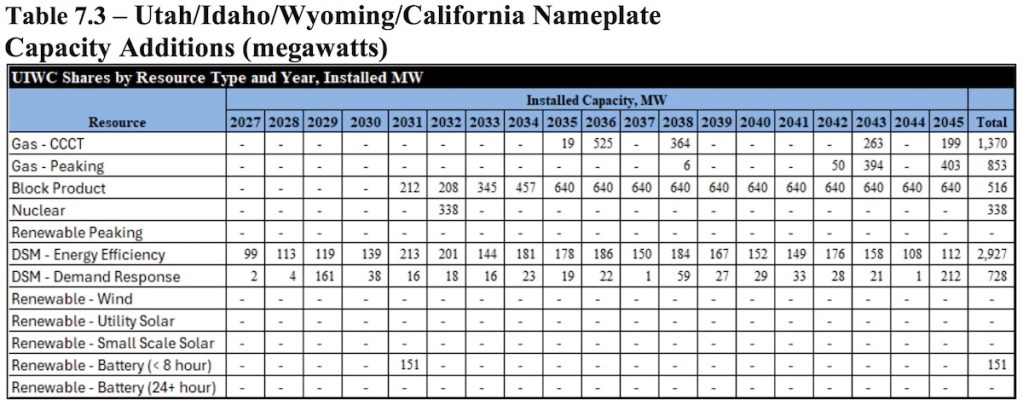
The electric utility has no plans to add more wind or solar facilities in Wyoming, Utah, Idaho and California from 2027 through 2045.
“Changes in this update are largely driven by the July 4, 2025, repeal of major portions of the Inflation Reduction Act,” the company says. “The repeal was enacted through the [“One Big, Beautiful Bill Act”], which, significantly, phases out or eliminates highly impactful tax benefits, primarily for renewable solar and wind generation resources.”
Rocky Mountain Power is Wyoming’s largest electric utility. PacifiCorp is part of billionaire investor Warren Buffett’s Berkshire Hathaway energy conglomerate.
Amid a series of rate hikes in recent years — which amount to about a 20% increase for Wyoming customers since 2020 — Rocky Mountain Power officials have testified that the company’s renewable energy additions were not the culprit, but had kept monthly electric bills from rising at an even higher rate.
“It is the company’s investment in these renewable resources that have mitigated the increase in net-power costs,” former Rocky Mountain Power President and CEO Gary Hoogeveen testified to Wyoming officials in 2023. “Without the company’s investment in these resources, the increase in net-power costs would have risen an additional $85.4 million or 65% in Wyoming.”
But the economic feasibility for wind and solar has changed, according to the utility. Federal tax credits for wind and solar had reduced the cost of wind and solar projects by about 30%, the company says. With the new phase out schedule, projects would likely have to begin construction within the next year to still qualify. That policy, along with Trump administration rollbacks for fossil fuel regulations, “may make coal a more competitive fuel source.”
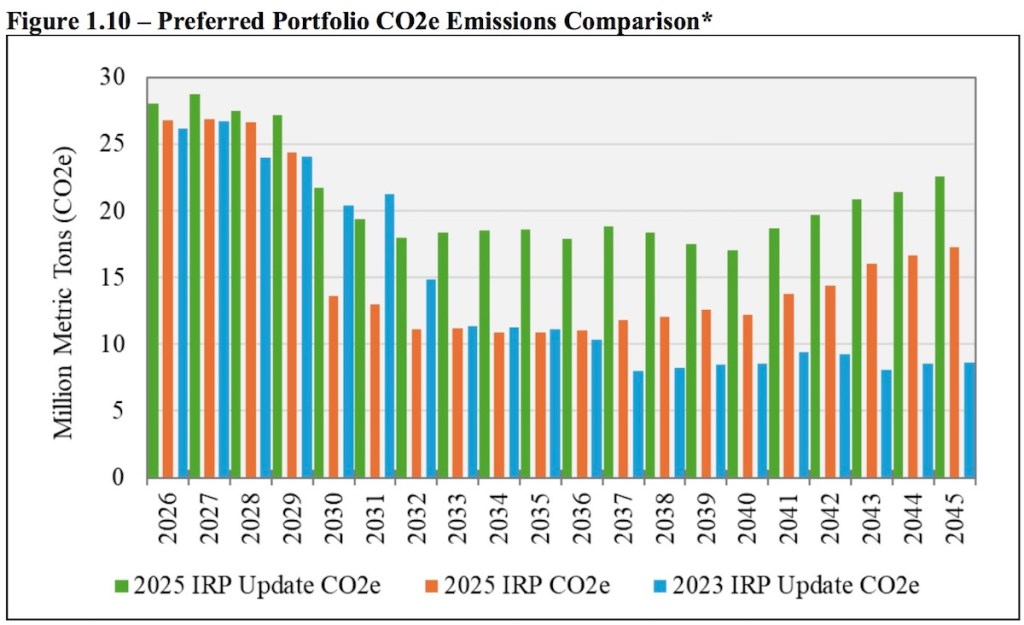
The utility giant has delayed some coal power plant retirement dates in recent years, including in Wyoming, and its new long-term planning outlook notes that its greenhouse gas emissions trajectory, which had been falling, will now go up.
“The update does not look good at all for renewable energy,” Sierra Club Wyoming Chapter Organizer Emma Jones told WyoFile.
This chart depicts the change in projected carbon dioxide emissions based on PacifiCorp’s resources planning, which was updated in March 2026. (PacifiCorp)
She noted, however, that such “integrated resource plans” continually change. Regulated utilities like PacifiCorp/Rocky Mountain Power are required to file a new resource plan every two years, and they frequently update those plans between filings.
The company also notes, as do other utilities, that it is not obligated to follow the plan, which looks 20 years into the future.
Yet the planning document does create “signals” that solidify electrical generation investments in the short term, Jones noted.
“If Rocky Mountain Power is saying it’s not planning on any new wind power for 20 years, I think that does create a level of uncertainty for [renewable energy] developers,” Jones said.
Wind out of the sails
PacifiCorp is responsible for about 35% of Wyoming’s 3,700 megawatts of installed wind-generated electrical capacity, according to the U.S. Energy Information Administration.
One megawatt is enough electricity to power about 750 homes.
Though the company is gutting future renewable installations, there are still a few more projects to come to fruition.
“The preferred portfolio includes about 1,200 megawatts of new solar located in Utah, over 400 megawatts of new wind located in Idaho and 26 megawatts of new wind located in Wyoming,” Rocky Mountain Power spokesman David Eskelsen told WyoFile. Some of those wind and solar facilities will generate power dedicated to PacifiCorp customers in Oregon and Washington, he added.
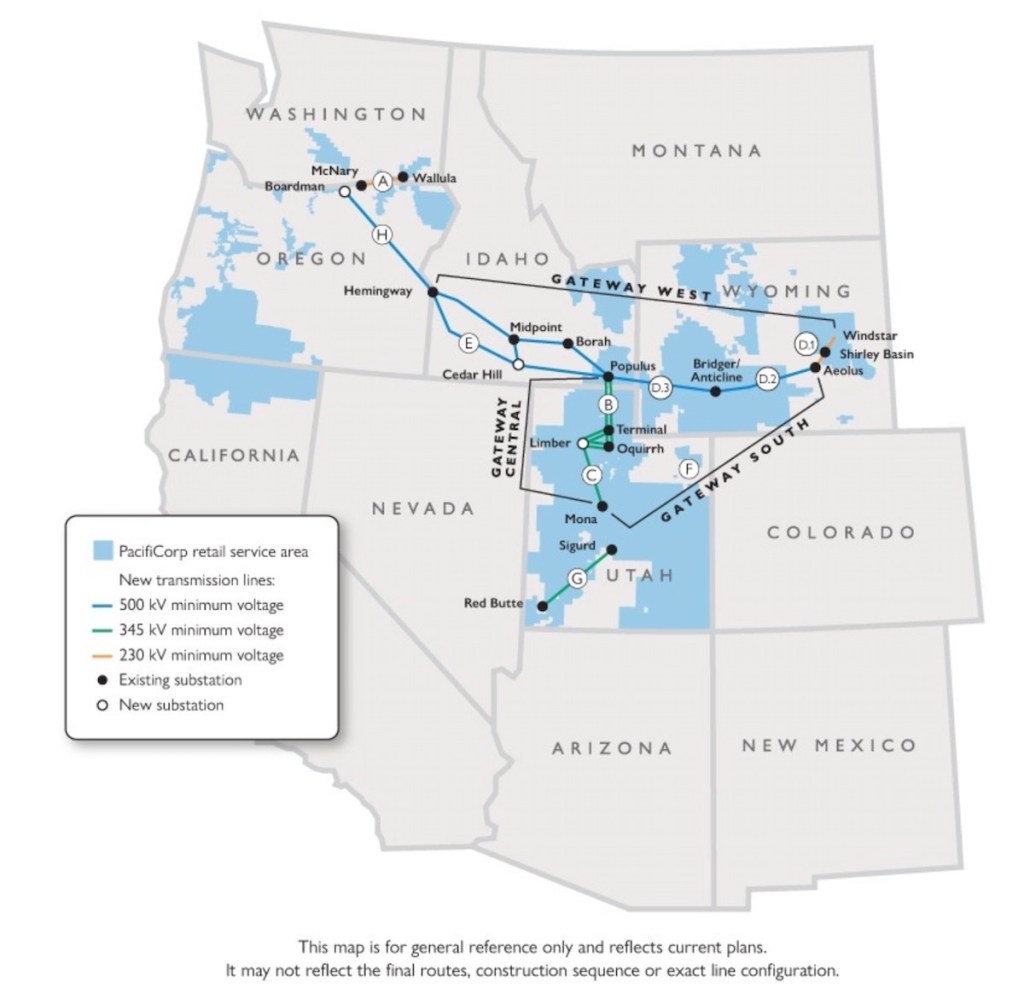
This map depicts PacifiCorp’s Gateway interstate transmission projects, connecting Wyoming wind-generated electricity to customers throughout the utility’s multi-state service region. (PacifiCorp)
Beyond that, PacifiCorp’s retreat from renewable energy development muddies the picture for future wind development in Wyoming. Frequently, a smaller company will propose a project under its own name, but it’s building to meet the needs of a larger utility — like PacifiCorp, or Black Hills Energy.
In addition to sometimes building their own electrical generation facilities, large utilities — based on their long-range planning — solicit new wind and solar energy from the marketplace by issuing a “request for proposal.” Essentially, they tell other companies that they’re in the market for more renewable power, and if somebody takes the investment risk and works through the permitting process on their own to build a wind farm, the utility will buy the power. It might even take ownership of the facility after the developer has set it up.
Essentially, PacifiCorp has dramatically driven a lot of wind energy development in Wyoming. Now that it’s removing itself from the game, it’s unclear what’s in store for the industry. Some industry watchers speculate that Wyoming co-ops might step into the game for their own reasons, and that data centers might become a bigger driver for wind energy development.
This chart depicts PacifiCorp’s planned new wind and solar additions, according to is planning document updated in March 2026. (PacifiCorp)
Others, including Jones of the Sierra Club, insist that it’s too late to kill wind and solar energy via federal policies, because they continue to gain efficiencies that likely overcome the loss of federal tax credits. Other utilities, beholden to their ratepayers who want low-cost electrons, are likely to consider adding more renewable energy to their portfolios.
PacifiCorp, Jones speculated, will probably return to renewable energy, too.
“I think the problem is that, even if [PacifiCorp officials] decide down the road, ‘We’re going to invest in renewables again,’ the delay that they’re creating is ultimately going to cost customers money that would have been saved by putting cheaper renewable energy online sooner,” Jones said.
The general sentiment in the utility industry, Jones added, is that it’s cheaper to build today than it is years down the road. “The longer we wait to build out infrastructure to meet the demands of customers, the more we’re going to have to pay in the long run.”
Southwestern Wyoming, other upper Colorado River Basin states, prepare for water shortages
Gov. Mark Gordon joined fellow governors from other Colorado River headwater states Thursday to announce that a significant extra water release from Flaming Gorge is imminent. Dire water conditions in the region will likely require reducing water use, he warned.
“Because of such diminished runoff, existing state laws in the Upper Division States [Wyoming, Utah, Colorado and New Mexico] require water users to face cuts to water rights dating back to the 1800s — these cuts are mandatory, uncompensated, and will have significant impacts on water users, including Upper Basin tribes, and local economies,” Gordon said Thursday afternoon in a joint press release with Govs. Spencer Cox of Utah, Michelle Lujan Grisham of New Mexico and Jared Polis of Colorado.
The Colorado River Basin has experienced the warmest winter on record, combined with historic low snowpack which feeds the Colorado River. Some 40 million people in seven western states and Mexico rely on the waterway.
Buckboard Marina owner Tony Valdez observes toxic cyanobacteria blooms at Flaming Gorge Reservoir on Sept. 26, 2022. (Dustin Bleizeffer/WyoFile)
Reached for comment, Wyoming State Engineer Brandon Gebhart told WyoFile, “There won’t be enough water to satisfy existing water rights, and so we regulate junior users to satisfy senior users.
“That regulation is the result of calls from senior Wyoming water rights, not a downstream demand on the Colorado River,” Gebhart added. “Due to the historically bad hydrology, we expect that many Wyoming streams will have only enough water to satisfy the most senior rights, many of those dating back to the 1880s.”
Water-use restrictions are imposed on a pecking order of senior-versus-junior water rights. Those who acquired their water rights most recently are the first to be ordered to close their spigots. In southwestern Wyoming, those junior water rights include municipalities and industrial facilities, such as some trona mines and soda ash operations.
For months, Gebhart has been warning that the historically bad outlook for the Colorado River will require extra releases from Flaming Gorge Reservoir — one of a handful of “upper basin” storage reservoirs to help maintain operational levels at Lake Powell and to ensure legally obliged flows to downstream states Arizona, California and Nevada.
How much and when those releases will occur is still to be determined, according to Gebhart. More details are expected by the end of April.
“The volume of the release is still uncertain, but we expect it will begin on May 1 or perhaps sooner,” Gebhart told WyoFile via email, adding that the federal Bureau of Reclamation is contemplating an extra release volume of 660,000 acre-feet of water or — potentially — up to 1 million acre feet. For comparison, Flaming Gorge Reservoir has a total storage capacity of about 3.8 million acre-feet.
Wyoming’s Colorado River Advisory Committee is scheduled to meet at 10 a.m. Friday. Gebhart is expected to provide more details about Wyoming and Colorado River matters. You can access a livestream of the meeting here.
Weston County Clerk Becky Hadlock resigns from office one day after arrest
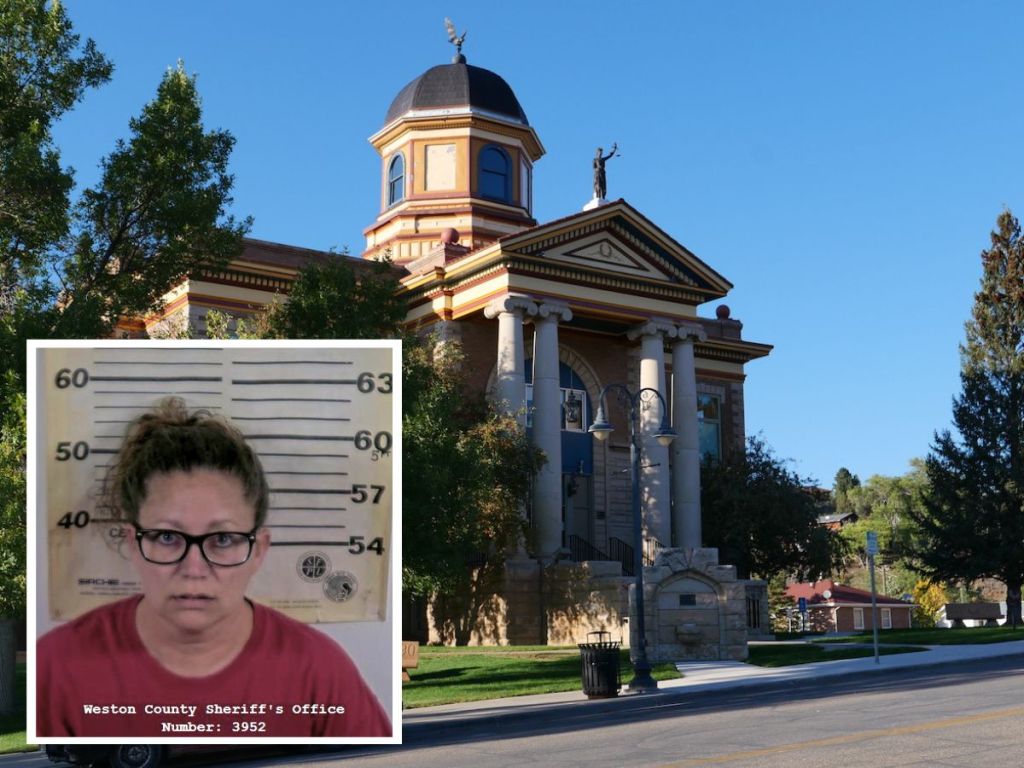
Weston County Clerk Becky Hadlock resigned from office Thursday, one day after she was arrested and charged with two felonies related to her conduct during and after the 2024 general election.
Hadlock faces one count of violating the election code as an official and one count of falsifying election documents. Each carries a penalty of up to five years in prison.
She was set to stand trial Monday in a separate case to determine whether she should be removed from office for acts of misconduct and malfeasance, which included allegations that she filed a false post-election audit and defied a legislative subpoena.
Ryan Semerad, Hadlock’s attorney, said a hearing was scheduled late Thursday to determine whether Monday’s trial would proceed.
“I am declining to comment on Clerk Hadlock’s resignation,” Semerad told WyoFile. “I look forward to fighting back against the criminal charges filed against her.”
On the night of the 2024 general election, Hadlock caused an initial ballot miscount in her county’s results after using the wrong ballots. That led to a dramatic undercount in the vote for Speaker of the House Chip Neiman. A hand count ultimately sorted out the results, as did a second post-election audit. However, the charges stem from an initial audit that Hadlock submitted, indicating there were no issues with the votes. In reality, there were 21 errors in that sample batch of 75 ballots.
“The investigation into the 2024 Weston County General Election reveals that County Clerk Becky Hadlock … knowingly filed a false post-election audit,” according to an affidavit of probable cause signed by a state investigator in the criminal case. Investigators say two people, including a deputy clerk, said they heard Hadlock refer to such mandatory audits as “stupid.”
The post-election audit was also one reason lawmakers subpoenaed Hadlock to appear at a legislative hearing last year. After she failed to do so, the Natrona County District Attorney’s office charged her with a misdemeanor in a case separate from the one scheduled to go to trial Monday. She has pleaded not guilty in that matter.
In January, Gov. Mark Gordon directed the Wyoming Attorney General’s office to seek Hadlock’s removal from office following a verified complaint from Weston County voters. Amy Edmonds, Gordon’s spokesperson, declined to comment Thursday following Hadlock’s resignation.
Weston County commissioners will meet Tuesday to accept Hadlock’s resignation and begin the process of filling the vacant seat, which is typically decided by voters.
“It’s just a bummer. It really is,” Commission Chairman Nathan Todd told WyoFile when asked what the mood was like in Newcastle.
“What’s upsetting is, I don’t ever think anything was done maliciously, and, you know, I could be wrong,” Todd said. “People make mistakes, and unfortunately, sometimes it’s hard for people to own up to them. And if that’s all this was, I guess that’s all it is.”
How much more wind energy might Wyoming see? It’s complicated.
Entering election season, some Wyoming candidates are embracing President Donald Trump’s hard-line opposition to wind energy, which he has described as “a blight on our country,” while vowing his administration is “going to try and have no windmills built in the United States.”
Republican candidate for Wyoming’s lone U.S. House of Representatives seat and sitting Secretary of State, Chuck Gray, has declared “woke wind is wrong for Wyoming” and that wind turbines “have been terrorizing the landscape for too long.”
Reid Rasner, also vying for Wyoming’s U.S. House seat, has said, “I stand with President Trump, I oppose windmill expansion and I will fight to make America energy dominant again,” while chiding Gray for past votes in favor of wind energy as State Board of Land commissioner.
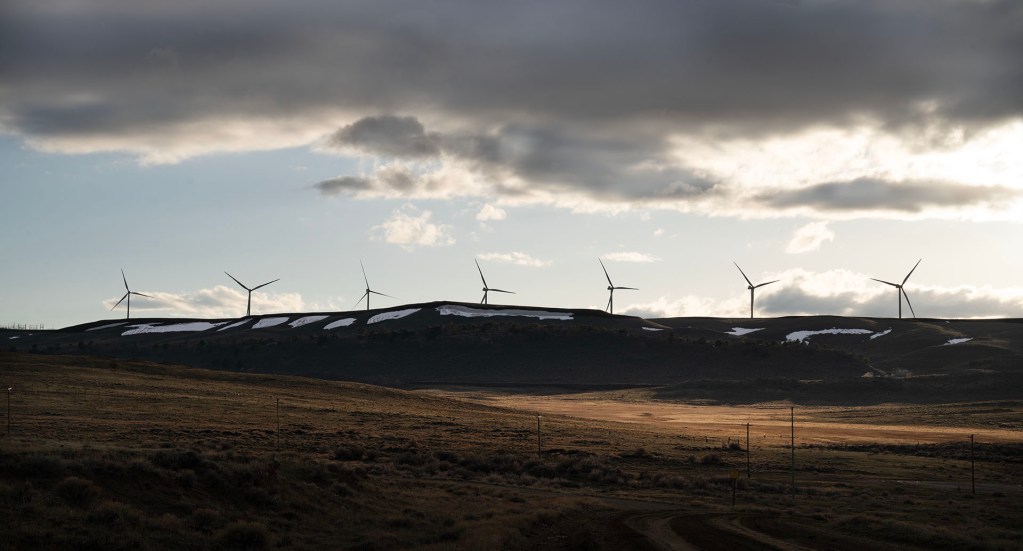
To date, there are about 1,500 wind turbines spinning in the state with a generating capacity of approximately 3,700 megawatts — that’s about 25% of Wyoming’s total electrical generation capacity, according to multiple sources compiled by WyoFile.
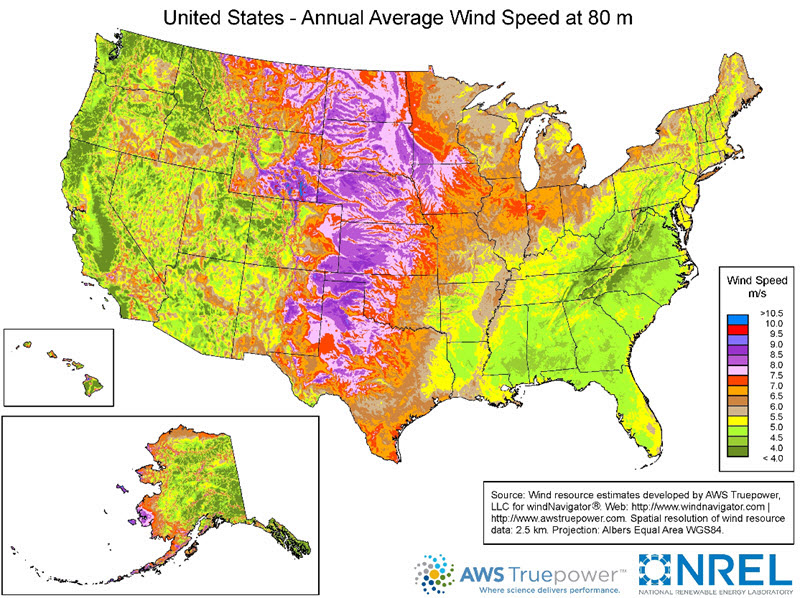
This map depicts average annual wind speeds in the U.S. (National Renewable Energy Laboratory)
What’s yet to come depends on multiple factors, and tracking which projects are moving forward and which have stalled is challenging because there’s no single source or clearinghouse for up-to-date, Wyoming-specific information.
The Trump administration’s order to halt wind project permitting on federal lands has no bearing on development proposed for state and private lands. While there’s much debate at the state and local level about where to locate and, sometimes, whether to permit wind and other utility-scale renewable energy projects at all, it’s hard to size up exactly how much more wind development is on the horizon for Wyoming.
“We need to improve the process and transparency,” Cheyenne area resident Wendy Volk said.
Patchwork and moving targets
The Wyoming Industrial Siting Council holds a wealth of information, but only regarding qualifying projects: those exceeding $240 million in construction costs and with significant socioeconomic impacts. Landowners and county officials hear from many other developers about potential projects that haven’t yet entered the county, state or federal permitting process. Plus, many of the renewable energy and other industrial projects on the council’s docket continually change in size, scope and timing.
“You have an applicant for a permit and he’s telling the Industrial Siting Council, ‘We’re going to need to delay our project. We might resize our project.’ Or, what they’re not saying is they potentially may never build the project,” Volk told WyoFile.
The council has sent out at least eight public notices so far this year regarding amendments to various projects. The Settler Wind Project in Converse County, for example, was granted a request to change its construction start date from August 2025 to November 2027. The Dinosolar Solar Energy Project in Natrona County was granted a request to reduce the size of the project from 440 megawatts to 240 megawatts and to delay construction from April 2024 to March 2029.
One megawatt is enough electricity to power about 750 homes.
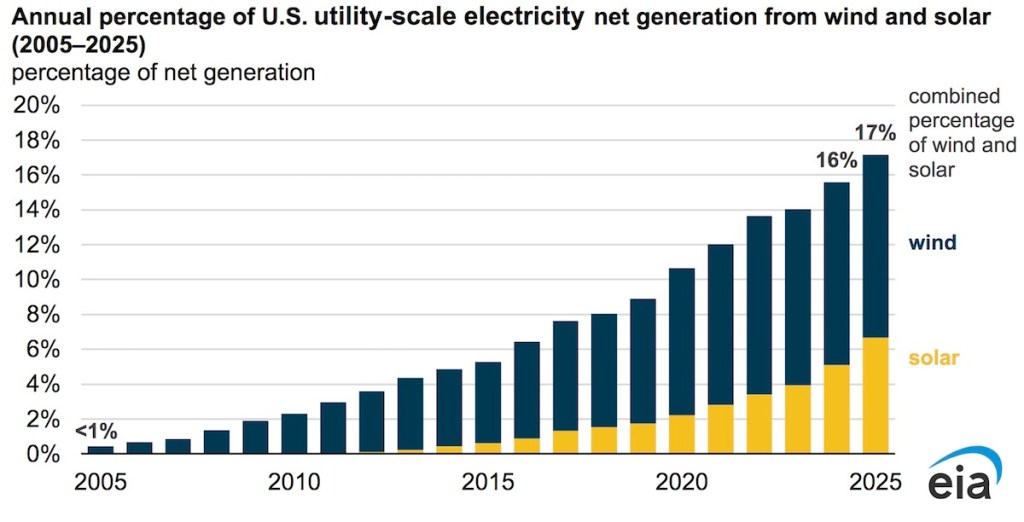
This chart depicts the growth of wind and solar energy in the U.S. (U.S. Energy Information Administration)
It’s not just the siting council that has incomplete and ever-changing information, Volk said. Residents are left to navigate fluctuating planning and permitting processes at the county, state and federal level. Some state-level officials have confided in her, Volk said, that the volume and ever-changing information is overwhelming and difficult to understand. Some have even suggested she generate a comprehensive map of existing and proposed renewable energy projects herself.
“Is that my job?” the real estate agent said.
Volk recently helped launch a petition that, in part, asks Wyoming officials to pause renewable energy permitting to conduct a “cumulative, landscape-level impact analysis.”
“Wyoming residents expect transparency, accountability and an honest conversation,” Volk continued. “When projects stack up across a region, impacts multiply — even when each project claims compliance in isolation. My biggest concern is transparency. But let’s look at that cumulative impact. And how can you look at the cumulative impact of a 150-mile corridor if you don’t even have a map?”
Inherently arduous
The tangle of multiple authorities, moving targets and changing scope of projects — not to mention market realities like supply chain interruptions — is not a nefarious divide-and-conquer strategy, Power Company of Wyoming Communications Director Kara Choquette told WyoFile.
“There’s just a lot of permitting processes that are difficult to match up with the reality of what it’s like to develop a wind project,” Choquette said. “It’s really hard to predict. The timeframe on all of those permits have to be linked together.”
She pointed to a Wyoming wind energy permitting flow chart on page 84 of this document.
Choquette said she speaks from experience. The $3 billion, 732-mile-long TransWest Express transmission line to bring electricity from Power Company of Wyoming’s Chokecherry and Sierra Madre Wind Energy Project in Carbon County to the southwest took some 15 years to permit.
“It’s difficult to permit and develop a big energy project,” Choquette said.
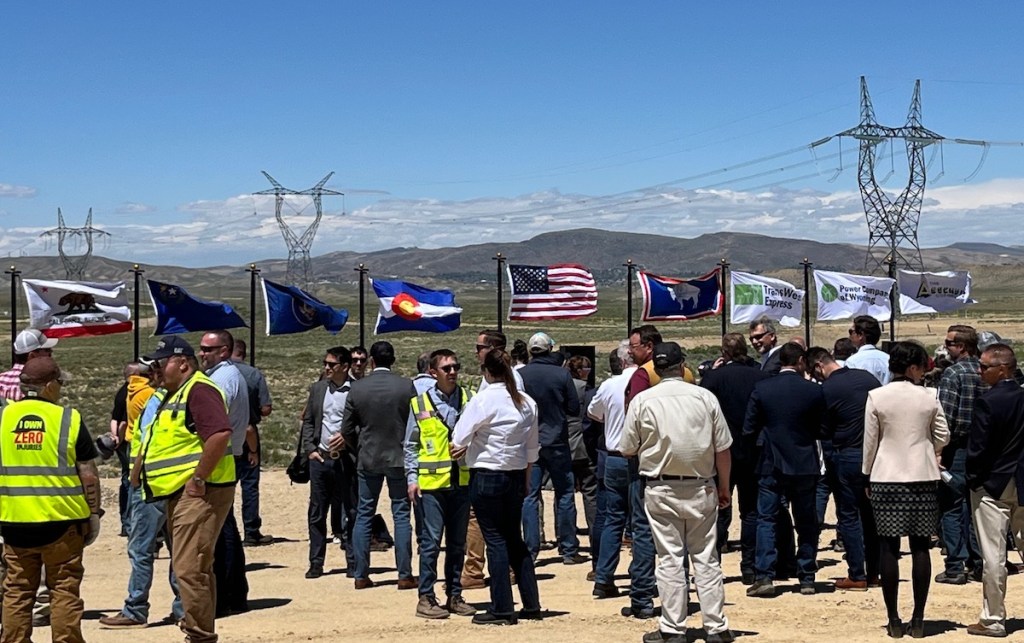
Federal and state officials gathered in Carbon County June 20, 2023, to celebrate the launch of the TransWest Express transmission project. (Dustin Bleizeffer/WyoFile)
Further muddying the picture of potential renewable energy development in Wyoming are legal entanglements.
Citing a court ruling, the Wyoming state lands board in February began the process of invalidating two wind leases it had approved last year — one related to the Pronghorn H2 Clean Energy Project in Converse County and one for the Sidewinder Clean Hydrogen Project in Niobrara County.
Before the vote, Wyoming State Auditor Kristi Racines said the board — made up of Wyoming’s top five elected officials — had sometimes whiffed on public notices and failed to give the public a proper platform to engage, referring to a December meeting that didn’t allow for a full discussion between the board and concerned residents.
“And so me, personally,” Racines said, “I am here today to tell you that I apologize. I apologize for the mess that this has become.”
Ex-Wyoming Catholic youth minister, diocese face lawsuit over sexual assault accusations involving 3 boys
A former Wyoming Catholic youth minister and teacher in Casper sexually assaulted three boys while they took part in youth programs facilitated by a local church and the Diocese of Cheyenne, a lawsuit filed Tuesday alleges.
The civil complaint alleges that then-Wyoming Catholic youth minister Doug Hudson sexually assaulted the three boys in the 1990s. The complaint also lists the Diocese of Cheyenne, which oversees parishes throughout Wyoming, and Our Lady of Fatima Church in Casper as defendants, stating that they failed to “supervise and control” Hudson and protect the plaintiffs, which allowed for the alleged sexual assaults to occur.
A spokesperson for the diocese declined to comment on the lawsuit until diocesan officials have consulted with legal counsel. He said in an email to WyoFile that the diocese plans to respond publicly to the allegations “in the near future.”
WyoFile attempted to contact Hudson through multiple phone numbers listed online under his name and through other people. Some calls were disconnected. WyoFile left voice messages at two numbers. A reporter called another, but the person who answered hung up when the reporter asked if the number belonged to Hudson. Other people that WyoFile asked didn’t have Hudson’s contact information or declined to share it.
Hudson’s court summons lists a North Carolina address, although WyoFile found records that appear to show a person with his name moved from North Carolina to Kentucky in 2024.
The allegations
As minors, the plaintiffs had taken part in Our Lady of Fatima Church’s youth programs, where Hudson worked as a youth minister under the Diocese of Cheyenne, the complaint states. All three allege that Hudson sexually assaulted them during one of these programs.
The Diocese of Cheyenne and Our Lady of Fatima Church provided Hudson with housing on its Casper campus for conducting youth activities and services. Two of Hudson’s accusers say he assaulted them at that home, the complaint states.
Plaintiffs allege that the Diocese of Cheyenne and Our Lady of Fatima Church knew Hudson was inviting minors to his house on campus. They also believe the diocese and the church were aware that Hudson had organized at least one off-campus overnight trip for youth activities and services.
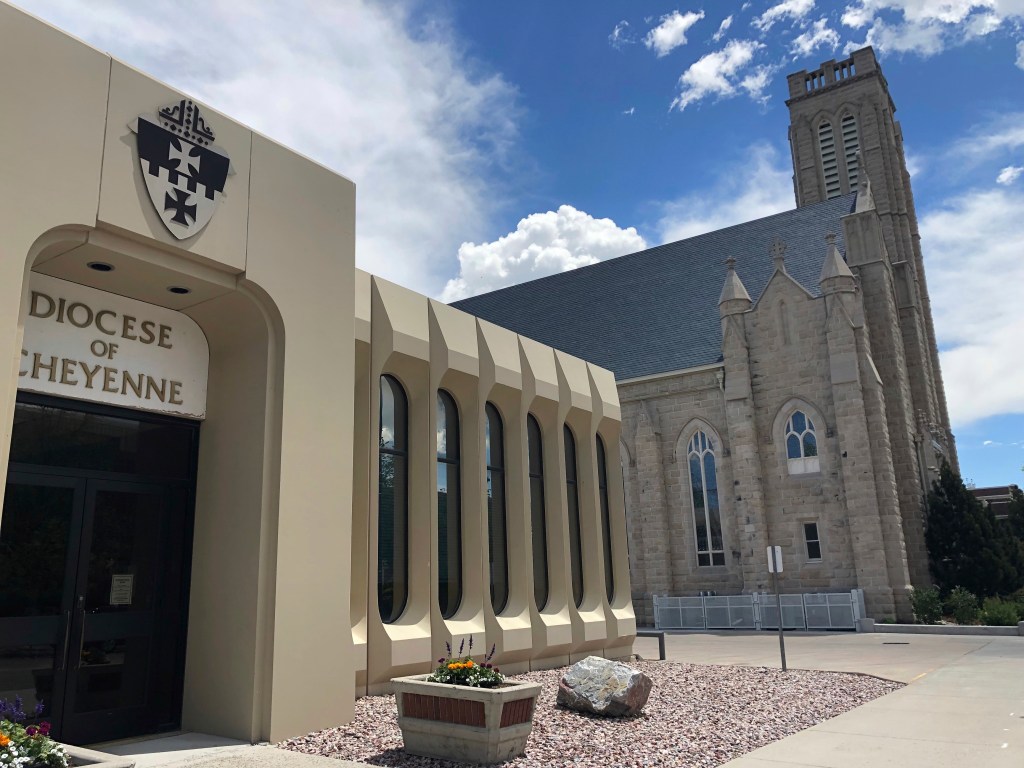
This June 13, 2019, file photo shows the offices for the Roman Catholic Diocese of Cheyenne and the Cathedral of St. Mary in Cheyenne. (AP Photo/Mead Gruver)
At the time, Hudson was supervised by Father Pietro Philip Colibraro, the lawsuit states. The Diocese of Cheyenne acknowledged a substantiated allegation of sexual abuse, reported in 2005, against Colibraro that involved an adolescent male. Colibraro, who died in 2017, became co-pastor of Our Lady of Fatima Church in 1990, then sole pastor of the church in 1997. He stayed there until his retirement in 2001.
According to the complaint, Colibraro was warned that Hudson was “plying adolescent males with alcohol.” The lawsuit doesn’t say who warned Colibraro or how this information came to light.
The lawsuit alleges Hudson sexually assaulted plaintiffs Anthony Jacobson and Ryan Axlund in 1995 and 1997, respectively, at the house provided by the Diocese of Cheyenne and the church. At the time, they were both minors.
According to the complaint, Hudson had “plied” each of them “with copious amounts of alcohol, including Southern Comfort” and assaulted them when they were intoxicated. Both “passed out from the alcohol intoxication,” the lawsuit states.
The complaint alleges Hudson sexually assaulted another plaintiff, James Stress, in 1996 or 1997 at a hotel during an off-campus overnight trip. According to the complaint, Hudson was assigned through the church’s youth ministry to be Stress’ personal counselor. The minister was also Stress’ teacher at Saint Anthony Tri-Parish Catholic School.
At the hotel, Hudson gave Stress “copious amounts of alcohol” and sexually assaulted him while he was intoxicated, according to the lawsuit. Stress eventually blacked out, the document states.
The complaint seeks damages of at least $50,000 per plaintiff to pay for their “bodily injury,” including past and future medical expenses and “mental pain and suffering and loss of enjoyment of life.”
Statute of limitations
While allegations of sexual abuse at the hands of Catholic leaders have occurred across the country, prosecutors in many states have run out of time to press charges.
Wyoming, however, is one of a handful of states that doesn’t have a statute of limitations for child sexual abuse crimes, meaning criminal charges can be brought at any time in the future. For civil litigation, like the case against Hudson, accusers can file a complaint within eight years after a minor turns 18, or within three years after the “discovery” of injury caused by childhood sexual abuse, whichever is later.
While he didn’t speak specifically about his clients, Dallas Laird, one of the plaintiffs’ attorneys, said that sometimes people “don’t discover what happened to them until they wonder why their life has gone the way it has, and they go to therapy.”
The lawsuit states that Jacobson and Axlund discovered in March 2024 and Stress discovered in April 2024 that Hudson had allegedly sexually assaulted them. It does not provide additional details about those discoveries.
According to Laird, one of the plaintiffs made a complaint to Casper police “when he found out what he thought happened to him.” A spokesperson for the Casper Police Department didn’t confirm or deny this, stating in an email that Wyoming law bars the department “from disclosing any information that may reasonably identify a victim or suspect in a sexual assault investigation until that investigation has been formally filed in district court.”
Laird, who lives in Casper, said he had never talked with Hudson before. “But I hope to be able to take his deposition at some point,” he added. Two Cheyenne attorneys, James and Michael Fitzgerald, are also representing the plaintiffs.
Laird said he advised his clients not to speak with the press.
In this Sept. 19, 1988, file photo, the Rev. Joseph Hart dispenses communion during an outdoor Mass celebrated for participants of the Basque Festival in Buffalo. (AP Photo/Dean Wariner, File)
The new allegations add to a list of abuse accusations against Catholic leaders and staff in Wyoming, perhaps the most infamous being former Wyoming Bishop Joseph Hart, who faced multiple sexual abuse allegations found credible by the Diocese of Cheyenne. People first came forward with allegations of abuse in 1989, but Hart, who died in 2023, steadfastly maintained his innocence, and a Vatican investigation later exonerated him of multiple allegations.
Meanwhile, Wyoming’s current bishop, Steven Biegler, announced in 2018 that an examination initiated by the diocese and conducted by an outside investigator concluded Hart sexually abused two boys in Wyoming. A month later, the diocese reported a third abuse allegation against Hart that it deemed credible.
From microschools to basements to boats, Wyomingites embrace school choice with or without state money
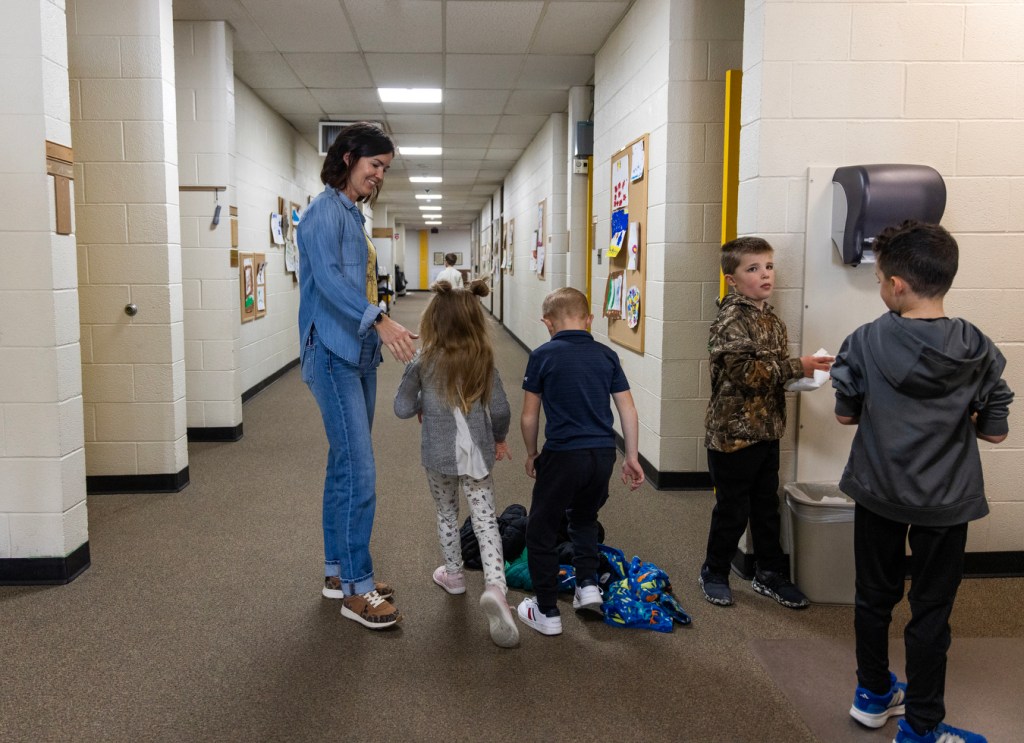
CASPER—It’s the Friday before Thanksgiving, and Bree Uresk is trying to wrangle her students to sit quietly. She knows the last day before a holiday break is particularly hard for 6- and 7-year-olds to be still. “You guys are being extra silly today,” she tells her eight students.
It’s a typical school scene, but with fewer kids than your average public school classroom. Powder River Prep, where Uresk teaches, serves only 10 families. And that’s what the women who founded it envisioned: smaller class sizes with an emphasis on student-led learning, parent involvement and conservative values.
Tiffany Gamble, along with her friend and fellow mom Kayleigh Clark, started the microschool after a search for a satisfactory kindergarten program for her child led to nothing but dead ends.
Touring established schools in Casper, Gamble was troubled when teachers told her they didn’t take their kindergarten classes out in the community because there’s “nothing to do in Casper,” she said.
“There’s plenty to do in Casper,” she told WyoFile. “But I have no idea how you would take [a class of] 24 kindergarteners to do it.”
What if, she thought, a parent wants their child to go on biweekly nature studies, or help out at a senior living facility, or take a karate class during the school day?
So Gamble and Clark set out to start their own school, and Powder River Prep emerged as a functioning microschool (so named because of its size) in August. The microschool combines parent involvement with class time led by licensed teachers like Uresk.
In her classroom, Uresk’s eight students wriggle around on a large checkered rug. Morning sunlight pours in from windows behind them. A papier-mache beehive hangs from the ceiling, and educational posters line the walls.
Students burn energy between lessons in the lower elementary class at Powder River Prep. (Dan Cepeda/WyoFile)
Students run on the playground during an outdoor break at Powder River Prep. (Dan Cepeda/WyoFile)
At 10:46 a.m., an older student pops into Uresk’s classroom. “Recess,” he whisper-yells, before darting away to follow his classmates outside.
Powder River Prep, which co-founder Clark described as a “school family,” is one of a growing number of alternatives to traditional public education in Wyoming.
Numbers-wise, public schools still reign supreme in the state. Just shy of 80,000 students were enrolled in the state’s public school system across all grade levels and school districts in 2024-2025, data from the Wyoming Department of Education shows. Much fewer were the families who registered to homeschool their children that same academic year — just over 4,500.
A new addition to the state’s education funding plans might grow that number. The Steamboat Legacy Scholarship Program, created last year by state lawmakers, would offer $7,000 to Wyoming families for K-12 non-traditional schooling costs, such as tuition for alternative education programs like Powder River Prep. There’s no income requirement to qualify for education savings accounts for K-12 students. The program is also available for pre-K education, but to qualify for those services, families’ income must be at or below 250% of the federal poverty level, WyoFile reported.
More than 4,000 families have signed up for the ESA program. Seven of those would have enrolled their children at Powder River Prep.
But whether they ultimately get that money remains an open question.
A June lawsuit by the Wyoming Education Association, and then an August injunction from Laramie County District Court Judge Peter Froelicher, blocked the state from giving out the funds after the program was approved in last year’s legislative session. The Wyoming Education Association, along with nine parents of school-aged children, see the potential funds as constitutionally questionable, they argued in their lawsuit. The Wyoming Department of Education, however, wants the program money to be freed from court.
Some policymakers view the possible funds as uplifting to families in the state who, for various reasons, decide not to utilize public schooling. State Superintendent of Public Instruction Megan Degenfelder is one of those.
“Every student learns differently, and ESAs are a very meaningful way to empower parents to find the best educational options for their children,” she wrote to WyoFile in an email.
Taggart True, center, goes over his books during individualized learning at Powder River Prep. (Dan Cepeda/WyoFile)
But other elected officials, such as Sen. Chris Rothfuss, D-Laramie, are concerned that the funds would detract from the constitutional obligation for Wyoming lawmakers to invest in public schools.
“There’s no indication or even suggestion that the education they’re receiving with these funds, assuming it was somehow constitutional, would be an equitable, high-quality education,” he said.
The lawsuit’s outcome will have big implications, both for the Casper microschool and nontraditional schooling in Wyoming. It could slow the momentum of the alternative education movement — homeschools, microschools and other such programs — just as new schools, like Powder River Prep, are opening their doors. Or it could allow the schooling experiment that Wyoming is pursuing to welcome many more students, at a time when traditional public schools are experiencing declining enrollment.
“Alternative forms of schooling tend to take money away from public schools and tend to compete with public schools for resources,” Rothfuss said. “Homeschooling traditionally hasn’t. But now there is some desire — not among all, but among some — to draw away resources towards homeschool, and this will potentially hurt — further hurt — and erode public education.”
An untraditional classroom in a traditional school building
Not all Wyoming families utilizing non-traditional education methods would be dependent on education savings accounts. WyoFile spoke with one family who relies on reimbursements from other programs and with another who homeschools because they travel for much of the year. Almost everyone emphasized that what they do works for their family, even if it might not be right for others.
“As long as our kids — my kids, in particular — are thriving here, learning and they want to be here, and this is a good fit for us, that’s as long as we’ll do it,” Gamble said. “I’m all in.”
Neither Gamble nor Clark could find existing kindergarten options they liked enough for their kids.
“It is significantly limited,” Gamble said of the educational options in Casper, where she and Clark live. “It is actually very disheartening. So we thought, ‘Let’s just start our own school.’”
Lower elementary educator Bree Uresk and co-owner Tiffany Gamble watch as students look over a Nativity Scene between classes at Powder River Prep. (Dan Cepeda/WyoFile)
The endeavor was massive, they soon realized. What if there was an existing educational program that they could join, and by joining, use their abilities to improve?
“Doesn’t exist. It’s not happening,” Gamble said.
So they decided they would have to start their own, one with smaller class sizes, more parent involvement, faith-based curricula, hands-on learning and “conservative values,” they said. (Gamble and Clark explained that “conservative values,” for them, are largely based on the Code of the West.)
The old Jefferson Elementary in Casper houses the microschool, though not all of its classrooms are currently in use. (As part of their commitment to student-led learning, school leaders are designing certain learning spaces for more niche interests, like sewing or woodworking.) The women told WyoFile that they closed on the building in August. Shortly after, they began their first academic year.
Jett Schulte, an upper elementary student at Powder River Prep, prays with his classmates during Bible study. (Dan Cepeda/WyoFile)
Their story echoes the feelings of many people who are unsatisfied with public schools — and even private and charter schools — for their children’s education. At Powder River Prep, Gamble and Clark could marry their desire to be active educators for their families, but not carry the full responsibility of traditional homeschooling.
Neither woman has ever worked in the education field, they said. According to their website, Powder River Prep employs three teachers, all of whom are licensed educators in the state.
On that blustery Friday morning before Thanksgiving break, one of those educators, Lisa McQueen, told WyoFile she enjoys a lot of support in teaching second, third, fourth and fifth graders. (The microschool is kindergarten through fifth grade, currently.)
“There’s a challenge to it, but given the pieces that I have been given — I have parent support, I have a small class size, I have the ability to adjust and change curriculum if we need to, I have experience, I’ve done it,” McQueen said of leading that wide a grade range. “Everything has its challenges, right? But not to that point where I’m stressing and going ‘Oh, this will never work.’”
Lisa McQueen, upper elementary educator, works with Roark True at Powder River Prep. (Dan Cepeda/WyoFile)
For their first year running a functioning school, both Clark and Gamble think it’s going well.
But it’s hard for them not to ask the question: What if the state money, those ESAs, hadn’t been tied up in court? Gamble thinks that the doors to more microschool models would have opened.
“The lack of flexible state funding is not helpful to coming up with innovative changes to education. That is a definite barrier to more of these popping up,” Gamble said.
“This should be happening in Wyoming. This is really sad to me,” she lamented a few weeks into the 2025-2026 academic year. “It’s not like we’re the first to come up with this idea, [but we are] the first to put hard work into what this means for our youth.”
Learning in a literal schoolhouse
Regardless of who wins the ESA fight, Laura Butler will continue to homeschool her son, Darren. Laura and Darren attend school every day in the basement of their Casper home, a portion of which Laura has organized to be a classroom space. That’s what she calls it, she said: the classroom.
Laura uses a program called Braintree Academy, which reimburses her yearly for various education-related expenses and provides virtual resources like clubs for Darren, an energetic, STEM-minded third grader. It’s not quite an online school, aside from the clubs, because Darren doesn’t have to log on at specific times. Laura gets to lead the day as she sees fit. But it does provide her with some resources that she wouldn’t have otherwise. Her only obligation is to send in a “progress check” for Darren every couple weeks, she said.
“Braintree is what I call my ‘group,’” Laura said. She receives $1,800 per academic year from the organization. The program requires testing twice per year, which Laura considers her “report card.”
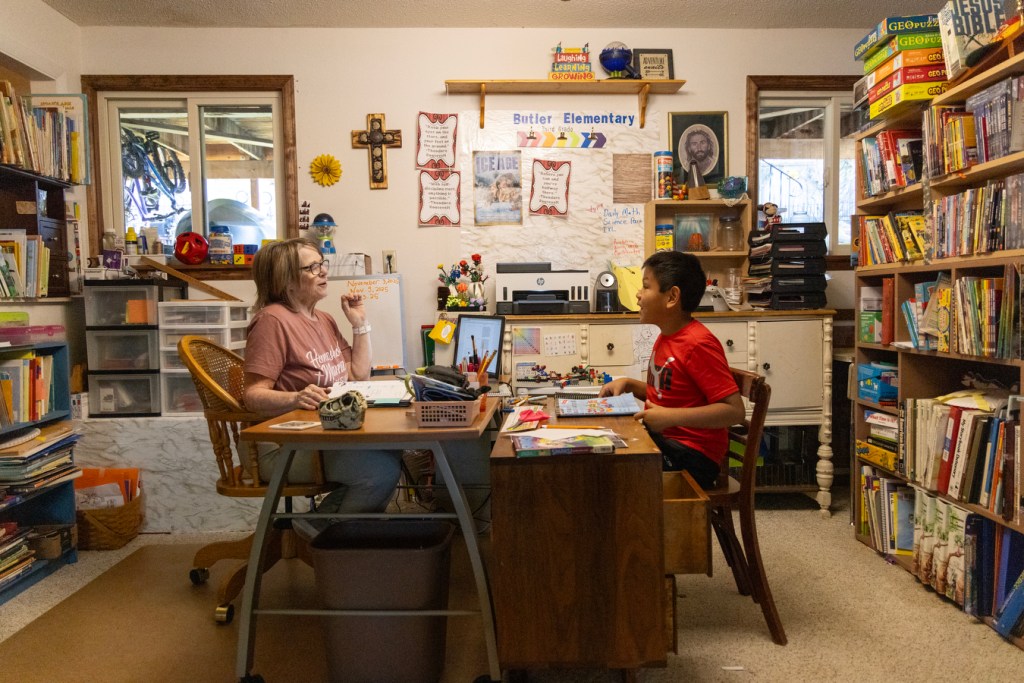
Laura Butler and Darren Butler watch an interactive educational video during homeschooling in an area set aside in the family’s basement in Casper. (Dan Cepeda/WyoFile)
For Laura, homeschooling is a chance to structure Darren’s academic and social life in accordance with her evangelical Christian worldview.
“School’s not — public school’s not the environment that I want Darren to have,” she said. “I don’t want everyone else’s viewpoints to come in to him. … I will choose who influences Darren as long as I can.”
Darren Butler flips through an illustrated Bible during homeschooling. (Dan Cepeda/WyoFile)
Darren goes to birthday parties, a weekly Bible club and plays with the neighbor kids when they are home, Laura explained. On Fridays, she takes him to Jump Craze, the trampoline park in east Casper. That might be the closest thing Darren gets to public school socializing — “playground stuff,” as Laura puts it.
“Is Darren socially awkward? No different from any other kid, I think,” she said. Social cues “are all a teaching thing.”
And she’s OK with putting in a little more effort to ensure Darren experiences the kinds of social interactions that might happen more organically in a traditional school setting.
Paired with Laura’s desire to oversee who is influencing Darren is the desire to respond to his interests. Sometimes, that means utilizing a spur-of-the-moment teaching style.
“Actually, whenever I get curious and grab something, my mom just wants to learn about it,” Darren explained to WyoFile on a Monday morning in October. The first part of that morning was spent learning about the Swiss Army Knife, European geography, how to pronounce the word “Scandinavia” and where various surnames come from.
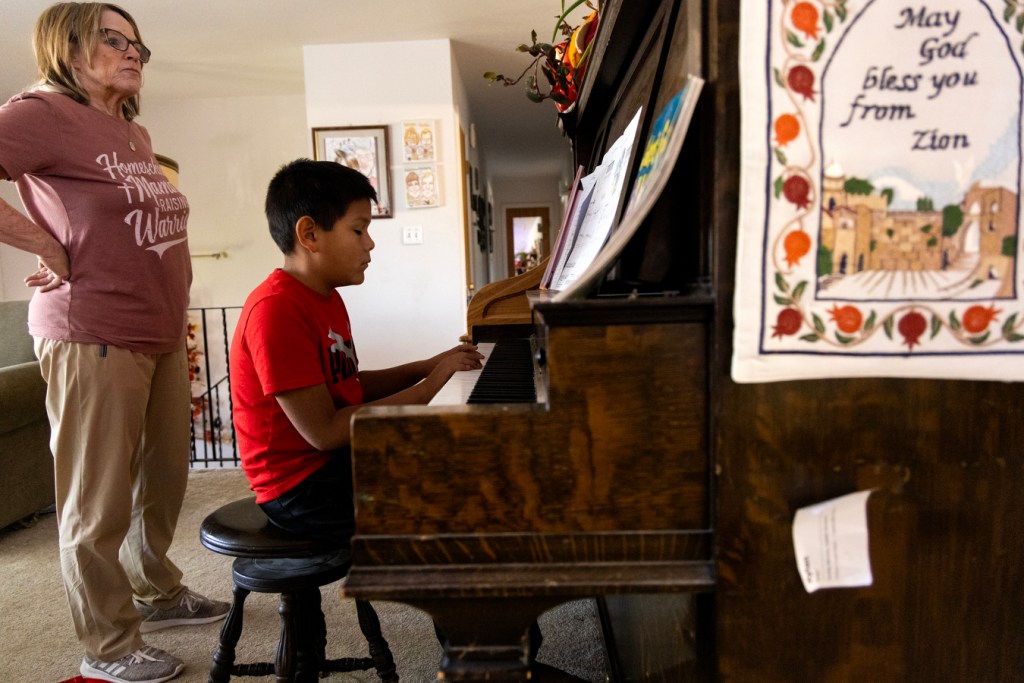
Laura Butler watches as her son, Darren, practices piano in the family living room in Casper. (Dan Cepeda/WyoFile)
Homeschooling is often associated with religion, as is the case with Laura and Darren, and conservative beliefs, like Powder River Prep. But homeschooling has become less religious and more diverse as a movement since the COVID pandemic, a 2023 Washington Post-Schar School poll found. In 2012, 63% of homeschool parents cited religious instruction as motivation for their decision. By 2023, that number had fallen to 34%.
When asked why they’d chosen to homeschool their children, 74% of parents cited concern about the school environment. While providing moral instruction was another top answer, so were dissatisfaction with school instruction and school shooting worries.
A maritime classroom
Some parents want the opportunity to travel with their school-aged children — and not just during summer breaks. Just a few hours to the south of Laura and Darren, Karen Vaughan was spending the fall in Laramie, waiting until she and her family were able to get back to their boat, where they live about eight months out of the year. (As of publication, Vaughan told WyoFile, they are in the Caribbean.) Her two children, who are 14 and 11 years old, use an online program for their schooling, which allows them to be active members of “boat life,” as Vaughan calls it, as well as active students.
It was Vaughan’s husband who first suggested the idea of boat life. With internet on their sailboat — Vaughan specifically mentioned Starlink satellite Internet as a huge asset to them — homeschooling that is heavily dependent on online classes made sense for her son and daughter, she told WyoFile.
Vaughan is another mother who doesn’t foresee her family being dependent on ESA funds. Public money or not, they’re unaffected, she said.
“We heard about it [the potential disbursal of funds] and were like, ‘Oh my God! We could pay for windsurfing lessons!’ Like, joking — but that’s extracurricular. We don’t have a basketball team, but we do have other things,” she said.
“I don’t know if those things would fly, and we’re not in it for the money,” she added. “We want to educate our kids, and this is how we do it.”
Each year, everyone in Vaughan’s family has to agree that continuing boat life for another season — and thus homeschooling, too — is the right choice. It’s not at all traditional, she acknowledges. But that’s the flexibility of homeschooling, or, as boating people say, “boat-schooling.”
“I don’t think we would be homeschooling if it wasn’t for the lifestyle choice we made,” she said, “but now that we are doing it, it’s awesome.”
The future of homeschooling in Wyoming
It’s not certain, in hard numbers, what would change if the courts allow education savings account money to flow to the 4,000 Wyoming families who signed up for those dollars. It is possible, however, that more microschools or microschool models would emerge. It’s possible more people would turn to education programs outside of public schools. It’s also possible that students would be able to explore more niche extracurricular activities.
There might also be unforeseen financial consequences. After Arizona implemented a school voucher program in 2022, the costs forced the state to reevaluate whether the program was worth it, according to a 2024 article from the Arizona Luminaria, a nonprofit news organization. To continue to afford its voucher program, Arizona ultimately slashed funding for water infrastructure projects, improvements to highway expansions and highway repairs in Phoenix, air conditioning additions to state prisons and budgets for the state’s community colleges.
Megan Degenfelder (Dan Cepeda/WyoFile)
For Degenfelder, Wyoming’s superintendent of public instruction, the parameters that officials here have put in place around ESAs give her confidence in the program’s success, she said. ESA students are required to take Wyoming’s state assessment or another nationally normed assessment, and their parents can spend the money only on providers approved by the Wyoming Department of Education.
Besides, she added in an email to WyoFile, “ESA students receive a fraction of the money a student in the public system would receive.”
“With less money,” she wrote, “comes less accountability.”
Degenfelder is a staunch supporter of school choice generally and education savings accounts specifically. And she’s not worried that what happened in Arizona could replicate itself in Wyoming.
“Yes, we did an enormous amount of homework with other states who have ESAs to avoid any pitfalls when launching our program,” she wrote. “We benefited from not being the first mover and learning from their mistakes.”
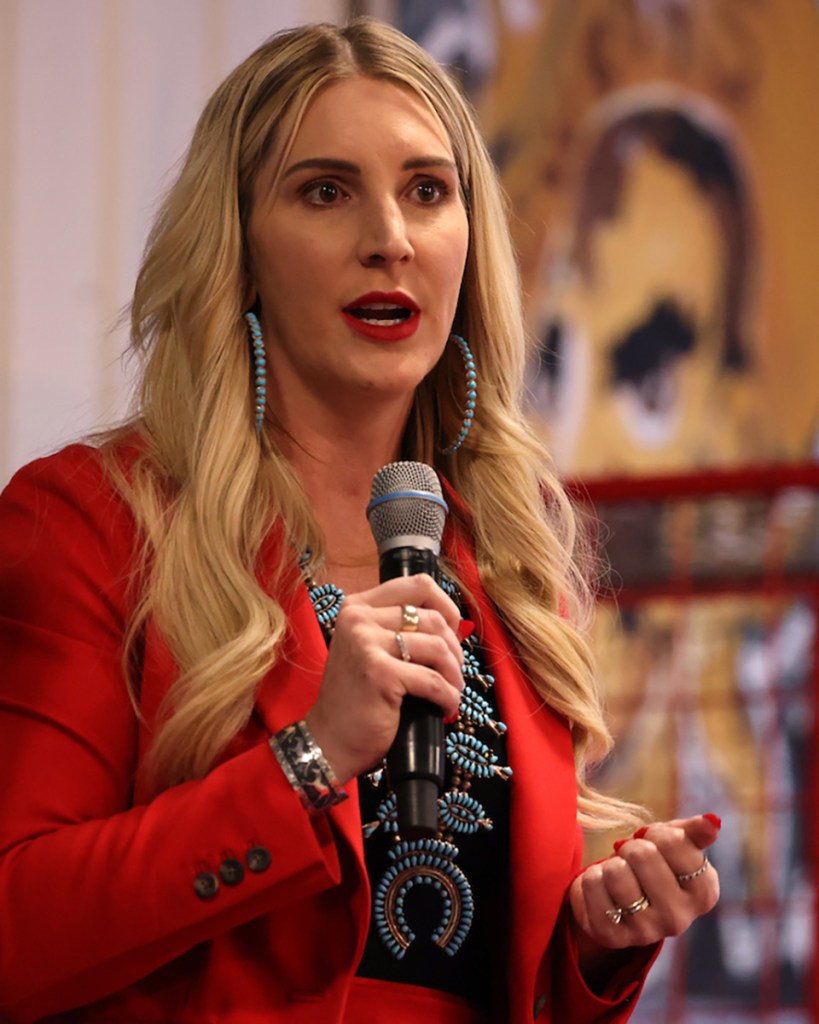
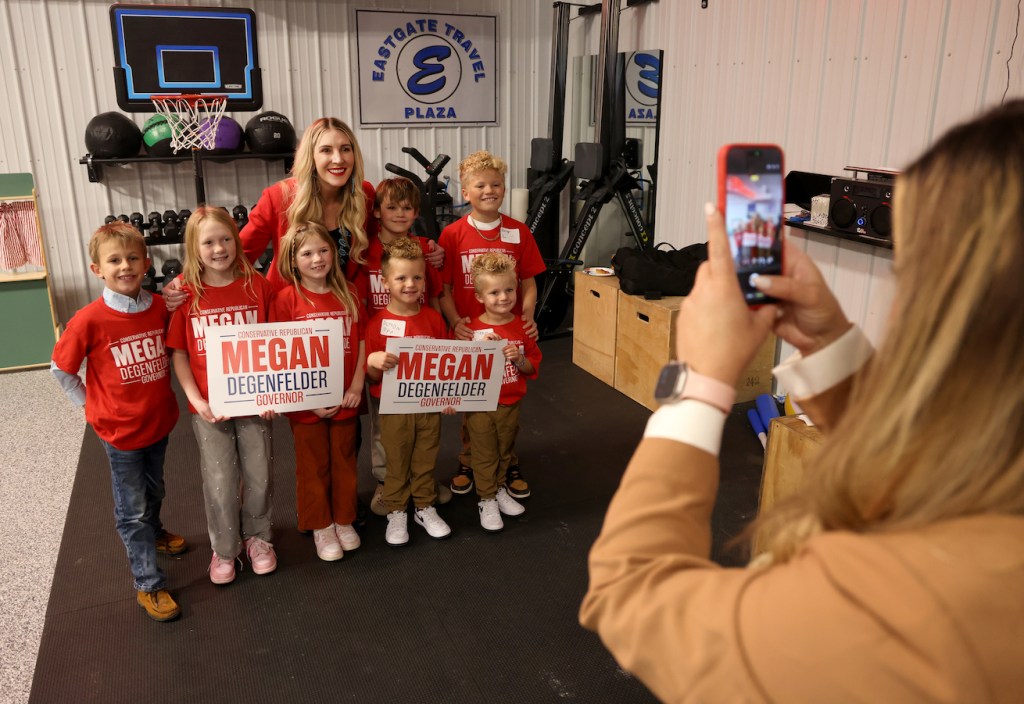
For Clark and Gamble, the microschool founders, Degenfelder’s support for ESAs is especially meaningful. At a January rally for Degenfelder’s bid for governorship, both women said they fully back her. Gamble and her husband provided the space for the event, WyoFile reported.
State Superintendent for Public Instruction Megan Degenfelder poses with children of friends and supporters during her campaign for governor launch party on Tuesday, Jan. 20, 2026 in Casper. (Dan Cepeda/WyoFile)
While ESAs have received considerable support from Wyoming politicians, they do have their critics, such as Sen. Rothfuss. While he’s “pro-student,” he said in an interview with WyoFile, he is not pro-ESAs. Utilizing state dollars incorrectly is one of the issues with it, he explained.
“Just at face value, the idea of providing money to individuals — and we have all these machinations in place to try to make it constitutional … they don’t work. And the courts understand that when dollars go to private enterprises, even when they’re passed through machinations, that that’s against the spirit of the [state] constitution,” he said.
Rothfuss, who is a University of Wyoming professor, refuted the notion that Wyoming’s proposed ESAs would have an appropriate number of parameters. But he does feel that providing ESAs for pre-kindergarten students would be beneficial, he added.
“I am hopeful that that gets used and is not blocked by the court,” he said.
Co-owner Tiffany Gamble talks with students after outdoor activities at Powder River Prep. (Dan Cepeda/WyoFile)
There’s a tension when it comes to how education should be funded, Rothfuss said. On one side, parents and guardians have a right to choose what they feel is the best educational program for their children. On the other, he believes there is a “societal interest” in ensuring that students have access to the best possible education.
There is, of course, no magic wand to wave in this situation. There aren’t dollars to dole out, either — at least not currently. There’s just these two competing interests, Rothfuss said, and the nuance that shades both of them.
“At the end of the day, our responsibility as a state is to provide an educational opportunity to all of our students,” he said. “And I think that gets lost on some people … the reality is that we should all be pro-student, pro-child, pro-education, and ensure that the state is giving the best access to a high-quality education that they can receive.”
Wyoming nuclear power plant receives federal approval for reactor construction
The U.S. Nuclear Regulatory Commission announced Wednesday that it has awarded TerraPower a construction permit for its Natrium nuclear power plant outside Kemmerer, a key step in bringing the next-generation project to southwestern Wyoming.
The Kemmerer Unit 1 plant is the first commercial nuclear reactor to win such approval in 10 years in the U.S., and it’s the first ever commercial-scale liquid sodium-cooled reactor to be permitted in the nation, according to TerraPower, which was cofounded by Microsoft founder and billionaire Bill Gates.
“Our team has worked relentlessly for over four years with the NRC staff to get to this moment,” the company said in a prepared statement. “We had extensive pre-application engagement with the NRC, and we submitted a robust and thorough construction permit application almost two years ago.”
TerraPower President and CEO Chris Levesque speaks to reporters June 10, 2024 at the location of the future Natrium nuclear power plant outside Kemmerer, Wyoming. (Dustin Bleizeffer/WyoFile)
The NRC also noted the expediency of its 18-month review as meeting a new benchmark for the agency, which has revised its review and oversight processes in anticipation of a wave of new “advanced” reactor designs.
“This is a historic step forward for advanced-nuclear energy in the United States and reflects our commitment to delivering timely, predictable decisions grounded in a rigorous and independent safety review,” NRC Chairman Ho Nieh said in a prepared statement.
“This is a massive move for American energy independence,” U.S. Sen. Cynthia Lummis said on a social media post Wednesday. “Wyoming has always powered this nation. Now we’re leading the next generation of nuclear energy technology.”
Natrium project
The Natrium nuclear power plant is designed to generate 345 megawatts of electricity and has an energy storage component to ramp up to 500 megawatts to meet demand peaks, according to the Bellevue, Washington-based company. One megawatt is enough electricity to power about 750 homes. The $4 billion project is backed by $2 billion from the Department of Energy — a commitment made under the first Trump administration.
This photo shows construction of the non-nuclear portion of the Natrium nuclear power plant outside Kemmerer in 2025. (TerraPower)
Before settling on Kemmerer to build its first Natrium facility, the company reviewed several locations in Wyoming, preferring to “co-locate” the project next to a coal-fired power plant so it could tap into existing power infrastructure. TerraPower chose the Kemmerer location for its proximity to the Naughton power plant, which recently shut down its last two coal-burning units to convert them to natural gas.
Next for the Natrium project, the NRC will formally issue the construction permit “in the next week or so.”
“TerraPower anticipates beginning construction on the Natrium plant in the coming weeks,” spokesperson Sarah Young told WyoFile. The company will submit an application to the NRC for an operating license in 2027 or early 2028.
“Today is a historic day for the United States’ nuclear industry,” TerraPower President and CEO Chris Levesque said in a prepared statement. “We are beyond proud to receive a positive vote from the Nuclear Regulatory Commissioners to grant us our construction permit for Kemmerer Unit One.”
Wyoming just wrapped up its warmest winter ever, surpassing Dust Bowl records
From Lander to Sheridan, Laramie to Evanston and almost everywhere in between, the 2025-26 winter officially goes down as the warmest winter since recordkeeping began in the 19th century.
The December-through-February period — known as the meteorological winter — set new high marks for average low temperature, average temperature overall and average high temperatures. Record heat across the season was recorded where climate stations were relatively new. And thermometers also climbed higher than ever before, where daily highs and lows have been recorded for 135 years, which is the case in Lander.
Lander’s three-month average maximum temperature was 47.7 degrees; its average overall was 34.6 degrees and the average minimum was 21.6 degrees. Each set the new all-time high mark, surpassing the historically warm winter of 1933-’34, according to National Weather Service Meteorologist Adam Dziewaltowski.
“That was one of the worst years for the Dust Bowl,” Dziewaltowski told WyoFile. “So it’s not good company.”
Every climate station monitored by the National Weather Service’s Riverton office set all-time warmth records in winter 2025-26. (NWS/Facebook)
All other climate stations monitored by the National Weather Service’s Riverton Office set their all-time warmest winter records, including in Big Piney, Buffalo, Casper, Cody, Greybull, Jackson, Lake Yellowstone, Riverton and Rock Springs. The office posted about it on Facebook, sharing the official numbers as well as the departures from average.
Several other National Weather Service offices monitor other portions of Wyoming. Querying data from those in Cheyenne, Billings, Salt Lake City and Rapid City, WyoFile learned of only one climate station that did not register its warmest winter on record. That was in Newcastle, which had its second-warmest winter on record.
“Obviously, there’s going to be some place or some elevation where it’s not going to be the warmest winter,” Wyoming State Climatologist Tony Bergantino said. “But I think you can say, generally speaking, around the state, it’s been the warmest.”
Bergantino is awaiting a batch of Wyoming climate station data to go through quality control. By around March 7, he said, there should be more finalized figures to describe the anomalous winter.
High temperatures climbed more than 10 degrees warmer than average in elevation portions of Wyoming in winter 2025-26. (Wyoming State Climate Office)
Lower-elevation areas in particular were unseasonably warm. Most in Wyoming were more than 10 degrees above average. Mountainous areas, especially in the northwest, weren’t as divergently hot — and the high-elevation snowpack in a handful of river basins is even near average.
But down low, it was a completely different story. Lander, for example, sits in the Wind River Basin, where the snowpack on Monday was 103% of the long-term median. But at the climate station, located at the 5,589-foot-elevation Hunt Field airport, just 8.2 inches of snowfall was recorded over the three winter months — the least ever, and just 16% of the average in-town snowfall of 52.9 inches, Dziewaltowski said.
Sometimes thermometers toppled previous records by significant margins.
Warm weather closed the Jackson Town Square ice rink for portions of winter 2025-’26.(Rebecca Huntington/WyoFile)
Over the 90 days of winter in Sheridan, temperatures breached 60 degrees on 20 different days and 50 degrees on 44 days.
“So practically half of the meteorological winter had highs over 50 degrees Fahrenheit,” said William McKeown-Robbie, a Weather Service meteorologist out of the Billings office.
Lander also had its share of especially unseasonably warm days. December hit a new monthly record high temperature. And there were two days in December, three days in January and one day in February that cracked the top 10 all-time highs for the month.
Christmas Eve in Lander reached 65 degrees, beating the previous all-time high by a whopping 10 degrees in a dataset that traces back to 1891.
“Very strong” high-pressure systems consistently parked south of Wyoming near the Four Corners region partly explains the record-setting season that’s now passed by.
“That kept anything coming down from Canada and the Arctic east of us,” Dziewaltowski said.
‘It looks bad’: Checkgate investigation reverberates around Wyoming
A growing controversy around a conservative activist handing out $1,500 checks on the House floor has dominated the legislative session now underway in Cheyenne. The blowback isn’t confined to Wyoming’s Capitol.
The checks originated with a Jackson donor, but were handed out by Rebecca Bextel, a Jackson woman who’s been advocating for legislation that would end housing mitigation fees that fund affordable and workforce housing in places like Teton County. They were intended for 10 lawmakers, at least some of whom received them at the Capitol.
Interviews with people in the communities represented by the 10 lawmakers suggested the controversy is receiving plenty of attention outside of Cheyenne.
“Checkgate is alive and well,” rancher Rob Hendry said this week. “The whole state’s talking about it.”
Rob Hendry at a political forum July 31, 2024, in Casper. (Greg Hirst/Oil City News)
The handoff struck Hendry, Natrona County GOP chairman and former county commission chairman, as exceptionally bad political form and unprecedented in his experience. Likewise, elected officials and political leaders from across the state criticized the location and timing of the campaign contributions while lauding efforts to investigate.
Since news broke last week that Bextel, a GOP fundraiser and state committeewoman for the Teton County Republican Party, distributed the donations to lawmakers on the House floor, the Laramie County Sheriff’s Office has opened a criminal inquiry into whether the checks amounted to bribery. Gov. Mark Gordon on Tuesday issued an executive order that bans campaign contributions in state buildings.
Wyoming Republican Party Chair Bryan Miller said Bextel was not representing the party while handing out checks on the House floor, and, as such, the incident falls outside the party’s jurisdiction.
“Regardless, the alleged act of handing out checks on the floor during a session, even after hours, needs to be investigated by relevant authorities to determine appropriateness,” Miller wrote in an email.
The location
Hendry has been traveling to Cheyenne to engage with the Legislature since the 1980s. He has rarely seen a member of the general public out on the House floor interacting with lawmakers.
“You’re out there in the lobby,” Hendry said. “You’d send a note in to them, and they choose to go out and talk to you. Ordinary citizens just don’t go on to the floor like that.”
Don Grasso, a Teton County donor, told a Jackson Hole News&Guide reporter Friday he’d written $1,500 checks to 10 Republicans before handing them over to Bextel.
The checks were intended for: House Speaker Chip Neiman, R-Hulett; Reps. Marlene Brady, R-Green River; Gary Brown, R-Cheyenne; John Bear and Christopher Knapp, R-Gillette; Tony Locke, R-Casper; Darin McCann, R-Rock Springs; and Joe Webb, R-Lyman; as well as Sen. Bob Ide, R-Casper. Former Sheridan lawmaker Mark Jennings was also on Grasso’s list. Each of the 10 Republicans has a tie to the Wyoming Freedom Caucus.
McCann and Webb have acknowledged receiving checks. A photograph of the exchange, taken by Laramie Democratic Rep. Karlee Provenza and now widely circulated, shows Bextel handing a check to McCann with Brady in the background. McCann confirmed to a reporter last week that Bextel had given him a campaign donation check from another donor. He also said, “No one’s ever told me how to vote. Ever.”
Rebecca Bextel hands a check to Rock Springs Republican Rep. Darin McCann on Monday, Feb. 9, 2026, during the 68th Wyoming Legislature’s budget session in Cheyenne. (Rep. Karlee Provenza)
Bear, the former head of the Wyoming Freedom Caucus and chairman of one of the Legislature’s most powerful committees, told a reporter Monday that he, too, had accepted a check. But Bear said he did not accept the check on the House floor.
Jennings said he is not aware of any rule or law Bextel violated in handing out checks on the House floor. The longtime lawmaker said he had not received Grasso’s check as of Monday evening.
“I don’t know about a check,” Jennings said. “I only heard rumors about that through the papers.”
It’s not known if others received checks or whether any were distributed on the House floor. In the photo, Brady is holding what appears to be a check, but she didn’t directly answer questions about what it was.
‘An absolute stain’
When asked by the Green River Star about the checks given out at the Legislature, Brady replied “no comment.”
Sweetwater County Commissioner Taylor Jones, however, did not hold back during the county commissioners regular meeting this week.
Republican Sweetwater County Commissioner Taylor Jones, center, celebrates unofficial primary results in 2024 alongside his wife, Sen. Stacy Jones, R-Rock Springs. Tony Niemec, back row, second from right, narrowly lost the Republican primary to Rep. Marlene Brady, who is embroiled in an investigation over $1,500 campaign donation checks being handed out on the House floor. (Hannah Romero/Green River Star)
“I will say as a Sweetwater County citizen and a commissioner, and yes I can do both at the same time,” he said, referring to a previous confrontation between commissioners and Brady where she claimed to only be speaking as a citizen and not a representative, “I’m terribly embarrassed by how some of our local legislators have acted recently regarding money received on the House floor.”
The incident hits close to home for the Republican, who is married to state Sen. Stacy Jones, R-Rock Springs. Taylor Jones stressed that while not everyone knows the rules for how things are done in the Capitol, and a regular person could make a mistake, legislators are trained on how things work and should know the ethics of how to handle situations.
Echoing reactions from around the state, he said, “This is an absolute stain on Wyoming, the Legislature, and actually our county as well.”
Rep. Marlene Brady, R-Green River, during the 2026 Wyoming Legislature budget session in Cheyenne. (Mike Vanata/WyoFile)
Brady narrowly defeated Tony Niemiec in the 2024 Republican primary. Niemiec is now chairman of the Sweetwater County Republican Party and issued a statement in that role.
“We fully respect the work of the Wyoming House Select Committee and the Laramie County Sheriff’s Office, and it is important that their investigations be allowed to proceed without interference or premature conclusions,” the statement read. “At the same time, our party holds its elected officials to a high standard of ethical conduct. The receipt of campaign donations on the House floor raises legitimate concerns and falls short of the separation the public expects between legislative business and campaign activity.”
GOP party chairs in Sheridan and Laramie counties declined to comment for this story.
The timing
Former Sweetwater County Rep. Stan Blake, a Democrat who served in the Legislature for 14 years, stressed how unusual the situation is.
“In all my years in the Legislature, I never saw anybody offer campaign checks,” Blake said, questioning how Bextel gained access to the floor since “you need to be invited.”
He also defended Provenza’s decision to document the moment.
“I would have done the same thing, I would have taken a picture of it,” Blake said. “To me, it looks bad. It looks horribly bad.”
“It just doesn’t look good for them to hand you some money and you haven’t even put your name in to run.”
Rob Hendry
Blake, Hendry and Miller all questioned the timing of the donations because people haven’t yet filed to run for office or formally announced their candidacies. The filing period is in May, although candidates sometimes announce ahead of that period. Political parties are prohibited from providing financial support for candidates until after the primary election in August, the state GOP’s Miller explained.
“It just doesn’t look good for them to hand you some money and you haven’t even put your name in to run,” Hendry said.
In his experience, candidates are fastidious about having campaign contributions sent to a campaign manager, secretary or other entity.
“I’ve tried to hand them a check at a campaign party after they’ve announced. They didn’t take it,” Hendry said. “They said send it to this address or the campaign office. Not to the person.”
People back home
For one constituent from a county where two lawmakers were intended to receive checks, the incident made a pattern she’d already been tracking more visible to the rest of the state.
Jenny Sorenson is a Gillette resident, former educator and parent who has children in high school and at the University of Wyoming. She has been highly critical of the Freedom Caucus in the past.
In early February, she wrote a letter to the editor that questioned Bear’s connection to Bextel. Sorenson brought up an amendment that Bear made to Senate File 40 last year, targeting Jackson’s affordable housing efforts. Bextel is a longtime critic of Jackson and Teton County policies, including mitigation rates that charge developers to fund affordable housing.
While Rep. Ken Clouston, R-Gillette, and Sen. Eric Barlow, R-Gillette, were working to come up with a way to get funding for a new Campbell County High School in 2025, Bear was working on the amendment targeting Teton County, Sorenson said. Sorenson’s letter questioning Bear’s priorities and connection to Bextel published in the Gillette News Record just as the news and image of the check being passed out on the House floor became public. Sorenson felt validated.
Rebecca Bextel, a conservative activist from Jackson, speaks with Gillette Republican Rep. John Bear during the 2026 Wyoming Legislature budget session in Cheyenne. (Mike Vanata/WyoFile)
Although Bextel and Grasso are Wyoming residents, Sorenson sees them as donors trying to shape Wyoming into their own image: “One that is more friendly to millionaire and billionaire investors than the working people who are keeping the lights on and plowing the roads and feeding our kids and taking care of our communities.”
And right now, Sorenson said, that side is winning, with issues such as slashing or eliminating property taxes and “irrational cuts” to the state budget gaining traction among lawmakers and voters alike.
“They’re winning because they have the money to create the marketing and propaganda to convince citizens they don’t need basic services like EMS or firefighters or even public education,” she said.
Lawmakers are showing where their allegiances lie based on their votes, she added, catering more to “Teton County donors than to their own constituents,” and it’s hurting the people back home.
As for the investigations now underway, Sorenson remains “skeptical.”
“I’m really worried that they’re going to create so much smoke,” she said, “we’re not really going to get to the bottom of it.”
Teton ‘wealthiest’ in U.S. again, prompting message to Wyoming
As Teton County again ranks as the wealthiest county in the U.S., with an average annual per capita income in 2024 estimated at $532,903, a Jackson Town Council member says the rest of the state should be applauding, not bashing, its western diamond.
“It’s disheartening,” Jonathan Schechter said, after crunching the latest estimates from the U.S. Bureau of Economic Analysis. “It feels [as if] the rest of the state isn’t celebrating our success and instead is trying to drag us down.”
The latest figures mark the 21st year in a row that Teton County has topped the list of per capita annual income. Summit County, Utah, home of Park City, had the second highest per capita income among the 3,116 counties, boroughs and parishes in the U.S.
But it was a distant second, with an average income of $280,510 per person. Teton’s figure was 90% greater than Summit County’s, Schechter wrote in his Cothrive newsletter, a product of his nonprofit Charture Institute.
An economic consultant, Schechter is tuned into Wyoming politics because of his elected position. He’s watched politicians in Cheyenne try to dismantle his community’s order by attacking affordable housing programs and undermining local zoning authority and control, among other things.
“The state could learn a lot from us,” he told WyoFile, because growing pains, and potential solutions to them, often start in Teton County. But, like California, “not until after they’ve been ridiculed and scorned.”
Mean vs. median
Teton County’s half-million-plus figure overshadows the median figure that better represents the income of an “average” resident in Teton county. That median — half above, half below — for 2024 is likely somewhere between $90,000 and $140,000 according to Schechter and WyoFile calculations from U.S. Department of Housing and Urban Development data.
“The people who could really figure this stuff out don’t,” Schecter said of the median income figure. He weathers criticism when he writes about the average, or mean, per capita income.
“Averages are skewed by the really rich people living here,” one gadfly told him. Yet Schechter continues to drill into the data, pointing out where Teton County money comes from and the effect overwhelming wealth has on a community.
Seventy-seven percent of Teton County residents’ incomes comes from investments — tops in the nation. Turning to wages – not investments — the largest source was from “location-neutral” industries.
The state could learn a lot from us.
Jonathan Schechter
Those fields include keyboard warriors in finance and professional services, he says. They can work from anywhere.
Wages — not investments — accounted for 21% of Teton residents’ total income in 2024, he wrote. That puts the county third from the bottom of all U.S. counties when ranking the percentage of income earned from wages, he wrote.
Yet in Teton County, the per capita wage — not investment income — was $111,642. That’s 10th in the nation and on par with pay in Silicon Valley, he wrote.
The staggering numbers mean Teton County, home to 4% of the state’s population, accounts for one quarter of state residents’ total income and half of its residents’ investment income.
“Over the past few decades,” he wrote, “Wyoming has enacted a series of laws which, combined, have made the state arguably the most wealth-friendly in the nation. Despite the fact that these laws apply equally in each of the state’s 23 counties, Teton County stands alone in the wealth of its residents.”
Which is why the rest of the state should hail, not stone, County 22.
Pay attention, Wyoming
“I think there are lots of opportunities that Teton County would be able to share and would like to share with the rest of the state,” Schechter said. “How many affordable housing efforts are there in Wyoming?” he asked, pointing to a program that bloomed first in Jackson Hole.
The lodging tax, too, had its origins in Teton County and now is widely employed across the state, he said.
“We could be making a huge contribution to the state financially with things like a real estate transfer tax,” he said. Real estate to Teton County is like hydrocarbons — coal, oil and natural gas — to the rest of the state, he said.
Cheyenne, however, has stiffly resisted that real estate tax idea.
Wyoming should also pay attention to Jackson Hole because it has become a gateway drug of sorts to the rest of the state, Schechter said.
People land in Teton County, poke around a bit “and find out it’s a cool state,” he said, with a bit of a Jackson Hole diaspora spreading out across Wyoming.
“For both good and ill,” Schechter wrote in Cothrive, “the changes washing over Jackson Hole are spilling over Teton Pass and running down the Snake River Canyon, arguably hitting our neighbors harder than us.”
For example, Lincoln County saw per capita income between 2018 and 2024 grow by 77%. That made Lincoln County’s annual per capita income the 26th fastest growing among the 3,116 counties in the U.S.
That influx of wealth into neighboring Lincoln County has brought corresponding impacts on land and real estate values and prices, if not on the income of the “average” resident there. He illustrates the relationship using Teton County figures.
“There’s a remarkably tight correlation between Jackson Hole’s housing prices and its [per capita income],” he wrote. Today’s gut-check: The average price of a home in Teton County is more than $5 million, according to the Cothrive newsletter.