Shutdown Ends but Food Insecurity Persists: A Single Bite Sees Demand Surge in Sullivan County
A Single Bite, the Sullivan County nonprofit focused on feeding families, says food insecurity has surged dramatically in recent months—even as federal SNAP benefits resume following the end of the government shutdown.
Executive Director Audrey Garro said the organization has seen demand double since early fall.
“Since September, we were feeding 625 people, families out there in the community with prepared food,” Garrow said. “Today, 1,200 people. So that’s double.”
Garro said some of the increase is due to heightened public awareness during the SNAP crisis, but the underlying need runs much deeper.
“These individuals are not going to call us tomorrow and say, ‘I have my SNAP benefits back. I don’t want your healthy prepared food anymore,’” she said. “My kids are still getting enough nutrition. That’s just not going to happen.”
She noted that even families with restored benefits remain behind on basic expenses. “They’ve already spent their rent money on food or their medicine money on food because kids and people need to eat every day,” she said.
Cynthia “Sam” Bugna, Manager of Programs, Projects, People, said those realities are clear on the ground.
“I have a family that’s been in temporary housing for quite a while,” he said. “The place has now been condemned… but she has a stove for the first time. She told me she hasn’t cooked a baked potato in years and she was so excited to have a potato and to have real food.”
A Single Bite provides prepared meals three days a week, delivered by volunteers from Long Eddy to Wurtsboro. Garro said the ready-to-eat meals remain vital for families who lack time, transportation, kitchen facilities, or the ability to prepare bulk food from pantries.
“During COVID, we learned that families struggle with time, working two jobs,” she said. “Do they have enough energy to have a propane stove? Is their stove working? There are many, many families living in temporary housing in this community.”
Both Garro and Bugna said the return of SNAP benefits has not eased the long-term fears families face.
“These are families that are living at or below the poverty level, period,” Garro said. “Catching up is not possible with the resources they have.”
Bugna said many residents only sought help when the shutdown pushed them past their limits. “Maybe they were really fighting and said, ‘We got this,’” he said. “But then the shutdown—that was when they hit the wall.”
As the holidays approach, Garro said A Single Bite will continue providing weekly shared meals, along with special Thanksgiving and Christmas dishes. But winter brings new challenges.
“We’ve received a lot of donated produce over the harvest time and that is going to subside,” she said. “We need to start purchasing fresh food… and make sure the highest-quality, most nutritious food ends up on people’s plates.”
Bugna said the public often doesn’t grasp the scale of need:
“The rest of us are going to bed, our bellies are full, our kids’ bellies are full. And there’s people out there that every day their kids’ bellies are not full when they go to bed.”
Garro encouraged residents to volunteer, donate, or simply learn more about the organization. “It’s not easy to ask for help,” she said. “And we respectfully provide that support every week.”
A Single Bite recently received a boost from Homestead School students, who grew pumpkins for their annual project. The pumpkins were turned into soup for families, and the students presented the nonprofit with a $3,000 check.
A full list of food pantries across the region is available at wjffradio.org.
Note: A Single Bite was founded by Sims & Kirsten Foster, owners of Foster Supply Hospitality. Foster Supply Hospitality is a financial supporter of Radio Catskill.
Feathers in flux: The wild makeover of a molting finch
If you’ve ever done a double take at your bird feeder, wondering, what on earth is that patchy bird, you’re not alone. It happened to me on a crisp October morning when I spotted a bird that looked like a faded watercolor version of a Purple Finch. I blinked. I checked my bird app. Was this a new species? Some exotic visitor blown off course? Nope, it was just one of my usual backyard guests, caught in the middle of a messy, magnificent transformation. Molting season had arrived.
Meet the Purple Finch—or what’s left of it. The Purple Finch is usually a stunner. Males, in particular, flaunt a vibrant raspberry wash over their head, chest and back, blending into streaky browns and whites below. They’re like the red wine of songbirds—bold, rich and unmistakable. But during molting, that confident color gets interrupted. Feathers fall out. Patterns become jumbled. Bald spots may appear. The once-glorious plumage turns into a confusing patchwork that makes even seasoned birders pause and say, ‘Wait… what bird is that?’
A molting Purple Finch passes through my backyard. Photo by Jackie Woodcock.
The photo above is a perfect example. This Purple Finch is deep in the throes of a molt. You can still see flashes of its true colors—literally—but the rest of it looks like it went through a bird-sized spin cycle. Pink feathers peek through faded patches. Dark spots sit where fresh feathers are just starting to emerge. The overall effect? A creature in flux, a feathered Frankenstein’s monster piecing itself back together.
Why birds molt
Why do birds molt anyway? Molting is nature’s way of giving birds a wardrobe refresh. Feathers wear out from sun, wind and day-to-day life. They’re not alive like hair or fur; once grown, a feather can’t repair itself. So instead of mending old ones, birds replace them entirely—usually once or twice a year, depending on the species. For Purple Finches, molting typically happens after the breeding season, around late summer into fall. It’s a gradual process, replacing feathers in a specific sequence so they can still fly, forage and escape predators. But the trade-off? Their looks take a temporary nosedive. Imagine trying to impress someone while wearing only half a suit. Or going to a party with your haircut stuck halfway between shaggy and buzzed. That’s the molting experience.
Bird lovers know this phase is just part of the finch’s story. Molting isn’t a mistake—it’s a natural, vital process. But the way it transforms these birds is pretty mind-blowing. During the height of molt, a male Purple Finch can look like a hybrid: part house finch, part juvenile, part who-knows-what. I’ve seen people mistake them for entirely different species, and honestly, it’s easy to understand why. That broken-up coloration and irregular feather coverage throws off all the typical field markers we rely on. But then—almost like magic—it all comes back together. New feathers grow in. Colors deepen. That unmistakable rose-red plumage returns. And just like that, the bird is whole again, like nothing ever happened.
Nature doesn’t need Photoshop. It builds the drama right into the design. It’s tempting to think of molting birds as less attractive versions of their usual selves. But if you’re a true bird enthusiast, this is one of the coolest times to observe them. You’re witnessing a live transition. A biological reboot. It’s like seeing the caterpillar become the butterfly—except here, it’s finches ditching last season’s feathers for a new, sleeker model. I’ve grown to love this ragged phase. There’s something raw and real about a bird in the middle of change. They’re not picture-perfect, but they’re alive, adapting and in motion. Watching a Purple Finch go from patchy and awkward to polished and brilliant again reminds me how resilient nature is. Let’s be honest—it’s kind of fun to play “guess that bird” when a half-molted finch shows up looking like it belongs in a bird-themed mystery novel.
What to look for
If you’re a backyard birder like me, fall is the perfect time to keep an eye out for molting Purple Finches. Look for: patchy plumage, irregular color patterns, especially around the head and back. Feather spikes or “pins,” new feathers still encased in their sheath. They look like tiny quills and will eventually unfurl. Awkward behavior; some birds might scratch more or preen excessively as new feathers grow in. That’s normal. And don’t worry—molting isn’t painful for birds. It can be a bit uncomfortable and energy-intensive, but it’s completely natural. If anything, it’s a sign the bird is healthy and going through a normal life stage.
Beauty in the process
There’s something deeply reassuring about the rhythm of molt. It’s a reminder that change doesn’t always look pretty in the middle—but it’s necessary. Even the most radiant creatures need to fall apart a little before they come back stronger. Seeing this ragtag Purple Finch on my feeder, looking like a bird-shaped jigsaw puzzle, reminded me that beauty isn’t always about polish. Sometimes, it’s about process. About watching something wild and wonderful slowly become itself again. So, the next time you spot a weird-looking bird that seems like it’s been through a storm—pause. Take a closer look. It might just be a Purple Finch, reinventing itself one feather at a time.
For fellow birders: snap a photo, take notes, and enjoy the transformation. There’s nothing quite like witnessing nature’s makeover in real time. That messy little bird? It’s not lost. It’s in progress. Just like the rest of us.
The ghost of Christmas future? Food insecurity in the Adirondacks
The Adirondack Almanack is a public forum dedicated to promoting and discussing current events, history, arts, nature and outdoor recreation and other topics of interest to the Adirondacks and its communities. We publish commentary and opinion pieces from voluntary contributors, as well as news updates and event notices from area organizations.
The information, views and opinions expressed by these various authors are not necessarily those of the Adirondack Almanack or its publisher, the Adirondack Explorer.
Holiday food drives have been an American tradition since the 19th century—our collective commitment that no one should go hungry while their neighbors feast.
This holiday season, though, hunger is on the rise in our communities. Food pantries and soup kitchens are seeing ballooning demand, and families are having to make difficult tradeoffs to stretch funds until the next payday.
This was true even before November 1, when the federal government shutdown halted the distribution of Supplemental Nutrition Assistance Program (SNAP) benefits, creating an immediate food crisis for thousands of families across the Adirondack region.
Though the courts have ruled that the government must use contingency funds, the crisis is far from over. The One Big Beautiful Bill Act, signed into law in July, calls for major cuts to SNAP in the coming months, with the potential to affect the more than 13,000 households receiving SNAP in Clinton, Essex, Franklin, Hamilton and Warren counties.
As the impacts of this temporary funding freeze are being felt, I’m reminded of the Charles Dickens classic “A Christmas Carol” and its themes of generosity and compassion for our fellow man. Are we being visited by the Ghost of Christmas Yet to Come—one of the three apparitions who convinced Ebenezer Scrooge to change his miserly ways—and will we heed its warning?
Adirondack Community Foundation (ACF) knows that generous and compassionate people are abundant in our community, and we have the honor of guiding many of them to make a difference for their neighbors.
We recently put out a call for donations to our Special and Urgent Needs (SUN) Fund and our community of donors stepped up in a big way, contributing more than $50,000 to the fund in less than a week. We also opened a simplified application to assist food pantries in meeting the increased needs and have already distributed $22,000 and counting. Other neighbors are giving to Generous Acts, the largest grantmaking program in the region that supports housing, jobs, child care and career pathways, as well as food insecurity.
Still more community donors are making the most of tax benefits that end in 2025 by increasing their giving this year and contributing appreciated stock to donor advised funds now so that they are poised to help give back in the months and years ahead.
All of this devoted support through ACF, along with contributions directly to local food pantries, soup kitchens, local food providers and other organizations addressing hunger, plus countless quiet, everyday acts of generosity and kindness, are evidence that our community shows up for each other when it counts.
Other community organizations are stepping up as well, including county social services and health departments, schools, community action and other nonprofit organizations. AdkAction and the Adirondack Food System Network recently hosted a video conference to share resources and spotlight needs, and Cornell Cooperative Extension is providing a direct link to local pantries.
As we monitor the direct results of the changes to federal programs, we are also keeping an eye on the less-obvious consequences, such as economic impacts to local farms, local grocery stores, and other small businesses that indirectly benefit. Please visit our continuously updated data, which can be found on our website.
We know that neither philanthropy nor the state can come close to making up for federal funding shortfalls that will dramatically affect our region. The challenges our neighbors are facing are real, and difficult decisions will likely be necessary for state and local governments.
But just as Scrooge’s ghostly messenger provided a glimpse of what might be, not what must be, we have the opportunity to shape our region’s future through our actions now. Our community’s heartfelt response to this and other past crises gives me hope that we will continue to choose generosity—at the holidays and all year round.
Cali Brooks is President and CEO of Adirondack Community Foundation, a community-based organization that works with generous individuals, families and foundations to establish funds, develop strategic initiatives and support emerging needs in the Adirondack region. Learn more at adkcommunityfoundation.org.
NY Voters Narrowly Approve Prop 1 to Protect Land and Make Amends in the Adirondacks
Voters in New York narrowly approved Proposition 1, a ballot measure that fixes a constitutional violation in the Adirondacks and will eventually add 2,500 acres to the Forest Preserve in the park.
According to unofficial election results, Prop 1 was approved by about 46% of voters, while more than 12% left the ballot question blank.
“This outcome underscores how thoughtful environmental stewardship and smart economic development can work hand in hand to strengthen the Adirondack Park for generations to come,” said Rocci Aguirre, Executive Director of the Adirondack Council.
The ballot measure addresses a violation that occurred years ago at the Mt. Van Hoevenberg Olympic Sports Complex in Lake Placid.
While preparing to host the 2023 World University Games, the Olympic Regional Development Authority oversaw the clearing and construction on 323 acres of Forest Preserve land. That work violated Article 14 of the Constitution, which states that the Forest Preserve must be kept forever wild.
A majority of voters in every North Country county approved Prop 1, while voters downstate were more evenly split over the issue.
In nearly every county in the New York City area, a majority of voters rejected Prop 1. Voters in Manhattan narrowly approved the measure by a 1% margin, with 12% of blank ballots.
Voters in New York have amended the Forever Wild clause of the Constitution more than a dozen times, including for similar amendments allowing the state to manage and develop Whiteface and Gore Mountains in the Adirondacks and Belleayre Mountain in the Catskills.
Ahead of Election Day, Prop 1 received widespread support from all of the top environmental groups in the Adirondacks.
“This amendment strengthens accountability for how state agencies manage and protect one of New York’s greatest natural assets, the public lands of the Adirondack Park,” said Aguirre from the Adirondack Council.
To make amends for the constitutional violation by ORDA at Mt. Van Hoevenberg, Prop 1 also included the protection of 2,500 additional acres in the Adirondacks.
The Department of Environmental Conservation hasn’t yet identified where that land will be, nor has it determined how it will pay for that land to be added to the Forest Preserve.
Story by Emily Russell/New York Public News Network
Image: The Olympic sliding tracks at the Mt. Van Hoevenberg Sports Complex in Lake Placid, which is hosted the 2025 IBSF World Championships. (Credit: ORDA)
With SNAP benefits in flux, Tompkins County frees up emergency $50K for food access
ITHACA, N.Y. — While the federal government has agreed to partially continue funding access to food assistance benefits, Tompkins County Administrator Korsah Akumfi has issued an emergency order to free up $50,000 with the goal of helping local food systems bridge the resulting gap and help residents in need.
Supplemental Nutrition Assistance Program (SNAP) benefits were set to lapse entirely on Nov. 1, but a court ruling stated the Trump administration has to continue funding the program despite the federal government shutdown. According to Akumfi’s emergency order, there are about 7,200 people in Tompkins County who receive SNAP benefits.
The funding will be used to “purchase staple food items sufficient to support impacted residents, engage the services of local food banks and community food programs to distribute purchased food.” Akumfi’s announcement states the Department of Social Services has estimated the $50,000 will cover about 30,000-35,000 pounds of “staple foods.”
Akumfi noted that the County Administrator has the power to disburse emergency funds “to protect the public health, safety and welfare in emergency circumstances.”
“This emergency expenditure is necessary to maintain the public health and welfare during the suspension of SNAP benefits, providing immediate relief to families and individuals who would otherwise face food insecurity,” Akumfi said.
While officials around the country have been bracing for SNAP benefits to end this weekend, a federal judge’s ruling on Friday may stem some of the impact. U.S. District Court Judge John J. McConnell ruled that the U.S. Department of Agriculture must continue paying for SNAP benefits for the tens of millions of people who receive the aid nationally, though New York Governor Kathy Hochul subsequently said her administration is still “prepari[ing] for the worst,” particularly if President Donald Trump tries to fight McConnell’s ruling, according to the New York Times.
On Monday, the Trump administration announced it would free up some funding for SNAP in reaction to the court ruling, but at this point, that only appears to be enough funding for about half of the usual SNAP benefits received by tens of millions around the country for November.
While SNAP benefits will potentially lapse as the shutdown continues, those with EBT money left over from October will be able to use those funds in November.
Jamaican Americans Mobilize After the Island’s Worst Hurricane in a Century
Out of many, one people.
Kimisha Simpson says she’s confident that Jamaica’s national motto will rally the diaspora and others to help rebuild the island that was battered by Hurricane Melissa earlier this week.
“We like to say, ‘We’re the heartbeat of the Caribbean,’” Simpson said. “Jamaica is an island that has given so much to the world — entertainment, the arts, the culture, the food, the tourism, the hospitality. And so knowing the devastation is unlike anything they’ve ever seen in centuries, it’s definitely time for the world to give back to Jamaica.”
After Hurricane Melissa hammered Jamaica as a Category 5 storm, bringing 185 mph winds on Tuesday afternoon, it brought life-threatening storm surge and floods to Cuba andHaiti. It later turned towards the Bahamas and headed to Bermuda.
The storm, one of the most powerful ever recorded in the Atlantic, left Jamaica reeling before weakening slightly as it crossed warm Caribbean waters toward its next target.
In its wake, dozens have died amid widespread destruction across Cuba, Haiti, and Jamaica. More than two dozen people died in Jamaica and Haiti as of Thursday. The exact death toll will become clearer in coming days once aid workers are able to reach more remote and damaged areas.
Simpson is the founder and CEO of Ignite Jamaica Fund, a nonprofit based in Philadelphia that does educational advocacy work on the island. Ever since the hurricane touched down there, she’s been reaching out to friends and family in Manchester, a parish in the western region. She said she wanted to “get updates beyond the media and hearing from them what they were experiencing.”
As the storm pummeled Jamaica, it brought the strongest hurricane wind speed to make landfall in 90 years. With it came catastrophic floods, landslides, and a sea surge up to 13 feet along the island’s southern coast. The storm knocked out power and telecommunications for much of the country, with internet connectivity dropping to about 30% of normal levels by Tuesday night, according to NetBlocks, which monitors global outages.
Hurricane Melissa destroyed the family home of Trevor Dixon in Mandeville in Manchester Parish, about 40 miles away from the eye of storm as it crossed Jamaica. (Courtesy of Trevor Dixon)
Power lines, roads, and bridges were damaged across the island, and more than half a million people were left without electricity.
“The change in its trajectory really took the island by surprise,” said Simpson, who was a former principal and teacher. “When we heard about the landfall earlier this week, and we started to get the videos, the updates from those on the ground, we were really devastated, and the community across the diaspora, right away, started to galvanize, mobilize, and have calls about just how can we start to gather resources. Even before we knew what the outcome was going to be, we just saw it unfolding before us.”
The island is home to about 2.8 million people, about 90% of whom are Black. The diaspora of Jamaica — or the Jamaicans who have left and their descendants who live in the U.S. and all over the world — is estimated to be over 2 million people.
Daryl Vaz, Jamaica’s science, energy, telecommunications and transport minister, told Sky News that initial reports from the hardest-hit western parishes were “catastrophic.” In Saint Elizabeth Parish, where Melissa made landfall, floodwaters and flying debris destroyed homes and farms in what officials described as a “complete disaster.”
“There are entire communities that seem to be marooned and also areas that have been flattened,” said Dana Dixon, Jamaica’s minister of education, skills, youth and information, on Thursday. “We are trying to get to the areas that have been marooned. We will get there … We are going to get to every single Jamaican and give them support.”
In Kingston and other eastern areas, where the eye of the storm did not pass directly overhead, damage was less severe. Still, critical infrastructure remained compromised. Most rural hospitals lost power, and major airports in Montego Bay and Kingston remained closed.
Debris is scattered outside Manning’s School in Westmoreland Parish. Hurricane Melissa made landfall in Jamaica with 185 mph winds. (Courtesy of Kimisha Simpson)
Jamaican Prime Minister Andrew Holness has declared a national disaster. At least three people died before Melissa’s arrival, with local officials warning that more fatalities could be confirmed once communication resumes with rural areas.
The storm’s intensity, fueled by unusually warm Caribbean waters, has underscored the growing climate threat to small island nations with fragile infrastructure. This is the fourth storm in the Atlantic this year to undergo rapid intensification of its wind speed and power, a feat made twice as likely because of climate change, according to studies.
Melissa made landfall early Wednesday in eastern Cuba as a Category 3 storm with sustained winds near 120 mph, according to the National Hurricane Center. Cuban President Miguel Díaz-Canel warned residents late Tuesday of a “very difficult night,” urging them to stay sheltered. Officials said roughly 750,000 people were evacuated.
Melissa likely caused $7.7 billion of damage in Jamaica alone, according to catastrophe modeler Enki Research. But across the entire Northern Caribbean, recovery will be difficult.
Recovery challenges ahead
“We have this saying in Jamaica: one coco, full basket,” Simpson said. “It’s a proverb that means that all small efforts will compound over time and make a large impact. So no donation, monetary or supplies are too small. Anything that you’re willing to give can make an impact in a difference.”
Simpson and other organizers said it is going to take time to rebuild from devastation that is unlike something Jamaicans have seen in centuries.
Aid experts fear that Jamaica and Cuba could face severe public health challenges in the days ahead — contaminated water, collapsed medical facilities, disease outbreaks, and growing mental health crises. The United Nations has warned that budget cuts and reduced global aid donations are expected to limit the amount of food and emergency support agencies like the World Food Program can provide this year.
Much of Jamaica’s southern coast, its agricultural “breadbasket,” remains underwater after more than 2 feet of rain.
In the area, which got its nickname because it is where most of the island’s food is grown, farmers were just recovering in areas like St. Elizabeth. Last year’s Hurricane Beryl damaged crops in June. And then came Hurricane Melissa.
This time is different. There was a direct hit.
A bedroom in the family home of Trevor Dixon illustrates the destruction of Hurricane Melissa. (Courtesy of Trevor Dixon)
“All the crops, I’m sure, are gone,” said Karen Shields, who lives in Westgate Hills in Montego Bay.
Shields is the island liaison for the Jamaicans Abroad Helping Jamaicans at Home (also known as JAHJAH) Foundation. As the director of operations, she helps coordinate aid to the island.
“The farmers are just getting back on foot,” she said. “And so it’s, I know it’s gonna take a very long time. But we have to see what we can do, just, you know, to make quick fixes and reach those low-hanging fruits to help to do what we can in the interim.”
The day after Melissa came ashore, the 48-year-old Shields said she and her family were wondering what they would eat for breakfast. There was no electricity and most means of communication are down on the island, so she and others cannot contact loved ones.
On Wednesday, a neighbor came to her gate with breadfruit from a tree. Her family roasted the starchy staple.
“We are very kind to each other. We help each other,” Shields said. “Like people have their disagreements, but I’m telling you, when it comes to times like this, we stand together as one, we are united as one.”
In Cuba, the storm threatens power grids already pushed to the brink by years of shortages and blackouts intensified by a United States-backed blockade against the country.
President Donald Trump said Tuesday that the U.S. is “prepared to move” to help Jamaica and neighboring countries recover. The State Department announced Wednesday that it had activated U.S.-based Urban Search and Rescue teams to assist Caribbean nations in Melissa’s path.
However, typically, foreign disaster aid comes in the form of USAID, which the Trump administration disbanded earlier this year. Jamaica lost $22 million in funding through those cuts. Additionally, the Organisation for Economic Cooperation and Development projects that rich countries, including the U.S. and most of Europe, will reduce foreign disaster and recovery aid by around 15% this year.
The remains of Manning’s School in Westmoreland Parish after Hurricane Melissa. It is the oldest continuously operated high school on the island. (Courtesy of Kimisha Simpson)
Government officials across the region continue to warn that no Caribbean nation is truly prepared for a hurricane this powerful — or for the accelerating climate chaos fueling such storms.
Trevor Dixon, an emergency physician based in New York, is the founder and CEO of the JAHJAH Foundation. His organization focuses on health care and education advocacy, and he said he and others are already planning to head to the island as soon as they can to help.
Dixon said his organization provided aid during the last hurricane. “So once we got the call that Hurricane Melissa was coming, I was like, ‘Oh my goodness, we’re gonna have to do this again,’ he said. “Hurricane Beryl was just a dress rehearsal for a more dynamic and more devastating hurricane.”
Dixon, whose family’s house in Mandeville in Manchester Parish was devastated during the storm, said he plans to collect supplies in multiple locations in New York and New Jersey to fill two shipping containers to take “home.”
About 4 million tourists visit Jamaica each year.
“They have given a lot to the world,” Dixon said. “They’ve given music, they’ve given food, they’ve given sports, they’ve given to other governments. They’ve given to health care, they’ve given to education.
“It’s time that we give back to the people in Jamaica.”
How to Help Hurricane Victims
The government of Jamaica has set up an official website for updates on the storm as well as donations for emergency relief, housing reconstruction, and health care.
Relief agencies and others are beginning to set up some resources to help people impacted by the hurricane:
Ignite Jamaica Fund is a nonprofit organization that works to enhance the education of children and youth in Jamaica and across the Diaspora.
Jamaican Americans For A Better Jamaica Inc. is a nonprofit organization that was founded with the mission of providing Jamaican Americans diverse and feasible opportunities to stay connected and give back to Jamaica.
The International Medical Corps has deployed an emergency response team to provide critical supplies, medical workers, and support.
Mercy Chefs provides hot, chef-prepared meals and clean drinking water to people impacted by natural disasters and emergencies.
World Central Kitchen, a nonprofit founded by chef and humanitarian José Andrés, mobilizes after disaster strikes to provide food and water for first responders and victims in the affected areas.
Food For The Poor, the largest charitable organization in Jamaica, provides food, housing, clean water, and educational supplies to impoverished families.
League of Women Voters Fights DOJ Bid for New York Voter Data
The League of Women Voters of New York State, joined by the Campaign Legal Center and the Brennan Center for Justice, has filed a motion to intervene in a lawsuit brought by the U.S. Department of Justice seeking access to New York’s full voter registration database.
The DOJ is requesting sensitive personal data, including driver’s license numbers and partial Social Security numbers—information voting rights advocates say the federal government has no legitimate reason to collect.
Erica Smitka, executive director of the League of Women Voters of NYS, told Radio Catskill the move is about protecting voters and trust in elections.
“The League has been working for 100 years to protect the rights of voters,” Smitka said. “When we register voters, we sometimes mention that their information is safe and secure under New York law. There’s really no justification for the federal government to demand this access.”
Smitka said misuse of the data could fuel false claims about election fraud, target political opponents, or pressure states to remove voters based on incomplete information. She also flagged privacy concerns tied to the DOJ’s collaboration with the Department of Homeland Security.
Voter data in New York is protected under state and federal law, including the Privacy Act. “Federal law authorizes states to control voter databases and does not require the release of sensitive personal information,” Smitka said.
The filing, made Oct. 24, follows a similar intervention in Maine. Smitka said the League is working closely with other voting rights organizations to ensure privacy protections remain strong.
“We are here, showing up in communities, running voter registration drives, and pursuing legal action to protect voters’ rights,” she said. “We won’t stop doing this work to keep our democracy strong.”
Bard Student, an Afghan Refugee, Is Detained by ICE After Routine Immigration Interview
Ali Sajad Faqirzada, an Afghan refugee and Bard College student, was detained by U.S. Immigration and Customs Enforcement agents on Tuesday. (Courtesy of Rev. Marcella Gillis)
An Afghan refugee and Bard College student was detained by U.S. Immigration and Customs Enforcement (ICE) agents on Tuesday on Long Island following an interview related to his pending asylum case.
The arrest has sparked outrage and calls for his release from local faith leaders, elected officials, and members of the Bard community.
Ali Sajad Faqirzada, 31, who resettled with his family in Ulster County more than three years ago, was detained by ICE after completing and passing a “credible fear interview” at the New York Asylum Office in Bethpage, according to Anwen Hughes, an attorney at Human Rights First, an organization that is representing him.
The interview, Hughes explained, is typically used to determine whether an asylum seeker has a “significant possibility” of facing persecution or torture if returned to their home country. Passing it grants an individual the right to apply for asylum before an immigration judge, she said.
After the interview concluded, according to Hughes, Faqirzada and his attorneys were instructed to wait at the office. Several hours later, ICE officers arrived and arrested him in front of his legal team.
“What exactly is the point of this?” Hughes said. Most of Faqirzada’s family members have already been granted asylum, and he holds valid work authorization. “We have here an entire close-knit family of people who’ve all been granted protection by the United States government based on the same set of facts that underlie [Faqirzada’s] case. And he’s been engaged in a whole process aiming toward the same result… He’s detained because he actually showed up for this interview.”
Faqirzada, a student in the Bard Baccalaureate program intended for older students who are seeking undergraduate degrees, had his asylum application pending with the asylum office for over two years when the Department of Homeland Security abruptly placed him in expedited removal proceedings, Hughes said. He is being held at Delaney Hall Detention Facility in Newark, N.J., according to ICE’s online detainee locator.
Attorneys at Human Rights First have filed a habeas corpus petition in New Jersey challenging the legality of his detention, which is currently pending. His volunteer legal team has also filed a formal release request with ICE in New Jersey, supported by what Hughes described as “a really extraordinary manifestation of support from members of the community [in the Hudson Valley]” that includes an extensive collection of letters from friends, neighbors, and local organizations attesting to his character.
Faqirzada and his family fled Afghanistan in 2022, first arriving in California before resettling in the Hudson Valley with support from the local organizations New Paltz for Refugees, the Afghan Circle of the Hudson Valley, and Christ the King Episcopal Church in Stone Ridge.
“We wanted to be of service to them in any way that we could,” said the Reverend Marcella Gillis, rector of Christ the King. The church offered the family use of its new commercial kitchen, where they began preparing traditional Afghan meals for takeout events once a month. “[It’s been] this perfect kind of synergy,” she said. “People come from all over the Hudson Valley to support these dinners. They’ve become a galvanizing community event…and a reliable source of income for this really wonderful family.”
Faqirzada works as a security guard at Kingston Hospital. He has been on track to graduate with Bard’s Class of 2028.
Faqirzada has been a beloved member of the Bard College community, according to Jennifer Strodl, director of communications at Bard. “Across the campus, Mr. Faqirzada is known for his kind spirit, hard work, and dedication to learning,” Strodl told The Daily Catch. “He frequently dedicates his time and efforts to support other students. He is well-liked and respected by faculty, staff, and students alike and is actively engaged in our College community. In other words, he is a Bard student that we are all—unequivocally and certainly—proud to have here.”
In a letter to students and staff on Thursday, Bard President Leon Botstein said the college is in contact with Faqirzada’s family and working with community leaders to support them. Bard has also sent a letter to the federal government advocating for his release, Strodl said.
“We know this news will be distressing to members of our community,” Botstein wrote in the letter. “Since its founding, Bard has remained committed… to the link between education and democracy. Central to strengthening that link is the extension of access to higher education to all.”
The Episcopal Diocese of New York and Bard College will co-host a “Vigil of Hope and Community Gathering” on Monday, Oct. 20, at 5 p.m. in Bard’s Meditation Garden for the community to gather in solidarity and support of Faqirzada and his family, community leaders said. “Faith leaders and people of moral conscience will gather to offer prayers of hope, stand together in solidarity, and call for justice and compassion in the face of unjust detention practices,” organizers wrote.
Faqirzada’s sister, Saida Faqirzada, said the family has been devastated by the arrest. “We were just following the laws and rules,” she said. “We already have past traumas. We already lived in a country for 20 years of attacks, fights, everything.”
State Senator Patricia A. Fahy (D-46) also condemned Faqirzada’s arrest. “The repeated use of authoritarian tactics to target refugees and asylum seekers who are playing by the rules undermines public safety and the rule of law,” she said in a statement posted to Facebook after Faqirzada’s arrest. “We cannot allow this flagrant disregard for due process to be normalized.”
A GoFundMe campaign to support the family’s living expenses is expected to launch in the coming days.
Hughes said the arrest illustrates the “inefficiency and unpredictability” of the current U.S. immigration system. “Clearly, the logical and humane thing to do here would be to release him so that he can prepare his case in a normal way, have his hearing, get the relief that he needs, and join the rest of his family as lawfully established residents of this country,” Hughes said.
TCAT faces service cuts unless Cornell, the county, and city each contribute an extra $500,000
ITHACA, N.Y. — Tompkins Consolidated Area Transit (TCAT) management said they need a cash infusion from its underwriters to help balance the agency’s 2026 budget. Otherwise, TCAT will have to make service cuts.
Tompkins County, the City of Ithaca, and Cornell University are TCAT’s three financial underwriters. All three received a request for an additional $500,000 in financial support from the organization, which would bring their total contributions to TCAT to just over $1.5 million each.
The request comes as TCAT has struggled to restore ridership to pre-pandemic levels, with projected budget deficits for the next three years. But if the agency wants to have a fighting chance at retaining riders and weathering the difficult financial headwinds, its management says a bigger contribution from TCAT’s underwriters is needed.
The Tompkins County Legislature passed a budget amendment on Oct. 2 to put the extra funds forward for TCAT, and a majority of Common Council members signed a letter of support on Sept. 29 in support of the request.
Cornell has not announced if it will make the additional contribution.
In response to a request for comment, a Cornell spokesperson said in a statement the university “values our ongoing partnership with the city and county” supporting TCAT, and that a decision to increase funding “should be made together.”
“We look forward to learning more about proposed improvements to put TCAT on a more sustainable financial path,” the spokesperson said.
“The reason we don’t want to decrease service is we want to avoid this feedback loop where service is reduced. Less people ride, which means a decline in state funding, which is tied to ridership, and then it means another round of service cuts, and then it just spirals. That’s what we’re trying to avoid here.”
TCAT General Manager Matt Rosenbloom-Jones
The Transportation Agreement, which commits Cornell, the city, and the county as TCAT’s underwriters, stipulates that the underwriters’ contribution must be unanimously determined. So if one of the underwriters declines to contribute the funds, or will only agree to a lower figure, it compels the other underwriters to change their contributions.
TCAT General Manager Matt Rosenbloom-Jones said the extra $500,000 request from each of underwriters is necessary to keep TCAT’s service levels consistent.
TCAT’s contribution requests from underwriters have not kept pace with the cost increases it has incurred. TCAT’s budget grew by about 55% from 2017 to 2025, while underwriter support grew by about 23%.
During that time period, TCAT management has chosen to draw down from its fund balance, which is valued at about $11.7 million with $8.7 million of available cash, instead of requesting larger increases from the underwriters.
If all the underwriters were to approve the increase TCAT requested, their contributions would make up about 19% of TCAT’s budget.
Rosenbloom-Jones said if ridership were to decline, it could impact the amount of state aid TCAT receives, which is doled out based on a formula that considers a transit agency’s ridership and the miles its vehicles travel. The state has continued to distribute STOA funding to transit agencies based on ridership levels before the pandemic, but it’s unclear when that may change.
“The reason we don’t want to decrease service is we want to avoid this feedback loop where service is reduced,” Rosenbloom-Jones said. “Less people ride, which means a decline in state funding, which is tied to ridership, and then it means another round of service cuts, and then it just spirals. That’s what we’re trying to avoid here.”
If ridership remains steady, TCAT leaders projected that New York State Operating Assistance (STOA) funding will contribute about $7.6 million in revenue to TCAT’s proposed $23.2 million budget.
In addition to its underwriter contributions, Cornell also pays TCAT about $3.3 million for the university bus pass program for faculty, employees and first-year students, who all receive free TCAT rides. Students in their second year and onward receive free rides after 6 p.m. on weekdays and on the weekends. The ridership this creates helps increase the STOA funding that TCAT receives.
In a budget presentation to the Tompkins County Legislature on Sept. 25, Rosenbloom-Jones said TCAT’s ridership is about 30% below its pre-pandemic levels, but that there are signs of ridership recovery. August 2025 was the best August TCAT has had since 2019, Rosenbloom-Jones said.
He added that transit agencies across the country have seen a lag in riders returning to public transit since the pandemic.
Budget shortfalls and looming service cuts have become the norm, too. Rosenbloom-Jones cited the examples of SEPTA in Philadelphia, Pennsylvania, TriMet in Portland, Oregon, and CTA in Chicago, Illinois, where large service cuts are being weighed.
It’s a fate Rosenbloom-Jones said he wants to avoid, and that an increase in contributions from the underwriters could stave off for at least another year.
Assuming that TCAT receives the additional $500,000 it is requesting from each of the underwriters, the transit agency’s projections show a budget deficit of about $1.6 million for 2026. TCAT’s budget projections show a continued deficit through 2028.
In response to TCAT’s budget presentation, Legislator Mike Sigler said he could not see how TCAT’s budget issues would be fixed in the near future. Sigler voted to approve the additional $500,000 request on Oct. 2, calling TCAT an “important” service.
If TCAT were to spend its fund balance and face financial losses, then the three underwriters would need to bail it out, in accordance with the terms of the Transportation Agreement.
Rosenbloom-Jones said that TCAT’s future budgetary challenges will be helped if ridership increases, but that he thinks an intervention from the national or state government will be needed in order to address the rising costs and service cuts that transit agencies across the country are facing.
After Leading New York State in Overdoses, Sullivan County Enters New Phase in Fight Against Opioids
This is the first story from Health on the Margins, a limited investigative series exploring the Catskills region’s fragile healthcare systems.
When the hospital called that September evening, Dorothy Sanchez said she knew.
She and her husband headed to the Garnet Health Catskills campus in Harris, New York, that Thursday, to find her son, Jonathan, still. He was pronounced dead from an overdose in September 2024 at the age of 33.
Sanchez still keeps a photo from that evening. It’s of her husband holding Jonathan’s hand after they had to identify his body. “I will never forget the cold of that moment. Not just the temperature of his skin but the cold reality of it all.”
In New York, an estimated 4,500 New Yorkers died from an overdose in 2024, according to the Centers for Disease Control and Prevention. That’s a sharp decline from what the state reported the previous year. Health advocates mark this as progress, but many families say they’re still grappling with the grief and loss that follows after an overdose.
“What do you do when you see your child just not alive anymore?” said Sanchez. “There’s no more anger. There’s no more pettiness. There’s no more who’s right. It’s just over.”
Nowhere in New York has the opioid crisis hit harder than in Sullivan County, which ranked the highest per capita overdose rate in 2022. But the following year, a shift happened: Sullivan County moved from being the highest overdose rate per capita in the state to third.
Sullivan County Health & Human Services Commissioner John Liddle says progress came from several strategies: more NARCAN distribution across communities, working with law enforcement agencies on alternative incarceration programs, and more.
But Liddle says how the county moves forward in its fight against the opioid crisis will require a change of tactics. Overdose deaths are down across the state, but what about building a life after NARCAN?
“What are we doing to bring people back to life, bring them back to their community, and really start living again? That’s where we definitely need to do better,” said Liddle.
Jonathan, a Monticello resident, was known in the streets as ‘Wavy,’ but to his mother, he was Sanchez’s biggest supporter.
“He had a special capacity to connect with people, like all kinds of people,” said Sanchez. “He was a mentor, the best brother, [and] the best son.”
Jonathan headed to Nyack College in his early 20s where he met someone, and the two got married. That’s when he started to experiment with drugs, Sanchez says, and when Jonathan and his former wife separated, he fell deeper into drug use.
The following years were a blur to Sanchez: she watched her son be admitted into several hospitals and held at several county jails, including Ulster County Jail, Orange County Jail, and as far as Lakeview Shock Correctional Facility in Brocktown about five hours from his hometown. Jonathan would call his mother if he needed food. She’d usually send takeout because it became too difficult to navigate in person.
Jonathan needed help, but Sanchez said there were few to no inpatient treatment programs in the county with the space and resources he needed. She’d ask the hospital staff to keep him for longer, but the state’s Mental Hygiene Law limited how long he could stay.
Jonathan was often released the same day he was admitted once his vitals were stabilized, just hours after an overdose.
“The system doesn’t allow for anything to happen except [to] try to stop them from dying and put them back out, try to stop them from dying and put them back out, and I couldn’t do anything,” she said.
Image: Dorothy Sanchez speaks during a Sullivan 180 International Overdose Awareness Vigil in Monticello, N.Y. in August 2025 (Photo Credit: Sullivan 180)
As local economy falls, the opioid industry thrives
How Sullivan County’s opioid crisis ballooned began nearly a century ago during the Borscht Belt era, said Liddle.
From the 1920s through the 1960s, Jewish Americans opened up as many as 500 hotels in the Catskills after many existing establishments excluded vacationing Jews.
But the region’s tourism changed as the rest of the world opened up. According to the Borscht Belt Historical Marker Project, new affordable airfares to Europe stole crowds of tourists and the draw of the Catskills declined. Most of the resorts closed, and many local businesses filed for bankruptcy by the 1990s.
“There’s automatically an opportunity for drug use to take root in a community like that where there was a functioning industry and perhaps even more so because it was a tourist industry, that the folks that were left behind by the hotels weren’t left with a lot,” said Liddle.
Just as the local economy declined in the 1980s and 1990s, Purdue Pharma released the opioid OxyContin in 1996 and started to aggressively market opioids. “[They] realized that they could make a ton of profit on numbing the pain,” said Liddle. “When you put those things together, it creates a scenario where Sullivan County was doomed. Not for its own fault but just because it was a victim of circumstances.”
In 2010, opioid prescribing peaked. This was also around when local hospital systems were struggling and beginning to consolidate.
The River Reporter details how, in the early 2000s, the county’s community general hospital faced multiple layoff rounds and shrinking healthcare providers. From 2023 to 2025, Sullivan County’s primary healthcare system Garnet Health laid off more than 60 employees to manage ongoing financial constraints and scaled back several outpatient and inpatient services.
Despite recent closures to local addiction treatment programs, Liddle says Sullivan County has a trusted network of providers he believes in and whose work is expanding.
The county hosts United Sullivan, a coalition of community-based and health organizations providing resources for substance use treatment and other public health needs. This fall, Lexington Center for Recovery also plans to bring back inpatient services to Sullivan County by opening an inpatient substance use treatment facility at the Garnet Health Harris campus with 47 residential and detox beds.
Still, he’s worried that the federal healthcare cuts from President Trump’s One Big Beautiful Bill could significantly disrupt substance use recovery and treatment programs.
“NARCAN, like I said, is preventing death, but it takes focused, dedicated treatment to really promote life,” said Liddle. “Quite frankly, we’re not optimistic right now.”
Not one but many solutions
Having long-term dedicated care is something that Sanchez says could have helped save her son Jonathan’s life. “We have to have some moral courage to say we are not gonna let people die. We see this: it’s not working.”
She says it’s not going to be just one solution that ends the nation’s opioid epidemic but many.
Sanchez believes a mandated order for treatment is a strategy that could help put people with substance use issues on the path to recovery. More than 30 states already have laws in place for involuntary substance use commitment, but it hasn’t come without pushback.
Sanchez is currently trying to collect signatures for Jonathan’s Legacy, a county bill focused on investing in long-term rehabilitation options for substance use treatment.
Sullivan County’s Substance Use Task Force looks at potential policy solutions like mandated orders and alternatives to incarceration programs such as Hope not Handcuffs, a program to find community-based alternatives for people with substance use addiction.
Part of the solution, Liddle says, has to be community building.
“The only way you defeat a disease of isolation is creating more community,” he said. “There is a balance that needs to be struck in this whole fight of supporting folks in need and punishing those who look to do harm to us. The better we strike that balance, the more likely we are to overcome it in the end.”
If you or someone you know needs help, you can find treatment and support at findtreatment.gov or call the 988 lifeline at 988 24/7. Sullivan 180’s Community Resource Guide has a list of behavior health & mental health providers, housing support, and more in Sullivan County.
Image: Attendees hold candles and photos of loved ones they lost during Sullivan County’s International Overdose Awareness Vigil in August 2025 (Photo Credit: Sullivan 180)











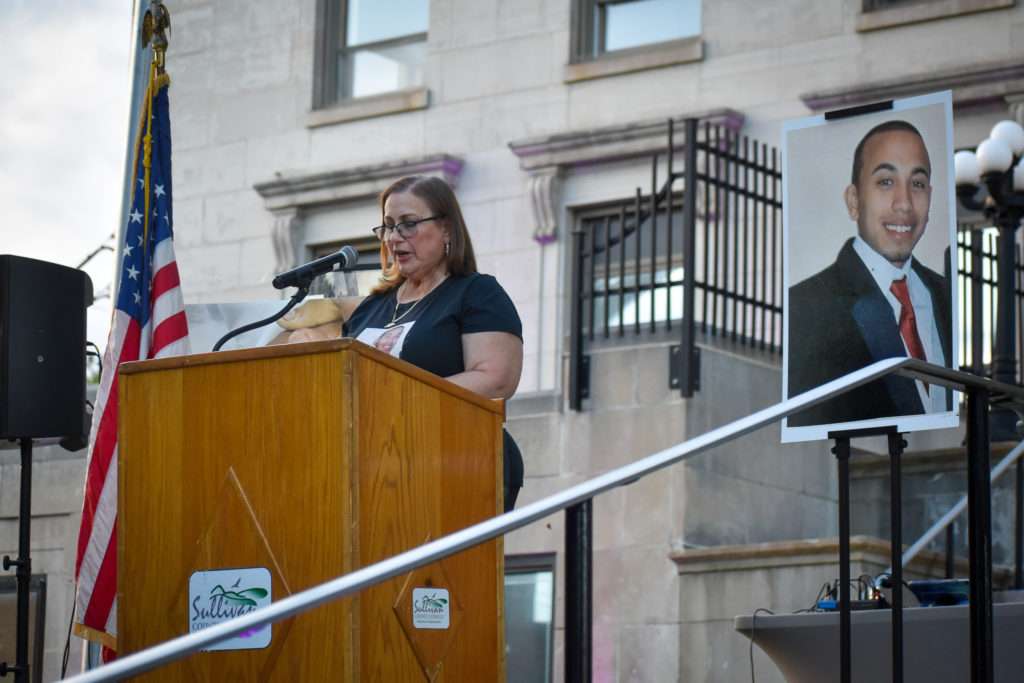 Image: Dorothy Sanchez speaks during a Sullivan 180 International Overdose Awareness Vigil in Monticello, N.Y. in August 2025 (Photo Credit: Sullivan 180)