
Here are the Fresno Unified schools that have lost the most students over the past decade — and what it means

Before they left for Mexico, they told Principal Faviola Perez their kids wouldn’t be at school anymore.
At least 10 families of students at Mayfair Elementary School have approached Perez over the last year to tell her that the federal government’s immigration policies have left them with no choice but to uproot their lives.
“I’m so devastated that I’m losing families,” Perez told Fresnoland. “But I do understand the fear because when I was in fifth grade, I watched my mom get deported. When I was a sophomore at Roosevelt High School, my brother got deported.”
Perez said the effects of national policy trickle down to the local level, and it’s changing local schools. She described enrollment declines due to immigration concerns at Mayfair Elementary as “another COVID.”
But immigration raids are just the latest challenge — and not the main culprit — to keeping students in Fresno Unified schools.
Well before a shift in immigration policy and enforcement tactics last year, student enrollment at Mayfair Elementary plummeted during the pandemic and never recovered. Over the last decade, Mayfair Elementary went from 736 students in 2016 to just 547 enrolled this school year.
That’s a 25% decline, and it’s not even the biggest enrollment drop across California’s third largest K-12 school district.
More than a dozen of Fresno Unified’s schools have lost over 20% of their students over the last decade, and most of the district’s elected trustees have remained silent on the looming school closure debate.
Today, Fresno Unified has 3,901 fewer students than it did a decade ago, according to a Fresnoland analysis of the district’s student enrollment over the last decade.
Those enrollment declines are concentrated at Fresno Unified’s elementary schools and in south Fresno, Fresnoland found.
Olmos Elementary in southeast Fresno has grappled with the second-highest loss in the last decade — nearly 34% of all students. But no school has been more devastated by enrollment declines than Storey Elementary, which has lost almost half its student population in the last decade.

Not all school districts are losing kids
While district leaders acknowledge the simmering school closure debate, they have no appetite to discuss it — and experts suggest there’s even less that the district can do to dig itself out of this growing hole.
Fresno Unified — far from the only California district confronting enrollment declines — currently has no process for identifying which schools may close in the coming years, with internal estimates ranging from three to as many as 11 schools.
“As other districts statewide who have consolidated or closed school sites,” said Fresno Unified spokesperson Adela Duncan, “here at FUSD three to five school sites may be considered, but there isn’t any current projected timeline.”
According to Patrick Jensen, Fresno Unified’s chief financial officer, several factors would need to be considered before closing a school. That includes the age and condition of school sites, the capacity of nearby schools and whether neighboring schools could accommodate incoming students.
On top of that, Jensen said the district would also examine how far schools are from their students, whether a school serves a historically underserved community, traffic patterns and whether students would need to cross busy intersections to go to school.
Fresno Unified’s challenges aren’t unique.
Close to three quarters of all K-12 public school districts in California are grappling with enrollment declines, according to a 2025 analysis from the Public Policy Institute of California.
That analysis also found that enrollment declines are steeper at larger, urban school districts that have more low-income students and a higher share of Latino students.
All of those attributes match up with Fresno Unified: An urban school district — California’s third largest — where 84.16% of students are identified as low-income.
“As far as clawing their way out of declining enrollment, I think a lot of the factors that are driving this declining enrollment overall are quite outside of the school’s control,” said Brett Guinan, a research associate at PPIC.
Declining enrollment isn’t a reality for all school districts, especially those in rural and suburban areas. Additionally, districts with higher shares of Asian and white students — and fewer low income students — are growing, according to the PPIC analysis.
That appears to explain what’s going on at neighboring Clovis Unified.
Student enrollment has been climbing at Clovis Unified since the second year of the pandemic, and the district enrolled a record-high number of students this year.
A Fresnoland review of the Clovis Unified School District confirmed that half of its schools are located within Fresno city limits, but only the northernmost neighborhoods where some of the most affluent communities in Fresno reside and property values are highest.
Guinan confirmed that Clovis Unified’s steady enrollment in the last decade matches similar trends in the state, where districts serving higher concentrations of Asian and white students aren’t facing the same reality as poor urban districts like Fresno Unified.
“Yes, we do see districts with fewer low income students tend to be those that are growing than those that have more low-income students,” Guinan said.

Disparities at elementary schools and in south Fresno
Fresnoland used state data to examine Fresno Unified’s enrollment woes school by school and found that more than 65% of all Fresno Unified schools have fewer students today than they did a decade ago.
Those declines are disparately concentrated at Fresno Unified elementary schools and in south Fresno, according to Fresnoland’s analysis.
The following five Fresno Unified schools had the largest percentage drop in student enrollment over the last decade:
- Storey Elementary
- Olmos Elementary
- Gibson Elementary
- Holland Elementary
- Jefferson Elementary
All five are elementary schools, and three are located south of the 180 freeway.
Over the last decade, the median Fresno Unified school lost 57 students.
Yet, the median elementary school in the district lost 74 students over the same time period.
Additionally, the median Fresno Unified school located south of the 180 freeway has 79 fewer students today than they did a decade ago.
Fresno Unified’s trustees haven’t had a single public conversation at school board meetings about the subject of school closures. Additionally, only one of its seven members spoke to Fresnoland about the likelihood of school closures.
Trustee Elizabeth Jonasson Rosas said she expects school closures to take place at Fresno Unified in the next couple years.
“The ability to have our resources focused in a school that is at capacity or a little below, versus two schools that are half full, is better for our students because we’re not having to maintain two facilities,” Jonasson Rosas told Fresnoland.
She added that closing school has an emotional impact on the communities they serve.
Public school districts get state funding based on the Local Control Funding Formula, which is based on enrollment and how often students show up to school. The decline in enrollment at individual Fresno Unified schools add up, especially for a district with more than 100 schools.
Jensen said those enrollment declines are largely responsible for Fresno Unified’s ongoing budget deficit, which is currently $88 million. District officials project a $55 million deficit for the 2026-27 school year even after approving cuts for 466 employees.
Over the last decade, the district’s largest annual decline in students happened the first year of the pandemic — enrolling 1,151 fewer students in the 2020-21 school year than the prior year.
The second largest annual decline was this year — with Fresno Unified enrolling 995 fewer students in the 2025-26 school year than the year prior.
“That’s basically what we’re struggling with,” Jensen told Fresnoland. “Because if we had stayed flat from where we were at pre-COVID and had the same attendance and same enrollment, we wouldn’t be here.”

Enrollment declines with statewide implications
Across California, K-12 schools have lost around 75,000 students in the past year, with an EdSource analysis showing a drop of nearly 10% in enrollment since the 2017-18 school year.
Guinan, of PPIC, told Fresnoland that those enrollment declines are unlikely to end anytime soon.
“There are definitely trends of declining enrollment statewide that are projected to continue for at least the next five, likely 10 years,” Guinan said, “driven primarily by declining birth rates and by higher migration out of the state than in prior years, especially during the pandemic years, and a slowing of international migration into the state.”
Each of California’s five biggest school districts have issued layoffs notices this year, including Fresno Unified. All but one have been grappling with shrinking student enrollment.
Los Angeles Unified, California’s largest K-12 school district, has already announced plans to close schools. So have a number of other districts, including San Jose Unified and Vallejo City Unified. At Oakland Unified, over 60 principals have called for the district board to close schools to balance a $100 million current deficit.
Additionally, the adoption of transitional kindergarten, or TK for short, did not have the enrollment impacts educators and leaders across the state were hoping for. It also hasn’t really changed enrollment figures for school districts across the board.
“With the expansion of transitional kindergarten statewide, that’s offset some of the declining enrollment, because it’s essentially added a new grade in for even younger students,” Guinan said. “But take up for TK hasn’t been quite as high as the program has expanded, not everyone who is eligible uses it.”
Historically, Guinan says that enrollment declines are larger in high school years than earlier grades. However, she confirmed that recent data trends are showing larger drops in enrollment in early grades, a trend that appears to be taking place at Fresno Unified.
“Recently, we are seeing bigger drops in enrollment among those earlier grades, and again, that’s likely due to this kind of lower birth rate,” Guinan said. “There just are fewer kids that can be entering the system.”

The very real impact of shrinking enrollment
Over at Mayfair Elementary, losing a quarter of its students in the last decade has had a marked impact on the school.
Lyle Patty, who has been teaching at Mayfair since 2014, recalled each grade level having at least five classes of students at the K-6 school. After steep declines during the pandemic, most grade levels at Mayfair now only have enough students for up to three classes.
“I find that the attendance decreases, but the responsibilities still stay the same,” Patty said. “Whether I have more resources or not, I still have the same expectations.”
Perez, Mayfair’s principal, said the school will be losing a third grade teacher along with a social worker and a restorative practice counselor, all part of the district’s cuts. She said she expects to truly feel the impacts of declining enrollment and average daily attendance (ADA) next year — which both directly impact state funding levels for Fresno Unified.
“The most important resource, most important capital that you have on your campus, is your adults,” Perez said, “and if we can’t pay the adults because we don’t have the ADA coming, then we’re losing the resources that are going to be able to help the students of Fresno Unified.”
Perez, who was born in Culiacán, Mexico, was able to pursue a higher education after AB 540 passed in 2001, allowing her to be eligible to pay in-state tuition at Fresno State. Just last year, she earned her doctoral degree in educational leadership as a Bulldog.
For Perez, who was undocumented up until she was 21 years old, she sees herself in the children and families who are choosing to move away amid heightened immigration enforcement.
The post Here are the Fresno Unified schools that have lost the most students over the past decade — and what it means appeared first on Fresnoland.
New initiative boosts funding, resources for childcare providers in Merced County
Santa Clara County looks to fund Latino ‘health promoters’
Latino community health workers in Santa Clara County, known as promotores de salud or “health promoters,” have for years knocked on doors that others couldn’t. Now the county needs them again — and has plans to make them a permanent part of the region’s public health system.
The Board of Supervisors on Tuesday voted unanimously to pursue options for funding a permanent system of culturally competent, one-on-one clinicians for the county’s most vulnerable Spanish speakers. Officials will look to three Medi-Cal providers in the region — the county’s own Family Health Plan, as well as private insurers Anthem and Kaiser Permanente — to help pay for it. Health officials say an expanded, full-scale army of promotores across East San Jose, South County and San Jose’s Cadillac-Winchester neighborhood would reduce hospital visits and prevent further strain on overflowing emergency departments.
It’s become especially urgent amid a tide of federal funding cuts threatening Northern California’s largest public hospital system.
“We are tapping on them once again to respond to this crisis,” District 1 Supervisor Sylvia Arenas said at the meeting.
Promotores have become an integral backbone of public health in Silicon Valley. They drove efforts to immunize Spanish speaking residents and prevent the spread of COVID during the pandemic. They also helped the county avoid federal funding losses by counting hard-to-reach households after President Donald Trump cut the decennial U.S. Census short in 2020.
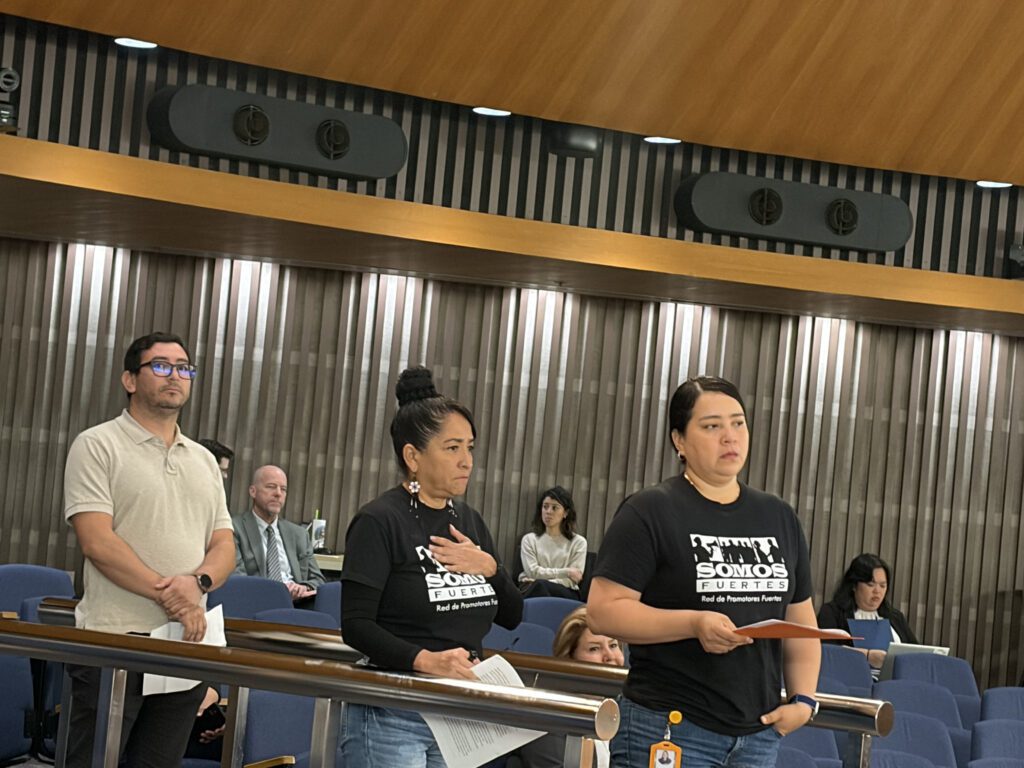
But promotores are underpaid, and their work has historically lived at the whim of grant cycles — at the end of which trained workers leave and programs diminish in size. At the same time, each clinical worker providing care coordination, chronic disease management and patient navigation generates an estimated $278,000 in healthcare savings every year, according to the findings of an April county Public Health Department study.
Promotores’ services are billable under Medi-Cal, though many don’t get reimbursed because they aren’t registered as a national health provider as required to submit claims, or cannot meet the licensed clinical supervision requirement. The county is exploring the creation of a centralized agency or “hub” — possibly located at a county library or clinic — to coordinate billing and credentialing.
“I’m asking the board: give us support,” Heiny Gonzalez, another promotora with SOMOS Mayfair, said at the meeting.
A new sense of urgency underlines their work. A landmark, multiyear study on the systemic health threats to Latino residents published last year prompted county leaders to declare a public health crisis, after troubling surges in deaths by suicide and diabetes. The report also identified higher rates of opioid overdose deaths among Latinos in South County than any other region.
“We are providing these services to very devastated communities,” Monica Mahecha, a promotora with SOMOS Mayfair, said in public comments at the meeting.
Promotores don’t just do clinical work. They also do community outreach, connecting residents with specific services available in their area. Sharon Luna, a neighborhood leader in the unincorporated South County community of San Martin, said promotores have had a noticeable effect on getting residents into healthy cooking, sports and academic tutoring.
“It is one of the most impressive programs I have seen in South County,” Luna said at the meeting.
The program cannot fund itself with those savings because not all of it directly benefits the county. Officials are looking toward a “blended” mix of funding from the county, grants and the region’s three managed care plans under the county, Anthem and Kaiser, with no single source exceeding 40% of the proposed system’s total budget.
“One of my recommendations is we urge the three Medi-Cal managed care plans in our county – Family Health Plan, Anthem and Kaiser – to … consider an appropriate level of investment, because those plans will have tangible savings in health costs avoided that will be bankable for them in a way that’s not true for county budget,” County Executive James Williams said at the meeting.
Williams added members of the Family Health Plan governing board — which the county moved to consolidate control over last year — have already voiced support for pitching in to fund the expansion of promotores.
“I don’t think Kaiser and Anthem should be off the hook,” Williams said. “We need to put a little fire under them to step up to the plate as well. We know exactly the kind of concrete investment that needs to be made.”

Arenas said the county’s promotores have risked their lives for the community time and time again.
“What other crisis are we going to wait for to finally integrate a framework that is fiscally proven?” she said.
Contact Brandon Pho at brandon@sanjosespotlight.com or @brandonphooo on X.
The post Santa Clara County looks to fund Latino ‘health promoters’ appeared first on San José Spotlight.
Beyond tolerance: the mental health of queer youth

Lea este artículo en español aquí.
On a winter evening, four friends meet to catch up at a local park. Among them is Gael Barba-Solis, a student who created one of the area’s only LGBTQ+ support spaces. They talk about their Dungeons and Dragons campaigns, their classes and teachers, and rehash old stories. They often walk around this spot in their town as it is one of the few areas they like to meet up outside of school.
Barba-Solis, 17, identifies as a trans man and pansexual, someone who is attracted to others regardless of their gender or sex. He said he feels very fluid when it comes to gender expression and started exploring his gender identity in middle school.
“As time went on, as I continued being called ‘she,’ being called my dead name, I didn’t like it,” Barba-Solis said. “I thought I was okay with it, but it eventually just sort of created like almost this pit in my stomach whenever I was called it. It was putting me in a dark place.”
The road was messy. He said he felt overwhelmed with thoughts of his identity and would spend nights in tears. Accepting himself, he said, felt like the easy part.
He shared that his closest friends, Haiden Dizon, Mae Pung and David, who wished to not include his last name to protect his privacy, have been there for him whenever he needed them and have been like a family. He said his older sister, who’s also in the LGBTQ+ community, was the first person in his family to use his preferred name and pronouns. Through her, he found the confidence to start a trans club at his high school, he said.

Barba-Solis said he created the Mariposa Club to support transgender teens at Hollister High School and give them the safe space he didn’t feel he always had. Club meetings focus on education, with topics ranging from how to safely use a chest binder (made for flattening the chest for a more masculine appearance) to LGBTQ+-friendly cities for after graduation.
“Now it’s like I have breathing room. I can actually be who I am,” Barba-Solis said. “I have friends who support me and who are there for me, as well as my parents and my sister.”
In 2024, California approved behavioral health reform through Prop 1. It consists of two parts: the Behavioral Health Services Act (BHSA) and the commitment of $6.4 billion to fund mental health services through the Behavioral Health Bond. BHSA replaces the Mental Health Services Act of 2004 and focuses on substance use disorders, mental illness and housing.
San Benito County will receive funding from Prop. 1 dispersed through multiple agencies, including to Youth Recovery Connections (YRC) and directly to the county’s Behavioral Health Department. While planning continues, LGBTQ+ youth in the county work to build their own safe spaces.

When it comes to LGBTQ+ awareness and support, San Benito County is lacking compared to nearby areas, said Maxx D’Elia, a trans man who has worked in mental health supporting students in the county.
“I worked with kids where they’d say ‘I want to be a boy because I want to date girls,’ And I’m like, ‘Well, you don’t have to be a boy to date a girl. You could date a girl and be a girl,” said D’Elia. “I think that’s where a lot more education needs to come in. I would also want these kids to know that it’s okay to slow down as well and take that time to just figure it out. There’s no rush. We’re all just figuring out life one day at a time.”
From 2018-2024, the county’s Behavioral Health Department funded San Benito+, a safe space for the queer community to gather at the Esperanza Center in downtown Hollister.
“There’s a lot of issues that pop up for this population that may need some specialized care, and usually it’s not addressed quickly and efficiently enough,” Interim Behavioral Health Director Rachel White said regarding the San Benito+ program. “And there’s consequences to that.”
In 2024, the program was shut down because of a lack of involvement. White said she recognizes that the program missed the mark and that it was just not reaching its community.
“Losing San Benito+ was a true setback in our little community and we currently lack quality gender and sexuality affirming care in this area,” D’Elia wrote in an email in May 2025. “That’s not to say it doesn’t exist, but it’s so far and few between. If you head over to Gilroy and Morgan Hill, they only have an LGBTQ support group that runs twice a month in Gilroy and twice a month in Morgan Hill at the libraries which are run by the LGBTQ Youth Space.”
D’Elia, who worked at San Benito+ with a handful of other part-time employees, said the program would do better with a full-time leader that could put in time to build outreach.
San Benito County Behavioral Health is working to get feedback from youth on what they need for future resources and, depending on those responses, possibly integrate the queer community’s needs into a Transitional Age Youth program, White said.
Behavioral Health created a public survey to gather input on a possible youth space. It closes on May 1.

San Benito County Behavioral Health has been allocated an average of $4.5 million annually from BHSA under Prop. 1, which goes into effect July 1.
In the meantime, Youth Recovery Connections (YRC), a local organization, was approved for funding through Prop 1 and the Behavioral Health Continuum Infrastructure Program bond.
YRC does prevention work focused on substance use and mental health. According to YRC Executive Director Michael Salinas, the group is now working on opening a second site in Hollister with expanded services to include treatment delivered by counselors and clinicians—the only place in the county to do so apart from the Behavioral Health Department.
BenitoLink interviewed six youths in the LGBTQ+ community for this article. They talked about their lives, the challenges they face and where they find emotional support, be it community organizations, family or significant others. BenitoLink agreed to allow a few to remain unnamed to protect their identity.

One anonymous local teen, who identifies as gay, said YRC has had a positive impact on his life, supporting him through the loss of loved ones, addiction, self harm and involvement in the juvenile justice system.
Both he and his older sister have struggled with addiction. They agreed to go to rehab at the same time but when he finished his program, he learned that his sister took her own life. YRC paid for her funeral, for which he said he was forever grateful.
She was the second person he lost to suicide, he said, following the death two years ago of his best friend, who identified as queer.
The Centers for Disease Control and Prevention (CDC) reports that 41% of LGBTQ+ students have seriously considered suicide compared to 13% of their cisgender—those whose gender corresponds to their sex assigned at birth—and heterosexual peers.
After multiple attempts to follow up with this teen, BenitoLink heard from those close to him that he broke parole and returned to rehab. While reporting this story, he also turned 18, qualifying him as a legal adult and thus possibly facing more serious consequences.

According to The Trevor Project, a leading LGBTQ+ suicide prevention nonprofit whose research is used in peer-reviewed publications, communities themselves have an impact on a person’s mental health.
The project’s 2024 survey of nearly 34,000 youth states that “LGBTQ+ young people who reported living in very accepting communities attempted suicide at less than half the rate of those who reported living in very unaccepting communities.”
Sarabi Grace Muñoz, 14, identifies as female and as omnisexual, which falls under the bisexual umbrella of sexual preferences. She moved to Hollister last year after living in San Jose and said she feels like the environment is far less welcoming of queer people.
“I’ve been called a faggot more times than I can count,” Muñoz said.
She recounted a few memories including one where she was denied entry to a church because of her appearance, noting that she was sporting a Pride pin that day. Another time, an acquaintance found out Muñoz had dated a woman and told her to repent while she still could.
“You can’t even really express the judgment and, like, disdain that is pushed upon you until you’re just walking the street with your friend and somebody yells out ‘faggot!’ and tries to hit you with a coke can,” Muñoz said, describing an incident she experienced at a Hollister Farmers Market.

Muñoz said she told her mom around the age of nine that she liked girls, and was generally accepted by her immediate family. She said she feels that her identity is complicated and harder to understand for her extended family, who are Catholic immigrants.
Her family’s religion factored into her guilt about her sexuality and impacted her mental health, she said. At one time, part of her believed that God didn’t love her, that she had disappointed Him because she was in love with somebody that was not a man.
Muñoz said she started therapy around the second grade during a tumultuous childhood. A few years ago, she was diagnosed with major depressive disorder by a psychologist in San Jose. Despite trying to find services in Hollister, she said her family faced limited options and decided to make the 50-mile commute to San Jose for providers.
The CDC reports 65% of LGBTQ+ students feeling sad or hopeless compared to 31% of cisgender and heterosexual students.

A teen in San Benito County who identifies as queer asked to remain anonymous for this article so he can come out to his family on his own timeline.
He shared that when he was about 12, he realized he’s never only been attracted to girls. A few years later, as a sophomore in high school, he started opening up to friends around him.
“It just felt good to talk about it with people because it’s something that I’d never talked about with anyone before,” he said. “I’m the kind of person where it feels good to get thoughts outside of my head and out into the world. It just feels like less mental weight on me.”
The teen said that he feels especially safe and comfortable when hanging out with his female friends, as some boys his age have a stigma around queer people.
“It’s not that they’re necessarily unaccepting,” he said. “It’s just that they’re kind of like, ‘Do your own thing and I’ll do my thing and I don’t really want to be associated with it.’”

A lingering fear exists for a few of the students interviewed.
Another teen interviewed for this article asked to remain anonymous to protect their identity from their parents.
“They’re very respectful,” they said about their parents. “There’s just some things they don’t really understand.”
As someone who is a part of the queer community, they specifically mentioned they fear for their safety outside of school.
“I feel like I always kind of have to assume how people feel about, like, queer identities or especially transgender people,” they said. “It’s just because I don’t know, I think it’s just really a safety thing.”

Barba-Solis reported being called slurs in middle school, and just outside of Hollister High a stranger threw apples at his back while he carried an LGBTQ+ flag.
“My identity, I’m secure in,” Barba-Solis said. “I know who I am. It’s more of the fear of others, I guess, and sort of kind of like how they would react.”
Several teens interviewed said their school is where they feel like they can be most open about their sexuality or gender identity. Clubs, and the friends they’ve made through extracurriculars, plus the occasional school counselor or teacher, make up common safe spaces for students. Notably, the theater departments at both Anzar and Hollister High schools provide welcoming organizations for students.
“Transgender and nonbinary young people who had access to gender-affirming clothing, gender-neutral bathrooms at school, and had their pronouns respected by the people they live with, had lower rates of attempted suicide compared to those who did not,” according to the Trevor Project 2024 U.S. National Survey on the Mental Health of LGBTQ+ Young People.


Pung, 17, supports her friend, Barba-Solis as vice president of Mariposa Club.
Pung identifies as bisexual but said she feels like her identity isn’t something she’s had to explain to her family. She also takes comfort in knowing she has other family members that identify with the LBGTQ+ community.
“I think my parents are already like normalized—normal to it—I guess. So it was relatively just smooth for me to just come out as bisexual,” Pung said.
Pung said she has struggled with mental health in the past but feels like it’s affected her less in recent years.
“I think I was diagnosed in middle school, but then we lost our insurance to our health care,” Pung said. “I couldn’t go to the doctors anymore. So I couldn’t get my prescription for the antidepressants I was taking. And then I met Haiden [Dizon]. I started dating Haiden and it kind of just went away. I think there are still a little bit of, like, remnants of it there, especially with anxiety occasionally. But for the most part, I’m not too bad.”
Dizon and Pung have been dating for just over two years, she said.

The future
D’Elia said hands-on education for community providers and students would be beneficial.
Barba-Solis has given presentations to Hollister High staff to help educate them about the LGBTQ+ community. In March, a joint effort of the Gay Straight Alliance and the Mariposa Club resulted in another staff presentation.
Youth Alliance, launched its first LGBTQ+-centered meeting in February. It’s currently working with Barba-Solis and the Mariposa Club to create more safe spaces and opportunities for education. The goal is to create two groups, Barba-Solis said, including one for youth and one for parents.
“To find that middle ground and that compromise, it kind of has to be accepted that this is both a journey for you and your parents, because it is,” Barba-Solis said. “It’s to help parents recognize that but also help educate them on how to support their child. Because I know some parents do try. It’s the trouble of understanding and then therefore that leads to miscommunication.”
Additional consulting work with community members on the use of resources is documented in the Community Planning Process Report. The BHSA Integrated Plan, outlining the use of funds and a proposed budget for 2026-2029 will be submitted in June to the San Benito County Board of Supervisors. A draft is available for virtual public comment until May 21. A public hearing for final community input is also set for May 21.
Currently, YRC Director Salinas says the goal is to have YRC treatment services available to the community in early 2027.

Looking forward, Barba-Solis said he hopes to see centers for students while supporting those who aren’t “out” with discretion.
“If we can just start with support groups or even, like, professionals who do specialize in identities with queer youth, I think that that could be a good start, especially in Hollister.”
24/7 crisis and suicide resources
San Benito County Behavioral Health Crisis Line: (831) 902-2911
TrevorLifeline: 1-866-488-7386 for 24/7 support via phone, text, or online instant messaging
The National Suicide Prevention Lifeline: 9-8-8 is available via call, text and online chat

This story was produced in partnership with CatchLight as part of its three-year Mental Health Visual Reporting Initiative.
We need your help. Support local, nonprofit news! BenitoLink is a nonprofit news website that reports on San Benito County. Our team is committed to this community and providing essential, accurate information to our fellow residents. Producing local news is expensive, and community support keeps the news flowing. Please consider supporting BenitoLink, San Benito County’s public service nonprofit news.
The post Beyond tolerance: the mental health of queer youth appeared first on BenitoLink.
UC Merced researchers sound the alarm on dust. What it could mean for your health
Proposed public housing rule could kick hundreds of Central Coast children into the streets
FEATURES | By George B. Sánchez-Tello Residents have until Tuesday, April 21 to register their opinions with the federal government on a proposed change to public housing rules that would exclude undocumented family members. Approximately 600 “mixed-status” families in Monterey County would be impacted by this proposal, according to the Housing Authority of Monterey County. […]
Maze students settle for pizza, bookstores after college field trip falls through

Lea este artículo en español aquí.
More than 40 Marguerite Maze Middle School students walked from campus along with teachers and parents to two downtown Hollister bookstores, eventually settling at Mountain Mike’s Pizza for lunch and some arcade games on April 8.
That might appear to be a treat, but it was more of a consolation prize after the district “cancelled” the group’s field trip to UC Merced, according to the teachers and parents chaperoning the students.
School district officials said permission documents for the trip were not finalized on time while acknowledging staff failed to do so in a timely manner.
Seventh grade teacher Angela Hagins said the required permission documentation for the field trip had been submitted to the district in January. School staff had lined up 15 parent chaperones and the district had secured substitute teachers for the day.
But Hagins said it wasn’t until 15 minutes before the school group was scheduled to leave that the district called to inform them there wasn’t any transportation available.
Hagins said the district uses an online platform to process field trip requests and that school staff attempted to get updates on their request from the transportation department but were unsuccessful, despite reaching out multiple times, including during the week of the field trip.
“Had we gotten a response that it was not approved, we would’ve been able to do something about it, but at that point we didn’t know it got stuck in the pipeline,” Hagins said. “There was no reason for us to assume it got denied.”
Hollister School District Superintendent Erika Sanchez said there is a multi-step process that requires details such as clearing students with medical needs, coordinating transportation, lunch and chaperone clearances.
“In this particular case the form spent weeks in the inbox of staff and unfortunately the form did not progress to the step required to secure transportation with the district office,” Sanchez said.
She added the transportation form “never reached the finalization [stage] until after the close of business” on April 7, the day before the field trip was to take place, and she acknowledged the request was submitted “well in advance” of the required four weeks before the trip date.
Sanchez said district staff attempted to secure buses in the hours leading up to the field trip but was unsuccessful.
Sixth grade teacher Candace Ledesma said the trip was particularly special for this group of students because they are part of the Advancement Via Individual Determination program and the majority are seeking to be first generation college students.
“These are students who choose to take a harder elective in order to get better skills and pave the road to college,” Hagins said. “They’ve already decided this is what they want to do. They’re first generation, lower economic status. So they don’t get the opportunity to travel, to go on field trips and see college campuses.”
Eighth grade student Mayra Lopez Villegas, 13, said she was disappointed because she was looking to tour the college campus and added that she felt the district didn’t care about some students.
“It just says sometimes other schools or students from Maze or Rancho don’t really matter,” she said.
Parent Celeste Rodriguez, who had an eighth grade student taking part in the field trip, said she was frustrated because it was the eighth graders’ last field trip of the school year.
‘I think it’s something that is not right,” she said.
Sanchez said the district understands how important field trips are for students.
“I also can appreciate how disappointing this may have been for all students, families and staff,” she said.
Ledesma said that, rather than give up, teachers involved in the field trip began making calls trying to find a way to get the kids to UC Merced.
She said Hollister High School informed them they had nothing available. The group also called a charter bus company, which she said would charge about $1,200. But, Ledesma added, the charter’s call to the district to obtain approval went unanswered anyway.
Ledesma said the teachers also considered taking the students to the new Gavilan Hollister Campus instead, but the college students were out on spring break.
Other activities they considered included taking the kids to the movies, but they were informed there wasn’t enough staff at the theater to accommodate the students.
“There is nothing for the kids to do,” Ledesma said. “ There are no hands-on activities for them.”
Ledesma said this was the second time the district cancelled a field trip at the last minute this school year. The first was in October when the district “forgot” to arrange for substitute teachers, she said.
The district’s focus “isn’t on the students, it seems,” she told BenitoLink, adding that about 70 students were part of the excursion.
But Sanchez said in the October case, substitutes were not secured because the field trip date fell on a “blackout date” when no field trips were allowed.
“Staff knew of this issue by Oct. 24,” she said, noting that the field trip was planned for Oct. 29, five days later.


We need your help. Support local, nonprofit news! BenitoLink is a nonprofit news website that reports on San Benito County. Our team is committed to this community and providing essential, accurate information to our fellow residents. Producing local news is expensive, and community support keeps the news flowing. Please consider supporting BenitoLink, San Benito County’s public service nonprofit news.
The post Maze students settle for pizza, bookstores after college field trip falls through appeared first on BenitoLink.
Mendocino County has its own dog breed
MENDOCINO CO., 4/17/26 — Drive south on Highway 101 toward Hopland, and you’ll pass a turnoff for McNab Ranch Road. Most people zip by without noticing. But that little road is the namesake of something Mendocino County can claim that few other counties in America can: a working dog breed that originated here in the late 1800s and is still riding shotgun in ranch trucks up and down the North Coast. Meet the McNab.
Did you know
…the McNab is one of the only dog breeds developed in California, and the only one tied to Mendocino County?
The breed traces to Alexander McNab, a Scottish sheep rancher who emigrated from Glasgow in 1866 and settled on a 10,000-acre spread in the valley south of Ukiah. In 1885 he returned to Scotland and brought back two Scotch Collies, Peter and Fred, who became the patriarchs of the breed. The Collies were brilliant in the Scottish highlands and underbuilt for the Mendocino summer — soft feet on the rocks, too much coat, no real answer to half-wild range cattle.
So McNab crossbred. He bred Peter and Fred to local dogs of Basque Spanish and English working stock — leaner dogs that already knew how to work in heat. He selected hard for stamina, smarts and tough feet, and he favored smoother coats for the California climate. Within a generation he had a dog that belonged here.
… there’s a Mendocino winery named after the breed?
McNab Valley itself is named after Alexander McNab. McNab Ridge Winery, purchased by John Parducci in 1999 and now run by his grandson Rich, takes its name from the same ground. The labels carry a McNab dog silhouette. The Petite Sirah is a good place to start.
… McNabs have what ranchers call cat feet?
Tight, compact paws with no rear dewclaws, built for rough country. It’s one of the breed’s signatures, along with the lean 35- to 50-pound build, the typically black-and-white coat and ears that can go either prick or floppy. Serious McNab people don’t care which.
… they herd differently than border collies?
This is the detail working ranchers love. Border collies are eye-stalkers. They crouch low, lock eyes with the sheep and move them with intensity. McNabs work loose-eyed and upright. They trot wide, work the heads of the herd and use body pressure rather than stare. The reason is practical: cattle don’t respond to a stare, and you can’t whistle a dog through a stand of manzanita. McNabs were bred to think for themselves in country where the rancher couldn’t see them half the time.
… they’re as smart as a border collie, just smart in a different way?
Border collies top every dog intelligence ranking ever published — they sit at No. 1 in psychologist Stanley Coren’s well-known list. McNabs aren’t on those lists because they aren’t recognized by the American Kennel Club, and most McNab breeders prefer it that way. Once a working breed enters the show ring, the work tends to leak out of it within a few generations.
Ask any North Coast rancher and they’ll tell you a good McNab is right there with a border collie. The difference is in style. Border collies are virtuoso instruction-followers. McNabs are independent problem-solvers. Drop one in a brushy canyon with 30 scattered cows and no commands, and a good McNab will bring them home on its own.
… one McNab can do the work of two or three other dogs?
Range. They cover ground. On a 5,000-acre ranch — and Mendocino has plenty of those — that adds up. They also handle heat better than border collies and work cattle more readily than most Australian shepherds, which is part of why they’ve held on in working ranch culture even as flashier breeds cycled through.
… you can’t really buy one online?
There’s no breed club marketing puppies, no AKC paperwork, no glossy operation. Working McNabs change hands rancher to rancher up and down the North Coast, mostly through people who already know each other. A lot of breeders won’t sell you a pup unless they’ve talked to you first. That’s how the breed has stayed a real working dog for roughly 140 years.
The McNab is a Mendocino County artifact: half Scotland, half California, all local. Built by a stubborn immigrant who took one look at this country and decided to engineer a dog that belonged here.
Spot a lean black-and-white dog riding in the bed of a ranch truck on the way to the Boonville feed store. Give it a nod. You’re looking at 140 years of Mendocino history with cat feet.
Got a McNab story or a working-dog tip for the Voice? Send it our way.
Measure D to decide the future of cannabis farming in San Benito County

Lea este artículo en español aquí.
On a heat-wavy late winter’s day, a farmer drives a tractor churning chopped wheat and barley into the earth, preparing the fields for yet another season. That land in southern San Benito County once hosted garlic. In just two months, it will have cannabis planted there and become one of the first in the county to do so.
Jordan Blancarte, whose family owns the property, watches from a nearby hill. Formerly a physicist who studied plasma and the magnetic field at the University of California, Berkeley, he switched paths in 2019 and now directs an organic cannabis and hemp farm on the Central Coast called Orso Farms. He spent his first years in the county growing hemp, a variety of cannabis without its main psychoactive compound, and is now growing cannabis for the first time.
“San Benito is a fantastic environment for cannabis to grow naturally,” Blancarte says. “We’ve got nice warm summers, which the plants love, and not as much moisture as some of the other counties have.”
Though San Benito County first allowed cannabis cultivation and sales in 2018, six years passed without a single legal farmer growing cannabis. Blancarte, county officials, and supervisors say this was the result of a cost-prohibitive tax structure that set an annual rate of $3 to $17 per square foot, one of the highest in California.
To address this, the Board of Supervisors approved, in late 2024, a tax exemption that runs through the end of 2026. But the supervisors’ bigger bet is Measure D, the only initiative county voters will decide on June 2, which aims to overhaul the tax structure to attract more growers.
If Measure D passes, the board will replace the current per-square-foot rate in the unincorporated county with a per-acre rate ranging from $1,000 to $10,000. The board would then set the exact rate within that range.
At a Feb. 24 meeting, Supervisor Kollin Kosmicki suggested a rate of $2,000 per acre had been discussed with industry stakeholders, which would give San Benito County one of the lowest cannabis cultivation tax rates in the state. Other cannabis businesses—such as distribution, manufacturing, laboratory testing, and retail—are taxed differently and would not be modified.
“The previous tax structure was not really set up for outdoor cultivation,” Blancarte says. “It was really set for indoor cultivation in mind. Outdoor cultivation is on a much larger scale, and the tax structure needs to understand the difference between indoor and outdoor cultivation. Square footage is not how farmers work.”

In the ballot argument in favor of the measure, the Board of Supervisors argues the new tax structure will attract more growers and increase county revenue to fund essential services.
“This new tax structure would collect much-needed revenue for county services like law enforcement, fire protection, road improvements, and other essential community needs,” reads the ballot argument signed by Board Chair Dom Zanger.
The measure has no known opponents, and no one has filed arguments against it. The only dissenting voice has been Supervisor Ignacio Velazquez, who voted against placing the measure on the ballot. Though he supported lowering the tax rate, he said the proposed rates were too low and was worried they would not generate enough revenue to cover the cost of increased enforcement and that the county could end up subsidizing cannabis.
A fiscal analysis by County Auditor-Controller Joe Paul Gonzalez estimated that by 2028 the county could earn as much as $20 million with the new rates. Though he said the county may face higher administrative and regulatory costs, those are expected to be “partially or fully offset” by tax revenues and permitting fees. He also warned that the projections depend on market conditions that have proven volatile.
“The California cannabis market has experienced significant price volatility and competition among producing regions, which may affect the number of operators willing to establish cultivation operations in San Benito County,” Gonzalez wrote. “As a result, actual revenue may vary significantly from estimates.”
A local cannabis farm
Like any other businessperson, Blancarte closely monitors the policies affecting his sector across California. As counties have been lowering the tax rates they set after legalization in 2016, he saw the county’s 2025 exemption as an opening into a place where he had always wanted to grow. Since the exemption took effect, four growers have set down roots in the county, including Blancarte, and one more grow is pending approval.
With 30 full-time employees, Blancarte is currently preparing about 85 acres in south county to grow about 60 varieties of cannabis. Cannabis cultivation, whether indoor or outdoor, is permitted in agricultural and industrial areas of the county. It is not allowed in residential or rural zones; and in the airport district, it requires special approval.
Unlike indoor cultivation, outdoor cannabis is subject to the cycles of the earth, just like any other crop.
“We get only one shot,” Blancarte says. “Indoor cultivation can do multiple cycles per year. We have one season.”

During the winter, his crew planted wheat, barley, and other cover crops to enrich the soil with nutrients before the cannabis goes in. Meanwhile, Orso Farms grows its starter plants in nurseries in Monterey and Santa Cruz counties.
In June, when the seedlings reach about six inches tall, they will be transported to San Benito County and planted.
California has very strict rules for growing cannabis. Every plant must be individually tagged and tracked through a state system from the moment it is planted until it reaches the consumer. Growers must also keep security cameras running around the clock across their entire property.
Harvest comes in October. Orso Farms will bring in up to 400 seasonal workers to cut the plants and pack them into large freezers on site, where hundreds of pounds of cannabis are stored until they are sold to manufacturers who turn them into the products Californians can find at dispensaries.
Blancarte is considering planting about 100 more acres next year on other fields in his property, but that hope depends, among other things, on what voters decide on Measure D.
Cannabis, he argues, is a great opportunity for farmers in San Benito County. Unlike garlic, which requires rotation to prevent disease, cannabis can be grown on the same land and fits naturally into crop rotation cycles. That flexibility, he says, makes it an attractive option for farmland that might otherwise sit idle.
“There are less and less opportunities for farmers to keep their land active,” he says. “We’re seeing more farmland in this part of the county turn into other things than agriculture, like home developments. This is an opportunity for farmers to have a profitable crop.”
We need your help. Support local, nonprofit news! BenitoLink is a nonprofit news website that reports on San Benito County. Our team is committed to this community and providing essential, accurate information to our fellow residents. Producing local news is expensive, and community support keeps the news flowing. Please consider supporting BenitoLink, San Benito County’s public service nonprofit news.
The post Measure D to decide the future of cannabis farming in San Benito County appeared first on BenitoLink.