Former San Benito County Free Library supervising librarian Erin Baxter was charged with three felony counts involving an alleged embezzlement scheme, including forgery and conspiracy to commit a crime with public funds. She posted $20,000 in bail.
Erin Baxter during a Coalition for a New Library meeting on July 13, 2019. Photo by Heather Graham.
According to court documents, Baxter allegedly took between $100,000 and $500,000 between July 2022 and April 2023.
San Benito County District Attorney Joel Buckingham said his office obtained a warrant for her arrest on May 21. She surrendered and posted bail two days later.
He said no other person has been charged in connection with the case but that his office is still involved in parts of the investigation that are ongoing to determine if “additional individuals should be charged.”
“It’s of utmost importance to me that taxpayers understand how important this case is to the District Attorney’s Office and ensure we hold all individuals accountable who were responsible for the loss of these funds,” Buckingham said.
San Benito County Sheriff Eric Taylor previously told BenitoLink he asked the FBI to become involved with the investigation because his office lacked “the expertise in forensic accounting.”
Taylor said the alleged suspect or suspects opened up a number of accounts that allowed them to order merchandise. No actual cash had been taken, he said, and an internal audit established that none of the library’s supply of Chromebooks, which had been purchased through a $11.8 million federal grant from the 2021 American Rescue Plan Act, were involved.
While merchandise, including camping equipment and electronics, was found at the home of the suspect or suspects, Taylor said he did not know if they planned to resell the goods.
Around the time the investigation began, the then-librarian Nora Conte retired. It is unclear if her retirement had anything to do with the investigation. BenitoLink also confirmed that other staff members resigned, but the county did not disclose how many. Baxter was among the staff that resigned. She is scheduled to appear in the San Benito County Superior Court on July 10.
San Benito County Public Information Officer Rosemerry Dere told BenitoLink Baxter had been a county employee since January 2017.
Since Conte’s retirement, Manny Gonzalez has been serving as the interim librarian.
In March, the county was set to consider hiring a new librarian but the item was removed from the San Benito County Board of Supervisors’ agenda. Dere said that the county decided to go in a different direction.
She said the county is currently going through a thorough background check process for one candidate for the position. Dere said there is no timeline for when the Board of Supervisors will consider this candidate.
“We’re actively trying to wrap it up as quickly as we can,” Dere said.
In April, the Board of Supervisors moved in a 4-1 vote to reduce the number of years of experience they would require from applicants because the county “experienced multiple unsuccessful recruitments,” according to the staff report.
Supervisor Bea Gonzales cast the “no” vote.
“Making this change will facilitate internal training opportunities and the opportunity to hire and promote from within the county,” the staff report states. “These revisions allow current staff promotional opportunities throughout several levels within the library structure as there are staff that currently possesses sufficient experience and capabilities to effectively fulfill the role of County Librarian.”
We need your help. Support local, nonprofit news!BenitoLink is a nonprofit news website that reports on San Benito County. Our team is committed to this community and providing essential, accurate information to our fellow residents. It is expensive to produce local news and community support is what keeps the news flowing. Please consider supporting BenitoLink, San Benito County’s public service, nonprofit news.
Few places in California are as unforgiving for driving an electric car as the remote and sparsely populated Imperial Valley.
Only four fast-charging public stations are spread across the valley’s vast 4,500 square miles just north of the US-Mexico border, according to the U.S. Department of Energy. That means if you’re Greg Gelman — one of only about 1,200 Imperial County residents who own an electric car — traveling almost anywhere is a maddening logistical challenge.
“It’s been, I won’t say a nightmare, but it’s been very, very, very inconvenient,” Gelman said on a recent afternoon as he charged his all-electric Mercedes-Benz at a charging station in a Bank of America parking lot in El Centro. “Would I do it again? No.”
California’s electric charging “deserts” like the Imperial Valley pose one of the biggest obstacles to the state’s efforts to combat climate change and air pollution by electrifying cars and trucks.
Experts say the slow installation of chargers in California’s remote regions could jeopardize the state’s phaseout of new gas-powered cars. Under the state’s mandate, 35% of sales of 2026 models must be zero-emissions, ramping up to 68% in 2030 and 100% in 2035.
Nestled in the desert in California’s far southeast corner, Imperial County ranks dead last in electric car ownership among California counties with populations of 100,000 or more, according to a CalMatters analysis of 2023 data. Only 7 out of every 1,000 cars are battery-powered there, compared with 51 out of every 1,000 statewide.
High poverty and unemployment are a major factor in the region’s slow transition to electric cars, but its lack of public chargers are a big drawback, too.
People living in rural, low-income regions like the Imperial Valley have the least access to electric car chargers, according to a state Energy Commission analysis. More than two-thirds of California’s low-income residents are a 10-minute drive or longer from a publicly available fast charger.
Luis Olmedo, executive director of El Comite Civico del Valle, a nonprofit advocating for environmental justice, has battled for years against the Imperial Valley’s unhealthy air. Now he is making a bid to become its go-to supplier of charging stations for zero-emissions cars.
Olmedo isn’t waiting for businesses or the state to make chargers a reality in Imperial County. Instead, his group has embarked on a $5-million, high-stakes crusade to build a network of 40 fast chargers at various locations. It’s an open question whether his somewhat quixotic endeavor will succeed.
Electric car chargers “are an opportunity for us to be able to breathe cleaner air,” Olmedo said. “It’s about equity. It’s about justice. It’s about making sure that everybody has chargers.”
Luis Olmedo, executive director of Comite Civico Del Valle, shown at a charging station in Calexico, is trying to build 40 fast chargers in the Imperial Valley. Photo by Adriana Heldiz, CalMatters
Esther Conrad, a researcher at Stanford University who focuses on environmental sustainability, said getting chargers in places like Imperial County is critical to California’s effort to transition to electric vehicles in an equitable way. Apartment dwellers and others who don’t have charging at home need nearby and reliable places to charge.
“When you have a rural community that’s low-income and distant from other locations, it’s incredibly important to enable people to get places where they need to go,” Conrad said.
Hours from urban centers
A car is essential for traversing Imperial County, which is the most sparsely populated county in Southern California.
Its neighborhoods are vast distances from urban centers that provide the services that residents need: El Centro — its biggest town, home to about 44,000 people — is much closer to Mexicali, Mexico, than it is to San Diego, which is about a two-hour drive away, or Riverside, nearly three hours. Its highways and roads cross boundless fields of lettuce and other crops that give way to strip malls, apartments and suburban tracts — and then even more crops and open desert.
If you drive an electric car the 109 miles from El Centro to Palm Springs, your route takes you through farmland, desert and around California’s largest lake, the Salton Sea, which is also one of its biggest environmental calamities.
The Salton Sea has been receding in recent years, causing toxic dust to blow into Imperial Valley towns. The region’s air quality is among the worst in the state, with dust storms and a brown haze emanating from agricultural burning and factories in the valley or from across the border in Mexicali, a city of a million people.
About 16% of Imperial County’s 179,000 residents have asthma, higher than the state average. The air violates national health standards for both fine particles, or soot, as well as ozone, the main ingredient of smog; both pollutants can trigger asthma attacks and other respiratory diseases.
More than 85% of Imperial County’s residents are Latino, and Spanish is widely spoken here. Agriculture is a major employer, and many businesses are dependent on cross-border trade and traffic from Mexico. The county’s median household income is $53,847, much lower than the statewide median, and 21% of people live in poverty.
El Centro, the biggest town in the Imperial Valley, is home to about 44,000 people. Photo by Adriana Heldiz, CalMatters
Now the discovery of lithium, used to manufacture EV batteries, at the Salton Sea has the potential to transform the region’s economy. State officials say the deposit could produce 600,000 tons a year, valued at $7.2 billion, and assist the U.S. as it tries to foster a domestic electric car industry that rivals China’s.
But Olmedo worries that when the mineral is removed from the valley, it won’t meaningfully change people’s livelihoods or their health. He points to examples in the developing world where local people have been left behind as extractive industries take what they need.
“We’re about to extract, perhaps, the world’s supply of lithium here, yet we don’t even have the simplest, the lowest of offerings, which is: Let’s build you chargers,” Olmedo said.
Chicken and egg: Too few EVs and too few chargers
Last year, electric cars were only 5% of all new cars sold in Imperial County, compared with 25% statewide. Getting chargers into low-income and rural places will become more and more important as California struggles to meet its ambitious climate targets.
The Energy Commission estimates that California will need 1.01 million chargers outside of private homes by 2030 and 2.11 million by 2035, when more than 15 million electric cars are expected on the roads. So far the state has only about 105,000 nonprivate chargers.
Edgar Ruiz, air control technician, and José Flores, research and advocacy specialist with Comite Civico Del Valle, demonstrate how electric vehicle charging stations will work when installed in the Imperial Valley. Photo by Adriana Heldiz, CalMattersFirst: New electric vehicle chargers in Calexico. Last: Components of an electric vehicle charging station. Photos by Adriana Heldiz, CalMatters
Nick Nigro, founder of Atlas Public Policy, which researches the electric car market, said charging companies won’t locate chargers in regions with few electric vehicles.
“You need revenue, and if the EVs aren’t there, then your customers aren’t necessarily there, so you do have a legitimate chicken and egg problem,” Nigro said. “We have to look to public policy to help that market failure.”
The Biden administration will invest $384 million in California’s electric car infrastructure over five years. And state officials are investing almost $2 billion in grants for funding zero-emission vehicle chargers over the next four years, including some special grants in rural, inland areas for up to $80,000 per charger. Olmedo says the funding has been insufficient so he’s had to turn to donations and other sources of funding.
Patty Monahan, one of five members of the California Energy Commission, said “it’s particularly important that we see chargers” in the Imperial Valley and other low-income counties with poor air quality.
Imperial Valley has only four fast-charging stations open for public use, where chargers are capable of juicing batteries up to 80% in under an hour, according to the U.S. Department of Energy. Three are in El Centro, with one exclusively for Teslas; another is in the border town of Calexico and was recently installed by El Comite. Six other stations offer only slower chargers.
Olmedo envisions a network of 40 publicly accessible chargers throughout the valley. El Comite is expecting funding from the California Energy Commission, and has received donations from Waverley Streets Foundation, the United Auto Workers and General Motors. The group is seeking more state funding.
Olmedo acknowledged that he is facing a slew of challenges with his project, including some local opposition and the high cost of installation and maintenance.
At a warehouse in the city of Imperial where El Comite stores the chargers, Jose Flores, project manager for the group’s charging initiative, said he and three colleagues spent four days in Santa Ana, about 200 miles north, at a facility managed by BTC, the company that makes the chargers that El Comite is installing.
They received training on installation and maintenance techniques, and discussed how not all chargers can be used by all electric vehicles. He learned about payment and cooling systems, and that the chargers might need more frequent maintenance because of Imperial Valley’s harsh desert conditions.
“We’re like a testing ground because we have poor air quality here due to the Salton Sea and being in a desert,” he said.
Chris Aldaz, of Calexico, charges his car at an Electrify America charging station in El Centro. Photo by Adriana Heldiz, CalMatters
El Comite installed its first charger at its Brawley headquarters in 2022. Last December, El Civico pressed ahead with a more ambitious project: Four of their fast chargers are now operating in a park in the border town of Calexico.
Chris Aldaz, 35, a U.S. Postal Service worker who lives in Calexico, charges at home, but at times uses chargers at the group’s Brawley headquarters that people can use for free. It is a Level 2, which can take several hours to charge.
“The reason why I wanted to get an EV was that it was cheaper,” Aldaz told CalMatters. “I don’t want to be spending all this money on gas, and on maintenance, and it was better for the environment.”
Nevertheless, Olmedo’s electric car chargers have become a local political issue.
Maritza Hurtado, Calexico’s ex-mayor, and coordinator of a City Council recall campaign, said it was inappropriate for El Comite to have built four electric car chargers in a downtown park. The chargers were a distraction “from our police needs and our actual community infrastructure needs,” Hurtado said at a public hearing at the county’s utility, the Imperial Irrigation District, in January. She declined to speak to CalMatters.
“We had no idea they were going to take our parkland,” Hurtado said at the hearing. “It is very upsetting and disrespectful to our community for Comite Civico to come to Calexico and take our land.”
Olmedo hopes that the chargers ultimately will be something the county’s Latino community takes pride in.
“Put this in perspective: It’s a farmworker-founded organization, an environmental justice organization, that is building the infrastructure. It’s not the lithium industry. It’s us, building it for ourselves.”
Data journalist Erica Yee contributed to this report.
An ‘impossible situation’: Why California hospitals are suing a major health insurer
Editor’s note: BenitoLink may publish work by other news agencies when it may impact residents of San Benito County. This story was written by Kristen Hwang for CalMatters and was published April 23, 2024. Republished with permission. Lea este articulo en español aqui.
Medical insurance delays can keep someone in a hospital bed much longer than they need to be waiting for after-care services like home health care. Those delays can also block hospitals from using beds needed for new patients.
California hospitals have long complained about those delays, and in a new lawsuit, they’re suing one of the state’s largest health insurers to force it to speed its approvals of secondary treatment.
The California Hospital Association, which represents more than 400 hospitals including Hazel Hawkins Memorial Hospital, filed the complaint against Anthem Blue Cross in Los Angeles County Superior Court Tuesday. The complaint alleges Anthem is violating the state’s long-standing patient protection laws, which require insurers to provide health care in a timely manner, and engaging in unfair business practices. It also claims that Anthem refuses to pay for the excess hospital days caused by its delays.
“Anthem’s misconduct creates an impossible situation for patients and hospitals,” the lawsuit states.
Although the lawsuit targets Anthem, hospital association President Carmela Coyle said delayed discharges are an industry-wide problem.
“This is a long time coming,” Coyle said. “California has some of the strongest laws in the nation governing insurance protection of patients, and these laws are violated every day.”
A spokesperson for Anthem said the company did not have an immediate response and would be investigating the allegations.
Anthem is the largest health insurer in the state, excluding Kaiser Permanente which contracts almost exclusively with its own hospitals. Anthem represents approximately 6 million Californians, nearly twice as many as the next biggest insurer.
Every day, 4,500 Californians spend unnecessary time in hospital beds waiting for health insurers to approve their discharge to a secondary facility, a recent report from the California Hospital Association says. That results in 1 million days of needless hospital care annually, the report said.
Coyle said the association has raised the issue with the Department of Managed Health Care, which oversees most health insurers.
In a statement, department spokesperson Kevin Durwara said the agency has been meeting with the hospital association to address hospitals’ “concerns and challenges” with insurance delays since 2021. The meetings resulted in a letter issued to insurers in Fresno County, where hospital capacity was particularly limited, instructing them to make it easier for hospitals to discharge patients.
State law does not specify how quickly insurers must approve hospital discharges to post-acute care and that complaints about delays are addressed on a case-by-base basis, the statement said. State law does however define how quickly patients need to be able to see a doctor for appointments.
Anthem met the access standards for urgent and non-urgent appointments 66% of the time in 2022, according to the most recent state data.
How insurance delays hold back patients
In general, health insurers are required by law to arrange for and authorize post-hospitalization care for patients in a timely manner. For example, a stroke patient may no longer need to be hospitalized but may need to be sent to a skilled nursing facility to continue recovering. Hospitals are not allowed to discharge patients who need additional services without authorization from insurers.
Patients who no longer need to be hospitalized spend an average of 14 extra days in the hospital as a result of insurance delays, according to a recent point-in-time survey from the hospital association. Those who need to be transferred to a mental health facility are stuck for even longer, spending 27 unnecessary days in the hospital on average.
Medi-Cal patients fare the worst, accounting for 46% of all unwarranted hospital days, according to the survey.
“This is basically a daily occurrence,” said Vicki White, chief nursing officer at Henry Mayo Newhall Hospital in Santa Clarita.
Across the state, the hospital association estimates delays cost hospitals an estimated $3.25 billion in unneeded hospitalization each year and contributes to overcrowded conditions in hospitals and emergency rooms.
Last winter during the seasonal respiratory virus surge, White said her emergency department had between 20-30 people waiting for a bed daily, in part, because discharge delays prevented the hospital from freeing up bed space.
“We are blocking 4,500 beds a day for people who need care,” Coyle said. “That is a serious problem.”
California doctors see long waits
The average number of days patients spend in hospitals increased by 9% in 2022 compared to 2019, partially because of discharge delays, according to a report from the California Health Care Foundation.
Dr. Sean Mairano, chief medical officer at Enloe Health in Chico, said in his experience insurance denials and delays have gotten worse over time. Frequently insurers will take days to respond to a request from a physician or won’t respond at all.
For example, the lawsuit describes a patient with “catatonic schizophrenia” that needed to be admitted to a full-time psychiatric treatment center. The lawsuit alleges that Anthem’s delays in finding an appropriate facility for the patient to be discharged to resulted in eight extra days of hospitalization.
“In extreme cases, people will be here for weeks or months on end awaiting decisions from insurance companies,” Mairano said.
What results is patients not getting the speech or physical therapy or other services they need to fully recover. Sometimes, patients get so frustrated they leave the hospital against medical advice and end up back in the emergency room days later, Mairano said.
“From the clinician’s standpoint it’s obviously frustrating (but) it’s really the patients who are stuck in the middle. It’s not their fault. They’re just trying to get well,” Mairano said.
Supported by the California Health Care Foundation (CHCF), which works to ensure thatpeople have access to the care they need, when they need it, at a price they can afford. Visit www.chcf.org to learn more.
Probation — which would levy state fees that could total millions of dollars — is the first step that could allow California regulators to eventually take over management of the region’s groundwater.
State officials have issued multiple warnings to Kings County growers, irrigation districts and local officials that their groundwater plan has serious deficiencies and won’t stem the region’s dried-up wells, water contamination and sinking land, all caused by overpumping.
Located in the southern end of the San Joaquin Valley, the Tulare Lake underground basin is the main source of drinking and irrigation water for 146,000 residents and hundreds of square miles of farms. Agriculture is king here — producing nearly $2.6 billion in dairy, pistachios, cotton, tomatoes and other crops and livestock in 2022.
Powerful agricultural interests shape the region’s groundwater policy, led by tomato-and-cotton giant J.G. Boswell Co. and Sandridge Partners, controlled by Bay Area developer John Vidovich. The two massive landowners have representatives on at least three boards managing vast swaths of the groundwater basin.
“This is the first time you really see the state play such an explicit role in groundwater management,” said Tien Tran, a policy advocate with the Community Water Center.
If the state doesn’t order improvements to protect household and community supplies, disadvantaged communities in the San Joaquin Valley will suffer, said Jasmine Rivera, a community development specialist with Self-Help Enterprises, which provides emergency water to households.
“The stakes are extremely high,” Rivera said. “And the risk is extremely high.”
Small farmers in Kings County worry that the state’s crackdown on groundwater pumping and steep fees will force them out of business. Growers still reeling from the 2023 floods that swamped their homes, orchards and crops would be forced to reckon with the decades-long decline of the water that is the lifeblood of the region’s biggest industry.
“In Kings County, there is no other economy,” said Dusty Ference, executive director of the Kings County Farm Bureau. “We do not have a tourism industry. We do not have an oil and gas industry. We do not have a manufacturing industry. Everything in this county relies on a successful agriculture industry.”
Since the groundwater act was enacted 10 years ago, fruit and nut acreage has grown in Kings County, although field crop acreage has shrunk. Groundwater extraction has not decreased — varying from year to year, but roughly the same amounts were pumped in 2022 as in 2015. New irrigation wells have been drilled. Communities still grapple with contaminants worsened by pumping. And, although well outages have slowed after flooding last year, some household wells are still going dry.
Land would also continue to sink, endangering canals, major aqueducts and flood control levees. Some land in the western side of the basin, near Hanford and Corcoran, subsided about six feet between 2015 and 2023 alone.
Kings County Supervisor Doug Verboon, a fourth generation corn and walnut farmer, said he’s been warning for years that the groundwater law could upend life in the county, especially for small farmers.
Now, with local agencies scrambling, “It seems like it’s a little too much, too late,” Verboon said. “We’re fighting against ourselves at this point.”
Even after months of research and debate, the agency boards and managers still hadn’t reached an agreement on the final plan with just days to go before Tuesday’s hearing, said Kings County Supervisor Joe Neves, who chairs one of the groundwater agencies. Now, he said, he fears “the state water board has probation as the only recourse.”
Probation would begin a period of extra state fees and extraction reports from growers while local agencies address the state’s concerns. If the local efforts last longer than a year and continue to fail, the state can initiate the process of taking control of the groundwater.
The state’s pumping fees of $20 per acre foot alone could reach almost $10 million a year, according to a CalMatters analysis based on average groundwater use reported between 2015 and 2022. Growers and communities pumped almost half a million acre feet a year on average, enough to serve about 1.5 million households.
“Everybody thought that we had time to adapt,” said Ference of the Kings County Farm Bureau. “The law is written that we have to achieve sustainability by 2040, not by 2024.”
Ference said he worries about the effects on the local economy. “If we drastically cut groundwater pumping this year to next, everybody here suffers. Kings County becomes a ghost town,” he said.
Deanna Jackson, executive director of one of the Tri-County Water Authority, one of the local groundwater agencies, said they will meet the law’s requirements.
“But in 2040, what are we really going to look like?” she said. “That’s the thing that keeps me up at night. We’re trying to protect disadvantaged communities, but the people that work there aren’t going to have a job…are we really benefiting the people that live there?
“Nothing is easy about this or pretty,” she added. “It’s all kind of ugly right now.”
Neither the Boswell company nor Vidovich responded to Calmatters’ interview requests. Attorney Nathan Metcalf wrote to the state water board on behalf of J.G. Boswell Co. in December, arguing that the probationary fees — which at the time included a $40 per acre foot pumping fee that has now been reduced to $20 — were excessive and that the water board doesn’t have the authority to impose them. Metcalf declined to answer CalMatters’ questions.
Michael Nordstrom, representing the Southwest Kings Groundwater Sustainability Agency, which is chaired by land baron Vidovich, told the state board that water in the part of the basin his agency manages, which includes Kettleman City, was sustainable. Many of the deficiencies in the basin’s plan that the state noted, he wrote, “do not apply to us.”
Towns struggling with no water
For communities in Kings County, water troubles are a fact of life.
Thirty families in the basin now rely on trucked water, a blow to home values and to residents who can no longer use water for gardens or livestock, according to Self-Help Enterprises.
Residents in the small, unincorporated communities of Hardwick and Stratford have struggled in the past with well outages. In Stratford, with no water to flush toilets, the local school temporarily set up porta potties for students during an outage in 2018. Even after water was restored, Stratford residents were left with a permanent sense of unease, said Robert Isquierdo Jr., founder of the nonprofit Reestablishing Stratford.
“They went without water not in a third world country, but in Stratford, California, the United States,” he said. “There was a real, big psychological effect.”
In the small, largely Latino town of Armona, about 33 miles northeast of Stratford Jim Maciel, president of the local water board, said until recent years no one was allowed to build new homes due to elevated levels of arsenic. Arsenic is a natural ingredient of soil in the area, but overpumping worsens the levels found in well water.
It took more than a decade and $9 million cobbled together from a grant, a zero-percent interest loan and cash on hand to drill a new well more than 1,200 feet into the earth and install treatment to scrub away the arsenic and other contaminants.
“There’s no doubt that not only Kings County but the whole valley — everybody — has been overpumping,” Maciel said. Not just farms, he added, but cities, too. “It’s going to change, for sure. They can’t keep doing this forever.”
But change could also upend life in the community, where up to a third of residents are farmworkers, he estimates. In time, he said, “there just won’t be any farm work for them to do.”
Now, the closest water is an irrigation ditch. The artesian wells that once bubbled through the valley are long gone. And the Tachi Yokuts have been forced to drill deeper and deeper — chasing groundwater so contaminated with arsenic that the nearby elementary school doesn’t serve it to children. The tribe sends treated water to the school, instead.
“As it’s going right now, I’m pretty sure we’re going to need water transported to us in like 20 to 30 years if they don’t stop doing what they’re doing,” said tribal member and cultural liaison Kenny Barrios.
Though the tribe has its own agricultural lands and runs a casino employing nearly 1,500 people, it has no official presence on the local groundwater agency boards, Hank Brenard, the tribe’s environmental protection director, said. “They don’t even really talk to us,” he said.
While farmers can cash out and leave, Barrios said, the tribe will remain, living with the consequences. “It’ll just be us uncivilized Native Americans again,” he said. “Adapting to the land again, of what they left us.”
Big costs for small growers
Jacky Lowe, 80, a small farmer, worries about the impact if new limits are placed on groundwater. She still lives on the land her great-grandfather settled in the 1880s, between Hanford and the Kings River. Now she leases the 40 acres that remain of the family property to a tenant who grows walnuts.
Over the past 10 years, groundwater depletion has forced her to drill one new agricultural well, and replace two household wells — at an estimated cost of about $150,000.
“I can remember back when I was a child my father talking about the use of water, and if we (farmers) were not good custodians of the land… eventually this was going to catch up with us,” Lowe said. “And unfortunately, I think it has now caught up with us.”
On the other hand, she sees the latest groundwater plans as hastily thrown together to meet state deadlines with little input from small local growers, and major costs to their livelihoods.
“The water situation in the Central Valley has been ignored for far too long,” Lowe said. “Now we are faced with draconian proposals with catastrophic consequences. I am most fearful that the family farm will not survive.”
The fees, General Manager Dennis Mills said at a March workshop, are aimed at funding the agency’s groundwater monitoring efforts, restoring dry wells and paying for projects to tackle subsidence and increase groundwater recharge.
The alternative, he said, is state officials taking over and managing the basin themselves.
Lowe said she’s hopeful — but not optimistic — that they’ll find a strategy that doesn’t harm smaller growers.
“It is political. It is economical. It is social, it’s emotional, it covers the gamut. And right now, because we have waited so long to address the problem, we’re now under the gun to come up with a plan,” Lowe said.
“This is not the first valley to go through a cycle of being extremely productive, and then become absolutely unfarmable.”
The California Northern Bankruptcy Court dismissed Hazel Hawkins Memorial Hospital’s Chapter 9 bankruptcy case on March 25, citing a $15 million discrepancy in figures provided by the hospital and its financial advisor B. Riley.
In its report, the court found a $15 million discrepancy in financial reports in the period between December 2022 and April 2023. Judge Stephen L. Johnson, who presided over the case, wrote that Hazel Hawkins’ monthly financial statements and B. Riley’s financial forecast were unreliable and could not prove the hospital’s insolvency.
“With a difference of over $15 million for those months with actual data, the court is also concerned about the accuracy of the projection and the court has no way to confirm the legitimacy of B. Riley’s figures,” the court report states.
According to the report, the health care district showed expenses totalling $143.3 million in 2022 and $158.1 million in 2023. Using those figures, the hospital spent an average of between $11.9 million to $13.1 million per month on expenses in 2022.
The health care district filed for bankruptcy in May 2023. Johnson presided over a four-day hearing on the hospital’s eligibility for bankruptcy protection in December 2023 after the California Nurses Association and the National Union of Healthcare Workers opposed the bankruptcy filing.
According to the USCourts.gov website, Chapter 9 bankruptcy provides a financially distressed municipality protection from its creditors while it negotiates a plan for adjusting its debts.
Jason Vogelpohl, a bankruptcy attorney who works with Chapter 7 and Chapter 13 cases for small businesses or people who cannot pay their debts, said that although he has never dealt with a case like Hazel Hawkins, he agrees with the court’s conclusion that the district didn’t prove it was insolvent.
“Without having been there for the whole trial, it seems like it was a sound decision made by Judge Johnson,” Vogelpohl told BenitoLink.
According to the court report, B. Riley Senior Managing Director Carol Fox attempted to explain differences between B. Riley’s financial forecast and Hazel Hawkins’ financial reports —specifically ending cash balances which were lower than those of the hospital’s financial reports. Fox said it was because the forecast was not based on a calendar month, but rather based on the last week of the month ending on a Saturday. Fox said the forecast only acknowledged revenue that was earned and expenses paid between those dates, unlike the hospital’s financial reports.
This would mean that an invoice received in May but paid in June was recorded in May by the district and recorded in June for B. Riley’s forecast, the court report states.
Contract terms
B. Riley was hired by San Benito Health Care District in November 2022 to help improve the hospital’s finances by restructuring the business and assisting the district in negotiations. The firm implemented its B. Riley Cash Forecast using the health care district’s online banking information and expected payment estimates for services provided, the court report states.
Health care district consultant Marcus Young told BenitoLink on March 22 the district hired B. Riley because of “their broad success in turning around troubled institutions and their skill set in finding appropriate suitors.”
The health care district’s contract with B. Riley outlines the services it required:
Identifying and evaluating strategic options available to the hospital in order to restructure the business and capital structure
Advising and assisting the district in negotiations and communications with customers, lenders, vendors and other stakeholders
Assisting the district with financial and liquidity projections and reports
Preparing monthly operating reports
Assisting in bankruptcy management
According to the contract, B. Riley was retained by the district on Nov. 4, 2022, for hourly rates ranging from $175 to $600 an hour, depending on the amount of staff used and out-of-pocket expenses. In 2023, the hourly rates increased to $275 to $650 an hour.
On March 26, BenitoLink requested the district’s invoices from B. Riley and subsequently received eight months worth of invoices including November, 2022; May 2023 and August 2023 to January 2024.
At the March 28 district board meeting, county resident Robert Bernosky made a comment about requesting the invoices and not receiving them but received the invoices shortly afterward. At our request, Bernosky shared the invoices with BenitoLink, which totaled $1.2 million from November 2022 to January 2024. A July 2023 invoice was not included.
According to B. Riley’s website, the firm has provided advisory services since 2008 to 33 health care agencies including Hillsboro Community Hospital, a Kansas critical access hospital, and Pine Creek Medical Center, a Texas surgical hospital.
The bankruptcy court report showed that B. Riley’s financial report added projected expenses such as $4 million for seismic retrofitting.
“This is problematic because no such sinking fund exists; these are purely hypothetical expenses,” the report states. “The District’s financial report shows no accrual for this amount.”
Vogelpohl said that the judge looked at the case the same way an accountant would look at auditing reports and found that expenses that haven’t happened were included in the expense report.
“They’re saying, ‘I have $1 million in the bank but one day in the future I’ll have this $2 million expense,’” Vogenpohl said. “The answer is ‘no, you don’t have this expense now.’”
Conflicting testimony
The court found that the health care district’s witnesses provided conflicting testimony, calling it “perplexing.”
The court’s report states that the hospital and B. Riley staff differed on which set of financial records best represented the hospital’s status and the cash-on-hand goal.
“But the point here is that the district is relying on B. Riley’s process of calculating cash that produces a result that is substantially and consistently lower than its own financial reports without adequate explanation and without evidence that the former is more accurate,” the report states.
The court found that B. Riley’s financial report was “cherry-picking” which expenses it included and failed to follow the court’s insolvency test procedure, which is used to establish whether the district can pay its current and future debts. Webster dictionary defines cherry-picking as “to select the best or most desirable”.
Vogelpohl said the case is not “clear cut.”
“You’d think it would be easy to prove solvency, but clearly with this, there was so much to consider to present all the evidence,” he said. “And then the evidence isn’t clear, it’s conflicting. Bottom line is, under the bankruptcy code, they haven’t proven their insolvency, unfortunately.”
Young could not say what the appeal will cost the district. The district will not be able to submit new evidence or testimony, as the appeal can look only at the ruling and argue parts of the ruling that were “reviewed incorrectly,” Young told BenitoLink.
We need your help. Support local, nonprofit news!BenitoLink is a nonprofit news website that reports on San Benito County. Our team is committed to this community and providing essential, accurate information to our fellow residents. It is expensive to produce local news and community support is what keeps the news flowing. Please consider supporting BenitoLink, San Benito County’s public service, nonprofit news.
California’s “Lithium Valley” may power millions of electric vehicles. Does Maine still need a lithium mine?
It would be hard to find two landscapes in the continental United States more different than the flat, arid desert of California’s Imperial Valley and the forested, stream-laced mountains of western Maine.
In late winter, while Maine’s ground is blanketed in snow, a patchwork quilt of irrigated fields covered with salad crops and hay stretch to the horizon in the Imperial Valley and to the Salton Sea, a 35-mile long, landlocked lake near the Mexican border.
But beneath the surface, western Maine and the Imperial Valley share something in common — nationally significant deposits of lithium.
It’s a strategic metal considered essential for batteries that power electric vehicles and the storage systems needed to support a global, renewable energy revolution.
News reports have highlighted the Maine discovery said to be one of the world’s largest deposits of lithium, locked in rock crystals on the side of Plumbago Mountain in Newry.
Meanwhile, lithium found thousands of feet underground in the superheated, salty water called geothermal brines is making global headlines.
There’s enough lithium contained in the brines around the Salton Sea for 375 million batteries for electric vehicles, according to a recent federal analysis. It’s enough to help the U.S. meet global demand for decades, the analysis says.
Only 2% of the world’s lithium supply now comes from the United States. Most comes from Chile, Argentina, Australia and China, with much of the processing taking place in China. So there’s a huge effort to ramp up domestic production for national security and economic reasons.
As America scrambles to develop a resource sometimes called the “new oil” or “white gold,” contrasts are emerging between what’s happening in western Maine and southern California. In a nutshell, Maine is moving cautiously to consider a single mine while California is well on the way to hosting a multi-billion dollar industry.
Maine has not been friendly to mining. The state’s metal mining laws, revised in 2017, are among the strictest in the country. No modern mines have been developed in decades, and no company has applied for a metallic mining permit from the Department of Environmental Protection since the law was passed.
Wolfden Resources Corp., a Canadian company aiming to mine for zinc and copper near Pickett Mountain, was recently turned down by the Maine Land Use Planning Commission in its request for a rezoning, the first step before the company could apply for a mining permit. That is the closest any company has come to testing the state’s regulations.
But Maine may be more receptive to a lithium mine. On Wednesday, the citizen board that oversees the Maine DEP voted unanimously to adopt changes to the mining law that would exempt some metals from the state’s strict metallic mining regulations, provided developers can prove they won’t pollute nearby watersheds or cause other environmental harms.
Chemical processing would still be regulated under the metallic mineral mining law. The changes are expected to go back to the legislature for approval in the coming weeks.
While Maine cautiously considers a way to permit a lithium mine, pilot projects aimed at extracting lithium on a large scale are well underway by California’s Salton Sea.
Global investors and major automakers are spending billions on what they say will be the world’s cleanest, major source of lithium extraction. Some boosters have dubbed the area, “Lithium Valley.”
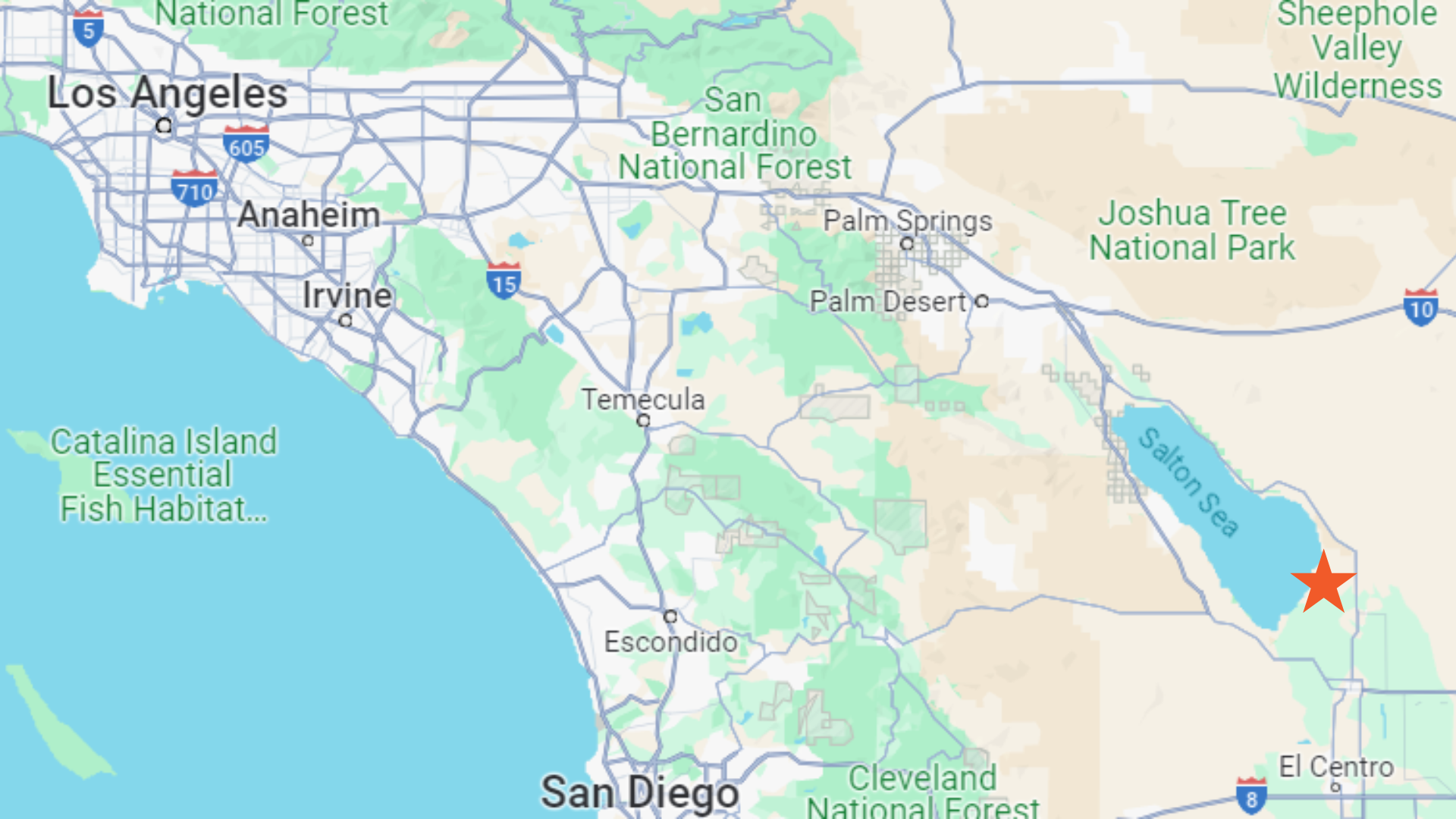
The orange star marks the approximate location of the area dubbed Lithium Valley, where global investors and major automakers are spending billions on what they say will be the world’s cleanest, major source of lithium extraction.
What’s happening in California could ultimately impact the future of lithium mining in Maine and other places by raising a critical question: If new, lower-impact technology can tease out global supplies of lithium from geothermal brine, is it better to leave rockbound deposits in the ground?
This question came to the fore because of activity at geothermal power plants at the southern edge of the Salton Sea. For more than 40 years, geothermal plants near the lake have pumped the 500-degree brine, using the steam to spin turbines and injecting what’s left back underground.
Today there are 11 power plants with a total generating capacity of 400 megawatts, enough to power 300,000 California homes, with more plants planned.
But until recently, the millions of tons of dissolved lithium in the brine were pumped back into the earth, unused.
Now three operators are at various stages of extracting lithium from the salty water using technology known as Direct Lithium Extraction, or DLE, which they say could bring their pilot projects to commercial scale.
If they succeed and the methods are financially viable, proponents say the process could capture lithium with lower environmental impacts than hardrock mining, while generating clean, renewable energy.
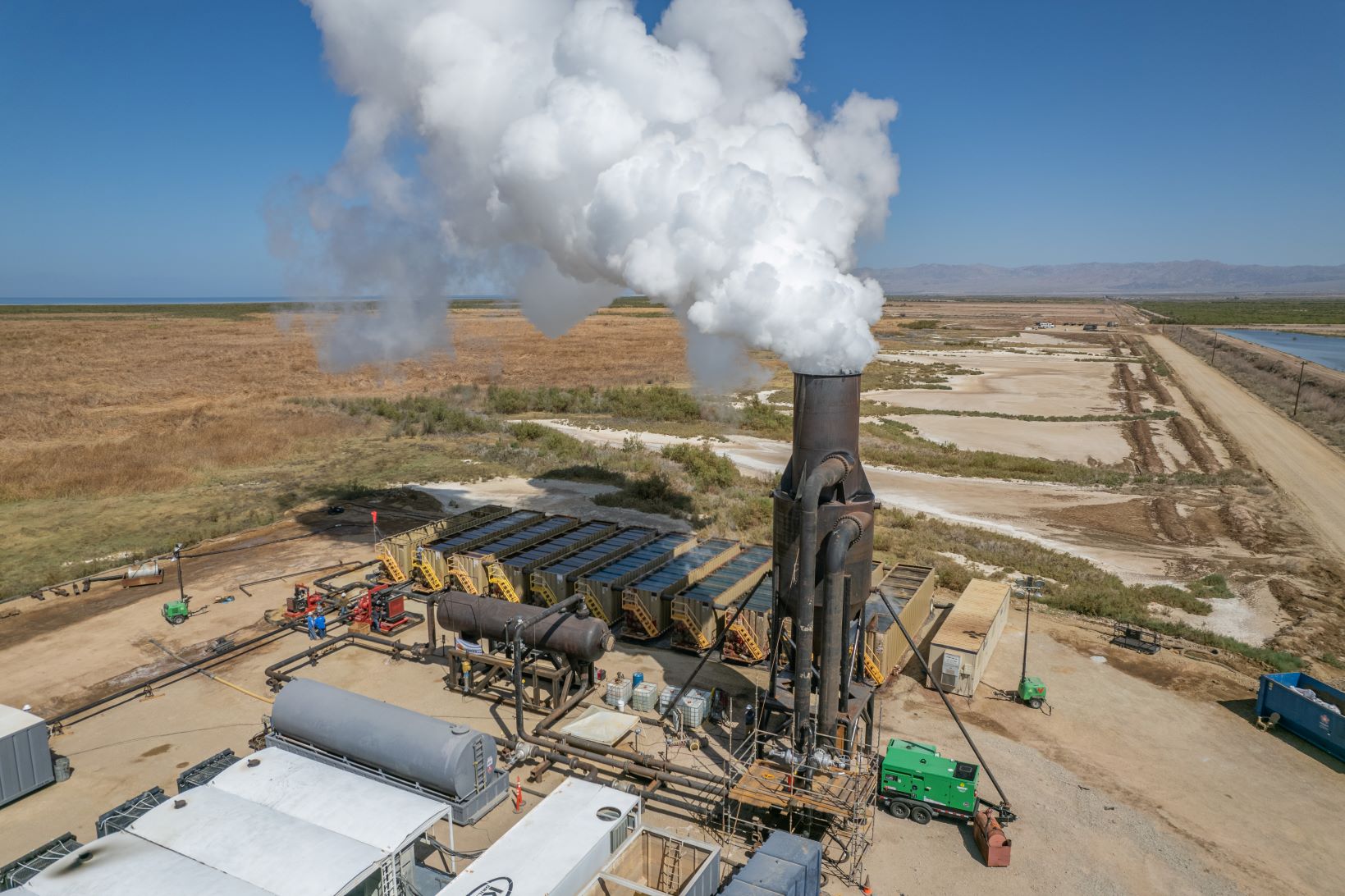
As part of the first phase of the proposed Hell’s Kitchen campus, Controlled Thermal Resources has drilled two geothermal production wells and is optimizing its process for recovering lithium from the hot brine. Source: Controlled Thermal Resources.
The projects, however, are not without controversy, in part because large volumes of water are used in extraction processes. An investigation by the Howard Center for Investigative Journalism, reported in February in USA Today, reviewed 72 proposed mine sites and found most would take billions of gallons of water from already stressed resources such as the Colorado River. That’s the largest source for Salton Sea projects.
There’s also pushback from residents in the impoverished Imperial Valley, who already struggle with elevated health problems. In January, the nonprofit Comite Civico del Valle announced its intent to sue to overturn permits for a proposed lithium production campus, citing concerns over water use and air pollution from construction and operations.
Meanwhile, developers and investors are in a race toward commercial viability. Three major players are taking the lead.
Berkshire Hathaway Energy Renewables:This Warren Buffett-led company’s subsidiary runs 10 geothermal plants. It has worked since 2022 on a process to recover lithium at a demonstration plant and produce battery-grade lithium carbonate.
EnergySource Minerals: This company is developing Project ATLiS at the 55-megawatt John L. Featherstone power plant. It’s using a patented extraction process and is aiming to be in full operation in 2025. Last year it signed a supply contract with Ford Motor Co.
Controlled Thermal Resources: This company held a groundbreaking ceremony in January to launch its $1.8 billion Lithium Valley campus, billed as the world’s first fully integrated facility to extract and process lithium, possibly with on-site battery manufacturing and recycling plants.
EnergySource Minerals is developing a lithium extraction process using geothermal brine at the 55-megawatt John L. Featherstone power plant, near the Salton Sea in southern California. It’s aiming for full operation in 2025, and has a supply contract with Ford Motor Co. Photo courtesy Daniel Alexander, Cyrq Energy.
The project is called Hell’s Kitchen and the company says fully realized, it could represent a $28 billion capital investment and support nearly 8,000 jobs. The company has entered into investment and supply agreements with General Motors, and has received $100 million from Stellantis, the parent company of Jeep and Chrysler, to advance development.
In late January, Biden administration officials were among those at a groundbreaking for the first phase of the planned Lithium Valley production campus.
“This administration supports the vision of Lithium Valley,” said John Podesta, Biden’s climate czar, during remarks at the event, “and it’s not just winning the (lithium) race, it’s about providing good-paying jobs.”
A game-changing technology
Direct Lithium Extraction isn’t a new process. But the latest techniques to filter lithium from the salty, mineral rich brine and create a sustainable industry in tandem with geothermal power plants, is a game-changer, according to Michael McKibben, a research professor at the Department of Earth and Planetary Sciences at University of California, Riverside.
“We should never mine lithium from hard rock again,” he said.
McKibben, who contributed to the federal analysis, said the key issue is the economics of bringing the extraction processes at the Salton Sea to commercial scale.
“I think ultimately, if DLE can be scaled up successfully in many places, it will put hard rock mining out of business. It may take a decade, but I think the writing is on the wall.”
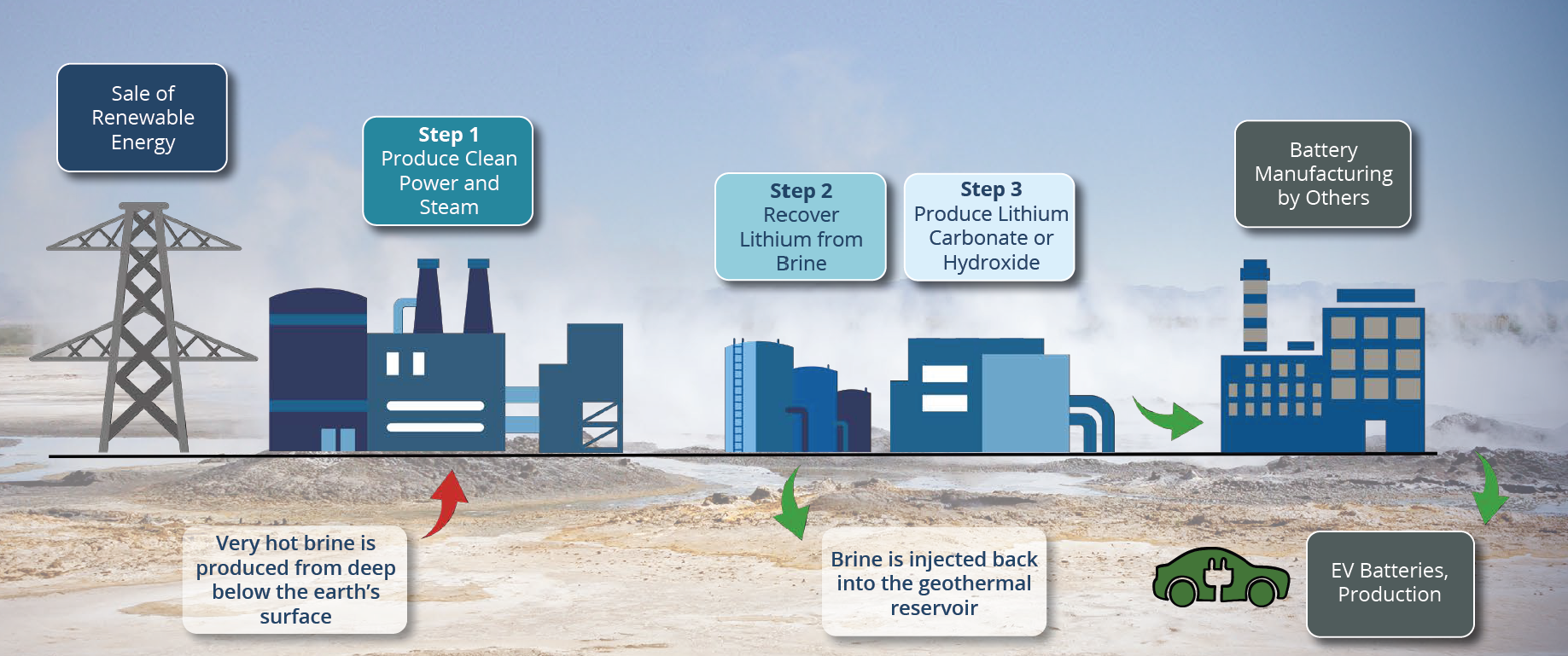
This flowchart shows how lithium can be extracted from hot underground brine, already used by geothermal power plants near the Salton Sea in California. After use, the brine is injected back underground, and the lithium can be used to produce batteries. Graphic courtesy Controlled Thermal Resources.
Not everyone agrees that the Salton Sea projects represent a disruptive technology.
“Do I think what’s going on at the Salton Sea will replace any or all lithium mining in this country?” said Corby Anderson, a professor and associate director at the Colorado School of Mines. “No, I don’t. It’s not a panacea. It’s an opportunity.”
Anderson said supporters downplay the technical challenges and costs of recovering lithium from a thick brine loaded with compounds and minerals. And he said public opposition to mining often is based on perceptions that linger from polluting practices no longer used.
“Modern mining,” Anderson said, “it’s not like all the dirty pictures of the past.”
Is Maine’s lithium still worth mining?
Mining is cleaner than it used to be. But with so much potential and investment already taking place at the Salton Sea, is mining in Maine needed for the U.S. to develop sustainable supplies of lithium?
Yes, said Mary Freeman, the co-developer of the Plumbago North project.
“If mining can be handled in an environmentally responsible manner,” she told The Maine Monitor, “what is the value of excluding Maine from participating in a viable sector of the economy?”
Freeman and her husband, Gary, are gemstone miners who split their time between Maine and Florida. They want to expand the pit they developed near Newry to mine lithium-bearing spodumene minerals from a deposit some experts estimated could be worth $1.5 billion.
They plan to ship it out of state for processing, which would avoid the waste products that could threaten Maine water supplies.
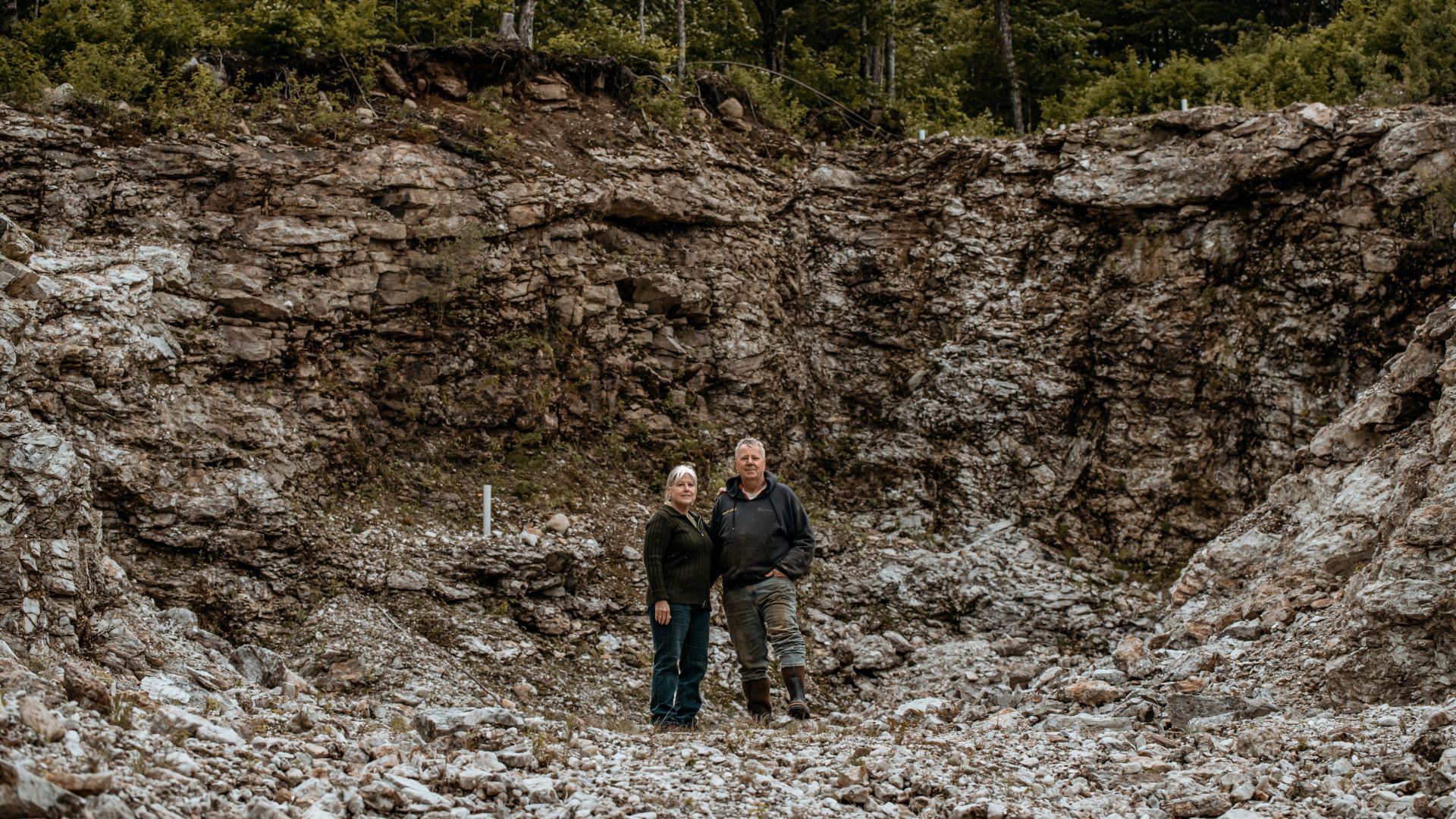
Mary and Gary Freeman stand in their test pit in the woods of Newry, surrounded by spodumene crystals. Photo by Garrick Hoffman.
Freeman said their project is on hold, awaiting legislative acceptance of the proposed amendments to Maine’s mining regulations.
But she said development of additional domestic resources such as the Salton Sea doesn’t diminish the value of mining the spodumene at Plumbago North, which contains large crystals with both high lithium oxide and low iron content. These materials can be used for products such as scientific glass, used in computer and cell phone screens.
This sentiment reflects the notion that market competition will lead the U.S. to develop a range of domestic lithium sources. That’s likely, according to Patrick Dobson, a lead geological scientist at Lawrence Berkeley National Laboratory and chief author of the federal analysis done for the U.S. Department of Energy that characterized the geothermal resource and lithium potential at the Salton Sea.
Dobson is aware of the Plumbago deposit and monitors efforts to extract lithium and other critical minerals from geothermal, hard rock and clay deposits. They include:
Silver Peak, Nevada: Albemarle Corp. has produced lithium from brine deposits for decades at what is, for the moment, the country’s only active lithium mine. Lithium is concentrated through evaporation in a series of ponds. The company plans to double production, even as opponents say it’s depleting the area’s aquifer.
Clayton Valley, Nevada: Canadian-based Century Lithium Corp. is working to advance a lithium brine project near the Silver Peak site. The Clayton Valley project is conducting pilot plant operations and has a processing operation elsewhere in Nevada.
Thacker Pass, Nevada: This mine, on the Oregon border, is at one of the country’s largest lithium deposits. Native tribes and environmental groups fought it but pre-construction has begun. General Motors is investing $650 million for rights to the lithium supply and now is the largest shareholder. It previously was owned largely by Ganfeng Lithium Group of China.
Lithium potential isn’t limited to the arid west. Piedmont Lithium is seeking to develop a project in North Carolina, in a forested area west of Charlotte that is more like Maine. The company describes the area as the “Carolina Tin Spodumene Belt.”
The company has asked state regulators for more time to conduct feasibility studies. The proposed open-pit mine faces opposition from Gaston County residents concerned with water pollution, groundwater levels and other concerns.
These and other projects illustrate the soaring demand for battery storage and political pressure to develop domestic supplies. But Dobson said it remains to be seen which ones come to fruition.
Whether Maine stays in the mix may be decided in the weeks ahead.
“Which lithium projects turn into actual commercial developments,” he said, “will depend on a variety of factors, such as local acceptance, environmental approvals and the commercial viability of each project.”
This is an edited summary of how lithium is extracted and processed, as detailed in the Lawrence Berkeley National Lab report to the Department of Energy.
How to Get Medical and Education Services When You Don’t Speak English
The California Health Report spoke with disability rights experts and parent advocates about what families who speak a language other than English need to know about their rights when accessing health care and special education services, and tips on how to advocate for themselves.Almost half of California residents speak a language other than English at home, most often Spanish.
Outage hits parts of Hollister and Tres Pinos during 49ers game
This article was written by BenitoLink intern Camille Mattish. Lea este articulo en español aqui.
Parts of Hollister and Tres Pinos experienced a power outage around 5:39 p.m. on Jan. 28.
PG&E power outage update.
According to PG&E Communications Representative Stephanie Magallon, approximately 5,000 customers were affected by the power outage, which occurred during the NFL championship game between the San Francisco 49ers and Detroit Lions, which the bay area team eventually won 34-31.
Magallon said that PG&E crews quickly responded and determined “there was an issue at a substation, and we were able to re-energize the majority of the impacted customers, 4,098, in about 25 minutes.”
She said the remaining customers affected by the outage had their power restored around 6:40 p.m.
In December 2023 California Department of Fish and Wildlife (CDFW) translocated seven North American beavers for the first time in 75 years.
In a news release, CDFW said it released a family of seven beavers into Plumas County, in a location that is known to the tribal community as Tásmam Koyóm. They were released into a site with one resident beaver.
The translocation from Sutter County followed many years of site preparation to ensure the beaver habitat provide protection from predators and support beaver population establishment.
According to CDFW, beavers in San Benito County are known to inhabit the eastern part of the Diablo Mountain Range. CDFW is conducting a population study and sightings can be reported here.
North American Badger range map. Photo courtesy of CDFW
These preliminary efforts in Plumas County were conducted through Maidu Summit Consortium’s collaboration with the U.S. Fish and Wildlife Service, Occidental Arts & Ecology Center’s WATER Institute, Lassen National Forest, Plumas Corporation, Swift Water Design, Symbiotic Restoration, Feather River Land Trust, The Sierra Fund, CalPBR Network and several others.
According to the National Wildlife Federation, the North American beaver is a semiaquatic rodent and the largest rodent found in North America, with adult males weighing up to 70 pounds and growing from two to three feet, not including the tail.
The American beaver’s most noticeable characteristic is the long, flat, black tail. A beaver’s tail not only helps it swim faster but is also used to make a loud alarm call when slapped against water. In addition, a large tail helps the beaver balance when carrying a heavy log or tree trunk.
Beaver working on dam. Photo courtesy Adobe-Stock
The beaver has dark-brown waterproof fur and webbed feet. Beaver teeth grow continuously throughout their lives, and they must gnaw on trees to keep their teeth from getting too long. Thick layers of enamel give their teeth an orange color.
They live in ponds, lakes, rivers and streams throughout most of continental U.S. Beavers are well known for their ability to build dams. They are one of the few animals that can actively change an ecosystem by blocking rivers and streams with trees and mud, creating new lakes, ponds and floodplains.
Beavers also build homes—called lodges—out of branches and mud, which can often only be accessed from underwater entrances in the ponds.
Beaver dam. Photo courtesy of Adobe Stock
Beavers form long term-monogamous bonds at around three years of age. Females gestate the young for roughly three months. A female will typically have one litter of kits a year, and the litter size ranges from one to four kits. These kits, along with those born the previous year, stay with their parents inside the lodge.
“Beavers help retain water on the landscape, which increases groundwater recharge, improves summer base flows, extends seasonal flows and increases fuel moisture during wildfire season, effectively creating green belts that can serve as wildfire buffers or breaks and provide refugia for wildlife,” said CDFW Director Charlton H. Bonham.
We need your help. Support local, nonprofit news!BenitoLink is a nonprofit news website that reports on San Benito County. Our team is committed to this community and providing essential, accurate information to our fellow residents. It is expensive to produce local news and community support is what keeps the news flowing. Please consider supporting BenitoLink, San Benito County’s public service, nonprofit news.